Saturday, September 20, 2025

Venezuela accuses US of waging 'undeclared war' in strikes on alleged drug traffickers

Venezuela on Friday accused the United States of waging an “undeclared war” in the Caribbean after a series of US military strikes on boats that the Trump administration says are used in drug trafficking. Venezuela’s Defense Minister Vladimir Padrino Lopez said that those killed in the strikes were “executed without the right to a defence”.


 20/09/2025 - 
By: FRANCE 24
Video by: Peter O'BRIEN


Venezuela on Friday accused the United States of waging an "undeclared war" in the Caribbean and called for a UN probe of American strikes that have killed over a dozen alleged drug traffickers on boats in recent weeks.

Washington has deployed warships to international waters off Venezuela's coast, backed by F-35 fighters sent to Puerto Rico in what it calls an anti-drug operation.

"It is an undeclared war, and you can already see how people, whether or not they are drug traffickers, have been executed in the Caribbean Sea. Executed without the right to a defence," Defense Minister Vladimir Padrino Lopez said as he attended a military exercise in response to the US "threat".

US forces strike third alleged drug vessel killing three, Trump says


His remarks came just hours before US President Donald Trump announced another military strike on a boat, claiming three more alleged "narcoterrorists" were killed, bringing the total number of deaths in recent weeks to 17.

He did not say when the attack took place, and only specified that it occurred in the US Southern Command area of responsibility, which includes Central and South America, as well as the Caribbean.

The strikes have prompted debate over the legality of the killings, with drug trafficking itself not a capital offence under US law.

Read more‘A show of strength’: Trump’s war on drugs with Venezuela

Washington has also not provided specific details to back up its claims that the boats targeted have actually been trafficking drugs.

Venezuelan Attorney General Tarek William Saab claimed that "the use of missiles and nuclear weapons to murder defenceless fishermen on a small boat are crimes against humanity that must be investigated by the UN".

The biggest US naval deployment in the Caribbean in decades has stoked fears the United States is planning to attack Venezuelan territory.

On Wednesday, Venezuela launched three days of military exercises on its Caribbean island of La Orchila in response to the perceived threat from a US flotilla of seven ships and a nuclear-powered submarine.

La Orchila is close to the area where the United States intercepted and held a Venezuelan fishing vessel for eight hours over the weekend.


Venezuela: Trump says US struck another alleged drug vessel
Venezuela: Trump says US struck another alleged drug vessel © France24
00:51

'Imperial plan'

Venezuelan President Nicolas Maduro, whom the United States does not recognise as legitimate and accuses of running a drug cartel, has urged citizens to join militia training to "defend the homeland".

Late Thursday, he announced that troops will provide residents of low-income neighbourhoods with weapons training.

Maduro, for whom Washington has issued a $50 million bounty on drug trafficking charges, suspects the Trump administration of planning an invasion in pursuit.

Trump had said on Tuesday that US forces "knocked off" three boats crossing the Caribbean, but Washington only provided details and video footage of two of the strikes.

Maduro accused the United States of hatching "an imperial plan for regime change and to impose a US puppet government... to come and steal our oil".

He has repeatedly vowed Caracas will exercise its "legitimate right to defend itself" against US aggression.

Opposition figure Henrique Capriles, a two-time presidential candidate and staunch Maduro critic, said Friday he would not support any US invasion.

"I continue to believe that the solution is not military, but political," he said, adding that Trump's actions were counterproductive and "entrenching those in power".

He called for the release of nearly a thousand dissidents locked up under Maduro, and for the Venezuelan government to show goodwill in foreign relations.

(FRANCE 24 with AFP)

Democrats File Resolution to Stop Trump’s Strikes Against Boats in Caribbean


“President Trump has no legal authority to launch strikes or use military force in the Caribbean or elsewhere in the Western Hemisphere,” said Sen. Tim Kaine.


The USS Sampson, a US Navy missile destroyer, docks at the Amador International Cruise Terminal in Panama City, Panama, on September 2, 2025. The deployment comes amid a broader US naval presence in Latin American and Caribbean waters following President Donald Trump’s order last month to take action against Latin American drug cartels.
(Photo by Daniel Gonzalez/Anadolu via Getty Images)

Julia Conley
Sep 19, 2025
COMMON DREAMS


With 14 people killed in the Caribbean in recent days by US forces at the direction of President Donald Trump, two Democratic senators on Friday moved to stop the Trump administration from continuing military strikes against boats that it claims are involved in drug trafficking.

Sens. Tim Kaine (D-Va.) and Adam Schiff (D-Calif.) introduced a joint resolution calling for the US to stop engaging in military hostilities that have not been authorized by Congress, days after Trump announced that US forces had killed three people whom the president claimed were part of “extraordinarily violent drug trafficking cartels” based in Venezuela.


Senator Says New Details of Venezuela Bombing Reveal ‘Trump’s Growing Lawlessness’
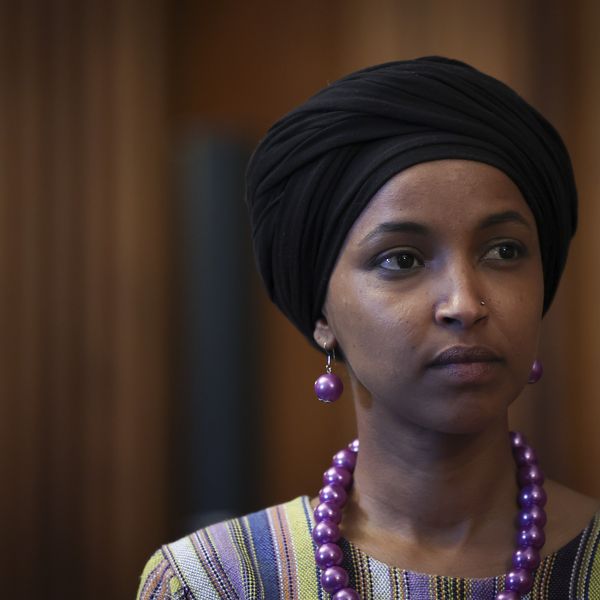


Omar Brings War Powers Resolution After Trump Bombed Boat in Caribbean With ‘No Legal Justification’

That strike followed the killing of 11 people aboard another boat in the Caribbean earlier this month, which US officials later acknowledged had turned back toward Venezuela before the US carried out the strike—further calling into question the claim that the vessel was headed toward the US and posed a threat.

“President Trump has no legal authority to launch strikes or use military force in the Caribbean or elsewhere in the Western Hemisphere,” said Kaine in a statement, adding that the administration has refused to release basic information showing it was necessary to attack the vessels.

The strikes have been condemned by legal and human rights experts as ”murder” and ”extrajudicial executions” of civilians—people who, if they were in fact bringing drugs to the US as the White House has claimed, would typically be confronted by law enforcement agencies instead of struck by the military


The US Coast Guard has in the past intercepted boats and searched them to confirm suspected drug smuggling, and arrested their crews.

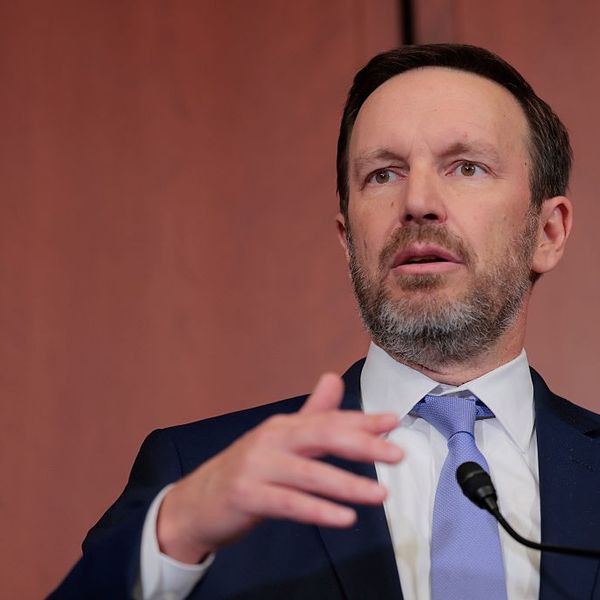
As Sen. Chris Murphy (D-Conn.) said last week, Trump’s claim that boats are carrying fentanyl, which caused roughly 48,000 drug overdoses in the US last year, is likely inaccurate. Fentanyl is primarily trafficked from Mexico and Central America into the US, he noted, not from Venezuela.

Secretary of State Marco Rubio said earlier this month that the United Nations Office on Drugs and Crime’s assessment that Venezuela is also not a major source of cocaine was of no importance to the administration.

“I don’t care what the UN says,” Rubio told reporters after the first military strike in the Caribbean.

The White House has not released evidence showing that the boats were carrying drugs; after the first bombing, the president said the administration had “tapes of [the victims] speaking” that showed they were members of the Venezuelan gang Tren de Aragua, which it has designated a terrorist organization that works directly with the South American country’s government—despite US intelligence agencies’ finding that the group does not work with President Nicolás Maduro.

Even if the president’s suspicions were correct, said Sarah Yager, Washington director at Human Rights Watch, “US officials cannot summarily kill people they accuse of smuggling drugs.”

“The problem of narcotics entering the United States is not an armed conflict, and US officials cannot circumvent their human rights obligations by pretending otherwise,” Yager said Thursday.

While claiming the military is targeting drug traffickers, Vice President JD Vance suggested this week that the US could mistakenly kill civilians who are not involved in drug activity, joking, “I wouldn’t go fishing right now in that area of the world.”


The administration has not disclosed a legal analysis of why it believes the strikes, which it has said will continue, are lawful.

Congress has not authorized any military conflict with drug cartels, and at a Senate Armed Services Committee hearing on Thursday, a nominee for a position at the Pentagon was unable to answer Democratic lawmakers’ questions about the legality of the administration’s strikes.

On Friday, reporting by The New York Times suggested that Republican lawmakers and the White House are working to grant the administration the legal authority to continue the strikes.

A draft bill is circulating around the White House and Congress to grant the president the power to order military strikes to carry out “the drug trafficking war.”

The authority would last for five years, and longer if renewed by Congress, and would cover groups that the administration has designated terrorist organizations as well as nations that harbor those groups.

Jack Goldsmith, a former George W. Bush administration official and a Harvard Law School professor, told the Times that the legislation is “insanely broad.”

“This is an open-ended war authorization against an untold number of countries, organizations, and persons that the president could deem within its scope,” said Goldsmith.

Introducing their resolution on Friday, Kaine and Schiff said they do not want to prevent the US from carrying out strikes in self-defense against an “armed attack.”

But, they emphasized, “the trafficking of illegal drugs does not itself constitute such an armed attack or threat.”

Yager called on Congress to also “open a prompt and transparent investigation into the decision-making process behind these attacks, including the legal rationale and chain of command.”

“The US military should immediately halt any plans for future unlawful strikes,” she said, “and ensure that all military operations comply with international human rights and humanitarian law.”


The Return of Drug War Imperialism

Trump’s priority isn’t drugs. It’s Latin American resources.

by  | Sep 19, 2025 | 

The Trump administration is escalating U.S. drug wars in Latin America as a cover for imperialism.

While the administration directs a military buildup in the Caribbean, killing people who it claims are drug smugglers, it is preparing to intervene in Latin American countries for the purpose of opening their markets to U.S. businesses. The administration’s priority is gaining access to Latin American resources, a main focus of its foreign policy, just as the highest-level officials have indicated.

“Increasingly, on geopolitical issue after geopolitical issue, it is access to raw material and industrial capacity that is at the core both of the decisions that we’re making and the areas that we’re prioritizing,” Secretary of State Marco Rubio said in June.

Drug War Imperialism

One of the major contributions of the United States to imperial history is drug war imperialism. Developed as part of the so-called “war on drugs,” which the Nixon administration began in the 1970s and the Reagan administration expanded in the 1980s, drug war imperialism has been one of the primary means by which the United States has intervened in Latin America.

During the late 1980s, the United States set the standard for drug war imperialism in Panama. After discrediting Manuel Noriega with drug charges, officials in Washington organized a military intervention to remove the Panamanian ruler from power.

Under the direction of the George H. W. Bush administration, the U.S. military invaded Panama, captured Noriega, and brought him to the United States, where he was tried, convicted, and imprisoned on drug charges. U.S. officials framed the operation as part of the war on drugs, but their primary concern was bringing to power a friendly government that acted on behalf of U.S. interests. U.S. officials valued Panama for its location and for the Panama Canal, a critical node for U.S. trade.

In the following decades, the United States exercised other forms of drug war imperialism in Latin America. In 2000, the administration of Bill Clinton implemented Plan Colombia, a program of U.S. military support for the Colombian government. U.S. officials framed Plan Colombia as a counter-narcotics program, but their objective was to empower the Colombian military in its war against leftist revolutionaries, especially the Revolutionary Armed Forces of Colombia (FARC).

In 2007, the administration of George W. Bush pushed forward a similar program in Mexico. With the Mérida Initiative, the Bush administration empowered the Mexican government to intensify its war against drug cartels. U.S. officials saw the program as way to forge closer relations with the Mexican military and confront the country’s drug traffickers, who were making it difficult for U.S. businesses to operate in the country.

Multiple administrations faced strong criticisms over the programs, especially as drug-related violence increased in Colombia and Mexico. A Colombian truth commission estimated that 450,000 people were killed in Colombia from 1985 to 2018, with 80 percent of the deaths being civilians. There have been hundreds of thousands of drug-related deaths in Mexico, with the numbers still increasing by tens of thousands every year.

Although most U.S. officials insisted that criminal organizations in Latin America bore primary responsibility for drug-related violence, some began to question the U.S. approach. They wondered whether U.S.-backed drug wars were ignoring root causes of the drug problem, such as the U.S. demand for drugs.

“As Americans we should be ashamed of ourselves that we have done almost nothing to get our arms around drug demand,” Secretary of Homeland Security John Kelly said in 2017. “And we point fingers at people to the south and tell them they need to do more about drug production and drug trafficking.”

In recent years, some critics have even cast the drug wars as a failure. Decades of U.S.-backed military operations, they have noted, have brought terrible violence to Latin America while failing to stop the flow of drugs to the United States.

“Drugs have kept flowing, and Americans and Latin Americans have kept dying,” Shannon O’Neil, who chaired a congressionally-mandated drug policy commission, told Congress in 2020. “Something is not working.”

Trump’s Embrace of Drug War Imperialism

Despite the recognition in Washington that drug wars do not counter drugs, the Trump administration is using them to create a justification for military operations across Latin America.

The Trump administration laid the groundwork for an intensified version of drug war imperialism shortly after entering office. On day one, Trump issued an executive order to designate drug cartels as terrorist organizations, claiming they “present an unusual and extraordinary threat” and declaring a national emergency to deal with them. The State Department quickly followed by labelling drug cartels and other criminal organizations as terrorist organizations.

In July, Trump secretly ordered the Pentagon to start attacking drug cartels.

Earlier this month, the U.S. military began to implement Trump’s orders by launching a drone strike on a speedboat in the Caribbean that was carrying 11 people. Administration officials accused the people on board of being Venezuelan drug smugglers, but critics questioned the Trump administration’s claims and argued that its actions were illegal. Some accused the Trump administration of murder.

Trump and Rubio discredited the administration’s justification for the attack by making different claims about the destination of the speedboat. Whereas Rubio said that it was headed toward Trinidad, Trump said that it was destined for the United States. Wanting to be consistent with the president, Rubio then changed his story, claiming that the speedboat was going to the United States.

Critics have also questioned whether the administration has been acting over concerns about drugs. One of their main points has been that Venezuela’s involvement in the drug trade has been overstated.

When Rubio faced questions about the administration’s attack on the speedboat, he dismissed reports that attributed less importance to Venezuela, including those by the United Nations.

“I don’t care what the UN says,” Rubio said.

Trump displayed the same disregard when he announced on social media on Monday that he ordered another strike on a boat in the Caribbean, saying that it killed 3 people. “BE WARNED,” he wrote. “WE ARE HUNTING YOU!”

For many years, in fact, several of the highest-level officials in the Trump administration have been eager for the United States to play a more aggressive role in Latin America not for the purpose of countering drugs but with the goal of acquiring greater access to the region’s resources.

It has long been known that Trump values Venezuela because it is home to the largest known oil reserves in the world.

“That’s the country we should be going to war with,” Trump is alleged to have said in 2017, during his first year in office. “They have all that oil and they’re right on our back door.”

Several high-level officials in the first Trump administration shared the president’s views. In 2018, then-Secretary of Defense James Mattis commented that Venezuelan leaders “sit on enormous oil reserves.”

When the first Trump administration rallied Venezuelan opposition forces in 2019 in a failed attempt to overthrow the Venezuelan government, several high-level officials boasted about the potential riches of Venezuelan oil, suggesting that it would be a boon to U.S. investors.

“It is a country with this incredible resource of petroleum, the greatest in the world,” then-Special Representative for Venezuela Elliott Abrams told Congress. “So I think you will find that with a change of leadership and a change of economic policy, that there will be lots of people who are ready to invest, and I think the World Bank and the IMF in particular will be ready to help start that engine.”

Since the start of his second administration, Trump has continued to think about the country’s oil, even as he has brought different people into his administration.

“You’re going to have one guy sitting there with a lot of oil under his feet,” Trump said in February, referring to Venezuelan President Nicolás Maduro. “That’s not a good situation.”

Ulterior Motives

While the Trump administration has forged ahead with its expansion of U.S. military operations in the Caribbean, giving special attention to Venezuela, it has deployed a familiar argument. Just as past administrations have done, the Trump administration has claimed that it is going to war against drugs.

“On day one of the Trump administration, we declared an all-out war on the dealers, smugglers, traffickers, and cartels,” Trump said in July, referring to his executive order to target drug cartels as terrorist organizations.

Administration officials have supported the president’s approach. Leading the way, Rubio has repeatedly insisted on the need to take military action against drug traffickers.

“The president of the United States is going to wage war on narcoterrorist organizations,” Rubio said earlier this month.

Still, U.S. officials have gestured at ulterior motives. When Rubio has spoken about the administration’s drug wars, he has indicated that he is focused on creating conditions in Latin America that will enable U.S. businesses to operate there more effectively.

“It’s nearly impossible to attract foreign investment into a country unless you have security,” Rubio said during a recent visit to Ecuador, where he acknowledged ongoing negotiations over a trade deal and a military base.

In fact, the Trump administration has made it clear that it is focused on creating new opportunities for U.S. businesses and investors in Latin America. Concerned that Latin American countries have been growing close to China, the Trump administration has been using drugs as an excuse for a more aggressive U.S. role in the region.

What the Trump administration is doing in short, is going to war against drugs as a cover for opening Latin American markets to U.S. businesses. Turning to a familiar playbook, it is implementing drug war imperialism


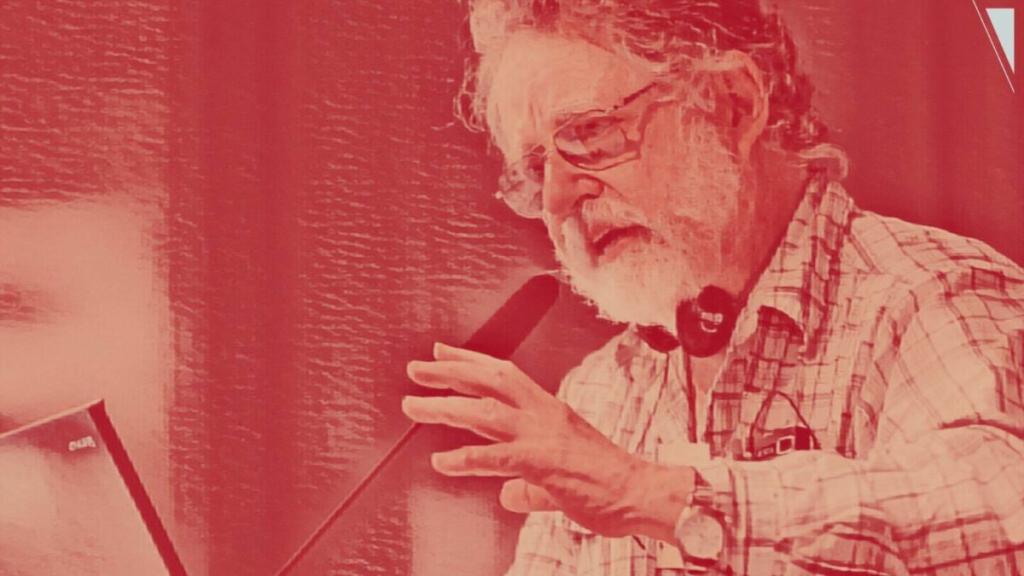
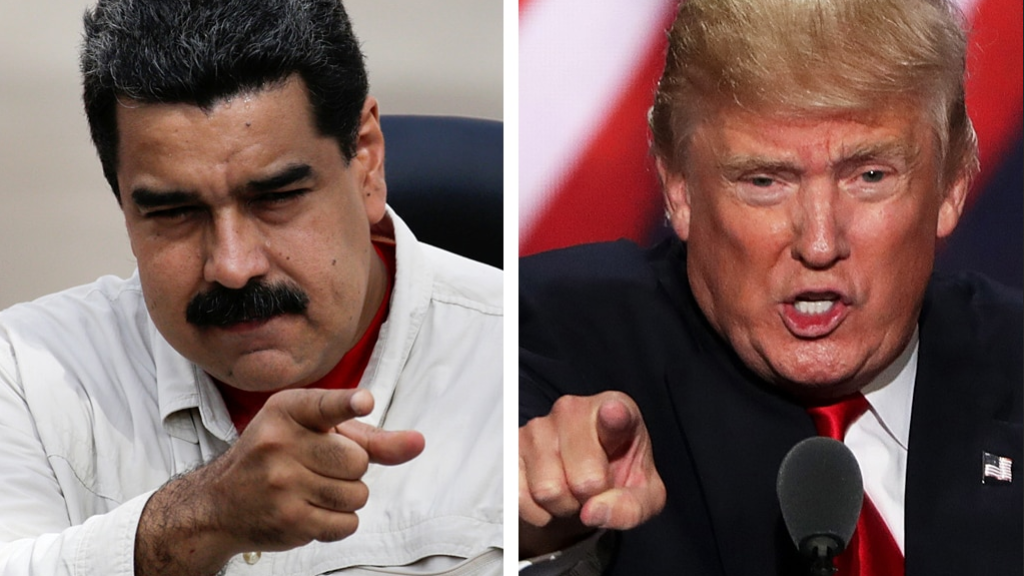
 

Venezuela’s authoritarian turn and the repression of its left: An interview with Edgardo Lander


Edgardo Lander Tempest

First published at Tempest.

Since Venezuela’s disputed 2024 elections, Nicolás Maduro’s government has escalated its authoritarian turn. More than 2,000 people were detained in the days following the vote, and targeted persecution has widened to include journalists, trade unionists, academics, and human rights defenders. Human rights activist Marta Lía Grajales was disappeared for two days after denouncing the brutal beating of mothers demanding freedom for their imprisoned children. María Alejandra Díaz, a Chavista lawyer and former Constituent Assembly member, was stripped of her license and harassed after calling for transparency in the vote count. These cases illustrate a broader strategy of intimidation and criminalization.

The repression is falling above all on the critical Left. In recent months, official media have accused Edgardo Lander, Emiliano Terán Mantovani, Alexandra Martínez, Francisco Javier Velasco, and Santiago Arconada of forming a supposed “network of foreign interference” disguised as academic and environmental work. Institutions such as the Faculty of Economic and Social Sciences of the Central University of Venezuela, CENDES, the Observatory of Political Ecology, and the Rosa Luxemburg Foundation have also been smeared as part of this alleged conspiracy.

Edgardo Lander — sociologist, retired professor at the Central University of Venezuela, and a leading voice in Latin American debates on democracy, extractivism, and the future of the Left — is himself among those targeted. His critical work on the Orinoco Mining Arc and his insistence on independent thought have placed him in the government’s crosshairs.

In this interview, conducted by Anderson Bean, Lander reflects on the deepening repression in Venezuela, the criminalization of dissent, and the stakes for academic freedom, democracy, and international solidarity. The conversation has been translated and lightly edited for clarity and brevity.

Tempest editor’s note: This interview took place prior to last week’s illegal U.S. naval attack on a Venezuelan-flagged boat in the Caribbean Sea that killed all 11 people on board.

LINKS editor’s note: For Lander's views on the US military build-up in the Caribbean see this statement by the Citizen’s Platform in Defense of the Constitution, which he co-signed as a founder of the platform.

Since the disputed 2024 elections, repression against critical voices has intensified, with more than 2,000 people arrested and targeted cases of persecution multiplying. How would you describe the general climate of repression in Venezuela since the elections?

Those elections were, in many ways, a watershed moment in Venezuela’s Bolivarian process. In recent years, what once seemed like hard limits—red lines that couldn’t be crossed — have been crossed again and again.

Until Venezuela’s presidential elections last year, the system was, by and large, trustworthy. Yes, there had been a few isolated cases where fraud was obvious, like gubernatorial races in Bolívar and Barinas, but those didn’t affect results at the national level. Venezuela’s automated electronic voting system, with its multiple safeguards, had made large-scale fraud very difficult.

The process was straightforward: you voted, the machine displayed your choice on a screen, then printed a paper receipt. You checked that it matched your vote, and deposited it in a ballot box. At the end of the day, the machines produced a report, and with witnesses present, the boxes were opened and compared to the machine tallies. The records were signed off by witnesses to certify that the electronic and paper counts matched. That’s why, up until that moment, Venezuelan elections were, I repeat, fundamentally reliable.

But this time, when the government began to receive the results, it realized it was not just going to lose but lose badly. They may have thought they could afford a narrow defeat and then massage the results in a few states to scrape through with a win. But the margin of defeat was so overwhelming that this was impossible. So they simply threw out the rules of the game.

They claimed the system had been hacked from North Macedonia. Then the head of the National Electoral Council appeared — literally with a napkin in his hand — reading out invented numbers that had nothing to do with the actual vote. Not long afterward, Maduro was declared the winner.

That was a very important red line, because it marked the shift from a government that, yes, manipulated public resources, threatened state workers, repressed and intimidated the opposition, blocked opposition parties from carrying out activities, and so on — but where, on election day itself, people’s votes were at least faithfully recorded by the machines. For the first time, brazenly, they decided to break the rules of the game and remove the very notion of elections from the political or democratic game. That was a step toward a regime that revealed itself as openly authoritarian, disregarding both the Constitution and electoral norms.

Naturally, that sparked massive protests, which the government answered with mass arrests. Many of these arrests were absolutely arbitrary: young people who happened to be standing in front of their houses, or who had just gone out to buy bread, were accused of terrorism and taken away. The government has essentially admitted that it cannot receive majority support, and that if it wants to remain in power, it must do so through repression and instilling fear in the population.

That’s why, after election day, there were two days of major demonstrations. At least 25,000 people took to the streets, and nearly 2,000 were detained amid brutal repression. With that, they managed to spread terror and drive people back into their homes.

Since then, that logic of systematic repression has continued at every level. It has meant the arrest of journalists, the arrest of economists for publishing figures the government didn’t like, the detention of trade unionists, of university professors. After the massive roundup in the days following the election, repression has become more selective, but it is moving steadily toward a total intolerance of dissent.

The government has closed more media outlets and invoked a series of laws in recent months — the “Anti-Hate Law,” the “Anti-Terrorism Law,” and others — aimed at criminalizing any act of opposition, no matter how peaceful, because any such act is immediately branded as terrorism.

Today, we are facing a government that is trying to deny any possibility of dissent finding expression, any space at all where it can exist. That explains the attacks on universities, on journalists, and the systematic campaign against NGOs. Since the government insists on framing everything as a battle between a “revolutionary government” and “imperialist aggression,” NGOs are labeled as foreign-funded instruments, run by the CIA, whose aim is to undermine the government. Most recently, this has included targeting the Rosa Luxemburg Foundation and branding denunciations of the Orinoco Mining Arc as attacks on the state.

A very recent and significant milestone in the authoritarian drift came with the assault on the vigil of the mothers of political prisoners. These mothers, whose sons are jailed, had gone from one state office to another, until they were told that only the president of the Supreme Court could decide their cases. They went to the court, requested an audience, were denied, and then decided to hold a vigil in the plaza outside. They pitched a tent, joined by human rights activists, and even had children with them. Around ten o’clock that night, the permanent guard outside the court was withdrawn, the lights in the area were shut off, and then some 80 members of pro-government colectivos, some masked, arrived. They beat the mothers, stole their cell phones and ID cards, and drove them out of the plaza in the middle of the night. Many of the mothers had come from the provinces and were left stranded in the city, unable to communicate.

It was truly an outrage, another escalation of authoritarian logic. And when the mothers tried to file complaints with the Attorney General’s Office and the Ombudsman, they were told nothing could be done, since it had been a “private action” by colectivos, not the police — an absurd claim.

This offensive against intellectuals, against the Central University of Venezuela — which has become an important space of thought and dissent — is part of a broader strategy: every single place where voices could exist that differ from the government’s is to be treated as an enemy, as an agent of imperialism, to be persecuted. Those are the new rules of the game.

In the past year we’ve seen cases where even people with Chavista backgrounds have been repressed — for example, Marta Lía Grajales, who was forced into an unmarked van and detained after denouncing the violent beating of mothers protesting for their children’s release, an episode you just described, and María Alejandra Díaz, a lawyer and former Constituent Assembly member, who was stripped of her license after demanding transparency in the 2024 elections. What do these cases reveal about the Maduro government’s readiness to target former allies and its own base? Could you also talk a bit more about their situations and why they are significant?

Marta Grajales was, in fact, disappeared for about two and a half days. Her husband and human rights organizations went around to the usual detention centers where people are taken in these circumstances, and in every single one, they were told she wasn’t there. The reaction was so strong — mobilization across Latin American public opinion, academia, networks of social organizations, and even among parts of the Chavista grassroots — that the government, apparently (I can’t say for certain, but this seems likely), was taken aback by the strength of the response and decided to release Marta right away.

That doesn’t mean she is free: she still faces extremely serious charges that could carry up to ten years in prison if her case goes to trial and she is convicted. But what’s already clear is that this is not about repressing the right-wing opposition. Marta is no right-winger — she is a compañera, a long-time Chavista activist. The point is that it no longer matters if someone has a party card, a militant record, or years of identification with the government. Being a Chavista is no longer a protection.

That’s why I highlight one of the key features of the current political moment, captured in a hashtag that has accompanied many government declarations in recent days: “To doubt is to betray.” They repeat it over and over. And that is a sign of weakness, of insecurity, because there are people inside the armed forces, the police, and even the Chavista base who disagree with what is happening. In this context, not only is it forbidden to denounce abuses — it is forbidden even to doubt. Anyone with doubts must keep them silent, because voicing doubt is treated as treason.

This is a new authoritarian model in which not only are autonomous organizations banned, but even unions have been declared obsolete — Maduro has announced he will create a new structure to replace them. He also declared the creation of workplace militias: 450,000 armed people in workplaces across the country, supposedly to resist imperialism when the Marines arrive. All of this is closing off every possible democratic space, every outlet for free expression. The goal is to generate fear — fear of going out into the street, fear of speaking up, fear among journalists who self-censor — so that in the end what we have is a closed regime with no options at all.

Maduro’s relationship with the Left across the continent has deteriorated enormously. The only governments he still aligns with are Cuba, Nicaragua, and, to some extent, Bolivia, at least until its recent elections. Beyond that, Venezuela is very isolated. Of course, there is still a sector of the Left that clings to the idea that “the enemy is always imperialism — whoever opposes imperialism is my ally, whoever doesn’t is my enemy.” And so, even in this context of serious denunciations, the São Paulo Forum — the umbrella for many of Latin America’s “official” Left parties (not all, but a significant number) — issued a statement that made no mention whatsoever of human rights, or of persecution, or of detentions. They spoke only of the threats that the United States represents for Venezuelan sovereignty — talking about something else entirely.

That is extremely serious. I always insist that the worst thing one can do to the Left, to any anti-capitalist or progressive option in the world today, is to call what exists in Venezuela “socialism” or a “left government.” Because that provokes such rejection that people understandably say: “If that is the left, if that is socialism, then I’ll vote for the right.” That is why I consider the stance of the São Paulo Forum so perverse: it perpetuates the myth that the governments of Cuba, Nicaragua, and Venezuela are revolutionary, progressive, democratic governments. And yet anyone can read the newspapers to see the reality.

In Venezuela’s case, it is even clearer because of the sheer number of migrants who have left the country. Their first-hand stories about what they endured cannot be silenced or denied — there are simply too many voices saying the same thing. Ask them why they had to leave, and the answers pile up: because of this, and this, and this. The testimonies are overwhelming.

In this context, you and other prominent academics have been accused in official media of being part of an alleged “network of political interference disguised as academic and environmental work.” Could you begin by explaining what these accusations actually consist of and where they come from? And from there, how do you interpret the broader meaning of these attacks for academic freedom and critical debate in Venezuela? Why do you think these attacks are happening now, and what do they reveal about the government’s priorities and fears at this moment?

I think these accusations are simply another expression of what I’ve been describing — a government that wants to prevent any form of disagreement with its policies. It’s not only about repressing workers mobilizing for wages, or mothers demanding the freedom of their imprisoned sons. It’s also about saying that the intellectual community itself, simply by researching state policies, is committing an offense.

Take the case of research on what has happened in the Orinoco Mining Arc. Just investigating — asking, what has happened to Indigenous populations? Studies show, for example, that Indigenous children have high levels of mercury in their blood. That is research: documenting what is actually happening. But for the government, this is an attack on its authority, on its right to define whatever policies it deems appropriate.

So, when they name me personally, it’s not because I’ve done anything out of the ordinary — beyond offering opinions, participating in debates, and circulating ideas across Latin America. But the government sees that as a danger, as a threat. And therefore it has to be silenced. It has to try to make intellectuals, even those offering only moderately critical opinions, censor themselves — or avoid doing research that could compromise the government or highlight inconvenient realities.

This is a tightening grip, a siege that, I repeat, keeps closing in and closing in — until there is hardly even room to breathe.

In addition to individuals like yourself, well-known institutions such as the Faculty of Economic and Social Sciences at UCV, CENDES, and the Observatory of Political Ecology have also come under attack. Among them, the case of the Rosa Luxemburg Foundation stands out, especially given its public ties to the German party Die Linke. For those who may not be familiar, could you explain what the Foundation is, what kind of work it has carried out in Venezuela, and why it might now be a target of attacks?

First, for those who may not be familiar with the German political foundations, it’s worth explaining how they work. In the German political system, parties that have parliamentary representation above a certain threshold receive public funding for a political foundation linked to that party. The Social Democrats have a foundation, the Christian Democratic Party has one — the Adenauer Foundation — and the Left Party, Die Linke, has the Rosa Luxemburg Foundation.

These foundations work mainly outside Germany, and their focus is on cultural and political debate. They are by no means political activists intervening directly in the affairs of other countries. In the case of the Rosa Luxemburg Foundation, it has offices across Latin America: in Mexico (covering Mexico, Central America, and the Caribbean), in Brazil, in Argentina (for the Southern Cone), and in Quito, which covers Venezuela, Colombia, Ecuador, and Bolivia.

During the years of the progressive governments, the Rosa Luxemburg Foundation — and especially its Andean office in Quito — worked on an issue that has been central to Left and social movement debates in Latin America since the turn of the century: extractivism. The issue of what it means to keep pushing the mining frontier into new territories, and the devastation this causes to Indigenous lands across the continent.

On the one hand, progressive governments encouraged, celebrated, and activated processes of popular organization — from urban popular sectors to Indigenous peoples, pastoralists, and peasants. But extractivist policies also meant that when Indigenous peoples resisted the occupation of their territories, the state responded with repression.

So the question of extractivism, and of the broader development model pursued by progressive governments, is bound up with the civilizational crisis we face. It touches on the limits of the planet, on the rights of Indigenous peoples, on environmental threats. These are inherently political issues — they are not neutral, purely academic matters. They affect people’s lives directly.

That is why, in Venezuela today, even research or public criticism of extractivist policy — such as challenging the government’s strategy in the Orinoco Mining Arc — is treated as a direct attack on the state. Most recently, the Rosa Luxemburg Foundation has been singled out as a principal enemy, precisely because it has supported debates, studies, and movements that question the social and environmental costs of mining and extractivism. What is, in reality, the work of academic inquiry and movement-building is reframed by the government as political subversion.

Think, for example, of water. It’s hard to imagine a movement anywhere in the world today in defense of water that wouldn’t be political. Because if people are defending water, it’s because someone is doing something to contaminate or deplete it. That necessarily makes it a matter of debate, and debate always involves political positions.

So, the point is not that the Rosa Luxemburg Foundation is apolitical. The issues it works on — extractivism, Indigenous rights, environmental threats — inevitably have a political dimension. But it is in no way a foundation that supports or finances policies aimed at undermining the Venezuelan government.

If there are groups investigating the Orinoco Mining Arc, and their reports show the extremely negative effects of illegal mining in that region, the government takes that as an attack against itself. And from there, the only alternative they leave is silence — no one says anything about anything.

The claim that the Rosa Luxemburg Foundation is funded by the German government and therefore part of a U.S. imperial project to undermine Venezuela is, apart from being paranoid, just an attempt to throw everything into the same bag and attack NGOs as a whole.

Of course, there are many small, diverse organizations working on issues like elections, the environment, human rights, women’s rights, and so on. Across Latin America, many of these groups receive external funding — sometimes from churches, sometimes from the European Union, sometimes from other sources. And the government tries to present all of this as part of one grand imperialist strategy to finance these organizations in order to subvert the government.

That doesn’t really make sense in any concrete way, but politically it makes perfect sense as a way of convincing the government’s base that Venezuela is under attack, and that anyone who appears neutral — or even sympathetic to Chavismo — but then criticizes government policies on issues the state considers vital, immediately becomes part of the enemy camp. And the enemy must be confronted.

This, of course, places the Rosa Luxemburg Foundation in a very difficult situation. It becomes extraordinarily hard for it to carry out its work. And the communities it has been working with — small farmers, peasants, and others — end up losing the support they had until now.

In any case, it’s important to be clear: this is a small foundation. It’s not sitting on millions and millions of dollars. Its projects are modest.

Why do you think these attacks are happening now, and what do they reveal about the government’s priorities and fears at this moment?

I think what’s happening right now has to do with what I’ve already mentioned — the government feels increasingly isolated. It feels more and more isolated internationally, and increasingly discredited within the global Left, even if there are tensions and contradictions in that field. And of course, it also sees discontent within its own base.

First and foremost, this is because the living conditions of ordinary people are not improving. Today, the minimum wage in Venezuela is less than one U.S. dollar per month. It’s partially offset by various bonuses, handed out arbitrarily to whomever they want, whenever they want — used as a tool of political control over the population.

What we have is a government that long ago abandoned any political project. The whole discourse of deepening democracy, of socialism — those have simply disappeared from the horizon. The government’s practically sole objective now is its own survival in power.

To preserve itself, it used to rely on a certain level of popular support. But as that support has dwindled and dwindled, repression has become its only option. That’s why its rhetoric now leans so heavily on appeals to patriotism, nationalism, anti-imperialism, and external threats. In that narrative, everything gets thrown into the same bag. NGOs, too, are lumped in — because the government needs to frame all of this not as threats to itself, but as threats to Venezuela.

Finally, many of those under attack, including yourself, are long-time collaborators with movements and comrades abroad. What forms of international solidarity are most useful at this stage?

First, speaking not just about the present situation but in a more permanent sense, I want to return to a point I made earlier. For sectors of the Venezuelan Left who have lived through, and suffered from, what has happened in this country over these years, it is very painful to see intellectuals, organizations, and left-wing journalists who continue to describe Venezuela as a Left government, a socialist government, or a revolutionary government. That is heartbreaking, deeply painful — because it means ignoring all the evidence of what is happening in the country, shutting one’s eyes to reality, all in the name of confronting imperialism.

But confronting imperialism necessarily has to mean offering a way of life that is better than what imperialism offers — not worse. That is why I think the work you are doing, and the initiative of your book, is so valuable: it creates space for a serious, thoughtful, reasoned discussion of what is actually happening, rather than falling into a simplistic, Manichean debate between “good guys and bad guys,” or “anti-imperialists versus pro-imperialists.”

This is a matter of solidarity — not solidarity with a government, but solidarity with peoples. And this matters not just for Venezuela but also internationally. The word “socialism” is becoming more popular in certain parts of the world; in fact, the word attracts many people. But when “socialism” is equated with Venezuela, it undermines the appeal. That’s why it is absolutely essential to distinguish the Venezuelan experience from the dream of another possible world.

Now, in terms of the current moment, the international reaction to the detention of Marta Lía Grajales, and then to the accusations against the Central University of Venezuela, CENDES, and the Rosa Luxemburg Foundation, must have come as a surprise to the government — because of the sheer level of rejection it provoked. And one of the defining characteristics of the Left has always been the notion of internationalism.

If we are to think about civilizational crisis, alternatives to development, resistance to extractivism — these cannot be thought within the confines of a single nation. They have to be approached through networks that cross borders. For example, during the struggle against the Free Trade Area of the Americas (FTAA/ALCA) twenty years ago, there was a remarkable level of articulation across the continent: unions, students, public sector workers, peasants, Indigenous organizations, feminist movements, from across Latin America and including Canada and the United States. Those articulations created networks, knowledge, personal contacts, ways of sharing information.

Those networks and that knowledge are still alive in Latin America. They no longer have the vigor they had during the fight against the FTAA, but they endure. That’s why, so often, when something happens in one country of the region, there is a reaction across the continent — because the channels to communicate what is happening and to call for responses are still there.

Citizens’ Platform in Defense of the Constitution: For a peaceful and democratic solution to Venezuela’s grave crisis


Published in Spanish at Aporrea. Translation by LINKS International Journal of Socialist Renewal.

Venezuela has been experiencing a serious political crisis for several years, which reached its peak when Nicolás Maduro’s regime ignored the results of the July 28, 2024, presidential elections, committed monumental fraud and declared Maduro the winner, with the complicity of the Supreme Court of Justice (TSJ) and the National Electoral Council (CNE). This fraud was finally consummated on January 10, when he was “sworn in” for a new term in office.

The Venezuelan people’s spontaneous reaction to this fraud was to initiate street demonstrations on July 29 and 30, 2024, demanding that the full results be published and that the majority vote for opposition candidate Edmundo González Urrutia be respected, based on what had been observed at polling stations and in the thousands of videos that showed local results being announced, including by military officers involved in Plan República [the military operation that safeguarded the electoral process]. The Maduro regime responded by unleashing brutal repression against peaceful demonstrations, resulting in more than 20 deaths and more than 2000 arrests.

Since then, Venezuela has effectively been under a state of emergency. Although several hundred detained protesters have since been released (though they face ongoing court proceedings), hundreds of other opposition activists have also been detained, including prominent democratic leaders such as Enrique Márquez.

The result, in which Maduro was “elected” president, has been imposed via terror, with kidnappings and disappearances becoming standard police practice, a repressive policy recently denounced by the Norwegian government, among others. The complete suppression of due process for those detained: their disappearance, isolation, and denial of access to private lawyers and the case against them — all widely denounced by family members and others close to those affected — are standard practice applied by the government against the nearly 1000 political prisoners currently in Venezuelan jails.

This context in which the United States government has undertaken its recent actions, declaring the so-called “Cartel of the Suns” a narco-terrorist organisation and deploying a naval fleet to the Caribbean Sea, supposedly with the objective of “combatting drug trafficking” being carried out by the aforementioned “Cartel” (that, they claim, is run by the Maduro government). An immediate result of the presence of these US warships was the recent announcement by the US government, with President Donald Trump himself acting as spokesperson, of a missile strike [on September 2] on a boat that was supposedly transporting drugs. [A second boat was attacked on September 15, after this statement was released]. The Maduro government, however, has responded by saying that this is a montage based on a video created using artificial intelligence. These events overlap with the cases that the US Attorney's Office opened up several years ago against Maduro, [interior minister Diosdado] Cabello and other high-ranking Venezuelan government officials accused of drug trafficking. A reward for the information leading to their capture has been offered that, in Maduro's case, was recently raised to $50 million.

We believe that this US military mobilisation, rather than representing a fight against drug trafficking, instead represents an unacceptable interventionist pressure, which seeks to provoke a change of government in Venezuela. The characteristics of the military vessels deployed to the Caribbean do not correspond with those needed to combat drug trafficking via sea, but instead reflect a capacity to carry out a military intervention through attacks on Venezuela’s territory or that of any other Latin American country.

Faced with this complex reality, we restate what we have defended for years as a political program to confront and overcome the Venezuelan crisis:

1) We reject all forms of foreign interference as a supposed way to resolve the Venezuelan crisis. While we support Venezuela maintaining cordial political and economic relations with all nations, we reject any intervention by major powers, or any other country, either publicly or covertly, in our nation’s internal affairs.

2) In accordance with this, we reject the rewards offered by the US government for the capture of Venezuelan officials, and also reject any possible armed intervention by this superpower, which aims to bring about a change of government in Venezuela. The Trump administration’s naval deployment is an unacceptable threat and must be repudiated by all Venezuelans, as its real objective is to increase US intervention in Latin America. We reject these threats, which imply the continuation of a US supremacist foreign policy based on the Monroe Doctrine, which considers us its “backyard,” and that the Liberator Simón Bolívar warned us about two hundred years ago.

3) We believe that Maduro's exit from power is a necessary and essential step to resolving the Venezuelan crisis. Maduro overwhelmingly lost the July 28, 2024, elections. By remaining in power, Maduro’s government has transformed into a de facto authoritarian government, violating popular sovereignty and shredding the 1999 Constitution. However, Maduro’s exit from power must occur in a peaceful and sovereign manner, through popular pressure and peaceful civil resistance in the streets, dialogue and negotiation, and the restoration of the democratic mechanisms enshrined in the Constitution.

4) The extremely serious situation we have outlined has one thing in common: the violation of our sovereignty by two different forces. On the one hand, the US government threat to violate our sovereignty as a nation, as established in Article 1 of the Constitution of the Bolivarian Republic of Venezuela (CRBV), which is currently ceasing to be merely a threat and becoming an accomplished fact, with the destruction of a Venezuelan boat in international waters in the Caribbean resulting in the deaths of the eleven crew members, along with threats against our Air Force aircraft that flew over US Navy vessels in international waters. On the other hand, the blatant violation of popular sovereignty (Article 5 of the CRBV), when the Maduro-PSUV [United Socialist Party of Venezuela] government ignored the results of the July 28, 2024 elections in which the vast majority of Venezuelans voted against the government, and yet Maduro was proclaimed the winner by the CNE and the TSJ, with the electoral body yet to publish results, more than a year after the elections, in violation of the law and the constitution.

Amid this profound crisis, we reiterate some basic measures for moving forward with restoring the national constitution, which the working people should demand from the ruling elite to achieve National Unity in a United Front to confront the aggressor US empire:

  • Immediate publication of the polling booth tallysheets with the results from July 28, 2024, tallied up and broken down by state, municipality, parish, polling centre and polling booth.
  • Immediate release of all political prisoners, including those from the military. The annulment of the 9000 ongoing trials against those who have been released.
  • Restoration of all fundamental and constitutional rights that the government has blatantly violated for years, such as to do with wages (Article 91 of the CRBV). Conversion of war and food bonuses ($160) into a minimum wage and the reinstatement of public administration salary scales based on a minimum wage of $160 a month. Bring pensions inline with this minimum wage.

To implement these proposals, we call for the greatest unity of democratic political forces, while promoting the peaceful organisation of the people through trade unions, professional associations, student unions, peasant organisations and any other form of participation contemplated by the constitution. We are convinced that only with the broadest participation of the Venezuelan citizenry can the constitution be restored and the republic saved.

For the Citizens’ Platform in Defense of the Constitution: Antonia Munoz, Oly Millan, Hector Navarro, Juan Garcia, Luis Mogollon, Gustavo Marquez, Edgardo Lander, Carlos Mendoza Potella, Roberto Lopez, Mariano Crespo, Santiago Arconada, Ana S. Viloria

Cyberattack hits European airports

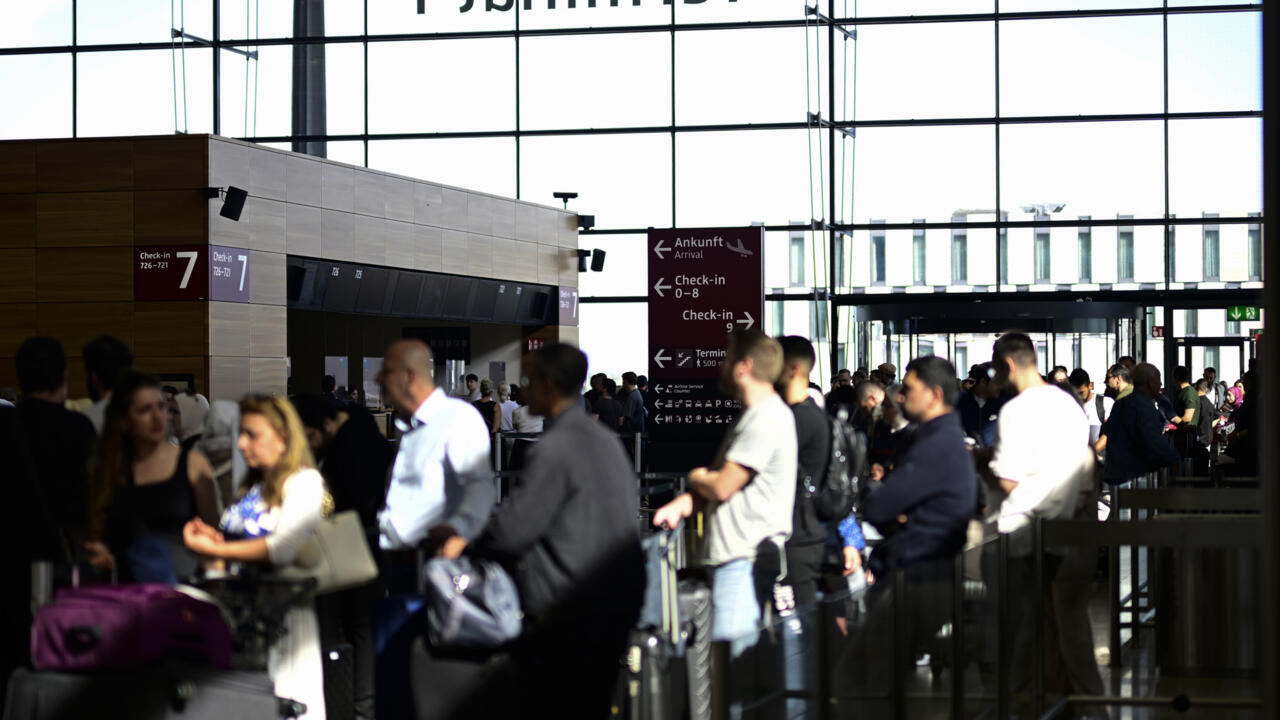
London (AFP) – Major European airports including Brussels, Berlin and London's Heathrow were Saturday hit by a cyberattack on checkin systems that caused cancellations and long delays for many passengers.


Issued on: 20/09/2025 - FRANCE24


Passengers queue for check-in at Terminal 1 of Berlin Brandenburg BER Airport Willy-Brandt in Schoenefeld, southeast of Berlin, after major European airports were hit by a cyberattack © Tobias SCHWARZ / AFP

At least three busy European air hubs warned of flight delays and cancellations.

At least 10 flights were cancelled out of Brussels Airport and another 17 delayed by over an hour after the system was hit by a "cyberattack" late Friday, the airport said.

"We have become aware of a cyber-related disruption to our MUSE software in select airports," airport service provider Collins Aerospace told AFP.

"The impact is limited to electronic customer check-in and baggage drop and can be mitigated with manual check-in operations," Collins Aerospace added.

Brussels airport said the attack was still having a "large impact" on flight schedules Saturday morning.

According to the BBC, aviation watchdog Eurocontrol said airlines had been asked to cancel half their flights to and from Brussels between 0400 GMT on Saturday and 0200 GMT on Sunday because of the attack.

Only manual check-in and boarding was taking place at Brussels, which advised passengers to check their flight status with airlines before going to the airport on Saturday.

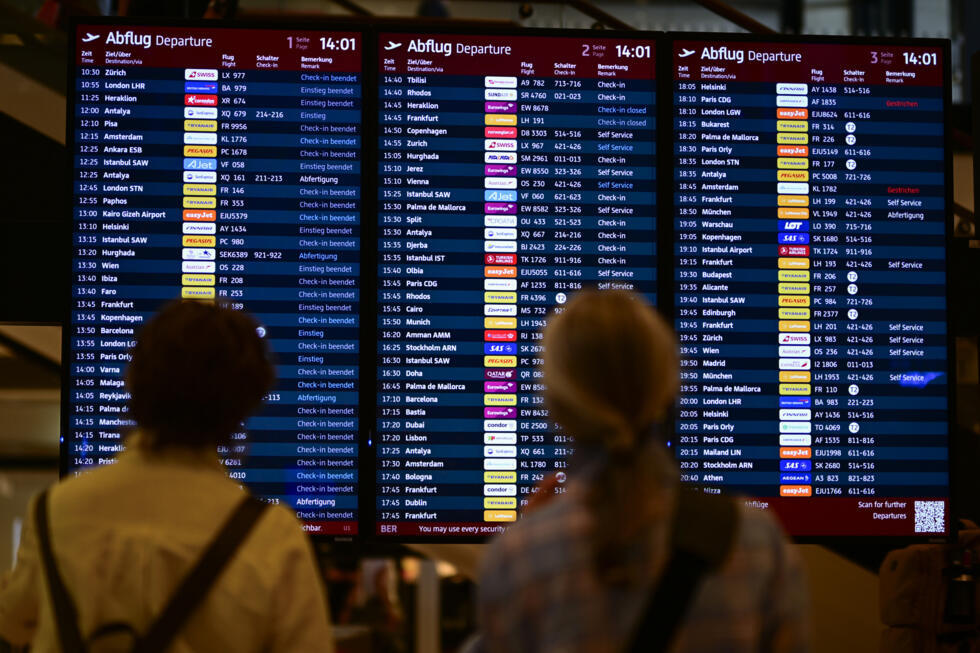
AFPTV images showed large queues at Brussels as passengers monitored announcement boards showing many flight delays.

London's Heathrow Airport -- the busiest in Europe -- said its check-in and boarding systems, also provided by Collins Aerospace, were hit by a "technical issue" that "may cause delays for departing passengers".

'Queues not moving'


"They didn't tell us anything. It's always crowded here, but today is like extra," said a 41-year-old architect, who gave her first name as Rowan.

"If the system is down they should delay the flight. That's what I'm hoping," she added, waiting in the packed check-in area at Heathrow's Terminal 4 for a Saudia Airlines flight to Jeddah.

Passengers check a digital display showing flights at Berlin Brandenburg BER airport © Tobias SCHWARZ / AFP

Another woman waiting for an Air Algerie flight to Algeria said she had waited for over an hour to check in.

"They said they're doing everything manually. That's all they've told us," said the 30-year-old, asking not to give her name.

Freelance journalist Tereza Pultarova was booked on a flight to Amsterdam with a connection onto a KLM flight to Cape Town.

"They were checking in people at the rate of, like, one person per 10 minutes," she said, adding it looked like she would miss a once-in-a-lifetime work trip to the Karoo desert which would probably head off without her.

"It was just insane, the queue wasn't moving."

The Berlin Airport website read that "due to a technical issue at a system provider operating across Europe, there are longer waiting times at check-in."

Collins Aerospace said it was "actively working to resolve the issue and restore full functionality to our customers as quickly as possible".

The aviation tech company, which specialises in digital and data processing services, is a subsidiary of the American aerospace and defense group RTX (formerly Raytheon).

Cyberattacks and tech outages have disrupted airports around the world in recent years, from Japan to Germany, as air travel increasingly relies on online, interconnected systems.

The aviation sector saw a 600 percent increase in cyberattacks from 2024 to 2025, according to a report by French aerospace company Thales released in June.

"From airlines and airports to navigation systems and suppliers, every link in the chain is vulnerable to attack," the report warned, pointing out that the strategically and economically important sector had become a "prime target" for cyberattacks.

In July, Australian airline Qantas was targeted by hackers, who broke into a system containing sensitive data on six million customers. In December 2024, Japan Airlines was also targeted.

© 2025 AFP