Monday, September 29, 2025


"Managed democracy" wins the Moldovan elections

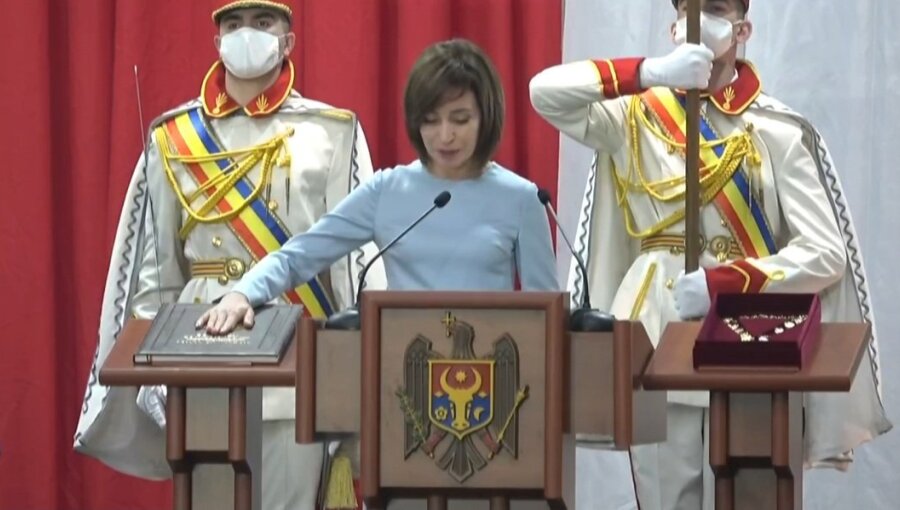
The ruling pro-EU PAS has won the elections in Moldova, but using questionable methods that are similar to teh Kremlin's "managed democracy" manipulations to make sure the "right" party wins. / bne IntelliNews
By Ben Aris in Berlin September 29, 2025

With the final results still coming in, it appears that the ruling Party of Action and Solidarity (PAS) has won the general election in Moldova on September 28, but to secure victory, President Maia Sandu seems to have taken a page out of the “managed democracy” Kremlin’s playbook.

Moldova’s elections turned into a geopolitical battlefield as the incumbent pro-Europe Sandu wrestled with massive Kremlin interference that was playing on dissatisfaction with her rule and pro-Russian sentiment amongst many of her people. And she was playing rough.

Only 48 hours before the vote, two of the leading pro-Russian parties were excluded from the race on campaign funding irregularities.

In her televised address before the vote, Sandu drew a stark parallel with Georgia which she claimed had been “crushed by Russia” and the European path for Moldova that would lead to prosperity.

But this emotional appeal came with some blatant gerrymandering, as only two polling stations were opened inside Russia for expatriates, but embassies across the EU opened their doors to would-be voters.

The effort to ensure the pro-EU forces had the upper hand were underway well in advance. Tech guru and Telegram founder Pavel Durov admitted in a post that he was approached by French intelligence services and Moldovan officials earlier this year while in Paris and asked to shut down opposition channels.

At the same time EU foreign policy chief and former Estonian Prime Minister Kaja Kallas openly announced that the EU was sending a “rapid reaction” force to Chișinău to “assist” in the elections and “counter” Russian meddling.

Managed democracy

Observers have criticized Sandu and the EU of adopting the Kremlin’s tactics of “managed democracy”: playing lip service to the norms of democratic voting, but making extensive use of the so-called “administrative resources” to manipulate voter sentiment: both through hard means, like gerrymandering and the use of courts to ban opposition candidates, and soft means, like flooding the information space and social media with pro-regime propaganda.

“There was the term “managed democracy” in Russia - a regime of hybrid and increasingly imitational democracy that existed between either 1993 or 1996 and 2012 when Putin undid democracy altogether.” journalist and bne IntelliNews columnist Leonid Ragozin. “This is what is happening in Moldova.”

The opposition Moldova Mare party was barred from elections just two days before the polls opened, but remained in the ballots, so people voted for it, unwittingly stealing votes from other opposition parties in favour of the ruling PAS.

Foreign Minister Mihai Popșoi said diaspora voting could be prolonged as Sandu called on diaspora to take active part, but not the diaspora in Russia though whose votes have been suppressed by limiting the number of polling stations to just two, reports Ragozin.

There were unconfirmed reports that the bridges to the breakaway regions of Transnistria were blocked on the day of elections to suppress anti-Sandu votes. Transnistria remains under partial Russian occupation.

The widely spread Moldovan one million-strong diaspora, 15% of the total population that already enjoys EU visa-free travel, plays a vital role in elections, but more than a third of those live in Russia. The pro-Russian candidates, like former president Igor Dodon and oligarch businessman Ilan Shor, allegedly used cash incentives, disinformation, and vote-buying to sway support. PAS struggled in June 2024 local elections, winning with a razor thin margin, where pro-Russian parties gained ground in rural areas and among Russian-speaking voters.

Georgia on my mind

Critics say Sandu was using the example of Georgia to fan flames of Russia’s intentions for the country. "Georgia has once again become a Russian colony. Moldova will not repeat these mistakes," Sandu said.

Georgia is also an EU candidate country, but the ruling regime, led by oligarch Bidzina Ivanishvili has broken with Brussels and maintains tight relations with Russia that has seen trade and investment flourish. That has led to almost a year of street protests as the majority of ordinary Georgian want to see their country accede to the EU.

“Georgia isn't, as she claims, a "colony of Russia", from what I could see they merely refused to be a colony of the EU, which is a pretty big difference,” political commentator Arnaud Bertrand said in a commentary.

As reported by bne IntelliNewsGeorgia suffers from a similar voting breakdown as Moldova: the urban population in the capital strongly support the EU-direction, but the poorer rural population favoured Ivanishvili’s Georgian Dream ruling party with its pro-Russia leaning.

Moreover, a side-by-side comparison of Georgia and Moldova reveals that George has easily outperformed Moldova in recent years, which remains one of two poorest countries in Europe. Last year Georgia's economy grew at 9.4% vs 0.1% for Moldova, according to the World Bank. “In fact since she became president in 2020, her country's GDP grew from $8.4bn to $9.25bn (so 10% growth in total in four years) when Georgia's grew by 45% (from $17.35bn to $25.13bn), Bertrand reports.

Romania

Critics say that this Moldovan election is similar to the last 2024 presidential election in Romania where far-right independent candidate Călin Georgescu came out of nowhere with a surprise first round win with approximately 22% of the vote.

However, seen as a pro-Russian spoiler, in December the Constitutional Court annulled the entire first round and Georgescu was barred from politics. The authorities claimed that Georgescu had received illicit funding from the Kremlin to run a highly effective social media campaign on TikTok and Telegram. A few months later, the authorities admitted they had no concrete evidence to substantiate that claim. A rerun returned pro-EU Bucharest mayor Nicușor Dan, who secured 53.6% of the vote in the second round on May 18.

He defeated hard-right nationalist George Simion in a dramatic upset as Simion was leading the first round but garnered 46.4% in the second round.

Dan’s victory ensured that EU-member Romania stays in the anti-Russian camp, championed by European Commission President Ursula von der Leyen and Kallsa, and out of the growing Patriots for Europe championed by Hungarian Prime Minister Viktor Orban and Slovak Prime Minister Robert Fico, who have become a major thorn in the side of the European Commission (EC) executive.

Managed democracy

Russia's "managed democracy" is a political system that emerged following President Vladimir Putin's rise to power in 1999-2000. It blends democratic structures with centralized authoritarian control.

The term, coined by Kremlin insiders like Vladislav Surkov, is a hybrid regime where elections, media, and political opposition exist and prima facie appears to be a true democracy, but in reality elections are carefully managed to achieve certain results.

Unlike the presidents in Central Asia that largely score well over 90%
“victories” in elections, over time the Kremlin has become more subtle as it refines the system. Putin won a mere 52.9% in this first election in 2000, but was swept into office on the back of the start of the second Chechen war after a series of apartment bombs – widely seen as being orchestrated by the Federal Security Service (FSB) – killed hundreds of Muscovites in their beds in the middle of the night.

Since then, Putin’s share of the vote has risen steadily, both thanks to genuine economic prosperity he brought the country by ending Yeltsin’s chaos, but also as control over voting improves, driven by the introduction of an electronic ballot system.

Putin presidential electoral victories:

2000 (March 26): 52.94% (first round; against Gennady

Zyuganov at 29.21%).

2004 (March 14): 71.31% (first round; against Nikolai Kharitonov at 13.69%).

2012 (March 4): 63.60% (first round; against Gennady Zyuganov at 17.18%).

2018 (March 18): 76.69% (first round; against Pavel Grudinin at 11.77%).

2024 (March 15-17): 87.28% (first round; against Nikolai Kharitonov at 4.31%).Interestingly, in each of these elections, Putin has been moving towards making sure that he wins enough theoretical numerical votes that is more than 50% of the entire population, not just a whopping majority of the smaller group of just registered voters. This share is rising from 25% in the first 2000 election but was 52.7% in the last election in 2024.

However, the parliamentary elections are more important. Russia is such a vast country, the Kremlin has to rely on the regional deputies and governors for actual day to day operations and as some of the regions are so far and there are so many of them they enjoy a fair amount of autonomy.

At the same time, the election results need to cross various constitutional thresholds to protect Putin’s position: in theory the Duma can veto presidential orders and change the constitution if it can raise more than 66% of the vote, so the Kremlin ensures that the ruling United Russia controls that many votes. The Kremlin also needs to ensure that it has enough deputies to control the Duma’s key committees where laws are actually drafted.

In more recent years, the Kremlin has promoted other parties to add a veneer of improved plurality, however, these parties belong to the so-called “systemic opposition”, such as the late Vladimir Zhirinovsky’s Liberal Democratic Party of Russia (LDPR), that always vote the Kremlin-line on big issues. The “non-systemic opposition” like late opposition figure and anti-corruption activist Alexei Navalny, who died in a Russian prison under questionable circumstances in February 2024, are excluded from the Duma.

The most recent example was 2021 Duma elections where, as reported by bne IntelliNews, the Communist Party (KPRF) are believed to have won the majority, defeating United Russia. However, when the electronic voting came in, those wins were overturned and United Russia took control. However, a statistical study showed clearly the result was systemically fixed in the Kremlin’s favour.

The system occasionally goes wrong: the fix in the 2011 Duma elections was so blatant that it sparked the largest mass demonstrations of Putin’s regime with more than 100,00 demonstrators on Bolotnaya Square in a park facing the Kremlin across the Moskva river.

Moldova and Romania are still a long way from a full managed democracy and have limited themselves to crude early-stage tactics of banning opposition leaders and parties in the run up the vote, a technique also favoured by Belarus President Alexander Lukashenko in the massively falsified president elections of 2000 that sparked mass demonstrations.

However, Georgia has gone much further down the managed democracy path. Putin abandoned his “repression-lite” model of managed democracy following the return to Russia and arrest of Navalny in 2021. He ramped up the powers of his so-called foreign agents law to close down the opposition press and jail journalists. He also made using the word “war” in the press illegal after the start of the ”special military operations” in Ukraine in 2022.

Georgian Dream is adopting a growing number of these tactics, shuttering foreign-backed NGOs, arresting journalists, and it also introduced its own foreign agents law last year that kicked off the on-going mass protests that are still running nearly a year later.

 

AFRIKA

China signs $1.4bn Tazara railway deal, reviving copperbelt link amid Lobito Corridor rivalry

China signs $1.4bn Tazara railway deal, reviving copperbelt link amid Lobito Corridor rivalry
/ bne IntelliNews
By bne IntelliNews September 29, 2025

Zambia and Tanzania have signed a $1.4bn agreement with China to modernise the Tanzania–Zambia Railway (Tazara), a strategic line linking the central African copperbelt to the Indian Ocean port of Dar es Salaam, Bloomberg reported on Monday (September 29). 

Tazara, stretching 1,860 km, has suffered decades of underinvestment and is operating far below capacity. The project revives infrastructure built with Chinese financing and expertise in the 1970s.

The rehabilitation aims to restore the efficiency of the railway line at a time when copper shipments from Zambia and the Democratic Republic of Congo (DRC) are placing unprecedented pressure on regional transport corridors.

With most ore currently moved by truck, congestion at border posts has become a persistent bottleneck. The upgraded railway is expected to cut transport times and provide a more reliable alternative for exporters moving bulk minerals to port.

The railway project also carries geopolitical weight among a scramble to secure supply chains for critical minerals.

Tazara’s development emerged during a period of resistance to Western influence in Southern Africa, after the US and Russia declined to finance the project, citing economic concerns.

Tazara (Tanzania–Zambia Railway)

  • Route: Dar es Salaam (Tanzania, Indian Ocean) ↔ Kapiri Mposhi (Zambia, copperbelt)
  • Length: 1,860 km
  • Origins: Built 1970–75 with Chinese financing/engineering, $500mn at the time (then China’s largest overseas project).
  • Current state: Operating far below capacity after decades of underfunding.
  • Revamp: $1.4bn China–Zambia–Tanzania deal signed September 2025.
  • Strategic role: Reduces dependence on trucking routes; relieves border congestion; symbol of Sino–African ties.

Tazara is in competition with the US- and EU-backed Lobito Corridor, a $3bn to $4bn rail and port project aimed at channelling copper and cobalt from the same mineral-rich central Africa belt to the Atlantic coast of Angola. For African governments, the rivalry offers potential leverage in negotiating financing, tariffs and service standards.

The Lobito Corridor has gained momentum as Washington and Brussels promote it as a “transparent alternative” to Chinese-backed infrastructure. Centred on Angola’s Lobito Port and the rehabilitated Benguela Railway, the 1,300 km corridor is already operational to the DRC border, with plans to extend links deeper into the copperbelt. The project is supported by the US, EU, African Development Bank (AfDB) and private operators.

Lobito Corridor

  • Route: Lobito Port (Angola, Atlantic Ocean) ↔ DRC copperbelt ↔ Zambia (planned extensions).
  • Length: 1,300+ km (rehabilitated Benguela Railway + new connectors).
  • Origins: Colonial-era line modernised in 2010s; now centerpiece of US–EU–Angola partnership.
  • Current state: Operational to Lobito; expansion ongoing to connect Zambia and DRC seamlessly.
  • Funding: US and EU backing, with World Bank and African Development Bank support.
  • Strategic role: Diversifies export routes; reduces reliance on east-coast ports; framed as “transparent alternative” to Chinese projects.


Japanese scientists measure seafloor sinking for the first time

Japanese scientists measure seafloor sinking for the first time
/ Silas Baisch - Unsplash
By bno - Jakarta Office September 29, 2025

A Japanese research group has, for the first time, measured yearly seafloor sinking near the Nankai Trough off the Pacific coast, The Japan Times reports. Using advanced water pressure gauges from the Donet earthquake and tsunami monitoring network, the team identified gradual subsidence at two points off the Kii Peninsula in central Japan.

The Nankai Trough is a tectonic boundary where the oceanic plate descends beneath the continental plate, gradually lowering the seabed. Over long periods, this process can culminate in sudden shifts along the plate boundary, sparking powerful earthquakes and tsunamis. Data from Donet is already crucial for Japan’s Meteorological Agency, which relies on water pressure changes to issue tsunami warnings.

Detecting small-scale movements has been a challenge, as shifts of only a few centimetres each year are easily mistaken for device errors. To overcome this, a team led by Yuya Machida of the Japan Agency for Marine-Earth Science and Technology (JAMSTEC) created a portable, highly accurate calibration tool. Installed at two sites, it uses laser-based measurements to verify subtle height differences.

Findings revealed seabed sinking of 1.5 cm and 2.5 cm annually at the southeast and south of the Kii Peninsula. Researchers aim to expand monitoring to better map long-term subsidence patterns. This breakthrough not only sharpens earthquake and tsunami risk assessment but also underscores how precision technology is becoming vital in safeguarding coastal populations.

CRIMINAL CAPITALI$M

How Azerbaijan's oil prince went from dining with Messi to facing decades in prison

How Azerbaijan's oil prince went from dining with Messi to facing decades in prison
A picture posted by Adnan Ahmadzada on Instagram showing his friendship with footballer Lionel Messi. / Adnan Ahmadzada via Instagram
By Cavid Aga in Warsaw September 29, 2025

Eight months ago, Adnan Ahmadzada stood on stage at Baku's Crystal Hall, basking in the adulation of thousands as he hosted Lionel Messi and his Inter Miami teammates for a charity event. The crowd chanted "Messi!" whilst children rushed to embrace their idol, some unable to hold back tears. Ahmadzada, the orchestrator of this "magical" evening, had cemented his status as one of Azerbaijan's most influential businessmen, a man who could bring the world's greatest footballer to the Caspian shores with a phone call.

Today, that same man sits in a Baku detention cell, accused of perpetrating one of the largest economic crimes in Azerbaijan's history, according to Reuters. The charges against the 47-year-old former oil executive read like something out of the TV series Succession: contaminating 200,000 tonnes of his country's oil exports with corrosive chemicals, facilitating billions in Russian sanctions evasion, and operating a shadow network of companies stretching from Malta to Dubai. If convicted, he faces up to 23 years in prison.

The arrest of Ahmadzada on September 11 by Azerbaijan's State Security Service has sent shockwaves through the global energy sector and raised uncomfortable questions about how Russian oil continues to flow into European markets despite supposedly watertight sanctions. But perhaps more intriguingly, it has exposed the dual life of a man who moved as comfortably in the company of sanctioned Russian oligarchs as he did with football royalty.

Who is Adnan Ahmadzada?

Born in 1978 in Baku, Ahmadzada's trajectory through Azerbaijan's oil bureaucracy was nothing short of meteoric. After graduating from the Academy of Public Administration in 1998 and earning a master's degree two years later, he immediately joined the State Oil Company of the Azerbaijan Republic (SOCAR), starting as a junior expert in export operations.

Over two decades, he climbed steadily through the ranks, accumulating power and knowledge of the international oil trade's most intricate mechanisms. By 2010, he was running SOCAR's entire Marketing and Economic Operations Department. In 2018, he achieved what many considered the pinnacle of Azerbaijan's energy sector: appointment as executive chairman of SOCAR Trading SA, the Geneva-based arm that handles billions in petroleum transactions annually.

President Ilham Aliyev himself recognised Ahmadzada's contributions in 2015, awarding him the prestigious Taraggi (Progress) medal for services in the development of the oil industry. By 2019, as deputy VP of SOCAR for investments and marketing, Ahmadzada had become one of the most powerful figures in Azerbaijani energy, with influence extending far beyond the Caspian region.

Yet in 2023, something went wrong. Ahmadzada was dismissed from SOCAR by presidential decree, officially due to "shortcomings in his work". Rather than fade into obscurity, he reinvented himself as an independent mogul, founding ABDA Invest Holding, a conglomerate spanning everything from supermarket chains to cinema complexes. He also began cultivating an entirely different kind of power: soft influence through sports and celebrity.

Ahmadzada's ability to attract global football stars to Azerbaijan became legendary. His relationship with Messi, which he described as involving "close family ties", enabled him to bring the Argentine superstar to Baku in January 2025. The visit was a sensation, with Messi touring cultural sites, viewing Azerbaijani carpets, and even paying respects at former president Heydar Aliyev's mausoleum. "This visit to Baku has given me the opportunity to experience the rich culture of Azerbaijan," Messi said at the time, thanking Ahmadzada personally for organising the event. Photos from Ahmadzada's Instagram account @adnan555 show him at Messi's Paris home, suggesting a personal relationship that transcended business.

Ronaldinho's appearance at COP29 in November 2024, accompanied by Barcelona president Joan Laporta, further demonstrated Ahmadzada's reach into football's elite circles. He also served as honorary president of Azerbaijan's Koshiki Karate-do Federation and was in advanced negotiations to purchase Mingachevir Football Club, promising to transform it into a major force with the help of his Barcelona connections. This carefully cultivated image of a cosmopolitan businessman and sports patron would soon collide catastrophically with a very different reality.

Contamination

The crisis began in July 2025 when routine quality checks at Turkey's Ceyhan terminal detected dangerous levels of organic chlorides in Azerbaijani crude oil arriving through the Baku-Tbilisi-Ceyhan pipeline. These compounds, highly corrosive to refinery equipment and capable of causing catastrophic processing failures, triggered immediate alarm across European energy markets.

BP, which operates the terminal, declared force majeure, a legal acknowledgement that it could not fulfil contracts due to circumstances beyond its control. The contamination affected approximately 200,000 tonnes of oil, spreading through supply chains to Romania, Italy, Austria, and the Czech Republic before being detected and contained.

Romania's response was particularly dramatic. The government declared a crisis-level emergency on August 4, forcing the country to tap strategic reserves of 80,000 tonnes of crude and 30,000 tonnes of diesel to maintain refinery operations. However, contrary to initial reports of equipment damage, OMV Petrom later confirmed that contamination was detected "before the crude oil reached the refinery", with all facilities "operating within normal parameters".

The market impact was immediate and severe. Azeri Light crude, Azerbaijan's premium export grade commanding top international prices, plummeted from approximately $77 per barrel to between $68 and $69, reaching what traders described as four-year lows. Whilst prosecutors claim losses of $2.01bn, this specific figure remains unverified, though the ten-dollar price drop across Azerbaijan's massive export volumes certainly caused damage in the billions.

By September 23, BP's Tamam Bayatlı announced the crisis had been resolved, stating that "all tanks at the Ceyhan terminal now contain on-specification crude oil". But by then, investigators had begun uncovering something far more troubling than a quality control failure.

Adnan's network

The contamination incident coincided with increasing scrutiny of Azerbaijan's role in oil trading. The scheme allegedly operated through multiple channels, but the most significant involved the STAR refinery in Turkey, owned 60% by SOCAR and 40% by Azerbaijan's Ministry of Economy. According to Global Witness's analysis of shipping data and customs records, over 90% of crude processed at STAR in early 2024 originated from Russia, representing $1.2bn worth of Russian oil in just the first quarter of that year.

Three Azerbaijani tankers central to these operations have since been officially designated as part of Russia's "shadow fleet" for sanctions evasion. The Zangezur was sanctioned by the UK on May 9, 2025, followed by the Shusha and Karabakh, both blacklisted by July. Sanctions documents describe these vessels as having been "actively engaged in transport of Russian crude oil from Primorsk to Nemrut Bay since November 2023".

The European Union's response was decisive. The 18th sanctions package, adopted on July 18, specifically banned imports of refined petroleum products made from Russian crude in third countries. EU foreign affairs spokesperson Anitta Hipper explicitly confirmed that the STAR refinery was covered by these restrictions, effectively cutting off a major avenue for Russian oil to enter European markets.

But perhaps the most intriguing element of the alleged network is Alkagesta Ltd, a Malta-based trading company founded in 2018 that investigators believe represents the hidden architecture of Ahmadzada's operations. Whilst his name appears nowhere on official company registrations, multiple sources identify him as the true power behind Alkagesta, with the CEO position held by Kamran Aghayev, reportedly his cousin.

Alkagesta, which describes itself as "an avant-garde commodity trading house", maintains offices across Switzerland, the UK, Dubai, Kazakhstan, Azerbaijan, Turkey, Turkmenistan and Romania. According to investigative reports, Alkagesta allegedly used falsified documentation to disguise Russian oil as Turkmen origin. Albanian authorities seized 22,500 tonnes of fuel they identified as Russian origin with falsified paperwork, with local media naming Alkagesta as involved. The company is reportedly under investigation by EU and UK authorities, though no formal charges have been announced.

The Russian question

The timing of the oil contamination has led some investigators to suspect this wasn't mere fraud but something more sinister: economic warfare designed to undermine Azerbaijan's growing role as Europe's alternative to Russian energy. On August 19, Yuri Podolyaka, a pro-Russian military blogger with suspected ties to Russian intelligence, published a post titled "News from the 'Azerbaijani front': or don't anger the Russian bear". In it, he characterised the contamination as Russia's "warning" to Azerbaijan and ominously suggested that "any incident could be repeated at any time".

Romanian intelligence services are reportedly investigating whether the contamination represented deliberate Russian sabotage, with sources suggesting organic chlorides may have been intentionally injected into the BTC pipeline as an act of economic warfare, according to Kyiv Independent. The precedent exists: in 2019, Russia's Druzhba pipeline suffered similar organic chloride contamination that affected 5mn tonnes of crude and caused $2.6bn-2.7bn in damages, an incident later traced to criminal activity.

Ahmadzada's connections to Russian energy elites add fuel to these suspicions. He was photographed at the birthday celebration of Vahid Alekberov, himself an ethnic Azerbaijani and Lukoil's billionaire founder, who is under Western sanctions, in Bodrum, Turkey. Some sources allege he even registered Alekberov's $80mn yacht Galactica Super Nova in his own name to help the oligarch evade asset seizures, though this claim remains unverified in maritime databases. The conspicuous silence of Russian media about Ahmadzada's arrest, despite it being a major international story, has only deepened suspicions about Moscow's potential involvement.

Ahmadzada now faces charges of economic sabotage and large-scale embezzlement in Azerbaijan, with prosecutors granted four months of pre-trial detention. This is the maximum amount of time a person can get legally. The investigation has expanded beyond Azerbaijan's borders, with UK authorities under pressure to explain how Ahmadzada obtained and maintained British citizenship whilst allegedly orchestrating massive fraud.

The European Union and the United Kingdom are investigating Alkagesta's operations, whilst Malta faces criticism from EU partners for what they perceive as insufficient action against a company allegedly at the centre of sanctions evasion. Each country that received contaminated oil could potentially bring separate charges, creating a cascade of legal challenges that could take years to resolve.

For Azerbaijan, the scandal represents a crisis of credibility at a crucial moment. The country has positioned itself as Europe's reliable alternative to Russian energy, signing strategic partnership agreements and investing billions in infrastructure. The revelation that Russian oil was flowing through Azerbaijani facilities whilst the country's own oil was being contaminated threatens to undermine years of diplomatic and economic relationship-building. Azerbaijan was already under suspicion, while people like presidential aide Hikmet Hajiyev vehemently denied the claims.

Prosecuting Ahmadzada demonstrates a commitment to the rule of law and distances Azerbaijan from sanctions evasion. But the investigation risks exposing systemic vulnerabilities in the country's energy sector and could invite Russian retaliation if Moscow were indeed involved in the contamination.

Several critical questions remain unanswered. How could someone dismissed from SOCAR in 2023 allegedly contaminate oil in the Baku-Ceyhan pipeline in 2025? If he acted alone, how did he maintain the access and influence necessary for such an operation? If he didn't act alone, who were his accomplices, and how deep does the corruption run?

The celebrity connections raise their own questions. Did Messi, Ronaldinho, and other sports stars who associated with Ahmadzada have any knowledge of his alleged criminal activities? There's no evidence they did, but their glamorous presence provided perfect cover for someone allegedly operating one of the largest sanctions-evasion schemes in the region.

Perhaps most crucially, was the contamination deliberate sabotage designed to undermine Azerbaijan's energy exports, or was it criminal negligence in pursuit of profit? The answer could determine whether this case is treated as massive fraud or as economic warfare with geopolitical implications.

Wider implications

The Ahmadzada affair represents more than just the fall of one ambitious businessman. It exposes the vulnerabilities in global energy supply chains, the sophistication of modern sanctions evasion, and the blurred lines between private corruption and state-level economic warfare. For the global energy market, the case serves as a warning about the ease with which insiders can manipulate systems they know intimately. For sanctions enforcers, it reveals how creative criminals and possibly state actors have become in circumventing restrictions. For Azerbaijan, it marks a moment of reckoning about governance, accountability, and the country's role in the new energy landscape shaped by Russia's war in Ukraine.

The arrest decision for Ahmadzada was unexpected. His lawyer, Shaig Mirzayev, currently representing the detained businessman, told the BBC: “Adnan Ahmadzada is a well-known businessman. He worked within SOCAR’s structure for a long time. Naturally, this incident was unexpected for him. But he is showing resilience, giving testimony in the investigation, and will also take part in other investigative actions.” According to Mirzayev, Adnan Ahmadzada is currently being held at the investigative detention facility of the State Security Service and, for now, has no intention of filing an appeal against the court’s decision. 

“Over the next four months, we will participate in the investigative actions. We will try to ensure that the truth about the case is revealed,” he said. Although the lawyer did not speak about details of the criminal case, he said the accusations circulated in Azerbaijani media violated Ahmadzade’s presumption of innocence. In his statement, he did not comment on any of the allegations voiced in the media, justifying this by saying that “all information in the investigation materials constitutes an investigative secret”.

As investigations continue across multiple jurisdictions and more revelations emerge, the full impact of the Ahmadzada scandal remains to be seen. But one thing is certain: the man who once brought the world's greatest footballer to Baku has become the face of one of the energy sector's most spectacular falls from grace. The most glaring question is how someone dismissed from SOCAR in 2023 could allegedly contaminate oil in the Baku-Ceyhan pipeline in 2025. This two-year gap suggests either Ahmadzada retained extraordinary access through accomplices still within the system, or he is taking the fall for a much larger network that remains unexposed. The sophistication and scale of the alleged operations — spanning multiple countries, involving billions in transactions, and requiring intimate knowledge of current SOCAR operations — seem implausible for one person acting alone, especially someone no longer officially connected to the company.


Forget OPEC Warnings The Real Oil Shock Is Happening Inside Russia

  • Ukraine’s drone and missile strikes on Russian refineries, depots, and ports have taken over 1 million bpd of refining capacity offline.

  • Despite talk of an oil glut and OPEC+ output hikes, global crude prices remain stable.
  • Russia is forced to export more crude while facing domestic fuel shortages and unrest.

While the world is watching the UN General Assembly discussions on Gaza-Israel, hybrid warfare in Europe (drones) and Trump, global oil markets are showing increased instability, as Ukrainian drones are destroying key oil and gas infrastructure inside of Russia. Over the last few weeks, a tsunami of reports has been published about a possible oil glut in the coming months or years, supported by OPEC-8 decisions to increase the export ceiling. However, reality in the market shows a different picture. Until now, no real crude oil price crash is showing; global prices are even very stable, while fundamentals in the markets are increasingly influenced by external geopolitical threats, not only Russian aggression towards NATO, or a heating up of the East Med (Turkey, Israel, Gaza Flotilla), but also increasingly Ukraine’s effective strikes on Russia’s infrastructure.

Almost daily, reports are showcasing the strategic success of Ukraine's campaign, which, in addition to its battlefield tactics, has effectively executed precision strikes and drone attacks on Russian oil refineries, fuel depots, and related logistics. These intentional strikes have targeted the Kremlin’s economic lifelines, leading some to assert that the most effective sanctions currently hitting Russia’s war chest or Putin’s lifeline are the Ukrainian drones.

While most energy analysts are still obsessed with OPEC, US shale, or Israel’s operations in Gaza, Russia, not only a pivotal player inside the so-called OPEC+ group, but also one of the world’s leading oil and gas exporters, is looking at a very dire situation. Ukrainian drones are not only degrading Moscow’s ability to turn Russian crude into exportable petroleum products (diesel, gasoline, kerosene) but also forcing Russian refineries to go offline. Both issues are hitting Putin’s war economy very hard, as they decrease options to monetize its hydrocarbon potential (exports) and also force higher domestic price settings for Russian citizens and external parties. Lately, in a move to squeeze Russia really, Ukraine has increased its attacks on Russian oil ports, in a move to hit export potential, while in the end forcing Russian crude oil production to be shut in.

The current situation, combined with increased geopolitical risks and strong global demand, suggests a potential shift towards a bullish environment. Even OPEC+'s theoretical production and export increases may not be enough to mitigate this shift, or in some cases, may not be sufficient at all. This potential for a bullish market should prompt all market participants to adopt preparedness and strategic planning.

The latest reports from Russia indicate that Ukrainian drones have hit dozens of Russian fuel facilities, while at the same time, maritime drones and missiles are being used. The potential of Ukraine’s latest military addition, the Flamingo Missile, could be a watershed development. This missile can reach much further into Russian territory with a larger payload, potentially causing significant damage to key oil and gas infrastructure. Western and Russian outlets have also indicated that over a million barrels per day of refining throughput is being hit or removed from the market, as major refineries and pipeline centers are being shut down or taken offline. For global oil markets, Russia’s exports are significant, as it is a leading exporter of diesel, fuel oil, and kerosene. The potential impact of the Flamingo Missile, combined with the ongoing drone attacks, underscores the evolving nature of the geopolitical risks in the oil market.

While global markets are being hit increasingly, even if additional Russian crude is exported, the situation has become very dire. Independent reports from Russia indicate severe fuel shortages in several regions of the country, not only impacting the war economy sectors (manufacturing, defense) but also increasing the potential for internal unrest. Russian oligarchs have been complaining about the fuel and energy situation for weeks. While Russian refineries, which supply the domestic market, are affected, seaborne crude flows are increasing, as Moscow is forced to export more. Russia doesn’t hold vast crude oil storage facilities or volumes, leaving it with no option but to export crude. Some Asian markets will be happy, as most Russian seaborne volumes will head there. Still, regional markets for Russian products will be struggling to find additional supplies.

All in all, this could mean a short-term increase in supply to Asia. To what extent this will be possible, given that the US and EU are increasing pressure, is, however, a valid question, especially when considering India. If Russia doesn't manage to export the increased volumes, domestic oil production may need to be shut in. When the market recognizes the increased geopolitical risks, a higher risk premium will result in higher oil prices. Downstream, prices will increase globally, as the current situation and today’s statement of renewed, stricter export bans on diesel or other products by Moscow will impact the market. Asian or Middle Eastern refineries will not be able to counter this.

Considering all these factors, the real net effect could be a decrease in global product availability in some consuming regions, even as seaborne crude volumes remain robust. This could then lead to a somewhat unexpected tightening of markets. OPEC+ export increases are unlikely to make a significant difference. Over the last few months, most OPEC-8 increases have been technical, aimed at legitimizing existing overproduction. The remaining spare production capacity of the group, or even OPEC+ as a whole, is shrinking. Current scenarios do not even include a new confrontation in the Middle East or the East Med, US actions against Venezuela, or a large-scale force majeure. In this context, the role of OPEC+ as a swing producer is limited, and the market should not rely solely on its actions to stabilize the situation.

By Cyril Widdershoven for Oilprice.com