Tuesday, September 30, 2025

Reagan-Appointed Judge Rips Into Trump Admin for Illegally Targeting Pro-Palestine Student Protesters

Politico’s senior law reporter called it “the most scathing legal rebuke of the Trump era.”
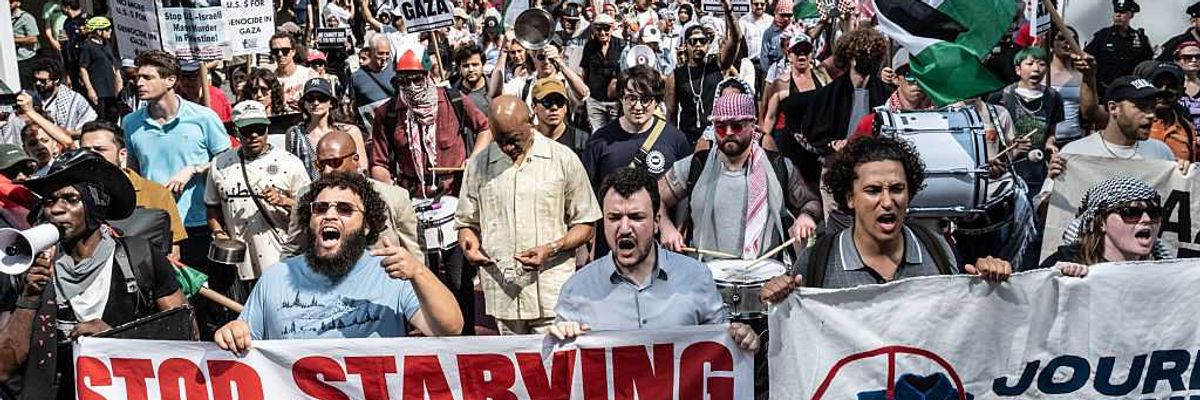


Mahmoud Khalil, former Columbia University graduate student known for his role in the 2024 Columbia University pro-Palestinian protests, leads a Pro-Palestinian “March for Humanity” against the humanitarian crisis in Gaza on August 16, 2025 in New York City.
(Photo by Stephanie Keith/Getty Images)

Stephen Prager
Sep 30, 2025
COMMON DREAMS

A federal judge issued an emphatic ruling Tuesday that the Trump administration acted illegally when it targeted pro-Palestinian student activists for deportation, describing it as part of an effort to “strike fear” into protesters exercising their First Amendment rights.

In the 161-page ruling, US District Judge William Young, who was appointed by former President Ronald Reagan, concluded that the Trump administration undertook illegal efforts “unconstitutionally to chill freedom of speech.”


Slamming ‘Fascist Tactics’ of Trump, Mahmoud Khalil Fights Judge’s Deportation Decision


He also launched a broadside against the Trump administration’s entire authoritarian ethos, describing President Donald Trump’s “palpable misunderstanding that the government simply cannot seek retribution for speech he disdains.”

Politico‘s senior law reporter Kyle Cheney described the ruling as “the most scathing legal rebuke of the Trump era.” Young himself called it the most important he’s ever issued in over 30 years on the bench.

The first page immediately captures this gravity, containing a scan of an anonymous postcard Young received in June as a prologue: “Trump has pardons and tanks... what do you have?” the sender asked.

Young included his response: “Alone, I have nothing but my sense of duty. Together, We the People ... have our magnificent Constitution. Here’s how that works out in a specific case.”

The case was launched following a lawsuit from the American Association of University Professors and the Middle East Studies Association, which represent hundreds of college professors around the US who testified that they felt intimidated by what they described as “ideological deportations” by the Trump administration of students who expressed pro-Palestinian views.

Often without warning, the State Department revoked nearly 1,700 visas from lawful immigrants before targeting many of them for deportation under an executive order by Trump that allegedly responds to “antisemitism,” but in practice extends far out to encompass any expressions of solidarity with Palestinians or criticisms of Israel.

During the trial, the Department of Homeland Security (DHS) acknowledged that it determined who to target using an anonymously operated pro-Israel “doxxing” website known as the Canary Mission, which publishes dossiers on college students around the country who express unfavorable views about Israel.

One of those students was Mahmoud Khalil, an activist at Columbia who held a green card, who was whisked away from his address in the middle of the night by Immigration and Customs Enforcement (ICE) and sent to a detention facility for months. As Young acknowledged in his ruling, Troy Edgar, the deputy secretary of homeland security, stated plainly in an interview that the effort to deport Khalil was because of “basically pro-Palestinian activity.” After a federal judge ordered Khalil’s release, the Trump administration began efforts to deport him to Algeria or Syria.

ICE agents also snatched Rümeysa Öztürk, a Turkish PhD student at Tufts, off the street in broad daylight after she co-wrote an op-ed calling for her university to divest from companies participating in Israel’s genocidal war in Gaza. Although the administration acknowledged that Öztürk, who had a legal student visa, committed no crime, she remained in an ICE detention facility for more than six weeks before a judge ordered her release.

Young said that Secretary of State Marco Rubio and other officials, such as Homeland Security Secretary Kristi Noem, who oversees ICE, “acted in concert to misuse the sweeping powers of their respective offices to target noncitizen pro-Palestinians for deportation primarily on account of their First Amendment-protected political speech.”

He refuted the professors’ contention that the administration had waged an “ideological deportation policy,” which he said “could have raised a major outcry.” Instead, Young said, their intentions were “more invidious—to target a few for speaking out and then use the full rigor of the Immigration and Nationality Act (in ways it had never been used before) to have them publicly deported with the goal of tamping down pro-Palestinian student protests and terrorizing similarly situated noncitizen (and other) pro-Palestinians into silence because their views were unwelcome.”

To strip visas “solely on the basis of political speech, and with the intent of chilling such speech,” Young said, “is not only unconstitutional, but a thing virtually unknown to our constitutional tradition.” The First Amendment of that Constitution, he added, “does not distinguish between citizens and noncitizens.”

Young did not order any changes to Trump administration policy with his ruling, but only because Trump “poses a great threat to Americans’ freedom of speech” as a whole, and further proceedings would be necessary in order to rein in those abuses more comprehensively.

He specifically identified the use of masks by ICE agents during arrests, which he described as “disingenuous, squalid and dishonorable.”

“ICE goes masked for a single reason: to terrorize Americans into quiescence,” Young said. “In all our history, we have never tolerated an armed, masked secret police.”

The final 12 pages of the ruling, which American Immigration Council fellow Aaron Reichlin-Melnick described as “truly remarkable,” focus on “the nature of our president himself,” who Young said “simply ignores” rulings he dislikes.

Young concluded that the courts, which he described as one of the few remaining bulwarks to Trump’s excesses, needed to do more than issue nonbinding cease-and-desist orders, but instead issue permanent injunctions that can result in contempt charges if the administration refuses to stop illegal policies.

Trump, he said, is not “entirely lawless,” but “has learned that—at least on the civil side of our courts—neither our Constitution nor our laws enforce themselves and he can do most anything until an aggrieved person or entity will stand up to him and say ‘Nay.‘”


Young also put the responsibility of resistance on the institutions that have capitulated to Trump’s demands.

“Our bastions of independent, unbiased free speech–those entities we once thought unassailable—have proven all too often to have only Quaker guns,” he warned. “Behold, President Trump’s successes in limiting free speech—law firms cower, institutional leaders in higher education meekly appease the president, media outlets from huge conglomerates to small niche magazines mind the bottom line rather than the ethics of journalism.”

“I fear President Trump believes the American people are so divided that today they will not stand up, fight for, and defend our most precious constitutional values so long as they are lulled into thinking their own personal interests are not affected,” he wrote in conclusion. “Is he correct?”

Trump's masked ICE agents compared to KKK by Reagan-appointed judge

Matthew Chapman
September 30, 2025
RAW STORY


Masked law enforcement officers, including HSI and ICE agents, walk into an immigration court in Phoenix, Arizona, U.S., May 21, 2025. REUTERS/Caitlin O'Hara

A federal judge in Massachusetts stunned observers on Tuesday with a scathing 161-page rebuke of President Donald Trump's administration for terrorizing noncitizen students for exercising their free speech rights to protest the Israeli occupation of Gaza. At various points, he criticized the administration's assault on basic constitutional rights and even addressed someone who sent his court a threatening message to deter a ruling against Trump.

But Judge Bill Young, an appointee of former President Ronald Reagan, did something more than that, noted CBS justice correspondent Scott MacFarlane: he went out of his way to compare Trump's Immigration and Customs Enforcement agents to the infamous white supremacist group the Ku Klux Klan, noting both groups use masks to hide their identities and spread fear more effectively.

The Trump administration has claimed that ICE agents' controversial practice of wearing masks is to protect officers' safety — an idea that Young thoroughly rejected.

"This Court has listened carefully to the reasons given by [Rümeysa] Öztürk’s captors for masking-up and has heard the same reasons advanced by the defendant Todd Lyons, Acting Director of ICE," wrote Young. "It rejects this testimony as disingenuous, squalid and dishonorable. ICE goes masked for a single reason — to terrorize Americans into quiescence. Small wonder ICE often seems to need our respected military to guard them as they go about implementing our immigration laws. It should be noted that our troops do not ordinarily wear masks. Can you imagine a masked marine? It is a matter of honor — and honor still matters."

"To us, masks are associated with cowardly desperados and the despised Ku Klux Klan," wrote Young. "In all our history we have never tolerated an armed masked secret police. Carrying on in this fashion, ICE brings indelible obloquy to this administration and everyone who works in it."

Young concluded this thought with a quote from former President Abraham Lincoln's second annual message to Congress in 1862: “We can not escape history ... [It] will light us down in honor or dishonor, to the latest generation.”

The judge is not alone in his criticism; many law enforcement experts have condemned the use of masks in immigration raids and arrests, with retired police chief and Brown University professor Brandon del Pozo saying, "I never for a second thought of hiding my face from the public, hiding my face from the people I policed. Nor did any cop that I knew and worked with. And we were proud that we had the courage to do our jobs that way."


Power & Pushback: U.S. Court to hear arguments in Mohsen Mahdawi and Rümeysa Öztürk lawsuits
September 30, 2025
MONDOWEISS 

Rumeysa Ozturk (Photo: Courtesy of the Ozturk family)

Today, a federal appeals court will hear oral arguments in the cases of two graduate students who say they were unlawfully detained as part of the Trump administration’s crackdown on Palestine activism.

The court will consider whether non-citizens can ask a federal district court to intervene if they’re being detained unconstitutionally.

Mohsen Mahdawi is a Columbia University student and permanent U.S. resident. He was arrested during his naturalization interview to become a U.S. citizen.
Advertisement

A legal brief from Mahdawi’s attorneys revealed that the citizenship interview had been a trap. ICE agents had planned to ambush Mahdawi and send him to the same Louisiana detention facility where Mahmoud Khalil and Rumeysa Ozturk.

However, a judge blocked the Trump administration from transferring Mahdawi out of Vermont before he could be transported. Two weeks later, a judge ordered his immediate release.

The Trump administration is challenging his release.

“Any other conclusion would give the executive branch a powerful tool of unchecked censorship — the ability to detain noncitizens as punishment for their political viewpoints, thereby chilling the speech of untold others for as long as the government takes to administer its executive branch immigration procedures,” argue Mahdawi’s attorneys.

Rümeysa Öztürk is a PhD student at Tufts University. In March, she was abducted by plainclothes ICE officers on the streets of Somerville, Massachusetts, and sent to a detention facility in Louisiana without prior notice to the court or her lawyers.

Öztürk was arrested for co-authoring an Op-Ed in her school paper, calling on the university to boycott Israel.

She was detained for 6 weeks before a judge ordered her release.

Trump’s team is pushing for that ruling to be rejected as well.

“Ms. Öztürk is now free, back living and studying in Massachusetts,” said her attorneys. “Respondents did something they had no power at all to do: unconstitutionally detain her to retaliate against and punish her for her speech in support of Palestinian human rights.”

Last week, attorneys for Dr. Badar Khan Suri urged the Fourth Circuit Court of Appeals to uphold the lower court’s rulings that ordered his release on bail.

In March, Khan Suri was arrested outside his Virginia home by masked ICE agents. He was detained across five different facilities through three states, before a federal judge ordered him to be released from a Texas facility

Without providing evidence, the Department of Homeland Security (DHS) has claimed that Suri was “spreading Hamas propaganda and promoting antisemitism on social media.”

“Dr. Badar Khan Suri should never have been detained,” said Noor Zafar, a senior staff attorney with the American Civil Liberties Union’s Immigrants’ Rights Project in a statement. “The government’s argument essentially boils down to the sweeping assertion that it can use immigration laws to silence speech it disagrees with and no federal district court has authority to review the constitutionality of its actions. This dangerous and unprecedented argument not only chills Dr. Suri’s and his family’s speech but that of other noncitizens who seek to speak up in support of Palestinian rights. We are asking the court of appeals to reject this frightening proposal.”

Earlier this month, a federal judge in Louisiana ordered activist Mahmoud Khalil be deported for allegedly failing to disclose information on his green card application.

“It is no surprise that the Trump administration continues to retaliate against me for my exercise of free speech. Their latest attempt, through a kangaroo immigration court, exposes their true colors once again,”said Khalil in a statement. “When their first effort to deport me was set to fail, they resorted to fabricating baseless and ridiculous allegations in a bid to silence me for speaking out and standing firmly with Palestine, demanding an end to the ongoing genocide. Such fascist tactics will never deter me from continuing to advocate for my people’s liberation.”

Casey Goonan was sentenced to almost 20 years in prison for burning an empty UC Berkeley police car in solidarity with the school’s solidarity encampment. The judge tacked on more time than prosecutors asked for via “terrorism enhancement.”

“This domestic terrorist could have taken untold lives had his violent attacks been more successful, and using the evils of Hamas as motivation speaks to his depravity,” declared Attorney General Pamela Bondi.

Goonan’s sentence arrives amid a widening crackdown on left-wing activism. At his Substack, Ken Klippenstein reports on President Trump quietly signing a national security directive identifying “anti-Christian” and “anti-American” views as indicators of left violence.

“This is the first time in American history that there is an all-of-government effort to dismantle left wing terrorism,” said Homeland Security advisor Stephen Miller said, referring to the issuance.

Klippenstein points out that virtually no congressional Democrats have even commented on the development.

Two protesters are being charged with felony criminal mischief for allegedly spray painting “NYT lies, Gaza dies” on the New York Times headquarters and dousing the building in red paint in July. A photojournalist who took pictures of the direct action is being charged with aggravated harassment in the second degree as a hate crime.


Further Reading
Will Australian courts outlaw anti-Zionism?

In Australia, the pro-Israel lobby is suing two University of Sydney scholars under racial discrimination laws. If they succeed, anti-Zionism will be legally classified as hate speech and essentially banned.
 September 28, 2025

John Keane (left) and Nick Riemer


In a few weeks’ time, Australia’s Federal Court will hold the first sessions of what promises to be a protracted hate speech trial against my colleague John Keane and me. John and I are academics at the University of Sydney and long-term supporters of Palestine. Our opponents allege that our advocacy against the genocide and for justice for Palestinians is motivated by antisemitism and so constitutes hate speech under Australia’s Racial Discrimination Act. The case is important because it will be the first to explicitly test whether Zionism should count as a protected identity under Australian law. The court’s finding against us would establish a precedent that anti-Zionism intrinsically constitutes racial hatred. This would effectively enshrine a key aspect of the IHRA antisemitism definition in Australian law and expose anti-Zionists everywhere in the country to the risk of lengthy and potentially ruinous legal action.

The statements for which John and I are being sued are no different from thousands of others made by Palestine advocates everywhere before and after October 7, 2023. The broad basis of the case against John is that, in open letters and various posts and essays, and in his widely-publicised resignation as Distinguished Professor from the WZB Social Science Centre in Berlin after 25 years, he supported ‘terrorism’; and that he brought ‘insult’, ‘humiliation’, ‘offence’ and other such harms to pro-Israel colleagues at the University of Sydney, whom he criticised in the context of a public condemnation of the genocide.

The case against me rests on numerous statements that I have made since October 7 on social media, in published articles, and in speeches at public demonstrations, in which I identify Zionism as the ideology driving Israeli apartheid and the current genocide. I particularly infuriated Israel-supporters by writing on X on October 8, 2023, that no progressive should publicly ‘condemn’ the Hamas attacks. This position, which became entirely orthodox in the Palestine solidarity movement, was wilfully misinterpreted as an endorsement of terrorism. In a clear indication of the fact that Palestine supporters in general are being targeted through the case against us, some of the complaint against me concerns my shares of other advocates’ social media posts. For our opponents, our criticisms of Israel and Zionism can only be motivated by hatred of Jews. This is a demonstrably false and highly offensive slur that, as convinced antiracists, John and I reject categorically.

The two of us have a long record of opposition to violence and support for Palestine and other antiracist causes. John is a distinguished political thinker, scholar of democracy, and public intellectual who has regularly spoken against Israel’s permanent war against Palestinians. I have been involved in the Palestine solidarity movement for many years, and have spent considerable energy promoting the academic boycott of Israel, including through my 2023 book on academic BDS, Boycott Theory and the Struggle for Palestine. It was under my presidency that the University of Sydney branch of the National Tertiary Education Union passed the first academic boycott resolution in a university branch in Australia, a move that was soon replicated around the country and then at the union’s highest, national level.

Israel-advocates in Australian universities organise through the ‘Australian Academic Alliance Against Antisemitism’ (5A) network, which coordinates vexatious claims of antisemitism against pro-Palestinian staff and students. 5A has scores of members at the University of Sydney. The complaint against us is brought by a small number of colleagues and one former colleague, several of whom hold official positions within pro-Israel organisations, including a delegacy role in the International Holocaust Remembrance Alliance. Absurdly, they are also suing the University of Sydney, our employer, alleging that it has ‘vicarious liability’ for our statements, even though the vast majority of these were not made in the context of our work.

Our opponents’ allegation that University of Sydney management might be complicit with us in our support for Palestine brought a bitter smile to John and my lips: like the majority of the global managerial class, Sydney University managers have firmly closed ranks behind Israel since October 7, doing everything in their power to make the campus a safe space for supporters of genocide. They have repeatedly obstructed Palestine solidarity at the university by instituting widespread crackdowns on political expression, refusing calls to divest, end weapons research, and endorse the academic boycott of Israel, while also appeasing the Israel lobby, whether through hosting an IDF propaganda event in the university’s main administration building, or conferring an honorary doctorate on a major Israel lobbyist.

John and I are not the only opponents of the genocide currently defending ourselves against lawfare in Australia: the well-known journalist Mary Kostakidis is also facing her own case. John and I present several advantages as targets. Neither of us is Jewish or Palestinian, a fact which removes a number of problems that the lobby would encounter if we did bear those identities. We also work at a rich and reputation-conscious university, which also happens to have the deepest and longest-standing tradition of Palestine solidarity in Australia. In 2014, our colleague Jake Lynch successfully fought a racial discrimination case brought by Shurat HaDin, an Israeli lawfare centre, based on his decision to boycott an official exchange program between the University of Sydney and the Hebrew University of Jerusalem. A 2017 conference at the university was the first academic conference in Australia specifically on the BDS movement. The 2024 Gaza solidarity encampment was one of the very first internationally outside the United States. Despite his clear opposition to Palestine advocates, the university’s Vice-Chancellor, Mark Scott, made a pragmatic decision not to disband it by force – a refusal which enraged Israel lobbyists, who rewarded Scott by mounting a ferocious but unsuccessful campaign for his dismissal.

No sooner had our opponents’ lawyers notified us that the complaint had been lodged with the Australian Human Rights Commission – a necessary first step before going to the Federal Court – than the story was on the front page of the Murdoch flagship Australian newspaper. For the lobby, a major benefit of lawfare is the opportunity to smear Palestine advocates in the media.

Israel-supporters have every reason to want to discredit us in this way. The Palestine solidarity movement in Australia is large and vigorous. October 7, 2023 triggered an exponential increase in organising. Capital cities are theatres of regular pro-Palestinian demonstrations and other events, including port blockades. In August, up to 300,000 people walked across the Sydney Harbour Bridge in the pro-Palestinian March for Humanity: not just the largest pro-Palestinian, but the largest antiracist demonstration Australia has ever seen. Attendance was massively boosted by publicity flowing from a police attempt to ban the march, and relentless opposition to the Palestine movement from the premier of New South Wales (NSW), Chris Minns, a politician whose stultifying Zionism has earned him the alternative title of ‘Minister for Israel’.

The extent of the popular mobilisation for Gaza has extracted a series of timid pro-Palestinian half-measures from the Australian Labor Party (ALP), the party currently in government federally and in many states, including NSW. The ALP certainly has pro-Palestinian members, including the former Foreign Minister, Bob Carr, but it has proven itself to be completely incapable of the decisive action that Israel’s crimes demand. Its limited concessions include recognition of Palestinian statehood – criticized as meaningless and counterproductive by many in the Palestine solidarity movement – and partial sanctions on several Israeli politicians. But it has refused to end arms sales to Israel, sanction Israel in general, or abandon the liberticidal restrictions on protest introduced in several states. Nevertheless, even the inadequate measures it has taken have been a step too far for the Israel lobby, which has redoubled its efforts to quash the opposition to the genocide in civil society to which the ALP has been responding.

Israel-supporters are unable to muster anything remotely approaching the numbers that the Palestine solidarity movement can bring onto the streets. Instead, they rely on their influence within Australia’s often backward and conformist political and managerial class. Not just in universities, but in the media, health care, the arts world, or education, managers have indulged the Israel lobby at every turn in a chilling spectacle of lack of scruple and complicity with genocide. Their gratification of Israeli barbarism must never be forgotten.

With the cooperation of institutional leaders, Israel-supporters have been responsible for hundreds of attacks on advocates for Palestine in a huge variety of organisations. These do not just proceed via formal lawfare like the case against John and me, but through censorship, exclusion, and, very frequently, vexatious abuse of organisations’ codes of conduct and complaints procedures. These moves are one manifestation of the strengthening of reactionary political energies in many parts of the global north, Australia included.

From the outset, many Palestine advocates, myself included, have identified opposition to Israel’s genocide in Gaza as the front line of antifascist and antiracist struggles in society. Several developments in the last few months have confirmed this analysis strikingly. First, the federal government-appointed ‘special envoy to combat antisemitism’, senior Israel-lobbyist Jillian Segal, was recently revealed to have been involved in substantial donations to the far-right, anti-immigrant lobby group ‘Advance’ via her family’s trust, thereby funding political forces that are themselves responsible for antisemitism and other forms of racism in society.

Second, the strength of Sydney’s Harbour Bridge march and other pro-Palestine demonstrations provoked major far-right mobilisations across the country in the form of the ‘March for Australia’ movement, in which neo-Nazis have played a leading role. Opposition to Palestine, that is, has become a lightning-rod for the far-right, and is spearheading a reactionary turn in domestic politics of concerning proportions.

The case against John and me will be an important battle in the lobby’s attempts in Australia to muzzle opposition to the genocide. For them, the stakes are high: if they succeed, they will have cemented a legal identification of anti-Zionists as antisemites, and placed a major obstacle in the way of pro-Palestinian politics in Australia and any other jurisdiction that may look to Australian law. But if, as is far more likely, they lose, they will have seriously undermined their wider project of insulating their anti-Palestinianism from the determined opposition it is encountering all over the world.

In either case, Israel supporters will have succeeded in dragging us into a legal morass. They hope, no doubt, that this will distract and gag us, and that we will be forced to suspend our ordinary advocacy for justice. They are sorely mistaken. Repression of opposition to the genocide, including through lawfare against advocates like us, has done nothing other than galvanize the Palestine solidarity movement. A crowdfunding appeal for our case raised over half of the initial AU$250,000 target in its first three weeks of operation, with more donations continuing to flow in. And on the Sydney University campus where we work, Palestinian flags increasingly fly from office windows, despite the university’s attempt to ban them. Whether it is John and me who are attacked or others, it is clear that Israel-supporters’ efforts to stifle Palestine
The role of national liberation politics and the centrality of Palestine to a new global alternative

The future of Palestine is about much more than the human and national rights of its own people — it has become the defining question about the future of humanity.
 September 29, 2025
MONDOWEISS


Sinn Féin National Chairperson Declan Kearney

This month marks the 80th anniversary of the United Nations Charter being adopted, which has become the foundation of the United Nations itself and our international law framework.

The Charter emphasizes the universal nature of human rights, the exercise of self-determination, and global peace.

Following the defeat of fascism in 1945, the UN Charter fueled the emergence of a new international moral order which established the primacy of multilateralism, diplomacy and peaceful coexistence in managing global relations.

In the colonized countries of the Global South, it inspired a wave of anti-colonial and independence struggles. The Charter directly challenged the existence of imperialism and colonialism. In short, it declared the right of oppressed peoples to be free and to self-determination.

Ten years later in 1955, the Bandung Conference brought together 29 newly independent and still colonized countries. This was another watershed moment. It gave voice to the popular aspiration of peoples in the Global South to control their own destinies.

The Bandung Principles explicitly expressed support for universal fundamental rights, and the UN Charter; for national self-determination and sovereignty; opposition to racial domination; and, for equality and peace.

The Bandung Principles foreshadowed the launch of the South African Freedom Charter just two months later.

From the midst of the apartheid regime and Afrikaner repression of the black and coloured people majority, the Freedom Charter outlined a democratic vision for South Africa with equality, justice and shared prosperity at its heart. It made clear that ‘the people shall govern’ and ‘the land shall be shared among those who work it’.

This was a seminal proclamation about the future of South Africa at that time.

While it initially receded from popular memory in the face of relentless repression, it later became a catalyst for the resurgent national liberation struggle in the 1980s.

As a result, the intensified armed struggle and emphasis on mass mobilisation throughout South Africa provided inspiration to other national independence and anti-colonial struggles elsewhere in Africa, as well as Latin America, Palestine, the Basque Country, and Ireland.

Earlier in the century, Ireland’s own freedom charter was expressed in the Proclamation of the Irish Republic declared at the outset of the Easter Rising in April 1916. It too was a visionary, transformational document which asserted the sovereign right of the Irish people to be free, and looked towards the establishment of a national Republic ‘guaranteeing religious and civil liberty, equal rights and equal opportunities for all its citizens, and resolved to pursue the happiness and prosperity of the whole nation, cherishing all of the children of the nation equally’. Today it continues to inspire the popular momentum for Irish national self-determination.

The central importance of the UN Charter, and enduring legacies of the Bandung Principles and South African Freedom Charter, represent important frameworks to inform how the challenges and contradictions of the modern geopolitical context are managed. They codify the basis of a new rights-based, world order.

Currently, the UN Charter and multilateralism are under sustained and deliberate attack.

Since the beginning of 2025, the words and actions of the new US administration have confirmed its total rejection of the existing rules-based approach to managing geopolitical relations.

A new, dangerous world order is emerging. The most graphic evidence is clear in US complicity with the Israeli Zionist plan to annihilate the Palestinian people, by prosecuting an apocalyptic genocide in Gaza, and annexation, apartheid, and ethnic cleansing in the West Bank and East Jerusalem.

Israel systematically violates international law. It defies the UN Charter and is carrying out multiple crimes against humanity in Palestine because the US allows it to do so with complete impunity.

As a result, the entire Middle East region is being destabilized and pushed towards a political abyss. But this suits US imperial interests.

Noam Chomsky has correctly described Zionist settler colonization as the most extreme form of imperialism. There is a direct correlation between US and Israeli objectives in the Middle East.

At the heart of all the present global turbulence is a relentless determination to reassert US global dominance through the use of inherently destabilizing strategies.

Hence, the threats to begin trade wars and the demonization of international partners; support for unilateral attacks against Lebanon, Syria, Yemen, and the unprovoked war against Iran; and most recently, the violation of Qatar’s national sovereignty by Israel (now viewed throughout the Middle East and elsewhere as a terrorist state).

And we can add to this list by including the narrative which denies the existence of a worldwide climate emergency; and continued aggressive implementation of US imperialist objectives in the Caribbean and Latin America – and in particular, against Cuba.

The quest for self-determination and national democracy is the essential struggle of our modern times.

The fundamental rights conferred on every nation by the UN Charter are being routinely ripped up, and repeatedly so on the floor of the UN General Assembly and UN Security Council.

Meanwhile, wars rage in Ukraine, as a result of the imperialist interests of Russian oligarchs; and in Congo and Sudan, due to the legacy of neocolonialism in Africa.

However, Palestine crystallizes the fundamental contradiction between the right to self-determination and colonialism.

It is the most totemic national democratic struggle of our generation. It is consequential for the Middle East region and the international community.

Gaza and the West Bank have become litmus tests for the enforcement and primacy of international law, and for the UN as the principal multilateral institution.

This latest phase of Israel’s one-hundred-year colonial war in Palestine is being used as a proxy to expand its borders into Syria, Lebanon, and Jordan.

Israeli expansionism is inextricably tied up with the strengthening of US economic and military interests in the Middle East and Asia. That is what the Abraham Accords strategy, and normalizing of relations between Gulf states and Israel, is all about. Palestine and its people are pawns and bargaining chips in these power plays.

What is happening in Palestine represents an existential strategic challenge for global democratic opinion. It asks the question about what type of world we choose to live in – one which is dominated by US imperial interests and its proxies, or a multilateral global system built upon rules and principles which respect the rights of all people to determine their national futures, and to live in peaceful co-existence with each other.

The future of Palestine is about much more than the human and national rights of its own people; it has become the defining question about the future of humanity and morality.

Our modern geopolitical landscape has been shaped by imperialism and colonialism.

The largest Western states continue to shore up their economic and military dominance through the G7, NATO, and the ‘Five Eyes’ surveillance and espionage alliance.

The role of the G7 has institutionalized the gap between the Global South and North. The result is a division in humanity maintained within a neocolonial framework, which perpetuates underdevelopment and global inequality.

And yet, despite this, significant global shifts and realignments are happening.

The courageous leadership given by South Africa by taking its case against Israel to the International Court of Justice under the Genocide Convention inspires hope. Its role alongside Colombia and others in developing the The Hague Group as a multilateral platform against Zionist colonialism in Palestine is hugely significant.

At the same time, the widening of the BRICS partnership is creating a bulwark against the attrition of Western neoliberalism in the Global South and East.

The influence of the African Union and the Community of Latin American and Caribbean States can no longer be ignored.

The mobilization of Africa, Asia, Latin America, and Arab countries, which are committed to the multilateral order, along with other democratic voices, will be essential to bringing about reform of the UN as an institution, and restoring its authority.

And although colonialism continues to cast a long shadow, we cannot lose sight of the fact that our global landscape has been progressively shaped by anti-imperialist struggles.

The Republics of Cuba, Vietnam, and South Africa all grew from the national liberation tradition.

The legacies of Fidel Castro, Ho Chi Minh, Nelson Mandela, and recently deceased Pepe Mujica, are beacons of inspiration. They remind us that change is possible, no matter how impossible it may seem.

The proof is to be found in the progressive governments in Brazil, Uruguay, Chile, and Colombia. All have their roots in anti-imperialist and national liberation politics. That is, the politics of self-determination, people’s sovereignty, and a vision of social and economic transformation. Change for the many, not the few.

In August, during the annual Féile an Phobail in Belfast, the Basque leader Gorka Elajabarrieta and I spoke at an event to address ‘Another World is Possible: The Politics of National Liberation’.

We drew from the experience of the unfinished national liberation struggles in the Basque Country and Ireland, and spoke about the challenges which have been confronted and the strategic progress being made. We set our contributions within the current global context.

We both made the case for a political strategy to counter insurgent imperialism and neocolonialism. The Zionist colonial war against Palestine, and the West’s attempt to reconstruct geopolitics in its imperialist interests must be stopped.

The starting point should be a fundamental strategic discussion among those movements, parties, and governments which reflect the modern national liberation tradition.

It is time to put the politics of national liberation at the center of global politics again.

A new international political program with self-determination and national democracy at its core is needed.

That should draw upon the experience of revolutionary and democratic forces from within the Global South, East, and North.

Basque and Irish Republicans are committed to helping progress this debate. A Luta Continua.

A version of this article first appeared in An Phoblacht.
Weekly Briefing: Netanyahu is confronted with Israel’s global isolation at the U.N.
 September 28, 2025
MONDOWEISS

Delegations walk out as Benjamin Netanyahu (at podium), Prime Minister of the State of Israel, addresses the general debate of the General Assembly’s eightieth session. (UN Photo/Loey Felipe)

Israel’s Prime Minister used the U.N. stage this week to taunt a world that is finally starting to hold him—and Israel—to account. Benjamin Netanyahu derided the recent wave of recognition for a Palestinian state and vowed to “finish the job” in Gaza. It was a defiant performance to a thinning audience, aimed mainly at Israelis and detached from reality. In Gaza City, al-Shifa Hospital is down to a handful of operating rooms and ICU beds as the ground invasion advances. In the Mediterranean, civilians—including U.S. veterans—are risking their lives to break the siege. In the West Bank, Israel is fast-tracking annexation to erase Palestinian self-determination. A project built on occupation, apartheid, and genocide is isolating Israel on the global stage.

If you read one piece this week, make it Hamza Hamouchene’s “Ecocide, Imperialism and Palestine Liberation.” Settler colonialism destroys people and land together; Israel’s “green” PR cannot mask a campaign that poisons water and air while leveling neighborhoods. Climate justice has a stake in Palestinian liberation—not as charity, but as survival politics.

Our Palestine team shows how Israel is trying to collapse the Palestinian Authority by choking off revenue and threatening the banking system—financial warfare meant to make any future state ungovernable, even as Western capitals offer symbolic recognitions. At the same time, planners push projects to split the West Bank and clear communities for settlement growth. Recognition without sanctions won’t stop this machinery; only material pressure will.

In U.S. politics, Phil Weiss tracks fractures on the right over Israel and the lobby after the killing of MAGA figure Charlie Kirk, while Mitchell Plitnick lays out Netanyahu’s next test: winning a White House green light for continued war and annexation under the banner of a “21-point plan.” When the policy is mass displacement and permanent rule without rights, fewer people will call it peace.

So much is moving at once. Please share our reporting to help your networks cut through the noise with a clear, anti-Zionist, movement-centered perspective.

This month’s Frontline Briefing for donors will unpack where global politics around Palestine may be headed—and what shifting dynamics could mean in the months ahead. Editor-in-Chief Yumna Patel and Palestine News Director Faris Giacaman will lead the conversation. If you’re a donor, send me an email and I’ll send your registration link. If you aren’t yet, become a donor today (below!) and join us for the Briefing—we’d love to see you there.

– Dave Reed, Publisher
Opinion...

Elder abuse in international relations: Attacking the United Nations at 80


United Nations (UN) Secretary-General António Guterres speaks during the United Nations General Assembly (UNGA) at the United Nations headquarters on September 23, 2025 in New York City. [Photo by Michael M. Santiago/Getty Images]

by Dr Binoy Kampmark
September 30, 2025

Elder abuse in the frothy swirl of debates regarding the role of the United Nations is currently modish. The body has, after all, reached the age of 80 years. It has been a life ramshackle, rickety and marked with failure. But it has also been one of audacity, experimentation and industry. The occasion of the UN General Assembly was, however, a chance to cast blame.

The blame for the body’s failings is characteristic. It’s elder abuse writ large. Too many instances of constipated failure. Too few cases of efficacy over aspiration. Bed-ridden, permanently in need of treatment, constantly offering the excreta of failure. Yet, the body continues to chug along. As UN Secretary General António Guterres says, “Eight decades later, one can draw a direct line between the creation of the United Nations and the prevention of a third world war.” In a commemorative message sounding almost jubilant, the organisation claims that, “By promoting peace, human rights and social progress, including access to healthcare and education [the UN] has improved the lives of people around the world, creating better living standards for all.”

It’s often forgotten by the sceptics and chauvinists that the functions of the UN can only ever be as good as the membership permits it to be. From the outset, the nature of the UN was one of imperfect republicanism, its various bodies more loosely divided than the binding, cast iron arrangements of any country. The General Assembly has 193 members; the qualifiedly powerful Security Council 15, of which only five are permanent. The sting in the membership of the five – the United States, the United Kingdom, France, Russia and China – is their use of the veto, one which all have made use of at various points to sink international measures seen as threatening to their causes.

A club ceases to have meaning in either form or function if its members run amok, soil the lavatory, trash the furniture and fail to observe the rules of engagement. The Security Council, the only body that approximates to a policing role in a busily anarchic international system, is often nobbled by great power disagreements. At times, they have done much to paralyse the broader international organisation when important decisions have been required on issues of international peace and security. The United States, for instance, has vetoed UNSC resolutions pertaining to Israel with habitual consistency. (As of December 2023, the US had used the veto favouring Israel 45 times out of the 89 instances it has used it in international relations.) The vetoes have assuredly extinguished any number of proposals: that Israel adhere to international law; that the Palestinians be granted statehood; that Israel be condemned for its policies of displacement and settlement in the West Bank.

Between 1946 and 1971, the Soviet Union used the veto power with the enthusiasm of a vulgar inebriate: 109 times in all, making it over four times that the number of the US and China for that same period.

Another important feature of the international system, even with the UN embedded into it, is that cheating on binding resolutions is not infrequent. In 2002, it was found that at least 91 Security Council resolutions were blithely ignored, with Israel and Turkey doing most of the ignoring (31 and 23 violations respectively). In September 2018, the Institute for Science and International Security expressed its stern disapproval at the conduct of 52 states for violating UNSC sanctions resolutions between January to September 2017 specifically pertaining to North Korea.

Institutes, think tanks and demagogues spend their time and efforts complaining about the UN, a body that tends to function like a matron with few powers of discipline. President Donald Trump’s cranky, narcissistic assertions in his speech to the 80th session of the UN General Assembly are a classic case of monumental, wilful misunderstanding. He spoke of his own fabled powers in ending seven “un-endable” conflicts without any assistance from the very organisation who should be doing that very thing. “All they seem to do is write a really strongly worded letter, and then never follow that letter up. It’s empty words – and empty words don’t solve war.”

It would help if various UN members – the US being at the forefront – acknowledged that the stuffing in such words lies in their observance, not rejection. It would also be helpful to acknowledge that member states have sometimes taken unkindly to the peacemaking efforts of UN representatives, most notably coming from the Secretariat. In September 1961, Secretary-General Dag Hammarskjöld’s efforts to broker peace in the Congo saw him pay with his life in circumstances that look much like murder. To date, relevant member states continue to withhold information on the crash of the chartered Douglas DC6 aircraft.

Rather than focus on such facts, Trump, with mendacious novelty, argued that the organisation was “actually creating new problems for us to solve.” It had, for instance, funded “an assault on Western countries and their borders”. Rather than halting invasions, it was creating and financing them, fulfilling a “globalist migration agenda”. He instanced the spending of US$372 million to aid “624,000 migrants to journey to the United States to infiltrate our southern border.”

When the members prove so unclubbable, serious questions of them should be asked. Imperfect at 80, it is fortunate that, on some level, the UN still exists. Hammarskjöld’s words, which may have been drawn from similar observations made by others, remain fittingly relevant: “that the United Nations was not created to bring us to heaven, but in order to save us from hell.”

The views expressed in this article belong to the author and do not necessarily reflect the editorial policy of Middle East Monitor.


Gaza Civil Defence: Bodies left in streets as rescue crews blocked by Israeli Army


September 30, 2025


Palestinian Civil Defence and ambulance crews in Gaza say they are facing severe obstacles in recovering bodies and rescuing the wounded, accusing Israeli forces of preventing access to conflict-hit areas.

Fares Afana, director of emergency and ambulance services in Gaza City and northern Gaza, said on Monday that dozens of bodies remain scattered in the streets of neighbourhoods including Sabra, Tal al-Hawa, al-Shati, and Sheikh Radwan. He added that Israeli forces have blocked rescue efforts, opening fire and shelling anyone attempting to intervene.

Afana warned that many people remain trapped under the rubble of destroyed homes, with civil defence teams unable to reach them. “A large number of the wounded are dying on the spot,” he said.

The Civil Defence further reported that stray dogs have begun feeding on the bodies left in the streets, as crews remain unable to intervene due to the heavy Israeli military presence and road closures in the affected areas.

Mahmoud Basal, a Civil Defence spokesman, said Israeli forces had rejected 26 out of 27 coordination requests over the past 22 days, in addition to more than 70 urgent requests in recent hours. He said the restrictions have left civilians and the injured exposed to “great danger.”
As a Jew, I Sail for Gaza to Help Break the Siege and End a Genocide

How can we atone for what has been committed in our name? How could we possibly take seriously our mandate to “heal the world” when the State of Israel is so determined to destroy it?


A view of Turkish Red Crescent providing food and medical aid to the Global Sumud Flotilla, which sets sail to deliver humanitarian assistance to Gaza, on September 29, 2025. The Turkish Red Crescent delivered food and medical aid to the ships of the 50-strong flotilla, which are continuing their voyage through the Mediterranean in the area between Crete, the island of Cyprus, and Egypt. The Global Sumud Flotilla, including dozens of ships, has been sailing towards Gaza for days. The fleet carries a large amount of humanitarian aid, particularly medical supplies, and constitutes the largest fleet to set sail for Gaza to date.
(Photo by Orhan Fatih Doan/Anadolu via Getty Images)


David Adler
Sep 30, 2025
Common Dreams

The following was posted as an open letter on social media on Tuesday, September 30, 2025, as the Global Sumud Flotilla passed into “high-risk” eastern waters of the Mediterranean Sea, closer to the besieged Gaza Strip which remains under a humanitarian blockade and military bombarment by the Israeli govenment.

Today, I am writing a very personal letter to you all — a letter about what it means to me to be Jewish on a mission that is set to arrive to the “Red Zone” during Yom Kippur, the holiest day of the Jewish calendar.

RECOMMENDED...


Lemkin Institute for Genocide Prevention Backs Gaza-Bound Global Sumud Flotilla

I almost never write “as a Jew.” I share the exhaustion of being forced to put Jewish feelings first—when a genocide has been committed in the name of Zionist “national interest,” and when activists have been detained, tortured, and deported in the name of our “safety.”

But today I felt compelled to write in that register—as one of the only Jews on this mission, which brings together over 500 people from more than 40 countries across the world.

If there’s any part of the Torah that I still remember, it is this obligation it bestows upon us: “Justice, justice you shall pursue.” How could we stand by while the State of Israel perverts this holy obligation, overseeing a holocaust of the Palestinian people?

I believe that the timing of our flotilla is not coincidental. On the contrary, I believe it is a blessing that we are approaching interception at the onset of Yom Kippur—our annual day of atonement—which calls on us to reflect on our sins, and what can be done to repair them in the spirit of tikkun olam.

How can we atone for what has been committed in our name? How can we seek forgiveness for sins that multiply by the hour, as bombs and bullets rain on Gaza? How could we possibly take seriously our mandate to “heal the world” when the State of Israel is so determined to destroy it?

If there’s any part of the Torah that I still remember, it is this obligation it bestows upon us: “Justice, justice you shall pursue.” How could we stand by while the State of Israel perverts this holy obligation, overseeing a holocaust of the Palestinian people?


I joined this flotilla just like any other delegate—to defend humanity, before it is too late. But on Yom Kippur, I am reminded that I am also here because my Jewish heritage demands it.

As a mere adolescent, my grandfather Jacques Adler (pictured) joined the Parisian resistance against the Nazis, putting his life on the line to sabotage their operations even as his friends and family were sent to their deaths in concentration camps.

I joined this flotilla just like any other delegate—to defend humanity, before it is too late. But on Yom Kippur, I am reminded that I am also here because my Jewish heritage demands it.

That is the tradition to which I am called, and the definition of “justice” that feels true to my Jewish identity—as the same genocidal rage that targeted my ancestors is now taken up by its principal victims.

The author’s grandfather, Jacques Adler. (Photo: Courtesy of David Adler)

Yom Kippur is a day of fasting, a way to manifest our atonement in physical form. But for the last two years, the starving people of Gaza have had no choice but to forgo their daily bread.

If Israeli forces intercept us on Yom Kippur, then let them see what true atonement looks like. Not fasting in comfort while starving their neighbors. Not praying in safety while dropping bombs over their heads. Atonement means action.

So as the sun sets tonight, and the fasting begins, I hope that fellow Jews will join me in redefining their approach to atonement — together with silent prayer, and toward courageous action to put an end to this horrific genocide.

G’mar chatima tova.

Our work is licensed under Creative Commons (CC BY-NC-ND 3.0). Feel free to republish and share widely.


David Adler
David Adler is a Policy Leader Fellow at the School of Transnational Governance (EUI) and the Policy Coordinator of the Democracy in Europe Movement (DiEM25)
Full Bio >

Italian frigate to quit Gaza-bound flotilla’s escort ‘soon,’ ahead of ‘critical zone’

September 30, 2025


A view from Global Sumud Flotilla, which is an international initiative aimed at reaching the Gaza to deliver humanitarian aid, at sea on September 30, 2025.
 [Ognjen Markovic – Anadolu Agency]

An Italian naval frigate shadowing the Gaza-bound Sumud humanitarian aid flotilla will soon leave the mission as it nears 150 nautical miles from Gaza, the flotilla’s organizers said Tuesday, Anadolu reports.

“The Italian Ministry of Foreign Affairs has informed us that the naval frigate shadowing our flotilla will soon issue a radio call, offering participants the ‘opportunity’ to abandon ship and return to shore before reaching the so-called ‘critical zone’,” the group said in a statement.

The organizers accused Rome of “sabotage,” claiming the decision was meant to “demoralize and fracture a peaceful humanitarian mission that governments have failed to take on themselves.”

They described Italy’s stance as “cowardice dressed up as diplomacy,” arguing that if Rome truly sought to protect lives, it would use its naval fleet to ensure the safe passage of volunteers to Gaza rather than act as “Israel’s enabler.”

“Every single participant on board came with full knowledge of the risks,” the statement added. “We are here because it is far more dangerous to remain silent in the face of genocide, starvation, and collective punishment than it is to sail carrying humanitarian aid.”

They vowed the mission would continue regardless of Italy’s withdrawal. “The flotilla sails onward. The Italian navy will not derail this mission,” the group said.

Italy’s General Staff announced earlier Tuesday that the frigate Alpino will issue a “final call” to activists once the flotilla reaches the 150-nautical-mile limit off Gaza, expected early Wednesday. The frigate “will not cross this boundary, ensuring that the safety of those on board is not endangered,” the statement said. It added that the ship is prepared to receive individuals who voluntarily decide to disembark, in line with security procedures and international regulations.

Defense Minister Guido Crosetto urged activists to consider a possible ceasefire initiative under US mediation and to explore alternative ways of delivering aid, while Foreign Minister Antonio Tajani reiterated that Italy’s navy would not escort the flotilla if it tries to break Israel’s blockade.

Gaza flotilla activists stick to nonviolence as Israel readies interception

September 30, 2025 


Global Sumud Flotilla, including dozens of ships, has been sailing towards Gaza for days. The fleet carries a large amount of humanitarian aid, particularly medical supplies, and constitutes the largest fleet to set sail for Gaza to date, on 29 September 2025
 [Orhan Fatih Doğan – Anadolu Agency]


An international aid flotilla bound for Gaza has entered a critical zone known for past Israeli interceptions of humanitarian vessels attempting to break Tel Aviv’s blockade on the Palestinian enclave, Anadolu reports.

The Global Sumud Flotilla’s approach coincides with reports of unidentified military aircraft flying above the fleet, with Israel’s official broadcaster KAN reporting preparations to seize the ships.

The flotilla, composed of 50 ships carrying more than 500 activists from 40 countries, is loaded with medical and relief supplies aimed at breaking an 18-year illegal Israeli blockade amid ongoing famine and relentless bombardment of the territory.

Activists aboard the ship Specter, carrying 22 participants, told Anadolu that they are fully committed to nonviolent resistance in the event of any Israeli interception.

They said any attempt to detain them or seize their cargo would constitute a “crime under international law.” Their strategy includes filing immediate complaints with the International Criminal Court (ICC) and potentially undertaking hunger strikes.
– Humanitarian corridor

“Our message is focused on humanitarian safety. We are not here for confrontation at all,” said Abdullah Mubarak Al-Mutawa, a 46-year-old Kuwaiti businessman.

He explained that if intercepted, the activists will sit, wear life jackets, and reinforce their humanitarian message, showing no intention of defensive action.

“Our primary goal is to sail safely and deliver aid to Gaza’s shores, even if it takes time or minimal escort,” he said.

Mutawa added that all flotilla participants received first aid training and legal instructions on their rights in international waters and during possible interception or questioning.

“Any attempt to seize relief supplies is theft in international waters. We are confident our voyage from Tunisia to Gaza is 100% legal,” he said, adding that the journey has already achieved its initial aim by opening a humanitarian corridor.

He thanked Spain, Italy, and Türkiye for providing partial aerial and naval protection along the route, emphasizing that their mission does not conflict with any ongoing local or regional disputes.

“This is purely humanitarian,” he stressed.

He explained that there is a “plan” to deliver aid if the fleet is intercepted, without revealing details.

– Legal complaints

Frank Romano, 73, a lawyer representing Palestine at the ICC and a former university professor, said protocols have evolved after a previous attack at the Tunis port.

“We now have a specific protocol for drone attacks,” he said. “Participants form a circle in a protected area on the ship.

“We are ready for any type of confrontation – interception, drone attack, or conventional aggression.”

Romano, whose nationality was not specified, said that if their ship comes under fire, they will follow the captain’s instructions and put on life jackets, as the captain is the one who decides whether to abandon ship.

He acknowledged the risks posed by Israeli commando units, stressing that the best chance for survival is to avoid provocation.

“If intercepted without aggression, we will likely be detained and taken to prison,” he said, unveiling plans to file war crime complaints with the ICC if mistreated.

He added that prisoners have a prearranged plan to initiate a hunger strike and communicate with the media immediately.

Among the measures they will take, he explained, is that lawyers will file legal complaints in Israeli and international courts, in addition to holding press conferences after deportation.
– Commitment to nonviolence

Abu Bakr Rivek, 24, an Australian marketing professional, emphasized the flotilla’s peaceful mission.

“We carry no weapons and intend no harm. We do not aim to commit any illegal act. Israel, by contrast, has a long record of violating international law,” he said.

Rivek said any potential Israeli interception would constitute an illegal act under international law, describing forced removal to Israel as kidnapping.

“We comply with international law. The question is whether Israel will allow us to deliver humanitarian aid to a population facing mass killing,” he said, calling on governments to exert pressure to halt the violence.

– Peaceful resistance

French human rights activist Bruno Moussouzi, 34, stressed the importance of avoiding unnecessary provocation.

“Our red lines include no contact with Israeli forces and strict nonviolence,” she said, noting that the aid flotilla has global public support.

Moussouzi acknowledged the risks, including potential detention by Israel and facing terrorism charges.

“We can endure a few days of this. We cannot remain silent when there is an opportunity for peaceful resistance.”

On Tuesday, Israel’s official broadcaster KAN reported the flotilla had entered Israel’s interception zone, with the navy preparing to seize the ships.

Israeli authorities plan to transfer the flotilla activists to a large warship and tow the vessels to the port of Ashdod, with the possibility that some may sink, KAN reported. Israel has ruled out allowing the flotilla to reach Gaza, according to political directives.

The flotilla, loaded mainly with humanitarian aid and medical supplies, set sail several days ago in a bid to break the Israeli blockade.

This marks the first time in years that dozens of ships have sailed together toward Gaza, home to about 2.4 million Palestinians and under Israeli blockade for roughly 18 years.

Israel tightened the siege further on March 2 by closing all border crossings and blocking food, medicine and aid, pushing Gaza into famine despite aid trucks piling up at its borders.

The Israeli army has killed over 66,000 Palestinians, most of them women and children, in Gaza since October 2023. The relentless bombardment has rendered the enclave uninhabitable and led to starvation and the spread of diseases.

Israeli Navy prepares to intercept aid flotilla as convoy approaches Gaza shores: Media

September 30, 2025 

A Gaza aid flotilla is approaching the coast of the Gaza Strip, becoming 150 nautical miles from the Israel-besieged territory, Israeli media said Tuesday, Anadolu reports.

“More than 50 ships from the Global Sumud Flotilla have entered Israel’s interception range and are roughly 150 miles from Gaza,” Israel’s public broadcaster KAN said.

“The Israeli Navy continues preparations to seize the ships at sea,” it added.

Due to the large number of vessels, the military is preparing to transfer activists to a large warship and tow the vessels to Ashdod Port in southern Israel, with the possibility that some may sink during the operation, the outlet said.

It stressed that Israel’s political leadership has ordered the military not to allow the aid flotilla to enter Gaza “under any circumstances.”

Earlier Tuesday, Amnesty International issued a statement urging protection for the flotilla as it approached Gaza’s shores, voicing concern over Israeli threats.

On Sunday, KAN reported that Israel was preparing to seize the ships, echoing previous operations against the Madleen and Handala vessels, which Israel intercepted in June and July.

The flotilla, loaded mainly with humanitarian aid and medical supplies, set sail several days ago in a bid to break the Israeli blockade.

This marks the first time in years that dozens of ships have sailed together toward Gaza, home to about 2.4 million Palestinians and under Israeli blockade for roughly 18 years.

Israel tightened the siege further on March 2 by closing all border crossings and blocking food, medicine and aid, pushing Gaza into famine despite aid trucks piling up at its borders.

The Israeli army has killed over 66,000 Palestinians, most of them women and children, in Gaza since October 2023. The relentless bombardment has rendered the enclave uninhabitable and led to starvation and the spread of diseases.


Amnesty International calls for protection for Gaza-bound aid flotilla amid Israeli threats


September 30, 2025 


A view from Global Sumud Flotilla, which is an international initiative aimed at reaching the Gaza to deliver humanitarian aid, at sea on September 30, 2025. 
Ognjen Markovic – Anadolu Agency

Human rights group Amnesty International called Tuesday for protection for an aid flotilla sailing toward Gaza to break Israel’s blockade on the enclave, expressing concern over Israeli threats to the convoy, Anadolu reports.

In a statement, the London-based organization voiced “deep concern over the (Israeli) threats against the Global Sumud Flotilla heading to Gaza to deliver urgent, life-saving humanitarian aid.”

Amnesty warned that as the flotilla approaches a “highly dangerous area,” fears are growing that Israeli forces may intercept the convoy, citing Israeli media reports that the military is planning an operation roughly 180 kilometers off Gaza’s coast – outside Israel’s territorial waters.

Israel’s public broadcaster KAN said Tuesday that the military is preparing to intercept the convoy and tow the vessels to Ashdod Port in southern Israel.

The rights group said the fleet includes more than 40 ships and hundreds of activists from 44 countries, describing the mission as a “peaceful initiative aimed at breaking Israel’s illegal blockade of Gaza,” in place for 18 years.

The flotilla’s departure, Amnesty said, comes amid “systematic famine, the collapse of the health care system, and a comprehensive (Israeli) blockade,” making humanitarian deliveries “an urgent and necessary act of solidarity.”

It said Arab League member states have a “special responsibility to protect their nationals on board,” and that countries in the region also bear a “moral and political responsibility toward the illegal blockade of Gaza.”

Amnesty called on governments to “publicly condemn any (potential) attack or obstruction of the flotilla and demand immediate protection for all participants.”

The flotilla, loaded mainly with humanitarian aid and medical supplies, set sail several days ago in a bid to break the Israeli blockade.

This marks the first time in years that dozens of ships have sailed together toward Gaza, home to about 2.4 million Palestinians and under Israeli blockade for roughly 18 years.

Israel tightened the siege further on March 2 by closing all border crossings and blocking food, medicine and aid, pushing Gaza into famine despite aid trucks piling up at its borders.

The Israeli army has killed over 66,000 Palestinians, most of them women and children, in Gaza since October 2023. The relentless bombardment has rendered the enclave uninhabitable and led to starvation and the spread of diseases.
In a single month, Britain sent over 100,000 bullets to Israel amid Gaza genocide: Analysis

September 30, 2025 


Demonstrators gather in front of the UK High Court demanding an end to the supply of weapons used in the attacks on Gaza in London, United Kingdom on May 13, 2025.
 [Raşid Necati Aslım – Anadolu Agency]


A total of 110,000 bullets were sent from Britain to Israel in August, amid the Israeli military’s continued genocidal offensive in Gaza, according to a new investigation by Channel 4, Anadolu reports.

The shipment, valued at around £20,000 (nearly $27,000), is part of a broader increase in UK arms exports to Israel, with total shipments this August exceeding £150,000 – the second-largest monthly total since January 2022.

According to the report, the items received through one shipment were categorized as “bullets” under Israel’s customs codebook.

Other shipments that month included parts for “tanks,” parts “of shotguns or rifles,” and a broad “other” category covering projectiles, explosives, and ammunition.

“Our analysis of Israel Tax Authority figures shows munitions worth around £400,000 arriving from the UK and passing through Israeli customs in June 2025 – the highest amount in a single month since available records began more than three years ago, ” the report said.

The UK government announced in September 2024 that it had suspended 29 licenses to export arms to Israel, which it believed “might be used in serious violations of International Humanitarian Law.”

Some 350 licenses remain active, with over 160 listed as “military.”

At the time, the government said it was blocking the sale of “items used in the current conflict in Gaza which go to the Israeli army.”

The report came one day after Britain’s ruling Labour Party passed a motion declaring that the UN has concluded Israel is committing genocide in Gaza – a conclusion contrasting sharply with the government’s refusal to declare a genocide.

The Israeli army has killed over 66,000 Palestinians, most of them women and children, in Gaza since October 2023. The relentless bombardment has rendered the enclave all but uninhabitable and led to starvation and the spread of disease.

Exposing JFK Airport’s hidden arms pipeline to Israel

Shipping records obtained by Mondoweiss show New York's JFK Airport is a key transit hub for U.S. weapons parts headed to Israel’s genocide in Gaza.
September 30, 2025 0
MONDOWEISS

(Illustration: Mondoweiss)


On July 16, 2025, a Boeing 747 operated by Challenge Airlines lifted off from JFK Airport in New York. The cargo manifest listed a 347-kilogram shipment from Lockheed Martin. Inside was a BRU-68 bomb release unit, a mechanism that allows an F-35 fighter jet to drop 2,000-pound bombs.

The flight’s final stop was Nevatim Air Base in southern Israel, home to the F-35I fleet bombing Gaza.

This was not an isolated transfer. Internal shipping records shared by the Palestinian Youth Movement, and cross-referenced with public flight-tracking data, reveal a steady flow of U.S.-made weapons components moving from New York to Israel. Parts for fighter jets, missile launchers, and ammunition have routinely left JFK on commercial cargo flights while Israel’s air campaign destroys homes, schools, and hospitals.

“What these records show is that the genocide in Gaza isn’t only manufactured in Washington—it’s facilitated right here in New York. JFK has become a gateway for the weapons that are killing our people.”Kaleem Hawa, Palestinian Youth Movement

These shipments started before the current genocide, but have increased greatly since October 7, 2023. They continue now despite mounting evidence of war crimes and calls for an arms embargo. What they reveal is that New York City is a crucial logistical hub in the supply chain arming Israel’s assault.

Between July 2 and July 23, at least six arms shipments from JFK to Israel were verified through waybills, flight data, and internal records provided to Mondoweiss.

These findings add new depth to earlier reporting in The Intercept and The Ditch, showing how JFK Airport has become a critical link in Israel’s military supply chain.

“What these records show is that the genocide in Gaza isn’t only manufactured in Washington—it’s facilitated right here in New York,” said Kaleem Hawa of the Palestinian Youth Movement. “JFK has become a gateway for the weapons that are killing our people.”

These flights and their deadly cargo reveal the logistics networks arming Israel’s genocide in Gaza that, for many in the U.S., is hiding in plain sight.
A civilian airport moving weapons to genocide

Challenge Airlines flight ICL982 departs JFK for Tel Aviv on a near-routine schedule, often before sunrise. Cargo bays handle electronics, produce, and mail. Mixed in are crates labeled “aircraft components” or “hazardous materials,” terms that hide their military use.

Among the shipments traced in July were: Aircraft structural parts and missile launcher struts from Lockheed Martin
Fuel selector valves used in Elbit Systems aircraft
Ammunition link containers for Israel Military Industries
A BRU-68 ejector unit for the F-35
Wingtip protective lenses for fighter jets

Each part is essential to the maintenance and repair of larger weapons systems, and they are moved under the cover of civilian logistics.

“Most of us just scan the cargo tags—we’re not told what’s inside,” a JFK cargo worker who asked to remain anonymous told Mondoweiss. “When pallets show up wrapped and labeled ‘confidential’ or ‘secret,’ we know not to ask questions. They bypass normal screening. We just load them.”

A second cargo handler recalled the difference on days when major military shipments arrive. “The pallets are heavier, wrapped tight, and marked with tags you don’t see on normal freight. Security is always hovering nearby. We’re told nothing and only given the signal to load.”

Why JFK? Geography, logistics, and loopholes

JFK’s east coast location shortens routes to Europe and the Middle East. Explosives depots along the coast allow rapid transport from factory to plane.

Jack Cinamon of Shadow World Investigations, an international research group that tracks the global arms trade and corruption, who studies U.S.-Israel weapons transfers, points to two reasons JFK is such a strategic node in the supply chain. The first is proximity to suppliers. “Along the East Coast are multiple explosives and ammunition depots,” he explained to Mondoweiss. “Being close to those locations makes JFK much more advantageous.”

Cinamon also says the abundance of established cargo carriers, like Challenge and FedEx, which operate full logistics hubs inside JFK, provides cover for defense contractors.

The airport also stores hazardous and explosive materials, a capability not available everywhere. This combination lets military cargo move in the same space as ordinary freight, hidden by commercial operations.

JFK is not the only American airport feeding the supply lines into Israel’s war machine. Dallas-Fort Worth, Memphis International, and Oakland also serve as key transit points in this network.

The endpoint: Nevatim Air Base

The end of the line is Nevatim Air Base, carved into the Negev desert southeast of Be’er Sheva. It’s here that Israel stations its fleet of F-35I “Adir” jets, the U.S.-built fighters engineered for precision bombing runs.

Among the cargo routed from New York City are BRU-68 ejector units, the hardware that allows these jets to release heavy munitions. The Pentagon itself places the BRU-68 under “Category VIII – Aircraft and Related Articles” on the U.S. Munitions List, noting its use in deploying precision weapons like the 2,000-pound GBU-31. These ejectors wear down quickly and must be replaced often, making the shipments routine. Alongside them are fuel valves, targeting consoles, and protective lenses—the pieces that keep the F-35Is in the sky and combat-ready.

The path is seamless. Parts are made from a Lockheed Martin assembly line, to a cargo bay at JFK, to the blast craters in Rafah. It is this steady pipeline between New York and Nevatim that enables Israel to sustain its air campaign over Gaza.
Law, policy, and complicity

Under the International Traffic in Arms Regulations (ITAR), Israel receives exemptions that speed licensing for some weapons components. The Arms Export Control Act and the Leahy Law bar U.S. assistance to military units committing human rights abuses, yet exports have continued throughout the bombing of Gaza.

Patrick Wilcken, Amnesty International’s head of military, security, and policing work, told Mondoweiss any state transferring arms to Israel “risks complicity in genocide and war crimes” and violates its obligation under the Genocide Convention to prevent genocide. States that knowingly continue transfers, he added, risk “aiding and assisting” in crimes under international law, including war crimes, crimes against humanity, and genocide.

Wilcken noted that Israel’s preferential treatment under U.S. export rules does not override international obligations. “International humanitarian law prohibits all states—including the U.S.—from transferring weapons to a party to an armed conflict where there is a clear risk that doing so would contribute to the commission of war crimes,” he said. Amnesty has long called for a total arms embargo, citing extensive evidence of repeated violations in Gaza.

The risk extends to private industry. “Companies, their executives, and employees risk being accomplices in crimes under international law if the products and services they provide contribute substantively in the commission of those crimes,” Wilcken explained. If they know their cargo will likely be used unlawfully, “they could be found legally liable.”

Amnesty says the threshold for halting arms transfers has already been met. Court challenges in Belgium and the Netherlands have successfully blocked shipments to Israel, even as similar efforts in France and the UK have failed.

In Belgium, regional governments suspended licenses for military goods bound for Israel following legal pressure and public outcry, while in Ireland, parliamentarians have raised questions over flights carrying Israeli explosives through Shannon Airport. Reporting from The Ditch revealed that shipments tied to Israel’s Ministry of Defense were routed through Europe, sparking scrutiny of how states may be complicit in the transfer of arms used in Gaza.

Congressional oversight


JFK Airport sits within the district of Congress member Gregory Meeks, who, as a ranking member of the House Foreign Affairs Committee, holds one of the key positions in Congress responsible for reviewing and overseeing arms sales. Under the Arms Export Control Act, his committee can delay, question, or block transfers, and Meeks has made use of that authority in the past. In 2021, he sought a temporary pause on a $735 million sale of precision-guided munitions to Israel to allow more time to review, and in 2024, he pressed the State Department for further assurances on a multibillion-dollar package of F-15s. These episodes highlight that he is not only aware of the stakes but is willing, at least in certain cases, to assert the committee’s oversight powers.

At the same time, Meeks has long been supported by pro-Israel advocacy networks, including AIPAC, whose lobbying efforts consistently push for expedited transfers and minimal restrictions on U.S. defense exports to Israel. Meeks has received more than $400,000 from AIPAC as of the most recent federal elections filings. Those ties place him at the center of competing pressures: on one side, his formal role as a gatekeeper tasked with scrutinizing foreign military sales, and on the other, the political influence of a lobby that has made the uninterrupted flow of weapons a top priority.

Mondoweiss contacted Representative Meeks for a comment on the fact that these shipments leave directly from his district through JFK. His office did not respond.

Protest and suppression

On July 9, protesters gathered outside JFK to stop a shipment of Elbit Systems parts. Authorities responded with a coordinated lock down. The Port Authority, MTA, and NYPD restricted access to all terminals, barring the press from the grounds. Protesters were pushed out of sight.

“We were blocked from every angle,” said a protester who asked to remain anonymous. “Police set up barricades so far back you couldn’t see the cargo area—not the planes, not the loading trucks, nothing. Anyone without a boarding pass was turned away. From where we were pushed, it was impossible to tell if anything was being moved. It felt deliberate.”

“They shut down the public’s right to witness it,” added another organizer.

The flight left on schedule.

Shaniyat Turani-Chowdhury

Shaniyat Turani-Chowdhury is an investigative reporter from Queens, New York. He received his master’s in International Relations and Certification in Modern Journalism from New York University in 2024. Follow him on Instagram at @__Shaniyat.