It’s possible that I shall make an ass of myself. But in that case one can always get out of it with a little dialectic. I have, of course, so worded my proposition as to be right either way (K.Marx, Letter to F.Engels on the Indian Mutiny)
Sunday, January 25, 2026
DRONE FOR GOOD
James Fisher Takes a Stake in Dive-Capable Drone Boat Venture
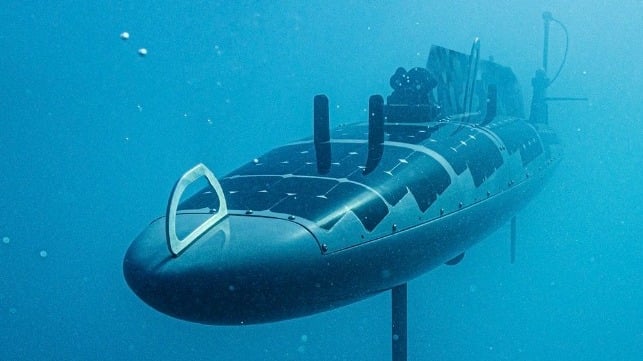
Ocean Aero's Triton drone boat in submergence mode, with sail lowered (Ocean Aero press handout)
British offshore services and shipping company James Fisher and Sons has bought a stake in the American autonomous sailing vessel startup Ocean Aero, which is developing a unique renewable energy-powered unmanned vessel.
James Fisher joined in a Series D funding round for Ocean Aero this month, taking a "strategic" minority stake in the business. Ocean Aero's focus is far from the tanker business that powers James Fisher day-to-day: it is developing a wind and solar-powered unmanned craft called Triton, which can operate below and above the surface. According to Ocean Aero, Triton can operate submerged for more than five days at a speed of two knots, acting as a submarine. In sailing mode, it can run for 30 days or more on a combination of wind a solar power. It will be fitted with a standard instrument package covering most mission sets, with room for options. A graphic user interface control system helps operators manage multiple units at once.
Triton's initial variant was produced in haze gray, and it was built with defense applications in mind. The device has a small radar cross-section to minimize the odds of detection, and a Made-in-the-USA pedigree that is important to U.S. Navy customers. James Fisher is interested in both defense and civilian applications in the offshore sector.
"Ocean Aero’s autonomous platform complements our established marine and subsea capabilities and strengthens our ability to deliver innovative solutions for our customers across the group," said James Fisher chief digital officer Sean Huff, a former U.S. Navy special warfare diver.
The Ocean Aero device could fill an interesting role in James Fisher's diverse lineup. James Fisher is a provider of technical services in the offshore sector, serving supermajor clients. It is also a shipowner, with a fleet of vessels in coastwide trade in Europe, but it has many other interests. As a contractor to allied militaries, the company is one of the only private firms that operate deep-diving submersibles for submarine rescue, a high end nation-state capability. It also builds rebreathers and specialized systems for special forces dive teams.
"By going to market with James Fisher’s respected team of experienced professionals around the world in the defense and energy space, we will learn from them, increase our footprint, and ultimately deliver even better world-class services," said Kevin Decker, CEO at Ocean Aero. "We are already benefitting from this investment and commercial agreement."
French carrier CMA CGM highlights that it will be putting its 400th owned ship (in a fleet of over 650 vessels) into service as it continues its growth strategy. The company highlighted its status as the first vessel in a new series of methanol dual-fuel vessels, and as it continues on track to surpass Maersk as the second-largest global container carrier.
CMA CGM reports that its operations serve more than 420 ports across five continents, and in 2024, it transported more than 23 million TEU. The fleet, which Alphaliner calculates at 712 containerships, is continuing to grow, with analysts last year highlighting the path to surpass Maersk’s capacity.
Currently, the French carrier is only about 11.5 percent in capacity behind Maersk. It has a total capacity of 4,155,811 TEU, based on Alphaliners’ league tables. Maersk is currently at 4,629,755 TEU. The French carrier, however, has a strong order book with 147 vessels, according to Alphaliner, which represents an additional capacity of 1,870,454 TEU, compared to Maersk’s 79 vessels with an additional capacity of 1,033,434 TEU.
Maersk has declared its strategy calls for maintaining its current capacity for its ocean-going operations. The two carriers, however, remain far behind industry leader MSC Mediterranean Shipping Company, which, based on Alphaliners’ data, now has 976 vessels with a total capacity of 7,154,803 TEU, and with another 2.1 million TEU capacity on order.
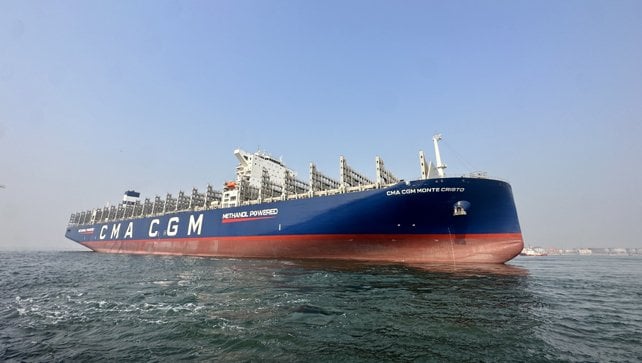
CMA CGM highlights its new vessel, CMA CGM Monte Cristo, built at DSIC Tianjin Shipyard, China, as its 400th owned vessel. The vessel’s naming ceremony took place on January 21, and it is scheduled to enter service on January 29. It will be operating between North Asia, the Levant region of the Mediterranean, and the Adriatic Sea.
“This key milestone reflects the Group’s long-term investment strategy, built on asset ownership and the integration of advanced technologies to enhance the environmental and operational performance of its fleet,” says CMA CGM.
The ship is the first in a series of six methanol-fueled containerships. It is reported to have a maximum capacity of 16,204 TEU, including around 1,000 reefer plugs. The 156,100-dwt ship is registered in Malta and measures 366 meters (1,200 feet) and will operate with a crew of 23.
The company highlights that it is the 11th ship in its fleet capable of operating on methanol as its primary fuel. CMA CGM is nearing the halfway mark with a total of 24 methanol-fueled vessels currently on order. The group says by 2031, it will be operating around 200 dual-fuel LNG and methanol-fueled containerships as part of its strategy to be powered with low-carbon energy.
REVANCHIST, REACTIONARY INDUSTRY GROUP
Interferry Demands Pause for EU ETS Due to Inequities and Use of Funds
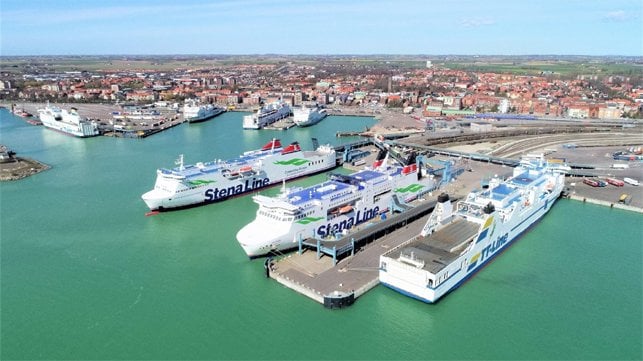
Interferry highlights the importance of ferries in the EU and the current inequities with road transport not in the EU ETS (Trelleborgs Hamn)
Interferry, the global trade association for the ferry industry, is calling for an immediate halt to the further phasing-in of the EU Emissions Trading System (ETS) for the maritime sector. The group is citing inequities and a severe competitive disadvantage as road transport remains exempt from the program. Further, it alleges that a lack of a funding scheme for e-fuels and investments such as electrification means the monies are instead being diverted to national member state budgets.
The trade group issued the demand following the EU Council’s decision to continue to exempt road transportation from a parallel ETS mechanism. They point out that remains the policy, the ETS program calls for increasing from 70 percent to 100 percent the obligations for maritime emissions in 2026.
“This exemption of road transport from the EU ETS creates an immediate, severe competitive disadvantage for RoRo and passenger ferries,” says Johan Roos, Director Regulatory Affairs of Interferry. “As it stands now, ETS creates an adverse incentive, pushing goods and passengers back onto already congested road networks due to higher ferry costs. This directly contradicts the long-standing EU policy of modal shift from road to sea.”
Interferry highlights that ferry services are critically important to Europe, with more than half of the world’s gross RoRo and passenger ship tonnage operating in European waters. It says that ferries transport 400 million passengers and 200 million vehicles and freight units every year within the EU, significantly offloading the road network.
The group says the industry supports decarbonization of the maritime sector and accepted the EU ETS on the clear understanding that funds collected would actually be used for decarbonization and that road transport would also soon be included. Every euro of freight rate increase on ferries they content risks pushing freight volumes back to the already congested European road networks.
“This action must remain in place until road transport is also in an ETS and funds collected are actually ringfenced for maritime decarbonization,” said Mike Corrigan, CEO of Interferry. “The EU must deliver on its promise of a level playing field and ensure its climate policy supports, rather than financially drains, its most forward-looking transport sector.”
Furthermore, the group cites the October 2025 postponement at the IMO of the adoption of a global Greenhouse Gas (GHG) pricing mechanism for at least 12 months. It points out that the framework was intended to replace the EU ETS and would have set clear guidelines for the use of the funds collected.
For now, it says ferries are being taxed at a rate of approximately €1 billion annually without a clear provision on how the money is reinvested to mitigate greenhouse gas emissions. It says the current approaches neither promote competitiveness nor cohesion, and hinder the industry’s ability to invest in cleaner technologies.
FUEDALISTIC TECHNO BRO
Tech-Sector Developer Has Grand Plans for a Bay Area Shipyard
A well-financed real estate development company in California has ambitions to build a new West Coast shipyard, comparable in size and scale to the largest in China.
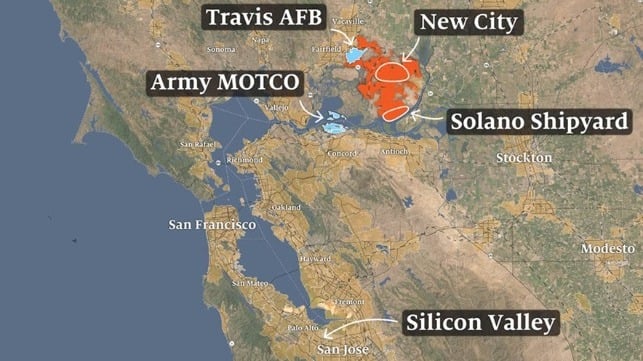
California Forever, a mega-scale property developer backed by some of the biggest names in tech, is known for its plans to build a vast manufacturing park northeast of San Francisco. The 2,100-acre Solano Foundry would be a place for high-tech manufacturers to set up shop, just an hour north from the engineering expertise of Silicon Valley. Alongside the industrial park, California Forever envisions a new city of 400,000 people and 170,000 homes. There is plenty of space: California Forever has bought up more than 100 square miles of land - about 70,000 acres - between Vacaville and Antioch. To build it out, the developer has signed a deal with the region's construction labor unions to use mostly union workers on projects within its boundaries for the next 40 years.
To the south of the proposed city, California Forever has secured rights to 7,500 acres of waterfront land on a 30-foot-deep channel in the Sacramento River. It is the largest piece of undeveloped land suitable for shipbuilding in the U.S., and would complement the capabilities available at Mare Island, a former U.S. Navy public shipyard located 25 miles to the west of the Solano site. A newly-commissioned economic impact study suggests that buildout of the Solano Shipyard site would cost about $22 billion over the span of 30 years, and the resulting mix of variously-sized yards on site would employ about 40,000 people - nearly twice as many as HII Newport News Shipbuilding. (The details of the envisioned yard buildout and vessel construction mix are yet to be released.)
A shipbuilding revival would be welcome in the region. The nearby Mare Island yard, which dates to World War II, recently closed down after 13 years under private management. Its commercial operator shuttered its doors and laid off its staff earlier this month after losing a contract to drydock the icebreaker USCGC Healy. About 80 jobs were lost in the Solano County area. The region also recently lost two other major industrial employers, and a new mega-industrial revival in rural Solano County would more than make up the difference.
ABP and University of Hull Partner to Research Port Safety
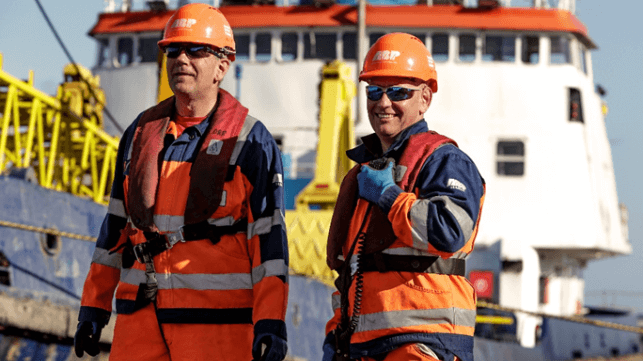
ABP employees at the Port of Immingham, the UK’s single largest port by tonnage.
Associated British Ports (ABP), the UK’s leading ports group, has partnered with the University of Hull to delve deeper into the context and drivers impacting safety performance on ABP’s ports.
ABP is working with the team of psychologists at The Centre for Human Factors based in Lampada Digital Solutions, a University of Hull subsidiary, to deliver a survey across all ABP’s 21 ports plus the group’s other locations utilising a diagnostic safety climate tool designed to help organisations assess and improve their safety culture. It measures employees' perceptions of safety in the workplace, focusing on areas such as organisational commitment and usability of procedures. The survey adopts the best practice approach from the Health and Safety Executive (HSE).
Sally Ford, Group Head of Health Safety and Environment for ABP, said “Safety is a core value for ABP. We are committed to doing all we can to make sure each of our colleagues goes home safe every day. We’ve made good progress over recent years but we know our focus must be relentless. That’s why we’ve partnered with the Centre for Human Factors – to bring a new perspective firmly grounded in rigour and evidence.
“We’re also particularly pleased to be working with a University in one of our port locations, Hull. Working with a local university in Hull is about more than research, it’s about investing in our community, developing lasting partnerships and supporting the local innovation ecosystem.”
Professor Fiona Earle, Chartered Occupational Psychologist & Director of the Centre for Human Factors said “Our focus at the Centre is on creating healthier and safer working environments. Over the past two decades, we have developed extensive expertise in translating research into practical, industry-relevant solutions. We understand that effective safety goes far beyond policies and formal processes—it requires a deep understanding of the unique context within each organisation.
“We’re delighted to be working with ABP, a major employer in a key industrial sector across the Humber region. Our collaboration is already well underway as we analyse survey results from 21 UK ports and explore emerging issues facing the business. Drawing on our in-depth expertise in human factors, we will work with ABP to develop interventions that drive positive shifts in safety culture.”
Fiona and Dr Léa Fréour will also be undertaking a series of deep dives into key outcomes from the survey, designed to give detail on attitudes and behaviour and drive towards actionable insights that ABP can adopt to drive safety performance improvements.
The Centre for Human Factors delivers sector?leading, evidence?based approaches to health, safety and wellbeing in the workplace, with long established experience in the field of human factors. This considers how people interact with their working environment and its systems.
As part of its sector leading network of 21 ports, ABP operates three other ports in the Humber region in addition to Hull – Immingham, Grimsby and Goole. Collectively they make up the UK’s largest gateway for trade with the world by volume, handling more than 50 million tonnes of freight each year. ABP’s Humber ports also provide a crucial foundation for the region’s contribution to the UK’s energy system today and tomorrow – enabling, for example, refining and energy generation activities and hosting major wind turbine manufacturing facilities.
The products and services herein described in this press release are not endorsed by The Maritime Executive.
Port of LA Displays Resilience, Achieving Third Best Year in 2025
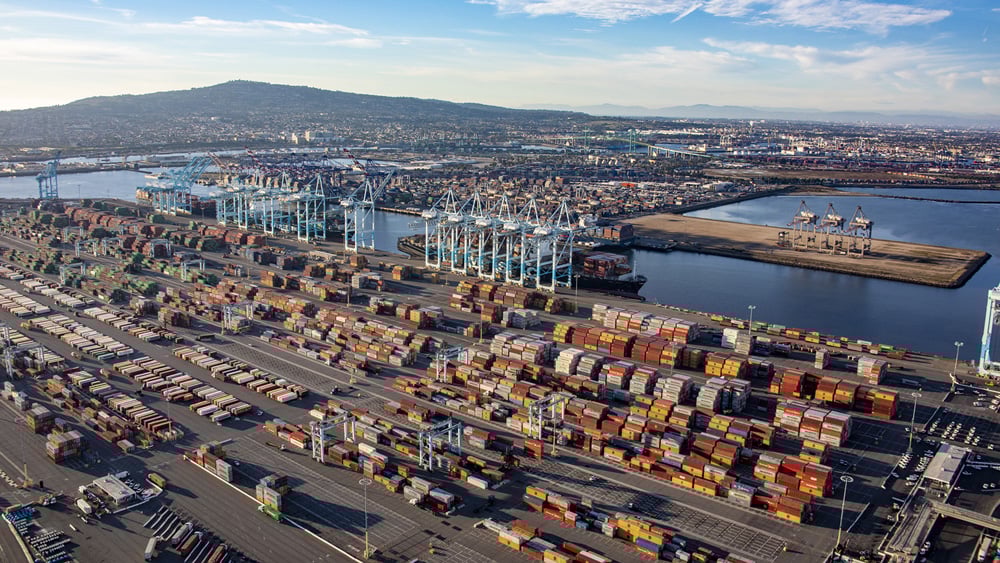
Port of Los Angeles looks to expand infrastructure despite the uncertainties due to tariffs (file photo)
The busiest port in the U.S., Los Angeles, is feeling the pressures of a redrawn global trade map due to shifting policies. While recording flat growth in container throughput in 2025, a year the port contends was characterized by uncertainty and volatility, it still achieved its third-best year in history in its 118-year history.
Despite maintaining its position as the top U.S. port for the 26th consecutive year and the only North American port to exceed 10 million TEU in a year, Los Angeles saw its container throughput take a one percent dip to 10.2 million TEU.
For Los Angeles, which commands about 17 percent of the total containerized waterborne international trade in the U.S., 2025 presented a mixed bag. While June saw the port record an eight percent increase in throughput to handle 892,340 TEUs and go down in history as one of the busiest months, December was a rather bleak month, posting a 14 percent decline to 791,587 TEU.
While presenting the 11th annual State of the Port status report, Port of Los Angeles Executive Director Gene Seroka admitted that 2025 was a rollercoaster year characterized by accelerated dips in volumes to record highs, specifically due to the uncertainties caused by Donald Trump’s erratic tariff wars. In July, for instance, Los Angeles recorded another busy month after handling one million TEUs, 8.5 percent more than the same month in 2024, but it was largely because retailers and manufacturers rushed to bring in goods at an elevated pace due to concerns of higher tariffs.
“Shifting trade policies are creating uncertainty and volatility, and the maritime supply chain is at the center of it all,” said Seroka, adding that the positive takeaway from the year is that fact that cargo remains the lifeblood of the U.S. economy. “American farmers, manufacturers, retailers, and consumers all depend on how well we move that cargo.”
Seroka went on to outline his vision for the future, which he believes will be anchored on “Build Bigger and Build Smarter” investment priorities in line with anticipated future cargo demand. The port will focus on infrastructure, technology, community, and the environment.
Part of the infrastructure projects includes the proposed expansion of Pier 500 marine container terminal that is expected to significantly increase the port’s overall cargo capacity. The terminal will be constructed on a 200-acre site with two new berths and approximately 3,000 linear feet of new available wharf. It is designed to increase cargo efficiency in addition to allowing for bigger, next-generation containerships to call at the port.
“Pier 500 would be the first new container terminal to be developed at the port in a generation,” noted Seroka. “We envision it to be the greenest, cleanest terminal in the world. It will be an investment in our workforce, sustainability, resilience, and innovation—keeping us ready for the opportunities of tomorrow.”
Los Angeles also intends to implement other infrastructure projects, including a dedicated hub for chassis parking and container pick-up and drop-off, and expansion at Fenix Marine Services terminal on Pier 300. It also proposes wharf and rail upgrades at the LA TiL Container terminal.
Another key focus in 2026 will be on expanding the port’s growing cruise business. Having handled a record 1.6 million passengers and 241 cruise calls last year, Los Angeles is anticipating growth in its cruise business in the future. Pacific Cruise Terminals, a joint venture between Carrix and JLC Infrastructure, has been selected to develop a massive new cruise terminal to be located at the outer harbor.
Though Los Angeles remains focused on future growth, the plans are intertwined with environmental goals. The latest emissions report shows that the port had achieved the lowest emissions ever on a per-TEU basis of any port in the world. The port contends that upcoming projects are expected to help further those gains.
Report: Hutchison Explores New Structure to Sell Port Terminals
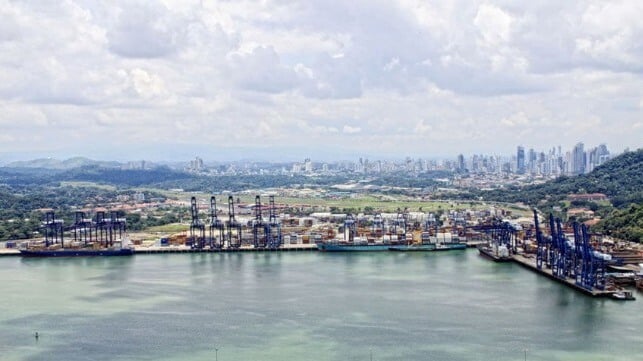
The original sticking point were the terminals in Panama and now China's insisting on control (Balboa - Panama)
CK Hutchison is reported to be exploring a new path to structure the deal for the company to sell its interest in terminal operations at 43 ports in 23 countries, including the controversial terminals at each terminus of the Panama Canal. The company announced in March 2025 that it had reached terms to sell the terminal portfolio in a deal valued at $22.8 billion, but it slowly unraveled as China said the company owned by billionaire Li Ka-shing was betraying national interests.
The latest structure, according to a report from Bloomberg, would break the sale of the portfolio into smaller parcels. Previously, Hutchison had agreed to a two-part deal where U.S. investment group, BlackRock, would have had the largest share of the two Panama terminal operations, with MSC’s Terminal Investment Limited (TiL) as a minority investor. TiL was to be the lead investor in the terminals beyond Panama, while Hutchison would have retained the operations in China. The deal was built on BlackRock’s long-term investment in TiL and the two companies' joint efforts at other ports.
China immediately objected to the proposed sale, linking it to political pressure from the Trump administration. Initial reports said China was demanding participation in the deal, and later Bloomberg reported China insisted that the state-owned COSCO have a majority position and veto rights. Hutchison had initially said it expected to complete terms for the two Panama terminals by April 2025. As the negotiations dragged on, the lock-up granted to the BlackRock-TiL consortium expired in July, and by December, Bloomberg was reporting the negotiations were at an impasse.
It says discussions on the new structure are preliminary, and details are yet to be finalized. Bloomberg, however, quotes sources saying China has signalled that the Chinese government “would find such a structure acceptable.” Bloomberg writes that China, through COSCO, would take control of the terminals in ports and regions both more friendly to China and critical to the country’s trade strategy.
COSCO is a logical company to lead the Chinese portion, as its COSCO Shipping Ports, as of December 31, 2024, reported that it operated and managed 375 berths at 39 ports globally. It said 226 were for containers, with an annual handling capacity of approximately 124 million TEU.
Bloomberg reports that China and the other companies have noted the “mounting geopolitical headwinds” facing the deal as Donald Trump presses U.S. interests in Latin America and continues to seek to challenge China. The Panama Canal was the original sticking point, with BlackRock positioned as the lead to satisfy the White House and Trump’s assertion that China was running the Panama Canal.
AD Ports Buys Spanish Shipyard Astilleros Balenciaga
AD Ports is expanding tis shipbuilding capabilities acquiring a Spanish shipyard specializing in the offshore energy sector (Astilleros Balenciaga Shipyard)
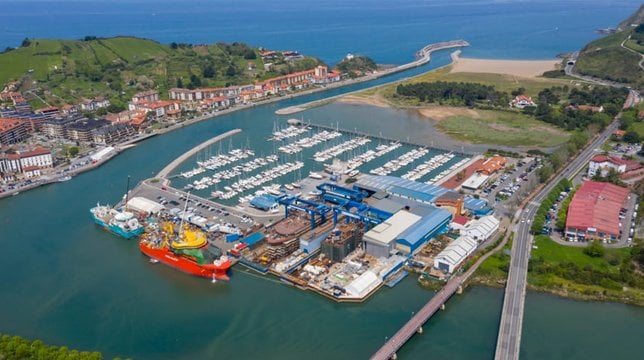
The Abu Dhabi-based AD Ports acquired a Spanish shipyard as part of its effort to expand in the Mediterranean and serve the offshore operations sector. The reports indicate that it paid €11.2 million ($13.1 million) for 100 percent ownership of Astilleros Balenciaga, based on the northern coast of Spain near Bilbao.
The shipyard, which traces its origins to 1921, will now be known as Balenciaga Shipyard. AD Ports acquired the yard for its Safeen Drydocks subsidiary, which is part of its Noatum Maritime group. The yard has both shipbuilding and repair facilities.
For AD Ports, the acquisition is an opportunity to further expand its presence in the offshore services sector and specifically offshore wind. The company recently announced a partnership with Masdar, the state-owned renewable energy company that is investing in the European offshore wind sector. Safeen will develop and deliver offshore wind projects for the partnership with Masdar.
Safeen Drydocks was launched in June 2023 as a joint venture 51 percent owned by AD Ports and working with Premier Marine Engineering Services, which was developing a shipyard at the Khalifa Port. It is a 45,000 square meter facility with a 350-meter (1,150-foot) berth for vessel repairs. The yard also has a floating dry dock.
The Balenciaga Shipyard has two dry docks, a 105-meter slipway, and a fabrication factory, as well as a cutting plant. The company recently invested in an expansion of its facilities.
The Spanish shipyard works with tug boats, offshore support vessels, fishing vessels, cargo vessels, and product carriers. Safeen highlights its capabilities in structural prefabrication of large modules for offshore projects, which it looks to leverage to further develop its presence in the offshore market. The shipyard is one of the few yards in Spain specializing in the construction of Service Operation Vessels (SOVs) as well as research vessels, offshore support vessels, and specialized tugs.
AD Ports Group highlights that it will further consolidate its operations in Spain and the Mediterranean region.
UK Pilot May Have Had a Fatal Heart Attack While Climbing Pilot Ladder
A British marine pilot who lost his life in a pilot ladder accident in 2023 was not medically fit to be on duty and likely suffered a heart attack mid-climb, according to a final report from the UK's Marine Accident Investigation Branch.
Humber estuary pilot Francesco Galia, 67, was off-duty at home on January 8, 2023 when he got a call from dispatch to join the ro/ro Finnhawk, which was inbound. A trainee pilot joined him at the office and drove with him to the pilot boat pier. On the transit, the trainee noticed Galia walking slowly; the trainee later told investigators that Galia had complained of back pain and poor sleep during the drive, and said he was taking painkillers. A third pilot - headed out to meet a tanker - joined them for the ride out of the harbor on the pilot boat.
Before embarking on the boat, the trainee told the third pilot that Galia appeared to be unwell. They approached Galia, who rejected an offer to switch jobs for an easier ladder climb or to remain on shore, according to MAIB. The trainee also informed the operations center staff that Galia had back pain. The pilot boat coxswain also expressed concern at Galia's slow gait as he walked down the pier - but Galia told the coxswain that he wanted to do the transit anyways, and all parties allowed him to do so.
Just before 1300 hours, the pilot boat met up with the ro/ro Finnhawk and moved into position for the pilot and trainee pilot to board. The climb up Finnhawk's side was about 21 feet. Before the transfer, the pilot boat coxswain again asked Galia if he wanted to attempt the climb, and Galia again said that he did.
The pilot boat deckhand and Galia both checked the ladder and determined that it looked fine. Galia stepped across onto the ladder and began to climb up it - but after making it about seven feet up, he looked back, leaned backwards and let go of the ladder with both hands, falling silently onto the pilot boat's deckhouse and rail. He then slid over the side between the two vessels.
Galia's lifejacket inflated as designed, and his PLB automatically activated. He remained afloat, his head above the water, and he appeared to move his arms in an attempt to stay off the cargo ship's hull. The pilot boat crew quickly maneuvered to retrieve him, and the deckhand caught him with a rescue sling. The crew brought him onto the boat's hydraulic recovery platform, but it sustained a mechanical failure and they were unable to get Galia aboard. The trainee pilot jumped down onto the platform to hold Galia's head out of the water, where he remained for the next 40 minutes.
Rescue assets were dispatched to assist, and the RNLI lifeboat out of Spurn Point arrived at 1326. It was too rough for it to come alongside, so it took some maneuvering with the lifeboat's small RIB to retrieve Galia from the water. This evolution continued until after 1340, and Galia was eventually transferred onto the RNLI lifeboat, where the rescuers began CPR. At 1355, he was winched off by helicopter and flown to shore for treatment. At the time he came aboard the helicopter, he did not have a pulse, and he was pronounced dead at the hospital.
A postmortem determined that the cause of death was heart disease combined with immersion in water, and noted that Galia had a 12-year history of ischaemic heart disease and hypertension prior to the casualty.
The pilot had previously had a heart attack and a stroke, plus chronic kidney disease and back pain, according to his medical records. His previous heart attack had occurred in 2011 while he was piloting a vessel, requiring a medevac, and he had been referred for medical care and had taken leave or reduced his workload multiple times. His last physical, six months before the accident, determined that he was "severely obese" and had high blood pressure; his doctor cleared him for duty with no limitations.
In the postmortem, the pathologist noted that Galia was "at risk of a sudden cardiac event occurring at any time," and it is "entirely possible that [he] suffered a sudden cardiac arrhythmia which caused him to let go." Alternatively, he could have sustained a heart attack upon entering the cold waters of the Humber. The fall had fractured his spine, and he had water in his lungs from ingesting seawater.
"It is probable that [Galia] suffered a cardiac event during the climb. This would explain why observers saw the pilot suddenly lean back, let go of the ladder by releasing both hands simultaneously, and fall backwards onto [pilot boat] Humber Saturn without making a sound," MAIB concluded.
The agency found that the doctor who performed Galia's last exam did not have access to all of his electronic medical records, did not seem aware of his past heart problems, and did not follow guidance for physical exam testing. "If the [approved doctor] had followed this guidance and assessed the pilot’s physical capability they would probably have declared him either temporarily unfit for sea or issued him with a restricted certificate to work as a marine pilot," the agency concluded.
In response, the UK MCA has rolled out an electronic medical record system for seafarer exams nationwide in order to unify the information available to physicians. Associated British Ports, which employs pilots on the Humber, has reviewed its medical standards and is strengthening requirements for new pilots. It has also added manual recovery cradles to its pilot boats as backup for hydraulic recovery platforms in case of failure.
Top image: Finnhawk (Wolfgang Berthel / VesselFinder)
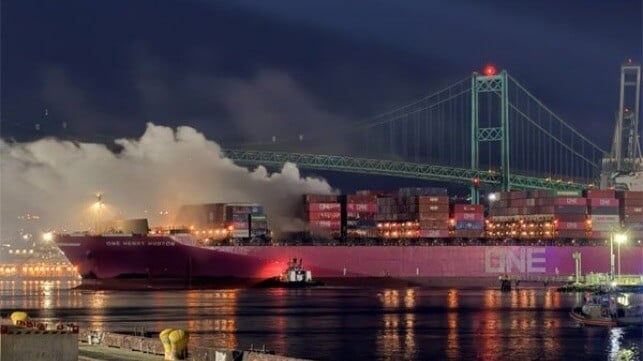
ONE Henry Hudson Departs Port of LA for Repairs in Asia
The containership caught fire during cargo operations in the Port of Los Angeles (USCG)
The damaged container vessel ONE Henry Hudson, which caught fire on November 22 while docked in Los Angeles, has completed cargo operations and departed for Asia. The vessel’s operator says the ship will undergo repairs in Asia.
Ocean Network Express (ONE) reported in a customer advisory that the cargo discharging operation was completed on Monday, January 19. It says that all cargo has been stored at the designated yard spaces at Yusen Terminal (YTI) at the Port of Los Angeles for inspection.
The vessel’s Japanese owners, Fukujin Kisen, declared General Average shortly after the fire, and ONE reported that a General Average (GA) Surveyor, Ken Shortall of TMC Marine, had been appointed. Surveys were beginning on January 14, and customers were being advised to follow the Salvage Security process to expedite the release of their containers.
ONE said it would be making new arrangements for the export containers unless customers instructed otherwise. The import containers would be available for pickup after the surveys. The company did not specify how many containers were involved from the ship that has a normal capacity of approximately 8,200 TEU. The ship had been working cargo when the fire began, so it is unclear how many boxes were actually aboard the ship, and how many, if any, were directly in the fire.
Reports at the time of the fire suggested it was an electrical fire in one of the ship’s cargo holds. There was no suggestion of a container fire that had spread to the ship, but the U.S. Coast Guard is leading an investigation into the fire.
After completing the cargo operations, ONE Henry Hudson (98,849 dwt) departed from the Yusen Terminal on Wednesday, January 21. It cleared the port on Wednesday evening, and its AIS signal shows it is due to reach an anchorage off Shanghai on February 9.
The ship was built in 2008. ONE reports it will undergo repairs. The U.S. Coast Guard had conducted a standard port inspection on the vessel on November 19, just days before the fire. The report showed no violations or deficiencies.
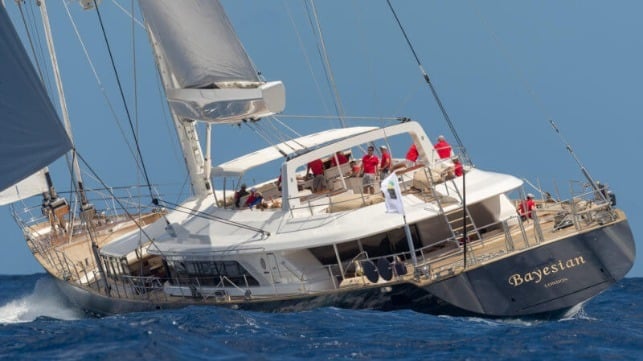
Shipbuilder Sues Owner of Lost Superyacht Bayesian
The builder of the lost superyacht Bayesian has filed a $500 million lawsuit against a company held by Angela Bacares, widow of tech billionaire Mike Lynch, who owned the vessel and was killed in the sinking. The shipbuilder alleges that the crew of the vessel caused the sinking through negligence, thereby damaging the builder's reputation and causing the loss of valuable business relationships.
Bayesian capsized and sank at anchor in a sudden squall at Porticello, Sicily on August 19, 2024. Seven people perished in the sinking, including owner Mike Lynch and his daughter. Bacares was among the survivors; she owns holding company Revtom, the Bayesian's legal owner and the target of the suit.
After the casualty, the UK Marine Accident Investigation Branch (MAIB) launched an inquiry into the British-flagged vessel's loss. The Bayesian was known for her record-setting single aluminum mast, the tallest in the world at the time. Using advanced computer modeling, marine engineering experts at University of Southampton determined for MAIB that the vessel - in its configuration at the time of the casualty - would be vulnerable to a knockdown and capsizing in wind speeds over 63.4 knots. UK Met Office simulations suggested that the extreme thunderstorm produced possible surface wind speeds in excess of 87 knots on scene that morning. Wind loading on the extra-tall mast structure accounted for about 50 percent of the calculated heeling moment.
"The investigation has . . . established that, in the assumed loss condition, wind speeds in excess of 63.4kts on the beam were sufficient to knock Bayesian over," MAIB concluded. "These vulnerabilities (when in the motoring condition with sails lowered, the centerboard raised and 10% consumables on board) were not identified in the stability information book carried on board. Consequently, these vulnerabilities were also unknown to either the owner or the crew of Bayesian." (The agency noted that its findings are not for use in litigation and are for safety analysis and study only; the report was a factual update, and it did not assign fault to any party.)
Bayesian was built by Italian yard Perini Navi, which was acquired by The Italian Sea Group (TISG) in 2021. TISG strongly asserts that there were no design factors at play in the sinking, and that the vessel went down because of crewmember negligence and operational failures.
In its new lawsuit, TISG seeks a total of $535 million from Bayesian's holding company, which is owned by Bacares. In the suit, first reported by The Telegraph, TSIG claims that the vessel's sinking has caused demand for Perini Navi yachts to collapse, cutting into profits, reducing its share price and causing the loss of business opportunities. The firm says that it has not sold any new Perini Navi yachts since the sinking.
Skipper James Cutfield and two crewmembers, Matthew Griffiths and Timothy Eaton, are also named in the suit. The three men also face a local prosecutor's criminal investigation into the sinking.
In response to the filing, a source close to the Lynch family told the Telegraph that the suit was "opportunistic" and "appears designed to distract" from issues raised by the MAIB investigation.
Indonesian Frigate Order Reflects SE Asian Naval Modernization
PT PAL Indonesia is implementing the shipbuilding and modernization efforts (PT PAL Indonesia)
During a visit of Indonesian President Prabowo Subianto to the United Kingdom last week, a Letter of Intent was signed by the Indonesians with David Lockwood, CEO of Babcock, for licenses to build two further general purpose frigates drawing on the Arrowhead 140 design. The Arrowhead 140 design forms the basis of the Babcock Type 31 frigates ordered by the Royal Navy and by Poland, and which are also in contention for orders from Denmark and Sweden.
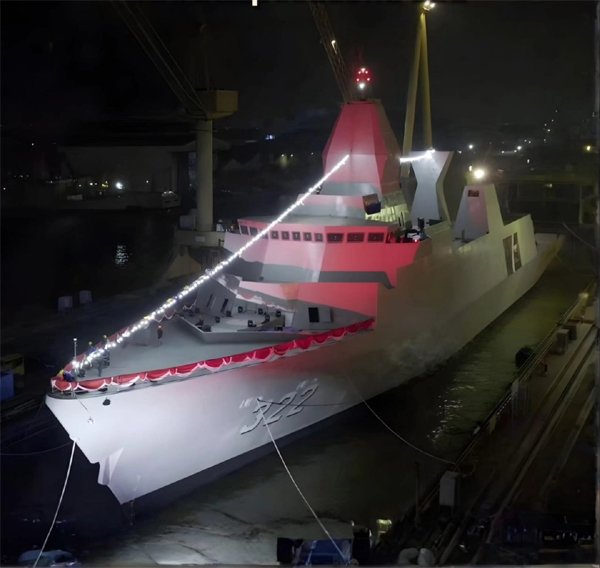
The first two Arrowhead 140 vessels are nearing delivery from the PT PAL Indonesia shipyard at Surabaya. KRI Balaputradewa (F322), the first of what is formally the Balaputradewa Class but which are commonly referred to as the Merah Putih (or Red-White) frigates, was launched on December 18 last year. The second frigate, presumably F323, has not yet been named, but is following on about 18 months behind the lead vessel. Both frigates should be operational well before the originally-planned 2029 in-service date.
These frigates are the first to be built domestically in Indonesia, making this early delivery quite an achievement. The license from Babcock allows PT PAL to develop further the design for export purposes. The new frigates make extensive use of Turkish sub-systems provided by Aselsan, Havelsan and Roketsan, and give the Indonesian a considerable boost in combat capability.
KRI Balaputradewa (F322) at its nighttime launch on December 18, 2025 (PT PAL Indonesia)
The Merah Putih frigates form part of a wider Indonesian naval expansion, the £4 billion Maritime Partnership Program, which started with a modernization of three F2000 frigates built by BAE in Glasgow and acquired half-price but nearly-new from the Royal Brunei Navy. The program upgrading KRI Bung Tomo (357), KRI John Lie (F358) and KRI Usman Harun (F359) is being overseen by Thales Netherlands and is due to be completed in 2028. The Maritime Partnership Programme is aimed at developing local shipbuilding capacity, but also seeks to diversify international sourcing of weapons and sub-systems. PT PAL is at the same time building two French Scorpène Class diesel-electric attack submarines with air-independent propulsion; these will supplement the Korean-built submarines KRI Nagapasa (S403), KRI Ardadedali (S404) and KRI Alugoro (S405). Further submarine orders are under consideration.
The naval expansion program has been supported by successive Indonesian presidents, predicated on Indonesia being a maritime nation spread across hundreds of islands from Sumatra in the West, across Kalimantan, Java, Bali, to New Guinea in the East. But another consideration must also be confrontation with China over disputed maritime borders in the South China Sea, which hitherto Indonesia has sought to downplay. In 2015, President Jokowi embarked upon a policy of destroying fishing vessels caught fishing illegally in Indonesian waters, amongst which were Chinese boats, but the policy has been relaxed in recent years. Under the Nine-Dash line dispute, China contests Indonesian control of the Natuna Islands, one of the smaller disputes China has with various ASEAN nations over the South China Sea.
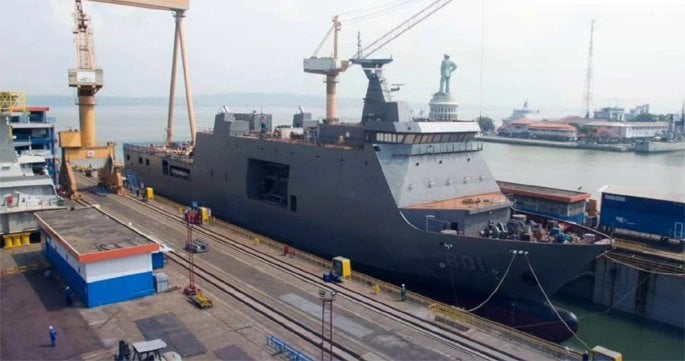
Other ASEAN nations are also building up their navies in response to clashes in the South China Sea. The Philippines is midway through its Horizon 2 expansion program, with the second of the Malvar Class frigates BRP Diego Silangnow (FFG07) in service, with possibly two more to follow, and the first of six 94m Offshore Patrol Vessels now delivered, all vessels being built by HD Hyundai Heavy Industries shipyard in Ulsan, South Korea. The Philippines Navy is also getting two 124-meter landing dock platforms, which are currently being constructed by the very busy PT PAL yard in Indonesia.
But Indonesia also has a number of other dormant territorial disputes over islands and sea areas with its ASEAN neighbors, strengthening its justification for building maritime capability. From its record of receiving naval port visits – recently from Australia, China, Iran, Russia, the United Kingdom, and the United States - it also seeks to maintain a neutral friend-with-all approach.
India Says Iran has Not Permitted Contact with Crew of Seized Tanker
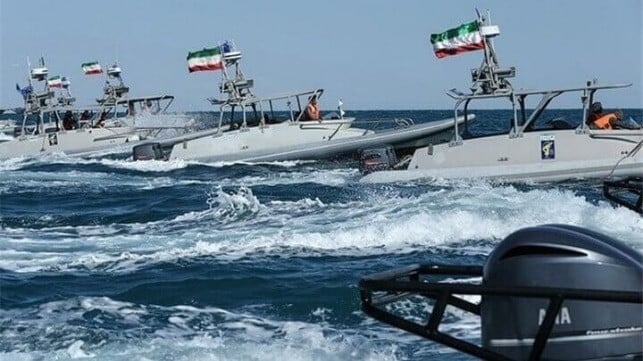
Iranian forces are cracking down on fuel smuggling (Mehr file photo)
India’s Embassy and Consulate in Iran went public with their complaint that Iranian authorities have not permitted consular access to the crew of a small product tanker that was seized a month ago, accused of smuggling. The public statement posted on X came after the families of the 16 crewmembers made a personal appeal to India’s Prime Minister Narendra Modi.
According to the Embassy, Iranian authorities notified them in mid-December that the tanker Valiant Roar (13,754 dwt) had been stopped on allegations of fuel smuggling. The ship was brought into port in Iran, with the Embassy saying it was advised there were 16 Indian nationals aboard, as well as one from Sri Lanka, and another from Bangladesh.
The vessel was one of several that the Iranian authorities seized in a crackdown on fuel smuggling. Iran reported stopping a tanker in the Gulf of Oman in mid-December, which it said was smuggling six million liters of diesel fuel. The situation was further complicated by Iran’s assertion that the vessel was operating without “valid maritime travel documents or a cargo manifest for its fuel shipment.”
Less than two weeks later, Iran stopped another tanker near the Strait of Hormuz. They said the vessel had four million gallons of oil, which was being shuttled to another tanker waiting outside the Gulf.
In the past, Iran has reported prosecutions of the officers of the seized vessels. In the spring of 2025, it announced long jail sentences and fines for the captain and senior officers of two vessels stopped for smuggling.
The Indian Embassy says it filed a request on December 14 for access to the crew. It says both it and the consulate in Bandar Abbas have made formal requests in writing and in person for access to the crew. The ambassador has also become involved in seeking access.
India wants to meet with the crew and is also asking the Iranian authorities to let the crew contact their families. The reports said Iran confiscated the crew’s phones and electronics. They are also asking the Iranian authorities to expeditiously complete any judicial proceedings
The Indian authorities said they also intervened with the Iranian Navy earlier this month after they received reports that the crew was running out of basic supplies. They wanted the Iranian Navy to aid in facilitating emergency provisions.
The vessel is reportedly owned and managed by a company based in Dubai. The Embassy said it immediately established contact with the UAE-based company as well as its agents in Iran. They are pressing the company to ensure the supply of food, water, and fuel for the ship. They have also asked the company to arrange legal representation for the crew in the Iranian court.

![Finnhawk (Wolfgang Berthel / Vesselfinder]](https://maritime-executive.com/media/images/article/Finnhawk-Wolfgang-Berthel-VesselFinder.8da880.jfif)