Tuesday, March 24, 2026

The Dead and the Dying in Trump’s American Gulag

A system of concentration camps is being built and it’s time the nation reckon with this monstrosity before any more people are killed.
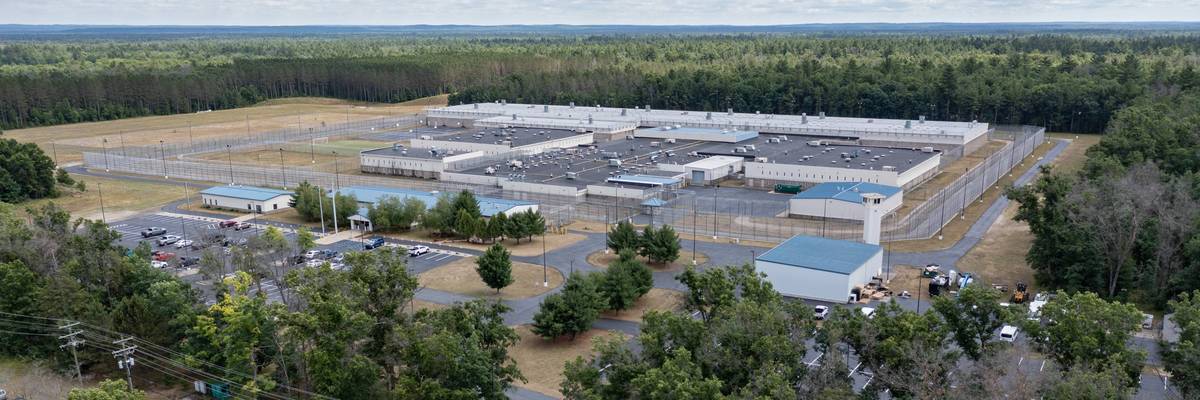

Activists rally against the North Lake Correctional Facility, which has just been reopened as the largest immigrant detention center in the Midwest. The rural Michigan facility is owned by the GEO Group and will house immigrants detained by ICE.
(Photo by: Jim West/UCG/Universal Images Group via Getty Images)

Rebecca Gordon
Mar 24, 2026
TomDispatch

The March 4, 2026, edition of the Arizona Daily Star put the facts succinctly: “A Haitian asylum seeker held for four months at Florence Correctional Center died Monday at a Scottsdale hospital due to complications from an infected tooth.” It seems the infection spread from his tooth to his lungs, and he developed the pneumonia that killed him.

In other words, U.S. Immigration and Customs Enforcement (ICE) allowed a prisoner to die of a toothache. His name was Emmanuel Damas. He was 56 years old and the father of two.

And we can only expect medical treatment at ICE centers to deteriorate further. As Judd Legum at Popular Information reported in January 2026:
“ICE… has not paid any third-party providers for medical care for detainees since October 3, 2025. Last week, ICE posted a notice on an obscure government website announcing it will not begin processing such claims until at least April 30, 2026. Until then, medical providers are instructed ‘to hold all claims submissions.’”

Emmanuel Damas’s unnecessary death would be outrageous enough, were it the only one of its kind. In fact, 32 people died in ICE custody during 2025, the most in two decades. Another six died in January 2026 alone, among them Geraldo Lunas Campos, a Cuban father aged 55, at Camp East Montana detention center in El Paso, Texas.

Although ICE initially claimed Lunas Campos had attempted suicide, the American Immigration Council reports that “the El Paso County Medical Examiner ruled his death was a homicide arising from asphyxia due to neck and torso compression.” Of course, it’s pretty hard to strangle yourself to death. Witnesses, however, described his murder this way: “Mr. Lunas Campos was handcuffed, while at least five guards held him down and one guard squeezed his neck until he was unconscious.” At least one other man has died at the Camp East Montana detention center, where tuberculosis and measles are also spreading.

Damas and Lunas Campos were among the roughly 73,000 people whom ICE currently holds in a tangle of detention camps sprawled across the country. And more centers are under construction. Many of them are former warehouses designed to function, as ICE acting director Todd Lyons put it last year, “like Amazon Prime for human beings.” (Like many Trump appointees, Lyons has not received Senate confirmation. His actual title, according to ICE, is “Senior Official Performing the Duties of the Director of U.S. Immigration and Customs Enforcement.”)

What Is a Concentration Camp?


Taken together, this network of prisons or, more accurately, concentration camps, constitutes an American gulag. “Gulag” is not so much a word as a Russian initialism that came to stand for the Soviet Union’s concentration camp program, originally developed under Joseph Stalin. The term stands for “Main Directorate of Correctional Labor Camps” and originally referred to the officials running the camps. Later, “gulag” came to indicate the camps themselves, which were a central instrument of Soviet political repression. Most Americans first learned about those camps through Aleksandr Solzhenitsyn’s 1973 internationally bestselling memoir, The Gulag Archipelago.

As Andrea Pitzer, author of One Long Night: A Global History of Concentration Camps, has written, such institutions are a relatively recent phenomenon. While human beings have long contrived ways to isolate groups they identify as enemies — for example, in the enclosed Jewish ghettos of medieval Europe — the modern concentration camp evolved thanks to two key inventions: barbed wire and the machine gun. That pair of technological advances made it possible for a small number of guards to control and contain a large number of people in one place.

Concentration camps have a number of defining features:Concentration camps exist outside regular legal structures. The people they hold are not prisoners, but detainees. So, we find people of all ages, from infants to ancients, in concentration camps. In most cases, they have not been tried or convicted of any crime. Rather, they are held because of their status, for example, as non-citizens, or in the case of Japanese-American citizens imprisoned during World War II, because of their ethnicity or national origin. This is true for the people held in ICE detention today. Their alleged offenses are against U.S. civil, not criminal law, and their detention exists outside of any court system, including the immigration courts run by the Department of Justice’s Executive Office for Immigration Review. Immigration judges, who are really administrative employees, can’t order anyone detained. That’s up to ICE and its umbrella agency, the Department of Homeland Security (DHS).Concentration camp inmates are civilians, not soldiers, which places them conveniently outside the strictures of the Geneva Conventions. That’s why the U.S. has never recognized the men it has held and, in the case of 15 prisoners, continues to hold as prisoners of war in the U.S. prison at Guantánamo Bay, Cuba. In the 1990s, almost a decade before the naval station at Guantánamo was first used to house detainees in the “global war on terror,” the U.S. held immigrants there, including as many as 50,000 Haitians and Cubans. Trump’s January 29, 2025, executive order entitled “Expanding Migrant Operations Center At Naval Station Guantánamo Bay To Full Capacity” directed the Defense and Homeland Security departments to prepare to hold as many as 30,000 migrant detainees there. As of July 2025, the camp held detainees from Africa, Asia, Europe, and the Caribbean.Concentration camps are associated with authoritarian regimes. They function both as a direct form of repression and, no less importantly, as a warning to the rest of the population about what could happen to those who resist the regime. In this sense, concentration camps are very much like another tool of repression, institutionalized state torture, about which I wrote in my book Mainstreaming Torture. Like state torture, concentration camps perform a kind of national security theater, made all the more entrancing by its quasi-secret nature. In the case of ICE detention camps, the DHS has made a show of not permitting local officials or members of Congress to enter those facilities. But such detention centers can’t fulfill their full repressive function if people don’t know anything about what goes on in them. So, we have the spectacle of a hearing in which a congresswoman asked then-DHS secretary Kristi Noem about a double amputee who “has to crawl through mold and feces and bodily fluids just to take a shower.” Knowing that this is happening to people who have almost no recourse is intended to have a chilling effect on political action.Concentration camps are not death camps, but people do die there. Many Americans tend to think that all German concentration camps were sites of direct extermination. In fact, the Nazis constructed six camps specifically designed for the industrialized murder of their inhabitants. But for a decade before the first death camp was even opened, prisoners had already been concentrated in thousands of “labor” camps. In fact, they were not there to be killed directly, but to be removed from society. As the National World War II Museum in New Orleans explains, “Initially, the population of these concentration camps were not usually Jews, but Communists, socialists, Roma and Sinti, Jehovah’s witnesses, gay men, and ‘asocial’ elements (alcoholics, criminals, people with mental disabilities, the poor).” Notably, like undocumented people in the U.S. today, these were groups who then received little sympathy from the larger German population. The conditions they encountered — lack of food and medical care, crowding, and unsanitary conditions — sickened and killed as many as a third of those who passed through them.

A Brief History of U.S. Concentration Camps


The Soviet gulag was not the world’s first concentration camp, although such institutions are, in fact, a relatively recent phenomenon. Human beings have long contrived to isolate groups they identify as enemies, as Americans at times did with enslaved Africans and the native peoples of this continent. Indeed, when the Cherokee nation was evicted from its lands under the 1830 Indian Removal Act and forced to travel the “Trail of Tears,” many of them were kept for some time in “emigration depots” in Alabama and Tennessee.

Almost everyone in this country has heard of Nazi Germany’s camps, but the history of the modern concentration camp really began at the end of the nineteenth century. As Andrea Pitzer recounted in a recent interview, Americans first became aware of such camps in the 1890s, when Spain instituted a policy of reconcentración in its efforts to put down a rebellion in Cuba. As has happened in ICE detention camps today, malnourished men, women, and children were shoved into holding camps there, where crowded conditions and poor sanitation led many to sicken and die. News of the horrifying conditions in Cuba led Americans to organize material aid for those being held.

The United States then dispatched the battleship Maine to accompany the ships carrying relief supplies to Cuba. When the Maine sank in Havana harbor under murky circumstances, the U.S. government had the pretext it needed to mount a military campaign against the remnants of Spanish colonial control in the Americas and the Pacific. That relatively short war ended with the U.S. in possession of most of Spain’s remaining colonies, including the island of Puerto Rico, and what would eventually become the nation of the Philippines. Almost immediately, the new American colonizers reproduced in the Philippines the kind of reconcentración camps they had supposedly gone to war to eradicate in Cuba. In another parallel with the twenty-first century, it was during the occupation of the Philippines that U.S. forces invented the form of torture we have come to call “waterboarding.”

Most Americans know about President Franklin D. Roosevelt’s 1942 executive order creating 10 concentration camps to hold people of Japanese descent, about two-thirds of whom were U.S. citizens mostly living in the western United States. Over 120,000 men, women, and children were interned for the duration of World War II. Many lost their homes, farms, businesses, and other property (often seized by their non-Japanese neighbors). A much smaller number of Italian and German nationals were also interned, as Germans had also been during World War I.

The Japanese camps were constructed by the Works Progress Administration (WPA), the same federal agency that provided mass employment for millions during the Great Depression under Roosevelt’s New Deal program. Few Americans know that, in addition to building roads, schools, dams, and the occasional zoo, the WPA also built the barracks and strung the barbed wire that enclosed World War II internees.

ICE’s predecessor agency, the Immigration and Naturalization Service (INS), ran about 20 of those camps, primarily ones imprisoning Japanese, German, and Italian non-citizens. Three of them were built in Texas to hold people from those countries who had been deported from Latin America. (Most of them were Japanese from Peru.) Those camps were guarded by the Border Patrol, rather than the military police. In other words, ICE and U.S. Customs and Border Protection (CBP) have a long history of running the U.S. version of concentration camps. They’re used to it.

American Gulag

It’s no exaggeration to say that ICE detention camps now threaten to become a central instrument of repression under the Trump administration. As many as 40 people have died in the camps since Trump returned to office in January 2025. And those are only the deaths that have been publicly acknowledged.

If Camp East Montana is the biggest ICE camp in the country, the most notorious may well be the Florida site in the Everglades that has come to be known as “Alligator Alcatraz.” Constructed hastily over just a week, according to Amnesty International, it “houses” people in horrific conditions:
“Inside, people are crammed into overcrowded cages around bunk beds with little room to move. Food is spoiled and maggot-infested. Mosquitoes swarm constantly, showers are scarce, and extreme heat and humidity make the center unbearable. There appear to be almost no reliable or confidential means for detainees to communicate with their attorneys or family members.”


That description is echoed in the testimony of people held in ICE detention camps nationwide. A complete report on the conditions at all of those camps would run to hundreds of thousands of words. Indeed, it’s hard to get a handle on the full scope of ICE’s concentration camp program, since reports on the number and size of such camps change quickly as new ones are proposed or come online. The organization Freedom for Immigrants maintains an interactive immigration detention map which identifies at least 200 separate locations where immigrants (and the occasional U.S. citizen) are detained. And the Trump administration is not done. According to the Guardian, DHS plans to spend $3.8 billion “upgrading” 24 existing warehouses to implement ICE Acting Director Todd Lyons’s dream of treating immigrants like human widgets.

And that brings us back to the point of all this. Concentration camps exist to support and expand the power of an authoritarian regime. They make everyone afraid of being treated like the current targets of the regime. Like state torture programs, concentration camps accelerate the process of dehumanizing groups of people in the public imagination. Such a process often begins by describing the target group as non-human, as “vermin” or “garbage” (as Trump has, of course, done). Ironically, the very act of placing people in inhumane conditions can amplify the public’s perception of their inhumanity. After all, would genuine human beings submit to such treatment? Would our good nation treat genuine human beings that way?

One other significant aspect of all this: the enrichment of a few corporations. President Trump’s “Big Beautiful Bill” gave ICE upwards of $45 billion to spend on those camps, which meant that there was a lot of money to be made. Today most of them are run by two private prison companies, CoreCivic and the GEO Group. The president’s Big Beautiful Bill also allows the Department of Homeland Security to expedite that money-making by using the U.S. Navy’s Supply Systems Command program, which serves as an end-run around the usual bidding process for federal contracts.

This morning, I asked my partner whether she thought that the Trump administration could make the transition from concentration camps, where people die as a “side effect” of their internment, to actual death camps. “I think it’s possible,” she responded — and so, horribly — do I.

It’s possible, but not yet inevitable. To date, local actions have provided the most effective means of resisting the creation of the American gulag our federal government is constructing. These have included organizing to oppose siting camps in specific communities, efforts to leverage local zoning laws to stop them, and attempts to generate state-level political opposition to them. (The Washington Post had an excellent roundup of recent efforts in one county in Maryland to block such a camp.)

We know what’s at stake. We know we can dismantle the American gulag, because some of us are already doing it. It’s time for the rest of us to get to work.


© 2023 TomDispatch.com


Rebecca Gordon
Rebecca Gordon is an Adjunct Professor at the University of San Francisco. Prior to teaching at USF, Rebecca spent many years as an activist in a variety of movements, including for women's and LGBTQ+ liberation, the Central America and South Africa solidarity movements and for racial justice in the United States. She is the author of "American Nuremberg: The U.S. Officials Who Should Stand Trial for Post-9/11 War Crimes" (2016) and previously, "Mainstreaming Torture: Ethical Approaches in the Post-9/11 United States" (2014). She teaches in the philosophy department at the University of San Francisco. You can contact her through the Mainstreaming Torture website.
Full Bio >


Trump Once Again Votes by Mail in Florida Election—But He Doesn’t Think You Should

The president is pushing the Senate to pass new voting restrictions, including on mail-in ballots.


US President Donald Trump walks toward the White House upon his arrival in Washington, DC on March 23, 2026.
(Photo by Celal Gunes/Anadolu via Getty Images)

Julia Conley
Mar 24, 2026
COMMON DREAMS

President Donald Trump has been escalating his push for the US Senate to pass sweeping legislation that would ban universal mail-in voting, spreading misinformation about mailed ballots, and slamming the system as “cheating”—but amid his efforts, he found time recently to cast his own ballot by mail for the latest time in Florida’s special legislative election.

Voter records in Palm Beach County showed Trump cast his ballot by mail before early voting ended Sunday in state House and Senate races in Florida.

It’s at least the second time that the president has voted by mail in Florida; he did so in 2020 as well.

“I can vote by mail,” he told reporters at the time. “I’m allowed to.”

That same year, he aggressively promoted the baseless notion that voting by mail—a system long used in states run by both Republicans and Democrats, including Utah and Washington—would lead to election fraud.

Numerous US courts found no evidence of fraud in the 2020 election, in which more voters relied on voting by mail due to the Covid-19 pandemic.

The president has said he aims only to prohibit universal mail-in voting rather than stopping individual voters from using mailed ballots; one of the new anti-voting rights bills he’s proposed, the Make Elections Great Again Act, would prohibit universal mail voting and limit the system to a select few people by requiring voters to submit an application to receive a mail-in ballot.

Trump referred to voting by mail as “mail-in cheating” in Memphis on Monday, and said for the second time in a week that the US is “the only country that does mail-in voting.”


He made a similar comment last week when hosting Irish Prime Minister Micheál Martin, whose country is one of dozens that allow voting by mail for some voters. Countries with universal mail-in voting include Canada, Iceland, Switzerland, and Germany.

Trump’s use of mail-in voting led House Minority Leader Hakeem Jeffries (D-NY) to denounce him as a “complete fraud” on Tuesday.

“Don’t ever believe a word he has to say about election integrity,” said Jeffries.

Republican senators on Monday agreed to include portions of the SAVE America Act, a new version of the Safeguard American Voter Eligibility (SAVE) Act, in a reconciliation bill that would also include funding for US Immigration and Customs Enforcement. The bill passed in the House last month.

Under the SAVE America Act, photo ID would be required for all voters, including copies of a voter’s ID with mail-in ballots.

“For voters who register by mail, the SAVE America Act requires documentary proof of citizenship to be delivered in person to an election office, effectively nullifying the benefits of mail registration,” said the Bipartisan Policy Center last month.

Trump said last August that Democrats want mailed ballots to be available to voters because “it’s the only way they can get elected,” despite the fact that such ballots are used by voters in both parties. He has also expressed confidence that Republicans “will never lose a race” if the GOP moves to restrict voting access.

Also on Monday, the US Supreme Court heard arguments in a case from Mississippi regarding ballots that are postmarked by Election Day and received within the state’s five-day grace period. The court’s right-wing majority appeared poised to ban states from accepting ballots after Election Day.
‘A Declaration of War Against the Working Class’: Sanders Demands Bezos Testify Over AI Robot Plan

“Our job is to ensure that this new technology benefits working families and is not simply used as another tool to make the wealthiest people in the world unimaginably richer.”


Humanoid robots are seen lined up as an engineer works on a robot in the production facility of X-Humanoid on March 20, 2026 in Beijing, China.
(Photo by Kevin Frayer/Getty Images)

Brad Reed
Mar 24, 2026
COMMON DRFAMS

Sen. Bernie Sanders is demanding that Amazon founder Jeff Bezos testify about plans to use robots powered by artificial intelligence to replace human workers.

In a Monday announcement, Sanders (I-Vt.) cited a report published by The Wall Street Journal outlining Bezos’ ambitions “to raise $100 billion for a new fund that would buy up manufacturing companies and seek to use AI technology to accelerate their path to automation.”


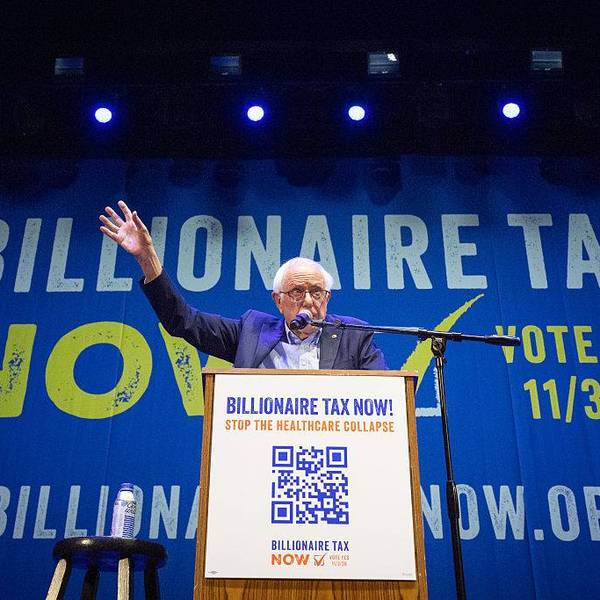
‘Poor Jeff’: Sanders Ridicules Bezos-Owned Washington Post for Attacking Billionaire Tax Plan

The Journal obtained investor documents describing the new Bezos initiative as a “manufacturing transformation vehicle” that would buy up firms in key industries such as chipmaking, defense, and aerospace, and use AI to boost the efficiency of their operations.

Sanders, the ranking member of the Senate Health, Education, Labor, and Pensions (HELP) Committee, warned that such a plan would risk putting millions of blue-collar manufacturing workers out of jobs.

Because of this, he asked Sen. Bill Cassidy (R-La.), chairman of the HELP Committee, to demand that Bezos testify about his new project’s impact on the working class.

“We must demand that Mr. Bezos come before our committee to explain to the American people why he believes it’s a good idea to replace millions of American workers with robots,” Sanders said. “We need to understand what will happen to these workers... will they simply be thrown out on the street in order to make Mr. Bezos even richer?”

Sanders emphasized the vital role of government in ensuring that advancements in technology are not used to further impoverish workers and erode their collective bargaining power.

“Our job is to ensure that this new technology benefits working families and is not simply used as another tool to make the wealthiest people in the world unimaginably richer,” Sanders said. “The American people are increasingly apprehensive about the impact that AI and robotics will have on the economy and their lives. Congress needs to act.”

In a separate social media post, Sanders described Bezos’ plan as “a declaration of war against the working class.”

Sanders for months has been raising alarms about the impact of AI on the global working class and democracy itself.

In December, Sanders called upon the US to impose a nationwide moratorium on the construction of AI data centers, warning of a future envisioned by tech moguls such as Microsoft co-founder Bill Gates, who has said that humans won’t be needed “for most things” thanks to advancements in AI.

“Do you believe that these guys, these multibillionaires, are staying up at night, worrying about what AI and robotics will do to working families of our country and the world?” Sanders asked. “Well, I don’t think so.”


‘Mind-Blowing Corruption’: Traders Placed Massive Bets Minutes Before Trump Post on Iran

“Who was it? Trump? A family member? A White House staffer?” asked US Sen. Chris Murphy.


Traders work on the floor of the New York Stock Exchange during morning trading on March 18, 2026 in New York City.
(Photo by Michael M. Santiago/Getty Images)

Jake Johnson
Mar 24, 2026
COMMON DREAMS

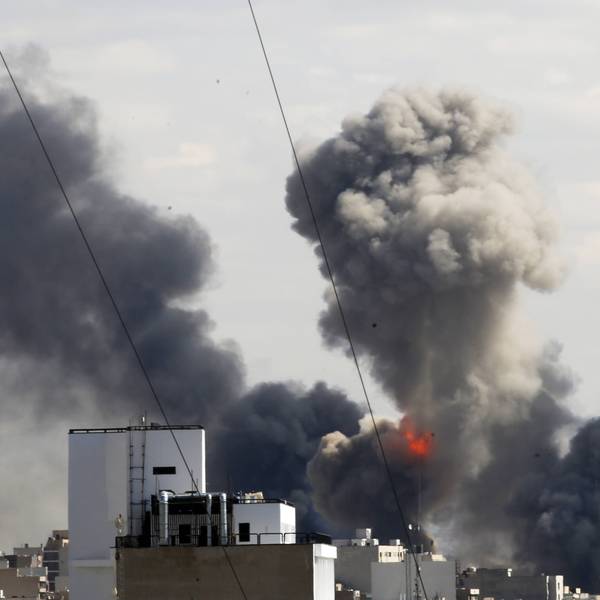
Just minutes before US President Donald Trump momentarily boosted the stock market—and sent oil prices tumbling—with his disputed Monday announcement of peace talks with Iran, unknown traders loaded up on positions that allowed them to profit from the resulting movement in equities and commodities.

The Financial Times reported that “roughly 6,200 Brent and West Texas Intermediate futures contracts changed hands between 6:49 am and 6:50 am New York time on Monday, just a quarter of an hour ahead of the US president’s post on Truth Social that there had in recent days been ‘productive conversations’ with Tehran to end the war in Iran.”


‘Insane This Is Legal’: Bettors Make Huge Profits From Suspiciously Timed Wagers on Iran War


Watchdog Demands Insider Trading Probe After ‘Highly Suspicious’ Bets on Iran War

FT added that the notional value of those trades was $580 million.

“Trading volumes for Brent and WTI leapt at the same time, 27 seconds before 6:50 am,” the newspaper reported. “Futures tracking the S&P 500 share index jumped in price moments after the oil trade, with volumes also rising significantly during that timeframe. It was not known whether one entity or several entities were behind Monday’s trades.”

An unnamed trader at a “major hedge fund” told FT that “my gut from watching markets for the last 25 years is this is really abnormal.”

“It’s Monday morning, there’s no important data today, there aren’t any Fed speakers you’d want to front-run. It’s an unusually large trade for a day with no event risk,” the trader said. “Somebody just got a lot richer.”


A BBC review of market data similarly found that “traders bet hundreds of millions of dollars on oil contracts just minutes before” Trump’s announcement of talks with Iran. Iranian officials publicly denied that they are negotiating with the Trump administration, and Iran’s top lawmaker accused the US president of peddling “fake news” in an attempt to “manipulate the financial and oil markets.”

The suspiciously timed bets ahead of the US president’s post heightened concerns that Trump administration insiders are illegally trading on—and profiting massively from—nonpublic knowledge.

Responding to a report that $1.5 billion worth of S&P 500 futures was purchased just five minutes before Trump’s Monday announcement, US Sen. Chris Murphy (D-Conn.) asked: “Who was it? Trump? A family member? A White House staffer?”

“This is corruption,” the senator wrote. “Mind-blowing corruption.”

Last week, Murphy joined US Rep. Greg Casar (D-Texas) in unveiling legislation that would ban prediction markets on “government actions, terrorism, war, assassination, and events where an individual knows or controls the outcome.”

The bill came on the heels of suspiciously timed, highly profitable bets related to US military actions in Venezuela and Iran.

The Guardian reported Monday that several newly created accounts on the online prediction platform Polymarket “laid bets on a US-Iran ceasefire over the weekend that appeared to show signs of insider knowledge, according to experts.”

Researcher Ben Yorke told the newspaper that the accounts—which are anonymous—“definitely” look like “someone with some degree of inside info.”

The Guardian noted that “online crypto watchers and experts suggested that the bets bore the signs of insider trading—both because they bought their positions at market price, and because some of the accounts looked like they could belong to a single investor attempting to conceal their identity by splitting their bet between multiple wallets.”

According to Yorke, “Typically, when you see wallet-splitting and deliberate attempts to obfuscate identity, it’s one of two scenarios: either a very large investor trying to shield their position from market impact, or insider trading.”

The Trump White House insisted Monday that any suggestion of insider trading “is baseless and irresponsible reporting.”

“The White House does not tolerate any administration official illegally profiteering off of insider knowledge,” said White House spokesperson Kush Desai.
Iran’s Retaliation Reignites Discontent With US Military Bases in Middle East

The US spent decades building an empire of military bases throughout the Middle East. Now they’re under attack.


March 20, 2026


Donald Trump arrives to address troops at the Al Udeid Air Base southwest of Doha, Qatar, on May 15, 2025.Brendan SMIALOWSKI / AFP via Getty Images

On Thursday, March 19, Saudi Arabia’s foreign minister Prince Faisal warned Iran that tolerance for its regional attacks was running short — and that the Saudi regime has “the right to take military actions if deemed necessary.” He elaborated that Saudi Arabia and other Gulf states have “very significant capacities and capabilities that they could bring to bear” if the attacks continue. This came a day after Iranian attacks on Gulf energy sites in Saudi Arabia, Qatar, and the United Arab Emirates, which Iran said was in retaliation for an Israeli strike on an Iranian gas field.

Over the past three weeks of the U.S.-Israeli war on Iran, Iran has increasingly targeted sites across the Gulf, further regionalizing the war. Among its prime targets are U.S. military bases in the region: Iran has targeted, and damaged, at least 17 U.S. sites in the region, 11 of which are military bases. The two largest bases, Al Udeid Air Base in Qatar and the U.S. Navy’s Fifth Fleet in Bahrain, host 10,000 and 9,000 U.S. military personnel, respectively — of an estimated 50,000 U.S. military personnel across the region.

The existence of these military bases should alert us to a larger problem — that the U.S. has come to dominate the region militarily, building relationships with local regimes that further encourage repression and domination. Now, Iranian retaliation against these bases spurred by U.S.-Israeli attacks is reigniting a divide between Gulf leaders and their populations

Popular Pressure and the First Wave of U.S. Military Bases

In the mid-20th century, the U.S. had very few military bases in the Middle East — and these were not permanent, but subject to popular pressure that led to their removal during the 1960s. One of the first U.S. military bases in the Middle East was built in 1946 in Dhahran, atop a major Saudi oil field. This was just after the U.S. discovered that Saudi Arabia was an oil-rich kingdom, and thus as it began to orient towards the Middle East as a region of key strategic interest. A year later, Aramco, the oil company based in Saudi Arabia, became dominated by U.S. firms.

But the U.S. military base at Dhahran was removed in 1962, after anti-imperialist and Arab nationalist sentiment gained strength across the region in the 1950s and ‘60s. Throughout the 1950s, Saudi Arabia witnessed a militant labor movement made up of both Saudi and other Arab workers from across the region, the latter of whom brought Arab nationalist, socialist, and communist ideas to the country. The movement initiated major strikes in the oil fields at Dhahran in 1953 and ’56. In 1956, just before the general strike at Aramco, a demonstration confronted King Sa’ud’s visit to Dhahran demanding, in the words of historian Toby Matthiesen, “the removal of the American military base there and the nationalization of Aramco.” Escalating popular pressure led King Sa’ud — who was otherwise friendly to the U.S. — to eject the U.S. military base in 1962. Due to widespread anti-U.S. sentiment across the region, Saudi Arabia did not allow the U.S. to have a permanent base in the country until the 1990s (though it did allow the U.S. to have temporary forces there, as discussed below).

This period was one of anti-colonial struggle, independence movements, and the rise of Egyptian leader Gamal Abdel Nasser and his version of Arab nationalism — all of which spread anti-imperialist and Arab nationalist sentiments across the region. Nasser’s popularity surged after his 1956 nationalization of the Suez Canal. At times, Nasser directly addressed the issue of foreign military bases in the region. In February 1964, for example, The New York Times reported that Nasser “called on Libya… to ‘liquidate’ United States and British military bases” from the country. The U.S.’s Wheelus Air Base in Libya, which it used during WWII and the Cold War, was forcibly vacated and handed over to the Libyan government after Muammar Gaddafi’s 1969 coup — Gaddafi was, at the time, strongly influenced by Nasser and his version of Arab nationalism. In Morocco, the U.S. had built four air bases in the 1950s, and the local Istiqlal (Independence) Party pushed forward the demand to remove the American bases; they were removed in 1963 following Morocco’s independence from France. This largely closed the first chapter of U.S. military bases in the Middle East and North Africa until after the Iranian Revolution of 1979.
The Iranian Revolution and the Fall of the USSR

The U.S. began to prioritize expanding its military reach across the Middle East after the Iranian Revolution of 1979, with the loss of its ally, the Shah. Throughout the 1970s, the U.S. had worked with the Shah’s regime, with the U.S. embassy and other intelligence stations in Iran conducting surveillance against the USSR, and 50,000 U.S. advisors training the Shah’s army and secret police. The Shah’s regime was seen as an important ally in the region, and in the early ‘70s it assisted in funding Iraqi Kurds to fight against the Iraqi state, and in ’73 sent troops to repress a popular, left-wing uprising in Oman. Israel, while cemented as a key U.S. ally in the region after its defeat of Egypt, Jordan, and Syria in the 1967 war, was not yet seen as capable of intervening on the U.S.’s behalf across the Gulf. With the loss of Iran, the U.S. began to search for other sites in the region from which to exert its power and military might, and other ways to control the Persian Gulf. Though Arab regimes were reluctant to associate openly with the U.S., Egypt, Oman, Bahrain, and Saudi Arabia allowed limited use of their military sites and began to build up a military relationship with the U.S. — often covertly and without the knowledge of their populations.

But the real expansion of U.S. military bases across the Middle East began in the early 1990s during and after the Gulf War, with the establishment of permanent U.S. bases in Kuwait, Qatar, and Bahrain, as well as sites in Saudi Arabia that the U.S. would use for long stretches. Though many expected U.S. global military presence to decrease after the collapse of the Soviet Union, the 1990 Gulf War saw a seismic expansion of U.S. troops in the Middle East along with the start of a unipolar world order dominated by the U.S. With the fall of the Soviet Union, the U.S. was now the world’s sole superpower, and the Middle East would experience its military might. Following the 1990-’91 Gulf War, Kuwait, Bahrain, Qatar, and the UAE all signed public, formal defense agreements with the U.S., granting the U.S. access to each country’s bases and other facilities. With the exception of Saudi Arabia, U.S. military presence was now well-known rather than discreet. And soon after the U.S.-led campaign ended Iraq’s occupation of Kuwait, the U.S. played a role in bringing the Palestinian First Intifada to an end, pushing for first the Madrid Conference and then the Oslo Accords to contain and end the uprising that challenged Israel’s brutal status quo. In the wake of the Oslo Accords, the U.S. also facilitated neoliberal transitions throughout the Middle East, accelerating privatization, deregulation, and the selling off of state assets — thereby reversing the nationalization policies of earlier decades and aligning the region with U.S. political and economic interests through a set of reforms and interventions commonly called the Washington Consensus. Thus, in the few years after the fall of the USSR, the U.S. managed to restructure the Middle East according to its designs; its military bases represented one pillar of its dominance and control over the region.
An Empire of Bases and Local Authoritarian Regimes

In 2001, the U.S. expanded its military bases even further, creating an “empire of bases” in the region as it launched its endless “war on terror.” During its wars on Afghanistan and Iraq, the U.S. held more than 1,000 installations in those two countries alone. New bases were established and old ones expanded in Qatar, the UAE, Kuwait, Iraq, and Jordan.

Though international and regional dynamics have changed over the past two-and-a-half decades, U.S. bases still dominate the region. The presence of these bases has also further encouraged U.S. support for authoritarian regimes capable of suppressing popular opposition to U.S. imperialism and support for the Palestinian cause. This is particularly obvious in the case of Bahrain, which hosts the U.S. Navy’s Fifth Fleet and some 9,000 U.S. troops — the second largest base in the region after Qatar’s Al Udeid Air Base — and is thus seen as a crucial base in the region. During the wave of revolutions that swept across the Middle East and North Africa in 2011, Bahrain witnessed an uprising in February and March that saw 150,000 people taking to the streets at its height — over 10 percent of the island country’s population — and a mass strike that included 80 percent of the country’s workforce. The majority-Shia population confronted its Sunni ruling class and its repression and marginalization of the popular classes. But the Bahraini regime quickly and harshly suppressed the popular protests, with the support of troops from the UAE and Saudi Arabia. While the U.S. tepidly criticized Bahrain’s crackdown, it was clear that it prioritized the maintenance of Bahrain’s regime, at least in part because of the presence of its Fifth Fleet in the country.


Protests are rare in Bahrain given the level of repression; but over the course of the current U.S.-Israeli war on Iran, they have reemerged in the island country. These have been in solidarity with Iran, against the killing of Khamenei, and against the U.S. military presence in Bahrain; the regime has responded by arresting at least 65 protesters, including individuals posting on social media about the war. As Iran’s regime has targeted numerous sites in Bahrain, and particularly the headquarters of the U.S. Navy’s Fifth Fleet, protesters have explicitly blamed the U.S. presence in their country for their lack of safety. Bahrainis similarly protested against the U.S.’s Fifth Fleet and their country’s normalization of relations with Israel in 2024, seeing their ruling elite, the U.S., and Israel all as colluding, oppressive forces. It should be noted that Israel has used intelligence gathered from U.S. military bases when coordinating its attacks against Yemen and Iran in 2024 and 2025, and throughout its regional war emerging from its genocidal war on Gaza. While protests have reemerged in Bahrain against the U.S. military presence, Bahrain’s ruling regime has doubled down, reaffirming its security agreement with the U.S. and U.K.

Qatar, home to the U.S.’s largest military base in the region, the Al Udeid Air Base — housing 10,000 U.S. troops and including components of the U.S. Central Command coordinating military operations across the region — has also maneuvered to get closer to Donald Trump over the past several years. The Al Udeid base, constructed in the ’90s after a defense agreement between the U.S. and Qatar in the wake of the Gulf War, was first used by the U.S. in its bombing campaigns of Afghanistan followed by Iraq. More recently, the U.S. has used the base in its bombing campaigns against the Houthis in Yemen, and in coordination with Israel during the 12-day war on Iran. The base has been targeted by Iran throughout the current war and in the 12-day June war. But the U.S. military base has also helped facilitate the close relationship between Qatar and Trump. Qatar drafted the “Trump peace plan” for Gaza — which rejects any Palestinian representation or self-determination — and Trump has visited Qatari regime officials at the air base at least twice. Qatar’s rulers have maneuvered to negotiate multiple other peace processes, and to secure investment deals, and defense and energy partnerships with Trump. When Israel attacked Hamas officials involved in ceasefire negotiations in Qatar in September 2025, Trump gave Qatar a security guarantee followed by an executive order promising to defend Qatar in the face of another attack. On Wednesday, March 18, Trump warned Iran not to attack the “very innocent” Qatar, threatening more bombing of Iran’s South Pars Gas Field.

The US-Israeli war on Iran and the regionalization of the war highlight both the U.S.’s historic domination of the region, and the extent to which the region’s regimes have normalized relations with the U.S — straying far from the anti-imperialist sentiments that dominated the region in the 1950s and ‘60s. Instead, it is a reactionary status quo that is entrenched across the Middle East. While Bahraini people dare to protest against their regime, the U.S., and Israel, the Gulf states’ ruling regimes double down in their reliance on U.S. military support, making their alignment clear. Qatar in particular has used its military base to cozy up to Trump. And yet it is this U.S. military presence itself that has pulled them into the increasingly regionalized war. Still, the large U.S. military presence remains in tension with the wishes of the vast majority of the population in most countries in the region, and it remains to be seen if the current U.S.-Israeli war on Iran, and Iran’s widespread retaliation against this network of bases, will once again reshape the U.S. military presence in the Middle East.

This article is licensed under Creative Commons (CC BY-NC-ND 4.0), and you are free to share and republish under the terms of the license.


Shireen Akram-Boshar
Shireen Akram-Boshar is a socialist writer, editor and Middle East/North Africa solidarity activist.


War Becomes Spectacle in Trump’s Horrific Propaganda Promoting War in Iran

The White House has circulated videos that fuse footage of bombing raids with visuals from video games and action films
.


March 21, 2026


During his presidential campaign, Donald Trump promised to be an antiwar candidate, boasting that, unlike his predecessors, he would end endless wars and keep the United States out of new military conflicts. Yet the trajectory of his presidency has unfolded in the opposite direction. From expanding military confrontations in the Caribbean to the escalating war with Iran, launched through large-scale strikes that risk igniting a wider regional catastrophe, Trump’s rule has increasingly relied on the language and machinery of war. As Zachary Basu points out in Axios, “he has attacked seven nations [and] authorized more individual air strikes in 2025 than President Biden did in four years.”

What makes this moment particularly disturbing is not only the violence itself, but also the way it is staged and celebrated. As the conflict with Iran intensified, the White House circulated promotional videos that fused real footage of bombing raids with visuals drawn from video games and action films, transforming acts of destruction into a spectacle of national triumph. In such images, war appears not as tragedy or political catastrophe but as thrilling display, inviting viewers to admire the technological performance of power while remaining detached from the human suffering it produces. These spectacles are more than crude propaganda. They reveal a deeper shift in political culture in which violence is aestheticized, cruelty normalized, and militarism staged as entertainment, training the public to experience domination not as a catastrophe but as an exhilarating display of power.

We live in an age of monsters. More than two centuries ago, Francisco Goya captured such a moment in his haunting 1799 etching, “The Sleep of Reason Produces Monsters,” an image that now reads less like a relic of the Enlightenment than a prophecy of our own time. The Italian political thinker Antonio Gramsci described moments like this as periods of historical crisis, writing that “the crisis consists precisely in the fact that the old is dying and the new cannot be born; in this interregnum a great variety of morbid symptoms appear.” Our present moment bears all the marks of such an interregnum.

We inhabit a time in which the promise of democracy has been kidnapped, stripped of its moral language, and cast into the abyss of authoritarian rule. Reason, once the fragile guardian of justice and collective responsibility, now suffocates beneath what Jeffrey Edward Green describes as an ocular politics of lies, corruption, and organized cruelty. It has been subordinated to a visual culture that “sparks deep emotional responses” while deriding solidarity, democratic values, and informed judgment. Justice itself has been weaponized, transformed into an instrument of state terror wielded by an army of thugs who abduct, assault, and kill protesters, migrants, and people of color. Hope is mocked as naïveté, memory is erased, and historical consciousness is censored in a political culture where resistance itself is treated as a crime.

Authoritarianism rarely arrives all at once. It does not begin with tanks rolling through the streets or the abrupt suspension of rights. It emerges more gradually through the corrosion of language, the collapse of civic trust, and the steady normalization of cruelty. In such moments, culture becomes a decisive battleground. Images, spectacles, and staged performances reorganize how people see the world, training the public to experience domination as thrilling, cruelty as justified, and violence as spectacle. In a media-saturated culture where entertainment and politics increasingly merge, war itself becomes a staged performance, packaged and circulated as if it were simply another form of digital entertainment. Under such circumstances, memory is corroded and violence is no longer relegated to the fringes of culture; under the Trump regime, violence is openly celebrated. Language has succumbed to the spectacle and become a crucial instrument in the microphysics of power. Drained of any substance, it has become a crucial element in the acceleration of violence in the United States. As Jonathan V. Crary reminds us, we live in a historical moment in which the misuse of language and history has become complicitous with the production of new technologies, modes of consciousness, identities, and values that are “complicit in the perpetuation of violence on a mass scale.”


Trump Has Made the US War Machine a Spectacle – and It’s Spectacularly Unpopular
Trump has brought the full extent of the war machine out into the open. Let’s channel public anger into organizing. By Khury Petersen-Smith & Azadeh Shahshahani , Truthout/InTheseTimes March 3, 2026


The Trump administration’s horrific Iran propaganda videos provide a striking example of how this aesthetic logic operates in contemporary political culture.

During a recent segment on The Lead, Jake Tapper questioned why the Trump administration was circulating a promotional video celebrating U.S. strikes on Iran. The video, a single and particularly egregious example of the administration’s war propaganda, stitched together real footage of bombing raids with stylized graphics resembling video games and scenes lifted from action films. Explosions were presented through cinematic cuts, dramatic music, and digital overlays that mimicked the visual language of gaming culture, collapsing the boundary between real warfare and entertainment. The segment highlighted how this montage blended authentic combat imagery with the grammar of digital spectacle, prompting widespread concern that the White House was effectively turning war into a form of entertainment. This episode illustrates how contemporary propaganda operates less through argument than through the visual seductions of spectacle.

The controversy surrounding the video is not simply about tone or political messaging

What the montage reveals is something far more troubling about the evolving culture of authoritarian politics. The imagery does not present war as a grave event demanding reflection or democratic deliberation. Instead, it transforms geopolitical violence into a stylized performance of national power. Explosions flash across the screen with cinematic precision, targets vanish in bursts of light, and the sequence unfolds with the rhythm of a digital combat game.

Such imagery signals a broader transformation in political culture. Violence is no longer justified through argument or strategic explanation; it is aestheticized, and destruction becomes a visual performance designed to excite audiences and affirm national power. As Guy Debord, John Berger, and Susan Sontag have variously suggested, we increasingly inhabit a culture shaped by the spectacle, one that invites viewers to identify emotionally with displays of domination while remaining detached from the human suffering such violence produces. In the age of social media, this spectacle circulates with unprecedented speed, amplified by algorithms designed to privilege images that provoke outrage, fascination, and emotional intensity over reflection or critical judgment.

The theoretical foundations for understanding this transformation were articulated long ago. Walter Benjamin warned that fascist movements seek to aestheticize politics. Rather than encouraging citizens to deliberate collectively about power, they mobilize sensation, spectacle, and emotional intensity. Politics becomes theater, and war becomes the ultimate aesthetic experience, a demonstration of technological beauty and national vitality meant to overwhelm reflection and judgment.

Benjamin’s insight resonates powerfully with the Iran montage. The video does not attempt persuasion through argument or evidence. Instead, it overwhelms viewers through visual intensity. Rapid editing, dramatic explosions, and cinematic framing create a spectacle designed to short-circuit critical distance and immerse the viewer in the intoxicating thrill of power.

Richard Etlin’s work on culture under the Third Reich deepens this analysis by revealing the moral sensibility embedded in fascist aesthetics. Etlin emphasizes that fascist culture normalized cruelty through what he calls the politics of the “sneer.” The sneer is not simply an expression of contempt. It signals that certain groups are considered disposable. It communicates the assumption that those outside the national community are inferior beings whose suffering is irrelevant.

In Nazi cultural production this contempt was reinforced through the depiction of enemies as degraded cultural and biological “types.” Jews, dissidents, and other targeted groups were portrayed through caricature and stereotype as morally corrupt, physically degenerate, and fundamentally alien to the national body. By reducing individuals to abstract types, fascist imagery made it easier for the public to accept their persecution and elimination. The aesthetics of contempt prepared the psychological conditions for political violence.

The Iran montage echoes this logic of disposability. The targets of the bombing appear not as human beings but as abstract coordinates. Explosions resemble cinematic effects rather than catastrophic acts of destruction. The viewer is invited to identify with technological power while remaining detached from the human lives that vanish behind the screen. Images of war, shattered cities, and dead children are stripped of the horror they convey. War is rendered as a video game, while the suffering it produces disappears beneath the seductive veneer of entertainment. What emerges is a form of brutal cruelty forged in the toxic fusion of technology, power, social media, and everyday life.

The sneer, in this sense, has migrated into the digital age. It appears not only in gestures of open contempt but also in aesthetic frameworks that render the suffering of others invisible. When violence is packaged as entertainment, the victims of that violence effectively vanish from moral consideration.

Susan Sontag anticipated this danger in her reflections on photography and war imagery. Sontag argued that modern visual culture has the capacity to transform suffering into a spectacle. Images that depict violence may initially provoke shock or anger, but repeated exposure can produce a form of moral anesthesia. The viewer becomes fascinated by the visual power of the image itself while the suffering it represents recedes into abstraction.

The Iran video exemplifies this transformation with disturbing clarity. By merging real bombing footage with the visual language of gaming and cinematic action sequences, it dissolves the boundary between war and entertainment. Explosions appear as cinematic effects, targets as digital objects, and violence itself becomes a consumable spectacle. In such representations, destruction is no longer experienced as tragedy or political catastrophe but instead as visual performance, inviting viewers to admire the display of power while remaining detached from its human consequences. Étienne Balibar’s analysis of cruelty further clarifies the political stakes of this spectacle. Balibar argues that contemporary forms of power increasingly operate through the public staging of violence. In such contexts, violence becomes not only a tool of domination but also a form of political theater that reinforces systems of power sustained by militarism, nationalism, and the brutal inequalities of contemporary capitalism.

For Balibar, cruelty in such contexts is not simply the imposition of suffering. It is a form of extreme violence that threatens the very foundation of democratic politics. When societies become accustomed to watching violence as spectacle, the ethical and civic sensibilities necessary for democratic life begin to erode. Citizens are transformed into spectators who consume images of domination rather than participants capable of judging power.

The Iran montage illustrates this transformation vividly. The spectacle does not invite democratic debate about the moral consequences of war. Instead, it mobilizes fascination with technological power and national triumph. The viewer is positioned not as a citizen deliberating violence but as an audience applauding it.

Such spectacles also play a crucial role in shaping what might be called the fascist subject. Authoritarian regimes do not rely solely on coercion. They cultivate specific modes of perception and emotional response. Through repeated exposure to spectacles of domination, individuals learn to admire power, distrust empathy, and view violence as both natural and exhilarating. As Mabel Berezin argues in Making the Fascist Self, fascist regimes actively sought to produce citizens whose identities were forged through public rituals, mass spectacles, and emotional identification with the nation rather than through democratic deliberation. Politics was staged as a series of dramatic performances that fused belonging, authority, and spectacle, encouraging individuals to experience power collectively rather than question it critically.

Within such environments, individuals are gradually educated to experience domination as affirmation and to interpret cruelty not as a moral failure but as evidence of strength, discipline, and national vitality. Within this formative pedagogical culture, fascist narratives circulating through social and digital media become powerful instruments for shaping subjects who identify with domination rather than question it. The deeper danger of such spectacles lies not only in the violence they display but also in the moral sensibilities they cultivate.

The fascist subject emerges gradually within this cultural environment. Images of cruelty train viewers to identify with authority rather than with those who suffer. Emotional responses such as compassion or solidarity are replaced by fascination with strength and domination. The capacity to recognize the humanity of others begins to erode.

Primo Levi warned that the seeds of fascism often take root long before they appear in the form of overt political regimes. They germinate in everyday attitudes, in climates of contempt, indifference, and the willingness to treat others as less than human. Fascism begins to grow when humiliation and cruelty become ordinary features of public life, when violence is normalized and empathy stripped of its moral force. In such conditions, authoritarian politics no longer appears as a shocking rupture but as the logical outcome of a society already accustomed to contempt, exclusion, and disposability. Writing in 1974, Levi captured the enduring danger with chilling clarity:


Every age has its own fascism, and we see the warning signs wherever the concentration of power denies citizens the possibility and the means of expressing and acting on their own free will. There are many ways of reaching this point, and not just through the terror of police intimidation, but by denying and distorting information, by undermining systems of justice, by paralyzing the education system, and by spreading in a myriad subtle ways nostalgia for a world where order reigned, and where the security of a privileged few depends on the forced labor and the forced silence of the many.

The aestheticization of violence contributes directly to this moral climate. When destruction becomes entertainment, and when suffering disappears behind the spectacle, the ethical sensibilities necessary for democratic life begin to weaken.

This aesthetic logic does not remain confined to the representation of war. It migrates across the broader culture of authoritarian politics, shaping how cruelty is staged, circulated, and normalized across multiple arenas of public life. The spectacle that glorifies violence abroad also prepares the public to accept repression at home, where migrants, protesters, and dissenters are increasingly cast as enemies to be subdued rather than people with rights.

Immigration enforcement provides one of the clearest examples. Images of detention centers, deportation raids, and militarized borders are staged as demonstrations of strength. Public officials pose before razor wire and prison walls while celebrating the supposed restoration of national order. The suffering of migrants becomes the backdrop against which state power performs itself.

Political figures themselves increasingly embody this aesthetic logic. Carefully choreographed images of militarized patriotism, hyper-stylized public appearances, and theatrical displays of authority function as visual markers of loyalty to the authoritarian project. Governance becomes inseparable from spectacle.

Under the Trump regime, morality collapses in the celebration of power. When New York Times reporter Katie Rogers asked Trump whether he saw “any checks” to his “power on the world stage,” he answered: “There is one thing. My own morality. My own mind. It’s the only thing that can stop me, and that’s very good.” In an interview with CNN’s Jake Tapper, Stephen Miller, Trump’s chief of staff for policy and homeland security advisor, echoed the fascist belief in raw power and brute force as the ultimate arbiter of politics. He stated without the slightest embarrassment: “We live in a world in which you can talk all you want about international niceties and everything else, but we live in a world, in the real world, Jake, that is governed by strength, that is governed by force, that is governed by power.”

As the editors of Equator magazine note, under the Trump regime and its allied Western governments, the adoration of force has become a ruling passion. Due process is ignored, opponents are abducted or threatened, world leaders are intimidated, and military violence is carried out with little regard for international law or human life. From the bombing of migrants and refugees at sea to the massive flow of weapons that have enabled Israel’s assault on Gaza and the killing of tens of thousands of Palestinians, the abandonment of restraint has become increasingly visible. War, both abroad and at home, is a defining feature of contemporary politics that increasingly threatens to become the organizing principle of society itself. As Equator’s editors observe:


Under the current regime, the United States has little left to offer the world but a shameless display of coercion and destruction. Trump and his lieutenants appear intoxicated by their own impunity, indifferent to international law and uninterested in manufacturing consent. Instead, they practice a form of political gangsterism marked by intimidation, abductions, and the open threat or removal of rival heads of state.

This intoxication with force is not simply a matter of policy; it is also staged and circulated through images that normalize domination and train the public to accept cruelty as a legitimate expression of power. These images share a common structure. They transform violence into visual affirmation. The public is encouraged to identify with the power being displayed rather than question its consequences. Cruelty becomes normalized through repetition and the spectacle rather than through argument.

The Iran video stands as a particularly stark example of this cultural logic. It demonstrates how easily digital media can convert acts of war into consumable entertainment. In doing so it reveals the deeper transformation of political culture in an era dominated by the spectacle.

Resisting such politics requires more than opposing specific policies. It requires confronting the aesthetic regimes that normalize cruelty and desensitize the public to suffering. Authoritarian power operates not only through laws and institutions but through images, narratives, and emotional appeals that shape how people perceive the world.

The Iran video is more than a piece of militaristic propaganda; it signals the emergence of a political culture in which destruction is aestheticized, domination becomes pleasurable, and war itself is staged as a spectacle. The spectacle is reinforced by a deeper ideological current circulating within parts of the Trump coalition. Reports from military watchdog groups indicate that some commanders framed the conflict with Iran as “part of God’s divine plan,” invoking biblical imagery of Armageddon and the imminent return of Christ. Such rhetoric reveals how militarism can fuse with apocalyptic religious narratives, transforming war not merely into spectacle but into a sacred drama in which violence becomes the instrument of divine destiny.

The obscenity of this spectacle becomes even clearer when one considers the reality it conceals. Behind the cinematic explosions and video-game imagery lie acts of devastating human violence. Among the most horrific was the U.S. bombing of an elementary school in Iran in which 175 people were killed, most of them children. Such atrocities expose the grotesque gap between the spectacle of technological triumph circulating through White House propaganda videos and the human devastation those images erase.

Meanwhile, within parts of the Trump coalition, the war has been framed not merely as strategic necessity but as a sacred mission. Political figures including Defense Secretary Pete Hegseth, Sen. Lindsey Graham, House Speaker Mike Johnson, and current ambassador to Israel Mike Huckabee have invoked biblical language suggesting that the conflict with Iran carries the meaning of a holy war. Hegseth has quoted scripture in military briefings and, in his own writing, boasted about ignoring the constraints of international law, further collapsing the fragile boundary between religion and the conduct of war. At the same time Trump surrounds himself with figures associated with militant Christian nationalism, including Pastor Paula White-Cain, whose apocalyptic rhetoric and speaking in tongues have led even a conservative commentator to describe her as a doomsday cultist. In such a climate, militarism fuses with religious fanaticism to produce a political theology of violence in which bombing raids can be framed as instruments of divine destiny.

History teaches that authoritarianism rarely begins with dramatic ruptures. It often begins with subtle shifts in sensibility. Democracy depends on citizens’ capability of recognizing the humanity of others and judging power critically. When contempt becomes ordinary, when suffering is turned into a spectacle, and when cruelty becomes a source of entertainment, the moral foundations of democracy begin to erode.

These developments are what Antonio Gramsci described as the “morbid symptoms” of an interregnum, moments when democratic institutions weaken and spectacles of cruelty and militarism rush in to fill the vacuum of a collapsing political order.

A society that learns to watch war as if it were a video game risks losing the capacity to recognize the humanity that disappears behind the screen. The danger lies not only in the violence such spectacles celebrate but also in the sensibility they cultivate, one that numbs moral judgment and prepares the ground for authoritarian rule. Resisting this culture of cruelty demands more than outrage or cosmetic reform. It requires a broad democratic awakening capable of confronting the economic and political system that feeds on war and inequality.

The spectacle of domination now circulating through digital culture is inseparable from a form of gangster capitalism that feeds on militarism, racialized exclusion, and the erosion of public life. Challenging this order will require mass movements willing not simply to temper its excesses but to dismantle the structures that sustain it. The struggle ahead is therefore not only to defend democracy from authoritarianism but also to build a democratic socialist society in which human dignity, shared prosperity, and collective freedom replace the brutal logics of profit, disposability, and permanent war.


This article is licensed under Creative Commons (CC BY-NC-ND 4.0), and you are free to share and republish under the terms of the license.

Henry A. Giroux
Henry A. Giroux currently holds the McMaster University Chair for Scholarship in the Public Interest in the English and Cultural Studies Department and is the Paulo Freire Distinguished Scholar in Critical Pedagogy. His most recent books include: The Terror of the Unforeseen (Los Angeles Review of books, 2019), On Critical Pedagogy, 2nd edition (Bloomsbury, 2020); Race, Politics, and Pandemic Pedagogy: Education in a Time of Crisis (Bloomsbury 2021); Pedagogy of Resistance: Against Manufactured Ignorance (Bloomsbury 2022) and Insurrections: Education in the Age of Counter-Revolutionary Politics (Bloomsbury, 2023), and coauthored with Anthony DiMaggio, Fascism on Trial: Education and the Possibility of Democracy (Bloomsbury, 2025). Giroux is also a member of Truthout’s board of directors.
2 Weeks of Iran War Released More Carbon Emissions Than 84 Countries Do Yearly

Destroyed buildings were the top contributor, new research finds, with at least 20,000 units in Iran hit in the war.
PublishedMarch 23, 2026
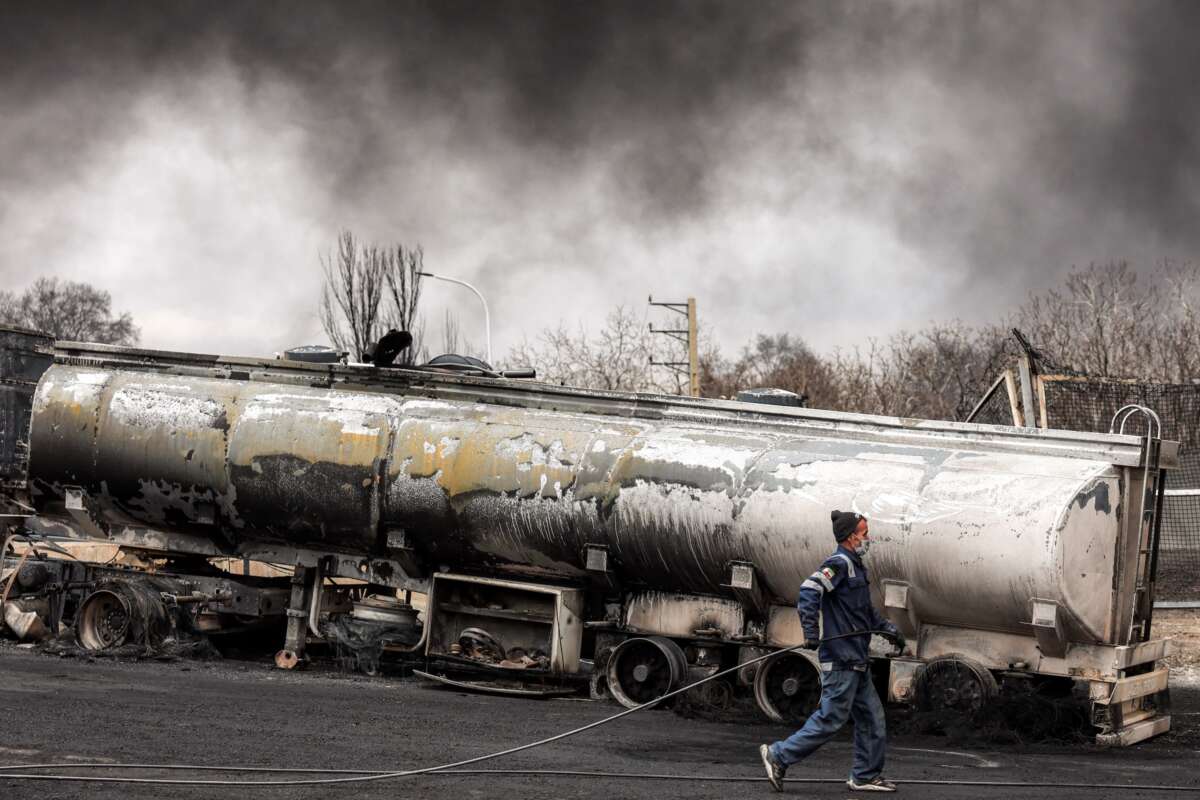
An Iranian civil defence member walks with a hose next to a destroyed fuel tanker vehicle near an ongoing fire following an overnight airstrike on the Shahran oil refinery in northwestern Tehran on March 8, 2026.AFP via Getty Images

The first two weeks of the U.S. and Israel’s war on Iran released a deluge of carbon emissions equivalent to the combined yearly climate warming pollution output of the lowest 84 emitters in the world, a new analysis finds.

Researchers for progressive think tank Climate and Community Institute found that the first 14 days of the assault released over 5 million metric tons of carbon dioxide emissions. This is more than the annual emissions of mid-sized economies like Iceland or Kuwait, and roughly the same as dozens of the lowest emitters together.

“No matter which of the many reasons Trump has since provided for attacking Iran, the US intervention in Iran is now clearly about oil, plunging the Middle East into another crisis and deepening the social, economic, and environmental costs of war,” wrote researchers Patrick Bigger, Benjamin Neimark, and Fred Otu-Larbi in a newsletter post about the analysis.

For their analysis, researchers examined reports from the media, international organizations and other independent institutions in order to gather data on factors like munitions quantities, fuel consumption, and infrastructure destruction. They then used that information to determine the volume of emissions based on prior research on emissions from the U.S. invasion of Iraq and from the Intergovernmental Panel on Climate Change.

The largest cause of emissions in the report is the destruction of homes and buildings, which has resulted in nearly 2.5 million tonnes of carbon dioxide emissions, the analysis found. Researchers based this estimate on data from the Iranian Red Crescent Society, which says that 20,000 units were damaged or destroyed in the conflict, including dozens of medical facilities and schools.

The emissions from building destruction alone are equal to those of 1.1 million gas-powered cars yearly, the group said.

The second largest contributor was the attacks on oil facilities by Israeli and Iranian forces in areas across Iran and the Middle East, as well as strikes on tankers in the Strait of Hormuz, amounting to 1.9 million tonnes of carbon dioxide emissions.

The remaining emissions came from fuel used by military warships, fighter jets, and support vessels and vehicles; the loss of equipment like the U.S.’s and Iran’s downed aircraft, lost naval vessels, and destroyed missile launchers; and the intensive use of drone and missile attacks.

“The carbon costs of the war will continue to rise dramatically as it drags on,” the Climate and Community Institute researchers wrote.

“However, the most significant climate impact of the attack on Iran will not be the emissions of the conflict itself, but from its aftermath,” they went on. “As the US continues to press on in its ill-conceived quest for ‘energy dominance,’ fossil fuel production will be expanded in the name of energy security, locking in emissions from extraction infrastructure for decades.”

Wars and military activity have long been some of the worst contributors to the climate crisis. Researchers for Brown University’s Costs of War found in 2019 that, if the U.S. military were a country, it would rank as the 55th worst polluter globally. Israel’s 12-day war last June left environmental and climate impacts that will last decades, experts said.

The environmental impact on Iranians is already immense. Israel’s attack on Iranian oil facilities earlier this month caused a massive black cloud to blanket Tehran, leading to toxic rain and atmospheric effects that may cause health effects like cancer for decades to come.

But the climate emissions from the war, which has no end in sight, will affect the entire world.

The report comes as the U.S. goes through a record heat wave, with eight states setting an all-time high heat record in March. The heat wave would have been “virtually impossible” without changes caused by the climate crisis, research group World Weather Attribution said. More heat may be yet to come, as weather and climate experts predict an extremely strong El Niño this year, which typically means hotter temperatures across the globe.
GESTAPO IN TRAINING

Bannon calls Trump agents at airports 'test run' for 2026 midterms


"War Room" host in Las Vegas on January 30, 2024 (Gage Skidmore)

March 23, 2026 
ALTERNET


Over the weekend, President Donald Trump announced plans to distribute ICE agents to airports across the country in an effort to alleviate long security lines caused by TSA staffing issues, which are in turn the result of a congressional standoff over Department of Homeland Security funding. With funding suspended, high numbers of TSA workers are calling in sick or quitting, and the ICE agents are purportedly being sent to fill the gaps.

But according to longtime Trump ally Steve Bannon, sending ICE agents to airports is really a “test run” for deploying them during the upcoming elections.


Speaking on his War Room podcast this morning, Bannon said, “We can use this as a test run, as a test case, to really perfect ICE’s involvement in the 2026 midterm.”

Bannon — who has been a key framer of the MAGA movement since its inception — has been advocating for Trump to place ICE agents at polling sites since last month, arguing it was necessary to prevent Democrats from “stealing” the election. Critics, however, say this is a blatant attempt to intimidate poll workers and voters with hopes of influencing the outcome.

The idea of putting ICE at polling stations has been gaining traction among conservatives, even though federal law expressly forbids deploying military or law enforcement at poll sites.

Bannon floated the idea to far-right lawyer Mike Davis, who said, “I think we should have ICE agents at the polling place because if you’re an illegal alien, you can’t vote. It’s against the law. It’s a federal crime for you to vote in federal elections. And so if you’re an American citizen, you should be happy that ICE is there, because you’re not going to have illegal aliens cancelling out your vote.”

Claims about widespread voting fraud have been thoroughly debunked, but that hasn’t stopped the president and his supporters from arguing that such voters stole previous elections from Trump. His opponents, however, say that placing ICE at polls would in fact be part of a Republican attempt to steal elections.

These opponents argue that such efforts have come in many forms, such as redistricting to shape the electorate to suit GOP needs, and the seizure of voter data and ballots from previous elections, typically in blue states or districts. Monday, a Republican sheriff in California seized more than 650,000 ballots in an attempt to overturn Democratic efforts to redistrict the state that were launched in response to similar efforts in Texas. And previously, Trump has said that he regrets not ordering the National Guard to seize ballots during his attempts to overturn the 2020 election.

If deploying ICE to airports doesn’t decrease security lines, says Trump, he will “bring the National Guard” next.

“Perfect training for the fall of 2026,” said Bannon. “This is another 5D chess move from President Trump.”


'Something we’ve never seen before': Finance reporter dissects Trump’s 'uncharted' economy


U.S. President Donald Trump gestures as he arrives to deliver remarks on the U.S. economy and affordability at the Mount Airy Casino Resort in Mount Pocono, Pennsylvania, U.S. December 9, 2025. REUTERS/Jonathan Ernst

March 23, 2026 
ALTERNET


The U.S. economy has entered "uncharted" territory under President Donald Trump, with Semafor's finance reporter, Liz Hoffman, explaining in a new video that "nonexistent" job growth has left things in a state "we've never seen before."


Semafor on Monday shared a video featuring Hoffman to X, in which she broke down why the economy under Trump has become something like a "lifestyle" company, in business terms, meaning that it is doing enough for its leaders to get by, but is not showing any meaningful growth that suggests a healthy long-term future.

"If America were a company, it would be what's called a 'lifestyle business,'" Hoffman said. "This is kind of a very specific sort of corporate dig that you hear a lot out of venture capital, but it's a company that isn't really growing. That is, makes enough money to sustain its owners, but isn't really building for a massively ambitious future."

She continued: "The U.S. economy is still growing, but the population isn't. That growth rate is starting to slow down, and Federal Reserve Chair Jerome Powell just last week said that flatlining job growth — you've seen these bad monthly job reports one after the other — is actually exactly what the economy needs, given that we have nonexistent growth in the labor force. Which, as he notes, is something we have never seen before."

In February, the latest jobs report found that the U.S. labor force had lost around 92,000 jobs, a sharp negative contrast to the expectation, which was that it would add 50,000. The Washington Post called that report “a striking loss signaling a warning flag for the economy," while NBC News called it "grim." Experts warned that such job numbers signaled that the U.S. economy was headed for a recession and the much-dreaded "stagflation," characterized by stagnant overall growth, weak job creation, and high inflation.

"The traditional engine of the U.S. economy was, in large part, more people, more output," Hoffman explained. "And better investment, more technology underpining that, but there was a human growth element to that. And because of changes to immigration policy and a birthrate that has been declining since the 1990s... the cohort that is now aging into the workforce is going to be smaller."

Hoffman noted that there is hope, albeit "uncertain," that AI will allow a smaller workforce to be more productive, but without that, things are looking bleak.

"The longstanding dynamics that have propelled the U.S. economy, certainly since the end of World War II, just don't seem to be working right now," Hoffman concluded.