Tuesday, March 24, 2026

How Iran's Ghalibaf turned concrete into power
How Iran's Ghalibaf turned concrete into power
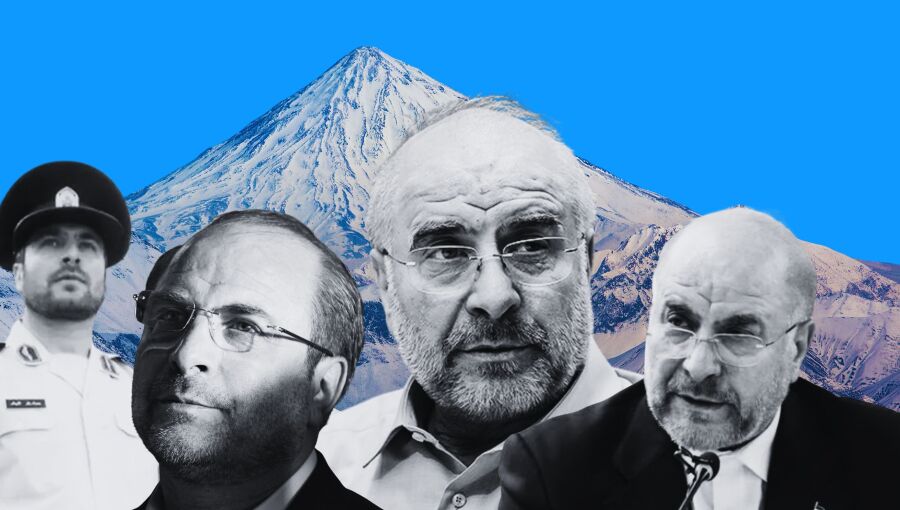
The many incarnations of Mohammad Bagher Ghalibaf now believe to be in charge of Iran. / bne IntelliNews
By bnm Gulf bureau March 24, 2026

There is a particular type of strongman, familiar to students of post-revolutionary states and increasingly to students of post-democratic ones, who rises not through ideology alone but through the patient accumulation of concrete, mortar and political capital. Mohammad Bagher Ghalibaf, currently speaker of Iran's parliament and the man now reportedly at the table as Tehran weighs its options after weeks of US and Israeli strikes, is precisely such a figure. A war veteran, former police chief, pilot, failed presidential candidate turned enduring power broker, he is, above all else, a builder, in every sense the term can carry when deployed as euphemism.

Born in 1961 in Torbat-e Jam, a small city in Khorasan near the Afghan border, Ghalibaf was still a teenager when the Islamic Revolution swept away the Pahlavi order and the Iran-Iraq War consumed the generation that followed. He fought in that war from the age of 19, rising through the IRGC to command the elite 25th Karbala Division. It was there, amid the mud and blood of the western front, that he forged the alliances that would define his subsequent career, most significantly with a young Kerman commander named Qasem Soleimani. The war produced a brotherhood whose members would go on to dominate Iranian politics, security and economics for the next four decades. That Soleimani was killed by Trump and Ghalibaf still standing tells you something about the relative merits of a political career over an operational one.

Conglomerate

In 1988 Ghalibaf's trajectory took a decisive turn. After the war, he became managing director of Khatam al-Anbiya, the engineering firm controlled by the IRGC. It was, at the time, a relatively modest outfit with a constitutional mandate to deploy military manpower on civilian infrastructure. What it became under successive IRGC commanders, and what Ghalibaf helped to shape during his tenure, was something of an altogether different order, that appears to have challenged the very foundations of the Islamic Republic which created it. 

Khatam al-Anbiya was established in 1989 by Khamenei's decree, ostensibly to utilise the civilian capacity of the armed forces in national development. The constitutional cover was Article 147, which envisaged the military lending a hand in reconstruction after the devastating eight-year war with Iraq. But what was originally intended as a joint enterprise between the army, the IRGC and the police turned, over time, into an exclusively IRGC venture, with managers appointed by the Guards and the sole oversight body being the IRGC's own Intelligence Protection Unit. In other words, it answered to no one outside the organisation it served, a structural reality that proved enormously convenient for what came next.

The conglomerate grew exponentially during the Ahmadinejad years, monopolising a lion's share of economic and development contracts in Iran. As international sanctions squeezed out foreign multinationals, the very companies that might otherwise have tendered competitively for oil and gas infrastructure, rail, roads and urban construction, Khatam al-Anbiya moved in to fill the vacuum. By 2012 it controlled more than 812 registered companies and had received 1,700 government contracts, with a workforce spanning 25,000 engineers and staff. Sanctions, rather than hobbling the IRGC's commercial empire, handed it the keys to the entire national construction economy. The Guards had always been ideologically hostile to foreign capital. Now they had a structural argument for excluding it too.

Khatam al-Anbiya also prepared what insiders called a "reverse sanctions list", a directive that goods producible by IRGC-affiliated domestic manufacturers should not be sourced abroad, effectively giving the Guards a monopoly over the production and import of key goods. This was not merely rent-seeking. It was the institutionalisation of a captive economy, designed to funnel public procurement permanently into military hands regardless of which president sat in the Pasteur Street offices.

Tehran

Ghalibaf's stewardship of Khatam al-Anbiya was formative, but it was his 12 years as mayor of Tehran, from 2005 to 2017, that transformed him from military technocrat into something resembling a property baron with political immunity. The mayoral role, appointed by the city council rather than directly elected, gave him control over one of the world's largest municipal budgets and, crucially, one of the world's largest urban land banks.

Documents from the General Inspection Office revealed that 1.1 million square metres of government-owned property, including apartments and villas, ended up in the possession of various individuals including government officials, sometimes sold at a 50% discount. By the time investigators attempted to piece together the full picture, the case encompassed more than 2,000 properties transferred to regime insiders and IRGC-affiliated companies. A municipal accountant estimated the city's losses at a minimum of 2,200bn toman, roughly $525mn, as a result of discounted land sales during Ghalibaf's tenure. One IRGC-affiliated company, Yas Holding, was accused of embezzling an estimated 13tn toman from Tehran Municipality for overpriced infrastructure projects built by construction companies linked to the IRGC during Ghalibaf's mayorship. Another outfit, Rasa Tejarat, reportedly owed trillions to the municipality but refused to pay its debt. Nobody knows for sure, but the numbers are eye-watering.

Ghalibaf also provided the IRGC's Intelligence Unit with no fewer than 23 parcels of land and property in the capital, to be used as safe houses, sites likely used for the detention, torture and extraction of forced confessions from detainees. The project was codenamed "Martyr Shateri," exiled Iran Wire reported. Properties were shifted not to homebuyers but to the surveillance state, under cover of a municipal administration that maintained no public register of where the city's real estate was going or to whom.

The journalist who first exposed the pattern, Yashar Soltani, was arrested. Ghalibaf was not.

In early 2022, a leaked audio recording purported to show former IRGC Major General Mohammad Ali Jafari discussing Ghalibaf's efforts to cover up the Yas Holding scandal by enlisting the head of the IRGC's Intelligence Organisation. This is, in essence, the Ghalibaf method: the scandal metastasises, the investigators circle, the loyal judiciary intervenes, and the man at the centre emerges not merely unscathed but promoted.

Trump comparison

It would be too easy, and too reductive, to draw the comparison cheaply. One man operates in a theocratic state under direct clerical authority, the other in an increasingly personalised democracy where institutional guardrails are being tested daily. The contexts are not equivalent. But the structural rhymes are striking enough to be worth examining seriously. Both men built their public brands on infrastructure and spectacle. Ghalibaf on Tehran flyovers built by the Chinese and shopping centres in the affluent north of the city; Trump on Manhattan towers, golf courses and the relentless assertion that his name on a building constituted a public good in itself. Both cultivated a reputation as men who get things done, a formulation that, in both cases, served as shorthand for dispensing with the procedural friction that accountability tends to create.

Both men ran repeatedly for the highest office in their respective systems and lost, only to find that proximity to power, through business, through the machinery of patronage, through institutional positions that lacked the visibility of the presidency but carried their own considerable weight, served them better than victory might have. Ghalibaf ran for president in 2005, 2013, and 2024, losing each time, yet was elected mayor of the capital and ultimately the speaker of parliament which appears to have saved him with the recent assisnations. Both have been accompanied throughout their careers by a persistent fog of financial opacity, allegations of self-dealing and a remarkable capacity to reframe every corruption allegation as a politically motivated attack by envious rivals. His implication in a series of corruption cases led some Iranian commentators to call him "the most corrupt commander" in Iran. The language echoes, transposed.

And then there is the luxury property angle, which in its absurdist detail almost writes itself. In April 2022, Ghalibaf's wife and family returned from Istanbul with 20 pieces of luggage following a luxury shopping trip, the scandal dubbed "LayetteGate" by Iranian Twitter, prompting calls for his resignation. Allegations subsequently emerged that Ghalibaf's family had purchased two luxury apartments in Istanbul's Sky Land complex for a total of 400bn rials (USD1.6mn). A parliamentary speaker, in a country suffering an acute economic crisis under the weight of US sanctions, apparently felt no contradiction in buying real estate abroad in someone else's name. The affair is trivial in dollar terms compared with the municipal land deals. Its significance lies elsewhere: in what it reveals about how men of this type understand the relationship between their public role and their private interests. The answer, in both cases, appears to be: not much.

That the man now reportedly leading Iran's nuclear negotiations with Washington should be precisely this figure, soldier, builder, accused looter of the public estate, survivor of a dozen scandals, networked to every node of IRGC power, says something revealing about the state Tehran wishes to present to the world. He is not a diplomat in any conventional sense. He is a demonstration of intent and forty years of power accumulation in flesh. We have also not seen anything of the alleged new supreme leader in recent weeks, leading ot many believing the transfer of power between the clerics to the guards has already happened and his martyrdom will be announced in the coming days when all the loose ends have been tied up. 


Clean energy stocks outperform oil majors as investors anticipate long-term switch to renewables due to Iran war

Clean energy stocks outperform oil majors as investors anticipate long-term switch to renewables due to Iran war
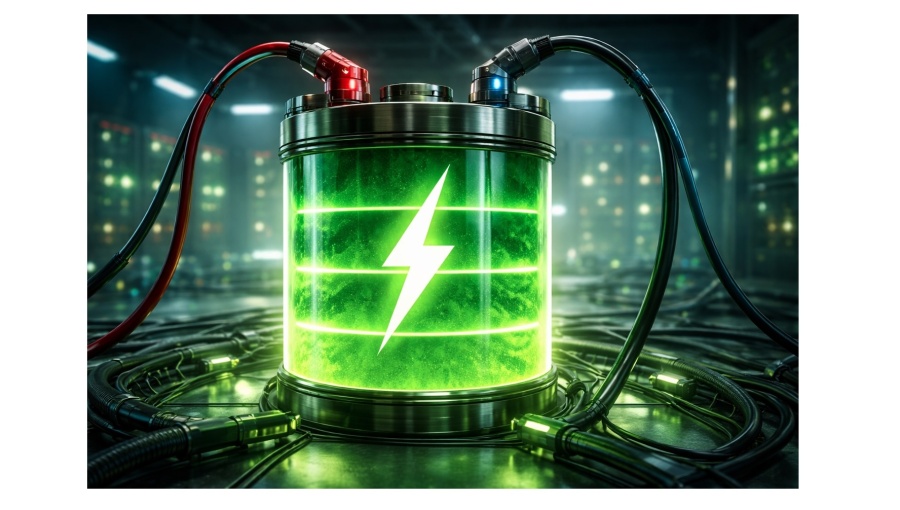
Stocks of Chinese battery producers are outperforming the leading oil companies as investors anticipate a drive to switch from oil to electricity due to the chaos the Iran war has caused in the long-term. / bne IntelliNews
By bne IntelliNews March 24, 2026

Shares in clean energy companies have outpaced oil majors since the outbreak of conflict involving Iran, as investors bet that higher fossil fuel prices will accelerate the shift towards renewables, the Financial Times reports.

China’s leading battery manufacturers — CATL, BYD and Sungrow — have added more than $70bn in combined market capitalisation since US and Israeli strikes on Iran at the end of February, according to Financial Times reporting on March 24. The gains reflect expectations that energy-importing economies will intensify investment in alternatives to oil and gas.

CATL’s domestically traded shares have risen 19%, while Sungrow is up 19.4% and BYD has gained 21.9% over the same period. The performance compares with increases of 15.2% for BP, 8% for Chevron, 8.3% for Shell and 4.7% for ExxonMobil, despite a 47% surge in oil prices.

The divergence highlights how equity markets are increasingly pricing in structural changes to energy demand, even as oil producers benefit from short-term price spikes linked to geopolitical disruption.

Investors are also responding to rapid technological advances in storage. The companies are benefiting from the “battery revolution” as prices fall, enabling broader adoption across electric vehicles and grid-scale storage. Industry expectations are rising around the development of longer-duration systems, including “the advent of the grid-level eight-hour battery” that will complete the green revolution and allow renewables to completely replace conventional source of power generation by solving the “baseload” problem.

China’s dominant position in battery manufacturing has placed its companies at the centre of this shift. The country already accounts for a large share of global battery production and continues to expand capacity, supported by policy incentives and strong domestic demand.

The scale of the opportunity is reflected in forecasts for storage deployment. The value of China’s domestic market for grid-scale battery storage is projected to increase to $199bn by 2032, up from $48bn last year, according to Mobility Foresights.

The rally in clean energy equities suggests investors expect the current geopolitical shock to reinforce longer-term trends, as countries seek to reduce exposure to volatile hydrocarbon supply and strengthen energy security through electrification and storage technologies.

WAR IS ECOCIDE

Middle East conflict causes surge in gas flaring and emissions

Middle East conflict causes surge in gas flaring and emissions
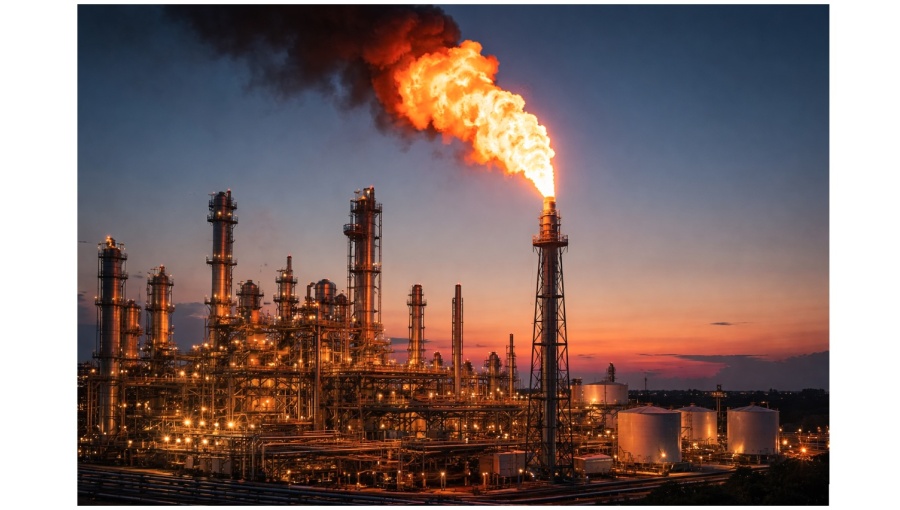
Middle East conflict disrupts LNG exports, driving a sharp rise in gas flaring and associated carbon emissions across key energy hubs. / bne IntelliNews
By Ben Aris in Berlin March 24, 2026

The war in Iran has caused a spike in gas flaring across the Middle East is adding to greenhouse gas emissions as energy infrastructure disruptions linked to regional conflict force producers to burn excess fuel.

Analysis by Bloomberg, citing data from investigative consultancy Data Desk, found that between February 28 and March 22 the United Arab Emirates’ Das Island liquefied natural gas facility flared volumes equivalent to about 74,100 metric tons of carbon dioxide. Qatar’s Ras Laffan plant, the world’s largest LNG export hub, emitted roughly 101,300 tons of CO2 equivalent over the same period.

The increase follows attacks on energy infrastructure and export bottlenecks, which have left operators with limited options for handling surplus gas. “Higher flaring volumes are likely linked to facility shutdowns, whether following direct strikes, as a preventive measure, or because of limited storage capacity elsewhere,” said Maria-Olivia Torcea, analyst at BloombergNEF. That “may have required a controlled release of gas from pipes, vessels and other equipment through venting and flaring,” she added.

When LNG cannot be exported or processed, companies typically burn it off or vent it, releasing carbon dioxide or methane, a more potent greenhouse gas. Satellite monitoring by firms including Capterio Ltd. indicates a broader regional uptick in flaring since the conflict escalated.

“There is also consistently high flaring at Iran’s Kharg Island, further indicating a slowing of exports of cargoes,” said Mark Davis, chief executive officer of Capterio.

Short-term spikes have been pronounced. On March 19, three days after a major attack, Ras Laffan flared enough gas to emit an estimated 6,200 metric tons of CO2 and methane, more than twice the average rate observed in 2025, according to Data Desk.

The full climate impact of the conflict is likely to be far greater. A study published in One Earth estimated that the Israel-Gaza war generated around 33mn tons of CO2 equivalent in its first 15 months, roughly matching Ireland’s annual emissions. Separate research by the Climate & Community Institute put emissions linked to the Iran conflict at about 5mn tons by March 14, while carbon accounting platform Greenly estimated US military activity alone produced 1.96mn tons of CO2 in the first six days.

Before the conflict, flaring levels in Qatar were relatively low. An analysis by Capterio found emissions amounted to less than 0.2% of throughput, compared with as much as 4% in some countries. QatarEnergy has pledged to eliminate routine flaring by 2030, although LNG facilities and downstream assets are excluded from that target.


The death of coal power in the UK - OWID

The death of coal power in the UK - OWID
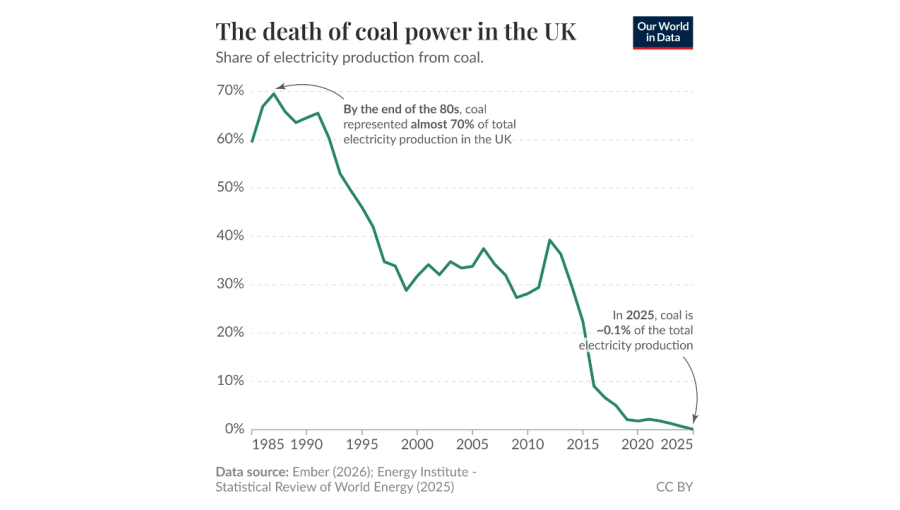
The UK was was the birth place of the coal industry that powered the industrial revolution. The last coal-fired power station was closed two years ago and it now contirbutes nothing to Britain's power mix. / bne IntelliNews
By Hannah Ritchie for Our World in Data March 24, 2026

The United Kingdom was the birthplace of coal. It has now, effectively, died there, Our World in Data reprots. 

As shown in the chart, in the late 1980s, around two-thirds of the UK’s electricity came from coal. By the time I was born in the 1990s, this had dropped to just over half.

The use of coal has plummeted in my lifetime. It now makes up around 0.1% of the UK’s electricity.

Coal was first replaced by gas, but is now being pushed out by wind, solar, and biomass.

Explore more charts on the death of British coal.


Bangladesh nears launch of first nuclear power plant

Bangladesh nears launch of first nuclear power plant
/ US Geological Survey - PD
By bno - Mumbai Office March 25, 2026

Bangladesh is set to bring its first nuclear reactor online within months, marking a long-delayed milestone as the country struggles with severe energy shortages linked to disruptions in the Middle East, Bloomberg reported.

The project, initiated under a previous administration that has since largely fled into exile following an August 2024 uprising, had originally been scheduled for commissioning early in 2025. However, technical challenges in integrating nuclear power into the national grid and suspected delays because of the Ukraine-Russia war have pushed back timelines.

The first of two 1.2 GW units at the Rooppur Nuclear Power Plant are now expected to begin fuel loading on April 7, with the reactor likely to be connected to the grid by as early as June, initially thereafter operating at around 30% capacity, which officials believe will offer partial relief to the strained power system.

At present, Bangladesh relies on gas for roughly half of its electricity generation, with import dependence rising steadily. Recent geopolitical tensions have disrupted supply routes through the Strait of Hormuz though, while an attack on Qatar’s Ras Laffan facility has also driven up LNG prices, leaving the country painfully exposed to potential shortages during peak summer demand and adding pressure on foreign exchange reserves.

To this end, officials have indicated that even partial output from the nuclear plant would help ease supply constraints, though sources familiar with the project suggest it could take up to a year for the facility to reach full operational capacity, Bloomberg has reported.

The plant is being developed with Russian-designed VVER pressurised water reactors supplied by Rosatom. Delays in equipment deliveries have also contributed to the extended timeline.

As such, Bangladesh has recently strengthened its cooperation with the International Atomic Energy Agency as part of efforts to ensure regulatory compliance and operational readiness.

In the short term, the government now plans to increase spot purchases of LNG to build a three-month buffer stock although this will not be easy in the current international climate. Dhaka also aims to procure 11 cargoes, some of which have already been secured at competitive rates, the energy minister said.

 Argentina marks 50 years since coup amid renewed tensions over memory and justice

Argentina marks 50 years since coup amid renewed tensions over memory and justice
Tens of thousands gathered today in Plaza de Mayo under the banner “Nunca más” (Never again), led by groups such as the Mothers and Grandmothers of Plaza de Mayo, who have spent decades demanding to know the fate of their relatives.
By bnl editorial staff March 24, 2026

Argentina marked on March 24 the 50th anniversary of the 1976 military coup that ushered in one of the country’s darkest periods, with tens of thousands marching in Buenos Aires and across the country to honour victims of the dictatorship while human rights groups and international experts warned of setbacks in ongoing efforts to secure truth and justice.

The coup, led by General Jorge Rafael Videla on March 24, 1976, ousted President Isabel Perón and initiated a military regime that ruled until 1983. During that period, around 30,000 people were forcibly disappeared, according to human rights organisations, in a relentless campaign of state repression which targeted political opponents, students, journalists and labour activists.

Half a century later, the legacy of those years remains central to Argentina’s public life. Demonstrators gathered today in Plaza de Mayo under the banner “Nunca más” (Never again), led by groups such as the Mothers and Grandmothers of Plaza de Mayo, who have spent decades demanding to know the fate of their relatives.

Thousands were expected to mobilise across the country, with the main rally in Buenos Aires calling for answers about the disappeared and rejecting policies seen as undermining historical accountability, AFP reported.

Argentina has long been regarded as a global reference for transitional justice. Since the return to democracy in 1983, the country has carried out landmark processes including the Trial of the Juntas in 1985, which sentenced top military leaders, and the prosecution of more than 1,200 individuals for crimes against humanity across over 350 trials.

Institutions such as the National Commission on the Disappearance of Persons (CONADEP) and the National Genetic Data Bank have played key roles in documenting abuses and restoring the identities of children forcibly taken from detained parents. To date, 140 of an estimated 500 stolen babies have recovered their identities.

However, more than 300 cases remain open, and efforts to advance accountability continue to face obstacles. Researchers and legal experts point to delays and resistance in investigating alleged complicity by corporate actors during the dictatorship.

Recent developments are a reminder that the search for truth is ongoing. Judicial authorities in Córdoba have identified the remains of 12 victims found in a former clandestine detention centre, highlighting continued forensic and legal work decades after the crimes.

The anniversary comes amid heightened political tensions over how the dictatorship is remembered. President Javier Milei’s right-wing government has questioned long-standing narratives about the period and called for what it describes as a “complete” account of the violence of the 1970s.

Milei's messaging has suggested that previous policies were built on a partial version of events, arguing that other victims of political violence by "leftist guerrilla groups" were overlooked. This stance has drawn criticism from human rights organisations and international observers. Over the past two years, the government released institutional material and promotional videos calling for a reassessment of the period and a broader interpretation of historical events, Tiempo Argentino reported.

It has also reduced state funding for civil society organisations and memorial sites, and imposed restrictions on protest.

United Nations experts warned that recent measures risk undermining decades of progress. “Although there have been oscillations and gaps, for decades the country has made major progress in the fight against impunity and to ensure the rights to truth and memory,” they said. “Unfortunately, today we are seeing a rapid deterioration of Argentina's global leadership in this area.”

They also cautioned against any potential pardons for individuals convicted of serious human rights violations, stating: “Pardons for serious human rights violations are strictly prohibited under peremptory norms of international law.”

Yet despite political divisions, public opinion appears largely aligned in condemning the dictatorship. A recent study cited by local analysts found that seven out of ten Argentines reject the military junta and its actions.

As commemorations continue, human rights groups insist that the demands of victims remain unchanged. Marchers carried photographs of the disappeared and repeated a central call that has endured for decades: “Tell us where they are," a demand for answers about the fate of those who never returned.

LESSON LEARNED FROM IRAN WAR

North Korea’s Kim Jong-un says nuclear-armed status ‘irreversible’


North Korea will never relinquish its status as a nuclear-armed state, state media reported leader Kim Jong-un as saying on Tuesday. Speaking after his reappointment to head the State Affairs Commission, Kim called the policy "irreversible" and vowed to intensify efforts against what he described as "hostile forces".


Issued on: 24/03/2026 - 
By: FRANCE 24

North Korean leader Kim Jong-un and his daughter Kim Ju Ae observing a training exercise © STR / KCNA VIA KNS/AFP

North Korea will never change its status as a nuclear-armed state, its leader Kim Jong-un said, state media reported on Tuesday.

The declaration – delivered on Monday – follows Kim's reappointment a day earlier as head of the authoritarian nation's highest policymaking body, the State Affairs Commission.

"We will continue to firmly consolidate our status as a nuclear-armed state as an irreversible course, while aggressively stepping up our struggle against hostile forces," he said in a policy speech at the rubber-stamp legislature in Pyongyang.

READ MORENorth Korea tests nuclear-capable rocket launchers amid US-South Korea military drills


In a lengthy policy address reported by the official Korean Central News Agency, the third-generation leader addressed a wide range of issues, from nuclear weapons and defence policy to economic goals and relations with South Korea and the United States.

"We will, in line with the mission entrusted by the Constitution of the Republic ..., further expand and advance our self-defensive nuclear deterrent," he said, referring to nuclear weapons.

Pursuing an expansion of nuclear weapons to consolidate its status as a nuclear-armed state has been "entirely justified", he added.

The isolated country will ensure "precise readiness" of its nuclear forces, he said, to fend off "strategic threats".

Kim did not mince words about his southern neighbour, which he called "the most hostile state".

"We will designate South Korea as the most hostile state and deal with it by thoroughly," he said.

North Korean leader Kim oversees test-launch of multiple rocket launchers via REUTERS
 - KCNA
01:49


Pyongyang will "make it pay mercilessly – without the slightest consideration or hesitation – for any act that infringes upon our Republic," he added.

Kim is the third-generation ruler of the state founded by his grandfather Kim Il Sung in 1948, and has ruled the country since his father's death in 2011.

The North's legislature re-elected Kim as president of state affairs, KCNA reported earlier, without saying whether the decision was unanimous or with dissent.

Critics argue that elections in North Korea are pre-determined and designed to give the leadership a veneer of democratic legitimacy.

(FRANCE 24 with AFP)