How Iran's Ghalibaf turned concrete into power
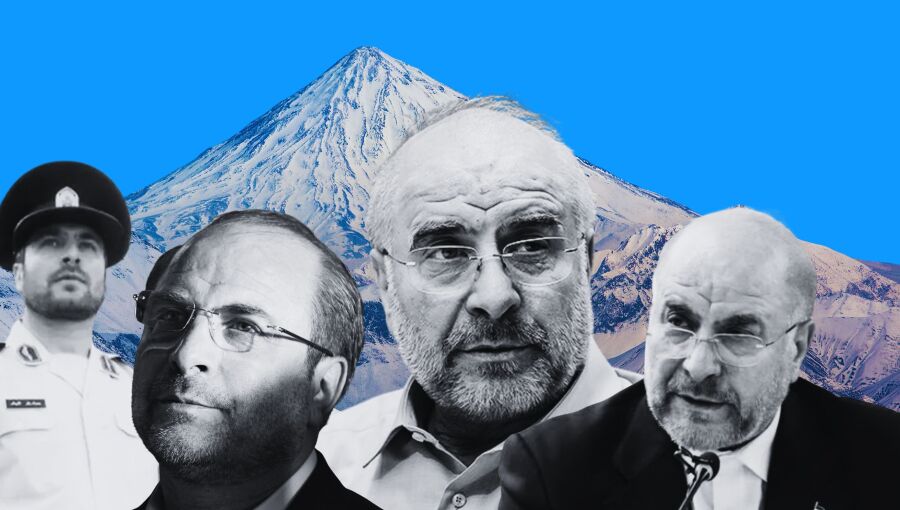
There is a particular type of strongman, familiar to students of post-revolutionary states and increasingly to students of post-democratic ones, who rises not through ideology alone but through the patient accumulation of concrete, mortar and political capital. Mohammad Bagher Ghalibaf, currently speaker of Iran's parliament and the man now reportedly at the table as Tehran weighs its options after weeks of US and Israeli strikes, is precisely such a figure. A war veteran, former police chief, pilot, failed presidential candidate turned enduring power broker, he is, above all else, a builder, in every sense the term can carry when deployed as euphemism.
Born in 1961 in Torbat-e Jam, a small city in Khorasan near the Afghan border, Ghalibaf was still a teenager when the Islamic Revolution swept away the Pahlavi order and the Iran-Iraq War consumed the generation that followed. He fought in that war from the age of 19, rising through the IRGC to command the elite 25th Karbala Division. It was there, amid the mud and blood of the western front, that he forged the alliances that would define his subsequent career, most significantly with a young Kerman commander named Qasem Soleimani. The war produced a brotherhood whose members would go on to dominate Iranian politics, security and economics for the next four decades. That Soleimani was killed by Trump and Ghalibaf still standing tells you something about the relative merits of a political career over an operational one.
Conglomerate
In 1988 Ghalibaf's trajectory took a decisive turn. After the war, he became managing director of Khatam al-Anbiya, the engineering firm controlled by the IRGC. It was, at the time, a relatively modest outfit with a constitutional mandate to deploy military manpower on civilian infrastructure. What it became under successive IRGC commanders, and what Ghalibaf helped to shape during his tenure, was something of an altogether different order, that appears to have challenged the very foundations of the Islamic Republic which created it.
Khatam al-Anbiya was established in 1989 by Khamenei's decree, ostensibly to utilise the civilian capacity of the armed forces in national development. The constitutional cover was Article 147, which envisaged the military lending a hand in reconstruction after the devastating eight-year war with Iraq. But what was originally intended as a joint enterprise between the army, the IRGC and the police turned, over time, into an exclusively IRGC venture, with managers appointed by the Guards and the sole oversight body being the IRGC's own Intelligence Protection Unit. In other words, it answered to no one outside the organisation it served, a structural reality that proved enormously convenient for what came next.
The conglomerate grew exponentially during the Ahmadinejad years, monopolising a lion's share of economic and development contracts in Iran. As international sanctions squeezed out foreign multinationals, the very companies that might otherwise have tendered competitively for oil and gas infrastructure, rail, roads and urban construction, Khatam al-Anbiya moved in to fill the vacuum. By 2012 it controlled more than 812 registered companies and had received 1,700 government contracts, with a workforce spanning 25,000 engineers and staff. Sanctions, rather than hobbling the IRGC's commercial empire, handed it the keys to the entire national construction economy. The Guards had always been ideologically hostile to foreign capital. Now they had a structural argument for excluding it too.
Khatam al-Anbiya also prepared what insiders called a "reverse sanctions list", a directive that goods producible by IRGC-affiliated domestic manufacturers should not be sourced abroad, effectively giving the Guards a monopoly over the production and import of key goods. This was not merely rent-seeking. It was the institutionalisation of a captive economy, designed to funnel public procurement permanently into military hands regardless of which president sat in the Pasteur Street offices.
Tehran
Ghalibaf's stewardship of Khatam al-Anbiya was formative, but it was his 12 years as mayor of Tehran, from 2005 to 2017, that transformed him from military technocrat into something resembling a property baron with political immunity. The mayoral role, appointed by the city council rather than directly elected, gave him control over one of the world's largest municipal budgets and, crucially, one of the world's largest urban land banks.
Documents from the General Inspection Office revealed that 1.1 million square metres of government-owned property, including apartments and villas, ended up in the possession of various individuals including government officials, sometimes sold at a 50% discount. By the time investigators attempted to piece together the full picture, the case encompassed more than 2,000 properties transferred to regime insiders and IRGC-affiliated companies. A municipal accountant estimated the city's losses at a minimum of 2,200bn toman, roughly $525mn, as a result of discounted land sales during Ghalibaf's tenure. One IRGC-affiliated company, Yas Holding, was accused of embezzling an estimated 13tn toman from Tehran Municipality for overpriced infrastructure projects built by construction companies linked to the IRGC during Ghalibaf's mayorship. Another outfit, Rasa Tejarat, reportedly owed trillions to the municipality but refused to pay its debt. Nobody knows for sure, but the numbers are eye-watering.
Ghalibaf also provided the IRGC's Intelligence Unit with no fewer than 23 parcels of land and property in the capital, to be used as safe houses, sites likely used for the detention, torture and extraction of forced confessions from detainees. The project was codenamed "Martyr Shateri," exiled Iran Wire reported. Properties were shifted not to homebuyers but to the surveillance state, under cover of a municipal administration that maintained no public register of where the city's real estate was going or to whom.
The journalist who first exposed the pattern, Yashar Soltani, was arrested. Ghalibaf was not.
In early 2022, a leaked audio recording purported to show former IRGC Major General Mohammad Ali Jafari discussing Ghalibaf's efforts to cover up the Yas Holding scandal by enlisting the head of the IRGC's Intelligence Organisation. This is, in essence, the Ghalibaf method: the scandal metastasises, the investigators circle, the loyal judiciary intervenes, and the man at the centre emerges not merely unscathed but promoted.
Trump comparison
It would be too easy, and too reductive, to draw the comparison cheaply. One man operates in a theocratic state under direct clerical authority, the other in an increasingly personalised democracy where institutional guardrails are being tested daily. The contexts are not equivalent. But the structural rhymes are striking enough to be worth examining seriously. Both men built their public brands on infrastructure and spectacle. Ghalibaf on Tehran flyovers built by the Chinese and shopping centres in the affluent north of the city; Trump on Manhattan towers, golf courses and the relentless assertion that his name on a building constituted a public good in itself. Both cultivated a reputation as men who get things done, a formulation that, in both cases, served as shorthand for dispensing with the procedural friction that accountability tends to create.
Both men ran repeatedly for the highest office in their respective systems and lost, only to find that proximity to power, through business, through the machinery of patronage, through institutional positions that lacked the visibility of the presidency but carried their own considerable weight, served them better than victory might have. Ghalibaf ran for president in 2005, 2013, and 2024, losing each time, yet was elected mayor of the capital and ultimately the speaker of parliament which appears to have saved him with the recent assisnations. Both have been accompanied throughout their careers by a persistent fog of financial opacity, allegations of self-dealing and a remarkable capacity to reframe every corruption allegation as a politically motivated attack by envious rivals. His implication in a series of corruption cases led some Iranian commentators to call him "the most corrupt commander" in Iran. The language echoes, transposed.
And then there is the luxury property angle, which in its absurdist detail almost writes itself. In April 2022, Ghalibaf's wife and family returned from Istanbul with 20 pieces of luggage following a luxury shopping trip, the scandal dubbed "LayetteGate" by Iranian Twitter, prompting calls for his resignation. Allegations subsequently emerged that Ghalibaf's family had purchased two luxury apartments in Istanbul's Sky Land complex for a total of 400bn rials (USD1.6mn). A parliamentary speaker, in a country suffering an acute economic crisis under the weight of US sanctions, apparently felt no contradiction in buying real estate abroad in someone else's name. The affair is trivial in dollar terms compared with the municipal land deals. Its significance lies elsewhere: in what it reveals about how men of this type understand the relationship between their public role and their private interests. The answer, in both cases, appears to be: not much.
That the man now reportedly leading Iran's nuclear negotiations with Washington should be precisely this figure, soldier, builder, accused looter of the public estate, survivor of a dozen scandals, networked to every node of IRGC power, says something revealing about the state Tehran wishes to present to the world. He is not a diplomat in any conventional sense. He is a demonstration of intent and forty years of power accumulation in flesh. We have also not seen anything of the alleged new supreme leader in recent weeks, leading ot many believing the transfer of power between the clerics to the guards has already happened and his martyrdom will be announced in the coming days when all the loose ends have been tied up.

No comments:
Post a Comment