It’s Time to Slash US Military Spending by Half
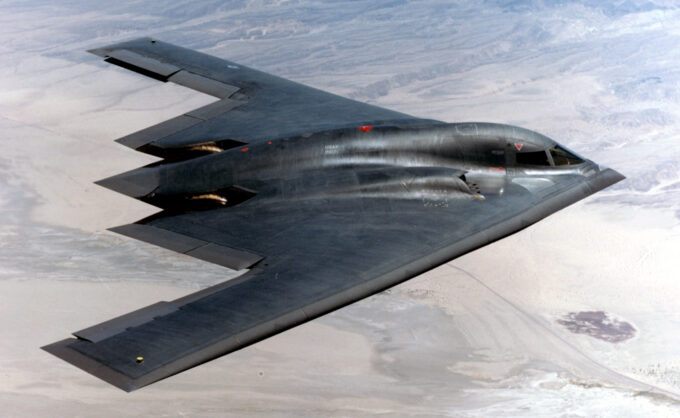
The B-2 Spirit. Photo: U.S. Air Force.a
Imagine in Iran that instead of spending their wealth – billions of dollars supporting terrorists or weapons, [they] had spent that money helping the people of Iran. You’d have a much different country.
–Secretary of State Marco Rubio
It’s not possible for us to take care of daycare, Medicaid, Medicare, all these individual things. . . . We have to take care of one thing: military protection.lgernon
–President Donald Trump
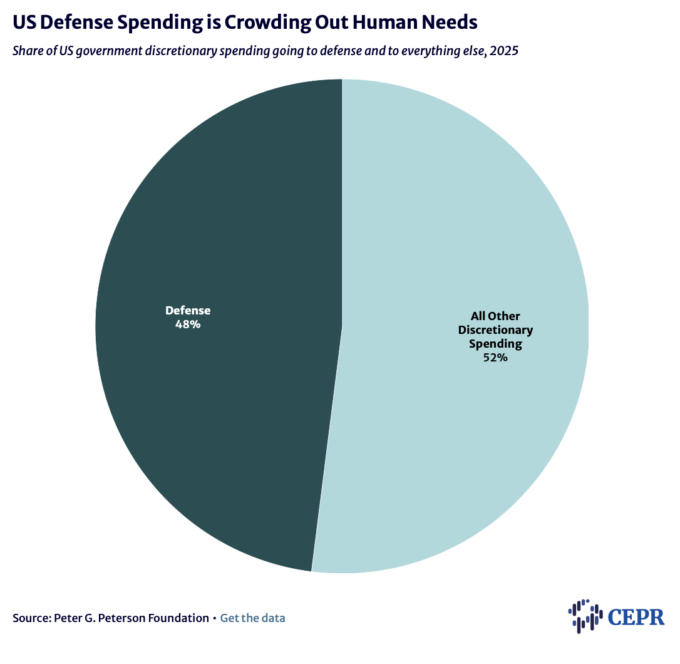
US military spending eats up nearly half of all discretionary spending (see below figure). Instead of rebalancing spending so that more money is going to things like daycare and health care that would help the people of the United States, President Trump wants to make the gargantuan military budget even larger.
Trump’s budget proposal “builds upon the historic $1 trillion overall defense topline enacted for 2026 and requests $1.5 trillion in total budgetary resources for 2027.” Trump wants to funnel money into the already stuffed coffers of the military-industrial-technological complex because apparently, in the Trump administration’s view, the purpose of government is to make the rich richer.
Instead of increasing spending on the military by 50 percent, we should cut military spending by 50 percent. Doing this would produce a massive peace dividend. Reducing the military budget by half and freeing up half a trillion dollars would put to rest the question, “Where are we going to get the money for that?” With half of a trillion dollars, we could begin the transition to a more affordable health care system. Or, we could simultaneously invest more in affordable housing andaffordable higher education and our energy infrastructure. There are many possibilities.
A US military that is half of its current size would still be a dominant military power in the world. A smaller US military should also make presidents less cavalier about starting unnecessary wars. This would save American lives, not just money. The United States would also likely be less of a global bully and have improved relations with the other countries of the world. A smaller military would be a win for the people of the United States and for the rest of the world.
This first appeared on CEPR.
America’s $2.5 Trillion National Security Budget for FY 2027

An E/A-18G Growler aircraft launches from the flight deck of the world’s largest aircraft carrier, USS Gerald R. Ford, during Operation Epic Fury, March 1, 2026. Photo: US Navy.
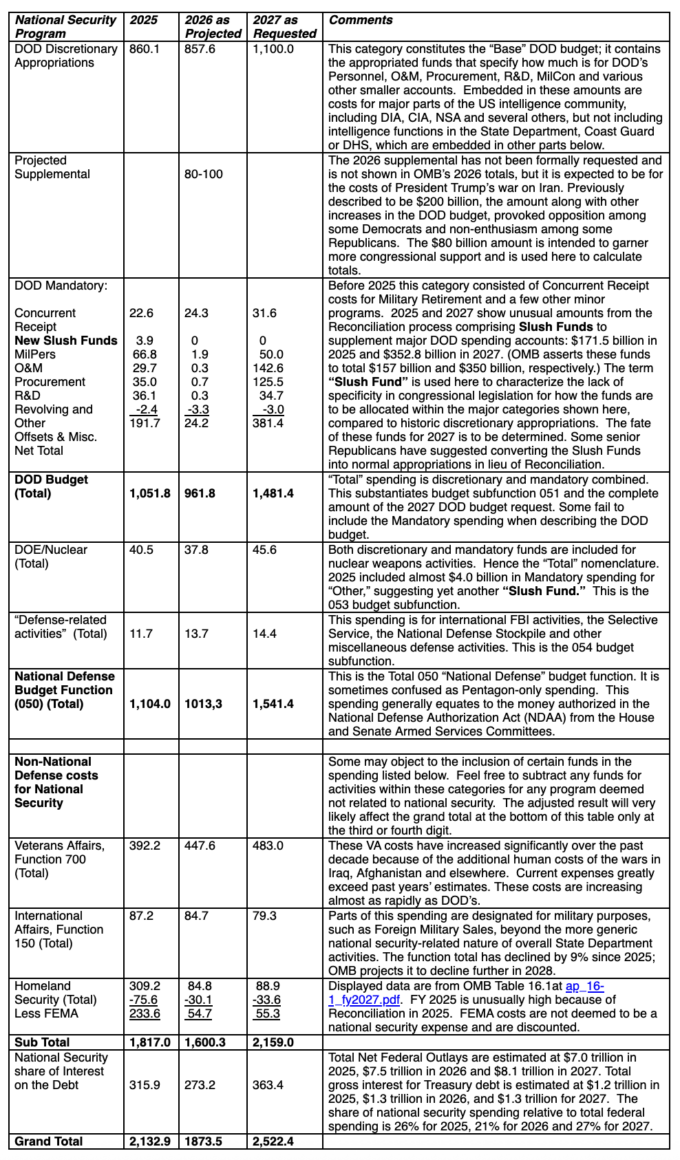
The table below displays the total US National Security budget. The amounts shown are not restricted to what constitutes Pentagon spending or the larger “National Defense” (050) budget function. Also included in the broader National Security category are the Veterans Administration (the human costs of wars), the State Department (diplomacy, arms sales, etc.) and Homeland Security (Coast Guard and border and internal security and more). I also calculate an appropriate share of what this spending contributes to the annual deficit. Overall, it is an attempt to capture the totality of what the US spends for protection from external threats, both real and those specified by politicians and ideologies.
I have provided figures for fiscal years 2025, 2026 and 2027, as complete and accurate amounts for recent years have been difficult to secure from OMB, CBO or CRS reports or have been only obscurely reported. Also, the new request for 2027 has only been thinly reported, beyond the unprecedented total for the Pentagon ($1.5 trillion) and the gigantic increase ($500 billion) that President Trump decided to add relative to 2026. As shown, the complete bill for US national security is a full $1 trillion higher. The $2.522 trillion grand total is an increase of $649 billion over 2026.
As astounding as these amounts are, the usual political battlelines over the security budget remain unchanged. Liberals and Progressives in the Democratic caucuses on Capitol Hill have rallied against the amounts. Republicans are rallying in favor of them. The non-progressive, party-line Democratic centrists have articulated some caveats, most of them meaningless, and can be expected to ultimately go along, lest they be attacked by the Republicans (and some other Democrats) as “anti-defense.” This will mean enough votes in the Senate to overcome the 60-vote filibuster threshold to pass what President Trump has directed.
That is, unless the excess of the increase and of the total amount provokes some new trend in the domestic politics surrounding this spending. One required change from normal behavior would be the ability of the Progressives to enlist the opposition of the balance of the Democratic caucus — perhaps through the exercise of better than normal oversight of how money is misspent for untested, poorly designed, excessively complex military hardware that may be underperforming in the wars President Trump has initiated.
Or, somewhat less plausibly, the Progressives might find a way to impose Nancy Pelosi-like authoritarianism over the complete Democratic caucus both in the House and the Senate. However, Democrat-only votes would fall short of what is needed to prevail, especially in the Senate. To succeed there the Democrats of any persuasion would have to exercise the willingness and ability to form a meaningful coalition with sufficient Republicans who might break the fever of unalloyed subservience to the person and haranguing of Donald Trump. Thus far, there is no sign of that.
The only thing we do know for sure is that history is not linear. Someday there may be something to alter the contemporary business as usual in Trump-era politics, even if that change is not now visible. The votes may change; in fact, they always do — at some point.