Friday, April 10, 2026

To Prevent the Extinction of Canada Lynx, the Forest Service Must Stop Clearcutting Lynx Habitat


 April 10, 2026

Canada Lynx stalking prey. Photo: Erwin and Peggy Bauer, U.S. Fish and Wildlife Service.

The U.S. Fish and Wildlife Service listed Canada lynx as “threatened” under the Endangered Species Act in 1999. Federal designation of “Lynx Critical Habitat” was intended to not only recover lynx but also recover the ecosystems upon which lynx depend for survival.

Canada lynx are comparable to the bobcat in size and particularly distinguished by its long legs and large paws, which make it well-adapted to hunting in deep snow. It is highly dependent on snow-covered acres due to its specialized predator-prey relationship with snowshoe hares, a species which, like lynx, evolved to survive in areas that receive deep snow.

Both lynx and snowshoe hare also need habitat with plenty of thick, mature, and old growth forests. Snowshoe hare need thick forests because they have to reach low-hanging branches above the snow and eat the twigs, bark, buds and pine needles they need to survive. Protecting lynx critical habitat is essential to recover and prevent lynx from going extinct, especially since studies show lynx avoid clearcuts for up to 50 years.

But the Forest Service does not have to follow the protections for lynx habitat in areas designated as the Wildland Urban Interface under the Healthy Forest Restoration Act.

Almost the entire Tally Lake Ranger District of the Flathead National Forest has been designated as lynx critical habitat. Yet, until Native Ecosystems Council, Alliance for the Wild Rockies, Council on Wildlife and Fish, and Yellowstone to Uintas Connection recently won in federal district court, the Forest Service continued to clearcut the forests there since the agency falsely claims that almost all of the Tally Lake Ranger District is in the Wildland Urban Interface, basically overriding the protection of lynx critical habitat.

The Healthy Forest Restoration Act defines the Wildland Urban Interface as being ½ mile from a community having at least 40 houses per square mile and having common community infrastructure such as sewage treatment. The Interface boundary can be extended out to a mile and half for a community if the areas have steep slopes of more than 30 degrees. But the Tally Lake Ranger District is generally rolling hills, not steep mountains.

Another serious problem with lynx management is a complete failure of the Forest Service and U.S. Fish and Wildlife Service to monitor population trends to determine if Forest Service projects are impacting populations. The problem is evident. The Forest Service and the U.S. Fish and Wildlife Service conveniently do not keep track of lynx population trends. So if the government never monitors them, no one can say that lynx are declining.

The Forest Service needs to amend the Revised Flathead Forest Plan direction for lynx and lynx critical habitat so that a valid conservation strategy based on the current best science is implemented to avoid extinction of the lynx in the Northern Rockies. That includes updating the definition of lynx critical habitat area in the Forest Plan to ensure recent clearcuts are not counted as lynx habitat, since lynx do not inhabit clearcuts.

No future logging projects should be allowed to go forward on the Flathead National Forest until the agency provides valid conservation strategies for old growth-associated wildlife, snag-associated species, various wildlife species, including the grizzly bear, and the Canada lynx and those species identified as Montana Species of Concern.

Without these valid conservation strategies for wildlife, any environmental analysis for logging will be invalid and likely illegal because adherence to the current Forest Plan direction will not ensure significant adverse impacts will not be avoided or that a diversity of wildlife will be preserved in the forest.

Coming Soon – US  Federal Red Ink Barfing Skyward Like You’ve Never Seen


by  | Apr 9, 2026 | 

Self-evidently, the news has been overwhelmingly focused on Washington’s current endeavor to unload $200 billion of imperial destruction upon Iran and its neighbors around the Persian Gulf. Well, and also upon all other users of petroleum products, LNG, LPGs, nitrogen fertilizer, food, helium, semiconductors, manufactured goods and most everything else anywhere on the planet.

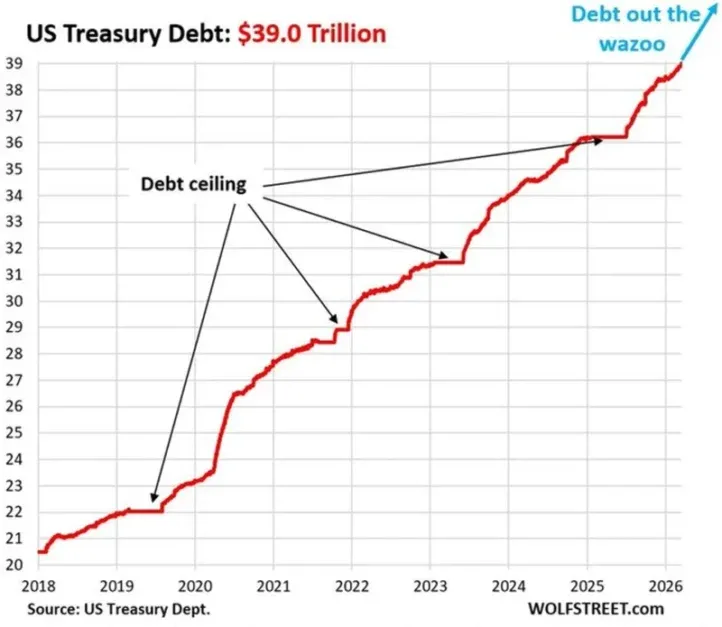
Accordingly, comparatively scant attention has been given to another recent milestone on America’s headlong dash to fiscal disaster. To wit, the public debt crossed the $39 trillion mark and nearly in the blink of an eye, too. Just four years ago, we were at the $29 trillion level and nine years ago at the $19 trillion mark.

Needless to say, the “peacemaker” in the Oval Office has played no small role in this skyward ascent of the public debt. During his first term, the public debt grew by a staggering $8 trillion and already another $3 trillion has been racked-up during his second go-round.

Stated differently, the King of Debt has surely earned his place in the history books. The $11 trillion of new debt on his watch to date already accounts for 28% of all the public debt incurred in America since George Washington!

Then again, he still has got nearly three years to go, and the debt impact of both the OBBBA and the impending financial and human bloodbath in the Persian Gulf are just getting started.

Indeed, as to the latter it’s as clear as the orange glow around his cranium that the Donald is doing another round of fake rope-a-dope negotiations with the Iranians. That’s to buy time to get the 82nd Airborne, various amphibious landing ships and other invasionary forces in place for his next “win”.

That’s right.The fool in the Oval Office is actually going to attempt to seize the Alamo Kharg Island. That will mean military chaos in the Gulf, unprecedented turmoil in the global economy and soaring military expenditures, which will make the pending $200 billion DOD supplemental look like a mere down-payment.

With respect to the latest round of Rope-A-Dope-With-Donald, the always astute Shanaka Anslem Perera noted this AM:

The 15-point plan was never a negotiating document. It was a pressure document:

  • Zero enrichment contradicts NPT Article IV.
  • Full HEU surrender contradicts 20 years of centrifuge investment.
  • Proxy cut-offs contradict the IRGC’s regional architecture.
  • Missile restrictions contradict the only conventional deterrent Iran has left after 25 days of decapitation.

The plan asks Iran to dismantle every strategic pillar simultaneously while receiving revocable phased relief. No government in history has accepted such terms without military occupation.

Iran knows this. The US knows Iran knows this. The plan exists not to be accepted but to be rejected, so that the rejection justifies the next phase of strikes, the pause expiry, and the eventual escalation to power-plant targeting that Trump threatened and temporarily paused on March 23. The rejection is the plan.

Meanwhile, down in the weeds of the budgetary figures for FY 2026 through February, we already have warning signs that a veritable fiscal conflagration lurks just around the corner. To wit, February YTD outlays of $3.102 trillion were already way the hell higher than revenues, which posted at just $2.097 trillion

So the resulting five-month deficit of -$1.004 trillion amounted to damn near 48% of revenues. And, again, the double-whammy of OBBBA and hot war in the Persian Gulf has not yet barged its way into the budget numbers.

Yet and yet. The sleepwalkers in Trumpian Washington are actually giving a one-hand clap for a declining deficit, owing to short-run timing aberration that has caused the FY 2026 YTD red ink to come in slightly below the -$1.146 trillion level posted in the first five months of FY 2025.

Then again, even in budget land it’s not over until the fat lady sings. In this case, there are some very shrill discordant notes in the YTD figures – one-time revenue gains and a temporary lull in defense spending growth – which will soon reverse and send the red ink totals soaring far higher in the months ahead.

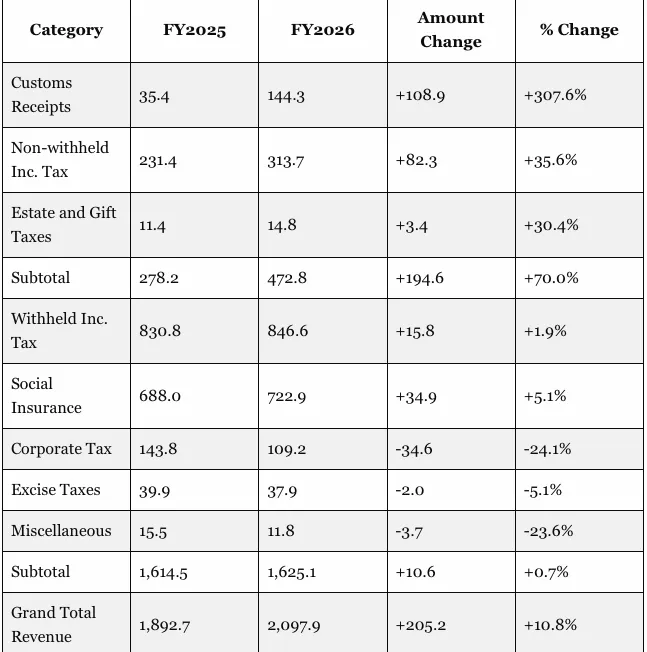
On the revenue front, the table below tells you all you need to know. When you look at the small corner of the receipt pie accounted for by customs revenue, non-withheld income taxes on capital gains and other income of the wealthy and estate and gift taxes, there has been a cornucopia of gains. These items are up versus FY 2025 by +308%, +36% and +30% respectively, accounting for a YTD revenue gain of $194.6 billion.

Now, that’s 95% of the entire YTD Federal revenue gain of $205.2 billion, and its accounted for by revenue lines that generated just 15% of YTD collections during the ordinary year of FY 2025.

More importantly, this 70% Y/Y revenue gain in this small corner of the revenue pie ain’t gonna last. The Supreme Court has already nullified the Donald out-of-this-word tariff impositions under the IEEA of 1977 and will actually be specifying refund arrangments in short order.

Likewise, the big gains in the stock market last year are surely over and done, as we plunge into a global energy, fuel, fertilizer and manufacturing dislocation that will make 1973 and 1979 look like a walk in the park. About the only replicable piece of the aberrant first subtotal shown in the table below is the possibility that during the balance of FY 2026 rich people will keep dying at the same rate as thru February, and also that their stock portfolios don’t take a whopping between now and then.

By contrast, if you look at the 85% of the Federal revenue pie that includes the workhorses of the governments ordinary course extractions from the people – withheld income taxes from 160 million workers, payroll taxes from even more workers and the corporate income tax – the year-to date figure is most definitely not something to write home about: it’s up by only $10.6 billion or just 0.7% from last year.

That’s right. We have a Federal budget that was on track to spend 7% more than last year, owing to built-in entitlement increases like the 8.3% rise in YTD spending for Social Security retirement and soaring interest expense. But spending growth is now headed toward double digits owing to the defense spending explosion already underway – even as baseline revenues are barely tracking the flat line.

And that’s before we get a wide-open outbreak of stagflation—falling paychecks and rising inflation.

February YTD Federal Revenues, FY 2026 Versus FY 2025

David Stockman was a two-term Congressman from Michigan. He was also the Director of the Office of Management and Budget under President Ronald Reagan. After leaving the White House, Stockman had a 20-year career on Wall Street. He’s the author of three books, The Triumph of Politics: Why the Reagan Revolution FailedThe Great Deformation: The Corruption of Capitalism in America, TRUMPED! A Nation on the Brink of Ruin… And How to Bring It Back, and the recently released Great Money Bubble: Protect Yourself From The Coming Inflation Storm. He also is founder of David Stockman’s Contra Corner and David Stockman’s Bubble Finance Trader.

Energy as War: From Oil Fields to Cobalt Mines


 April 10, 2026

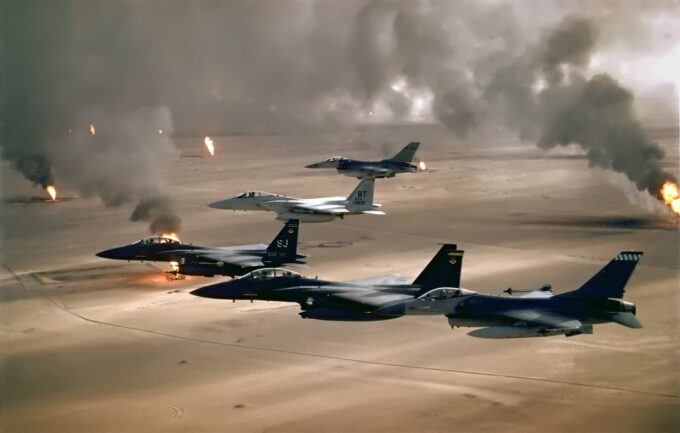
Photograph Source: US Air Force – Public Domain

The energy analyst known as Doomberg recently remarked on the Decouple podcast that ‘all wars are energy wars.’ From the decisive role energy access plays in combat itself (think oil in World War II), to its infrastructure being an inviting target, and its spillover effects for the global economy, it is hard to argue with that sentiment.

Since the U.S. and Israel began this war with Iran, there has been the Israeli attack on Iran’s piece of the South Pars natural gas field, Iran’s drone attack at the Ras Laffan Industrial City in Qatar- Qatar produces 20 percent of the world’s liquified natural gas (LNG) and the damage at Ras Laffan is expected to reduce production by 17 percent for five years. It was a $50,000 drone that hit the plant (back in 2019, it was another Iranian drone attack that hit the Saudi Aramco facility at Abqaiq, the largest oil processing facility in the world).

Lest the war happening in Europe be forgotten, the same week as the attack on Ras Laffan saw Ukrainian drones hit the Arctic Metagaz, a Russian LNG carrier transiting toward the Suez Canal. About a week ago, Reuters reported that at least 40 percent of Russia’s oil export capacity is at a halt. If the report calculations are correct, the shutdown is the most severe oil supply disruption in the modern history of Russia, the world’s second-largest oil exporter.

With the Strait of Hormuz tied up, the shifts in the price of oil have been daily headlines. The price at the gas pump is certainly one thing, yet much of Asia is dependent on LNG from the Middle East for its energy and the blockade is forcing many countries to consider further ramping up on coal and turning to Russian oil. Coal already accounts for over 40 percent of Asia’s energy. In the Philippines, more than 90 percent of energy imports come from the Middle East. President Ferdinand Marco Jr. recently declared a national emergency and for the first time in almost five years, Russian oil arrived in the country. South Korea, which relies almost totally on imported energy, lifted its 80 percent cap on coal installed capacity.  In Japan, where bus and ferry services across the country have been curtailed, coal could offset up to 70 percent of gas-fired power generation. Taiwan normally gets 30 percent of its LNG from Qatar and, since it has retired many of its coal plants, may suffer worse.

Slowing imports have strained distribution systems, prompting governments to prioritize household supply and restrict commercial use. The New York Times reports that ‘In India and Pakistan, shortage of liquefied petroleum has left millions unable to cook daily meals, forcing the closing of thousands of small businesses and restaurants.’ When analyzing social unrest across developing countries between 2000 and 2020, researchers at the IMF found a clear association between fuel price increases and protests.

As is widely known by now, the Strait of Hormuz is also a critical transit point for fertilizer exports. Several fertilizer plants in Bangladesh and Pakistan have shut down or scaled back production just as the planting season is getting underway. Prices haven’t yet hit the peak of the aftermath of the Russian invasion of Ukraine, but if the blockage goes on, nothing is out of the question. As for the oil market, Saudi Arabia has been shipping about 5 million barrels of oil a day from the Red Sea port of Yanbu, bypassing Hormuz. With the Houthis claiming they are now in the war, there is concern that the Red Sea will become another front- or the Iranians themselves could attack the port or the East-West pipeline that supplies it.

On one hand, fossil fuel companies can enjoy the inflated prices; but on the other hand, if prices stay high long enough it could lead to a loss of demand. It was getting shut out of the LNG market after Russia invaded Ukraine (along with many years of endemic blackouts) that made people in Pakistan interested in solar panels. In 2021, solar power provided only 4 percent of Pakistan’s electricity; by 2025, it was 25 percent.

Many an environmentalist, including David Wallace-Wells in the New York Times, has quipped, “Nobody ever started a war over solar panels.” It is a nice thought but actually, it’s not at all difficult to imagine solar panels being targets in future conflicts. In the midst of al of the above, it is certainly understandable for anyone to have missed a small story in the Wall Street Journal on March 9th with the title ‘Cobalt Plant Sickened Congo Town.’ The story describes how health workers near CMOC Group’s plant, a Chinese-owned cobalt processing plant that produced 41 percent of the world’s supply in 2024, saw a surge of local townspeople coughing up blood, suffering recurring nosebleeds, and experiencing coughs and chest pain- symptoms toxicology experts associate with sulfur dioxide exposure. The company, of course, denies the evidence. Most of its cobalt, which is extracted during copper mining in two large mines in Congo’s copper belt (Kisanfu and Tenke Fungurume), goes to China and Europe for EV batteries, but lithium-ion batteries (cobalt is often included in their cathodes) are also a premier choice for solar storage.

The awful reality of cobalt mining in Congo has received attention (see Nicolas Niarchos’ informative new book Elements of Power or Siddharth Kara’s Cobalt Red: How the Blood of the Congo Powers Our Lives), but the geopolitics can’t be overlooked either. We have already seen China flex its muscles with rare earth metals a couple of times. With much of the material needed for the energy transition controlled by Chinese entities, in both mining and, especially, refining, the U.S. is desperately trying to break the stranglehold.

The Brazilian government is hesitating to sign a mineral agreement with the U.S. over issues of where processing will be done and Brazil’s trade relations with China. Brazil has the world’s second-largest rare earth reserves. This past December, a deal brokered by the Trump Administration between the DRC and Rwanda gave privileged access to U.S. mining companies. On March 31st, the Wall Street Journal reported that U.S.-based Virtus Minerals finalized a purchase of the assets of Congolese company Chemaf, which accounts for about 5 percent of global cobalt production. The U.S. also invested $553 million in the Lobito Corridor, a railway from Congo’s copper belt to Angola’s Atlantic coast for faster shipping to the U.S. In February, Orion CMC, a consortium that includes the U.S. government, signed a memorandum to take a 40 percent stake in Glencore’s DMC assets (Glencore is one of the world’s largest mining companies).

Mining can’t be turned on and off like a light switch. In fact, the lag between discovery and an operational mine has gotten longer, now averaging about 12.4 years across a wide range of sectors. Hence, when was the last time anyone heard of that rare earth deal with Ukraine or conquering Greenland? However, the firm Benchmark Mineral Intelligence estimates that between 336 and 384 new mines for minerals like lithium, cobalt, nickel, and graphite will be needed to meet demand by 2035. Is it really out of the question that all this scrambling could spill over into actual combat?

The point is this energy transition, if ‘transition’ is even the correct description, has many of the same features as previous ones. As activists push for greener energy, other standard fights aren’t going away. Workers’ rights need to be demanded and fought for throughout supply chains. The rights of local communities to both benefit from and resist resource extraction are vital. Public funding for scaling up battery recycling efforts and developing less resource-intensive materials will only get more important.

As another war rages in the Middle East, with a U.S. president blathering on about ‘taking oil’, such battles are more relevant than ever.

Joseph Grosso is a librarian and writer in New York City. He is the author of Emerald City: How Capital Transformed New York (Zer0 Books).