Wednesday, April 15, 2026

Drinking Water Near Coasts Is Under Threat Worldwide


By 

Coastal groundwater is a key source of drinking water in many regions of the world. However, it is threatened by over-abstraction and the potential for salinization. Rising sea levels are further exacerbating the situation. This is demonstrated by a recent study published in Nature Water by a research team led by Professor Robert Reinecke from the Institute of Geography at Johannes Gutenberg University Mainz (JGU) and Annika Nolte from the Climate Service Center Germany (GERICS) in Hamburg.

“Between 1990 and 2024, more than 20 percent of the coastal areas we studied showed significant changes in the groundwater level. In some cases, levels have dropped by more than 50 centimeters per year. This points to over-abstraction and, consequently, the potential intrusion of seawater and associated salinization,” explained Professor Robert Reinecke. The interaction between over-abstraction and rising global sea levels due to global warming is particularly critical: “If groundwater levels drop, seawater can intrude more easily.”

Data from about 480,000 wells 

The study is based on data from approximately 480,000 wells across different countries, compiled by the researchers, making it the largest global dataset of coastal groundwater measurements to date. “Our study makes three key contributions. First, it translates available measurement data from different locations into globally comparable metrics, enabling large-scale assessment for the first time. Second, it identifies areas at particular risk and highlights the changes occurring there. Third, it provides indicators that can be used to model developments along previously unmonitored coastlines,” said Reinecke.

Changes in groundwater levels in the affected areas vary considerably: levels have risen in some locations, while in others they have declined. However, since 2016, researchers have observed an overall increase in declining groundwater levels. “The extent of groundwater-level change varies significantly, even on a small scale within many regions,” said Reinecke. Falling levels have been observed primarily along the coasts of the United States and Central America, the Mediterranean region, South Africa, India, and southern Australia.

The study also examined where coastal groundwater is particularly vulnerable to saltwater intrusion.

“Coastal areas where the groundwater table is close to sea level are especially at risk, as are arid regions where populations rely heavily on groundwater. Our study provides global evidence that coastal groundwater is threatened by salinization and must be prioritized for monitoring and management,” emphasized Reinecke. “Over the next 50 years, drinking water shortages could arise in all coastal areas of the world.”

This poses risks not only to the water supply of coastal populations – accounting for more than 30 percent of the world’s population – but also to local food production and ecosystems.


Whales Go Quiet During Noisy Underwater Surveys


By 

A new study has shown that whale calls can reduce by as much as 50 per cent in response to seismic surveys, which are commonly used to find oil and gas reserves.

Researchers are worried that such surveys could impact vulnerable marine species, which rely on sound for communication, navigation and foraging.

The paper, published in Scientific Reports, reveals how fin whale calls dropped dramatically along a key migratory corridor off northwestern Spain during seismic surveying.

The technique involves air guns shooting compressed air in powerful, loud, repeated bursts. Sound waves travel through the water, into the seabed, and bounce back to create a picture of the geological structures below.

The sound is one of the loudest human-made noises in the ocean and can travel more than three thousand kilometres from ships conducting the surveys

“Fin whales exhibit a range of whale calls that we think are related to important mating and social behaviours,” says Amy Feakes, a postgraduate researcher at the University of Southampton who co-led the research with masters student Elodie Edwards.  

“Despite significant concern about how these surveys might disrupt their calls, there have been very few studies and limited evidence available until now.”  

Researchers studied underwater recordings from three sites over 63 days to investigate how whale calls differed during periods of ‘shooting’ compared to quiet intervals when the ship was in port for repairs.

Using machine learning to identify and log the whale calls, the team found the number of calls dropped by an average of 70 per cent across the three sites during shooting periods.

Some calls would have been masked by the sound of the shots, but even when accounting for this effect, the decrease was still 52 per cent.

“We don’t know whether the whales reduced their vocalisations, moved away from the survey area, or did a combination of both,” says Professor Tim Minshull, also from the University of Southampton.

“Given the widespread use of seismic surveys and their capacity to propagate sound over long distances, these findings start to illuminate the potential impacts on fin whale communication, energy expenditure and habitat use.”

Researchers say the timing, intensity, and coverage of seismic surveys in areas important for whales need to be carefully considered to aid conservation efforts.

Exclusion zones, seasonal restrictions or using quieter seismic exploration technologies could also help reduce disruption to whale populations.

How Black Holes Light Up The Dark

Artist’s depiction of a supermassive black hole tearing apart a star, with roughly half of the stellar debris flung back into space while the remainder forms a glowing accretion disk around the black hole. CREDIT: DESY, Science Communication Lab

April 15, 2026 
By Eurasia Review

Supermassive black holes are among the most enigmatic objects in the universe. They typically weigh millions or even billions of times the mass of the Sun and sit at the centers of most large galaxies. At the heart of the Milky Way lies Sagittarius A*, our Galaxy’s supermassive black hole, with a mass of about four million Suns. But these black holes do not emit light, so astronomers can only detect them indirectly through their effects on nearby stars and gas.

In a new study published in the The Astrophysical Journal Letters, Eric Coughlin, assistant professor of physics in Syracuse University’s College of Arts and Sciences, and colleagues clarify what happens when a star wanders too close to one of these black holes and is torn apart.

When Black Holes Capture Stars

A star “ingested” by a supermassive black hole does not simply vanish in a single gulp. Instead, the black hole’s gravity tears the star into a long, thin debris stream. Over time, the debris stream wraps around the black hole – an effect that ultimately arises from Einstein’s General Theory of Relativity; gravity according to Newton does not produce this effect. When parts of that circling stream crash into one another, they release a burst of energy and subsequently “accrete,” or slowly spiral into, the black hole. Both of these effects – the initial collision and the subsequent accretion – produce so much radiation that they briefly outshine the entire galaxy in which they occur (i.e., ~ 1 trillion Suns).

Astronomers refer to these events as tidal disruption events, or TDEs. TDEs offer one of the few ways to study supermassive black holes like Sagittarius A* in other galaxies.

“We can study tidal disruption events to learn more about black holes hidden from view,” says Coughlin.

For years, TDEs have fascinated researchers because each of these massive flares is like a fingerprint. By measuring how a flare rises, peaks and fades, scientists can infer properties of the black hole that produced it, including its mass and perhaps its spin. But the details of how these flares form have remain
ed difficult to pin down, in part because the process is hard to simulate accurately.


Seeing the Debris Clearly

That is where new high-resolution simulations are changing the picture. Recent work by a team led by Lucio Mayer at the University of Zurich, including Coughlin, uses a methodology known as smoothed particle hydrodynamics, which decomposes a star into “particles” that interact with one another hydrodynamically (i.e., according to the Navier-Stokes equations – the same fundamental equations that govern the flow of water through a pipe). Their study employed tens of billions of particles to model the disrupted star’s gas in unprecedented detail. The result is a superior view of what happens after a star gets ripped apart. Rather than dispersing chaotically, the debris forms a narrow, coherent stream that follows a predictable path around the black hole before crashing into itself.

Their finding supports a long-standing theoretical prediction. Earlier simulations often mis-characterized the stream’s structure because they lacked the resolution to capture such fine detail, leading to a “spraying” of the stellar debris and unexpectedly high levels of fluid-dynamical dissipation. With far more particles and through the exploitation of graphics processing units (GPUs) on powerful supercomputers, the shape of the debris becomes much easier to see.

But the new models also reveal something else.


The Spin Factor

Three properties of a supermassive black hole and the stellar orbit can influence the outcome of a given TDE: the black hole’s mass, how fast it “spins,” and the orientation of that spin relative to the orbital plane of the incoming debris. Together, they may determine when the flare begins, how bright it becomes and how long it lasts.

If the black hole is rotating, it induces additional variation in the spacetime around it compared to a non-spinning black hole and produces an effect known as “nodal precession.” This effect may shift the debris stream out of its original plane, meaning the stream may miss itself after one orbit, then miss again before finally colliding. In some cases, the flare may be delayed by several loops around the black hole.

That complication may help explain one of the enduring puzzles of TDE research. No two events look exactly alike. Some rise quickly and fade fast. Others unfold more slowly. Some are brighter, some dimmer. Some behave in ways that are still hard to classify. While differences in the mass of the black hole could account for some of these differences, these new simulations suggest that black hole spin may be one of the key reasons for that diversity.

TDEs turn invisible objects into readable signals. A star gets shredded, debris collides, light emerges and a previously hidden black hole is revealed. With better simulations and more powerful telescopes, astronomers are learning how to read those signals more clearly than ever before.
VIDEO

Lost 19th Century Film By Méliès Discovered At The Library Of Congress


Photographic portrait of Georges Méliès at 34, in 1895. Photo Credit: Wikipedia Commons, retouched


April 15, 2026
 Library of Congress
By Neely Tucker

The reels of film were old and battered and no one knew what was on them.

They were from before World War I and had been shuttled around from basements to barns to garages and had just been dropped off at the Library. There were about 10 of them and they were rusted. Some were misshapen. The nitrate film stock had crumbled to bits on some; other strips were stuck together.

The librarians peeled them apart and gently looked them over, frame by frame.

And there, on one film, was a black star painted onto a pedestal in the center of the screen. The action was of a magician and a robot battling it out in slapstick fashion. It took a bit, but then the gasp of realization: They were looking at “Gugusse and the Automaton,” a long-lost film by the iconic French filmmaker George Méliès at his Star Film company.

The 45-second film, made around 1897, was the first appearance on film of what might be called a robot, which had endeared it to generations of science fiction fans, even if they knew it only by reputation. It had not been seen by anyone in likely more than a century. The find, made last September but now being announced publicly, is a small but important addition to the legacy of world cinema and one of its founders.Gugusse et l’Automate English language title: Gugusse and the automaton

“This story is one that you see movies or television shows written about,” says Jason Evans Groth, curator of the Library’s moving image section.

“This is one of the collections that makes you realize why you do this,” said Courtney Holschuh, the archive technician who unraveled the film. (Here’s how they did it.)

Equally delighted was Bill McFarland, the donor who had driven the box of films from his home in Grand Rapids, Michigan, to the Library’s National Audio-Visual Conservation Center in Culpeper, Virginia, to have the cache evaluated.

His great-grandfather, William Delisle Frisbee, had been a potato farmer and schoolteacher in western Pennsylvania by day, but by night he was a traveling showman. He drove his horse and buggy from town to town to dazzle the locals with a projector and some of the world’s first moving pictures.

He set up shop in a local schoolroom, church, lodge or civic auditorium and showed magic lantern slides and short films with music from a newfangled phonograph. It was shocking.

“They must have been thrilled,” McFarland said. “They must have been out of their minds to see this motion picture and to hear the Edison phonograph.”

A Méliès film would have been an unforgettable experience to almost anyone in the 19th century.

A prominent French stage magician, he turned to filmmaking as soon as he saw the Lumière brothers’ world-first motion pictures in Paris in 1895. That a camera could rapidly project a series of still images on film and thus make them appear to move – “motion pictures” – was seen as a magic trick unto itself.

Méliès built his own camera and a glass studio (like a greenhouse) in Paris. He filmed ordinary scenes at first, but after accidentally discovering that a jump cut appeared on film as an astonishing transformation, he pioneered other tricks such as double exposure, black screens and forced perspective. All of these became staples of cinema. On screen, he could make a man appear to take off his head and flip it in the air, or a woman disappear, reappear and double.

He was also a devotee of the science fiction work of Jules Verne and H.G. Wells, and his films often featured surreal, fantastical sets and manic action. An image from his most famous film, “A Trip to the Moon” – that of a rocket landing in the eye of the man on the moon – became the image representing early cinema. It now plays at the Museum of Modern Art in New York. His 1896 short, “Le Manoir du Diable,” is considered to be the world’s first horror film.

More than a century later, his lasting impact was exemplified in Martin Scorsese’s 2011 film “Hugo,” about a boy and an automaton in 1931 Paris. An elderly Méliès – by then, as in real life, a toy-shop owner largely forgotten by the world – appears as the boy’s soft-spoken savior.


“Gugusse,” for its part, is a one-shot, one-reel short filmed in front of a painted screen made to look like a workshop in which clocks and automatons were being made. For centuries, inventors and engineers had made wind-up automatons – contraptions full of gears and levers with a shell that looked like a person – that could, as the gears unwound, do all sorts of things, even writing and drawing.

In “Gugusse,” the magician (Méliès), winds up an automaton dressed like the famous clown Pierrot, which is standing on a pedestal. Once wound up, the clown begins to beat the magician with his walking stick. The magician retaliates by getting a huge sledgehammer and bashing the automaton over the head, with each blow seeming to shrink it in half, until it is just a small doll. The magician then smashes it into the floor.


Méliès made more than 500 films but never progressed beyond his early technical achievements. The film world passed him by. In World War I, the negatives for most of his films were melted down for silver and celluloid, and he burned more himself after the war.

But because his work had once been so popular – and because of widespread pirating – duplicate copies remained, and today about 300 of his films are known to exist. The Library has about 60. The “Gugusse” print McFarland gave to the Library is a duplicate at least three times removed from the original.

Library technicians spent more than a week scanning and stabilizing it onto a digital format, so that it can now be seen by anyone online – in 4K, no less.

The cache of Frisbee’s exhibition films also contained another well-known Méliès film from 1900, “The Fat and Lean Wrestling Match,” as well as fragments of an early Thomas Edison film, “The Burning Stable.” They survived due to McFarland and his family preserving them for a century, if often in haphazard circumstances.

After Frisbee died in 1937, two small trunks of his old projectors and films, along with some of his diaries and papers, went to his daughter (McFarland’s grandmother), who passed them along to her son (McFarland’s dad), who passed them along to him.

McFarland didn’t know what was on the reels – they could no longer be safely run through a projector – and after years of searching for a home for them, a lab technician in Michigan suggested he contact the Library.


“The moment we set our eyes on this box of film, we knew it was something special,” said George Willeman, the Library’s nitrate film vault leader.

McFarland, relieved to have finally found a home for his family’s treasure chest, found it all fascinating, the films and the diaries of his wandering showman of a great-grandfather.

“He talks about full houses, and rowdy houses, and canceled shows, and he went all the way to the Pennsylvania-Maryland line, and I think into Ohio as well,” he said. “He made as much as $20 bucks a night, I see in his records, and sometimes he made $1.35 for the night, you know?”

It was, this deep dive into the old boxes and trunks in the attic, a magic trick known to researchers, historians and librarians – documents from another time drawing you back into a world gone by.


This article was published by the Library of Congress

The Library of Congress is the largest library in the world, with millions of books, films and video, audio recordings, photographs, newspapers, maps and manuscripts in its collections. The Library is the main research arm of the U.S. Congress and the home of the U.S. Copyright Office.


Inside the fireproof vault housing US movie history


By AFP
April 15, 2026


The highly combustible nitrate film used from the dawn of cinema in the 1890s until the early 1950s has a permanent home in a vault run by the Library of Congress - Copyright AFP/File Ina FASSBENDER


Matthew PENNINGTON

Once upon a time in the golden days of Hollywood, the movies were bigger, the stars brighter and the celluloid they were filmed on was, well, explosive.

Which is why the US Library of Congress maintains a special, fireproof vault in Virginia, near Washington, DC.

There, the highly combustible nitrate film used from the dawn of cinema in the 1890s until the early 1950s has a permanent home, rarely accessed by the public but toured by AFP.

Lost movies on the volatile but durable medium are still being discovered and preserved in the facility. And thanks to digitization, the lost treasures can also be safely viewed for the first time in decades.

Some 145,000 film reels are stored in strictly fireproof conditions in a vast, chilly vault at the library’s National Audio-Visual Conservation Center in Culpeper, Virginia.

It is crammed with cinematic treasures that rekindle warm memories of an era when movies ruled.

The vault’s leader, George Willeman, reeled off the names of classics with negatives there: “Casablanca,” Frank Capra-directed films like “Mr. Smith Goes to Washington,” and the grand-daddy of all action movies, “The Great Train Robbery” from 1903.

Down a spartan corridor so long it seemed to recede into the distance, he unlocked a series of cell-like steel doors.

Inside each of the 124 cells — there’s one dedicated just to the Disney archive — were floor-to-ceiling cubby holes.

Each one held film canisters containing negatives and prints, all arranged meticulously: packed tight to prevent canisters from opening, but far enough apart to prevent any fire from spreading.

Since being set up in 2007 in a former US Federal Reserve building in the foothills of the Blue Ridge Mountains, the vault has maintained a perfect no-fire record.

– Film nerds’ delight –

Nitrate film is just part of the center’s collection of more than six million items of moving images and recorded sound. They also have supporting scripts, posters and photos.

Willeman, who sports a button badge with the invocation to “Experience Nitrate,” said the Library of Congress began preserving the medium when in the 1960s, “it was discovered that so much film was being lost” due to fires and defunct companies throwing negatives away.

With the American Film Institute, the library began collecting and copying nitrate film, including the holdings of big Hollywood studios – RKO, Warner Brothers, Universal, Columbia and Walt Disney.

They also tapped the personal collections of film icons like movie impresario and silent era star Mary Pickford and motion pictures inventor Thomas Edison, whose early studio produced hundreds of films.

“We’re 50 some years in, and it (the collection) just keeps growing,” Willeman said.

With the arrival of digital media, the mission has expanded beyond preservation for purists and cinema historians — who say movies just look better on nitrate footage — to putting old films online.

“Now we can make them available for everybody, which to me, being the film nerd I’ve been since, like, third grade, is just amazing.”

Nitrate film made by early artisans often preserves better than the later safety film, said Courtney Holschuh, nitrate archive technician.

At a workstation with no light bulbs or exposed batteries — either of which could ignite dust or gas from vintage film — Holschuh recounted how last September she carefully peeled apart a cache of 10 vintage reels donated by a retired schoolteacher.

There were 42 different titles on the reels — only 26 of which have been identified. They included a lost film, “Gugusse and the Automaton,” by French cinema pioneer Georges Melies.

“So much of our early film history is still out there for us to see and to experience,” Willeman said.


Developing countries skip landlines and go straight to mobile phones - OWID

MOBILE COMPUTERS


Developing countries skip landlines and go straight to mobile phones - OWID
Many emerging markets are leapfrogging over landline telecoms networks and going straight to mobile phones / bne IntelliNewsFacebook
By Hannah Ritchie for Our World in Data April 14, 2026

The concept of “leapfrogging” is popular in development. It suggests that, as they develop, lower-income countries can skip intermediate technologies or systems and go straight to the modern equivalent, Our World in Data  (OWID) reports.

One example of this is the use of landlines and mobile phones.

The landline telephone was invented in 1876 and became a dominant form of communication across Europe and North America. As you can see in the chart, it was increasingly adopted in the United States and the United Kingdom throughout the 20th century.

However, mobile phone adoption increased rapidly in the 1990s, and landlines have declined since the millennium. Mobile phones have become a substitute.

But many countries have almost skipped landline adoption entirely. Ghana and Nigeria are good examples: landline subscriptions have remained extremely low, and instead, mobile phone adoption has exploded.

Explore landline and mobile subscriptions in more countries.

Where elections are seen as fair or flawed - OWID

 You will find more infographics at Statista


By Anna Fleck for Statista April 14, 2026

US President Donald Trump signed an executive order earlier this month directing the Department of Homeland Security and the Social Security Administration to compile lists of US citizens eligible to vote in each state, Statista reports. The order also instructs the US Postal Service to send mail ballots only to individuals included on those lists.

More than 20 Democratic-led states and the District of Columbia have since filed a lawsuit seeking to block the measure from taking effect. Trump, who recently cast a ballot by mail in a special election in Florida, has repeatedly claimed that the United States faces significant issues with fraud related to mail-in ballots.

However, multiple studies have found that voter fraud in the United States is extremely rare. In global comparisons, the country also scores highly on measures of electoral integrity. According to the 2025 Free and Fair Elections Index, produced by the Varieties of Democracy, the US receives a score of 0.9 out of 1. While 34 countries rank higher - including Belgium, Norway, Australia, Germany and Spain - the US remains among the top performers overall

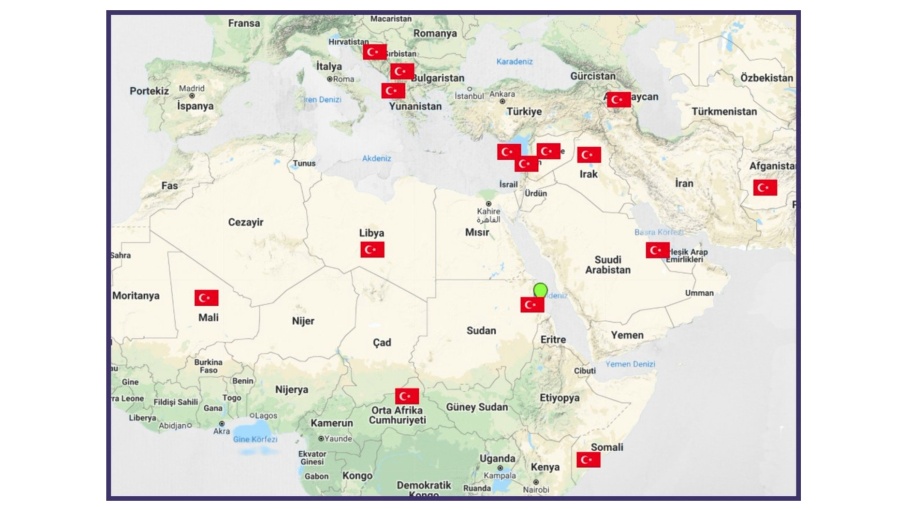
Turkey has the second most foreign military bases in the world after the US

Turkey has the second most foreign military bases in the world after the US
Turkey has the second most military bases in the world after the US with 133. most large powers have less than a dozen. The US has 887. / bne IntelliNewsFacebook
By bne IntelliNews April 14, 2026

Turkey has emerged as the country with the second-largest number of foreign military bases in the world after the United States, and is the only Muslim-majority nation with a global military base network of this scale.

According to available figures, the United States maintains 887 foreign military bases worldwide, far exceeding any other country. Turkey follows with 133 bases, placing it ahead of several traditional military powers.

The United Kingdom ranks third with 117 overseas bases, reflecting its longstanding global military presence. Russia maintains 29 foreign bases, while India has established 20. Israel operates 14 bases abroad.

Turkey’s position is notable both for its scale and for its geographic reach, marking a significant expansion of its military footprint beyond its immediate region.


World leaders head to Beijing, as China becomes geopolitical fulcrum


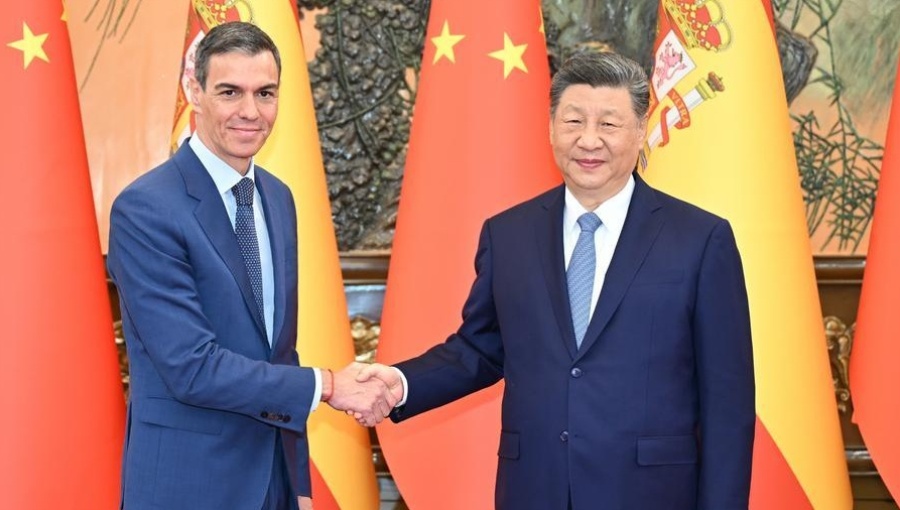
Spanish PM Sanchez met with Chinese President Xi in Beijing as Europe reassesses its relations with the US and turns to China as a counterweight. / bne IntelliNews

By Ben Aris in Berlin April 15, 2026


The Trump administration’s being ostracized by the international community for America’s war mongering. That is making China a fulcrum in the East-West clash that now has its centre of gravity in the Middle East. World leaders are flocking to Beijing to find a counterbalance.

Russia has long since been pushed into China’s arms, thanks to the extreme sanctions imposed following the invasion of Ukraine, but now it is being joined by unlikely partners from Europe.

Spanish Prime Minister Pedro Sanchez made the trip to Beijing on April 14 to meet with Chinese President Xi Jinping and pledge closer ties in the face of the chaos in the current world order. Highlighting Beijing’s growing importance, Russian Foreign Minister Sergei Lavrov was also in Beijing the same day.

Sanchez has been amongst the most outspoken European critics of Trump’s war in the Middle East and refused the US permission to use its military bases to fly supplies to its forces. He has also called out Israeli Prime Minister Benjamin Netanyahu’s invasion of Lebanon, calling it illegal and demanding the arrest of the Israeli leader on the International Criminal Court (ICC) charges of war crimes. Spanish ministers have gone further, accusing Netanyahu of “genocide.”

Sanchez said on social media: "Today, with President Xi Jinping, I have confirmed that the bond between Spain and China emerges strengthened following this official trip. In a world that is increasingly uncertain, Spain is betting on a EU-China relationship based on trust, dialogue, and stability. We must continue advancing toward a multipolar order built from respect and pragmatism."

By referencing the “multipolar world order”, Sanches was acknowledging the geopolitical changes underway and the “rise of the rest”, as this has been a constant talking point for both Xi and Russian President Vladimir Putin who have objected to what they term the “unipolar order”, a US-led hegemony since the end of WWII.

That is a sharp reversal from earlier nervousness of China's increasing cloud in international politics and its growing dominance of key sectors such as renewable energy and EVs. But with the decades-old transatlantic special relationship between The US and Europe in tatters, moving closer to China has become more appealing.

Europe and China must forge closer ties to counter ​threats to multilateralism, Spanish Premier Pedro Sanchez said as the old international order is "crumbling".

Europe has been revising its attitude to China and Sanchez is only the latest in a string of top EU officials to have made the pilgrimage to the Chinese capital, including Britain, ​Canada, Finland, Ireland and France.

Xi has also hosted leaders from the Global South as the BRICS+ group continues to develop. In particular Prime Minister Narendra Modi made the visit as years of enmity are put aside and Beijing and New Delhi build a new pragmatic cooperative relationship as ties amongst the leading Global South nations deepen.

Spain has been one of Europe's loudest proponents of expanding trade ​and treating China as a strategic ally, rather than the economic and geopolitical rival seen by Trump. Sanchez called on XI to take a leading role on issues from climate change to security, defence and the fight against inequality.

On the business front, the Spanish leader said Beijing had agreed to measures to narrow his country's ​trade deficit with China. The trade gap has more than doubled in four years, reaching nearly $50 billion in 2025, and now accounts for three quarters (74%) of Spain’s total trade deficit -- a figure Sanchez called “unsustainable” in the long term.

He also signed several agreements with Premier ​Li Qiang, including expanded access for Spanish agricultural products to China and improving Spain's transport and infrastructure, without giving details, Reuters reported.

Sanchez also discussed the "grave situation" in Lebanon, Gaza and Ukraine ​during his meeting with Xi. China has had its own showdown with Trump in the Strait of Hormuz refusing to heed the naval blockage imposed by the US on April 13. Two Chinese flagged ships ran the gauntlet a day earlier and successfully exited the Persian Gulf without the US stopping them.

China has played an important role in trying to bring the conflict to an end. As the biggest buyer of Iranian oil Beijing has a lot of sway over Tehran and pushed it to make concessions in the Islamabad Accord talks on April 12.

"The role China can play is important in order to find diplomatic means that end this war and contribute to stability and peace," Sanchez said. "All nations, especially those which are in dialogue and have not actively taken part in this illegal war, are not only welcome, but are also absolutely necessary," Sanchez added. This is his fourth visit to China in just over three years.

The Chinese president called for a "comprehensive and lasting" ceasefire in the Middle East, stressing that the solution to the crisis must be found through political and diplomatic means.

Lavrov laying the foundations for the multipolar world

To highlight just how multipolar China is, Beijing also received Russia’s foreign minister on a work visit with his counterpart. Lavrov met Chinese Foreign Minister Wang Yi to discuss closer strategic alignment and criticise western policies during the opening session of talks.

Lavrov said preparations were under way for another meeting between Putin and Xi as “there are specific schedules for upcoming contacts” on the agenda. Since Xi became China’s president in 2013, the two have met more than 40 times in bilateral and multilateral settings.

Lavrov said that Moscow and Beijing intended to develop “concrete steps” to advance Xi’s global security initiatives alongside Putin’s proposals for a Eurasian security architecture – ideas the two presidents laid out in detail in a 8,000 word essay last year.

The Russian foreign minister accused European countries of planning “to form a new aggressive bloc involving Kyiv and direct it against Moscow”. He further said that “the West is artificially escalating the situation around Taiwan and on the Korean Peninsula”.

Wang said ties between the two countries continued to deepen, stating that “Russo-Chinese interaction continues to strengthen”. He added that both sides should “take advantage of the historic opportunity” to elevate their strategic partnership.

“Russia and China fully synchronize their positions and mutually support each other in international affairs,” Wang said.
Senate Republicans are ready to replace Alito — before the midterms: report


U.S. Supreme Court Justice Samuel Alito attends an event organized by the U.S. Embassy to the Holy See, in Rome, Italy, September 20, 2025. REUTERS/Vincenzo Livieri

April 14, 2026 
ALTERNE

Supreme Court Justice Samuel Alito, 76, has given no public indication he plans to retire — but if he does, Senate Republicans stand ready to fast-track President Donald Trump’s nominee through committee and lock in a confirmation before the November midterm elections.

“Senate Majority Leader John Thune (R-SD) told the Washington Examiner on Tuesday that Republicans are ‘prepared’ for the possibility of a retirement as speculation swirls that Alito, a conservative vote on the Supreme Court, is weighing stepping down at the end of the current term, slated for the end of June or early July,” the Washington Examiner reports.

“That’s a contingency, I think, around here you always have to be prepared for,” Thune said. “And if that were to happen, yes, we would be prepared to confirm.”

Alito is thought to want to avoid a similar repeat of events when liberal Justice Ruth Bader Ginsburg eschewed requests from the left to retire during President Barack Obama’s term. Republican President Donald Trump was able to fill her seat upon her death with a conservative, changing the balance on the Court.

Justice Alito is not the court’s oldest justice — that distinction belongs to Justice Clarence Thomas, 77, who has given no public indication he plans to step down either.

“I hope they stay ’cause I think they’re fantastic, OK?” Trump told Politico in December 2025, referring to both Alito and Thomas. “Both of those men are fantastic.”

Should Alito or Thomas — or both — retire, Trump could secure a conservative majority, possibly for decades to come. Chief Justice John Roberts, also a conservative, is 71 and is not rumored to be seeking retirement.

The three remaining conservative justices Trump placed on the court during his first term. Amy Coney Barrett is 54, Brett Kavanaugh is 61, and Neil Gorsuch is 58.


The three liberal justices are Sonia Sotomayor, 71, Elena Kagan, 65, and Ketanji Brown Jackson, 55.
Conservative accuses Trump of 'Mind-boggling' vendetta against NFL


'Draw the line': NFL veterans rage against Trump using their image to sell his war
April 14, 2026
ALTERNET

President Donald Trump is pursuing an antitrust case against the National Football League (NFL) — but an editor from a magazine one might expect to support him instead implied this is about a vendetta.

The Justice Department is investigation whether the NFL uses anti-competitive tactics to keep watching football too expensive, and Reason Magazine managing editor Jason Russell suspects this has little to do with consumer protection

“Could it be because President Donald Trump tried to get into NFL ownership several different times and came up short?” wrote Russell on Tuesday, adding that Trump tried and failed to buy the Baltimore Colts, Dallas Cowboys, New England Patriots and Buffalo Bills at various points between 1981 and 2014, and even successfully purchase a football team (the United States Football League’s New Jersey Generals) in 1983 — but in a league that eventually folded.

“No one is entitled to watch the NFL,” Russell wrote. “If someone decides a game is too difficult or costly to watch, no one dies or suffers anything other than very minor entertainment-related harm. (The league, it's worth noting, is actually one of the easiest to watch, ‘with over 87 percent of our games on free, broadcast television, including 100 percent of games in the markets of the competing teams,’ according to a league spokesperson.)”

Russell added, “Watching sports on broadcast TV instead of streaming platforms is not some sacrosanct human right that needs to be protected by the federal government. As we prepare to celebrate the 250th anniversary of America's founding, it is mind-boggling to be at the point where ‘Should a sports league be allowed to put more games on streaming platforms?’ is a real question that the Justice Department and the FCC are spending their time on.”

Trump has had other recent feuds with the football world. Last month former football players Kenny Bell of the University of Nebraska and Tampa Bay Buccaneers linebacker Mason Foster expressed dismay that images of them playing were used to promote the US military’s recent wars without their consent.

“I’m at a loss for words,” Foster told The Washington Post. “It’s a strange feeling, seeing those clips like that. I don’t think anything going on in the world today is as simple as a great football play or a hit. I’m still wrapping my head around it. ... When people are losing their lives, I don’t think it can compare to a game.”

Both Bell and Foster said the White House has not obliged their requests to remove the video and that they believe the NFL, which holds the rights, should use the courts if the president does not do so.

Trump appears to be sensitive to his rising unpopularity, even in the football world. During Super Bowl LX in Santa Clara, California in February, Trump reportedly declined to attend because his advisers feared he would be booed en masse, and that this "would instantly create a wealth of viral video clips and media coverage that administration officials would prefer to avoid."

"[Booing is] another thing we don’t want right now," the adviser anonymously told Zeteo.