Wednesday, April 15, 2026


Content warfare, AI slop and 80s French hits: Is Iran out-trolling Donald Trump?

Content warfare and AI 80s French hits: Is Iran out-trolling Trump?
Copyright AP Photo - screenshot X Iran Embassy SA

By David Mouriquand
Published on 

Iran has been turning Donald Trump’s own communication tactics against him with a series of AI-generated videos which have taken the internet by storm. A recent example features a cover of a French hit from the 80s and has raked up more than 8 million views since its publication...

Welcome to the age of online content warfare. We’d rather be in any other timeline.

Ever since Donald Trump launched the war on Iran with joint US-Israeli airstrikes on 28 February, Iran has trolled the White House with a barrage of AI-generated propaganda videos.

These clips have featured Lego-style figurines, “LOSER” and “Get lost Goldilocks” slogans over gangster rap beats, Trump as Captain Jack Sparrow in a new feature film presented by “Pedoflix”... It's seemingly never-ending slop designed to give Trump a taste of his own medicine.

Indeed, Trump has heavily relied on AI-generated visuals and pop culture pilfering antics to ridicule his political adversaries and marginalised groups – something Kurt Sengul, a researcher at Macquarie University in Australia, ferred to as “memetic warfare” when speaking to Euronews Culture.

The troller-in-chief has shared rage-baiting videos and images of himself as the next Popea jediSuperman, a king dumping feces over protesters and Jesus – a recent image which has drawn criticism from his own MAGA base to prominent members of the Catholic Church.

Now, he’s being hoisted with his own AI-sloppetard, courtesy of a group of pop culture savvy activists creating satirical content which is resonating online, judging by the millions of views.

The X page for Explosive Media, subtitled “Iranian Lego-style animation team. Fast, Instant, Explosive”, produce their Trump-trolling efforts which speak to a huge audience. In their propaganda videos, they demonstrate their literacy when it comes to Western cultural references and aesthetics.

Some are irked by this 21st century online warfare, as the videos make light of a real war with immense loss of lives; some official government accounts have shared these AI videos, responding in kind to the White House posting a video of real American attacks spliced with clips from movies and video games.

The most recent example is an AI-generated, 80s-style music video shared by the Iranian embassy in South Africa, featuring Donald Trump singing about the Strait of Hormuz blockade - all soundtracked to a cover of the 1989 hit song ‘Voyage, voyage’ by French singer Desireless.

The video, mocking the blockade of the Strait of Hormuz ordered by a mullet-sporting Trump, is titled ‘Blockade, blockade’. It features lyrics like “I will never give you up / The Strait of Hormuz must be shut” and “Blockade, blockade / I thought this was easy-peasy / Now MAGA & Melania leave me / Surrender is beneath me.”

As of writing, it has racked up 8.6 million views, showing that this trolling communication strategy is depressingly effective.

Once again, videos like these mirror the style of those shared by the White House and Trump on Truth Social, and show that Iran has understood its adversary. At least understood how attention economy works.

A sad indictment of modern geopolitical communication? Without a doubt.

Has Trump been completely outmanoeuvred in the trolling wars he started? At least, he’s been matched.

As for the ‘Voyage, voyage / Blockade, blockade’ video, Desireless singer Claudie Fritsch-Mentrop has spoken out, and she’s not best pleased at being cast as a propaganda tool.

“I've had it all,” she told French broadcasters BFMTV, adding: “I refuse to let anyone use my song without my consent, let alone politicians.”

The less said about the fact that those behind the video probably didn’t pay royalties, the better.

The slopaganda wars continue... And if anyone knows the entrance to the alternative dimension poet ee cummings was referring to when he wrote “there's a hell of a good universe next door; let's go”, do share.


Iran Says YouTube Is Trying to ‘Suppress the Truth’ By Banning AI Lego-Style Videos Mocking US-Israeli War


One expert said the videos have gone viral by “hitting on points of disaffection in the United States.”


A Lego-style animated video posted by the Iranian company Explosive Media mocks US President Donald Trump and Israeli Prime Minister Benjamin Netanyahu on March 7, 2026.
(Screenshot from a video by Explosive Media)

Stephen Prager
Apr 14, 2026
COMMON DREAMS

Iran’s foreign ministry is accusing YouTube of trying to “suppress the truth” by banning the account responsible for a series of viral Lego-style animations mocking the US-Israeli war.

The small team known as Explosive Media has racked up tens of millions of views across several platforms, with slickly produced music videos mercilessly lampooning the Trump administration and glorifying Iran’s struggle against the US and Israel’s attacks that began at the end of February.


Viral Parody Video Exposes Absurdity of Trump’s Illegal Iran War


Trump White House Pushes Satellite Firm to Withhold All Images of Iran War

Last week, Explosive Media had its channel suspended from YouTube for “violent content,” which its owners disputed. “Are our LEGO-style animations actually violent?” the group asked on social media.

On Monday, Esmaeil Baghaei, the spokesperson for Iran’s Ministry of Foreign Affairs, joined the criticism of the ban.

“In a land that proudly hosts Pixar, DreamWorks Animation, and The Walt Disney Company, an independent animated YouTube channel—which had organically grown by depicting US aggression and warmongering, and garnered millions of viewers—was abruptly shut down!!” he wrote on social media.

“Why?!” Baghaei said. “Simply to suppress the truth about their ‘illegal war’ on Iran and shield the American administration’s false narrative from any competing voice.”


While Explosive Media’s content can no longer be viewed on YouTube—which is owned by Google—it appears unaffected on other major platforms like Instagram, X, and TikTok, where it has garnered millions of views.

The videos appear aimed at a US audience, often leaning into jokes and memes about the personal foibles of those leading the war.

They frequently reference the familiar accusation that President Donald Trump launched the war to distract from the growing scrutiny of his connections to the late multimillionaire sex criminal Jeffrey Epstein. Another video takes aim at Defense Secretary Pete Hegseth’s history of alcoholism and accusations of serial adultery and sexual misconduct.


The videos also portray a strident pro-Iran message. Following the announcement of a ceasefire last week, a video declared that “Iran won” the war. Others have shown Iranian missiles hitting the White House or heading toward Tel Aviv.

The videos also seize on growing domestic outrage over the US government’s devotion to Israel, which it implies is controlling Trump and dragging the US into a war against its interests. One video, uploaded last week, portrays Trump being literally walked like a dog by Israeli Prime Minister Benjamin Netanyahu.

“Your government is run by pedophiles. They ordered you to die for Israel,” repeats one video’s chorus.


A spokesperson for the team, who identified himself as “Mr. Explosive” in an interview with the BBC, has described his group as “totally independent.” But he did say that the Iranian government is a “customer,” implying possible collaboration.

Explosive Media has denied any links with the Iranian government. Responding to a journalist at The Associated Press who said the sophistication of the videos suggests government involvement, the group’s official X account replied, “We’ve told you—and other journalists—multiple times that we are independent. Yet you keep repeating the same false claim, insisting that we are connected to the government.”

It added: “Western media shows no real commitment to truth—they simply repeat their own baseless claims until they start to sound like facts.”


While the Trump administration often portrays the war as a clash of civilizations, the videos posted by Explosive show the American people in a sympathetic light.

Though the videos pull no punches toward their leaders, ordinary Americans are portrayed protesting the Trump administration or fearful about being sent to fight in a foreign war by an administration that promised to end such conflicts.

Polls show that the majority of Americans disapprove of the war and fear it escalating. Moustafa Ayad, a researcher with the Institute of Strategic Dialogue, told WIRED that the videos have likely gotten so much attention because they tap into this discontent.

“People are disengaging from some of the real conflict content and looking for something that can distill what’s happening quickly and in a language and tone that they understand, and that’s what those Lego videos are doing,” he said. “They’re making it easily accessible to understand the conflict from Iran’s point of view, and it’s hitting on points of disaffection in the United States at the same time. It’s working on two fronts.”
OpenAI announces restricted-access cybersecurity model


By AFP
April 15, 2026


The latest AI models have been able to identify security flaws - Copyright AFP SEBASTIEN BOZON

Artificial intelligence company OpenAI said Tuesday that it would release its latest cybersecurity model to a limited number of partners, after rival Anthropic also restricted release of a new system that uncovered thousands of vulnerabilities.

The restricted releases by two of the biggest names in the field reflect fears of an AI-enabled arms race between defenders and hackers, who could use the latest tools to cause havoc.

“Our goal is to make these tools as widely available as possible while preventing misuse,” OpenAI wrote in a blog post.

Anthropic offered its latest Claude Mythos model to just 40 major tech players last week in an initiative dubbed Project Glasswing.

OpenAI’s GPT-5.4-Cyber will be available to “the highest tiers” of people and organisations in its Trusted Access for Cyber (TAC) scheme.

That programme encompasses “thousands of verified individual defenders and hundreds of teams responsible for defending critical software,” the company said, without naming any of the partners.

Although not specifically trained for the field, Anthropic’s Mythos wowed many cybersecurity experts by uncovering vulnerabilities in widely-used software.

Some of them had gone unnoticed for years or even decades.

Media reported Friday that major American bank chiefs met US Treasury Secretary Scott Bessent and Federal Reserve Chairman Jerome Powell to discuss the system’s dangers to the financial sector.

The Mythos release followed several months of excitement in Silicon Valley about generative AI’s growing capability in producing and evaluating computer code.

Those same capabilities enable the models to find bugs and security flaws that could be exploited — although developers attempt to build in safeguards so their publicly available models will refuse malicious requests.

GPT-5.4-Cyber is “trained to be cyber-permissive” so that defenders can use it to test their own systems for vulnerabilities without encountering as many refusals, OpenAI said.

Anthropic said as it unveiled Mythos that its strict access limits were designed to give defenders a head start in fixing vulnerabilities before they could be exploited by attackers.

“We don’t think it’s practical or appropriate to centrally decide who gets to defend themselves,” OpenAI said Tuesday.

“Instead, we aim to enable as many legitimate defenders as possible” using “systems that can validate trustworthy users and use cases in more automated and more objective ways,” it added.


OpenAI firebomber was trying to kill boss Sam Altman: prosecutors


By AFP
April 14, 2026


The luxury home of OpenAI CEO Sam Altman was hit by a Molotov cocktail - Copyright GETTY IMAGES NORTH AMERICA/AFP/File Anna Moneymaker

A man who allegedly threw a Molotov cocktail at Sam Altman’s luxury California home was trying to kill the boss of artificial intelligence giant OpenAI and in possession of an anti-AI document, US officials said Monday.

The claims came as prosecutors levied federal charges against Daniel Moreno-Gama, 20, over the attack on Friday in San Francisco.

The Department of Justice said Moreno-Gama had travelled from his home in Texas to carry out the attack on Altman, whose company is behind the popular ChatGPT chatbot.

“Violence cannot be the norm for expressing disagreement, be it with politics or a technology or any other matter,” said Acting Attorney General Todd Blanche.

“These alleged actions -– which damaged property and could well have taken lives -– will be aggressively prosecuted.”

Prosecutors say that after lobbing a firebomb at the gates of Altman’s home, Moreno-Gama fled on foot to the San Francisco headquarters of OpenAI, where he tried to smash the glass doors of the building with a chair.

He “stated that he had come to burn down the location and kill anyone inside,” prosecutors said in the federal criminal complaint.

According to the complaint, when police arrived, they found Moreno-Gama with a jug of kerosene, a lighter and a document entitled “Your Last Warning” which “advocated against AI and for the killing and commission of other crimes against CEOs of AI companies and their investors.”

The three-part document was allegedly authored by Moreno-Gama, and listed “names and addresses that purported to belong to multiple CEOs and investors.”

Another part of the publication dealt with the “purported risk AI poses to humanity,” according to the compaint.

Prosecutors say he ended the document, which included an admission he was trying to kill Altman, with the phrase: “If by some miracle you live, then I would take this as a sign from the divine to redeem yourself.”

Moreno-Gama faces one charge of damage and destruction of property by means of explosives, and one of possession of an unregistered firearm.

It is the latest high-profile attack in the US allegedly involving a call to arms against executives or influential figures.

– Anti-AI protests –

No one was injured in the home and office attacks, which came as Altman’s profile has risen with the increasing use of AI and ethical concerns surrounding its use.

The CEO and his firm have become targets for people protesting the technology as a threat to society.

Detractors have been particularly troubled by OpenAI’s decision to provide its know-how to the US Department of Defense.

In a rare post on his personal blog in the aftermath of the attack, Altman shared a photo of his husband and their baby “in the hopes that it might dissuade the next person from throwing a Molotov cocktail at our house.”

The OpenAI chief defended his convictions and called for a de-escalation of rhetoric on the topic.

“I empathize with anti-technology sentiments and clearly technology isn’t always good for everyone,” Altman wrote.

“But overall, I believe technological progress can make the future unbelievably good, for your family and mine.”

OpenAI last month said it was valued at $852 billion after a funding round that raised $122 billion.

The figure reflects the surging costs of computing power and came amid lingering questions about whether OpenAI and rival companies can generate sufficient revenue to cover expenses.

ChatGPT claims the top position in consumer AI, with more than 900 million weekly active users and some 50 million subscribers.

Use of ChatGPT’s online search engine has tripled over the course of a year, according to OpenAI.
Czech govt draws ire with public media financing plan


By AFP
April 14, 2026


Thousands of Czechs rallied against the media financing switch in March - Copyright AFP Michal Cizek

The Czech culture minister angered the opposition and media freedom watchdogs with a plan presented Tuesday to fund public media from the state budget instead of fees paid by citizens.

Opponents argue the bill, due to take effect in 2027, would harm the independence of Czech TV and Czech Radio and make them vulnerable to influence by the government of billionaire Prime Minister Andrej Babis.

More than 200,000 people rallied against Babis’s government in Prague in March, with the media bill among their grudges.

“Our proposal cancels the outdated system of TV and radio licence fees,” Culture Minister Oto Klempir told reporters.

Klempir, a former rapper from the small rightwing eurosceptic Motorists party, insisted the new law had protections preventing politicians from meddling with the public media programme.

Klempir said that, while the two outlets’ budget would shrink between 2026 and 2027, the sum would annually be indexed to inflation, up to five percent, to “guarantee absolute independence”.

The bill must now be approved by the cabinet and both chambers of parliament before being signed into law by the president to take effect on January 1, 2027, as planned.

Babis’s three-party nationalist government vowed to cancel the licence fees when it took office last December.

Critics have accused Babis of trying to restrict media’s independence in a similar fashion as his allies, Slovak Prime Minister Robert Fico and Viktor Orban, Hungary’s outgoing premier who lost weekend elections.

“The government… is slowly but surely wiping out public media,” Martin Kupka, head of the rightwing opposition Civic Democrats, said on X.

Pavol Szalai, head of the Prague office of the Reporters Without Borders (RSF) watchdog, told AFP financing from the state budget threatened to “weaken the independence of the two outlets”.

“We do not think the pledge to index the payment by up to five percent is a sufficient guarantee,” he added.

Earlier this year, RSF spoke out against “any transition to state budget funding without equivalent safeguards and political consensus between government and opposition”.

Coalition lawmakers will also submit a proposal to exempt Czechs aged up to 26 and over 75 as well as companies from paying the licence fees before the media law takes effect.

“It’s a chaos which the government presents as a strategy,” said Szalai.
‘Fantastic feeling’: Sudan capital returnees relieved after three years of war

By AFP
April 15, 2026


Despite decimated infrastructure, those coming back to Khartoum were overwhelmed by the thought of seeing their city for the first time in years - Copyright AFP Ebrahim Hamid
Bahira AMIN

Sudanese pilot Mohamad Daafallah grins as he shakes hands with passengers after their landing at Khartoum Airport, exactly three years after it was bombed to shreds during the outbreak of war in Sudan.

The airport was one of the last footholds of the rival paramilitary Rapid Support Forces (RSF), where battles raged as the army launched an offensive last year to retake Khartoum.

A year after the army successfully recaptured the capital, authorities have refurbished a terminal to receive daily domestic flights from the Red Sea city of Port Sudan, allowing relieved residents to return home.

“It’s a fantastic feeling, to bring people home, to have our country back,” Daafallah told AFP, beaming with pride.

Khartoum’s city centre, once home to bustling markets, towering businesses and wealthy districts, remains a ghost town, a mass grave and a minefield.

But despite decimated infrastructure, those coming back were overwhelmed by the thought of seeing their city for the first time in years.

“I’m just so exhausted, I want to be home,” Bothaina, a septuagenarian poet dressed in a bright, flowing thobe, told AFP as the plane landed.

“I’ve wanted to be home for so long.”

Behind her on the runway lie the remains of some bombed-out planes.

The airport’s formerly charred and shattered terminals became symbols of the war when fighting broke out between the army and the RSF on April 15, 2023.

Port Sudan served as the government’s wartime capital as fighting raged, but has since become a layover for those eager to find a way back to Khartoum with no international flights running.

“Every morning, the flight from Cairo basically unloads straight onto the flight to Khartoum,” an airport worker told AFP.


– Ghost town –


Of the nearly four million people — around half Khartoum’s pre-war population — who fled during the conflict, more than 1.8 million have returned over the past year.

Yet fewer than 80,000 people have come back to central Khartoum, according to the United Nations.

A quick drive through downtown Khartoum leaves little to the imagination.

The battles went street by street, first in April 2023 when the paramilitaries swept through town, and again last year when the army and allied fighters forced their way back.

Nearly every building taller than four storeys — banks, government institutions and office blocks — looks the same: every window shattered.

Soot covers the structures from floor to roof while bullet-riddled facades overwhelm the city.

The thin spines of minarets are pockmarked with bullet holes, leaving the sky visible through them.

Between the verdant banks of the Nile, a vital bridge connecting Khartoum with twin city Omdurman has its middle chunk missing, the result of an air strike to cut off the RSF.

Even as officials push a reconstruction agenda, thousands of explosives still litter Khartoum.

Mine clearance teams work every day, but the sheer scale left behind is more than they could handle in a year.

Reliable electricity and water services still haven’t returned to much of the city.


– ‘Toxic legacy’ –


The UN Environment Programme warned on Wednesday that “stagnant pools of water and sewage have become breeding grounds for malaria-carrying mosquitoes”.

A “toxic legacy” has been left in Khartoum, it said, “threatening to sicken and kill for years to come”.

There is no confirmed death toll from the war, but authorities say more than 20,000 bodies have been exhumed and reburied in Khartoum.

Many were pulled from mass graves or makeshift cemeteries where families buried their loved ones while under siege, unable to give them a proper burial.

Even the living are hard to find. In much of the city centre, not a soul stirs, save for an odd soldier lounging underneath a tree, or a lone woman walking in the blazing sun.

In Omdurman, which remained relatively safe throughout the fighting, a semblance of normalcy has returned with workers sweeping the streets and commuters waiting for buses.

It is where many returnees are now headed, including Bothaina.

Even the few advertising billboards that dot Khartoum’s streets — those that don’t commemorate the army’s fallen soldiers — are all about return.

A dairy company says “it’s back for its people”, while a flour milling company vows: “We’re back, and stronger than before.”

But while it was a relief to be home for returning Khartoum residents, some were still anxious after years of war.

“It’s my first time back to Sudan in three years, I’m going to see my house for the first time,” said government employee Tarek Abdallah, adjusting his suit jacket, his voice shaky with anticipation.

“But I’m still worried,” he added, saying he would not uproot his teenage children to move back to the city, even as the government pushes for revival.
Renault to cut up to 20% of engineers


ByAFP
April 14, 2026


Renault developed the new electric version of its classic Twingo subcompact in two years -- half the normal time - Copyright AFP/File Thomas SAMSON

French carmaker Renault said Tuesday that it plans to reduce its number of engineers by 15 to 20 percent in the coming two years as it seeks to remain competitive.

A company spokesman said the reductions, out of a total of some 12,000 engineering posts worldwide, would be made without forced layoffs.

The carmaker, which has made a push into battery electric vehicles, has sought to reduce costs by speeding up development.

Renault developed its recently launched electric Twingo subcompact in two years, half the normal time, by working with its Chinese partners.

The company said last month it aims to lower the costs of its electric cars by 10 to 30 percent, with much of this by reducing development costs.

The spokesman said development of new technologies and fundamental design work would remain in France.

Engineering centres in other countries such as Brazil, India, Morocco, Romania, South Korea, Spain, and Turkey will also be reducing the number of engineering posts.


Flotilla carrying activists and aid for Palestinians in Gaza sets sail from Spain


By Christina Thykjaer & Gavin Blackburn
Published on 

Organisers of the Global Sumud Flotilla say that more than 70 boats and 1,000 people from around the world will participate.

Dozens of boats carrying activists and aid for Palestinians in Gaza set sail from the northeastern Spanish city of Barcelona on Wednesday.

Organisers of the Global Sumud Flotilla say that more than 70 boats and 1,000 people from around the world will participate, with campaigners saying it's the biggest civilian-led mobilisation of its kind against Israel’s actions in the Palestinian territory.

Nearly 40 boats left Barcelona while the rest will join the fleet from other ports along the Mediterranean as they sail eastward, according to Thiago Ávila, one of the flotilla's leaders who spoke at a news conference on Sunday during a symbolic send-off event.

Bad weather had forced organisers to delay their departure, which was originally planned for 12 April.

As attention has turned to the Iran war, activists hope that their latest mission will revive attention to the plight of Palestinians living in Gaza.

"We sail because governments have failed," said Saif Abukeshek, a Palestinian activist and member of the flotilla's global steering committee.

Boats carrying activists and humanitarian aid for Palestinians in Gaza in Barcelona, 12 April, 2026
Boats carrying activists and humanitarian aid for Palestinians in Gaza in Barcelona, 12 April, 2026 AP Photo

"They want a society that feels helpless, that cannot act, that cannot mobilise," Abukeshek said on Sunday. "We refuse to be that society."

Last week, Gaza marked six months since a ceasefire made the most intense fighting between Israeli forces and Hamas-led militants stop. Yet Israeli attacks have killed more than 700 people in the six months since the ceasefire, according to Gaza's Health Ministry.

Much of the ceasefire work remains to be done, from disarming Hamas and ending its rule to deploying an international stabilisation force and beginning vast reconstruction.

Around 2 million Gaza residents are still living in ruins with shortages of food and medicine and only limited aid entering through a single, Israeli-controlled border post.

Israel and Egypt have imposed varying degrees of a blockade on Gaza since Hamas seized power from rival Palestinian forces in 2007.

Israel says the blockade is needed to prevent Hamas from importing arms, while critics say it amounts to collective punishment of Gaza’s Palestinian population.

The Global Sumud Flotilla's latest efforts come less than a year after another attempt was foiled by Israeli authorities.

Last autumn, dozens of boats sailed close to Gaza, with one even crossing the 12-nautical-mile line marking the divide from international waters to territorial waters off Gaza. But they were all ultimately intercepted and seized or turned away.

Those sailing last year, including Swedish climate activist Greta Thunberg, were arrested, imprisoned and deported by Israel.

Some claimed that Israeli authorities abused them while in detention, accusations that Israel denied.

Their interception at sea had been broadcast live by onboard cameras, sparking worldwide protests at the time.

But attention on Gaza has since waned, with eyes focused now on the latest Iran war upending the Middle East and roiling global markets.

Palestinians walk along a street surrounded by buildings destroyed during Israeli air and ground operations in Khan Younis, 9 April, 2026
Palestinians walk along a street surrounded by buildings destroyed during Israeli air and ground operations in Khan Younis, 9 April, 2026 AP Photo

Organisers hope this mission will bring back attention to the conditions of Palestinians living in Gaza, which was ravaged by the Israel-Hamas war.

More than 70,000 Palestinians have been killed since the war in Gaza began with the Hamas-led attack on southern Israel on 7 October 2023, which killed about 1,200 people and saw 251 taken hostage.

Greenpeace Spain and migrant rescue group Open Arms, which have committed their two large vessels to sail alongside the smaller flotilla boats, are among those supporting the flotilla.

"We sail because the people of Gaza have a right to exist and to breathe and to thrive on their land," said Eva Saldaña, head of Greenpeace Spain.

COMMENT: The US and Israel ostracised by the global community

COMMENT: The US and Israel ostracised by the global community
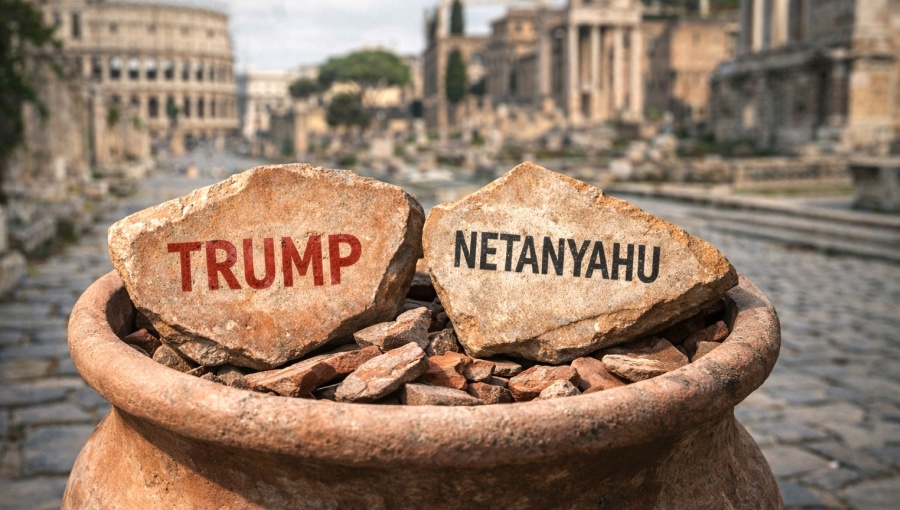
US president Trump and Israeli Prime Minister Netanyahu have painted themselves into a corner and are increasingly becoming ostracised by the global community for an unprovoked and pointless war. / bne IntelliNewsFacebook
By Ben Aris in Berlin April 14, 2026

For most of the first year of the Trump administration, America's so-called western allies spent most of their time flattering, toadying and attempting to manipulate the US President's ego in a vain effort to rescue the fast decaying transatlantic "special relation." They even agreed to more than double their military spending from 2% of GDP to 5% at the Nato summit in the Hague on the implicit understanding that most of this money would be spent on US-made arms.

Now they have given up. Things have spun out of control to the point where global leaders, not just those in Europe, have reached a tipping point and are actively trying to break away from any dependency on the US.

President Donald Trump's heavy-handed, indiscriminate use of military force and decapitation schemes, his aggressively bullying tactics, and his crass rhetoric have become unbearable.

He told Saudi Arabia's Crown Prince Mohammed bin Salman (MbS), one of his strongest allies in the Gulf, that he could "kiss my ass" after he had the audacity to sign a defence pact with Ukrainian President Volodymyr Zelenskiy without asking the White House permission. The next day, MbS said he would no longer buy US weapons. "Those days are over," the prince said. More recently, Trump went further to threaten that "everyone in Iran will die" if the Islamic Republic didn't comply with his demand to open the Strait of Hormuz again.

Italian Prime Minister Giorgia Meloni also lambasted Trump over remarks directed at the Pope. Trump had said, "The Pope is weak against crime and he is not doing his job well. He is terrible for foreign policy."

Meloni responded that such comments were "unacceptable", defending the role of the head of the Catholic Church. "The Pope is the head of the Catholic Church and it is right and normal for him to call for peace and to condemn every form of war," she said, the first sitting prime minister to publicly challenge Trump over his comments on the Pope.

Trump is coming across as increasingly delusional and incompetent. The preparations for the Iran war were reportedly minimal. Now his demonstrable failure to win is leading to the break-up of the decades old western alliance. What has changed is that America's so-called allies have lost their fear of Trump and are openly defying the White House.

Europe has been flattering Trump with copies of old maps and portraits for over a year. The EU's top brass were happy to ignore the nonsense the US commander-in-chief regularly spouts, and European Commission President Ursula von der Leyen submitted to a humiliating one-way street trade deal and a "delusional" energy deal. The head of Nato even called him "Daddy" in a press conference. The leaders would do anything if they thought it would ensure transatlantic security and weapons supplies for Ukraine.

Those efforts have come to nought. Instead Trump has unleashed the largest military conflict since the end of WWII and the "worst oil crisis in history" according to Goldman Sachs.

But now he is losing the war to a heavily sanctioned and nominally backward Iran, the Global North elite has run out of patience. The global economy is now infected with a crisis-virus and is unstoppable, even if the war stops tomorrow. It spreads down the supply chains, and Trump is floundering in his efforts to halt it. International leaders' displeasure with Trump has graduated from mere disdain to "enough is enough."

And it's not just the Europeans. As images come in of the 168 Minab school children slaughtered by a US Tomahawk missile strike – however, that happened – or Israel's wanton flattening of every residential building it can find in southern Lebanon, condemnation of Trump has become loud and explicit. International leaders have called for his arrest. Domestic politicians are calling for his impeachment.

Israel's full-scale invasion of Lebanon and Israeli Prime Minister Benjamin Netanyahu's immediate refusal to participate in the two-week ceasefire deal and the murderous bombing of civilians in Beirut the very next day have crystallised sentiments.

Condemnation of the Iranian war was to be expected by his rivals in Russia and China, and it clearly wasn't going to be welcomed by the main customers for Gulf state oil and gas in Asia, but the surprise is that the criticism of the US-Israeli coalition has become almost universal.

Spain steps out

Spanish Prime Minister Pedro Sánchez has emerged as the star of the show. Spain had already closed its airspace to US military supply flights bound for the Middle East and barred vessels carrying weapons to Israel from docking in Spanish ports.

At the same time, Sánchez has imposed an arms embargo on Israel and said Spain will veto any Nato involvement in operations linked to the Strait of Hormuz.

"Spain won't applaud those who set the world on fire just because they then show up with a bucket," Sánchez said, in a direct rebuke to Washington.

But he has gone well beyond the normal rhetoric and called for Israeli Prime Minister Benjamin Netanyahu's immediate arrest by the International Criminal Court (ICC) for the 70,000 deaths in Gaza and the murderous airstrikes at the weekend in Beirut.

"No one should be above the law," he said. "Netanyahu launched the worst possible, unjustified attack against Lebanon. His contempt for life and international law is intolerable. He is a criminal who must be arrested immediately."

"There is a difference between defending your country and bombing hospitals or starving innocent children," he added.

The response from Israel was immediate. Netanyahu announced a break in diplomatic relations on April 12, accusing Spain of having an "obsessive anti-Israel bias" and warning that "no country" would be allowed to act against Israel without consequence. "I do not intend to allow any country to wage a diplomatic war against us without paying an immediate price," he said, going on to add veiled threats of physical violence against Spain.

His comments were welcomed with country-wide applause, and top officials joined the PM in the assault. Spanish Health Minister Mónica García described Israel's actions as "war crimes against humanity".

"This man is committing genocide, he committed one of the biggest genocide operations of our time, killing 70,000 civilians in Palestine, more than 20,000 of them are children, and the destruction of southern Lebanon," she said.

When Israel struck back, accusing her of slander, she retorted: "We are not slandering you. We are defining you."

Spain was expelled from the US' Civil-Military Coordination Center (CMCC) in Kiryat Gat, the base helping implement Trump's Gaza peace plan, due to the country's "obsessive anti-Israel bias," according to a government statement. It responded by reopening its embassy in Tehran. In a YouGov poll last month, 66% of Spaniards had an "unfavourable" view of the US, even more than the 45% before Trump's second term began.

Trump has poured fuel on the genocide accusations fire, threatening that, "a whole civilization will die tonight, never to be brought back again" if no deal was struck in the run up to the ceasefire talks on April 11.

In what may prove to be the most significant change as a result of this row, Spain has announced it will buy oil from Iran but pay in Chinese yuan, striking at the heart of the petrodollar system that has been in place for decades and a major source of US power. Indeed, among Iran's demands is to keep control of the Strait of Hormuz, but less well reported is that from now on it will only accept payment in yuan and cryptocurrencies.

Russia and China have long since changed to payments in their national currencies and India is also paying for Russian oil in rupees or rubles. Large regions of non-dollar oil trading have appeared in the last few years, but the Iran war is going to accelerate their spread. This comes at a time when US debt has reached an all-time high of $39 trillion and interest payments are now eating up 15% of US budget spending – more than it spends on defence. It is set to hit 25% in the coming years if nothing changes.

Western allies pull back

Across the Western alliance, the pattern is consistent: distance, hedging, and in some cases outright refusal. When Trump called on European Nato allies to send their navies to open the Strait of Hormuz, they all refused. Now Trump has called for a naval blockade of Iran, and they have refused to participate in that, too.

The UK and France have called for any ceasefire framework to include Lebanon, which is a direct rebuke of Israel's continued lethal bombing campaign there and its attempt to annex the lower half of the country as part of a "Greater Israel" project. The decades-long stigma of openly criticising anything that Israel does wrong has been broken – except by the US, which is now being tarred by association.

Australia has rejected participation in naval operations in the Gulf. "We need peace that lasts. And we need stable fuel prices. We don't need wars," Prime Minister Anthony Albanese said.

These tensions are leading rapidly to the potential break-up of Nato. Trump's disappointment at Europe's reluctance to support his naval campaign in the Gulf led him to suggest that he would pull the US out of Nato on at least two occasions. Europe is increasingly taking the line: bring it on.

The Netherlands' Chief of Defence confirmed publicly last week that Europe is now actively constructing an independent military capability specifically designed to operate without American participation. The architecture is being built around advanced, lower-cost technology. Suddenly Ukraine and its state-of-the-art drone technology that has proven highly effective in the war with Russia is in demand, while American sophisticated technology has failed in Iran to protect bases and allies in the Gulf. The European move is a deliberate attempt to reduce the dependency on US hardware procurement that has defined Nato logistics for three-quarters of a century. The alliance has not broken, but in anticipation, Europe is quietly installing a second door.

The ballot box verdict

The political toxicity of the Trump brand is now measurable at the ballot box, and the results are unambiguous. Trump personally endorsed Viktor Orban twice this year and dispatched Vice President JD Vance to Budapest in the final days of the Hungarian campaign. According to local pollsters, the visit cost the incumbent prime minister three percentage points. Orban was crushed regardless.

The pattern has repeated itself across three continents. In Romania, the pro-Trump candidate George Simion went into election day as the strong favourite and lost by a landslide. In Australia, the centre-left won after conservatives were successfully branded as Trumpian. In Canada, the Liberals were headed for a historic defeat until Trump's tariff threats and annexation rhetoric around Canadian sovereignty flipped the race entirely, producing one of the most dramatic reversals in that country's recent political history.

Even within European domestic politics, association with Washington is becoming a liability. Right-wing parties that previously aligned with Trump — including France's National Rally and Germany's Alternative für Deutschland — are softening those links as polling turns against the Donald. Surveys suggest 64% of Europeans now view Trump negatively, with support for US alignment in core EU states falling into single digits. The far right, with its reliable instinct for self-preservation and the popular mood, has concluded that Washington has become too toxic to touch.

US Vice President JD Vance endorsed Hungarian Prime Minister Viktor Orban's re-election, a move that knocked 3% off his approval rating, according to local pollsters.

Canada: leaving, not drifting

Canada is shifting more structurally. Prime Minister Mark Carney told parliament his country is also ending longstanding US defence procurement. He argued that Washington is "beginning to monetize its hegemony" and said of the decades of military spending, "Those days are over." The announcement drew a standing ovation — a rare political signal for what is, in effect, strategic decoupling. For decades, Canada directed roughly 70 cents of every defence dollar to the US.

A recent poll found that nearly 60% of Canadians now support their country becoming a full member of the EU – the last bastion of the liberal rules-based order that Canada shares. That number would have been unthinkable three years ago. Canada is not drifting away from the US. It is leaving.

Embraces in the Global South

The Global South was never convinced of the US' self-proclaimed right to be "leader of the free world," but they went along with it as the US has the most powerful military in the world and remains the biggest consumer market on the planet.

Those calculations have altered now. Under the previous regime the US stuck to trade regimes and, provided you didn't cross the White House politically, the rest of the world's second tier "emerging markets" were largely left to their own devices. Under Trump, now an innocent country that was previously an ally like Greenland can suddenly find itself a target because the Trump administration wants to acquire its raw material bounty for "national security" reasons.

Trump has ditched international law and ignores the 1945 UN charter that guarantees the sovereignty of nations. He believes the only morality there is "is in my head." In the Global South, the US is increasingly seen as a belligerent loose cannon.

Countries that have circled in the US orbit as a useful counterweight to the local superpowers like Russia and China are now abandoning efforts to flirt with Washington. Azerbaijan has reopened its embassy in Tehran. Ireland has formally recognised the state of Palestine. Brazil has cancelled a $134mn arms deal with Israel.

"I want to say this loudly and clearly," President Luiz Inácio Lula da Silva told reporters. "The Israeli president is committing genocide against women and children. This is a historical fact," in a bald condemnation of Israel that would have been unthinkable as little as a month ago.

Russia and China have been vocal, if predictably so. "As long as China, Russia and Iran exist," Vladimir Putin said, "it is impossible for anyone to behave like a global ruler."

Pakistan has raised the temperature to an altogether different register, issuing an explicit nuclear warning: "If Israel uses a nuclear bomb, Pakistan will respond with a nuclear strike on Israel." North Korea has announced it will "punish Israel" in any scenario involving an attack on Iran. And Pyongyang's threats carry weight as it holds an estimated 50 nuclear warheads and its longest-range ICBMs can fly a theoretical 10,000km – enough to reach Israel.

Israel in the spotlight

Opposition to the US-Israeli campaign is no longer fragmented or confined to traditional adversaries. It is converging, and it is acquiring a quality of simultaneity that is new.

Israel just lost its strongest supporter in Europe – Hungarian Prime Minister Viktor Orban, who was blocking attempts to condemn or sanction Israel for atrocities it has committed in Gaza in return for Israel's influence in the US. However, amongst the first things Hungary's new Prime Minister Peter Magyar has done is to call for Hungary to rejoin the International Criminal Court (ICC), which has an arrest warrant out for Israeli Prime Minister Benjamin Netanyahu on war crimes charges.

Relations with Turkey, Israel's rival in the region, have also been rubbed raw. Following the indictment by Turkish prosecutors of 35 senior Israeli officials over Israel's interception of a Gaza-bound flotilla in October 2025, President Recep Tayyip Erdoğan delivered an unvarnished rebuke of the government in Tel Aviv, although contrary to several reports he did not go as far as to threaten an invasion.

The Israeli response was immediate and unrestrained. Foreign Minister Israel Katz dismissed Erdoğan as a "paper tiger." National Security Minister Itamar Ben-Gvir, himself among the 35 officials targeted by Turkish prosecutors, responded with a two-word expletive. Netanyahu accused Erdoğan of harbouring Hamas and massacring his own Kurdish citizens. In televised remarks Netanyahu defended the IDF as the "most moral army in the world," and threatened Erdoğan with "punishment" for disrespecting the Israeli military.

In the war of words that has broken out, Turkey's Foreign Ministry replied that Netanyahu was "the Hitler of our time" and that he had "no moral values or legitimacy to preach to anyone." Israel has since announced the closure of its embassy and consulates in Turkey. A relationship that was already strained has now collapsed entirely — and with it, one of the last bridges between Israel and a major Muslim-majority Nato member.

With their aggressive rhetoric and cavalier abuses of what were allies, both Netanyahu and Trump are painting themselves into a corner of isolation and opprobrium by the international community, from which they will not easily recover.

Edited 08:30 UTC


One million Europeans ask the EU to suspend association agreement with Israel for 'crimes in Gaza'

A demonstration in support of the Palestinian people in Gaza in Venice, Italy, in August 2025
Copyright AP

By Vincenzo Genovese
Published on 

Citizens Initiative calling for the full suspension of the EU–Israel Association Agreement has reached the one million signatures required to trigger a response from the European Commission and the European Parliament.

A civil petition calling for the total suspension of the EU–Israel Association Agreement for alleged war crimes has reached one million signatures across all 27 member states.

Under EU rules, the European Commission and the European Parliament must now assess the request. This comes as the northern Gaza Strip continues to be hit by occasional Israeli strikes, despite a ceasefire with Hamas that took effect last October.

According to the initiative’s text, the State of Israel is responsible for “an unprecedented level of killing and injury of civilians, large-scale displacement of the population, and the systematic destruction of hospitals and medical facilities in Gaza”.

It also cites Israel’s “breach of multiple rules and obligations under international law” and its failure “to prevent the crime of genocide as ordered by the International Court of Justice” as grounds for suspending the agreement.

The European Citizens' Initiative (ECI) was launched by the European Left Alliance (ELA), alongside civil society organisations and pro-Palestinian movements.Promoters want to reach 1.5 million signatures before ending the collection. National authorities will then have three months to verify the signatures, after which the initiative can be formally submitted.

The European Commission will then be required to outline any action it intends to take in response, or explain why it will not act. The European Parliament must hold a hearing with the organisers and may also debate and vote on a resolution.

However, the initiative appears unlikely to gain traction.

The EU–Israel Association Agreement, which entered into force in 2000, underpins political dialogue and economic cooperation. The EU is Israel’s largest trading partner, with total trade in goods reaching €42.6 billion in 2024.

In September 2025, as Israel’s offensive in Gaza continued, European Commission President Ursula von der Leyen proposed a partial suspension of the agreement, citing a “man-made famine” and “a clear attempt to undermine the two-state solution”.

The proposal has since stalled, with member states deeply divided. Countries including Germany, Hungary and the Czech Republic have opposed the move, preventing the formation of a qualified majority needed to adopt trade restrictions.

Diplomats told Euronews that, in recent meetings, several member states have reiterated their reluctance to move forward.