Wednesday, April 15, 2026

World Bank chief economist warns of hunger risk from war in Iran


By AFP
April 15, 2026


The economic ramifications of the war in the Middle East have dominated discussions at the 2026 IMF-World Bank Spring Meetings in Washington - Copyright AFP Tierney CROSS


Paul BLAKE, Théo MARIE-COURTOIS

The conflict in the Middle East could push millions more towards hunger as its economic fallout reverberates further around the globe, the World Bank’s chief economist warned in an AFP interview on Wednesday.

“You have about 300 million people who suffer from acute food insecurity already,” Indermit Gill said. “That’ll go up by about 20 percent very, very quickly,” as knock-on effects grow.

Gill spoke on the sidelines of the International Monetary Fund-World Bank Spring Meetings in Washington.

The blocking of the Strait of Hormuz, a key oil supply route, has sent fertilizer prices soaring since they rely on oil-based inputs.

Higher prices for fertilizers, which are used in agriculture, may entice countries to halt food exports and hoard more food for themselves, further driving up food prices.

“Those export bans scare us massively,” Gill told AFP.

Most exposed are people in countries that are at war or have fragile governments.

If the situation isn’t resolved soon, “hunger will start to stalk these countries massively.”

Currently, the shortage of petrochemicals and their economic effects are being most felt in Asia, Gill explained, but “as the crisis gets longer, it’s very rapidly going to spread first to Africa.”

“The food that’s in the market right now has already been grown,” Gill said, but the real effects could be felt in a few months.

– Lower growth, higher inflation, more expensive debt –

Low-income people across the world tend to spend a larger share of their earnings on basic needs like food and fuel.

“If you get inflation in, especially in the kind of things that the poor consume relatively more often, that inflation is going to hurt massively,” Gill went on.

Gill also warned that inflation – not just in food prices – could rise from about 3 percent globally to as much as 4.7 percent this year, in the most extreme scenario where the conflict stretches to August.

At the same time, global growth could be cut by as much as 40 percent on a yearly basis, if the crisis drags on.

Higher inflation mixed with lower growth would be a “double whammy” for the debt sustainability of poor countries, further hindering their ability to deal with this and future crises.

Gill warned that many headline figures for regional growth may appear too rosy, as the massive US, Chinese, and Indian economies, which are generally more insulated from external shocks, tend to drag up estimates.

When you remove them from the estimates, “you start to see a lot more vulnerabilities,” Gill said.

“And by the way, that extreme scenario, with every passing day, is not that extreme of a scenario — because we’re getting closer and closer to August.”
World Bank announces water security plan covering one billion people


By AFP
April 15, 2026


The World Bank says better water security is needed to grow the global economy - Copyright AFP Kent NISHIMURA

The World Bank announced a plan Wednesday that aims to improve secure water access for a billion people within the next four years.

The “Water Forward” program will “expand reliable water services and strengthen systems against droughts and floods.”

The Bank said its own funds and technical advice would help improve water supplies to about 400 million people by 2030, with the balance coming from partners.

Water “determines whether people are healthy enough to work, whether children have a childhood to learn and to explore, and whether businesses can operate and economies can grow,” World Bank President Ajay Banga said.

The program will see countries identify areas of priority, then “development banks, governments, philanthropies, most importantly, the private sector as well, align behind that plan,” he said.

The global lender did not specify how much funding it was committing to the initiative.

Other participating institutions include regional development banks, OPEC’s development fund, and the BRICS-aligned New Development Bank.

Fourteen countries had already voluntarily committed to reforming and strengthening their water sectors under the new program, the Bank said.

Some four billion people — half the world’s population — face water scarcity, due in part to “unclear policies, weak regulations, and financially unsustainable utilities that have slowed progress and deterred investment,” the Bank said.

The focus on water governance issues — not simply physical infrastructure — is promising, said David Michel, senior associate at the Center for Strategic and International Studies.

“In many countries, the water sector fails to fully deploy the funds already allocated to it.”

However, the Bank’s initiative “faces a long and difficult road ahead,” he warned, noting that countries with the greatest water insecurity often have the least capacity to reform.

The issue of access to safe drinking water has been highlighted during the war in the Middle East, with desalination plants in Iran and across the region damaged in bombardments.

Beyond conflicts and immediate drinking water needs, the World Bank said better water security is needed to grow the global economy.

“Strong water systems are foundational to healthy economies that can attract private investment and create jobs,” the Bank said.
War In The Middle East Challenges Global Financial Stability – Analysis


April 15, 2026
IMF BLOG
By Tobias Adrian


Global financial markets entered 2026 from a position of strength. Asset prices rose across major markets, volatility was subdued, and financial conditions were easy by historical standards. That benign backdrop has now been tested by the war in the Middle East.

So far, markets have absorbed the shock with a degree of resilience. While the decline in asset prices has been significant, market functioning has been orderly. Nonetheless, this resilience should not be taken at face value. Rather, it reflects cycles of escalation and de-escalation, structural improvements in the financial system, and the absence of a decisive adverse turn that would trigger sustained market drawdowns.
Repricing, orderly market functioning

Global markets reacted swiftly following the outbreak of hostilities. Equity prices declined, sovereign bond yields rose, and volatility increased across asset classes, reflecting higher energy prices and renewed inflation uncertainty. Importantly, this adjustment was reasonably orderly, without signs of acute liquidity stress or funding problems among financial institutions and investors.

In fact, this price‑based absorption of shocks is a key feature of resilient markets. It facilitates risk sharing across investors and preserves price discovery critical for efficient capital allocation. So far, short‑term funding markets and core market infrastructures have helped facilitate the repricing of assets.

Financial conditions have tightened since the onset of the conflict, but they remain far from the stress levels observed during past episodes of global turmoil. Compared with earlier crises, there is still a considerable margin of safety. At the same time, the relatively modest adjustment to date also indicates that markets have not fully priced adverse scenarios.


Inflation as a transmission channel

The main channel through which the conflict has affected markets has been via inflation expectations. Higher energy prices have pushed breakeven inflation rates and yields up across advanced and emerging economies. Yield curves have flattened, with short‑term rates rising more than long‑term rates.

This highlights the difficult environment facing central banks. With near-term inflation risks having risen substantially, monetary policy must remain focused on price stability. On the other hand, the longer the war continues, the more damaging it is to economic growth and labor markets—the flattening of the yield curve, should it continue, could be a sign of this. In this environment, clear communication, credibility, institutional independence, and timely tightening when warranted are essential to anchoring expectations.
Spotlight on emerging financial vulnerabilities

Higher yields have renewed focus on public debt risks. Many advanced economies are entering this episode with elevated debt levels and limited fiscal space. Together with changes in the investor base—away from central banks and toward price‑sensitive nonbank investors—sovereign yields may respond more forcefully to inflation shocks than in the past.

Emerging markets are more sensitive to these changes. Elevated pre‑shock valuations and the growing dominance of debt portfolio flows and carry‑trade strategies have increased exposure to global risk sentiment. While resilience has improved over the past decade in many countries, vulnerabilities remain pronounced in those with high external financing needs or volatile investor bases.
Amplification mechanisms

The key financial stability risks do not lie in the initial shock itself, but in amplification channels that could turn market volatility and sell-offs into more acute stress. Elevated leverage in parts of the nonbank financial sector, increased concentration in equity markets, and historically tight credit spreads all raise the potential for abrupt forced-selling and sudden liquidity strains through margin and collateral calls.


Private credit is an important area of focus. Rapid growth in direct lending has made the sector more important to the overall economy and financial system, while opacity, valuation practices, short‑term funding backed by longer‑term assets, and rising defaults pose challenges. While these vulnerabilities have not yet been tested by an adverse shock, their presence means that the system is more exposed, even if markets have remained orderly so far.
Policy space: constrained, but differentiated

In addition to monetary policy, other key policy areas also have uneven space to act. Fiscal policy is limited by high debt and persistent deficits. By contrast, financial stability policy is less constrained. Central banks have reduced their balance sheets, freeing some capacity for asset purchases if needed, and crisis‑management frameworks and liquidity backstops are stronger than in the past. Targeted prudential measures, robust supervision, effective stress testing, and well‑designed liquidity tools can also be deployed.
Prepare, don’t predict

The experience of recent months underscores that resilience should not be inferred from the absence of stress. Elevated asset prices, intact risk‑taking incentives, and stronger amplification channels mean that risks remain skewed to the downside—even if markets have adjusted in an orderly manner so far.

The task for policymakers is therefore not to predict the next shock, but to ensure that vulnerabilities are mitigated and the system remains capable of absorbing stress without amplifying it. Amid recurring supply shocks and heightened geopolitical uncertainty, financial stability cannot be taken for granted—it must be actively protected


Source: This article was published at IMF Blog and based on Chapter 1 of the April 2026 Global Financial Stability Report, “Global Financial Markets Confront the War in the Middle East and Amplification Risks.”


Tobias Adrian

Tobias Adrian is Financial Counsellor and Director of the Monetary and Capital Markets Department, IMF.
‘A Very Dark Picture’: IMF Warns Trump’s Iran War Could Unleash Global Recession

One expert called the new IMF forecast “extremely concerning for the global economy,” noting that “the most dire impacts of our economic situation will be felt by the poor and the vulnerable.”


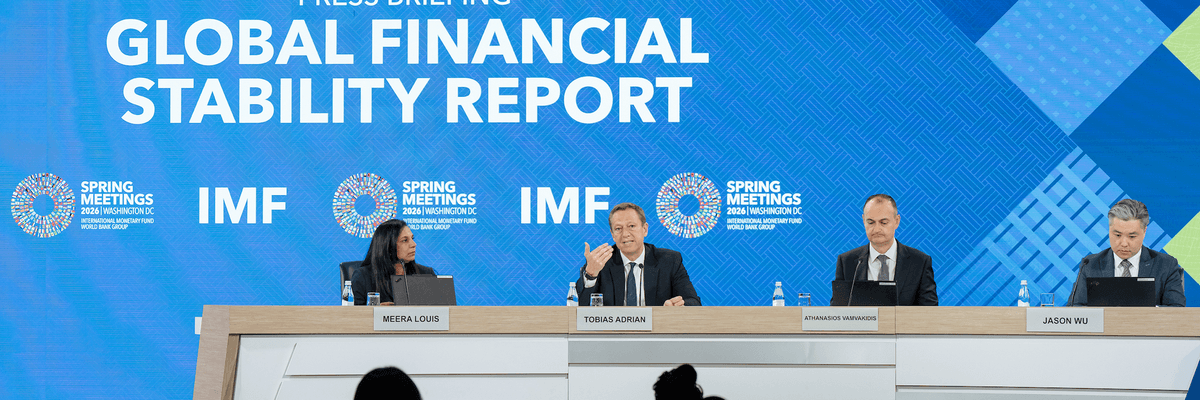
International Monetary Fund officials are seen during an April 14, 2026 panel on the group’s latest world economic outlook report, in Washington, DC.
(Photo: International Monetary Fund/X)

Brett Wilkins
Apr 14, 2026
COMMON DREAMS

The International Monetary Fund warned Tuesday that the US-Israeli war on Iran could slow global economic growth, stoke inflation, and increase the possibility of a worldwide recession and energy crisis.

The illegal war of choice on Iran being waged by US President Donald Trump and the government of fugitive Israeli Prime Minister Benjamin Netanyahu has already had wide-ranging negative impacts on the global economy, from soaring fuel prices caused by the closure of the Strait of Hormuz to supply chain disruptions and financial market volatility.


However, a major global economic crisis has thus far been averted. That could soon change.

“Despite major trade disruptions and policy uncertainty, last year ended on an upbeat note,” International Monetary Fund director of research Pierre-Olivier Gourinchas wrote in an analysis of the IMF’s latest World Economic Outlook report. “The private sector adapted to a changing business environment, while powerful offsets came from lower US tariffs than originally announced, some fiscal support, and favorable financial conditions coupled with strong productivity gains and a tech boom.”


“Despite some downside risks, the momentum was expected to carry over into 2026, lifting the pre-conflict global growth forecast to 3.4%,” Gourinchas continued. “War in the Middle East has halted this momentum. The closing of the Strait of Hormuz and serious damage to critical facilities in a region central to global hydrocarbon supply raise the prospect of a major energy crisis should hostilities continue.”

The IMF said that even if the war ends quickly, lasting damage to the world’s economy will still happen.

According to the IMF report:
Under the assumption of a limited conflict, global growth is projected at 3.1% in 2026 and 3.2% in 2027, below recent outcomes and well under pre-pandemic averages. Global inflation is expected to tick up in 2026 and resume its decline in 2027. Pressures are concentrated in emerging market and developing economies, especially commodity importers with preexisting vulnerabilities. Risks are decisively on the downside. A prolonged conflict, deeper geopolitical fragmentation, disappointment over [artificial intelligence]-driven productivity, or renewed trade tensions could weaken growth and unsettle markets. High public debt and eroded policy buffers add vulnerability. Policies should foster adaptability, enhance credibility, and reinforce international cooperation.

The IMF said that “the shock’s ultimate magnitude will depend on the conflict’s duration and scale—and how quickly energy production and shipment normalize once hostilities end,” and that effects will vary by location.

“Countries will feel the impact differently,” Gourinchas wrote. “As in past commodity-price surges, importers are highly exposed. Low-income and developing economies—especially those with vulnerabilities and limited buffers—are likely to be hit hardest. Gulf energy exporters will face economic fallout from damaged infrastructure, production disruptions, export constraints, and weaker tourism and business activity. Remittances will fall in countries that supply migrant workers to the region.”

Eric LeCompte, executive director of the religious development group Jubilee USA Network and a United Nations finance expert, called the new IMF forecast “extremely concerning for the global economy,” lamenting that “the most dire impacts of our economic situation will be felt by the poor and the vulnerable.”

The new report comes as the IMF’s annual Spring Meetings are underway in Washington, DC.

“World leaders coming to Washington are receiving a very dark picture of the global economy,” said LeCompte. “The war is causing greater poverty and increases in our fuel and food costs.”

Other groups have also warned of the adverse economic effects of the US-Israeli war on Iran.

Ben May, Bridget Payne, and Paul Moroz of Oxford Economics recently published a report warning that a longer war in Iran “could tip the global economy into recession.”

In such a situation, “the Gulf states suffer most acutely—GDP down over 8% in 2026—before rebounding sharply as production recovers,” they wrote. “Advanced Asian economies, which are especially reliant on Gulf oil, take a heavy blow from energy import cost surges and supply chain disruption.”

“Europe faces a painful squeeze on gas and electricity,” the trio added. “The US fares somewhat better given its domestic energy production, but an equity market decline of nearly 20% weighs heavily on consumer spending.”

Some US-based organizations have focused on the war’s domestic economic impacts.

Dean Baker, a senior fellow at the Center for Economic Policy Research, published an analysis earlier this month asserting that “making enemies makes us poorer.”

“Secretary of Defense (or War) Pete Hegseth seems to be having a really great time killing people in Iran, but his live action video games come at a big cost—not just in lives, but in budget dollars,” Baker wrote. “To be clear, the main reason to oppose this pointless war is its impact on the people of Iran and elsewhere in the region. But it also has a huge economic cost that is seriously underappreciated.”

“In addition to reducing our security and jeopardizing the well-being of people around the world, Donald Trump’s belligerence will cost us a huge amount of money,” he said. Focusing on US military spending, Baker noted that “Trump wants the country to spend 5% of GDP, or $1.5 trillion a year, on the military. This comes to $12,000 per household.”

Trump and his Republican Party are seeking to offset some of their record military spending with devastating cuts to social programs upon which tens of millions of Americans rely. Already reeling from the biggest cuts to Medicaid and Supplemental Nutrition Assistance Program spending in those programs’ histories, Trump’s budget request for fiscal year 2027 contains $73 billion in total reductions in nondefense spending.

“It is striking to see that Congress might be willing to quickly cough up this money,” said Baker, referring to military funding, “when it has refused far smaller sums that could have made a huge difference in the lives of tens of millions of people.”

Harvard Expert Says She Is ‘Certain’ Price Tag of Trump’s Illegal Iran War Will Hit $1 Trillion

“The interest costs alone will add billions of dollars to the total cost of this war,” said Linda Bilmes. “And unlike the upfront costs, these are costs we are explicitly passing on to the next generation.”


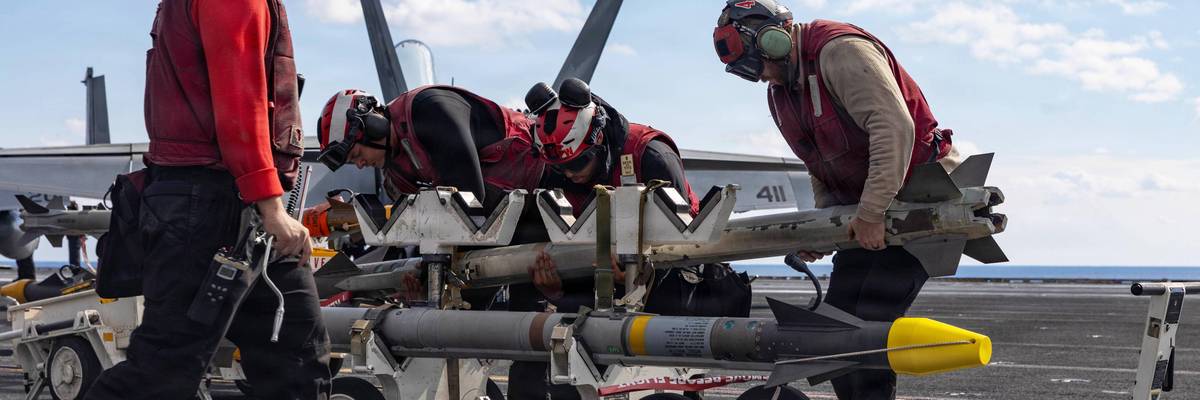
Sailors handle ordnance on the flight deck of the USS Gerald R. Ford in the eastern Mediterranean Sea in support of the US-Israeli war on Iraon on March 2, 2026.
(Photo: US Navy)

Jake Johnson
Apr 14, 2026
COMMON DREAMS

A Harvard expert who specializes in looking beyond official government estimates to calculate the true financial cost of US wars has said she is “certain” the price tag of President Donald Trump’s assault on Iran will eventually reach at least $1 trillion, once benefits for troops, replenishment of munition stockpiles, borrowing costs, and other factors are fully taken into account.

“We are borrowing to finance this war at higher rates, on top of a much larger debt base,” Linda Bilmes, the Daniel Patrick Moynihan senior lecturer in public policy at the Harvard Kennedy School, said in a recent interview. “The result is that the interest costs alone will add billions of dollars to the total cost of this war. And unlike the upfront costs, these are costs we are explicitly passing on to the next generation.”


With No End in Sight, Cost of Trump’s Illegal Iran War Balloons to at Least $25 Billion


‘Hell No’: Pentagon Wants Over $200 Billion to Fund Trump’s Illegal Iran War

Bilmes, who co-authored The Three Trillion Dollar War: The True Cost of the Iraq Conflict with Nobel laureate economist Joseph Stiglitz, estimates that the first several days of the US-Israeli assault on Iran cost American taxpayers at least $16 billion—significantly more than the Pentagon’s official figure, $11.3 billion.

“The short-term costs are even higher than they appear,” Bilmes emphasized. “The Pentagon reports costs based on the historical value of inventory, instead of the actual cost it takes to replace what we are using. And those replacement costs are far higher.”

Bilmes also pointed to the substantial costs of “large, multi-year contracts” the Trump administration has inked with arms manufacturers such as Lockheed Martin.

Over the long-term, said Bilmes, the cost of veterans’ care will be massive. “We now have roughly 55,000 US troops deployed in this conflict who have been exposed to toxins, contaminants, and environmental hazards, such as burning fuel and chemical residues that we know can cause long-term harm,” she noted. “If even one-third of the 55,000 troops deployed today claim benefits, then we are committing ourselves to tens or hundreds of billions of dollars in disability and medical care costs for this cohort alone.”

“I am certain we will spend $1 trillion for the Iran war,” Bilmes said. “Perhaps we have already racked up that amount.”

The Trump administration is expected to request that Congress approve between $80 billion and $100 billion in funding for the Iran war, according to The Washington Post. Earlier this month, the Trump White House released a budget proposal that called for $1.5 trillion in military spending next fiscal year.

Bilmes noted that if Trump’s request is fully enacted, US military spending would rise “to levels about 20% higher than the peak reached during World War Two.”

“This raises the baseline,” Bilmes said. “Even if Congress does not agree to approve the full increase, it is highly likely that at least $100 billion per year will be added to the base defense budget that would not have been approved in the absence of this war.”

“And once that increase is built into the base,” she added, “it raises the baseline and compounds—so an additional $100 billion per year is $1 trillion over the next decade.”
Mideast war revs up electric car demand in Asia


By AFP
April 14, 2026


Electric vehicle maker BYD hit a record high after news of a battery it says can charge in just five minutes - Copyright AFP BAY ISMOYO


Tran Thi Minh Ha, Julien Girault in Tokyo and AFP teams in Bangkok, Manilla and Jakarta

Electric vehicle sales have jumped in Southeast Asia as cost-conscious buyers have poured into dealerships looking to dodge the fuel price spikes driven by the Middle East war.

Asian nations have been particularly hard hit due to a sharp fall in the crude shipments they rely on — and have few alternatives to replace them.

Yet the energy crisis has been a windfall for Vietnam’s leading electric vehicle maker Vinfast as well as Chinese manufacturers.

Vietnamese office worker Do Thi Lan explained the simple math of the cars’ appeal at a Vinfast showroom in Hanoi.

“We have to calculate our monthly expenses, as the money we spend on petroleum has been on the rise,” she said.

She said her family owns a car that runs on petrol but was considering buying an electric vehicle to save money.

Dao Thi Hue, also at the showroom, was looking to go electric too.

“Driving an EV is so much better than driving a petroleum vehicle, in terms of costs and also in terms of saving fuel, queuing to fill up,” the school teacher said.

Crude oil prices have soared by around 50 percent since the start of the Middle East war and again exceeded $100 per barrel on Monday, driving up the cost at the pump.

Vinfast, listed on the Nasdaq, saw a 127 percent surge in annual sales in Vietnam in March, reaching 27,600 cars.

About 40 percent of cars sold in Vietnam in 2025 were electric, but the trend has been accelerating.

“At this point in time, clients consider fuel costs a lot when making a decision on which cars to buy,” said Pham Minh Hai, deputy head of sales at a Vinfast showroom.

“In March we sold 300-400 cars,” he said, noting that the showroom normally sells between 200 and 250 cars a month.

Hai said more than 50 percent of his clients changed from petroleum to electric cars last month, while the number of customers at the showroom was up by around 30 percent.

He added that opening hours had been extended to deal with the rush.

Outside Vietnam, Chinese manufacturers specialising in electric vehicles, particularly Tesla’s main rival BYD, are booming.


– ‘Punished by gas prices’ –


At the Bangkok Auto Show earlier this month, BYD secured the most orders of any manufacturer, surpassing Japan’s Toyota for the first time.

“I drive a lot, nearly 100 kilometres (60 miles) a day… with the current fuel situation and no idea how long it will last, it’s become a major factor pushing me to make the switch,” said Pleng Nawintham, a 36-year-old pharmacist from Thailand.

BYD was also seeing increased sales in the Philippines.

Mae Anne Clarisse Bacquiano, manager of a BYD showroom in the suburbs of Manila, said foot traffic at the dealership was “at another level”.

“It was all because of the rise in fuel prices,” she said. “Earlier today, I had a customer, a doctor who was ranting to me about how he is being punished by gas prices… He was in a hurry to go full electric. There’d be a huge difference in expenses.”

She added that all of her stock for the month had already been reserved by buyers.

“I don’t expect the gas (prices) to go back down over the next couple of months,” said Arlone Abello, an entrepreneur who was browsing BYD models at the showroom.

As BYD sales decline in China due to fierce local competition, the manufacturer hopes to gain international momentum.

The company told analysts that it now expects to exceed 1.5 million exported vehicles in 2026, well above the 1.3 million target announced in January.


– Structural change –


Exports of Chinese electric vehicles — for which Southeast Asia is a major market — doubled in March, compared to the same month last year across all manufacturers, according to the industry association CPCA.

Economic factors are at the forefront of the increased demand for greener vehicles.

“You have the individual consumer response to what they are seeing in terms of the price of petrol or diesel suddenly surge,” said Euan Graham, an electricity and data analyst at energy think tank Ember.

The installation of charging stations in the region is also growing rapidly.

Jakarta promised last week to take “more serious steps to accelerate the development of a national electric vehicle ecosystem” to combat its “high level of energy consumption”.

Electric vehicles are gaining momentum beyond Southeast Asia.

“There are signs that global demand has already picked up substantially,” Capital Economics said, adding that registrations of electric vehicles in Japan, South Korea, and New Zealand more than doubled in March, and rose by over 50 percent in India, Australia.

burs-tmh-jug/lkd/jm


Rolls-Royce unveils ultra-luxury limited series electric car

By AFP
April 14, 2026


Rolls-Royce has unveiled its new luxury electric vehicle, limited to just a 100 cars at the company's Goodwood plant in Chichester, south of London - Copyright AFP CARLOS JASSO

Far from the downturn that has shaken many luxury houses in recent years, Britain’s Rolls-Royce on Tuesday launched an ultra-luxury, limited-series electric car.

The imposing bonnet, crowned by the marque’s iconic Spirit of Ecstasy mascot, remains, but the new convertible series marks a further step into fully electric luxury motoring.

Limited to just 100 clients, the collection will be available by invitation only.

The company intends to offer an opportunity “to be part of that journey, to be able to meet our designers, meet our craftspeople” and personalise every detail, Julian Jenkins, Rolls-Royce director of sales and brand told AFP.

“Our clients have over 44,000 colours to choose from of our current palette.”

While the company, owned by BMW since 1998, has not disclosed the price of the vehicles, it placed them between its most complex private commissions and other bespoke creations, which can reach several million pounds.

The carmaker recorded a slight decline in sales last year, with a total of 5,664 vehicles sold — a six percent drop from its record 2023 performance.

The dip remains modest compared with the turbulence faced by other luxury brands, such as fellow British brand Burberry.

In fact, 2025 was the company’s “fourth best year”, Jenkins said.

“We’ve seen an increasing strength, particularly in our bespoke operation with our clients really wanting to commission something very special, something unique.”

The company already knows who will be the 100 clients, and they will receive their cars from 2028.

They are mainly based in the United Kingdom, Europe, the United States and the Middle East, but not in China, where the car “is not homologated” due to “the efficiency regulations for electric vehicles”, he said.

The pastel blue prototype, named Project Nightingale, is a convertible two-seater with a sleek, streamlined silhouette.

The model is inspired by the brand’s experimental high-speed ‘EX’ models of the 1920s. Its range has not been revealed.

It is Rolls-Royce’s second electric model, following the launch of the Spectre three years ago.

Swiss watchmakers say time will tell on effects of Mideast conflict


By AFP
April 15, 2026


Watches and Wonders is the watchmaking industry's biggest annual showcase - Copyright AFP/File Giuseppe CACACE


Nathalie OLOF-ORS

The Middle East war has plunged Swiss watchmakers into uncertainty, testing the resilience of an iconic national industry already shaken by several crises.

Behind the opulent booths at the Watches and Wonders fair in Geneva, the industry’s biggest annual showcase, the conflict is on everyone’s lips.

The war is not the first crisis that watchmaking has faced in recent years, said Elie Bernheim, the chief executive of Raymond Weil, a family business started by his grandfather that generates approximately 10 percent of its revenue in the Middle East.

“There was the subprime mortgage crisis in 2008,” then the arrival of the smartwatch, when “the worst was predicted for the watchmaking industry”; the Covid-19 pandemic and “the US tariffs last year”, Bernheim said.

And yet, in the long run, “the watchmaking industry has demonstrated considerable resilience”, he added.

Over the last 20 years, Swiss watch exports have more than doubled, despite all the challenges.

The unusual aspect of current events in the Middle East — a war which has seen Tehran target Gulf countries in retaliation for US and Israeli strikes on Iran — is that “nothing can be anticipated”, said Bernheim.

“Everything can change from one day to the next, we have no control, and I think that is the most destabilising thing,” he said.


– Uncertain consumer climate –


Like many watchmakers, Bertrand Meylan, co-owner of the H. Moser brand, believes the war could have an impact on the global consumer climate.

“The longer the conflict lasts, the greater the risk that anxiety will spread to the rest of the economy,” he told AFP, noting that “people don’t buy during times of anxiety”.

On the ground, “brands that depend on tourism are suffering enormously”, the Dubai-based entrepreneur said.

But with local customers, business continues to thrive, “a bit like during the Covid period”, when consumers, unable to travel, had more time and disposable income to buy a watch.

His brand generates six percent of its revenue in the Middle East.


– 10% of exports –


The Geneva watch fair, which runs until April 20, sees 65 major watch brands, including Rolex, Patek Philippe and Cartier, display their latest creations.

This year’s Watches and Wonders comes after two tough years for the sector, with a drop in demand in China followed by US tariffs.

Swiss watch exports first fell by 2.8 percent in 2024 and then by 1.7 percent in 2025, to 25.6 billion Swiss francs ($32.5 billion).

Last year, the Middle East as a whole accounted for around 10 percent of the sector’s exports, which is “already a lot”, Yves Bugmann, president of the Federation of the Swiss Watch Industry, told AFP.

For comparison, the United States — the leading market for Swiss watchmakers — represents 17 percent of exports, he explained.

Japan comes second, ahead of mainland China, Hong Kong, Britain and then Singapore.

The United Arab Emirates is the largest market in the Middle East, ranking eighth among the top 10 destination countries, sandwiched between Switzerland’s neighbours France and Germany.

Saudi Arabia is the 15th-biggest market, with Qatar 21st, Kuwait 25th and Bahrain 27th.

At the start of the year, Bugmann was “relatively confident” for the industry’s prospects in 2026.

However, “the war in the Middle East is a game-changer”, and it is “too early to make predictions” as to its impact, he said.

Everything, he said, will depend on “how the conflict unfolds”.

Why Anthropic's new Mythos AI model has Washington and Wall Street worked up

FILE - The Anthropic website and mobile phone app are shown in this photo, in New York, July 5, 2024.
Copyright AP Photo/Richard Drew, File

By Pascale Davies
Published on 

Anthropic's most powerful new AI model, Mythos, is too dangerous to release to the public, the company says, sparking urgent discussions with governments and financial regulators.

Anthropic is in discussions with the US government over its new Mythos AI model, which the company has said is too powerful to release to the public as it "poses unprecedented cybersecurity risks".

The banking industry is also sounding the alarm.

“The government has to know ​about this stuff,” Anthropic’s co-founder said on Monday at the Semafor World Economy event in Washington.

“Absolutely, we're talking to them about ​Mythos, and we'll talk to them about the next models as well," he added.

Referencing the public dispute with the government, which led to the company being labelled a supply-chain risk last month, he said, “I don't want ​that to get in the way of the fact that we ​care deeply about national security."

The supply-chain risk designation followed the collapse of negotiations over Anthropic's efforts to limit how the US defense department can use its AI models.

The move comes after Treasury Secretary Scott Bessent convened a meeting of senior American bankers in Washington to discuss the Mythos model last week.

The meeting encouraged the banking executive to use Antropic’s Mythos model to detect vulnerabilities, according to Bloomberg.

Anthropic also said it would limit the release of its new AI model to a few tech and cybersecurity firms. The list includes Amazon, Apple and JP Morgan Chase.

Goldman Sachs, Citigroup, Bank of America and Morgan Stanley are reportedly testing the Anthropic model too, Bloomberg reported.

On Monday, the United Kingdom’s government AI Security Institute (AISI) issued a warning that Mythos was a “step up” over previous models in terms of the cyber threat it posed.

Meanwhile, the Financial Times reported that the UK financial regulators are also discussing Mythos’ potential risks.

AI expansion drives up profits for Dutch semiconductor giant ASML

FILE. The logo of ASML hangs on the head office in Veldhoven, Netherlands, Jan. 2023
Copyright AP Photo/Peter Dejong

By Quirino Mealha
Published on 

ASML, the Dutch semiconductor giant, has posted a rise in net profits to €2.76 billion for the first quarter of 2026 representing a 15% increase compared to the same quarter in the previous year.

The most valuable technology company in Europe, ASML, reported on Wednesday that the ongoing expansion of AI infrastructure has significantly enhanced its bottom line.

The Dutch firm delivered net profits of €2.76 billion for the first quarter of this year, representing a 15% increase compared with the same period in 2025.

As a pivotal player in the international supply chain of semiconductors, ASML produces the lithography machines required to create the world's most advanced microchips.

Following a strong start to the year, the company now expects full-year sales for 2026 to reach between €36 billion and €40 billion, an increase from its previous forecast range of €34 billion to €39 billion.

According to the firm's CEO, Christophe Fouquet, the semiconductor industry's growth outlook continues to solidify, particularly as logic and memory customers accelerate their capacity expansion plans.

The company's first-quarter revenue reached €8.77 billion, placing it at the higher end of previous guidance. This performance also represents a notable increase from the €7.8 billion recorded during the same period in 2025.

In particular, South Korea has emerged as the company's largest market this quarter, accounting for 45% of system sales as manufacturers there ramp up production for AI-related memory chips.

To maintain its competitive edge and manage costs, ASML underwent an organisational restructuring early last year, which resulted in approximately 1,700 layoffs, primarily within leadership positions in the Netherlands and the US.

Navigating geopolitical headwinds and export controls

Despite the positive financial results, ASML remains a central figure in the escalating trade tensions between Washington and Beijing.

The company reported that its sales to China accounted for 33% of its revenue in 2025, a decrease from 41% the year before.

This shift comes as the US continues to lead a coordinated effort to restrict the export of high-end semiconductors to China, citing concerns over military applications.

ASML has previously cautioned that its Chinese sales could see further declines this year due to these regulatory pressures.

However, Fouquet noted that the updated sales forecast for 2026 is designed to accommodate various potential outcomes regarding ongoing discussions over export controls.

Ben Barringer, head of technology research at Quilter Cheviot, also highlighted the geopolitical nuances of the company's position, noting that "the Dutch prime minister met with President Trump so we can only assume that the issue came up in discussion."

US President Donald Trump is scheduled to visit China on 14 May, marking the first US presidential trip to China in nearly a decade.

FILE. Trump and Xi during the last US presidential state visit to China, Nov. 2017 AP Photo/Andy Wong

Market reaction and future prospects

At the time of writing, ASML shares have risen 1.4% in the European trading session.

Market analysts have reacted positively to the results, noting the company's ability to exceed expectations despite macroeconomic uncertainty and suggesting that the overall data remains robust.

Barringer stated that the firm provided a decent beat in its latest results but nothing exceptional for what is an in-demand company with an enviable market position.

He further observed that "the company delivered a 2% beat on expectations when it came to revenues, while earnings per share beat by about 10%".

As AI demand continues to drive the logic and memory markets, ASML appears well-positioned to navigate the complexities of the current technological landscape.


Allbirds shares surge over 550% as footwear firm trades shoes for AI business

FILE. The entrance of an Allbirds shop in San Francisco, California, Oct. 2019
Copyright Liz Hafalia/San Francisco Chronicle via AP


By Quirino Mealha
Published on 

In a radical strategic overhaul, Allbirds is divesting its footwear business while securing $50 million (€42.4 million) in new financing to acquire GPUs and rebrand as NewBird AI.

In a decisive break from its origins as a sustainable footwear maker, Allbirds is exiting consumer products entirely to reposition itself as a provider of AI compute infrastructure, according to a company announcement.

Shares of the firm rose over 550% in the first few hours of the New York trading session on Wednesday.

The move comes as the business seeks to capitalise on strong demand for specialised computing resources, redirecting capital away from its legacy operations towards high-growth opportunities in AI.

Allbirds has already entered into a definitive agreement to sell its brand and all footwear assets to American Exchange Group. The purchaser plans to maintain the Allbirds legacy business and continue supplying products to customers.

Subject to shareholder approval, the transaction is expected to conclude in the second quarter of 2026.

Upon completion, and subject to approval, the company intends to issue a special dividend to eligible shareholders in the third quarter of 2026, on 20 May. This step effectively separates the footwear operations from the listed entity, allowing the latter to pursue a new direction without the drag of its former activities.

NewBird AI targets AI compute infrastructure

To finance the transition, Allbirds has executed a definitive agreement for a $50 million (€42.4m) convertible financing facility with an institutional investor.

The investment bank Chardan is acting as a placement agent on the deal, which is scheduled to close in the second quarter of 2026 and remains subject to shareholder approval at a special meeting anticipated for 18 May.

Proceeds from the facility will initially be deployed to purchase high-performance GPU assets. These will underpin the provision of dedicated AI compute capacity, offered to customers under long-term lease arrangements, according to the announcement.

In tandem with the pivot, the company anticipates changing its corporate name to NewBird AI. The rebranded business aims to evolve into a fully integrated provider of GPU-as-a-Service and AI-native cloud solutions.

Plans include growing its neocloud platform through expanded compute offerings, strengthened partnerships with customers and organisations and the evaluation of strategic merger and acquisition opportunities.

FILE. Amazon Web Services data centre in Boardman, Oregon, Aug. 2024 AP Photo/Jenny Kane


The announcement highlights unprecedented structural demand for AI compute, driven by rising global enterprise spending on AI services and data centre investments.

At the same time, procurement lead times for advanced hardware are lengthening, North American data centre vacancy rates have hit historic lows and available compute capacity through the middle of 2026 is already fully committed.

Such conditions, the company notes, are leaving enterprises, developers and research organisations struggling to secure the resources needed to train and run AI models at scale.

However, moves of this nature also raise questions about the risks of excessive speculation and the potential formation of an AI investment bubble in certain market segments.

Rights Groups Warn Against Meta’s ‘Dystopian’ Plan to Add Facial Recognition Tech to AI-Powered Eyeglasses

“Meta’s reported plans to introduce this technology into broadly available consumer products is a red line society must not cross.”


Meta CEO Mark Zuckerberg shows a prototype of computer glasses in Menlo Park, California on September 25, 2024.
(Photo: Andrej Sokolow/picture alliance via Getty Images)

Brad Reed
Apr 14, 2026
COMMON DREAM

The ACLU and a coalition of 75 other rights organizations on Tuesday issued a warning to tech giant Meta about its plan to install facial recognition technology onto its artificial intelligence-powered eyeglasses.

In a letter organized by the ACLU, the ACLU of Massachusetts, and the New York Civil Liberties Union (NYCLU), the groups said adding facial recognition technology to Meta’s Ray-Ban and Oakley glasses would pose a grave threat to Americans’ privacy.


Naomi Klein, Bernie Sanders, and Ro Khanna Roundtable Explores Future of AI


Rights and Tech Coalition Calls On Congress to End Warrantless Mass Surveillance

“People should be able to move through their daily lives,” the letter states, “without fear that stalkers, scammers, abusers, federal agents, and activists across the political spectrum are silently and invisibly verifying their identities and potentially matching their names to a wealth of readily available data about their habits, hobbies, relationships, health, and behaviors.”

When it comes to specific dangers posed by embedding this technology into the company’s products, the letter points to the potential for scammers to use it to “find out, quickly and in complete stealth, not just the name of the person sitting next to them on the subway—but their address, marital status, social media profiles, workplace, income, hobbies, health information, and habits.”

Because of this, the letter says that “Meta’s reported plans to introduce this technology into broadly available consumer products is a red line society must not cross.”

Blocking facial recognization technology from Meta glasses “is a prerequisite for a free and safe society,” reads the letter.

The letter concludes with a series of demands, including that Meta stop any plans to attach facial recognition technology to its products; publicly disclose any past instances of Meta glasses being used for stalking and harassment; and reveal any “past or ongoing” discussions with law enforcement agencies such as US Immigration and Customs Enforcement about deploying the technology.

Cody Venzke, senior staff attorney working on surveillance, privacy, and technology issues for the ACLU, described facial recognition technology as “inherently invasive and unethical,” and said adding it to a widely available consumer product “would vastly increase the risk of harm to individuals, families, and our democracy itself.”

Kade Crockford, director of technology and justice programs at the ACLU of Massachusetts, argued that “the American people have not consented to this massive invasion of privacy,” which is why Meta must abandon plans to deploy it.

“Stalkers and scammers would have a field day with this technology,” Crockford said. “Federal agents could use it to harass and intimidate their critics. It’s dangerous and dystopian, and Meta must disavow it.”
AI-driven chip shortage slowing efforts to get world online: GSMA


By AFP
April 15, 2026


GSMA boss Vivek Badrinath told AFP higher smartphone prices caused by the global shortage of memory chips were dealing a blow to efforts to get more people online - Copyright AFP Lluis GENE


Katie Forster

A memory chip crunch fuelled by the artificial intelligence boom is hindering efforts to bring more people online worldwide, the head of the GSMA telecoms industry association told AFP.

An estimated 2.2 billion people — around a quarter of the global population — were not connected to the internet at all in 2025, according to the United Nations.

Yet only four percent of people live in mobile internet connectivity blackspots, according to the GSMA, whose members include more than 1,000 mobile operators and related businesses.

That means higher smartphone prices caused by the global shortage of memory chips are a “real hit” to efforts to close the gap, director general Vivek Badrinath said.

“It is a very tight situation” and “many manufacturers have reduced their efforts on low-end devices”, he said in an interview ahead of a GSMA event in Tokyo on Wednesday.

“The risk of that is that there are fewer available low-end devices, which in Africa in particular is going to hurt. It is a serious issue.”

The rush to build AI data centres has sent orders soaring for advanced high‑bandwidth memory microchips, which help the systems process vast amounts of data.

As chipmakers prioritise the lucrative AI industry, they are producing fewer less flashy chips that are used in everyday consumer electronics like phones and laptops, pushing up device prices.

Chey Tae-won, chair of the South Korean business group that includes chip giant SK hynix, told reporters at a tech conference in San Jose in March that the shortage will likely persist through 2030.


– Satellite regulation –


If everyone were able to access the internet through their mobile, global gross domestic product could grow by as much as $3.5 trillion by the end of this decade as digital tools and information make businesses more profitable, according to the GSMA.

The organisation is “engaging with every player in the industry” to address the issue — including by lobbying policymakers to cut taxes or provide financing, and by encouraging smartphone recycling, Badrinath said.

Meanwhile, the rapid expansion of low-orbit satellite communications networks promises to eventually offer connectivity to people practically anywhere on the planet.

Amazon said Tuesday it had signed a deal to buy the US telecoms satellite group Globalstar, to expand its own space-based internet network and compete with Elon Musk’s Starlink.

Despite the exciting developments, most people will only “use satellite once in a while”, Badrinath said.

“Most of the time, you’re still going to be at home under wi-fi or outside on your mobile network. And satellite doesn’t work indoors that well.”

It’s also important that satellite companies offering cross-border services follow existing frameworks for the mainstream mobile internet, Badrinath stressed.

“It’s important that policymakers define policies that ensure that… rules on privacy, on legal intercept, all those compliance rules are also adhered to by satellite operators. And that’s something that we’re working on with them.”
EU rejects Meta’s pay-for-access remedy in WhatsApp AI chatbots probe


By AFP
April 15, 2026


The EU is seeking to reign in Big Tech firms - Copyright AFP/File Fabrice COFFRINI

The EU told Meta Wednesday that charging rival AI chatbots for access to its WhatsApp platform runs against the bloc’s antitrust rules, rebuffing the measure taken by the US giant in response to a probe.

Meta started charging a fee as redress in March after an EU probe found it had “effectively” barred third-party artificial intelligence assistants from the messaging platform — in breach of competition rules.

But the European Commission, the European Union’s competition watchdog, said it was unsatisfied with the remedy.

“Replacing the legal ban with pricing that has a similar effect does not change our preliminary view that Meta’s conduct appears to be an abuse of its dominant position, that may seriously harm competition,” said the bloc’s antitrust chief, Teresa Ribera.

The commission said it intended to order Meta to reinstate third-party AI assistants’ access to WhatsApp under the same conditions as before its October 2025 policy change as part of interim measures pending completion of the probe.

Opened in December, the EU investigation is part of attempts by the 27-nation bloc to rein in Big Tech firms, many of which are based in the United States, which has drawn the ire of President Donald Trump.

Meta has integrated its own generative assistant, Meta AI, across the company’s platforms, which also include Facebook and Instagram, used by billions of people globally.

Its restrictions on rivals apply when AI is the core service offered — as with a chatbot or assistant — though firms can still use AI for support functions such as customer service via WhatsApp.

EU regulators are concerned that locking WhatsApp’s more than three billion users into Meta AI could give the company a commercial advantage over rival chatbots, particularly smaller market entrants.

The investigation was extended to Italy and now covers the entire European Economic Area (EEA), made up of the bloc’s 27 states, Iceland, Liechtenstein and Norway, the commission said Wednesday.

Italy had been previously excluded for it had opened its own separate probe into the matter.