Wednesday, April 29, 2026


That's so Gen Z: One third of younger people believe they're psychic, according to survey

One third of Gen Z believe they possess psychic abilities...
Copyright Canva

By Amber Louise Bryce
Published on 

Can you see into the future? If not, maybe you're just too old...

In a world of constant uncertainty, psychic abilities have never seemed so appealing.

Fortunately, if you were born between 1997 and 2012, you might already possess such powers - or at least believe yourself to.

One third of Gen Z Americans claim to have had twice as many psychic moments as Boomers, according to a survey by Talker Research. This means their sixth senses only tingle about once or twice a month - but you can't always be on the crystal ball.

While psychic abilities can include anything from communicating with the dead (mediums) to gleaming visions from objects and places (clairvoyance), the Gen Z respondents claimed theirs refer to a strong intuition for knowing how situations will unfold.

In the survey, 33 per cent said they knew when something was "off", 28 per cent cited being able to sense dishonesty, and 26 per cent reported a gut feeling about when to walk away from a situation.

For those over the age of 29 and feeling left out, rest assured that some psychic intuitions also crossed generations. Both Boomers and Gen Z shared a sixth sense for finances, while Millennials tied on dating.

Gen X were also the likeliest generation to correctly predict outcomes, according to the survey.

Although some of you might be shaking your head and muttering, "that's not psychic ability, that's just common sense", these New Age beliefs have become increasingly prevalent since the rise of social media.

Interest has spiked in tarot cards, crystals and astrology, while buzzy theories like manifestation and ‘delulu’ have also gone viral - both centred around the idea that believing something enough will make it happen.

A 2025 study by Pew Research Center found that 30 percent of Americans consulted astrology, tarot cards or fortune tellers at least once a year, with most claiming to do this just for fun.

It coincides with growing anxieties about the state of the world. Socioeconomic instability, geopolitical turmoil, climate anxieties and a lack of mental health support mean some younger people are searching for a sense of control elsewhere.

But while psychic intuitions might provide illusions of guidance, the majority of young people still remain sceptical - or at least unsure about their validity.

Of all the survey's respondents, 35 per cent said they did not feel confident in differentiating between their instincts and anxiety.

And maybe that uncertainty isn't such a bad thing. It means anything is still possible and endless riches and world peace could be just around the corner.

But hold on, we'd better consult our crystal ball to be sure.


From Italian courts to TikTok: How tarot became a tool for reflection and resistance
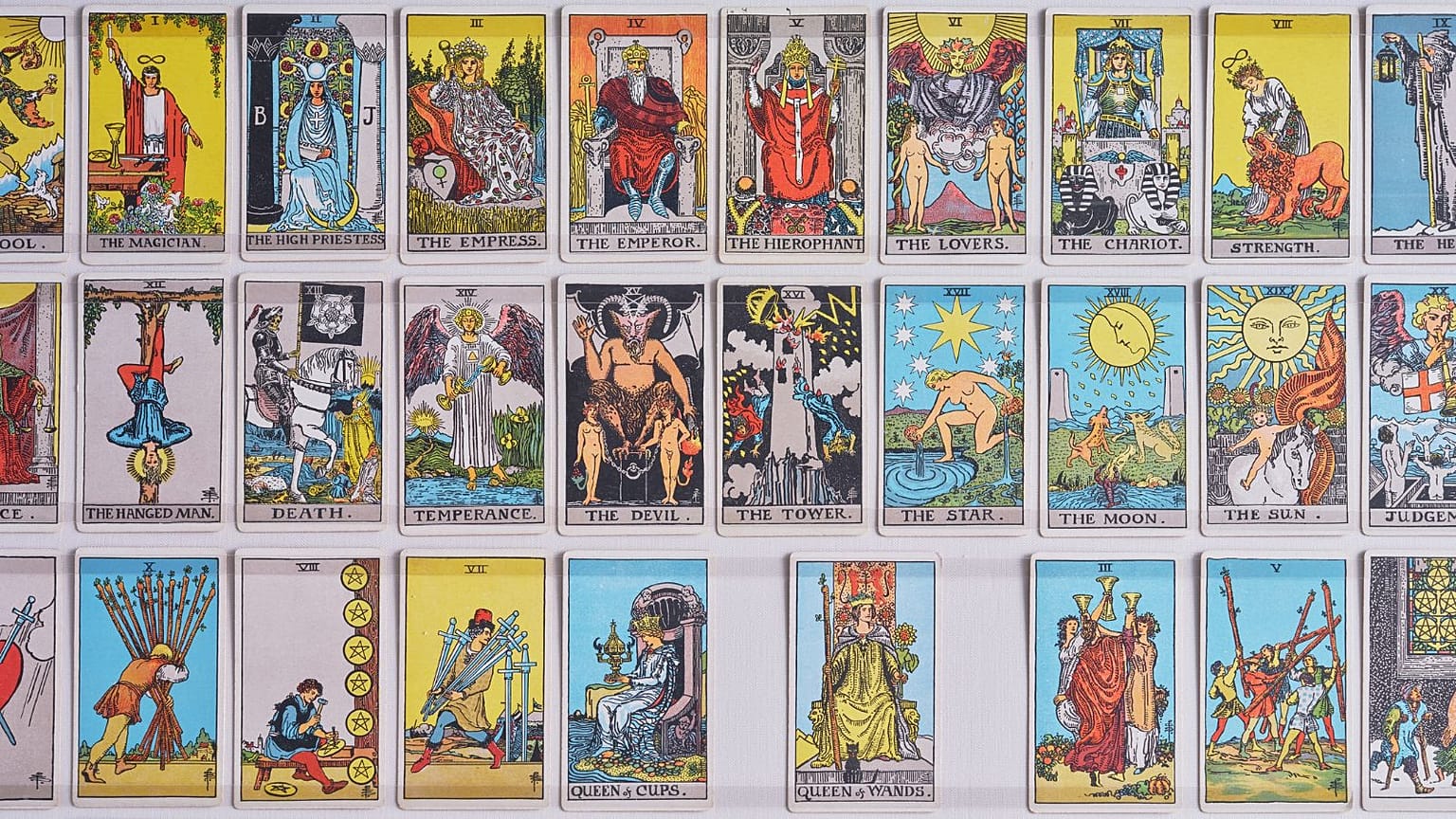
A selection of cards from the Rider–Waite Tarot deck.
Copyright Courtesy of The Warburg Institute


By Amber Louise Bryce
Published on 

What began as a set of playing cards evolved into tools of divination that continue to captivate modern generations, but our enduring fascination with tarot reveals more about the present than the future.

Melissa, a professional tarot reader in the UK, recalls attending an event at which a man drew the Justice card — often associated with balance, fairness, and truth. He began to cry. Then, quietly, he admitted he had been cheating on his wife. 

“He probably hadn't spoken to anybody about this,” Melissa told Euronews Culture. “But because there was an opportunity to talk to somebody, that was the moment he needed to tell his secret.”

Moments like this have shaped Melissa’s practice, and reflect a society still drawn to mysticism as a form of release. From TikTok readings to subversive decks, tarot has re-emerged as a modern tool for introspection — its iconic imagery an echo through time that mirrors, rather than predicts.

“It’s using old system symbology to check in on what's going on in your life,” said Melissa. “To see if there are any blockages and create a plan or guidance.”

Hand-painted tarot cards on display at The Warburg Institute's 'Tarot - Origins & Afterlives' exhibition.
Hand-painted tarot cards on display at The Warburg Institute's 'Tarot - Origins & Afterlives' exhibition. Courtesy of The Warburg Institute

But long before it became a mainstay of spiritual wellness, tarot’s origins — much of which remain shrouded in mystery — were surprisingly secular. The earliest known decks appeared in 15th-century Italy, exquisitely hand-painted and used as playing cards among nobility. 

“What we now know as the Major Arcana, which includes more symbolic cards like The Hanged Man, The Star and The World, [were] used as trump cards within different forms of play,” explained Phoebe Cripps, an associate curator at The Warburg Institute in London, which is displaying an exhibition on tarot’s ‘Origins & Afterlives’ until 30 April.  

The Renaissance imagery of these early Milanese decks is core to tarot’s magic; a bridge between the past and present, religion and individualism. Within their ambiguity, different interpretations flourished: “The cards began to evolve, moving between places in Europe,” said Cripps. "After wars between Milan and France, soldiers brought them into France, particularly to Marseille, and developed their own form of them."

Tarot was transformed into the esoteric by a French clergyman that believed it held the secrets of an Ancient Egyptian text.
Tarot was transformed into the esoteric by a French clergyman that believed it held the secrets of an Ancient Egyptian text. Courtesy of The Warburg Institute

By the 18th-century, tarot had arrived in Paris — and caught the attention of two spiritually-inclined clergymen. The first, Antoine Court de Gébelin, was reportedly struck by a vision that the cards came from Ancient Egypt, encoded with the secrets of an Ancient text known as The Book of Thoth. This theory was then expanded on by occultist Jean-Baptiste Alliette, who published guides that redefined tarot as a tool for divination, laying the foundations for its mystical rebirth.

“Occultists attach themselves to tarot and tarot attaches itself to them,” said Cripps. “And [the cards] eventually take on this Victorian, kind of moralistic view, every time they get redrawn.”

It was the Rider-Waite Tarot deck, however, that reimagined tarot for the 20th-century — and cemented its power to evolve across generations. Illustrated by Pamela Colman Smith and commissioned by Arthur Edward Waite for the Hermetic Order of the Golden Dawn (a secret society specialising in occultist study), its rich allegorical imagery made tarot more visually engaging and accessible than ever before.

The Rider–Waite Tarot deck remains one of the most popular and widely-imitated.
The Rider–Waite Tarot deck remains one of the most popular and widely-imitated. Courtesy of The Warburg Institute

“Arthur Edward Waite and Pamela Colman Smith were the first people that decided the Minor Arcana should be illustrated,” said Melissa, whose favourite deck is the Rider–Waite. “So before, we had all the cups, pentacles, wands, and sword cards just as numbers with the objects. But now we have full scenes.”

From decks themed around feminism and queer identity, to the movie poster art of Alice Rohrwacher's La Chimera, pop culture continues to reinterpret tarot’s iconography to tell new stories, and reflect the shifting values and anxieties of modern life.

Younger generations in particular are driving its rise, with more than 13 million posts under #tarot on TikTok, and a 2021 survey revealing that 51 per cent of 13–25-year-olds in the US have engaged in tarot or fortune telling. It reflects a broader cultural fascination with astrology, manifestation, and other spiritual ideologies — not just as therapeutic outlets, but as subtle forms of revolt against societal norms. 

In a world overwhelmed by political turmoil, economic instability and all-encompassing uncertainty, there’s a sense of control to be found beyond traditional structures. 

Contemporary interpretations of tarot.
Contemporary interpretations of tarot. Courtesy of The Warburg Institute

“Tarot highlights that people still want to leave space in society and in culture for a kind of magic. Something that is unknowable, that can't be neatly ordered,” said Cripps. “It's got a kind of rebellious underside to it, woven in, and I think that's what people gravitate towards.”

Yet its proliferation on social media has also sparked growing concerns about the exploitation of vulnerable people, some of whom can develop unhealthy dependencies on tarot as a source of false hope. 

“Especially on TikTok, I've noticed the question I get asked most in my readings is: ‘Is my ex coming back? How can I get my ex back?’,” said Melissa. “And I won't answer that question. I'll reframe it, and we'll look at what's going on in the person's life and help them feel really empowered to move forward.”

Whether used as a source of aesthetic cool, artistic inspiration, political commentary or self-help, Melissa sees contemporary tarot as a playground for curiosity — the kind that utilises mysticism without relying on it.

"I would encourage anyone who's interested to pick up a tarot deck. It doesn't have to be one of the old school ones — it can be something that you relate to, like a Buffy the Vampire Slayer deck," she said. "It's just a way of exploring and connecting with yourself."

Throughout its centuries of evolution, one thing remains true: Tarot has always helped us make sense of the present. When the internal knots of life can’t be undone by logic, its cards give us space to dream, reflect and conjure meaning from what already exists. Perhaps this is where their real magic lies


Viral backfire: Melania Trump called out as hypocrite after Jimmy Kimmel joke criticism

Viral backfire: Melania Trump called out as hypocrite after Jimmy Kimmel joke criticism
Copyright AP Photo - X Screenshots


By David Mouriquand
Published on 

The First Lady posted that “people like Kimmel shouldn’t have the opportunity to enter our homes each evening to spread hate", following a joke the talkshow host made three days before the shooting incident at the White House Correspondents’ Dinner. Now, her comments have backfired online...

What a difference a few hours make...

Following calls for his firing from The White House and Melania Trump, US talkshow host Jimmy Kimmel has defended a joke he made, in which he called the First Lady an “expectant widow” just days before the recent shooting incident at the White House Correspondents’ Dinner.

The host made the joke last Thursday (23 April), during his show Jimmy Kimmel Live!.

“Our First Lady, Melania, is here. Look at Melania, so beautiful. Mrs Trump, you have a glow like an expectant widow,” he said.

On Saturday (25 April), a gunman fired several shots at the Hilton in Washington, before being apprehended.

Posting on Truth Social yesterday, the US president said Disney and ABC should immediately sack the comedian – and not for the first time.

Kimmel’s show was temporarily suspended by ABC last year following the murder of Charlie Kirk and Trump’s calls for the talkshow host to be fired.

The First Lady also posted on X that “people like Kimmel shouldn’t have the opportunity to enter our homes each evening to spread hate”.

“His monologue about my family isn’t comedy – his words are corrosive and deepens the political sickness within America. (...) How many times will ABC’s leadership enable Kimmel’s atrocious behaviour at the expense of our community.”

Kimmel has defended the joke as a “very light roast”, saying that “obviously, it was a joke about their age difference and the look of joy we see on her face every time they’re together.”

“It was a very light roast joke about the fact that he’s almost 80 and she’s younger than I am. It was not – by any stretch of the definition – a call to assassination. And they know that. I’ve been very vocal for many years, speaking out against gun violence, in particular.”

“But I understand that the first lady had a stressful experience over the weekend, and probably every weekend is pretty stressful in that house,” he continued. “And also, I agree that hateful and violent rhetoric is something we should reject. I do, and I think a great place to start to dial that back would be to have a conversation with your husband about it. Donald Trump is allowed to say whatever he wants to say, as are you and as am I. Because under the First Amendment, we have, as Americans, a right to free speech.”

Check out the clip below:

Now, the tables have turned, with Melania Trump finding herself at the centre of a textbook and viral example of tables turning.

The First Lady has been accused of hypocrisy, as many are pointing out that her husband's violent rhetoric are routinely “corrosive” and responsible for the “political sickness within America.”

“This is your husband by the way,” someone posted along with a screengrab of Trump celebrating the death of former director of the FBI Robert Mueller.

“You know this guy?” asked another who shared a screenshot of Donald Trump sharing a post which called for Democrats to be hanged.

Check out some of the viral reactions below:

As of publication, Jimmy Kimmel still has a job.


Donald Trump's regulator orders licence reviews after Jimmy Kimmel’s Melania joke

Trump's regulator orders licence reviews after Jimmy Kimmel’s Melania joke
Copyright AP Photo

By David Mouriquand
Published on 

Network ABC is under pressure since Kimmel made a joke about Melania Trump three days before the White House Correspondents’ Dinner shooting.

Following growing pressure from the Trump administration for network chiefs to sack Jimmy Kimmel, Disney-owned TV stations must submit to early licence reviews.

The ‌Federal Communications Commission (FCC) said the reviews, which were due to start in October 2028, had been brought forward.

The move comes after talkshow host Jimmy Kimmel made a joke about Melania Trump days before the White House Correspondents’ Dinner shooting.

On his show, Jimmy Kimmel Live! - on Disney’s ABC network - Kimmel said the First Lady had a "glow like an expectant widow".

A Disney spokesperson confirmed the company had received the FCC's order.

"ABC and its stations have a long record of operating in full compliance with FCC rules and serving their local communities with trusted news, emergency information, and public‑interest programming," they said.

"We are confident that record demonstrates our continued qualifications as licensees under the Communications Act and the First Amendment and are prepared to show that through the appropriate legal channels," the spokesperson added.

Democratic FCC commissioner Anna M Gomez called the FCC's order a "political stunt". She wrote: "This is unprecedented, unlawful, and going nowhere. (...) Companies should challenge it head-on. The First Amendment is on their side."

The Freedom of the Press Foundation also described the FCC’s actions as an “attack on the First Amendment” - which guarantees freedoms concerning religion, expression, assembly, and the right to petition.

The Trumps have demanded the sacking of Kimmel, who was already taken off-air last year over Kimmel’s comments about the killing of Charlie Kirk.

In a post on X, Melania Trump said Kimmel's "hateful and violent rhetoric" intends to divide the US.

"His monologue about my family isn't comedy - his words are corrosive and deepen the political sickness within America. (...) Enough is enough. It is time for ABC to take a stand. How many times will ABC's leadership enable Kimmel's atrocious behaviour at the expense of our community," she wrote.

Kimmel responded to criticism of his joke by saying it was merely a reference to the couple's age difference.

"It was a very light roast joke about the fact that he's almost 80 and she's younger than I am," Kimmel said. "It was not by any stretch of the definition a call to assassination."

Melania Trump’s comments have backfired massively, as comments calling her out for being a hypocrite have gone viral.

Elsewhere, actor George Clooney defended Kimmel during Monday’s Chaplin Award Gala, saying that “jokes are jokes”.

“Jimmy’s a comedian, and I would argue that Karoline Leavitt didn’t mean shots should be fired,” Clooney said, referencing a pre-dinner remark by White House Press Secretary Karoline Leavitt. She said she was anticipating “some shots fired tonight in the room,” referring to remarks that Trump was expected to make during the event.

“She was making a joke. Fair enough," continued Clooney. "You look at that side and go, ‘Well, jokes are jokes.’ But the rhetoric is a little dangerous. And we’ve seen it a lot lately.”

Clooney said the extreme rhetoric “can be toned down.” He added: “When one side is calling anyone they disagree with traitors to the country, which is a charge that’s punishable by death, just because they don’t agree with someone, I think the rhetoric is a little too heated.”


Conspiracy theories abound after White House Correspondents' Dinner shooting


By James Thomas & Tamsin Paternoster
Published on 

\US President Donald Trump is no stranger to theories alleging that attempts on his life are false flag operations.

Leaders across Europe have condemned the shooting that took place at the White House Correspondents' Association dinner on 25 April, which US President Donald Trump attended.

Trump, First Lady Melania Trump, and Vice-President JD Vance were among those evacuated at the Washington Hilton hotel after gunshots were fired near the main security screening area for the annual event.

Suspect Cole Tomas Allen has since been charged with attempting to assassinate the president. He has not yet entered a plea, and the US Department of Justice says it has yet to establish a clear motive.

European Commission President Ursula von der Leyen said on X that she had spoken to and expressed solidarity with Trump following the attack, which has sparked plenty of speculation and numerous conspiracy theories.

In the aftermath of the incident, influencers and social media users flooded X, Bluesky and Instagram with allegations that the attack was staged, despite multiple journalists reporting first-hand on the incident.

Yet more accused the Trump administration of deliberately staging the shooting to stir up support for Trump's White House ballroom project, which has faced legal challenges.

Trump claimed in the shooting's aftermath that the planned $400 million (€342 million) ballroom within the White House itself is crucial for his safety, as it limits the need for him to host events outside and would contain an underground bunker.


A selection of false posts suggesting the shooting was staged Euronews

But there is no evidence that the shooting was staged, despite this conspiracy theory taking hold of mainstream social media platforms with millions of views.

Some of these posts refer to an image that shows Trump's reaction after the shooting. Others suggest that Fox News abruptly cut off a reporter as she began to imply that it was a false flag after Nicholas Riccio, husband of White House Press Secretary Karoline Leavitt, told her to stay safe.

The Fox reporter who supposedly had her call cut, Aishah Hasnie, later posted on X that her call only dropped because there was little signal in the ballroom of the hotel, and that Riccio only told her to stay safe in general terms, not as a warning of the attack that was to come.

"He was telling me to be careful with my own safety because the world is crazy," Hasnie said. "Which is what my own father and other people have also said to me recently. He was expressing his concern for my safety."

"I was going to say — before I lost my signal — that it was unfortunate that only a short time later, this all happened," she added.

A similar claim suggesting that the attack had been staged pointed to an interview Leavitt gave to Fox News prior to the dinner, in which she said that "shots would be fired" in the room.

Some posts on X interpreted this remark as evidence that Leavitt had prior knowledge of the shooting.

However, the full interview makes it clear that Leavitt was teasing Trump's planned speech, after Fox News interviewer referenced the 2011 White House Correspondents' Dinner, at which the then-President Barack Obama and comedian Seth Meyers famously made jokes about Trump.

"He is ready to rumble, I will tell you. This speech tonight will be classic Donald J Trump," Leavitt said. "It will be funny. It will be entertaining. There will be some shots fired tonight in the room. So everyone should tune in. It will be really great."

Was the shooter given a signal?

Several posts showed a clip of a man standing next to Trump briefly holding up a card. Seconds later, shots can be heard in the background.

Social media users claimed that the person holding up the card may have been giving a signal to someone else to begin the attack.

However, the cardholder was Oz Pearlman, a mentalist and performer. According to an interview he gave to CNN, he was performing at the moment this clip was taken.

"It was a pivotal moment in the trick where you're just about to do the reveal of like 'wow', and we hear commotion," Pearlman said, explaining that at first he thought there was a medical emergency in the room.

Despite a complete lack of evidence, these theories were amplified online, with some tying the motive of the shooter to Israeli causes.

Others were amplified by Russian state media, some of which have since taken down reports that suggested that the attack was staged.

It's not the first time social media users have speculated that shootings involving Trump are false flag operations, with a similar theory spreading after the attempt on his life during a rally in Pennsylvania in 2024, despite a lack of evidence.


LA REVUE GAUCHE - Left Comment: Search results for AMERICAN CONSPIRACY ORIGINS

Decline In Prey Increases Risk Of Jaguar Extinction In Atlantic Forest
In the Green Corridor, ongoing conservation initiatives such as the Iguaçu Jaguar Project and long-term efforts to combat illegal hunting help maintain a prey base capable of sustaining viable jaguar populations CREDIT: Iguaçu Jaguar Project


April 29, 2026 
By Eurasia Review

In addition to habitat loss and illegal hunting, the jaguar (Panthera onca) faces another threat that increases its risk of extinction in the South American Atlantic Forest: food scarcity.


A study by Brazilian researchers found that the availability of jaguar prey is reduced, even in the protected areas of the biome, which covers approximately 15% of Brazil and extends across 17 states in the South, Southeast, and Northeast regions, as well as parts of Argentina and Paraguay.

Jaguar prey species, including peccaries (Tayassu pecari), agoutis (Dicotyles tajacu), and deer, are hunted by humans and have dwindled to numbers that likely cannot support viable jaguar populations in the Atlantic Forest. The researchers warn that if this situation worsens, the biome, which currently has fewer than 300 jaguars, could become the first in the world to lose a top predator.

The results of the study, which was supported by FAPESP were published in an article in the journal Global Ecology and Conservation. The study also involved researchers from the Cananeia Research Institute (IPeC), the Chico Mendes Institute for Biodiversity Conservation (ICMBio), as well as its National Center for the Research and Conservation of Carnivorous Mammals (CENAP/ICMBio), the State University of Mato Grosso (UNEMAT), and the Iguaçu Jaguar Project – Pro-Carnivores Institute.

“We found an alarming situation of low abundance of key prey species for the jaguar even in protected areas of the Atlantic Forest, where national and state parks are located and where one would expect the situation in terms of the animal’s conservation to be better,” Katia Ferraz, a professor at the Luiz de Queiroz School of Agriculture at the University of São Paulo (ESALQ-USP) and coordinator of the study, tells Agência FAPESP. “Most likely, the decline of these prey species is one of the main causes of the critical conservation situation facing the jaguar in this biome,” she notes.

Field survey

The researchers combined information on the jaguar’s diet and feeding habits with data obtained through an on-site survey of the feline’s prey species. They did this using camera traps distributed across nine protected areas in the Atlantic Forest. Based on the data, they estimated the abundance and biomass of 14 prey species in these areas, which have varying levels of jaguar populations, and made comparisons between them.

The analyses revealed that the largest feline in the Americas primarily feeds on large prey, particularly wild pigs and deer. These prey were more abundant and had higher biomass in the Green Corridor than in the Coastal Atlantic Forest regions, such as the Serra do Mar, where jaguars are absent or occur at very low densities. The data reveal a striking difference in biomass between the Green Corridor (638 kg) and the coastal regions (8.2 kg).

“The results show a consistent pattern. Areas with greater prey availability, especially of medium- and large-sized prey such as wild pigs and deer, are also those where jaguars persist. Where the prey base is very limited, jaguar populations tend to be absent or extremely small,” notes Ferraz.
Easier access

According to the researcher, the low abundance and reduced biomass of the analyzed species were due to human presence. Prey were more abundant in areas that were more difficult to access and less abundant where illegal hunting was easier, indicating that this activity remains a core problem, even within conservation areas.

“We’ve observed that the low availability of prey is linked to increased human access to protected areas. In areas that are more easily accessible due to factors such as terrain and proximity to villages and urban centers, prey availability is lower,” says Ferraz. “This suggests a direct link to hunting pressure. In addition to the pressure on the jaguar itself, the predator, there’s very strong pressure on prey populations, leading to the decline of the feline,” she explains.

In the Green Corridor, protected areas are more connected and less accessible to human activity. Ongoing conservation initiatives, such as the Iguaçu Jaguar Project, and long-term efforts to combat illegal hunting also help explain why there is a prey base capable of sustaining viable jaguar populations.

In the coastal portion of the biome, such as the Serra do Mar, the low abundance of prey may reflect historical and still-persistent human pressure, despite the vast territorial extent and numerous ongoing conservation efforts, whether government-led or not. The authors of the study note that this reality is linked to the region’s proximity to major urban centers, such as Curitiba and São Paulo, and to the greater ease of access to protected areas.

According to the authors, this scenario poses a core challenge to environmental management. While some regions function as refuges that maintain ecological balance, others require intensive actions to control hunting, recover wildlife, and manage human use to prevent the permanent disappearance of the Americas’ largest predator in the Atlantic Forest.
Conservation oases

Of the areas evaluated in the study, Iguaçu National Park stood out as one of the last places in the Atlantic Forest with relatively high populations of predators and prey.


The successful conservation of jaguars in the park is due to a combination of human and ecological factors, including the work of the Iguaçu Jaguar Project and altitude. “Across all the areas analyzed, it was observed that the lower the altitude, as in the park, the greater the abundance of prey – a pattern also recorded in other areas of the Atlantic Forest,” explains Ferraz.

The Iguaçu Jaguar Project is based on three pillars: research, coexistence, and engagement. In the research area, applied studies are conducted to inform effective strategies on topics such as food ecology, vegetation corridors, and monitoring.

The engagement pillar aims to transform fear into understanding and fascination with jaguars, strengthening the bond between local communities and conservation efforts. The coexistence pillar involves working with communities surrounding the park to offer guidance on best practices for livestock management, preventing predation, and reducing misinformation. When there are reports of sightings or tracks, immediate guidance on safety and appropriate behavior is provided.

“Jaguars here in the region were nearly extinct. In 2009, we had between nine and 11 animals, and over the past 15 years, the population has nearly doubled,” says Yara Barros, the executive coordinator of the project. One of the actions that contributed to this result was precisely the increased effort to combat illegal hunting. “Hunting poses a major threat because people often enter the forest to hunt the animal’s prey and end up killing it as well,” she says.

The increase in agriculture and decrease in cattle ranching around the park may have also contributed to the recovery of the species, as the change in land use has reduced retaliatory killings. “We collaborate with communities in ten municipalities. A project technician visits rural properties not only when predation occurs,” says Barros.

According to Barros, coexistence is key: “We’re creating a tri-national network with partners from Paraguay and Argentina to share and replicate our experience,” she says.
Invasive Goldfish Are Reshaping Freshwater Ecosystems


April 29, 2026

By Eurasia Review

A new peer-reviewed study conducted by researchers at the University of Toledo and University of Missouri provides some of the first rigorous experimental evidence that goldfish — one of the world’s most popular pets — can dramatically change freshwater ecosystems when released or they escape into the wild.

The findings published in the Journal of Animal Ecology, carry an urgent message for pet owners, resource managers and policymakers alike: goldfish might be great pets, but they are not harmless in the wild.

“It is critically important to inform the public that their pets can become pests that will harm freshwater ecosystems. The evidence is now clear — releasing a goldfish into the wild might be seen as an act of kindness, but it can turn into a major ecological threat,” said the study’s lead investigator, Dr. William Hintz, associate professor in UToledo’s Department of Environmental Sciences and Lake Erie Center.

Rigorous Scientific Approach; Stark Results

Titled, “Invasive goldfish trigger a regime shift in experimental lake ecosystems of varying trophic state,” the study used large-scale, controlled outdoor mesocosm experiments to simulate realistic lake conditions and track the effects of goldfish introductions across different ecosystem types.

The researchers introduced goldfish (Carassius auratus) into experimental lake ecosystems representing two common environmental conditions — nutrient-poor (oligotrophic) and nutrient-rich (eutrophic) waters — and monitored the ecological consequences over time. The results were stark:Water quality collapsed rapidly. In nutrient-rich conditions, goldfish triggered a rapid deterioration of water clarity and a sharp increase in suspended solids, signaling a fundamental shift in the ecosystem’s state.

Native species declined across multiple trophic levels. Goldfish presence led to significant reductions in snails, amphipods, and zooplankton — small invertebrates that form the base of healthy aquatic food webs — through direct consumption and destruction of habitat.

Native fish suffered. Goldfish out-competed native fish for food and resources, reducing the body condition of native fish species — a warning sign for long-term population health.

No lake type is safe. Goldfish proved harmful across both oligotrophic and eutrophic conditions, though the nature of the impacts differed. No freshwater ecosystem appears immune.

The study employed both additive and substitutive experimental designs — a rigorous scientific approach that allowed researchers to disentangle the specific effects of goldfish from those associated with total fish density. This revealed that while some changes to aquatic plant communities were tied to the overall number of fish present, the most damaging ecological outcomes were clearly attributable to goldfish themselves.

A “regime shift” — the scientific term for when an ecosystem crosses a threshold and rapidly reorganizes into a fundamentally different, often degraded state — was documented in goldfish-invaded systems. Once triggered, such shifts are notoriously difficult and expensive to reverse.

Call for Pet Owner and Management Action


The pet trade moves exotic animals across the globe at an unprecedented scale, and goldfish rank among the most widely distributed ornamental fish on Earth. When released into rivers, lakes or ponds — whether intentionally or through flooding of ponds — they can quickly establish invasive populations.

“If goldfish are released into the wild, they rapidly grow into very large fish that stir up lake sediments, consume large numbers of prey and compete with native fish,” said Rick Reylea, professor in the University of Missouri College of Agriculture, Food and Natural Resources, director of Mizzou’s Johnny Morris Institute of Fisheries, Wetlands and Aquatic Systems and co-author of the study.

The authors urge natural resource managers worldwide to treat goldfish as a high-priority invasive species and implement prevention, early detection and control strategies before populations become established. They also call for stronger public education campaigns to ensure that pet owners understand the consequences of releasing aquatic animals.

For pet owners with unwanted goldfish, humane alternatives to release include returning fish to the pet store, rehoming them with other aquarium enthusiasts or contacting local wildlife authorities for guidance.
Cadmium crisis pushes France towards long-delayed political test

France is facing mounting pressure over cadmium – a toxic heavy metal linked to cancer and found in everyday foods – as fresh health warnings, public anger and political action intensify around a long-running contamination crisis now heading for a parliamentary battle.


Issued on: 28/04/2026 - RFI

Cadmium in phosphate fertilisers can accumulate in farmland over decades before entering everyday foods such as bread, pasta and other staples. © REUTERS/Gleb Garanich

By:RFI
ADVERTISING


Health warnings over cadmium exposure in France have been mounting for years, but political action over the crisis has repeatedly stalled.

A citizens’ petition launched on 9 April urged the government to curb exposure to the toxic metal “without delay”, criticising what it called “unjustifiable political inertia” – as lawmakers prepare to examine a proposed crackdown on cadmium-heavy fertilisers on 14 May.

Pressure has intensified since Anses, France’s national health and food safety agency, warned in March that nearly half the population is exposed to cadmium above recommended safety levels.

The agency warned the level of exposure was worrying and said contamination affects all age groups, including very young children.

Classified as a proven carcinogen by the International Agency for Research on Cancer, cadmium is also linked to reproductive problems, neurological disorders and cardiovascular disease. The metal builds up in the body over time and is difficult to eliminate.

Children are especially vulnerable. More than a third have cadmium levels above acceptable daily thresholds, Anses said.

For most people, contamination comes mainly through food – including staples such as bread, pasta, biscuits, rice and potatoes. Smokers are also exposed through tobacco.

From fertiliser to food


France’s high exposure is closely tied to its farming model.

The country is Europe’s biggest user of phosphate fertilisers, which have been spread on farmland for decades. These fertilisers contain cadmium, which builds up in soil, is absorbed by crops and enters the food chain.

Much of France’s phosphate supply comes from Morocco, home to some of the world’s largest phosphate reserves, including deposits with particularly high cadmium levels.

As a result, cadmium levels in France can be twice as high as in Italy and up to three times higher than in the United States. Santé Publique France, the public health agency, said average contamination nearly doubled between 2006 and 2016.

Since 2021, the agency has also suspected a link between cadmium exposure and the sharp rise in pancreatic cancer cases in France.

In June last year, a group of doctors wrote to the prime minister and the health, agriculture and ecological transition ministers, warning that cadmium exposure was a “health time bomb” and urging action.

European Union rules cap cadmium in phosphate fertilisers at 60 milligrams per kilogram, with a target of 20mg/kg by 2035.

France still allows up to 90mg/kg. Anses has urged since 2019 that France move to the stricter 20mg/kg threshold “as soon as possible”.

France’s agriculture ministry opened consultations in October 2023 on lowering the limit, but no decision has followed.

Fear and deadlock


Several factors have slowed reform, according to journalist Martin Boudot, whose 2021 investigative documentary Vert de Rage: Engrais Maudits ("Green with Rage: Toxic Fertilisers") examined cadmium contamination linked to phosphate fertilisers.

“There was very strong lobbying from the phosphate fertiliser industry,” Boudot told RFI.

Russia’s invasion of Ukraine then added geopolitical complications. In 2022, the prospect of relying on lower-cadmium fertilisers, including some from Russia, was used as an argument for delaying tougher rules.

Fear of angering France’s farming sector also became a major stumbling block. “There is a real fear of a farming backlash,” Boudot added.

Daily newspaper Le Monde reported that the agriculture and ecological transition ministries asked expert bodies in the summer of 2025 to assess the economic impact of stricter rules.

A report initially expected by the end of 2025 was delayed because of “the scale and complexity of the analysis required”, the ecological transition ministry told the paper.

The case has also reached France’s highest administrative court, where lawyer and former environment minister Corinne Lepage has accused the state of culpable inaction.

RFI contacted the agriculture ministry for further details, but received no response.

Parliamentary test

Greens MP and farmer Benoît Biteau tabled a bill in December that would ban the most cadmium-heavy fertilisers from 2027.

It narrowly passed committee in February, but has struggled for political space and was placed last on the agenda for the next cross-party parliamentary slot on 14 May.

“We have all the evidence, and yet we keep waiting,” Biteau told RFI, calling the resistance “incomprehensible”.

“There is no reason left to wait, because alternatives exist,” he said.

Those alternatives include farming methods that reduce reliance on phosphate fertilisers, lower-cadmium phosphate sources from countries such as Finland and Norway and technology that can remove cadmium from phosphate.

Morocco itself is already lowering cadmium levels in its phosphate. “Today they are already capable of getting below 40 milligrams, and they are aiming for 20 milligrams within a few years,” Biteau said.

The FNSEA, France’s biggest farming union, did not respond to RFI’s questions about cadmium contamination and lower fertiliser thresholds.

Its president, Arnaud Rousseau, said in a France Inter interview in early April that he could support stricter limits if affordable alternatives were available.

France’s fertiliser industry said that it has been “fully committed to reducing cadmium inputs for many years”, but warned that cadmium removal methods “remain complex and costly and cannot be the only answer”.

A report published in April by Green MP Catherine Hervieu warned that French environmental health policies remain too weak for what it called “colossal” public health challenges.

Biteau said he hopes the citizens’ petition will show parliamentary group leaders how strongly action is expected on cadmium.

Even if tougher decisions were taken immediately, it would still take years – possibly decades – for cadmium levels to fall in soil and in the food supply, Biteau added.

For now, France has agreed to reimburse cadmium screening tests, expanding detection while the broader fight continues over whether lawmakers will finally curb contamination at its source.

This story was adapted from the original version in French by Aurore Lartigue.