Wednesday, April 15, 2026

Conservative accuses Trump of 'Mind-boggling' vendetta against NFL


'Draw the line': NFL veterans rage against Trump using their image to sell his war
April 14, 2026
ALTERNET

President Donald Trump is pursuing an antitrust case against the National Football League (NFL) — but an editor from a magazine one might expect to support him instead implied this is about a vendetta.

The Justice Department is investigation whether the NFL uses anti-competitive tactics to keep watching football too expensive, and Reason Magazine managing editor Jason Russell suspects this has little to do with consumer protection

“Could it be because President Donald Trump tried to get into NFL ownership several different times and came up short?” wrote Russell on Tuesday, adding that Trump tried and failed to buy the Baltimore Colts, Dallas Cowboys, New England Patriots and Buffalo Bills at various points between 1981 and 2014, and even successfully purchase a football team (the United States Football League’s New Jersey Generals) in 1983 — but in a league that eventually folded.

“No one is entitled to watch the NFL,” Russell wrote. “If someone decides a game is too difficult or costly to watch, no one dies or suffers anything other than very minor entertainment-related harm. (The league, it's worth noting, is actually one of the easiest to watch, ‘with over 87 percent of our games on free, broadcast television, including 100 percent of games in the markets of the competing teams,’ according to a league spokesperson.)”

Russell added, “Watching sports on broadcast TV instead of streaming platforms is not some sacrosanct human right that needs to be protected by the federal government. As we prepare to celebrate the 250th anniversary of America's founding, it is mind-boggling to be at the point where ‘Should a sports league be allowed to put more games on streaming platforms?’ is a real question that the Justice Department and the FCC are spending their time on.”

Trump has had other recent feuds with the football world. Last month former football players Kenny Bell of the University of Nebraska and Tampa Bay Buccaneers linebacker Mason Foster expressed dismay that images of them playing were used to promote the US military’s recent wars without their consent.

“I’m at a loss for words,” Foster told The Washington Post. “It’s a strange feeling, seeing those clips like that. I don’t think anything going on in the world today is as simple as a great football play or a hit. I’m still wrapping my head around it. ... When people are losing their lives, I don’t think it can compare to a game.”

Both Bell and Foster said the White House has not obliged their requests to remove the video and that they believe the NFL, which holds the rights, should use the courts if the president does not do so.

Trump appears to be sensitive to his rising unpopularity, even in the football world. During Super Bowl LX in Santa Clara, California in February, Trump reportedly declined to attend because his advisers feared he would be booed en masse, and that this "would instantly create a wealth of viral video clips and media coverage that administration officials would prefer to avoid."

"[Booing is] another thing we don’t want right now," the adviser anonymously told Zeteo.
Confederate groups furious as Virginia kills their tax breaks


Miranda Pederson, Public domain, via Wikimedia Commons
April 14, 2026
ALTERNET

On Tuesday —161 years after the conclusion of the American Civil War — the state of Virginia ended long-standing tax exemptions for a range of organizations linked to the Confederacy. Signed by Democrat Gov. Abigail Spanberger and passed by the Democrat-controlled state legislature, the bill ending financial benefits represented a victory in the hard-fought effort for the state to rid itself of its legacy as the Confederate capital.

While the action will stop tax exemptions for a number of groups, the largest is the United Daughters of the Confederacy, which was created in 1894 with the stated intention of honoring its members’ ancestors. Over the course of its existence, the organization has erected hundreds of Confederate memorials across the U.S. to promote the “Lost Cause” narrative, which critics have argued was an intentional effort to romanticize the Confederacy and maintain a pro-slavery presence across the country. These statues and monuments have become targets for social justice efforts in recent years, with many being burned or torn down.

The United Daughters of the Confederacy has yet to respond following the bill’s signing, but as the matter was being debated in February, organization president Julie Hardaway said the bill “reeks of discrimination” and is “based on misguided and biased opinions.”

State General Assembly delegate Alex Askew, who sponsored the bill, disagreed, saying, “Let’s be very clear about what we’re dealing with. Organizations like the United Daughters of the Confederacy have promoted the Lost Cause. Why is the commonwealth supporting groups that rewrite history to obscure the true cause of the Civil War? A war fought to uphold the institution of slavery, America’s original sin?”

The bill isn’t the only current Virginia legislation that aims to cut ties from the state’s Confederate past.

One signed last week ends the issuance of specialty license plates that feature Confederate General Robert E. Lee and the Sons of Confederate Veterans. Sons of Confederate Veterans spokesman Frank Earnest asserted that the discontinuation of the Lee plate was a “terrible” attack on free speech, saying, “I could go down to the D.M.V. right now and point out some fact about every plate there that I didn’t like. So if we’re going to cancel every plate because somebody out there doesn’t like it, we might as well just cancel the whole program.”

Another bill — which Spanberger has sent back to the state legislature with recommendations — would create a task force at the Virginia Military Institute tasked with distancing the college from the “Lost Cause” messaging that has long undergirded its curriculum.

While opponents argue that these bills represent an attack on their heritage, Askew sees things differently.

“A tax exemption is a privilege and not a right,” he said before the bill’s passage. “This legislation does not challenge Confederate organizations’ right to exist. It is not about free speech. It’s not about taking down any monuments. But it’s about fairness and financial and fiscal priorities of Virginia.”


One Step Away From The Trump-Netanyahu Black Hole, The Italian PM Stands Out – OpEd


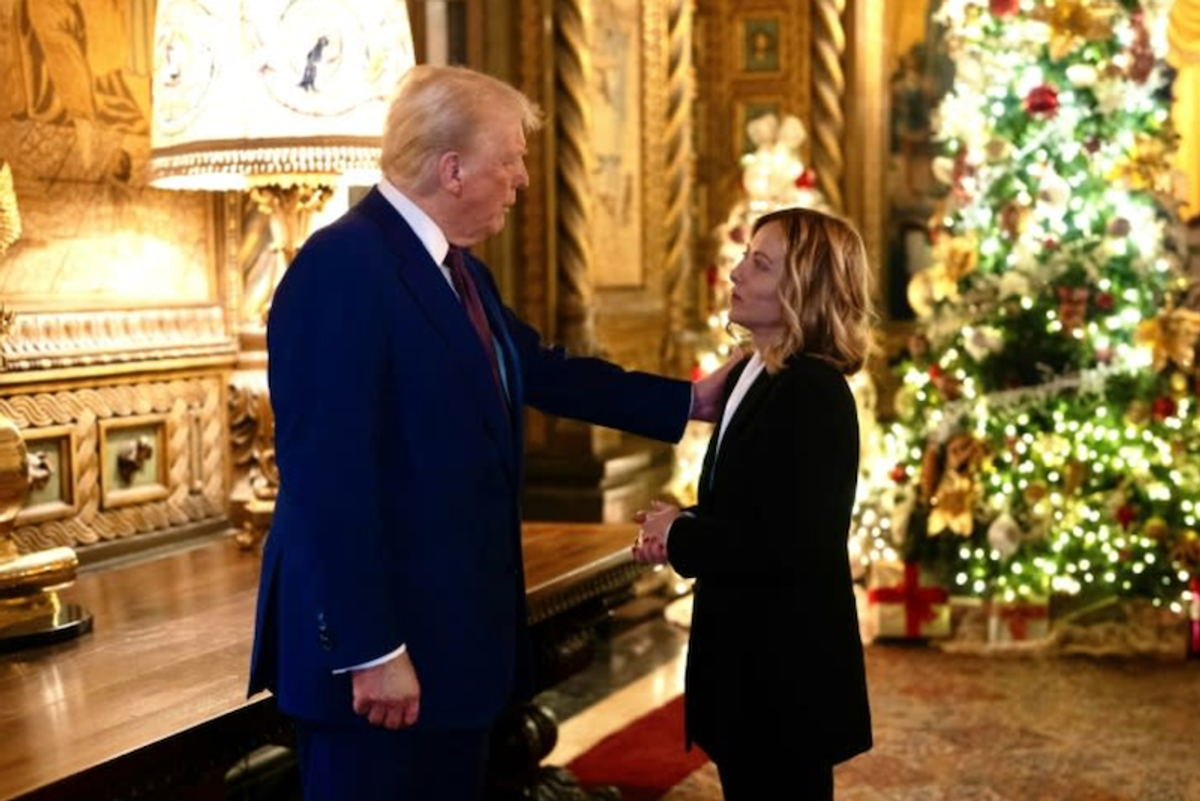
Italy's Prime Minister Giorgia Meloni with US President Donald Trump. 
Photo Credit: The White House


April 15, 2026 
By Prof. Umberto Sulpasso


The electoral precipice for Giorgia Meloni was one step away. And the matrix was evidently all in the symbiotic alliance with Trump and Netanyahu, the two leaders who are shaking up the international political order with wars and disruptions. The resounding defeat in a constitutional referendum. The disjointed collapse in Hungary of the anti-Europe ally practically kicked out by the voters, had already shaken the electoral base of the PM. But Trump had the knockout blow in store: a frontal attack on the Pope and this would have been lethal for the PM if she had not decided to distance herself from the Trump-Netanyahu duo. But it is not certain that having changed course is enough

The Three Preparatory Blows To Meloni’s KO

1. The Jab-cross that opened the guard : The Constitutional Referendum lost

2. Jab-left hook. The resounding defeat in Hungary of Victor Orban, a symbol of anti-Europeanism disguised in the form of nationalism

3. Uppercut. The attack on the Pope by the American President

Three blows capable of transforming the next electoral experience into a historic KO capable of reserving the same fate for Meloni as the Hungarian leader. Cancellation.

The Italian political context is dominated by two women, PM Giorgia Meloni, and opposition leader Elly Shlein. And here Louisa May Alcott could be the inspiration for the post-Netanyahu-Trump in Italy. Her first successful book, “Little Women” was followed by a further success “Little Women Grow Up,” and Alcott’s second title fits singularly well with the politics of PM Giorgia Meloni, who on the brink of the precipice has decided that she politically wants to survive three blows received in less than a month, before they turn into a real KO.


From Manufacturing Consent To Manufacturing Dissent


If the defeat in the referendum can be read as a national event, the election in Hungary is the sign of an epochal eclipse of a political approach that had two leading theorists in Noam Chomsky and Edward Barnays: the election of Peter Magyar at the expense of Orban certifies the crisis of consensus as a means to conquer power, replaced by dissent.

I continue to consider Noam Chomsky a master of political philosophy despite the recent Epstein injuries. Personally, I am not hunting for unblemished heroes, there are none, and if there were they would not belong to the human species, and in any case they would not interest me: perfect beings are boring. I look for and appreciate personalities who do important positive operations of political theory, and Chomsky has done many. Opposition to the Vietnam War, struggle for freedom of information, support for qualified liberal personalities. Criticism of the fascist right wing in Israel. The Israeli government even denied him a visa for a conference in Tel Aviv. All this cannot and must not be forgotten and it is worth remembering Chomsky with regard to the Hungarian political election, because there is one thing that the great linguist taught like few others, and can be found in Manufacturing Consent, along with the book Propaganda by Edward Barneys, another pillar of twentieth-century political communication. And let’s see why.
Freud’s Nephew

Edward Barnays, Freud’s nephew, theorized the principle that government must be conquered with subliminal messages. He gave a practical demonstration of the potential of these messages in at least three sensational situations. One: launching the idea of the abundant “American breakfast”, (Eggs and Ham). Two: by favoring the coup d’état in Guatemala, by inventing, on behalf of United Fruit – from which Woody Allen would one day draw inspiration for his banana republics – the message that the president-elect was a communist, which was not true, but the subliminal message passed and there was a coup d’état favored by the CIA. Three: perhaps the most resounding success because it also concerns us, doubling the cigarette market with the brilliant idea of loading the image of the woman who smokes with positive messages. “Torches of Freedom” was the operation by which simultaneously a considerable number of women of American high society lit a cigarette in public, making it a symbol of female freedom. The cigarette, which was seen as a phallic symbol, became a manifestation of female sexual freedom. There were a few more cancers… but Barnays got a very high reward from the American Tobacco Association that had hired him, perhaps greater than that obtained by United Fruit.

Epochal Political Change: Power Conquered Not By Building Consensus But By Building Dissent – A Dangerous Political Change

But why were “Manufacturing Consent” and “Propaganda” put in the attic with the Hungarian election?

They go to the attic because it is now evident that electoral power is no longer won by “building consensus”, that is, by making positive proposals, while the vice versa of “building dissent” focuses on what is not good. On what goes wrong.

Péter Magyar, beat Victor Orbán not because he proposed an alternative program, but because he “disagreed”. Magyar does not come from the opposition, but from Orban’s own party from which he “disagrees”. His ex-wife, Judit Varga, was at one time Orbán’s Minister of Justice, is publicly accused of covering up regime scandals. And this is the winning lever. In Hungary, therefore, it was not the opposition that won, but dissent.

“Manufacturing Dissent” has a phenomenal lever in the spread of the Internet, and of the socials, which facilitate dissent in an endemic way, hyperbolically multiplying individual manifestations, favoring that state of social malaise that favors the seizure of power by the political producers of dissent, which is the media mechanism that has temporarily put Chomsky and Barneys in the attic.

But it is a very dangerous mechanism. Podemos has dissolved into thin air. The 5 Stars have had to give up all the most relevant reforms. Polls on Trump show his vertical fall. .
The Uppercut That Prepares For The KO Of PM Meloni: Trump’s Brutal Attack On The Pope

Italy has essentially become a secular country, but there is no doubt that the Pope continues to have a role of great importance. A role that has increased considerably in recent years. Francis’ pontificate has produced enormous sympathy even on the left and has created cultural and political availability that was unthinkable 30 years ago, when the left recognized itself in a strong anticlericalism. But this is an international phenomenon. Pope Francis greatly increased the approval rating for the Vatican on the basis of principles and values that the left – including the American left – has always made its own. Respect for the different. Protection of humanistic values. And above all, peace as an indivisible unifying good. Leo XIV seems to be following in those footsteps. Brutally attacking the Pope without taking into account the scope of the spiritual values in which progressives from all over the world, including those in Italy, recognize themselves, not only means creating a new fracture in America, but also means disintegrating the electoral base of the PM in Italy.


The Pope very intelligently chose not to start a war, but in Italy Meloni basically had to choose between two Americas: to stay by the side of the American President or to defend the Pope’s America.

And the PM, in order not to fall into the black hole of anti-pope Trumpism, has chosen to govern, distancing herself from Trump and Netanyahu for the first time. And it was resoundingly appreciated by the leader of the opposition, also a woman.

Little women grow up, Louise Alcott would say. It is not necessarily enough for the PM to remain in power. It is clear in Italy as everywhere that dissent is used to conquer power, but not to govern. Maybe Trump will also soon also find out.


Prof. Umberto Sulpasso

Prof. Umberto Sulpasso has taught in many European and American universities. He is the author of the GDKP the Gross Domestic Knowledge Product, the first quantitative model in the world of Wealth of Nations in terms of knowledge produced, purchased and circulated. The Indian Government had officially appointed in 2019 Prof. Sulpasso as Director of GDKP INDIA. Among his recent publications there is, " Know Global, The Most Important Globalization"; "Darwinomics, The Economics Of Human Race Survival"; "New Enlightenment In Economics In The 21st Century"; and "Knowledge the new measure of Wealth of Nations." Prof. Sulpasso has launched “Knowledge the infrastructural information which will create the New Silk Road with Africa and Asia countries” in a recent international conference.


'I thought she was brave': Trump turns on Italian ally over Pope criticism

Tom Boggioni
April 14, 2026 
RAW STORY


U.S. President-elect Donald Trump has played host to a slew of foreign leaders, most recently Italy's Prime Minister Giorgia Meloni, as he prepares to take office (Filippo ATTILI/AFP)

Donald Trump has turned on Italian Prime Minister Giorgia Meloni, publicly denouncing her as "unacceptable" for defending Pope Leo XIV against the president's criticism of his unprovoked Iran war.

According to Politico, Trump spoke directly with Italian daily Corriere della Sera to express his fury with Meloni's refusal to join his attack on the first American-born Pope who resides in Vatican City.

"I was shocked by her. I thought she was brave, but I was wrong," Trump said in the phone interview, delivering a stinging personal rebuke to an ally he had publicly praised just a year earlier.

When confronted with Meloni's Monday statement calling Trump's criticism of Pope Leo "unacceptable," the president responded with characteristic vindictiveness:

"It's her who's unacceptable, because she doesn't care if Iran has a nuclear weapon and would blow up Italy in two minutes if it had the chance."

Trump's grievance extends beyond the Pope dispute. He complained that Meloni expected the United States to "do the work for her" by protecting Italy from nuclear threats and ensuring stable oil supplies — suggesting she should be grateful for American military protection rather than criticizing his policies.

The deterioration of their relationship is striking. Trump noted the two hadn't spoken "in a long time," a stark contrast to just last year when Meloni visited Mar-a-Lago as Trump's guest. At that dinner, he called her "a fantastic woman" who had "really taken Europe by storm."

The rupture exemplifies Trump's pattern of discarding allies the moment they show independence from his agenda — a warning sign for other world leaders considering whether solidarity with the American president is worth the political cost.

MAGA faithful turn on Trump: 'There’s a decent chance he’s the antichrist'


April 13, 2026
ALTERNET


Since launching war against Iran at the end of February, there has been a notable uptick in the extreme nature of President Donald Trump’s words and actions, from threatening that “a whole civilization will die tonight” to accusing the Pope of being “WEAK on Crime.” For many, this has raised questions about Trump’s mental health. Others, however, have begun to see something more sinister in his behavior. The president, they suspect, may be the antichrist.

Discussion of Trump’s possible unholiness began in earnest on Sunday following an upswing in the president’s rhetoric against the Vatican. Conflict flared between the White House and that papacy following early April reports that representatives of the administration had made threatening remarks suggesting that armed action could be taken against the Pope were he not to support Trump’s military endeavors. While that meeting took place in January, its public revelation coincided with the Pope speaking out against “those who wage war” in a thinly veiled criticism of the strikes on Iran two months later.

Trump didn’t like that one bit, and fired back on Sunday with a lengthy Truth Social post in which he railed against the Pope for being “terrible on Foreign Policy” and “Weak on Nuclear Weapons.” He implied that the Pope is pro-murder, rambled about his 2024 electoral win and the stock market and suggested that “Leo should get his act together as Pope” and “stop catering to the Radical Left.”

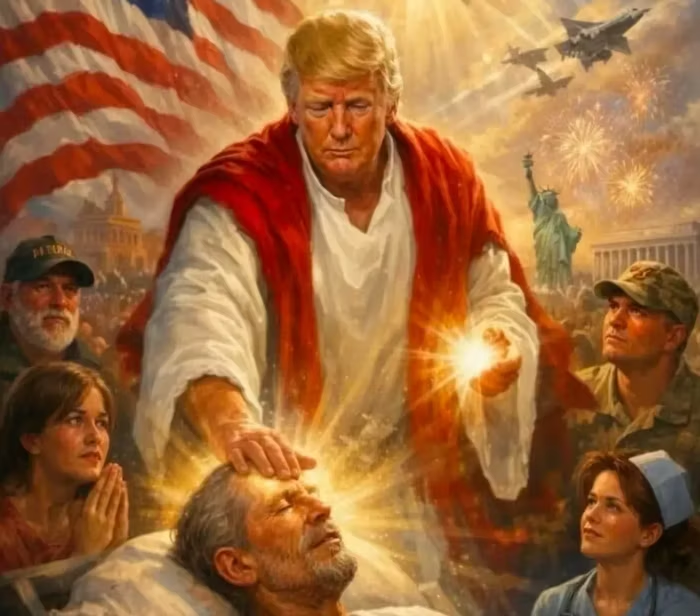
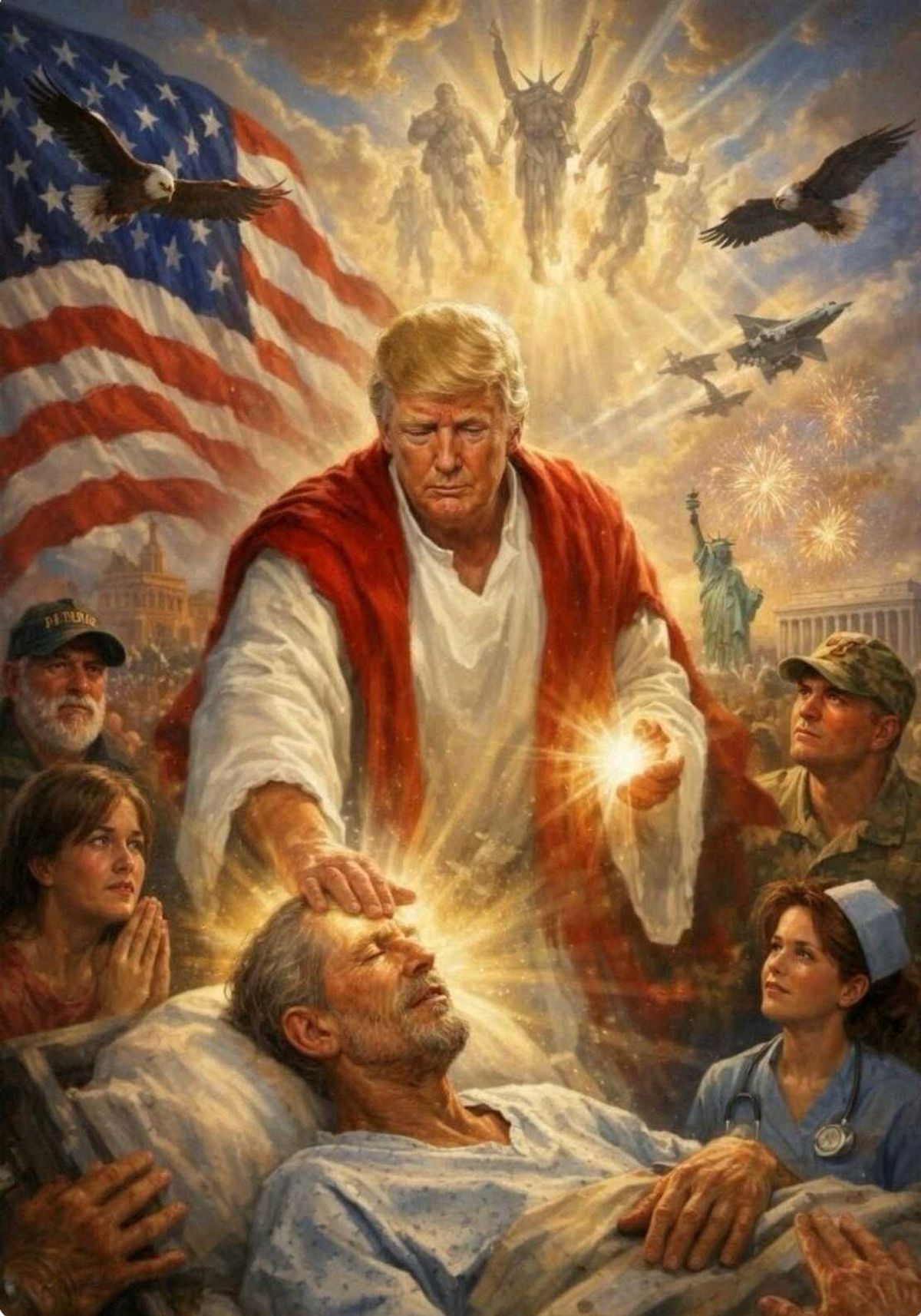
The president then posted an AI-generated image of himself as Jesus, and for Christian onlookers, that’s when all hell broke loose.

“It’s more than blasphemy. It’s an Antichrist spirit,” posted former Representative and Trump ally Marjorie Taylor Greene.

“In 18 months I went from hesitantly voting for Trump to thinking there’s a decent chance he’s the antichrist,” declared Clint Russell, host of the right-wing Liberty Lockdown podcast.

“I genuinely believe Trump is currently demon possessed,” far-right Texas pastor Joel Webbon asserted before hosting a livestream where he and others debated a simple question: “Is Donald Trump the Anti-Christ?”

It wasn’t just Trump’s higher-profile supporters making such accusations. In the comments beneath his Trump Social post, scores of his followers lambasted the president’s “sacrilegious” behavior, ramping up the backlash to the point that he deleted the post on Monday morning.


All of this comes days after far-right commentator Tucker Carlson—who has been a vocal critic of the war on Iran and has questioned Trump’s mental health—raised similarly spiritual concerns about the president’s potential dark motivations.

“Is it possible what you’re watching,” wondered Carlson, “is a very stealthy yet incredibly effective attack on what, from a Christian perspective, is the true faith: belief in Jesus? Is it possible that the president sees this in bigger terms? Sees this as the fulfillment of something? An elevation of some higher office beyond President of the United States?”
Trump taps into anti-Catholicism that's 'baked into' US political culture: historian


Pope Leo XIV leads a prayer vigil, ahead of Pentecost Sunday, in St. Peter’s Square at the Vatican, June 7, 2025. REUTERS/Guglielmo Mangiapane

April 13, 2026
ALTERNET


Catholics are by and large reacting very negatively to President Donald Trump’s repeated attacks on Pope Leo XIV.

Despite denying reports that Trump officials tried to bully a Vatican representative several months ago, on Sunday the president posted a lengthy diatribe lambasting the Pope. Denouncing him as “Weak on Crime” and “Weak on Nuclear Weapons,” Trump included an AI-generated image of himself as a Jesus-like figure healing the sick with patriotic iconography in the background. He later claimed he thought the image showed him as a doctor and promoted the Red Cross before taking down the post entirely.

Trump is criticizing the Pope because Leo XIV, who was born in America as Robert Prevost, has urged him to treat immigrants more humanely and cease his unprovoked wars against Venezuela and Iran. In response to Trump’s recent posts, the Pope noted that the president did so on a social media platform he owns called Truth Social.


"It's ironic, the name of the site itself,” the Pope said. “Say no more.”

Speaking to AlterNet about Trump’s anti-Pope statements, Christendom College associate professor of history Dr. Christopher Shannon explained that he is participating in a larger history of U.S. anti-Catholic sentiment.


“Anti-Catholicism is baked into Anglo-American political culture,” Shannon told AlterNet. “During the Revolution, patriot leaders from [future president] John Adams to Thomas Paine repeatedly denounced British oppression in language drawn directly from earlier denunciations of the Catholic Church. For example, in Common Sense, Paine likened monarchy to ‘popery.’”

Shannon elaborated on how the so-called American Party thrived during the mid-19th Century on a platform of opposing mass immigration, especially from Catholics. Millard Fillmore, then a former president, won the second-highest vote ever accrued for a third-party candidate (22 percent) when he ran in the 1856 presidential election on an explicitly anti-Catholic ticket.

“Even up to 1960, [America’s first Catholic president John] Kennedy had to respond to a fear of a papal takeover of America were he to be elected,” Shannon pointed out. “Popes [e.g., Leo XIII (1878-1903)] sometimes had good things to say about America, yet no pope clearly endorsed modern democracy and religious pluralism, so the papacy was always suspect in the eyes of non-Catholic Americans. In 1965, the Second Vatican Council, under Pope Paul VI, issued a document that finally affirmed the legitimacy of democracy and religious pluralism. After that, tensions greatly decreased.” Yet even then, President Ronald Reagan aroused controversy from anti-Catholic groups when he appointed an ambassador to the Vatican City in 1984 — the first such diplomat in US history.


It is into this fraught context that Trump stepped when he attacked the Pope, a decision Shannon speculated was made because “Trump thinks [it] is about him. He thinks everything is about him.” He disagreed with Trump’s insinuation that Leo XIV owes his papacy to the idea that he would somehow be a pro-Trump pope.

“As far as Leo XIV, I suppose his status as an American had something to do with his election, but it is important to remember that he is as much the second Latin American pope (after Francis) as he is the first United States pope,” Shannon wrote. “Most of his episcopal career has been in Peru. He certainly had no public profile in the Church in the United States. He cannot be pigeon-holed into either of the ‘liberal’ or ‘conservative’ sides of the internal Catholic culture war. Though American by birth, he is perhaps the least American of bishops because he refuses to take sides in what, considering the global nature of the Catholic Church, is a very petty squabble.”

Given that Pope Leo XIV has a global rather than specifically American outlook to his papacy, American Trump supporters (including, as the president pointed out, the Pope’s big brother and Navy veteran Louis Prevost) now need to choose between their loyalty to basic Catholic principles and their loyalty to the president. Drawing from recent history to understand precedents, Shannon predicted they would do so by ignoring seeming contradictions between their religious and their political beliefs.


“John Paul II and Benedict XVI both spoke out against the second Iraq War [when they were popes], but American Catholics did not, as a unified people, follow their lead,” Shannon told AlterNet. “Conservative Catholics supported the war for conservative reasons, liberal Catholics opposed the war (mostly) for liberal reasons. I do not see the recent dust up between Trump and Leo changing this. Catholic Trump supporters will likely dismiss this as ‘Trump being Trump,’ and anti-Trump Catholics didn’t need any more reasons to oppose Trump.”

Landon Schnabel, an associate professor of sociology at Cornell University, argued that Trump’s attack against the Pope could fray the already-tenuous alliance between Christian evangelicals and Catholics.

“The Catholic-evangelical alliance that anchors the religious right was always more fragile than it appeared,” Schnabel said in a statement. “Catholics and evangelicals were adversaries for most of American history — John F. Kennedy had to reassure voters his pope wouldn't run the country. They eventually built a coalition around shared cultural traditionalism: abortion, family, sexuality, and religious authority in public life. That project held for four decades.”

Schnabel added, “But coalitions forged on one set of issues are vulnerable when new issues expose the theological differences underneath. The Iran war is doing exactly that. Defense Secretary Hegseth prays at the Pentagon for ‘overwhelming violence’ in the name of Jesus Christ and frames the war as divinely ordained. Pope Leo quotes Isaiah in response: God ‘does not listen to the prayers of those who wage war.’ Two traditions that agreed on abortion have very different theologies of war. Conservative Catholics who have supported Trump may now feel the need to decide between him and the pope.”


Kim Haines-Eitzen, a Cornell professor of ancient Mediterranean religions and expert on early Christianity, had a scathing assessment of Trump’s AI image of himself as Christ.

“Throughout Christian history, there have been many who claimed to be Christ or claimed Christ’s divine authority,” Haines-Eitzen explained in a statement, citing infamous cult leaders like Sun Myung Moon, Jim Jones, Charles Manson and David Koresh of the Branch Davidians.

“The question now is whether Trump’s so-called Christian base will be willing to speak out against what has long been considered blasphemy throughout Christian history,” Haines-Eitzen added. “It is one thing for Christian preachers and leaders to encourage fellow Christians to live in Christ-like ways — giving to charity, caring for the poor, offering forgiveness. It is another thing for a president to present himself as Christ.”

Speaking to ABC 7 Chicago, a major regional news network from the Pope’s home (the Chicago metropolitan area), a pair of ordinary Catholics expressed dismay at Trump’s statements about the Pope.


“As a Christian and a Catholic, I've had enough,” said one man wearing a Chicago Cubs cap. (The Pope’s favorite baseball team are the Cubs’ crosstown rivals, the Chicago White Sox.) “I've just had enough. I've supported many things he's done. I'm actually in favor of what we're doing in Iran, but this country needs real leadership, and what we're getting now is an absolute disgrace. And Americans need to stand up because it's disgusting.”

Similarly a self-described Catholic parishioner said “I think it's deplorable that the President of the United States would take aim at our first American pope. And instead of working together and having an understanding, to attack is the wrong way to do it.”

Among Catholics in Long Island — which is home to 1.2 million baptized Catholics, one of the largest dioceses in the country, and is near Trump’s childhood home of Queens — there is similar disapproval. Bishop John Barres, head of the Diocese of Rockville Centre, said that his diocese joins "Pope Leo XIV in calling for peace, especially in the Middle East and in places where Christians are persecuted for their faith. We pray for and support our Holy Father in the mission of Christ's mercy and the proclamation of the Gospel—Blessed are the peacemakers."

Richard Koubek, a former public policy advocate at Catholic Charities on Long Island, told Newsday that "President Trump, who revels in the support of Christian nationalists, thinks Pope Leo is ‘too liberal.' That is quite ironic since Leo is simply proclaiming ancient Christian values that emphasize peace, care for the poor and marginalized. ... Does he think the Gospels are too liberal?"


A pro-Trump Catholic named Mike Ferrara said that while he agrees with Trump over the Pope on specific policy issues, he is unhappy with Trump’s disrespectful tone.

"I’m a Trump supporter,” Ferrara said. “I like Trump. But the way he talks about the pope, I’m not really thrilled about that. The pope is the leader of our church. As a Catholic, I don’t want to see the pope get attacked."

Regarding the AI image, Ferrara argued that "you don’t emulate Jesus Christ. Jesus Christ is Jesus Christ."

Trump’s attack on the Pope is also unpopular in Nashville, a Tennessee city with a large Catholic population and influential Catholic voices like right-wing commentators Michael Knowles and Candace Owens.

“I assumed someone has already told him, but it behooves the President both spiritually and politically to delete the picture, no matter the intent,” Knowles said on social media. Meanwhile Owens, reflecting on the rumored 2028 presidential ambitions of Trump’s Catholic vice president, posted on social media that Trump’s war with the Pope “will be consequential for JD Vance.”

Even in Italy, the nation where the Vatican is effectively located, the Italian prime minister disregarded the fact that both she and Trump are right-wingers to slam his attacks on Pope Leo XIV.

“I find President Trump’s remarks about the Holy Father unacceptable,” Meloni said in a statement. “The Pope is the head of the Catholic Church, and it is right and proper that he call for peace and condemn all forms of war.”

Italian politicians across that country’s political spectrum agreed with Meloni’s position.
Trump’s 'pope derangement syndrome' has him flailing in the face of 'God's messenger'


Robert Francis Prevost, now Pope Leo XIV, on the central balcony of St. Peter's Basilica in Vatican City on May 8, 2025 (Marco Iacobucci Epp/Shutterstock.com)

April 14, 2026   
ALTERNET

President Donald Trump is suffering from what one expert on Catholicism called "pope derangement syndrome," causing him to lash out against "God's messenger" Pope Leo XIV with bitter, politically charged jabs due to his fundamental misunderstanding of the role.

James V. Grimaldi is the Pulitzer Prize-winning former executive editor of The National Catholic Reporter. On Tuesday, he published a piece in the New York Times calling out Trump's recent feud against the pope and accusing him of "missing the point" when it comes to the pontiff's actual role within the church.

Leo, who ascended to the head of the Catholic Church last year following the passing of Pope Francis, has emerged as something of a thorn in the side of the MAGA movement due to his statements calling for the humane and compassionate treatment of immigrants, among other issues. Most recently, his opposition to armed conflicts has drawn the ire of Trump amid his spiraling with Iran, prompting the president to lash out against him in a Sunday Truth Social post, bafflingly accusing the pope of being "WEAK on Crime, and terrible for Foreign Policy."

This latest escalation also came on the heels of a bombshell report revealing that the Pentagon had seemingly threatened military action against the Vatican in response to Leo's comments.

In his piece, Grimaldi stressed, as many have, that Leo's comments are not driven by partisan antipathy for Trump and MAGA, but rather by an accurate interpretation of Catholic teachings. He also noted that the cardinals who elected him last year did so with an eye to "the future in terms of the unity and strength of the Roman Catholic Church," not because they were "designating a foil for Mr. Trump."

"Pope Leo’s statements aren’t partisan barbs; they are expressions of his understanding of the Gospel and Catholic social teaching," Grimaldi explained. "For Mr. Trump to respond to them as potshots or challenges to his authority reflects a misplaced obsession with the pope and a misunderstanding of his role as the spiritual leader of more than a billion Catholics worldwide — call it pope derangement syndrome."

He continued: "For many Catholics, myself included, Leo’s words make us proud of our faith and thankful to have a pope who isn’t afraid to clearly and powerfully articulate a vision of what we consider morally and scripturally right, even if — or especially if — the church’s teaching clashes with the views of a president. But that’s not necessarily because we are Democrats or disaffected Republicans (I am neither), nor because we’re reflexively anti-Trump. It’s not because we secretly hope Leo was elected to hector the president. It’s because we Catholics believe that the pope is the Vicar of Christ, in essence God’s messenger on earth. It only follows that he would proclaim God’s message, particularly when it matters most, regardless of the political fallout."

‘I Will Continue to Speak Out Strongly Against War,’ Says Pope Leo in Face of Trump Abuse

“The message of the Gospel is very clear: ‘Blessed are the peacemakers.’”


Pope Leo XIV gestures during a visit at the Maqam Echahid Martyrs’ Monument in El Madania, near Algiers on April 13, 2026.
(Photo by Alberto Pizzoli / Pool / AFP via Getty Images)

Brad Reed
Apr 13, 2026
COMMON DREAMS

Pope Leo XIV on Monday said he would not back off his criticism of President Donald Trump’s war of choice in Iran after the president targeted him with an unhinged late-night social media rant.

In a Sunday Truth Social post, Trump accused Pope Leo of being “WEAK on Crime, and terrible for Foreign Policy,” even though dealing with crime and running US foreign policy are not part of the pope’s job description.

“Leo should get his act together as Pope, use Common Sense, stop catering to the Radical Left, and focus on being a Great Pope, not a Politician,” Trump wrote at the conclusion of his long tirade. “It’s hurting him very badly and, more importantly, it’s hurting the Catholic Church!”

A short time later, Trump posted an artificial intelligence-generated image that depicted him as a Christ-like figure.


Pope Leo in recent weeks has been openly critical of the US war in Iran, taking particular issue with US Defense Secretary Pete Hegseth claiming that the conflict was being waged in the name of Jesus Christ.

“This is our God: Jesus, King of Peace, who rejects war, whom no one can use to justify war,” the pope said during a Palm Sunday sermon last month. “He does not listen to the prayers of those who wage war, but rejects them.”

According to a Monday report from the Associated Press, the pope remained defiant in the face of criticism from the president.

“The message of the Gospel is very clear: ‘Blessed are the peacemakers,’” he said. “I will not shy away from announcing the message of the Gospel and inviting all people to look for ways of building bridges of peace and reconciliation, and looking for ways to avoid war any time that’s possible.”

Leo added that he is “not afraid of the Trump administration or of speaking out loudly about the message of the Gospel,” and insisted that “I will continue to speak out strongly against war, seeking to promote peace, promoting dialogue and multilateralism among states to find solutions to problems.”

Trump’s attack on the pope drew a rebuke from Sen. Mark Kelly (D-Ariz.), who said it was reflective of a presidency circling the drain.

“ Donald Trump is flailing,” Kelly wrote in a social media post. “His war in Iran has led to the death and injury of American servicemembers and the death of Iranian children. He will attack anyone or anything to try to protect himself, even the Church that millions of Americans find faith and comfort in every day.”

Rep. Pramila Jayapal suggested that Trump’s anti-pope rant was more evidence that he is mentally unwell and should be removed from office.

“The deranged and disgusting post from Trump attacking Pope Leo should certainly help him appeal to the more than 50 million Americans who identify as Catholics,” she wrote. “Perhaps this will convince JD Vance to invoke the 25th Amendment to remove Trump from office?”

Archbishop Paul Coakley, president of the US Conference of Catholic Bishops, said he was “disheartened” that Trump “chose to write such disparaging words about the Holy Father.”

“Pope Leo is not his rival; nor is the pope a politician,” Coakley added. “He is the vicar of Christ who speaks from the truth of the Gospel and for the care of souls.”

The Rev. James Martin said he doubted Pope Leo “will lose any sleep over” Trump’s rant, but added “the rest of us should” because “it is unhinged, uncharitable, and unchristian.”


Ex-GOP insider reveals why Trump’s AI Jesus keeps him up at night: 'He wants your worship'


Nicole Charky-Chami
April 14, 2026 
RAW ST0RY

Former Republican strategist Rick Wilson shared just why President Donald Trump's decision to share an image of himself posed as Jesus "raising someone who looks a lot like Jeffrey Epstein from the dead," troubles him.


The co-founder of The Lincoln Project, an anti-Trump organization, discussed in his Substack on Tuesday why Trump's latest move was not only unsettling, but analyzed just how "the entire scam" has played out among MAGA and Christian followers who supported Trump.

"Now, it’s been a minute since Divinity class, but I know my Bible well enough to know that what we’re looking at here is either the greatest act of accidental self-own in the history of organized religion, or, and bear with me here, a slow-roll confirmation of the one prophecy nobody in MAGA land bothered to read before slapping on the red hat," Wilson wrote.

"He might be the Antichrist," Wilson wrote. "And I mean that with exactly as much comedy and as much genuine theological dread as you think I do."

Trump's rise to power was propped up by a number of supporters, including the religious right.

"Trump has been sold to evangelicals (and a damn good percentage of Catholics) as America as a vessel of divine providence," Wilson explained. "The man with three wives, the hush money, the Epstein mess, the whores, the sexual abuse, the porn stars, the casinos, the fraud judgments, the scams and rip-offs, the gleeful cruelty, this is the man God chose."

MAGA was convinced Trump was essentially their guy, Wilson argued.

"That’s the pitch. With a straight face. From pulpits. Joel Osteen has several private jets and a house the size of Rhode Island because he and others like Franklin Graham sold you this guy. Think on that," Wilson wrote.

But the meme that sparked public outrage this week has led to more revelations about who Trump really is — and what he really desires, according to Wilson.

"Here’s the thing about the Jesus meme that keeps me up at night, not the blasphemy of it (though, sure, that too), but the demand it represents. The man doesn’t just want your vote. He wants your worship. He wants to be the thing you kneel before. He has always wanted that," Wilson added.


NYT conservative warns Trump put religious MAGA supporters in 'spiritual peril'

Daniel Hampton
April 14, 2026 
RAW STORY


A post on U.S. President Donald Trump's Truth Social account depicts an AI-generated image of himself apparently as Jesus posted on April 12, 2026. @realDonaldTrump/Truth Social/Handout via REUTERS

A prominent conservative Catholic columnist at The New York Times is sounding the alarm for President Donald Trump's religious base, warning that his escalating blasphemy is a harbinger of things to come that true believers should not ignore.

Ross Douthat, a conservative Catholic opinion writer who is not known for being a Trump critic, wrote Tuesday that the president's weekend social media rampage — which included a profanity-filled Easter post, an attack on Pope Leo XIV, and an AI-generated image depicting himself as Jesus Christ — represents something far more serious than typical Trumpian excess.

"The compounding offense isn’t against religious identity or papal dignity. It’s a violation of the first and second commandments, where the offended party is Almighty God," Douthat wrote Tuesday.

Douthat was careful to acknowledge that popes are not infallible on political matters, and that conservative Catholics have legitimate grievances with the Vatican's leftward tilt. But he argued that Trump has simply never made a coherent moral case for the Iran war, leaving the pope with a valid reason to call it unjust.

In a striking passage, Douthat directly addressed Trump's believing supporters.

"If you are a secular observer who assumes that blasphemy is a sin without a real object, that escalation matters mostly as a window into the president’s second-term state of mind.

"If you’re a believer, though, then Mr. Trump’s entire political career — his catalyzing role in liberalism’s crisis, his movement from power to exile to power once again — exists under providential power. In which case a turn to presidential blasphemy is a warning for his religious supporters about potential conclusions to the story, and the spiritual peril of simply sticking with him till the end."


Trump is alienating America’s 'biggest religious swing voters'

Photo by Pedro Lima on Unsplash

April 15, 2026
ALTERNET

When John F. Kennedy Sr. won the Democratic presidential nomination in 1960, many political journalists wondered if U.S. voters would elect a Catholic president. But JFK narrowly defeated the Republican nominee, then-Vice President Richard Nixon, by less than 1 percent but won the electoral vote 303-219.

Sixty years later, in 2020, devout Catholic Joe Biden defeated incumbent President Donald Trump by roughly 5 percent in the popular vote and 306-232 in the Electoral College. Now, in 2026, Vice President JD Vance, is a convert to Catholicism, and Catholics dominate the U.S. Supreme Court.

Moreover, Protestant candidates actively court Catholic voters. But in a biting opinion column published on Wednesday, April 15, The Guardian's Arwa Mahdawi argues that President Trump's attacks on Pope Leo XIV could alienate Catholic voters and become a political liability for Catholic Vance (who was raised Protestant).

"On Sunday, (April 12), Trump, who identifies as a nondenominational Christian, attacked the Pope on Truth Social, calling him 'WEAK on Crime, and terrible for Foreign Policy,'" Mahdawi observes. "Shortly after, the president posted, and later deleted, an AI-generated image of himself as a Jesus-like figure anointing the forehead of a man who looked vaguely like a skinny Jeffrey Epstein…. 'Blessed are the peacemakers,' Leo said on Monday, when asked about Trump's comments. 'I'm not afraid of the Trump Administration or of speaking out loudly about the message of the Gospel.'"

Mahdawi notes that the "majority of Catholics," according to polls, "disapprove of Trump's handling of the war on Iran."

"Alienating Catholics is not the smartest move: they are the U.S.' biggest religious swing voters," Mahdawi argues. "They largely voted for Biden in 2020, but, in 2024, Trump won the group by a 10- to 20-point margin. Unless he makes good on his threat to run for an unconstitutional third term, Trump doesn't have to worry about courting the Catholic vote again himself, but he hasn't made life easy for his Catholic vice-president, JD Vance, who is generally seen as Trump's successor. Vance has been very quiet about all this, causing Denise Murphy McGraw, the national co-chair of Catholics Vote Common Good, to call him out and state that silence is complicity."

The liberal Guardian columnist continues, "Vance broke his silence on Fox News on Monday, saying, 'It would be best for the Vatican to stick to matters of morality.… and let the president of the United States stick to dictating American public policy.' I know you're desperate for your boss' job, JD, but I think it would be best for American public policy if there were a little less dictating and a little more morality."


Ex-Fox News host on Trump's Jesus post: 'Maybe he thinks he's a really important figure'

Robert Davis
April 13, 2026 
RAW STORY


A political analyst was stunned on Monday after President Donald Trump retreated from his religious snafus over the weekend.

Trump posted on Truth Social on Sunday that Pope Leo XIV is "weak" on crime and foreign policy, and that Trump "doesn't want" a Pope who criticizes him or his administration's war with Iran. Trump also posted, and then deleted, a photo of himself appearing as Jesus Christ while healing a man lying on a bed. Both posts generated significant criticism from analysts and lawmakers.

Gretchen Carlson, a former Fox News anchor, discussed the posts on "Erin Burnett OutFront" on Monday.

Burnett asked Carlson why she thought Trump made the posts.

"The first thing that came to me was because the Pope is more popular," Carlson said. "And in fact, today, right here on CNN, you showed a poll where the approval rating of Pope Leo in America is very high, and the approval rating of Donald Trump currently is low. And that is sort of what makes Trump click on a daily basis, he tends to take his ill feelings out on people who are more popular or who he deems to be having more success at the time."

Carlson added that she was surprised Trump received so much backlash from the posts.

"With regard to getting into religion, do I think it's going to have any impact? Probably not," Carlson said. "In normal times, I would have said yes, but he's gotten away with so much else. He makes fun of disabled people. He makes fun of people with autism. He made fun of Michelle and Barack Obama as apes. I'm actually surprised he took the post down."

"I'm not so sure that he doesn't totally think that he is some sort of really, really important figure," she added. "And maybe he had no understanding that it would have this kind of backlash."


MTG squirms as CNN throws her previous claims about 'Jesus' Trump back in her face

Robert Davis
April 13, 2026
RAW STORY


CNN screenshot

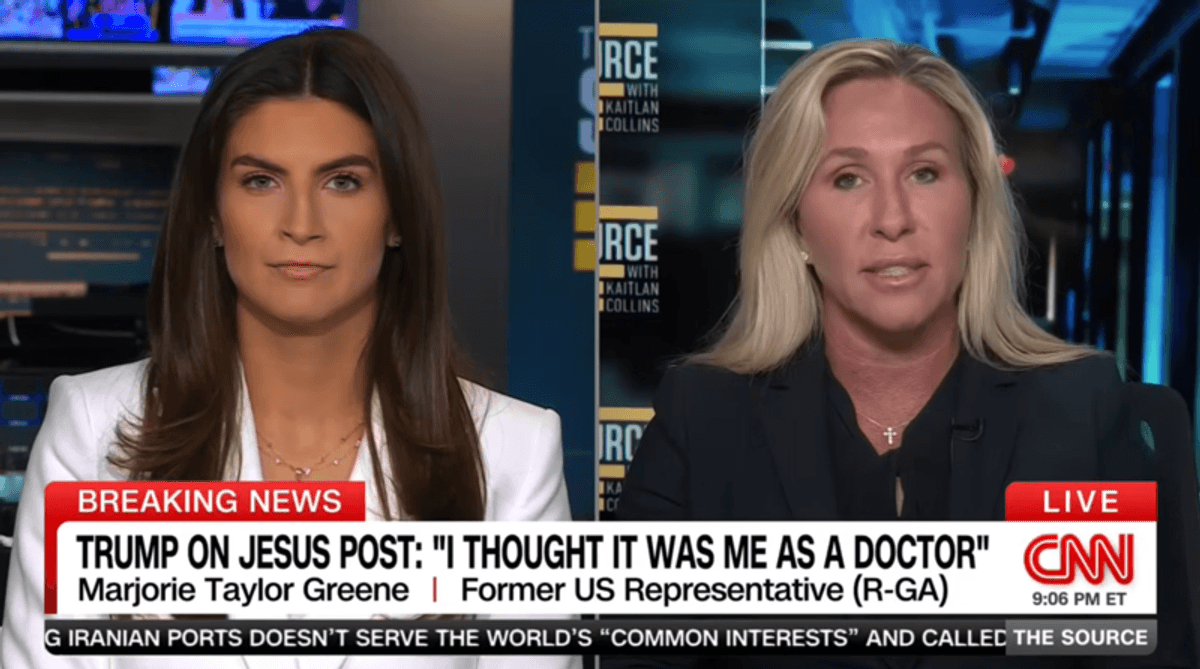
Former Republican Rep. Marjorie Taylor Greene squirmed on CNN after anchor Kaitlan Collins asked her about previous comments where she compared President Donald Trump to Jesus Christ.

Greene joined Collins on CNN's "The Source" on Monday, where the two discussed Trump's most recent controversial social media posts. In one post, Trump called the Pope "weak" on crime and foreign policy. In the other, Trump posted an AI-generated photo of himself appearing as Jesus Christ healing a sick man in bed.

Trump doubled down on his comments about the Pope on Monday, but said he failed to recognize the clearly Christian iconography in the AI-generated photo.

Collins reminded Greene that she had once compared Trump to Jesus because they both were arrested, and played a clip of her saying it.

Greene seemed uncomfortable as she responded.

"We were talking about people being prosecuted unfairly by weaponization of government, political prosecutions, things such as the political protesters," Greene said. "That's what I was referring to there. I wasn't talking trying to portray [Trump] as Jesus. I think that was completely different."


Trump voter tells MS NOW he's appalled after seeing Jesus picture: 'I'm ashamed'

Tom Boggioni
April 14, 2026 
RAW STORY


Alex Tabet interviews Trump voter (MS NOW screenshot)

Attempts by Donald Trump to put out the firestorm he created by posting a meme picture of himself as Jesus on Truth Social seems to be flopping, MS NOW is reporting.

On Monday the president defended the picture, which had been taken down, claiming that he was being portrayed as a doctor, but in interviews on the street, self-identified Christians and Catholics uniformly criticized the president when shown a printout of the picture, with one Trump voter claiming he was “ashamed.”

Speaking with Anna Cabrera from in front of St. Patrick’s Cathedral in Manhattan, reporter Laura Haefeli told the host, “One thing is clear is this could actually cost him possibly the Catholic vote in this country, because people here outside of the most recognizable cathedral in the country are upset.”

Shown the picture, one woman told her, “Disgusting, just forget it. It's evil. Just evil. Yeah. Nothing more to say about it. He's crazy. Done.”

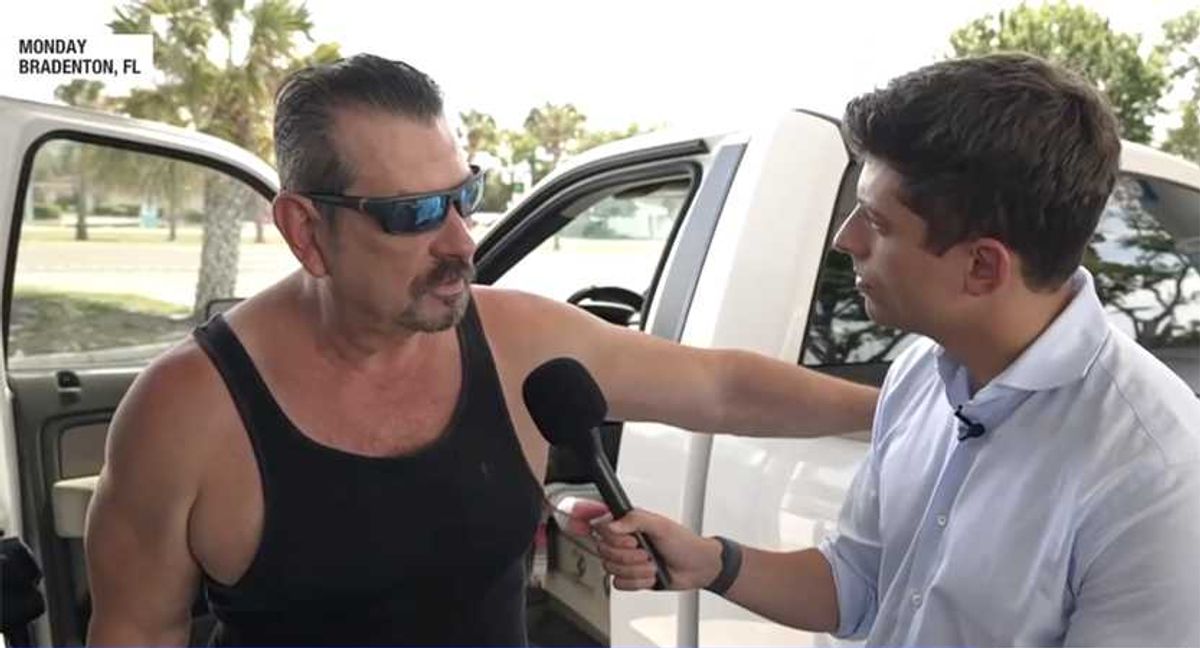
Reporting from Bradenton, Florida, MS NOW’s Alex Tabet, got similar responses when sharing the picture.

One man responded, “Personally? It's disgusting. I talked with my wife about it earlier. I mean, Jesus Christ is my lord and savior. And that right there is, I mean, that's I don't really have words for that. That's disgusting.”

“As a Christian, how do you feel when you see this image?” Tabet asked a man standing by his truck.

“Offended,” the unidentified man quickly shot back before continuing, “ Yeah. I'm ashamed. I'm ashamed that he would actually do that. The man I voted for and trust."

”Politics are one thing, but stepping into that area is a little bit different. You know, a little bit stings for me a little bit," another man stated.


'Showed great respect': Mike Johnson praises Trump over 'sacrilegious' Jesus post

David Edwards
April 14, 2026 
RAW STORY


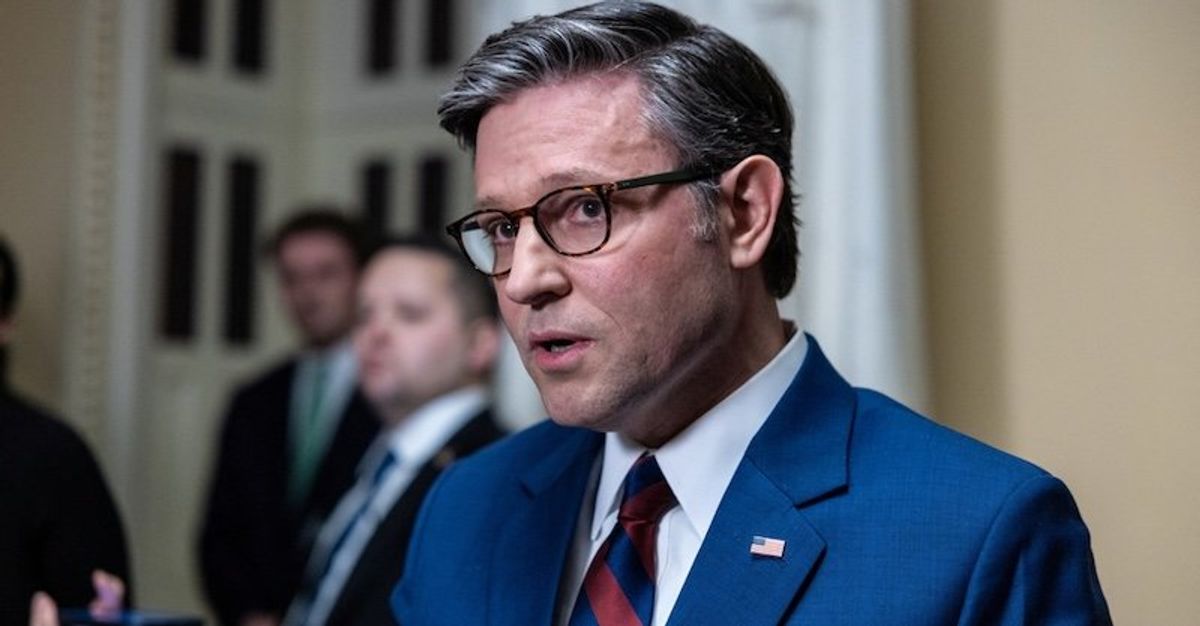
Speaker of the House Mike Johnson (Reuters)

House Speaker Mike Johnson (R-LA) said President Donald Trump shared an image of himself as Jesus because he didn't view it as "sacrilegious."

On Tuesday, Johnson told CNN's Veronica Stracqualursi that he contacted the president after he posted the sacrilegious image.

"Was it blasphemy?" the reporter wondered.

"I talked with the president about it as soon as I saw it and told him that I don't think it was being received in the same way he intended it," Johnson replied. He agreed, and he pulled it down. That was the right thing to do."

"He explained how he saw that, and I don't think he thought it was sacrilegious at all," he said.

Johnson insisted that Trump "showed great respect to others by removing it."


Trump's threat against Pope Leo is exactly why Francis shaped him for the job


Donald Trump just inadvertently invoked the Christian understanding of the Antichrist


April 12, 2026 

In recent days we learned that Pope Leo will likely not visit the United States during Trump’s presidency and declined an invite to the 250th birthday celebrations.

The tensions between the Vatican and the U.S. have been clear as Leo has slammed Trump for his brutal attacks on immigrants and, now, his reckless war in Iran, in which Trump threatened to “wipe out” an entire civilization.

A report has now surfaced that the Pentagon—not the State Department—called the Vatican’s ambassador in for a meeting in January after the pope’s state of the world speech in which he criticized Trump’s military moves. And the Vatican emissary was given a stark warning. From AL.com:

A Trump administration official gave the Vatican’s ambassador to the United States a “bitter lecture” about America’s military might and suggested the Catholic Church get on board with American foreign policy after Pope Leo XIV gave a speech condemning use of force and preaching diplomacy, according to a new report.

Cardinal Chrisophe Pierre, who at the time of the January meeting was the Holy See’s ambassador to the U.S., was summoned by Under Secretary of War for Policy Elbridge Colby to the Pentagon in an unprecedented move, the Free Press reported Monday.

Pentagon officials “picked apart” the American pontiff’s January speech, “reading it as a hostile message directed at Trump’s policies,” according to the outlet’s sources. The Pentagon was reportedly furious that the speech challenged Trump’s so-called Donroe Doctrine that the Western Hemisphere should be controlled by the United States.

At one point during the meeting, according to the Free Press, “one U.S. official went so far as to invoke the Avignon Papacy, the period in the 1300s when the French Crown leveraged its military power to dominate the papal authority.”

Pope Francis was preparing for just this kind of battle before he died, seeing Trump as a threat to the world. I wrote back when the conclave chose Leo in May of last year about how Francis shepherded Leo into the job. I figured this was a good time to repost it.


May 9, 2025

With the arrival of Pope Leo XIV, much of the media has emphasized the mystery of the papal conclave, focusing on cryptic rituals, traditions shrouded in secrecy, and deep solemnity—which sells and keeps people riveted—when there are some things that are pretty clear as day regarding the politics of the selection of Chicago-born Cardinal Robert Francis Prevost. And even MAGA world sees that, and is in a full-blown meltdown over it.

The Catholic church is a global institution with huge cultural impact. As a nation state, The Vatican, with embassies and diplomats all over the world, and a presence at the U.N., has a head of state who has outsized power. The pope has a massive political platform. Certainly Francis sought to influence public policy, in the U.S. and in countries around the world.

And, as I noted last week, Francis was a smart politician—unlike his predecessor, Benedict, who was a lousy politician, a man led by the impulsiveness of his zealous conservatism, rarely making strategic decisions.

It’s clear that Francis knew—or certainly tried to ensure—that Prevost would be the next pope, desiring to have someone who would continue his direction for the church, away from the conservative American church’s ideologies and emphasis. Francis had named the vast majority of the cardinals who voted on his successor, and they were loyal to him—and likely loyal to his wishes if indeed he’d lobbied them prior to his death.

Francis brought Prevost to the Vatican in 2023—making him a cardinal, and thus eligible to be pope, only two years ago—to further learn the intricacies of the Vatican (and, by default, the papacy), obviously grooming him for the job. Francis put Prevost in charge of the office in the church that vets bishop nominations from around the world, one of the most powerful offices in the Vatican, tasked with reshaping the church’s leadership.

It involved choosing new bishops upon retirements, but also sometimes removing church leaders and replacing them because they were trouble. Prevost worked alongside Francis in the two years before his death, a critical time. That was when Francis was seeking to reshape the American church’s hierarchy, as I wrote at the time, which for years has been deeply enmeshed in GOP—and MAGA—politics.

It was during that two-year period when there were big moves, such as Francis’ firing of Bishop Robert Strickland of Tyler, Texas—an icon of extremist MAGA Catholics—who defied Francis’ teachings. It was also during that time that Cardinal Raymond Burke was booted from his palatial Vatican apartment and sent packing. He was a Trump-supporting Covid denier who was making a fortune on the MAGA speaking circuit in the U.S.—and someone who also defied Francis’ reforms.

Prevost was there for all that and was deeply involved in helping carry out those decisions.

Before taking that job in Rome, however, Prevost, who was born in Chicago and educated in the U.S. and had spent his early years as a priest in the Midwest, was in the field as a missionary in Peru, where he also became a citizen of that country. He was Apostolic Administrator of Chiclayo, then named the Bishop of Chiclayo by Francis in 2015, where he served until Francis brought him to Rome in 2023 and made him a cardinal.

He got the experience as a missionary—a life experience that was vital to Francis’ outlook in reaching the people and getting beyond the church’s stone buildings—and then came to the Vatican to work with Francis in his last two years.

Francis may have had a few people in mind whom he was preparing over the years, but it was Prevost he clearly seemed focused on near the end of his life. The cardinals’ selection of Prevost, an American, sent shock waves through the world of church scholars and pundits, since no one expected an American to become pope because the U.S. has traditionally been seen as having too much power already.

But I believe having an American as pope at this point in time was part of Francis’ plan. Prevost was active in recent months on X. He hadn’t posted in all of 2024, but this year he slammed JD Vance, among other posts criticizing the Trump administration. I don’t think any of this was an accident, as these social media posts would become big news—which they are—upon the pope’s death and Provost’s becoming Pope Leo, sending a very clear message.

One opinion piece from The Catholic Standard that Provost re-posted just a few weeks ago was written by the auxiliary bishop of Washington, DC, Bishop Evelio Menjivar, who is from El Salvador and had been an undocumented immigrant himself for many years. It’s a powerful piece slamming the Trump administration:

The video of a student being accosted by masked agents after her visa was revoked without notice – apparently because of an op-ed she co-wrote years ago – is horrifying. Most egregiously, the government has now claimed the authority to unilaterally seize certain people based on mere suspicion, or because of their tattoos, and send them to a prison in El Salvador accused of human rights abuses – all without review by a court to even determine their identity. The government admits some have been wrongfully deported, but officials are fighting attempts to right these wrongs.
More than a few natural-born Americans are saying they do not recognize their country anymore, but many of us from other lands recognize all too well the terror of people being snatched by secret police and disappeared. We left our former countries precisely to get away from it.


It’s also noteworthy that Prevost chose Leo for his name, meant to signify his carrying on the work of Pope Leo XIII, who was known as the father of social justice. In his 1891 encyclical Rerum novarum, Pope Leo outlined the rights of workers to a fair wage, safety in the workplace, and the ability to form labor unions. Interestingly, the previous Pope Leo served from 1878 to 1903, during the entire presidency of Trump’s favorite president, William McKinley, the fanatic on tariffs who also emboldened big business to trample on workers.

Provost also criticized Trump often in his first term, on issues such as gun violence and immigration. I believe Francis understood the need for a pope who is from this culture, who speaks English fluently, who spars in his own voice on social media, and who could sit down with American television interviewers and lay out the case against harsh policies and attacks on the marginalized.

While the U.S. is just one country among many, and while the church is growing much more in Asia and Africa, Francis had to see—as many of us have—that right now Trump is an existential threat to everything in the world that is held sacred, including the Catholic church itself. The Vatican is smack dab in the middle of the European Union, under attack by Trump’s trade war and by the U.S.’s encouragement of Vladimir Putin’s encroachment on Europe. And the Vatican is surely impacted by any weakening of NATO.


But it’s, of course, beyond self-preservation. The causes that Francis promoted—supporting migrants, helping the poor and marginalized, saving the planet—are under assault.

We don’t know a lot about Leo’s recent beliefs and positions on women in the church, LBGTQ rights and other issues. Like Francis himself, he showed some hostility to gay rights many years ago—almost 15 years ago, in fact—but like Francis, he likely evolved, like many other leaders.

He recently remained open—though not fully committed—to Francis’s having allowed blessings of same-sex unions. And he has supported Francis’s commitment to “synodality”—diverse inclusiveness from grassroots lay people in the church—which the American conservatives in the church have fiercely opposed. My hunch is that Francis told him to keep his powder dry on the issue—as Francis did before he was pope—but we’ll know in time.

What is true is that there is no going back now to the archconservatives. Francis’s legacy lives on. And there is now a voice in the Vatican who is both a citizen of Peru and the U.S., someone whose maternal grandparents were Creole people of color from Louisiana. And he is someone with an enormous platform, who looks like he will be an outspoken home-grown counterpoint for all Americans—and the world—to the brutality of the Trump era.


'Never happened before': Trump admin workers flooded with 'grotesque' Christian nationalism


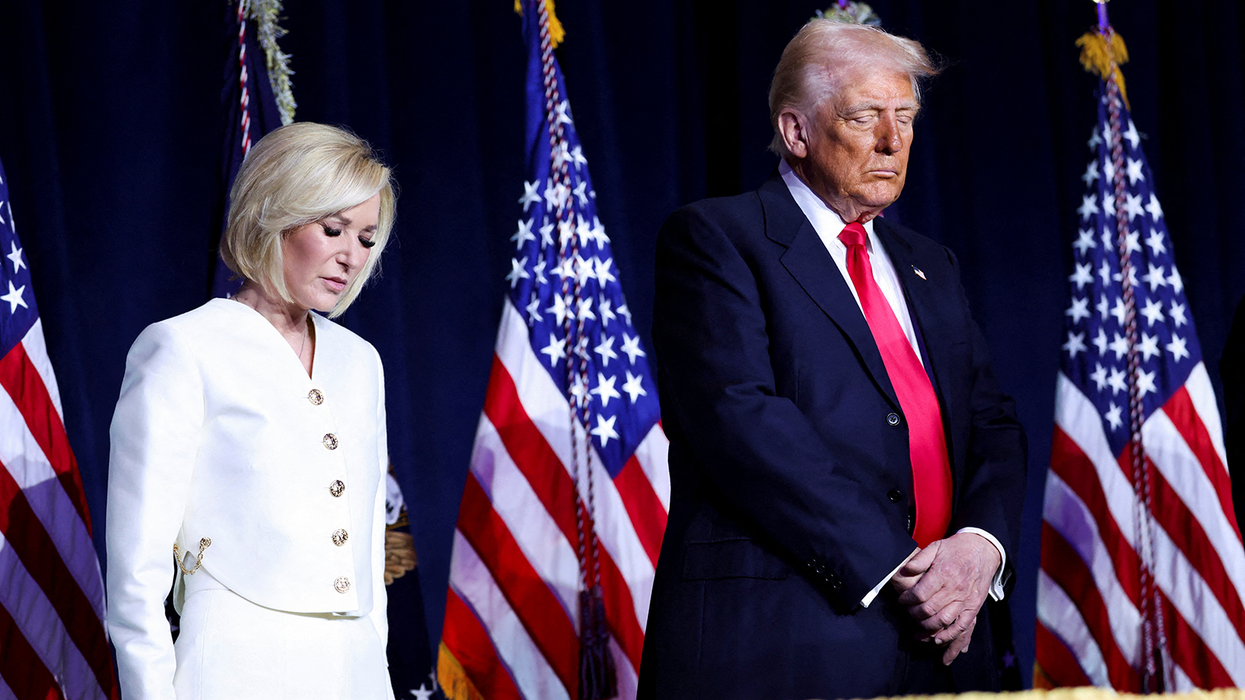
U.S. President Donald Trump and Pastor Paula White attend the annual National Prayer Breakfast at Hilton hotel in Washington, U.S., February 6, 2025. REUTERS/Kevin Lamarque

Sarah K. Burris
April 14, 2026  
ALTERNET


Speaking to several federal workers, Wired revealed that the Department of Agriculture, Office of Management and Budget, Department of Labor and Department of Health and Human Services have all ramped up references to religion.

According to one person at the Department of Labor, the new focus on religion left a bad taste. “The vibes are bad, and people don’t like it."

“They always spend a lot of time carrying on like, ‘No one's forcing you to pray, these are voluntary,’” the employee told Wired. “But it's happening in the middle of a government workplace.”

They were particularly concerned about Alveda King, niece of civil rights leader Martin Luther King Jr. She manages faith and community outreach at the USDA.

In January, King made comments about atheists and nonreligious people, saying they were going to Hell.

“We have different denominations, different faiths, and some have no faith — and those are the ones I would be more concerned about. If someone is totally without hope, can’t believe in anything, think the world is just falling apart, then that’s when we want justice to stand. And you bring justice every day you come to work," King told staff.

An employee told Wired, “People are uncomfortable. I know several who are offended and angry. These [worship services] are very Christian in nature.”

“I've thought about complaining, but I would worry about some form of retaliation if I were to do that, to be honest,” an employee at the Department of Labor said.

The Small Business Administration launched a Fellowship Prayer Service in March, something that staff there found "weird" and "uncomfortable."

“Honestly, I don’t know anyone who actually went to them because they are optional but it’s still uncomfortable to know that there’s a Christian prayer service happening in a government building, which is supposed to be religiously neutral," said the SBA employee.

A spokesperson for the DOL made it clear that the events are voluntary and that the service was nondenominational.

However, it has been clear to non-Protestant Christians that they aren't part of the services. On Good Friday, the Pentagon sent an email about a service and specifically called out Catholics, saying there would be no Mass. Catholics don't typically have a Mass on Good Friday.

“I guess so the Catholics know their kind ain’t welcome,” an employee, who requested anonymity, told the Huffington Post. “It’s so ridiculous.”

The Pentagon confirmed to HuffPo that there was no additional service for Catholics.

“The Protestant service is the only service scheduled in the Pentagon chapel today,” they said in a statement.

The report noted that Defense Secretary Pete Hegseth, "a far-right evangelical Christian, has tried to infuse his religious views into Pentagon activities."

He has openly hailed President Donald Trump as divinely appointed. The report came a week before Trump posted an AI image depicting himself as Jesus Christ. Trump claimed he thought it was a "doctor."

Even Trump's own allies questioned the move, with one far-right pastor questioning if Trump was the anti-Christ.

Meanwhile, Trump has been in his own war of words with Pope Leo XIV, the first American pope. It has played into anti-Catholic sentiment, one historian explained.

Wired cited recent data from 2025 showing that only 22.5 percent of federal workers feel safe reporting wrongdoing without fear of retaliation from superiors. In 2024, that number was 71.9 percent.

“This has never happened before,” said a USDA employee, who, like others who spoke to Wired was too fearful to have their name disclosed publicly. The Ag. Department got an email from Secretary Brooke Rollins celebrating Jesus as "the greatest story ever told."

"I have never gotten a message like this from anyone," the employee said, noting that even military chaplains don't operate like this and it's part of their job.

Federal workers have had it with the Trump administration’s religion


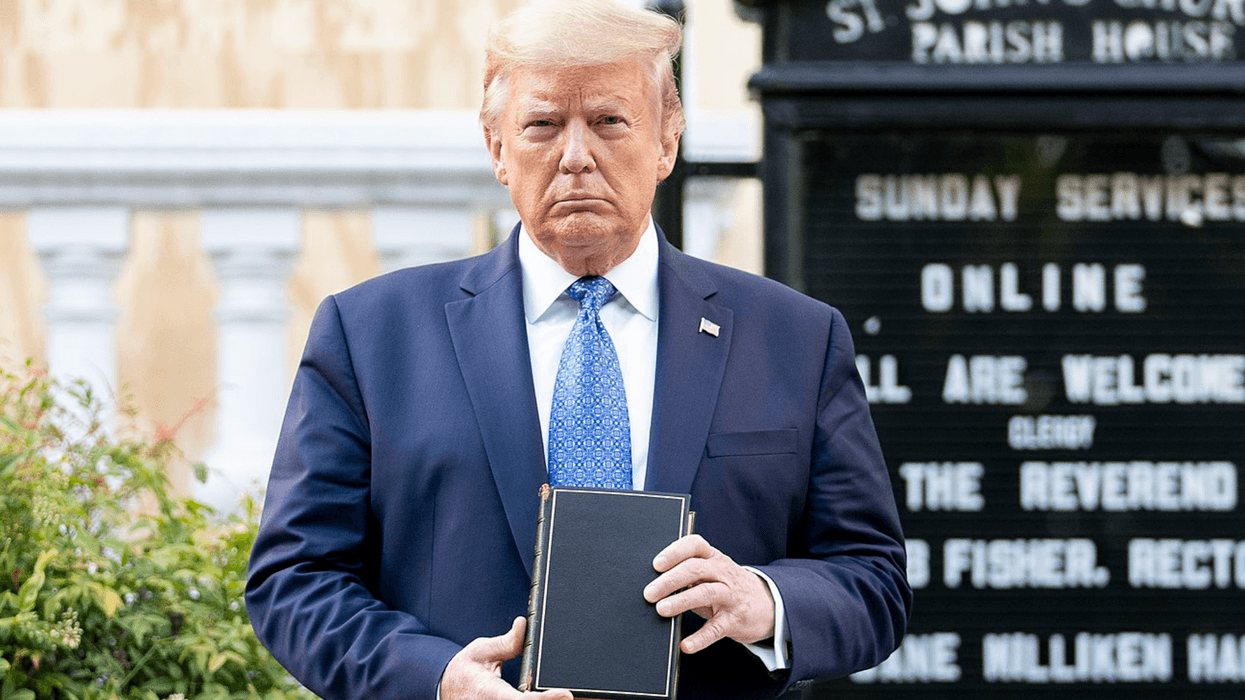
Donald J. Trump walks from the White House Monday evening, June 1, 2020, to St. John’s Episcopal Church, known as the church of Presidents’s, that was damaged by fire during demonstrations in nearby LaFayette Square Sunday evening. (Official White House Photo by Shealah Craighead)

April 14, 2026  
ALTERNET


President Donald Trump and his administration are making people “uncomfortable” with their overt calls to religiosity, according to a recent report — and federal workers are sick of it.

“On Easter Sunday, US Department of Agriculture secretary Brooke Rollins sent out an email titled ‘He has risen!’ to the entire agency,” Wired reported on Tuesday. “In the email, Rollins calls the story of Jesus Christ the ‘greatest story ever told, the foundation of our faith, and the abiding hope of all mankind.’”

An employee for the Agriculture Department described the email as “grotesque” while another employee, Ethan Roberts, complained to the Office of Special Counsel by alleging that the email has “eroded the separation of church and state.”


“The secretary is within her rights to send a message to employees and the public on the Easter holiday,” a USDA spokesperson told Wired. “Just like secretaries of agriculture and presidents have in the past.”

“On February 11, the [Department of Labor] hosted pastor Leon Benjamin, who runs two churches and previously ran for Congress as a Republican, to speak to employees during the monthly prayer service,” Wired reported, and employees say they they're unnerved by the ubiquitous presence of religion.


"I've thought about complaining, but I would worry about some form of retaliation if I were to do that, to be honest," one employee told Wired. And recent data shows that in 2025 only 22.5 percent of federal workers believed they could report wrongdoing without fear of retaliation, down from 71.9 percent in 2024.”

On January 12, Wired reports that Alveda King, the niece of civil rights leader Martin Luther King Jr., told DOL employees during a monthly worship service that "We have different denominations, different faiths, and some have no faith—and those are the ones I would be more concerned about.”

“People are uncomfortable. I know several who are offended and angry,” an employee told Wired. "... They always spend a lot of time carrying on like, ‘No one's forcing you to pray, these are voluntary. But it's happening in the middle of a government workplace.” The employee added that they were particularly concerned about King’s comments concerning atheists and nonreligious people, saying they felt King had implied atheists are for sure going to hell.


Secretary of Health and Human Services Robert F. Kennedy Jr. is hardly known for his religiosity, but his department has also reportedly become explicitly religious.

“Last year, HHS lent full support to religious exemptions for vaccines; in February, the agency announced the expansion of funding for ‘faith-based’ addiction treatments,” Wired reported. “In his announcement, Kennedy called addiction a ‘spiritual disease.’”

But of all the government departments, perhaps none have been so impacted as the Defense Department.


In a sermon delivered before Christmas, evangelical pastor Franklin Graham told members of the military that ‘God is also a god of war," reports WIRED. Secretary of Defense Pete Hegseth has also framed the U.S. war in Iran as a ‘holy war,’ calling Iranians ‘barbaric savages’ and calling on Americans to pray for victory ‘in the name of Jesus Christ.’”

Critics sound alarm as Trump official calls separation of church and state 'a lie'


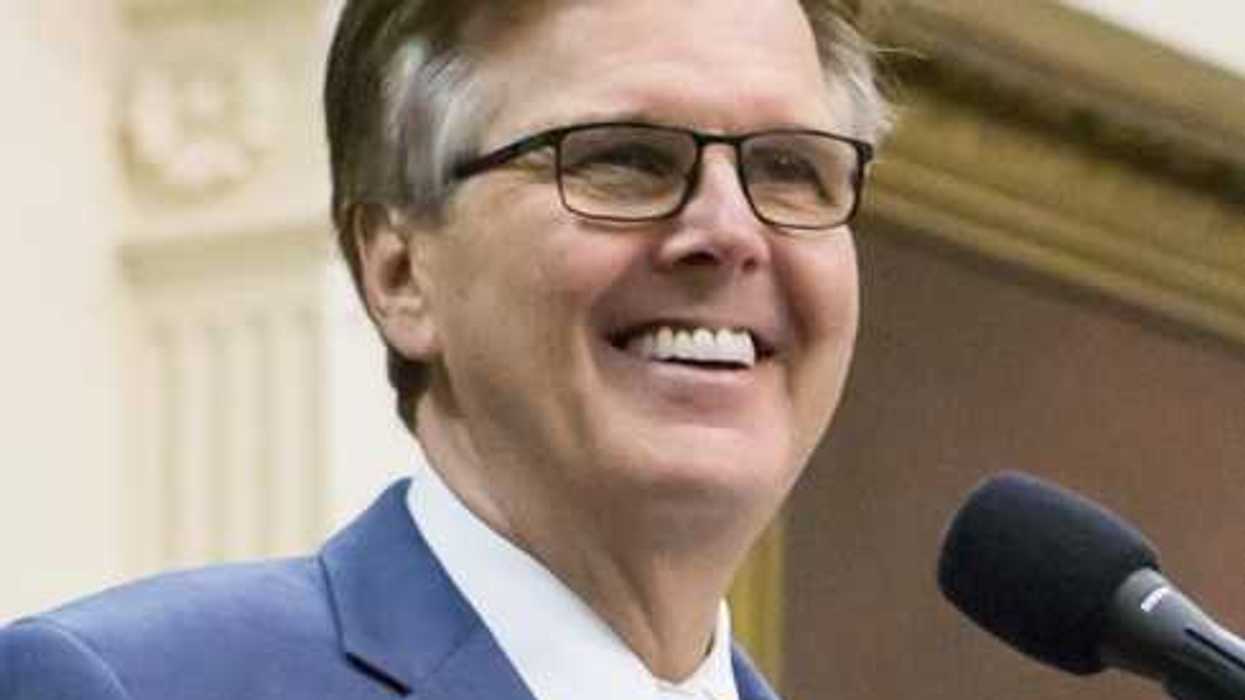
Texas Lt. Gov. Dan Patrick (Wiki Commons)

April 14, 2026  
ALTERNET

Religion News reports the leader of President Donald Trump’s Religious Liberty Commission said out loud that church and state separation is a falsehood at the group’s final meeting — which immediately drew fire from a pro-Constitution advocacy group.

At a Monday hearing at the Museum of the Bible in Washington, D.C., Texas Lt. Gov. Dan Patrick, a Republican and the chair of the commission, broached his claim, saying: “Would it not be a good recommendation that every school, every university, every business, has to have that one sheet on the bulletin board about protecting people’s religious liberty, and that the separation of church and state is the biggest lie that’s been told in America since our founding?”

Patrick said posts proclaiming the death of church and state could be similar to federal notices from the Occupational Safety and Health Administration promoting safety and preventing hazards. Religion News reports Patrick posed his question to George Mason University’s Antonin Scalia Law School professor Helen Alvaré, who agreed.

“You’re responding to the signs of the times where this has been misunderstood, and like any other thing, where people are unclear about their rights, this might be a way to clarify them,” Religion News reports Alvaré saying.


But Rachel Laser, the president and CEO of Americans United for Separation of Church and State, had none of it, arguing that the Constitution protects freedom of religion specifically by accepting the separation of church and state as granted.

“Church-state separation ensures we are all free to live as ourselves and believe as we choose, as long as we don’t harm others,” Laser said. “It allows us all to come together as equals to build a stronger democracy. It is an American original, something we should be proud of, fight for, and cherish.”

Laser went on to hammer Trump’s so-called "‘Religious Liberty’" Commission, saying it “once again demonstrated that its mission isn’t about protecting religious liberty for all. Instead, today it rebuked a foundational pillar of religious liberty: the separation of church and state,” Laser said. “Chairman Patrick repeatedly calling the separation of church and state a ‘lie’ is an attack on our democracy.”

Trump created the commission by executive order last year to “bring cases before the Supreme Court” that provide the opportunity “to remake the First Amendment's Establishment Clause, which bars the government from endorsing a national religion.” Since it’s formation, the commission has been plagued by infighting as anti-Israel board members were jettisoned from the board and further deepened the Israeli rift among Trump’s MAGA followers.