Thursday, April 16, 2026

'You absolutely said it': Dem scolds RFK Jr. for denying comment about Black kids

David Edwards
April 16, 2026
RAW STORY
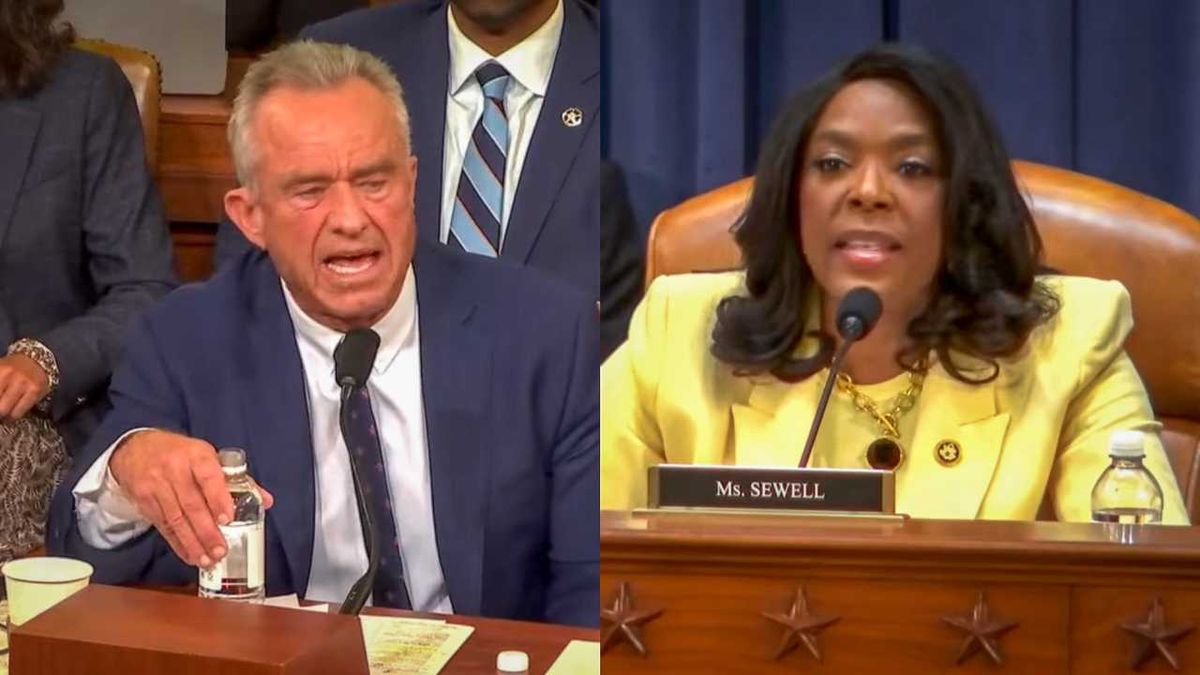


Rep. Terri Sewell (D-AL) scolded Health and Human Services Secretary Robert F. Kennedy Jr. after he denied saying that "every Black kid" should be "re-parented" instead of getting mental health treatment.

During a Thursday hearing before the House Ways and Means Committee, Sewell noted that Kennedy had made the remarks in a 2024 podcast on the 19Keys Online Show.

"Have you ever re-parented or parented, I should say, a Black child?" the Democratic lawmaker asked Kennedy.

"I don't even know what that phrase means, and I doubt that I said it," the secretary snapped. "No, I'm not going to answer something that I didn't say."

"You absolutely said it," Sewell assured him.

"Oh, I'd like to hear the recording," Kennedy said. "So to be clear, I don't even know what it means."

"Mr. Secretary, for Black families of the United States, the issue of family separation is not new," the lawmaker explained. "During slavery, Black children were taken from their parents and sold with no regard."

"For you to suggest that Black families are not capable of raising their own children is deeply offensive," she added. "And to suggest that they have to be re-parented is offensive."

"I never suggested that," Kennedy griped.


"Your words matter," Sewell remarked. "When those words are careless, communities pay the price. When your words are imprecise, they create confusion. And when your words are dismissive, they cause real harm."

"I expect, and the American people expect that you choose your words with sincereness and with seriousness, the seriousness that your position demands."



Trump loses again as his ballroom's above-ground construction is blocked by judge

David Edwards
April 16, 2026 
RAW STORY


U.S. President Donald Trump holds an image of a rendering of the new White House ballroom to be built, as he meets with Secretary General of the North Atlantic Treaty Organization (NATO) Mark Rutte (not pictured) in the Oval Office of the White House in Washington, D.C., U.S., October 22, 2025. REUTERS/Kevin Lamarque

U.S. District Court Judge Richard Leon again blocked the majority of construction on President Donald Trump's White House ballroom.

In a 10-page opinion on Thursday, Leon noted that the circuit court had ordered him to revise an earlier ruling after Trump claimed that a national security exception would allow him to construct the entire ballroom.

Leon's original injunction excluded "actions strictly necessary to ensure the safety and security of the White House and its grounds, including the ballroom construction site, and provide for the personal safety of the President and his staff."

"Defendants argue that the entire ballroom construction project, from tip to tail, falls within the safety-and-security exception and therefore may proceed unabated," Leon wrote. "That is neither a reasonable nor a correct reading of my Order!"

"I will further clarify and amend my Order to stop only above-ground construction of the planned ballroom," he continued. "My Amended Order does not, however, stop below-ground construction of national security facilities, work necessary to provide for presidential security, and construction necessary to protect and secure the White House and the construction site itself."

"The exception for underground national security facilities does not include the proposed ballroom because Defendants themselves distinguished between below-ground and above-ground construction, stating that 'the below-surface work is driven by national security concerns independent of the above-grade construction,'" the judge noted.

Above-ground construction "that is strictly necessary to cover, secure, and protect such national security facilities" would be permitted, Leon said.

In a separate order, the judge clarified that White House defendants were enjoined "from taking any action in furtherance of the above-ground, physical construction of the proposed ballroom at the former site of the East Wing of the White House."

"[S]ubject to the safety-and-security exceptions above, no such work shall proceed absent express authorization from Congress," he added.
Clarence Thomas hounded by observers for 'manipulation' of role: 'An outright psyop'

Supreme Court Justice Clarence Thomas has been criticized by political analysts for a recent speech denouncing progressive politics.

Ewan Gleadow
April 16, 2026
RAW STORY


Clarence Thomas (Photo via Shutterstock)

Supreme Court Justice Clarence Thomas has been criticized by political analysts for a recent speech denouncing progressive politics.

Thomas, 77, appeared in a broadcast where he spoke against progressivism, a political philosophy he described as a threat to the principles on which the United States was founded. Thomas has faced persistent speculation about potential retirement, with White House advisors reportedly preparing for a vacancy.

The recent appearance from Thomas at the University of Texas Austin Law School saw the George H. W. Bush-appointed judge hit out at that popular political philosophy. He said, "Progressivism seeks to replace the basic premises of the Declaration of Independence and hence our form of government.

"[Progressivism] holds that our rights and our dignities come not from God, but from government. It requires of the people a subservience and weakness incompatible with a constitution premised on the transcendent origin of our rights.

"In my view, we must find in ourselves that same level of courage that the signers of the Declaration have so that we can do for our future what they did for theirs."

Zeteo News CEO Mehdi Hasan wrote, "If Dems had a spine, they’d run on impeaching this financially corrupt justice who got away with the allegations of sexual harassment during his hearings."

Fellow political commentator and The Left Hook Substack founder, Wajahat Ali, added, "Expand the Court."

Political scientist and The Atlantic contributing editor Norma Ornstein wrote, "Most corrupt justice in the history of the United States speaks."

Investigative journalist Jacke Singh added, "Um. Wow. An outright psyop attempt. Narrative inversion. Manipulation. From a sitting Justice."

Thomas could find himself replaced before the end of Donald Trump's second term in the Oval Office, with the president hinting at two or three changes to the Supreme Court.

The 79-year-old president strongly suggested in an interview with Fox Business host Maria Bartiromo that he would like to replace up to three justices before the midterm election, where Democrats appear poised to take back the House and narrow the already thin Republican Senate majority, according to CNN's Aaron Blake.

“In theory, it’s two or three, they tell me," Trump told Maria Bartiromo. "If you just read statistics, it could be two, could be three, could be one. I don’t know. I’m prepared to do it.”


Iran war brings U.S. close to net crude exporter for first time since World War II


Published: 

An oil tanker is docked at the Exxon Mobile Baytown complex along the Houston Ship Channel in Baytown, Texas

HOUSTON -- The U.S. nearly turned into a net crude exporter last week for the first time since World War II as shipments surged close to a record high to meet demand from Asian and European buyers scrambling to replace Middle East supplies cut by the Iran war.

The U.S. and Israel’s war with Iran triggered the largest ever disruption to the global energy market as Iranian threats to shipping stopped around a fifth of the world’s oil and gas supplies from transiting the Strait of Hormuz waterway.

Refiners in Asia and Europe that depend on those supplies have bought alternative cargoes from wherever they can, sharply boosting demand for oil from the U.S., the world’s largest producer.

However, analysts and traders say the U.S. is rapidly approaching its export capacity.

Net imports of crude oil, or the difference between imports and exports, narrowed to 66,000 barrels per day last week, the lowest on record in weekly data that goes back to 2001, according to U.S. government data released on Wednesday, while exports climbed to 5.2 million bpd, the highest in seven months.

On an annual basis, the U.S. was last a net exporter of crude in 1943, data showed.

Rising U.S. crude exports are evidence that Atlantic Basin and Asian buyers are reaching further out for available supply, with regional oil price differences making up for the costs of shipping, said Rystad vice president of oil markets, Janiv Shah.

Countries such as Greece have snapped up U.S. crude for the first time ever in recent months.

About 2.4 million bpd, or some 47% of U.S. exports last week sailed toward Europe, according to ship tracking service Kpler. Around 1.49 million bpd, or about 37%, headed to Asia, up from 30% a year ago.

Top buyers included the Netherlands, Japan, France, Germany and South Korea.

A vessel carrying 500,000 barrels of crude signaled it was en route to Turkey, which would mark the first U.S. export to the country in at least a year, Kpler data showed.

Soaring Brent makes U.S. oil attractive

Imports to the U.S., meanwhile, dropped by more than 1 million bpd to 5.3 million bpd last week. The U.S. still imports a lot of its crude as its refineries are designed to take heavier, more sour grades than the light sweet crude it produces.

The disruption to Middle East supplies blew out the premium for Brent crude futures over U.S. West Texas Intermediate crude futures to as much as $20.69 a barrel last month, reducing U.S. buyers’ appetite for imports, while making U.S. crude attractive to refiners in Europe and Asia.

The price of physical crude oil cargoes for prompt delivery to Europe hit a record high near $150 a barrel on Monday, and those for Africa hit new peaks, according to LSEG data and traders.

Exports nearing capacity

U.S. exports are likely to touch about 5.2 million bpd for April, Matt Smith, an analyst at Kpler said, adding that exports were pushing up against capacity limits on a monthly basis.

The U.S. can export as much as 6 million bpd, traders and analysts said, citing limited pipeline capacity and vessel availability. Its exports hit a record high of 5.6 million bpd in 2023, government data shows.

“The market is already testing the export ceiling with 5.2 million bpd exported last week. Every incremental barrel from here costs more in freight and logistics than the last one,” according to Bekzod Zukhritdinov, a Dubai-based oil trader.

A release of medium sour crude from the Strategic Petroleum Reserve could push more light, low sulfur U.S. crude grades out for export, Rystad’s Shah said. But a shortage of tankers, and higher freight rates could hurt that export demand, he added.

About 80 empty supertankers were heading to the Gulf of Mexico as of Wednesday, likely to pick up crude over April and May, said Rohit Rathod, a senior analyst at Vortexa.

(Reporting by Arathy Somasekhar and Georgina McCartney in Houston; Editing by Liz Hampton and Sonali Paul)

YOU ONLY LOSE ONCE

Relaxation of U.S. day-trading rules opens door to YOLO trading, higher risk


“That can mean more freedom to lose money faster,”


Published: 


A pedestrian walk past the New York Stock Exchange. (Liao Pan/VCGPIX/AP)

PROVIDENCE, Rhode Island/NEW YORK -- A U.S. regulatory move allowing smaller, everyday investors to engage in more day trading could spur impulsive, high-risk “YOLO,” or “you-only-live-once,” trades and allow eager individual traders to take an even bigger role in driving markets.

The U.S. Securities and Exchange Commission late on Tuesday approved a proposal to remove restrictions that limited accounts under US$25,000 to three day trades - defined as the buying and selling of the same security within the same trading day - within five business days, known as the “pattern day trader” rule.

The decision was a win for brokerage firms like Webull and Robinhood and retail traders who now have a much greater ability to buy and sell frequently - but may also take on higher risk with YOLO trades driven by conviction or impulse rather than by research and careful portfolio planning.

“Removing the restriction makes it easier for undercapitalized traders to take more ‘YOLO’ shots intraday,” said Ophir Gottlieb, chief executive of Los Angeles-based Capital Market Laboratories.

“That can mean more freedom to lose money faster,” Gottlieb added.

Gottlieb noted that there will still be some guardrails on retail trading under the new rules, where instead of the $25,000 minimum account size, customers would need to meet certain margin requirements based on their market exposure.

“Retail traders have been a large part of this market since COVID and it’s time to allow more flexibility rather than a hard gate,” he said.

Retail trading on the rise

Prior to 2020, individual investors with small accounts at brokerages like Charles Schwab, Fidelity Investments and other firms accounted for about 15 per cent of trading on U.S. exchanges daily, according to several academic studies.

But the COVID-19 pandemic, together with big leaps in technology and the advent of new trading platforms, helped retail traders to boost that share as high as 25 per cent, and become key players on particularly volatile days.

Retail investors have especially been drawn to trading as markets rallied from their recent slump, and there has been heightened buzz around stocks that attracted retail interest such as footwear-to-AI firm Allbirds, which saw a surge of buying on Wednesday.

“The pattern day trader rule really still restricted the ability of our smaller clients to participate in the markets and reduced their opportunities to take advantage of big market moves,” said Anthony Denier, group president and U.S. CEO at Webull, whose stock soared 11 per cent on Wednesday.

Denier said the average Webull client has about $5,000 in their trading account, far below the $25,000 in assets that, under the pattern day trader rule, would entitle them to engage in more than three day trades within a five-day period.

The Financial Industry Regulatory Authority, or FINRA, created the PDT rule following the popping of the dot-com bubble in 2000, as a way to rein in speculation and limit losses for traders with brokerage accounts that allow them to buy stocks on margin.

Denier and others who have pushed for overturning the rule argued that imposing a $25,000 minimum balance requirement was arbitrary and tilted the playing field in favor of wealthier investors.

The new rules will come into effect 45 days after they are posted on FINRA’s website. FINRA did not immediately respond to a Reuters query on the precise timing.

“This is certainly going to open up opportunities for our smaller customers and democratize access to the markets,” Denier said.

Raises risks

Still, some analysts were wary that the move would nudge investors into taking on more risk.

“I think it will push some of these traders toward riskier bets,” said Garrett DeSimone, head quantitative analyst at OptionMetrics, adding that it would be logical for small investors with limited capital to seek out more bang for their buck.

Higher transaction volumes, particularly among retail investors, tend to translate into greater losses, DeSimone said.

In February, the North American Securities Administrators Association, an investor protection group, said the SEC had not made a solid enough case for changing the rule.

“NASAA said it would be inappropriate to remove or dilute important regulatory guardrails,” said Ben Schiffrin, director of securities policy at Better Markets, which favors stricter oversight of Wall Street.

Webull’s Denier said the change would still leave rules in place to forestall any opening of the risk floodgates.

“Someone with a few thousand dollars won’t just be able to open up a brokerage account and start day-trading options contracts,” he said, noting that traders will still have to meet certain thresholds in terms of knowledge or skills.

“It just wouldn’t be Big Brother saying, ‘You’re not rich enough,’ anymore.”

(Reporting by Suzanne McGee in Providence, RI, Saqib Iqbal Ahmed in New York and Arasu Kannagi Basil in Bengaluru; Additional reporting by Douglas Gillison in Washington; Editing by Megan Davies and Edmund Klamann)


Who’s paying Amazon’s Canadian fuel surcharge, and how much is it?


Updated: 


A package from Amazon Prime is loaded for delivery on a UPS truck, in New York on May 9, 2017. THE CANADIAN PRESS/AP, Mark Lennihan

Canadian companies using Amazon to pick, pack and ship goods will have to start paying a new surcharge because of rising fuel costs.

The e-commerce giant says the 3.5 per cent surcharge on fulfillment fees will take effect on Friday.

It will only apply to companies using its fulfilment program and will be charged to the business, not consumers buying products on Amazon.

Spokesperson Andrew Gouveia says Amazon felt the surcharge was necessary to implement to partially recover some of the elevated fuel and logistics costs it was experiencing.

Up until now, Gouveia says Amazon was absorbing the increases.

Gas prices have soared in the wake of the war in the Middle East, which has blocked the Strait of Hormuz, a key fuel passageway.

This report by The Canadian Press was first published April 16, 2026.

Tara Deschamps, The Canadian Press