Anemoi Fits Out a Valemax Bulker With Five Rotor Sails
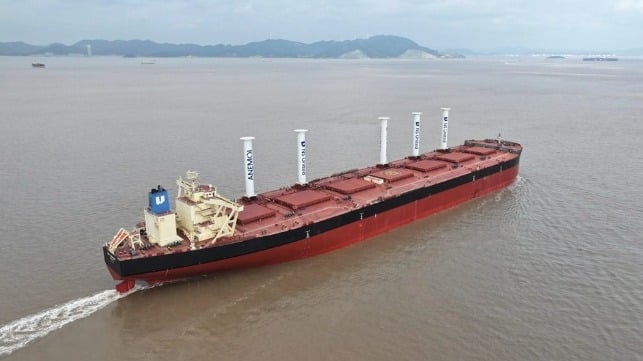
The push to cut shipping emissions through wind assisted propulsion continues to gain traction after Anemoi Marine completed the installation of five rotor sails on the very large ore carrier (VLOC) NSU Tubarao, a vessel operated by Brazilian mining giant Vale International.
Built by Japan Marine United, the 400,000 dwt Tubarao was delivered in 2020 and is among the largest bulk carriers in the world. The 361-meter vessel, which is owned by NS United Kaiun Kaisha and sails under the Liberian flag, has been retrofitted with five rotor sails measuring 35 meters tall and five meters in diameter.
The rotor sails are designed to maximize the Magnus effect, which provides lift and thrust to reduce engine propulsion demand in order to sail at a given speed. The wind-assisted propulsion technology is expected to reduce the ship’s fuel consumption and CO2 emissions by approximately six to 12 percent annually.
The installation was completed during a scheduled dry docking at the Chinese yard Zhoushan Xinya Shipyard. The rotor sails are deployed using a folding (tilting) mechanism for flexibility during cargo handling. It is the fourth VLOC installation on vessels chartered by Vale, all used primarily to transport iron ore from Brazil to Japan.
With the Tubarao retrofit, Anemoi has now surpassed 1.6 million dwt of vessel tonnage installed with its wind assisted propulsion technology.
During the scheduled dry docking, Tubarao was also equipped with a new shaft generator designed to enhance efficiency. The upgrade not only improves the vessel’s own energy performance but also optimizes fuel consumption when operating the rotor sails. Integrating the technology with the vessel’s shaft generator through advanced control system integration is designed to ensure seamless coordination between wind propulsion and onboard power supply.
“The scale of this project shows the market’s growing confidence in wind power as a crucial enabler of lower emissions shipping. Working with progressive partners, we are able to advance rotor sail technology and show how optimizing propulsion integration and navigation for wind assistance can deliver even greater benefits,” said Clare Urmston, Anemoi CEO.
Vale has been investing heavily in cutting-edge efficiency and environmental innovation in shipping as part of efforts to cut down on emissions. Since 2020, the company has announced investments of up to $6 billion to reduce scope 1 and 2 emissions by 33 percent by 2030 and committed to a 15 percent reduction in scope 3 emissions by 2035.
The company is the largest producer of iron ore, pellets and nickel, and also has operations in manganese, ferroalloys, copper, gold, silver, and cobalt. It operates second-generation Valemaxes with a capacity of 400,000 dwt and Guaibamaxes with a capacity of 325,000 dwt.
In July, the company signed 25-year charter agreements with Shandong Shipping for 10 new Guaibamax vessels measuring 340 meters in length and with a capacity of 325,000 tonnes. The vessels, which will be methanol dual fuel-powered, will also be equipped with five rotor sails each.
Samsung Heavy Industries Agrees to Build Amogy's Ammonia-Power Systems
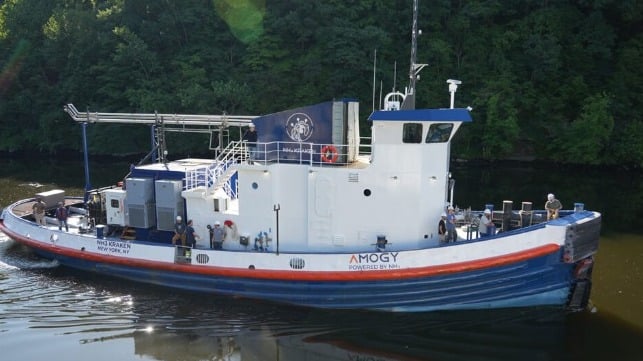
Ammonia-power startup Amogy has reached an agreement with Samsung Heavy Industries (SHI) to manufacture Amogy's systems in South Korea. The deal will see SHI set up a facility for production and testing, starting with the manufacture of the equipment for an ammonia distributed-power project in the city of Pohang-Si.
Amogy's system uses catalysts to split ammonia into nitrogen and hydrogen. The hydrogen is then used to power a fuel cell or a reciprocating engine. This takes advantage of the high energy density of ammonia, but without direct ammonia combustion, which comes with certain challenges related to fuel toxicity and emissions. It has been tested in drones, tractors, trucks, and a midsize tugboat.
The Pohang-Si city power generation project is a major step ahead in scale. With a consortium of Korean partners, Amogy plans to deliver a one-megawatt power generation system by next year, then scale up to 40 MW for commercial operations by 2029. The installation will pair Amogy's ammonia cracker with HD Hyundai's HX22 hydrogen powered engine.
Samsung is an investor in Amogy, and it signed a deal with the startup in 2024 to develop ammonia power systems for maritime applications. The new agreement expands the partnership by making SHI a contract manufacturer for Amogy's modules, which can be used for both shoreside and vessel applications.
“Samsung Heavy Industries has the world’s most advanced manufacturing and production capabilities, and partnership with them to manufacture our systems is a significant step forward for Amogy,” said Seonghoon Woo, CEO of Amogy. “With SHI’s expertise, we can ensure the quality, reliability, and scalability of our systems as we accelerate commercialization – advancing decarbonization across both land and sea.”
MSC Spends $4B for Two New Cruise Ships at Chantiers de l'Atlantique
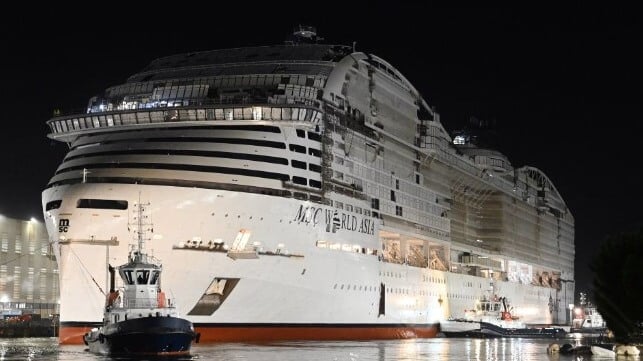
The cruise industry's ambitious bet on continued growth extended further into the next decade on Tuesday as MSC Cruises signed contracts worth $4 billion for two additional vessels to be built at Chantiers de l'Atlantique.
The Geneva-based cruise operator made the announcement during milestone ceremonies at Saint-Nazaire for two other vessels in its World Class lineup. In back-to-back ceremonies, the yard floated out the newbuild MSC World Asia and held a coin ceremony for MSC World Atlantic.
The pair of newly-ordered ships, designated World Class 7 and 8, are slated for completion in 2030 and 2031 respectively. The addition expands MSC's investment to $12 billion across eight World Class vessels in various stages of planning and construction.
“We are deeply grateful to MSC Cruises for their renewed confidence. What our shipyard is achieving today is truly exceptional — four new ships ordered in 2025! The World Class series, now totaling eight vessels, is a testament to our teams’ expertise and to MSC’s vision," said Laurent Castaing, General Manager of Chantiers de l’Atlantique.
Pierfrancesco Vago, head of MSC's cruise division, said that the investment shows confidence in cruising's future trajectory. He emphasized the ships' energy efficiency and their use of liquefied natural gas, which the company views as a bridge to future green fuels.
Each World Class ship is designed with distinct themed districts, intended to offer passengers varied atmospheres and experiences within a single vessel.
Once fitted out and delivered, MSC World Asia will begin Mediterranean service in December 2026. The ship's itineraries will include weekly voyages calling at Barcelona, Marseille, Genoa, Civitavecchia, Messina and Valletta.
MSC World Atlantic is scheduled for delivery in 2027, and the vessel will operate on Caribbean routes from Port Canaveral beginning in the 2027-28 season.
The World Class series began with MSC World Europa, delivered in 2022. MSC World America entered service this year, while four additional unnamed vessels are scheduled for completion between 2028 and 2031. Construction on the two newest orders will begin in 2029.

No comments:
Post a Comment