It’s possible that I shall make an ass of myself. But in that case one can always get out of it with a little dialectic. I have, of course, so worded my proposition as to be right either way (K.Marx, Letter to F.Engels on the Indian Mutiny)
Thursday, November 13, 2025
Bechtel Chief Says U.S. Must Subsidize Trump’s Nuclear Revival
Bechtel CEO Craig Albert said the U.S. government should help cover the costs of new nuclear plants under Trump’s proposed expansion.
Nuclear power relies on layers of government subsidies for insurance, fuel, and waste disposal.
If more reactors are truly needed, the government—not private firms—should build and operate them to lower capital costs.
Well, someone important finally said it. Craig Albert, head of construction firm Bechtel, credited by the Financial Times for “rescuing” the Vogtle nuclear project in Georgia (we think “finishing“ it would be a better description), told that august paper that if the government wanted to get Donald Trump’s nuclear construction expansion going, it should be willing to pick up part of the costs. That is, subsidize the seemingly inevitable cost overruns? All the stories that followed talked about encouraging the “early movers” as if nobody had been building nuclear plants for the past seventy years, with cost overruns a common feature of construction in the US and Europe for at least 40 years.
We’ve said, and written in blogs and books, that building nuclear power plants in the USA (and a lot of other places) is not and has never been a commercial business venture. And maybe not a rational one, either. (The list of government subsidies for the industry like insurance, fuel procurement, nuclear waste disposal etc. go on and on.) And Mr. Albert’s comments seem to bear that out. Just about every other electricity source is cheaper. If you don’t believe in climate change, then why not build more coal and gas? The USA has large domestic supplies of both. They run around the clock, too. If you believe in climate change, wind and solar assisted by batteries and better transmission can do the same job as a base load plant at about the same price points. And the wind and sun don’t have to be imported. But the Chinese control the rare earths that go into those facilities. Yes, but there are plenty of rare earths to be found elsewhere (“rare” being a misnomer). The problem is that the Chinese control the processing. So, would it take more time to build a nuclear plant or to build rare earth processing facilities in friendly places?
Or, if we really were worried about national security or the climate and were looking for an economical way out, we might want to do something about our outsize consumption of electricity, roughly 50-100% higher than in similarly developed countries in similar climates. For years, energy economists have argued that saving energy is a lot cheaper than producing it. A nonstarter nowadays. (Ever since 1977 when Jimmy Carter caused a controversy by turning down the thermostats and putting on a sweater in the White House to encourage energy conservation this has been a political nonstarter. Sad.)
Here’s the point. We need lots of electricity, but we don’t need nuclear power. So why should we subsidize the risk? This is not a new technology. Our first commercial reactor entered service in 1957. It’s an old, extremely complicated technology that never met its promised potential. A workable fusion reactor might change the world, but not more fission nukes. However, if the powers that be really want more nukes, we suggest that the government build and run them. It couldn’t do worse than the private generating companies. It would open the nuclear subsidy to public scrutiny and it would save a bundle on capital costs. (The government can always finance things much more cheaply than the private sector.) Our conclusion is that nuclear power is not a place for the private sector because it is not, and has never been, a commercially viable business.
By Leonard Hyman and William Tilles for Oilprice.com
If global nuclear energy capacity is to at least triple by 2050 there needs to be huge investment - potentially USD250 billion a year for 25 years. So how will it be financed, and what are the opportunities and challenges for financiers wanting to get involved?
This episode features World Nuclear Association's Lola Infante, Senior Programme Lead Economics and Finance, and David Stearns, nuclear finance advisor and consultant.
They consider why nuclear projects have generally been state-financed in the past, and what the industry needs to do to ensure that it attracts private finance for future schemes. There is discussion of the growing appetite by global investment banks and multilateral banks to invest in new nuclear and also the challenges of structuring financing to ensure it is attractive despite the long timescales involved in planning, building and then operating a new nuclear power plant.
Stearns says the current appetite to invest in nuclear is "absolutely massive" but there is on-going work needed to tackle the circular issue of the industry wanting to get fleet orders, and financiers wanting to see a "bankable project structure and cost and schedule certainty".
He says there needs to be "financing by design" where, as Stearns puts it, "you embed and you write the financial coding at the same time that you're doing your site assessment, at the same time that you're checking your early stage regulatory approvals".
Infante says there is nothing necessarily more difficult with a new nuclear project than with other large infrastructure projects. However, in those countries which have not built plants in the past few decades, "the financial and nuclear communities haven't had the opportunity to develop frameworks and models that will allow them to reach quick investment decisions".
She says that helping to facilitate conversations which can help develop those investment models has been one of the aims of World Nuclear Association's Financing Nuclear Briefing series, which brings the nuclear industry and financiers together under Chatham House rules.
Stearns says that nuclear - and other large-scale infrastructure projects - needs to be looked at in stages, with different investors willing to enter and exit at different stages, and with clarity over their conditions for entering and exiting the project.
Infante says that the required capital expenditure up to 2050 "may sound like a lot, but it isn't .. people talk about it as a challenge but I think it is an investment opportunity ... to put it in perspective, in the US alone, utilities are already investing around USD200 billion a year ... in 2024 around the world USD2 trillion was spent on clean energy investments, so, really, USD200 billion to USD300 billion a year is not as scary a number as it sounds".
Fourteen major banks and financial institutions have signed up to the pledge to aim to at least triple nuclear capacity by 2050 with some more likely to follow, she says - "not only are they investing and interested in the sector they're actually signing a pledge to help the industry get to that goal - so what we need to do now, is anything we can to make sure that projects get to final investment decisions as soon as we can. Speed is the name of the game at this point, de-risking projects and information exchange and developing replicable models and frameworks".
The potential role of multilateral banks is also likely to be key, says Stearns, who points out they can take the 100-year view on investments, which governments and other financiers may not be able to. They can take the socioeconomic view of a particular infrastructure class, knowing that a nuclear power plant can create jobs, economic growth, skills and graduate training over the very long term, as well as drawing in foreign direct investment.
Episode credit: Presenter Alex Hunt. Co-produced and mixed by Pixelkisser Production Cover Picture: Thomas Breher/Pixabay
Nuclear power is making a comeback, says IEA
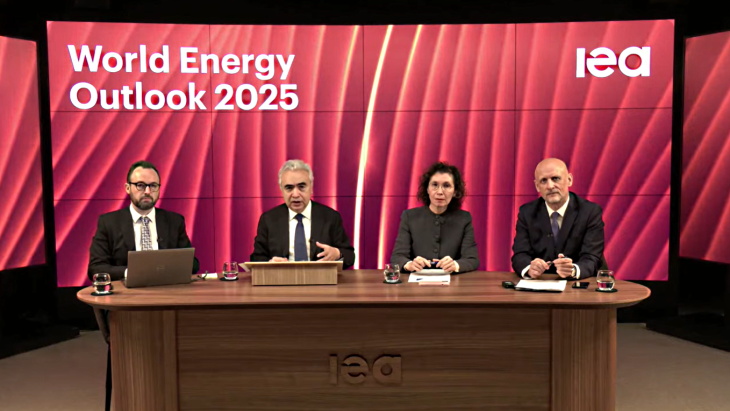
After more than two decades of stagnation, global nuclear power capacity is set to increase by at least one-third to 2035, according to the latest World Energy Outlook from the International Energy Agency. Global nuclear generating capacity is expected to increase from 420 GWe in 2024 to 728 GWe in 2050 in a scenario based on existing energy policies.
IEA Executive Director Fatih Birol (second from left) announces the release of its latest World Energy Outlook together with (from right) lead authors Tim Gould and Laura Cozzi, and Head of Communications at IEA Jethro Mullens (Image: Screengrab from online launch)
"A record high in nuclear power output is expected in 2025," the IEA says. "Technology advances - particularly in small modular reactors (SMRs) - are improving the outlook for nuclear power. As demand surges and the need for reliable, low-emissions baseload electricity increases, nuclear is increasingly seen as a critical part of a secure, affordable and diverse electricity mix."
The latest World Energy Outlook notes that more than 40 countries now include nuclear energy in their strategies and are taking steps to develop new projects. In addition to reactors that are restarting operation, notably in Japan, there is more than 70 GWe of new capacity under construction, one of the highest levels in 30 years. "Innovation, cost control and greater visibility on future cash flows is essential to diversify a sector that has been characterised by high market concentration, including for construction, uranium production and enrichment services," it says. "Technology companies are supporting the emergence of new business models, with agreements and expressions of interest for 30 GW of SMRs, mainly to power data centres."
The World Energy Outlook 2025 considers three scenarios. The Stated Policies Scenario (STEPS) provides an outlook based on the latest policy settings, including energy, climate and related industrial policies. The Current Policies Scenario (CPS) considers a snapshot of policies and regulations that are already in place. The Net Zero Emissions by 2050 Scenario (NZE) describes a pathway to reduce global energy-related carbon dioxide (CO2) emissions to net-zero by 2050.
Under the Current Policies Scenario, global nuclear generating capacity increases from 420 GWe in 2024, to 563 GWe in 2023 and reaches 728 GWe in 2050. The IEA says the "current pipeline of projects helps raise deployment in the 2030s to levels not seen since the 1980s".
"This momentum follows a challenging period marked by delays and cost overruns in several high-profile projects in Europe and the United States. Globally, nuclear power output doubles [to 784 GWe] to 2050 in the STEPS, maintaining a stable 9% share of electricity generation but falling well short of global initiatives to triple capacity," the report says.
In the Net Zero Emissions by 2050 Scenario, the pace of nuclear capacity additions is expected to slow after the mid-2030s, in line with other low-emissions technologies, as most electricity systems become largely decarbonised by then. As a result, capacity rises to 1,079 GWe.
Investments in nuclear energy have grown by more than 70% over the past five years, according to the IEA. "Spending on nuclear increases in both scenarios as several countries take final investment decisions on large new reactors, pushing the current investment level up 40% to more than USD100 billion per year in the Stated Policies Scenario, and by about 30% to over USD90 billion per year in the CPS."
The World Energy Outlook notes that several countries have signed a pledge to triple global nuclear power capacity by 2050. "If fully realised, this commitment would increase global nuclear capacity from 413 GW in 2020 to 1,240 GW by mid-century, which would exceed the level in the NZE Scenario by 160 GW."
It adds: "Achieving this tripling of nuclear capacity would require a significant increase in investment. Annual investment spending would need to rise from over USD70 billion today to a peak of about USD210 billion around 2035 before plateauing at around USD160 billion through the 2040s. Investment would need to be on average 50% higher throughout the 2040s than in the NZE Scenario, resulting in an additional USD900 billion of spending by 2050. This scaling up would be heavily dependent on robust supply chains, skilled labour and long-term policy support."
Age of Electricity
Electricity is at the heart of modern economies, the IEA says, and electricity demand grows much faster than overall energy use in all scenarios in the latest World Energy Outlook. "Investors are reacting to this trend: spending on electricity supply and end-use electrification already accounts for half of today’s global energy investment. For the moment, electricity accounts for only about 20% of final energy consumption globally, but it is the key source of energy for sectors accounting for over 40% of the global economy and the main source of energy for most households."
"Analysis in the World Energy Outlook has been highlighting for many years the growing role of electricity in economies around the world. Last year, we said the world was moving quickly into the Age of Electricity - and it's clear today that it has already arrived," IEA Executive Director Fatih Birol said.
"In a break from the trend of the past decade, the increase in electricity consumption is no longer limited to emerging and developing economies. Breakneck demand growth from data centres and AI is helping drive up electricity use in advanced economies, too. Global investment in data centres is expected to reach USD580 billion in 2025. Those who say that 'data is the new oil' will note that this surpasses the USD540 billion being spent on global oil supply - a striking example of the changing nature of modern economies."
Anfield breaks ground at Utah uranium mine
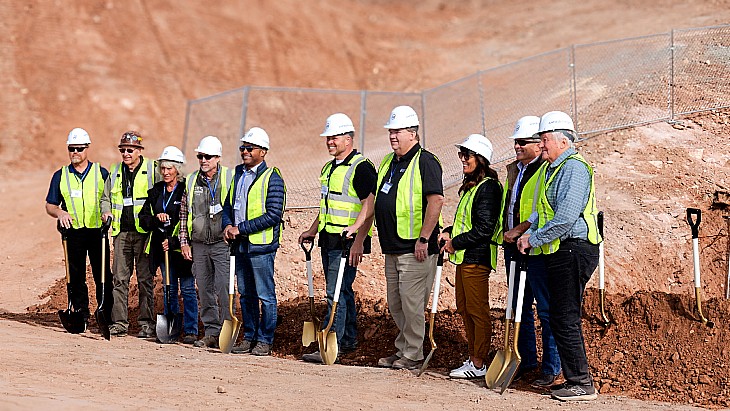
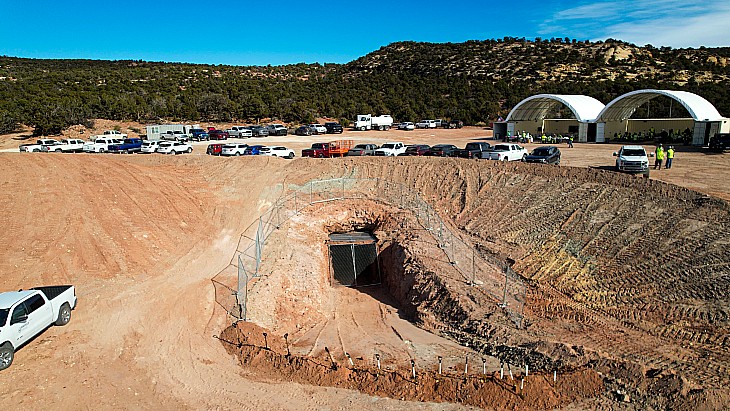
Weeks after receiving its final construction permit from the State of Utah, Anfield Energy has broken ground at the Velvet-Wood Uranium-Vanadium Mine - first production could be as soon as 2026.
(Image: Anfield)
The symbolic first dig marked the official launch of construction activities including mine reopening, dewatering, and development, following expedited federal and state approvals. The mine, in southeastern Utah, was approved for fast-tracked development earlier this year, and the company said the milestone underscores the alignment between policy advancements and on-the-ground progress in revitalising the US domestic uranium supply chain.
(Image: Anfield)
The ground-breaking ceremony on 6 November took place as the US Geological Survey (USGS) published its newest list of critical minerals which, for the first time since 2018, now contains uranium - and the timing "could not be more auspicious", Anfield said, adding that it "sets the stage for potential first production in 2026".
"This is a transformative moment for both American energy security and Anfield," said said CEO Corey Dias. "With uranium now officially classified as a critical mineral, our advanced-stage projects located in both Utah and Colorado potentially stand to benefit from expedited permitting, targeted federal investments, and enhanced market access. We've now broken ground at our Velvet-Wood mine, and this policy shift will supercharge our path to near-term production, delivering clean, reliable nuclear fuel to the grid while reducing reliance on overseas suppliers."
(Image: Anfield)
Critical mineral
The US critical minerals list is published by the US Department of the Interior through the USGS, and is updated every three years. The 2025 List of Critical Minerals contains all 50 critical minerals from the previous list, published in 2022, with the addition of 10 new minerals - boron, copper, lead, metallurgical coal, phosphate, potash, rhenium, silicon, silver, and uranium - based on new data, public feedback and interagency recommendations. Vanadium, which will also be mined at Velvet-Wood, was already on the list as a critical mineral.
The Department of Energy had recommended the addition of metallurgical coal and uranium to the list, citing the use of these minerals in steel production, energy, and defence. An Executive Order signed by President Donald Trump on his first day in office in January instructed the Director of the USGS "to consider updating the Survey's List of Critical Minerals, including for the potential of including uranium".
The US Energy Act of 2020 defines critical minerals as essential to the economic or national security of the USA; having a supply chain that is vulnerable to disruption; and serving "an essential function in the manufacturing of a product, the absence of which would have significant consequences for the economic or national security of the US". Vanadium is also on the list.
Critical minerals designation unlocks a suite of federal incentives and streamlined processes which directly support Anfield's hub-and-spoke model centred on its Shootaring Canyon Mill, Anfield said. Shootaring Canyon is one of only three licensed and permitted conventional uranium mills in the USA. It has been on standby since 1982, but in April 2024, Anfield submitted a production reactivation plan to the State of Utah's Department of Environmental Quality.
Accident-tolerant fuel completes second US PWR cycle
The first complete assembly of accident tolerant fuel to operate in a commercial nuclear reactor has completed its second cycle of operations and has undergone testing before being loaded into Constellation's Calvert Cliffs plant for a third 24-month cycle.
(Image: DOE)
The lead fuel assembly of enhanced accident tolerant fuel (E-ATF) was first loaded into unit 2 at the plant in Maryland in 2021, completing 24 months of operation before being examined and reinserted for an additional two years of operation in 2023. Teams from Framatome and Constellation inspected the assembly during the 2023 spring refuelling outage, after its first 24-month cycle, and again during the 2025 spring refuelling outage after completion of its second 24-month cycle of operation in the pressurised water reactor (PWR). The assembly will complete its third 24-month cycle of operation at Calvert Cliffs in spring 2027, after which it will be shipped to a US Department of Energy (DOE) national laboratory for post-irradiation examination to help inform licensing activities.
Accident-tolerant fuel - ATF - is a term used to describe new technologies that enhance the tolerance of light-water reactor fuel under severe accident conditions as well as offering improvements to reactor performance and economics. Such fuels may incorporate the use of new materials and designs for cladding and fuel pellets.
The fuel assembly contains 176 chromium-coated rods and chromia-enhanced pellets, which DOE - which is supporting Framatome's PROtect E-ATF programme - said can better respond to changes in the reactor core and are expected to reduce corrosion and hydrogen production under high-temperature conditions.
The fuel assembly was fabricated at Framatome's manufacturing facility in Richland, Washington, as part of a 2019 contract with Constellation. Chromia-enhanced pellets - which can be produced at Richland on an industrial scale - are now a standard feature in Framatome's ATRIUM 11 boiling water reactor fuel design, with reloads operating at eight US commercial power plants, the company said.
"The performance of our technology continues to demonstrate the expertise of our people to develop safe, cost-effective solutions for our customers and our industry," said Lionel Gaiffe, senior executive vice president, Fuel Business Unit at Framatome. "The Constellation team has been instrumental in helping us reach this milestone, leading the industry integrating accident tolerant fuel characteristics into their operations."
The fuel prototype builds on previous testing in the USA and Switzerland through Framatome's PROtect programme and could deliver the industry's first major upgrade to nuclear fuel and cladding technologies since the 1970s, DOE said.
"This public-private partnership is helping to drive the fulfillment of national power demands and executive orders issued by President Trump," said Frank Goldner, the federal programme manager for the DOE's Accident Tolerant Fuel Program. “This fuel assembly will continue operating under commercial conditions, providing crucial data to support the nation's energy objectives."
Framatome, GE Vernova, and Westinghouse are all testing fuel concepts in commercial reactors across the USA with the goal of widespread adoption by 2030, the DOE said.
Korean reactor cleared for extended operation
The continued operation of unit 2 at the Kori nuclear power plant until 2033 has been approved by South Korea's Nuclear Safety and Security Commission. The reactor has been offline since April 2023, when its original 40-year operating permit expired.
The four-unit Kori plant (Image: KHNP)
Kori unit 2 - South Korea's second nuclear power reactor - began commercial operation in August 1983. The 685 MWe pressurised water reactor's operating permit expired on 8 April 2023, and it has remained offline since. Korea Hydro & Nuclear Power (KHNP) submitted a safety assessment report for continued operation of Kori 2 in April 2022 and applied for a permit for continued operation, including the results of a public opinion survey on the radiation environmental impact assessment.
The Korea Institute of Nuclear Safety (KINS) - a regulatory agency under the Nuclear Safety and Security Commission (NSSC) - conducted a safety review between April 2022 to July 2025, and the Nuclear Safety Expert Committee conducted a preliminary review of the KINS review results for between March 2025 to September 2025 and determined that the review results were appropriate.
The NSSC previously considered the proposal for continued operation of Kori 2 at meetings on 25 September and 23 October, but failed to reach a decision. However, at a meeting on Thursday, the commission concluded that the unit "maintains sufficient safety margins" and meets safety requirements and decided to approve the continued operation of Kori 2 until 8 April 2033.
KHNP said it plans to restart Kori 2 in February 2026, after completing ongoing facility improvements and confirming safety through regular inspections by regulatory agencies. "Furthermore, the plant's safety and performance will be further enhanced during this period of continued operation through continuous facility improvements and thorough implementation of safety measures," it noted.
The decision to allow the continued operation of Kori 2 is expected to set a precedent for the extended operation of other South Korean reactors.
KHNP is currently submitting safety assessment reports for the continued operation of nine other nuclear power units (Kori 3 and 4, Hanbit 1 and 2, Hanul 1 and 2, and Wolsong 2, 3, and 4), whose operating licences expire before 2030, to the NSSC for review.
Operation of units 3 and 4 at the Kori plant was suspended in September 2024 and August this year, respectively, as their 40-year design lives had expired.
Unit 1 of the Kori plant was permanently shut down in June 2017, after 40 years of operation, and become the first South Korean reactor to enter decommissioning. KHNP submitted its application to dismantle the unit to the NSSC in May 2021. The regulator approved the decommissioning of Kori 1 in June this year.
"Continued operation will contribute to the national economy as a stable energy source for future power demand growth, such as for AI and data centres, and will play a significant role in achieving carbon neutrality by 2050," said Jeon Dae-wook, acting president of KHNP. "We will do our best to restart Kori unit 2 at the right time, with safety as our top priority."
Brazil’s microreactor project under way
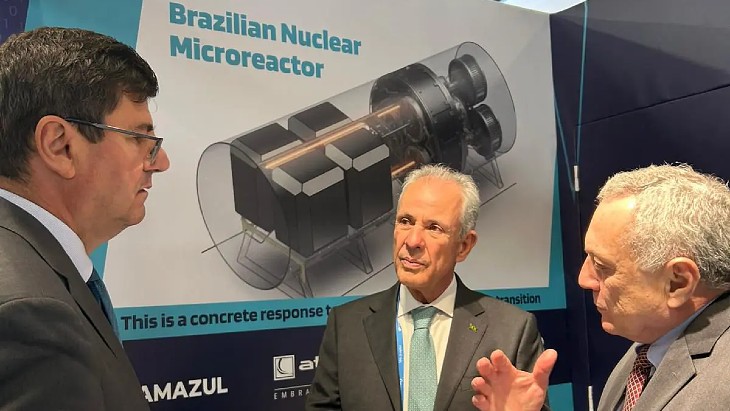
A three-year BRL50 million (USD9.1 million) project brings together private and public sector bodies to develop a concept for a 5 MWt microreactor with core cooling by heat pipes.
Chairman of Núcleo Energia, Bento Albuquerque (centre), and Coordinator of the Brazilian Nuclear Microreactor Project, Adolfo Braid (right), at WNE. (Image: Diamente Energia)
The National Nuclear Energy Commission (CNEN) project aims to demonstrate the feasibility of the development of a Brazilian 3-5 MW microreactor. The vision is for the microreactor to fit within a 40-foot container and be operated remotely for more than 10 years without any need for refuelling.
Earlier this year Industrias Nucleares do Brasil signed a contract with the Ministry of Science, Technology and Innovation and the Financing Agency for Studies and Projects for the development and testing of critical technologies applicable to Brazil's planned microreactor.
The project also brings together research centres, universities and others, including the navy and the Institute of Energy and Nuclear Research and the Institute of Nuclear Engineering.
The microreactor project is headed by Diamante Energia, Núcleo Brasil Energia and Terminus, who presented the concept at World Nuclear Exhibition in Paris last week. They are aiming for the first units to be operational in eight to ten years.
They say that the project "contemplates the manufacture of new alloys using strategic and abundant materials in Brazil, such as uranium, beryllium and niobium, and the state of the art in manufacturing techniques by additive manufacturing".
Industrias Nucleares do Brasil (INB) will be responsible for supplying nuclear fuel and specialised engineering services, as well as providing technical and administrative support.
In an update on progress, the National Nuclear Energy Commission said that one aspect to be defined is which fluid will be adopted for the heat pipes - saying that they are commonly "sodium (Na) or a eutectic alloy (sodium-potassium, NaK), due to its high thermal conductivity, low melting point, and wide operating range".
It said two alternatives are being studied for the conversion of thermal energy into electrical energy: "(1) Closed Brayton cycle - the heat released by the heat pipe heats a pressurised gaseous fluid (usually helium (He) or carbon dioxide (CO₂) to the brink of boiling) in a heat exchanger. The hot gas expands in a microturbine, driving an electric generator. Then the gas is cooled and compressed again, closing the cycle" or "(2) Stirling cycle - heat from heat pipes heats a sealed cylinder containing gas (helium or hydrogen). The gas is cyclically heated and cooled, moving a piston that drives a linear electric generator. The system operates in a closed, silent, and combustion-free manner."
Potential technical bottlenecks are listed as licensing, because existing regulations were designed for large plants, plus costs and scale, security and testing and validation of heat pipe cooling systems to ensure long-term reliability.
Positive technological developments are listed as passive safety systems, new fuels such as TRISO nuclear fuel, the enhanced abilities of advanced simulations and the wider benefits of collaborative work.
At the end of the three-year project it is proposed to demonstrate the main technologies planned, as well as seeking the first regulatory authorisations from Brazil’s regulators.
Suggested future uses for the microreactor include providing reliable power to remote towns, to hospitals and factories and reducing dependency on diesel generators. In March the commission said: "The project is currently at the TRL 3 technological readiness level, which corresponds to the mathematical modeling and preliminary studies phase. The goal is to advance to TRL 6, the level at which the technology is demonstrated in a relevant environment, closer to practical application."
There are various microreactor projects at different stages of development around the world. While small modular reactors are generally seen as including reactors up to 300 MW, microreactors are said by the International Atomic Energy Agency to be those designed for up to about 20 MW, with container-based ones seen as especially having the ability to be transported to a wide range of potential locations, including isolated areas.
IEN/CNEN researcher Maria de Lourdes Moreira said: "Aligned with the current government's policy of reindustrialisation and technological sovereignty, the microreactor symbolises a new stage in Brazilian energy innovation - sustainable, strategic, and fully national."
Brazil currently has two operating power reactors - Angra 1 and Angra 2 - which generate about 3% of the country’s electricity. Work on the Angra 3 project - to feature a Siemens/KWU 1405 MW pressurised water reactor - began in 1984 but was suspended two years later, before construction began. The scheme was resurrected in 2006, with first concrete in 2010. However, amid a corruption probe into government contracts, construction of the unit was halted for a second time in 2015, when it was 65% complete. It has since restarted and been halted again, with a decision currently awaited on completing it.

_63535.jpg)
_46884.jpg)
_84894.jpg)

No comments:
Post a Comment