It’s possible that I shall make an ass of myself. But in that case one can always get out of it with a little dialectic. I have, of course, so worded my proposition as to be right either way (K.Marx, Letter to F.Engels on the Indian Mutiny)
Thursday, November 13, 2025
UK selects Wylfa to host at least three Rolls-Royce SMRs
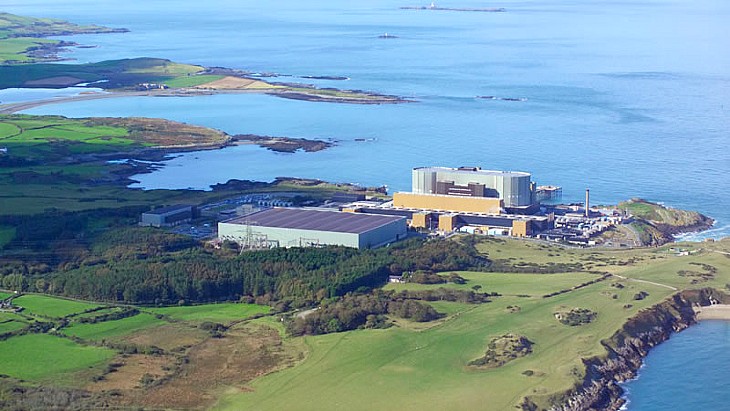
The UK government has announced that Wylfa on the island of Anglesey, North Wales, will host three Rolls-Royce small modular reactors. It said the site - where a Magnox plant is being decommissioned - could potentially host up to eight SMRs.
(Image: ONR)
"Sitting on the North Wales coast, Wylfa has a strong nuclear heritage dating back to the 1960s," the government said. "The first-of-its-kind project is expected to support up to 3,000 good jobs in the local community at peak construction, underpinned by billions of pounds of infrastructure investment out to the mid-2030s."
Great British Energy - Nuclear (GBE-N) will start activity on the site in 2026 with the aim for Wylfa's SMRs to be supplying power to the grid from the mid-2030s.
In June this year Rolls-Royce SMR was selected as the UK government's preferred technology for the country's first SMR project with the goal of signing contracts later this year and forming a development company. A final investment decision is expected to be taken in 2029.
The Rolls-Royce SMR is a 470 MWe design based on a small pressurised water reactor. It will provide consistent baseload generation for at least 60 years. Ninety percent of the SMR - measuring about 16 metres by 4 metres - will be built in factory conditions, limiting activity on-site primarily to assembly of pre-fabricated, pre-tested, modules which significantly reduces project risk and has the potential to drastically shorten build schedules.
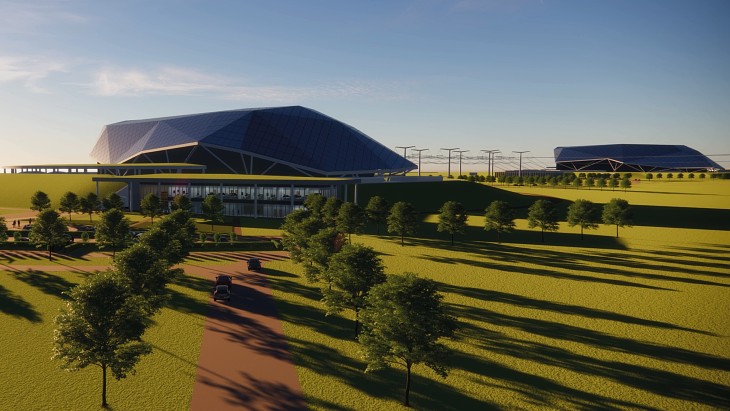
An image of how two units might look (Image: Rolls-Royce SMR)
"We are honoured to have the opportunity to establish our UK fleet programme with an initial three units at the Wylfa site," said Rolls-Royce SMR CEO Chris Cholerton.
"Today's announcement marks the first step in what will be a 100-year commitment to clean energy, innovation, and community partnership at Wylfa. This is a tremendous opportunity not just for North Wales but for the whole country, as we establish an enduring supply chain that will enable our fleet deployment in the UK and a large export programme, starting in Czechia. We will deliver nuclear power very differently by utilising modularisation and a high level of factory build, therefore minimising the impact on local people from infrastructure delivery. We are excited to be working with the local community to create jobs and growth."
The Wylfa site
Wylfa was the biggest and last Magnox site to be built in the UK. Its twin 490 MWe reactors began commercial operation in November 1971 and January 1972, respectively. Unit 2 was permanently shut in April 2012, with unit 1 following in December 2015. Defuelling of the plant was completed in September 2019.
Hitachi's Horizon Project - launched in 2009 - was to develop two UK Advanced Boiling Water Reactor units at Wylfa Newydd with the intention to develop the company's nuclear business in the UK. However, it decided to suspend the project in January 2019, from the viewpoint of its "economic rationality as a private company" because it was clear that further time was needed to decide on a financing structure for the project, and the conditions for building and operating the nuclear power plants. In January 2021, Horizon withdrew its application for planning consent for the Wylfa Newydd nuclear power plant.
In March 2024, the government announced that an agreement had been reached to buy the Hitachi-owned sites for new nuclear at Wylfa and at Oldbury-on-Severn in southwest England. At the time, it said the two sites were expected to be prioritised for new nuclear as the UK seeks to expand nuclear energy capacity. It marked the first time the government had acquired land for new nuclear since the 1960s.
Rolls-Royce SMR said in November 2022 that Wylfa was among four existing nuclear power plant sites owned by the UK's Nuclear Decommissioning Authority identified as priority potential locations for its SMRs. The company matched the sites against a set of assessment criteria that will enable plants to be operational by the early 2030s, including: existing geotechnical data, adequate grid connection and a site large enough to deploy multiple SMRs.
In May last year, the government announced that Wylfa was its preferred site for a new large-scale nuclear power plant. It launched talks with international energy companies to explore building a power plant at the site.
Decision welcomed
"Britain was once a world-leader in nuclear power, but years of neglect and inertia has meant places like Anglesey have been let down and left behind," Prime Minister Keir Starmer said. "Today, that changes. We're using all the tools in our armoury - cutting red tape, changing planning laws, and backing growth - to deliver the country's first SMR in North Wales."
Energy Secretary Ed Miliband added: "This landmark investment proves Britain can still build big projects that stand the test of time. A generation of young people across North Wales will benefit from the good jobs, homes across Britain will get clean power and we will take a big step forward in meeting our ambition to create a network of small modular reactors across the UK."
"This is a historic moment for the UK, and is another momentous step in realising Britain’s potential in leading the way on nuclear energy," said Simon Bowen, Chair of GBE-N. "These first SMRs at Wylfa will lay the groundwork for a fleet-based approach to nuclear development, strengthening the UK's energy independence and bringing long-term investment to the local economy. Wylfa has a proud history of nuclear excellence, and we're excited to build on that foundation to deliver jobs, training, and low-carbon energy for generations to come."
Tom Greatrex, CEO of the Nuclear Industry Association, said: "Bringing nuclear back to Wylfa is a historic moment for Wales and for the UK's clean energy future. Wylfa's revival offers a once-in-a-generation opportunity to deliver clean, reliable power for decades to come, create thousands of skilled jobs, attract major investment, and revitalise North Wales’s proud industrial heritage. With Great British Energy-Nuclear and Rolls-Royce SMR leading the way, the project will bring lasting economic and social benefits to the communities that have long been at the heart of our energy story. We look forward to working with government, local partners and industry to make Wylfa's return a lasting success."
Plans for large-scale reactors
The UK government aims to grow nuclear energy capacity to 24 GW by 2050, with a mix of traditional large-scale power plants and SMRs.
Alongside the SMR siting announcement, to pursue the option of a further large-scale reactor project beyond the current deployments at Hinkley Point C and the recently confirmed Sizewell C, the government also announced that GBE-N has been tasked with identifying suitable sites that could potentially host such a project.
GBE-N will report back by Autumn 2026 on potential sites to inform future decisions in the next Spending Review and beyond. The Energy Secretary has requested this includes sites across the UK, including Scotland.
"Any further large-scale project, subject to future policy decisions, would be similar in scale to the Hinkley Point C or Sizewell C projects, with the potential to power the equivalent of 6 million homes," the government said.
Rolls-Royce Shares Soar After Major Profit Forecast Upgrade
Rolls-Royce is projecting a full-year operating profit of £3.1 billion to £3.2 billion, a 26 per cent increase over the previous financial year, driven by its civil aerospace and defence businesses.
The civil aerospace division benefited from the recovery of global air travel and new engine orders, while the defence arm saw steady demand due to increased government spending.
Rolls-Royce SMR, a co-owned division, was selected as the UK’s provider of small modular reactor technology, which helped the firm’s stock price surpass 900p for the first time.
FTSE 100 giant Rolls-Royce said it expects profit for the full-year to be 26 per cent higher than the previous financial year after a hefty boost from its civil aerospace and defence divisions.
The Derby-headquartered group is eyeing an operating profit of £3.1bn to £3.2bn after upgrading its earlier guidance of £2.7bn to £2.9bn.
This would mark a major jump from the £2.5bn scored in the 2024 financial year.
The London-listed has benefited from tailwinds in the recovery of global air travel, which has bolstered its civil aerospace division, whilst heightened geopolitical tensions have led to governments increasing spending providing steady demand for its defence arm.
Large engine flying hours in the ten months to 31 October grew eight per cent year-on-year whilst soared 109 per cent above pre-COVID levels.
The firm has also secured a pipeline of new orders for engine manufacturing from the likes of IndiGo, Malaysia Airlines and Avolon.
Aarin Chiekrie, equity analyst at Hargreaves Lansdown, said: “Rolls-Royce continues to cruise above the clouds, with its third-quarter update showing little sign of turbulence.
He added: “Margins are improving thanks to contract renegotiation, operational efficiencies, and part upgrades, which are improving the time its engines spend on wing. All of this is helping Rolls-Royce convert the increased flying hours and revenue into profits.”
Rolls-Royce takes on UK nuclear contract
In defence, the business said the UK and Türkiye agreement – signed in October – would allow it to export 20 Eurofighter Typhoons, ensuring guaranteed engine sales and a long-term service contract.
Rolls-Royce SMR, which is co-owned by the FTSE 100 giant and Czech power company CEZ, was named to build three units in the UK in a move which the firm said would “generate employment, boost the supply chain and generate economic growth, including through the capture of significant export opportunities”.

No comments:
Post a Comment