Copyright AP Photo/Jean-Francois Badias
By Romane Armangau
Published on 12/11/2025 - EURONEWS
Fighting for democracy is the 27-member bloc's foremost enshrined value, but NGOs and MEPs argue that the new Democracy Shield falls short on concrete measures and funding.
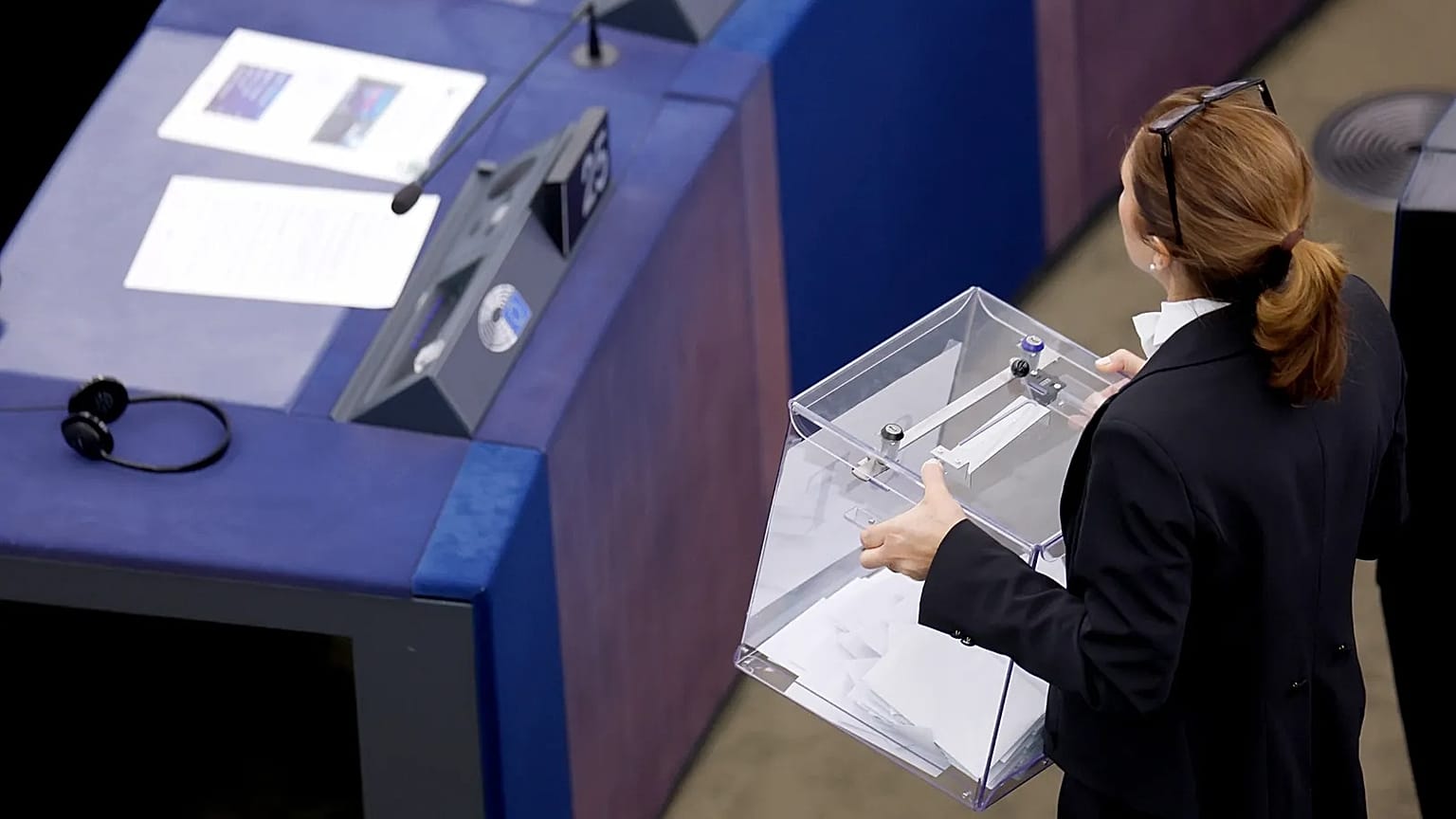
The European Commission unveiled its new Democracy Shield on Wednesday, a roadmap to better protect democracies and electoral processes from foreign interference and information manipulation — including those originating within the bloc itself.
At the heart of this strategy lies Russia and its “state or non-state proxies”, which for over a decade have conducted online destabilisation campaigns across the EU.
These efforts have been amplified by the rapid development of new technologies that make false information more convincing and its dissemination more viral.
Recent elections demonstrated how damaging online campaigns can be to democratic processes.
Last December in Romania, presidential elections were cancelled by the Constitutional Court after reports from intelligence services revealed Russian involvement in influencing voters through a propaganda campaign in favour of ultranationalist candidate Calin Georgescu.
Meanwhile, in Moldova, an EU candidate country, social media platforms were rife with disinformation in the run-up to the September parliamentary elections. Driven by artificial intelligence, bots were deployed to flood comment sections with posts deriding the EU and the pro-European party ahead of the vote.
What is Brussels' Democracy Shield about?
“Our Europe may die,” French President Emmanuel Macron warned during his Sorbonne speech in April 2024, a concern the European Union wants to address.
The Commission writes that the Democracy Shield “is not only necessary to preserve the EU’s values, but also to ensure Europe’s security and to safeguard its independence, freedom and prosperity.”
In the 30-page document, the Commission lays out its plan to “enhance democratic resilience across the Union”. Despite the strong rhetoric, the initiative comes with few concrete measures.
The centrepiece of the Democracy Shield is the creation of a European Centre for Democratic Resilience. Its purpose will be to identify destabilisation operations, pool expertise from member states, and coordinate the work of fact-checking networks already established by the Commission.
However, participation in this centre is purely voluntary for members. French MEP Nathalie Loiseau (Renew Europe), who heads the Democracy Shield committee, believes that the Commission should have gone further.
“There is a certain timidity about this Democracy Shield. It is true that some powers remain national and that the European Union cannot impose itself," Louiseau told Euronews.
"But let us remember that, just as with online platforms — where the Commission long relied on their goodwill only to realise it did not exist — it is time to build something that truly protects individuals, European citizens, including against states that would seek to undermine democracy.”
The EU executive put a strong emphasis on including EU candidates in this defensive plan, but also potentially "cooperation with like-minded partners could also be foreseen, and that is something that we will develop over the period ahead,” European Commissioner for democracy and rule of law Michael McGrath told journalists.
McGrath, who is in charge of the file, also explained that the nature of the centre would evolve in the future, “as the nature of the threat that it will be dealing with is constantly evolving.”
The Commission also proposed "setting up a voluntary network of influencers to raise awareness about relevant EU rules and promote the exchange of best practice," to hold influencers participating in political campaigns accountable.
Big promises, small purse
However, both the specific measures and their funding remain unclear. “There has to be funding to actually do this, otherwise it just ends up being hot air,” Omri Preiss, managing director of Alliance4Democracy nonprofit, told Euronews.
Although he recognised that it was an important step, Preiss highlighted that the Russian government spends an estimated two to three billion euros a year on such influence operations, while “the EU is not really doing anything equivalent.”
The allocation of funds will also depend on the outcome of the Commission budget discussion – currently under negotiation.
For Loiseau, protecting democracy means that the Commission must first apply the rules it adopted to regulate its online sphere.
“I’m a little afraid Ursula von der Leyen’s hand may have trembled, because what we are seeing today is, of course, massive Russian interference," she said.
"But it’s also the behaviour of platforms like TikTok, which raises many questions -and, even more so, the collusion between the US administration and American platforms," Loiseau added.
"On that front, it seems Ursula von der Leyen struggles to take the next step. She tells us that she will implement the legislation we have adopted and I should hope so. But we must go further.”
Several rules aimed at protecting electoral processes have already been adopted. Since 2023, the Digital Services Act has required greater transparency in recommendation algorithms and includes provisions to reduce the risks of political manipulation.
Meanwhile, the AI Act, adopted last year, mandates the labelling of AI-generated deep fakes. The European Media Freedom Act, which came into force this summer, is designed to ensure both transparency and media freedom across the bloc.
Yet, under pressure from US tech giants backed by the Trump administration, Commission sanctions have to materialise — despite serious suspicions of information manipulation and algorithmic interference.
“These rules reflect the will of those who elected us. Enforcing them is the first step in building a shield for democracy,” the centrist group Renew in the European Parliament said.
“It is imperative to ensure that the European Media Freedom Act is fully implemented across the European Union,” the group wrote in a letter to European Commission President Ursula von der Leyen.
“The actions will be gradually rolled out by 2027,” Commissioner McGrath said. This year will be a decisive test of the Shield’s resilience in the information war, as citizens in key EU member states — notably France, Italy and Spain — head to the polls.
Antwerp port
November 13, 2025
By EurActiv
By Miriam Saenz de Tejada
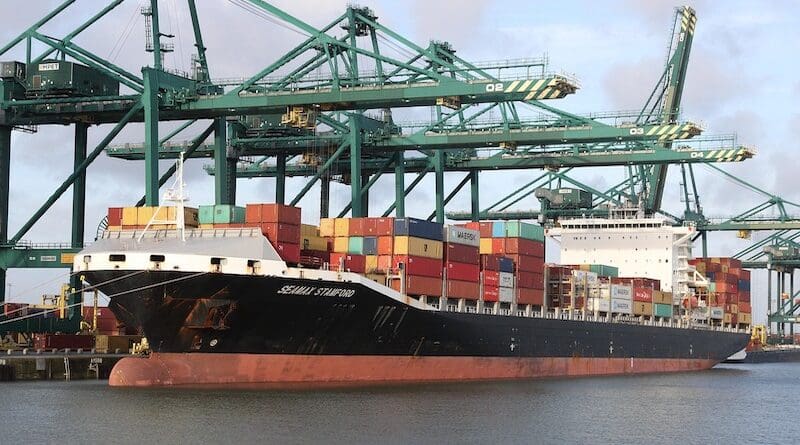
(EurActiv) — Belgium wasn’t always Europe’s drug hub. Today, its ports – Antwerp, Zeebrugge, and their sprawling container terminals – move millions of tonnes of cargo, concealing tonnes of cocaine, heroin, and synthetic drugs. Their deep-water access, nonstop container traffic, and Schengen freedoms make the country a dream for traffickers – and a nightmare for law enforcement.
In Antwerp alone, drug seizures surged from 91 tonnes in 2021 to nearly 110 in 2022, overtaking Rotterdam and cementing the port’s place at the centre of Europe’s narcotics trade.
Just 45 kilometres inland, Brussels now feels the shockwaves – shootings, gang turf wars, and fear spreading through neighbourhoods such as Molenbeek and Anderlecht.
So, after an Antwerp judge – who spent four months in a safe house – warned the country was at risk of becoming a “narco-state,” how real is the threat? The jurist also warned that organised crime is infiltrating ports, police, and even the judiciary, with mafia networks acting as a parallel power. Belgium’s ports remain a critical entry point to Europe, where drugs flow in, and its streets pay the price.
How smuggling works
The drug trade starts far from Europe. For cocaine – the most heavily trafficked drug through EU ports – bulk shipments leave Colombia, Peru, or Ecuador, stuffed inside legal cargo like fruit crates, machinery parts, or steel pipes. Some go straight across the Atlantic, while others zigzag through trans-shipment points in West Africa – via Senegal, Ivory Coast, or Cape Verde – or through Caribbean ports to blur their trail.
By the time containers reach Europe, the cargo manifests appear clean. Some pass through the Canary Islands or the Azores, making the paperwork even harder to trace. Then they dock at Antwerp, Zeebrugge, or Rotterdam, where “extractor” crews – often teenage recruits – break open the containers, remove the drugs, reseal them, and slip away before inspectors arrive.
In the numbers game of smuggling, networks have adapted quickly. Belgian customs data now show traffickers favor smaller, more frequent loads to dodge scanners – 82 cocaine shipments intercepted in early 2025 in Antwerp averaged 204 kilogrammes each, down from 359 kilogrammes in 2024.
Europol notes that gangs use feeder ships and container swaps during transit to obscure origin points and exploit weak checks.
The same patterns apply to other drugs. Heroin moves along the Balkan route from Afghanistan via Turkey and the Balkans, while cannabis resin still flows from Morocco into Spain, and synthetic drugs and precursors such as methamphetamine arrive from Asia by air freight or even postal parcels.
All roads lead to Belgium
Geography made Belgium a gateway, but globalisation made it a goldmine. Antwerp’s position, connected by road and rail to every major Western European market, means a large share of the cocaine that lands there is trucked elsewhere – cut, repackaged, and resold at many times the profit.
The scale is staggering. The European cocaine market is estimated at €11.6 billion, while cannabis adds another €12.1 billion. With that kind of money moving through legitimate supply chains, Belgium’s ports have become ideal not only for smuggling but also for money laundering. In 2024, the Antwerp region alone recorded 128 drug-related arrests, including 16 minors.
But what starts at the docks rarely stays there. Brussels – 45 km away inland – is now on the front line of the drug fallout. At a press conference in July 2025, prosecutors reported 57 shootings – 20 of them over the summer – many tied to turf wars between rival gangs, according to Brussels’ public prosecutor Julien Moinil.
In February, a gunfight outside Clémenceau metro in Anderlecht left one dead. In September, a massive police sweep checked 708 people and 621 vehicles across the city. Yet the violence never stops. Brussels now records a homicide rate of 3.19 per 100,000 people – among the highest in the EU’s major urban areas – with neighbourhoods like Molenbeek and Anderlecht hit hardest.
A fight that just started
Across the EU, overall drug seizures have climbed over the past decade, with the amounts of amphetamine, meth, and ecstasy fluctuating year to year. Every catch is a reminder of what still slips through. Belgian customs estimate they intercept only 10–40% of cocaine arriving at its ports. The rest floods Europe. A kilo bought for a few thousand euros in Latin America can fetch close to €30,000 on EU markets, warns the European Union Drugs Agency (EUDA).
The money doesn’t just disappear; it’s washed through trading firms, real estate, and logistics companies that double as laundering fronts operating in Belgium. Even with 16.7 tonnes of cocaine seized in Antwerp in the first half of 2025, traffickers are outpacing enforcement: hiding shipments behind encrypted networks, corrupt dockers, and shell firms.
Brussels is racing to catch up. The EU’s new Roadmap Against Drug Trafficking targets chemical precursors, widening controls to cover fast-evolving derivatives. The EUDA now backs the Commission on monitoring and threat assessments – completing the EU’s first-ever precursor risk reviews in early 2025. As for the city, other ideas come to mind: merging Brussels’ six police zonesand increasing spot raids.
But as prosecutor Julien Moinil warns: “Ten or twenty years of laxity can’t be fixed overnight.”
Belgium remains Europe’s gateway: seizures make headlines, but the real trade never stops.
EurActiv publishes free, independent policy news and facilitates open policy debates in 12 languages.

No comments:
Post a Comment