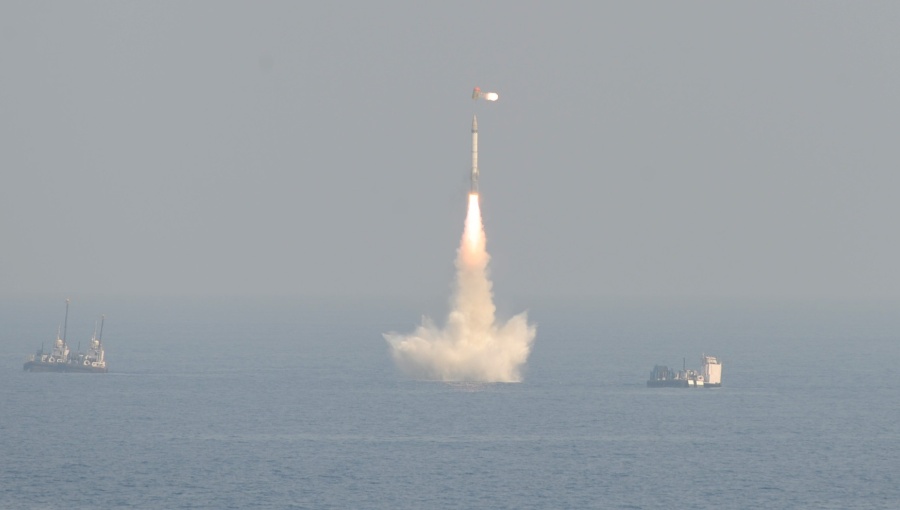
The commissioning of the INS Aridhaman marks an important point in India’s nuclear triad, giving it a third nuclear ballistic missile submarine meaning that the nation can now maintain a continuous at-sea deterrent, Carnegie India writes.
The vessel was quietly commissioned on April 3, at India’s Ship Building Centre in Visakhapatnam with no formal announcement made, although defence minister Rajnath Singh did post a message on social media in Hindi which Carnegie translates as reading: Not words but power, Aridhaman. It is reported that Singh was in the city at the time for the commissioning of a separate naval vessel, a fourth frigate under the Project-17A programme.
The induction of INS Aridhaman is highly significant for India’s nuclear doctrine. Announced in 2003, India bases its nuclear capabilities on assured retaliatory second-strike capability and a no-first-use posture. The act of maintaining a continuous deployment at sea requires at least three submarines: one on patrol, with the others in maintenance or transit.
With the INS Aridhaman now believed to be operational, India has reached that threshold.
The country’s first indigenous SSBN, the INS Arihant, also known as S2, was developed under the Advanced Technology Vessel programme and launched in the 1980s. A 6,000-tonne submarine powered by an 83-MW reactor, was launched in 2009 by then prime minister Manmohan Singh and eventually commissioned in 2016. Two years later, in 2018, current prime minister Narendra Modi announced that the vessel had completed its first deterrence patrol, confirming its operational nuclear strike role while also completing India’s nuclear triad across land, air and sea.
The second SSBN, the INS Arighaat, was commissioned in August 2024 meaning that the addition of the INS Aridhaman, with all its further technological enhancements, albeit classified and not made public, now completes the current three-submarine requirement for continuous deterrence.
In terms of the nation’s payload, India’s ballistic missile arsenal includes the Prithvi and Agni series.
The Agni-5, with a range of over 5,000km, is a canisterised missile in order to improve mobility and storage and was tested in 2024 with multiple independently targetable re-entry vehicles. Air-delivered nuclear capability includes the much-publicised Mirage-2000, Sukhoi-30MKI and Rafale aircraft.
Among the triad, SSBNs remain the most survivable platform for second-strike capability.
All five recognised nuclear powers in the world operate SSBNs with intercontinental submarine-launched ballistic missiles. India, however, still faces a capability gap in this area. Its current submarines are armed with the K-15 missile, which comes with a range of just 750km - thus requiring deployment close to enemy coastlines for retaliation to be effective.
The INS Arighaat and INS Aridhaman are capable of carrying the K-4 missile, with a range of 3,500km, although it is not yet fully operational, Carnegie adds. When deployed, however, the K-4 is expected to form the backbone of India’s underwater deterrent until the K-5, with a planned range of 5,000km, enters service.
A fourth submarine, for now referred to as the ‘S4*’ was launched in 2024 and is expected to be commissioned next year. Other future platforms in the pipeline include the ‘S5’ – which like the S4 is expected to be significantly larger than current submarines at around 13,500 tonnes while also being powered by more advanced reactors.
Attention in India is now also turning to nuclear-powered attack submarines (SSN) which are seen as a critical addition to current naval capabilities for long-range endurance operations in the Indian Ocean. While India currently operates 17 conventional submarines, most are understood to be nearing the end of their operational lifespan.
With this in mind, the Cabinet Committee on Security approved the design and construction of two SSNs in 2024, although the first is not expected to come into service until 2036–37.
By contrast, China operates more than 60 submarines, including at least 12 nuclear-powered vessels and according to the US Office of Naval Intelligence, by 2035 half of Beijing’s projected fleet of around 80 attack submarines could be nuclear-powered – a probability India will need to counter in the long-term given ongoing tensions between Beijing and New Delhi.

No comments:
Post a Comment