Showing posts sorted by relevance for query jewish question. Sort by date Show all posts

Friday, December 20, 2019

The Jewish Question: History of a Marxist Debate By Enzo Traverso

Jay Rothermel at Marxist update - 1 week ago
Traverso's version of Marxism never rises above the level of caricature and academic kitsch. Neither Marx, Lenin, Engels, or Trotsky ever promoted the idea of linearity or inevitability in history in general or in the contemporary class struggle. They were conscious polemical opponents of such ideas; at their best, so were Kautsky, Labriola, and Plekhanov, not to mention Mandel and George Novack. Traverso, for a "man of the left," seems to be satisfied with a knowledge of Marxism obtained second-hand, not from the works of the movement's founders and leaders. To tackle subjec... more »

Reading notes on Conclusion of The Jewish Question: History of a Marxist Debate By Enzo Traverso

Jay Rothermel at Marxist update - 1 week ago
The Jewish Question: History of a Marxist Debate By Enzo Traverso Translated by Bernard Gibbons Brill, [2018] The below are my underlinings/highlightings of Traverso. My own thoughts appear, if at all, as [N.B.]. Jay Conclusion ....Classical Marxism was incapable of comprehending the nature of anti-Semitism, or of recognising the Jewish aspiration to a distinct separate identity. Actually, it shared this misconception with all intellectual and political currents that belonged to the tradition of Enlightenment, from democratic liberalism to Zionism. ....The movement founded... more »

Reading notes on Chapter 10 of The Jewish Question: History of a Marxist Debate By Enzo Traverso

Jay Rothermel at Marxist update - 1 week ago
The Jewish Question: History of a Marxist Debate By Enzo Traverso Translated by Bernard Gibbons Brill, [2018] The below are my underlinings/highlightings of Traverso. My own thoughts appear, if at all, as [N.B.]. Jay Chapter 10: Post-war Marxism and the Holocaust ....lack of a Marxist debate on the causes, forms and consequences of the destruction of the European Jews ....During the 1940s and 1950s Marxism became an essential component of anti-fascist culture, in which the Jewish tragedy was reduced to a marginal aspect of the gigantic conflict that had ravaged Eur... more »

Reading notes on Chapter 9 of The Jewish Question: History of a Marxist Debate By Enzo Traverso

Jay Rothermel at Marxist update - 1 week ago
The Jewish Question: History of a Marxist Debate By Enzo Traverso Translated by Bernard Gibbons Brill, [2018] The below are my underlinings/highlightings of Traverso. My own thoughts appear, if at all, as [N.B.]. Jay [N.B. There is no better place to understand Abram Leon's book The Jewish Question than the book itself, available in many places on the web, and for purchase here. Traverso in his chapter on Leon tries to have his cake and eat it, too on nearly every page: Leon is too dogmatic in his Marxism/he breaks from previous Kautsky dogmatism; Leon counterposes assi... more »

Reading notes on Chapter 8 of The Jewish Question: History of a Marxist Debate By Enzo Traverso

Jay Rothermel at Marxist update - 1 week ago
The Jewish Question: History of a Marxist Debate By Enzo Traverso Translated by Bernard Gibbons Brill, [2018] The below are my underlinings/highlightings of Traverso. My own thoughts appear, if at all, as [N.B.]. Jay Chapter 8: The Messianic Materialism of Walter Benjamin 3 Critique of Progress ....his acceptance of Marxism was critical and, so to speak, selective. What interested him about Marxism was its subversive and revolutionary dimension, of which there no longer remained any trace in social democracy. Educated by Bernstein and Kautsky, the latter conceived ... more »

Reading notes on Chapter 7 of The Jewish Question: History of a Marxist Debate By Enzo Traverso

Jay Rothermel at Marxist update - 1 week ago
The Jewish Question: History of a Marxist Debate By Enzo Traverso Translated by Bernard Gibbons Brill, [2018] The below are my underlinings/highlightings of Traverso. My own thoughts appear, if at all, as [N.B.]. Jay Chapter 7: From Weimar to Auschwitz: Anti-Semitism and the German Left ....Just as the German left in the nineteenth century had ignored the anti-Semitic propaganda of Richard Wagner, Heinrich von Treitschke and Hous-ton Stewart Chamberlain, under the Weimar Republic it did not pay attention to Mein Kampf. ....Nazi anti-Semitism, on the contrary, was charge... more »

Reading notes on Chapter 6 of The Jewish Question: History of a Marxist Debate By Enzo Traverso

Jay Rothermel at Marxist update - 1 week ago
The Jewish Question: History of a Marxist Debate By Enzo Traverso Translated by Bernard Gibbons Brill, [2018] The below are my underlinings/highlightings of Traverso. My own thoughts appear, if at all, as [N.B.]. Jay Chapter 6: Gramsci and the Jewish Question [Gramsci has zero to do with the continuity of revolutionary Marxism. He, like Benjamin and the Frankfurters, have been embraced by petty bourgeois radicals and academics who traded curiosity or support for independent working class political action for the companionable teat of bourgeois public opinion every time the wo... more »
SEE  https://plawiuk.blogspot.com/search?q=fascism 

SEE  https://plawiuk.blogspot.com/search?q=marxism

SEE  https://plawiuk.blogspot.com/search?q=jewish+question

Monday, January 29, 2024

Our Conventional Wisdom About the Origins of American Jewish Defense of Palestinian Rights Misses a Lot

Geoffrey Levin
Sun, January 28, 2024

On a cold and rainy November day, a 65-year-old American rabbi trudged down the muddy roads of a Palestinian refugee camp. When the rabbi and his colleagues stopped, refugees gathered around them in a scene of “disappointment, frustration, [and] despair.” Gaunt men and “children, big-eyed and thin,” walked up and clutched the rabbi’s raincoat. Several began chanting, in Arabic, “We want to go home!” Weary, broken women watched silently from their tents as rain and wind chilled their bare feet. Guilt overcame the rabbi. “In my deepest heart, I said the prayer of confession,” the rabbi wrote, referring to a prayer recited on Yom Kippur, the fast of atonement. “Anachnu Chatanu.” We have sinned.

One could imagine this scene taking place recently. Yet it was 1953 when Rabbi Morris Lazaron walked through the refugee camp—Shatila, located in Lebanon—where he witnessed firsthand the suffering of Palestinian families who had lost their homes during the war that accompanied Israel’s creation in 1948. The “illimitable misery” of the refugees, to use Lazaron’s words, had a decisive impact on the former head rabbi of the prestigious Baltimore Hebrew Congregation. After his trip, Rabbi Lazaron began calling on the Israeli government to recognize the right of Palestine’s Arab refugees to return to their prewar homes and urged the Jewish state to admit 100,000 of them into the country immediately.

Lazaron felt that the Jewish historical experience should compel all Jews to support the Palestinian refugees. As members of what he called “the tribe of the wandering feet,” Lazaron pressed fellow American Jews to remember that they, too, were once “strangers in the land of Egypt.” Jewish identity weighed heavily on the rabbi’s mind as he considered how to respond to Palestinian suffering. Yet the hidden context of the rabbi’s trip reveals that the stakes of his response extended far beyond the realm of Jewish ethics. Lazaron’s visit to Lebanon had been organized and financed by a secretly CIA-funded advocacy organization called American Friends of the Middle East, a group created to give Americans a more sympathetic picture of the Arab side of the Israeli-Arab conflict. AFME published Lazaron’s book about the trip in 1955, apparently as part of a broader public relations effort that aimed to make it easier for United States officials to pressure Israel to accept the return of 75,000 Palestinian refugees.

The CIA was far from the only government body interested in American Jewish responses to the Palestinian refugee crisis. Lazaron articulated his lament on a playing field where various governmental actors—Israeli, American, and Arab—all jockeyed to shape U.S. public opinion surrounding the Palestinian refugee question. Just as AFME was organizing Lazaron’s trip, Israeli diplomats were quietly working to undermine both the Jewish newspaper that Lazaron wrote for and the anti-Zionist Jewish group he represented, the American Council for Judaism, which in turn had begun fostering warm ties with Arab officials. The American Jewish debate over Palestinian rights involved a struggle over Jewish identity, as Lazaron’s words reflect. But as his broader story shows, the debate also is, and always has been, part of a high-stakes political struggle between government officials and others over the future of Israel, the fate of the Palestinians, and the orientation of American foreign policy toward the Middle East.

There is a narrative about the trajectory of the American Jewish relationship with Israel that pervades all corners of the organized Jewish community today. “For millions of secular-minded American Jews, Israel was the glue. Israel was the cause,” declared conservative commentator Bret Stephens at the American Jewish Committee’s 2022 Global Forum. “Zionism was an effective and powerful and emotionally satisfying substitute for religious observance,” he continued, bemoaning that in contrast, “at the height of last year’s war [the 2021 Gaza crisis], so many young American Jews were eagerly signing letters denouncing Israeli behavior.”

While young American Jewish letter-signers may not appreciate Stephens’ tone, they probably would not dispute the gist of his historical observation, which is considered common knowledge both in Jewish political commentary and in scholarly works. For decades, American Jews had rallied around the Jewish state, with Israel uniting American Jewry in a way that nothing else could, including religion. But then at some point, according to this telling, young left-wing Jews began criticizing Israel over its policies toward the Palestinians, breaking with past generations to shatter this once-sacred consensus and imperil any semblance of Jewish unity.

Despite its ubiquity, this narrative is flawed in its basic assumptions. Ever since an estimated 750,000 Palestinians lost their homes amidst Israel’s birth in 1948, there have been American Jews deeply unsettled by Israeli policies toward both the Palestinian refugees and Arabs living under Israeli rule. These critics of old consisted not only of a few stray rabbis like Morris Lazaron, but in fact extended well into the American Jewish establishment—including leaders and staff members of the AJC. The collective amnesia with regard to this history has been complete: None of the over 1,000 AJC members in Stephens’ audience likely had any idea that in 1957 their organization’s president confronted Prime Minister David Ben-Gurion, urging him to liberalize Israel’s policies toward its Arab citizens. The audience would not have known that at an AJC gala 66 years before their own, the Jewish advocacy organization announced a plan to aid Palestinian refugees that it ultimately shelved in response to Israeli pressure. And unless they had sifted through faded yellow papers in their archives, they could not have known that the first Middle East expert on the AJC’s staff, Don Peretz, lost his job because Israeli diplomats did not like his research on the Palestinian refugee issue.

Stephens and his audience cannot be faulted for being unaware of these past events because they are, more or less, unknown. Histories of American Jewish life make almost no mention of any communal concern for the Palestinians in the years after Israel’s creation, implying that it emerged, at the earliest, in the 1970s. Even studies of Jewish anti-Zionism and non-Zionism during Israel’s early years have tended to neglect the Palestinian question, focusing instead on debates over the role of nationalism in Jewish identity.

The fact that this historical undercurrent is so unknown is, to some extent, the result of concerted campaigns. From the beginning, Israeli diplomats watched American Jewish interest in Palestinian rights issues with deep suspicion. Declassified Israeli foreign ministry files reveal that some of Israel’s most celebrated diplomats secretly plotted to undermine American Jews who wrote about the sensitive question of Palestinian refugees, often succeeding in getting them removed from positions of influence. These diplomats persuaded reluctant employers to drop “troublesome” employees whom they had once trusted, quietly sidelining various American Jewish efforts to highlight or resolve Palestinian rights issues in the 1950s, 1960s, and 1970s.

These findings call for a rethinking of the very nature of the early Israel-American Jewish relationship. So much written about this era focuses on the emotional affinities that American Jews held for Israel, but far less has been written on Israel’s views of American Jewry. Rather than acting from a place of emotional connection and intracommunal kinship, Israeli officials acted in pragmatic ways toward the American Jewish community in the context of a wider public relations battle that raged between them and pro-Arab voices, which included Arab diplomats and some in the U.S. government. Israel during its early years was in a precarious place as it faced an economic crisis, high security costs, and the expense of resettling hundreds of thousands of Jewish immigrants. To meet these budgetary needs, the Israeli government turned to American Jews, who between 1948 and 1956 sent Israel more than $700 million in charitable donations and over $270 million in cash from bond sales, a combined sum that would total over $10 billion in 2022 dollars. American supporters of Israel, including Jews, also lobbied elected officials on diplomatic issues and successfully urged the government to send economic aid to Israel, which totaled $450 million (around $5 billion today) in combined loans and grants during that same eight-year stretch. Since the young country was reliant on American Jewish support in so many ways, perhaps it should be expected that its officials acted to ensure that the question of Palestinian rights did not weaken American Jewry’s commitment to Israel, harm Israel’s public image, and damage the U.S.–Israel relationship more broadly. Israel was, in short, acting as any state might, given the circumstances.

To a certain extent, my new book shows that Israeli leaders instrumentalized American Jewish organizations, which highlights the power of the young state and the political savvy of its diplomats. But to focus only on that would be an oversimplification. American Jewish organizations first had to yield some of their autonomy to the Jewish state. Doing so involved American Jews beginning to conceptualize their interests and ideals not as distinct from those of Israel but as identical to them—a process that blurred crucial differences between the community and the state. This required that these organizations turn away from a distinctive American Jewish identity as a historically dispossessed minority that has thrived in a liberal secular state and instead adopt the values of Israel, a country premised on meeting the needs of an ethno-national majority. To frame the question underlying this shift in biblical terms, as Lazaron might have: Is the core of Jewish identity remembering that “we were once strangers in the land of Egypt”? Or is it all about maintaining a restored Kingdom of David?

American Jews of the 1940s, 1950s, and beyond often had remarkably deep conversations about the meaning of Israel’s power over Palestinians. In recovering this history, Our Palestine Question serves not so much as a starting point for discussion as a medium that will inform conversations that are already taking place today and engage them with lost voices from the past. From there, one can see how the path to the present involved not fate but crucial decisions made over the course of decades that have shaped the politics of today surrounding Israel, the Palestinians, and the nature of transnational Jewish politics.

This history sheds light on political dynamics that at times feel very distant from those of the present. The American Jewish establishment did not always view anti-Zionism as inherently antisemitic. Some Jewish community leaders considered themselves “non-Zionist” until years after Israel’s founding. American Jewish institutions that had been established long before 1948 took time to accommodate themselves to the reality of Jewish statehood, a process that involved countless discussions about what Jewish sovereignty overseas meant for Jewish citizens of the United States. Jews had been a perpetual minority, so many American Jewish institutions had mobilized around liberal and left-leaning ideologies designed to protect minority groups and those seeking refuge. Suddenly, after 1948, there was a Jewish state that not only ruled over a non-Jewish minority group but also denied the right of refugees to return to their homes on the basis of their ethnicity and religion. Israel’s birth created a sense of cognitive dissonance for these American Jewish organizations as they attempted to come to terms with Israel’s power over the Palestinians without abandoning the ideologies that they regularly used to protect the rights of Jews outside the Jewish state.

More than 75 years later, American Jews are grappling with new aspects of these same crises, an internal struggle that the bloody Israel-Hamas war in Gaza has made all that more urgent. These dilemmas will not be resolved easily, but perhaps the only way to start working through them is by reflecting on their long, forgotten history.

Excerpt adapted from the introduction of Our Palestine Question: Israel and American Jewish Dissent, 1948–1978, by Geoffrey Levin, published by Yale University Press, ©2023 by Geoffrey Levin. Refer to book for footnotes. All Rights Reserved.

Tuesday, June 10, 2025

The Past, Present, and Future of Left Jewish Identity

June 9, 2025
Source: Jacobin


As Jewish protesters began flooding capitol building rotundas, blockading roads in cities across the country, and staging an unprecedented protest in New York City’s Grand Central Station, journalists attempted to pin down this “new” phenomenon. Some in Jewish establishment organizations decried these Jewish dissenters, either claiming them as patsies for terrorism, betrayers of their community, or not Jews at all. Others saw this as a brand new reclamation of Jewish identity, the building of an authentically emergent way of being Jewish that broke with the mainstream Jewish consensus. While this was a resurgence in alternative Jewish organizations and religious and cultural life away from the overwhelming Zionism of American Jewry’s dominant institutions, in truth, nothing about this was new.

As scholar Benjamin Balthaser tracks in his new book, Citizens of the Whole World: Anti-Zionism and the Cultures of the American Jewish Left, the vision of Jewish identity on display in Jewish-led Palestine solidarity demonstrations organized by groups like Jewish Voice for Peace, IfNotNow, and the Jewish Anti-Zionism Network are the latest stage in a long history that sees Jewish identity as in relationship with all communities facing oppression and on a diasporic model of internationalism.

Shane Burley spoke with Balthaser about how Jews in both the Old Left and the New Left convened their sense of Jewish identity, how they understood and responded as Zionism emerged and then later dominated American Jewish life, and how this model of Jewishness has found its continuity in the radical Jewish activism attempting to halt the genocide in Gaza.

Shane Burley

How did the Jews who were populating the American Jewish left conceive of their Jewish identity apart from Judaism? Especially considering that they were not overwhelmingly religious.

Benjamin Balthaser

The book starts in the 1930s, the heyday of the American Jewish left, with the Communist Party, the Socialist Workers Party [SWP], and a huge Jewish labor movement, particularly in New York City with the International Ladies’ Garment Workers’ Union [ILGWU], constituting hundreds of thousands of American Jewish members.

The Jewish left long precedes the 1930s. In fact, historian Tony Michels points out that the Jewish left really begins in the late-nineteenth century and actually precedes the European Jewish left.

While there was never a huge presence of the Jewish Labour Bund in the US, the Jewish wing of the Communist Party was actually very Bundish in their celebration of Jewish identity. There was a kind of Bundishkeit to the American Jewish left that adopted many of the cultural hallmarks of the Bund — diasporism, cultural pride, internationalism, Yiddishkeit — even if they did not adopt the Bund’s call for Jewish autonomy. This could be seen in the Jewish People’s Fraternal Order [JPFO], which was a breakaway from the Workmen’s Circle, magazines such as Jewish Life and Morgen Freiheit, as well as with artists such as Ben Shahn, Victor Arnautoff, Hugo Gellert, and writers such as Mike Gold and Muriel Rukeyser.

So what was Jewish culture in the 1930s and 1940s? It was often pro–Yiddish language and grounded in what they called “Jewish progressive values.”

Shane Burley

How did this sector of the Jewish left understand Zionism?

Benjamin Balthaser

The anti-Zionism of the Jewish left in the 1930s was a little different than today. In some ways, they were probably more critical of the idea of a Jewish state. But their anti-Zionism emerged organically out of their diasporic, Jewish, Yiddish, secular humanism. They didn’t become anti-Zionist and then leftist — they were leftists, humanists, internationalists. So, when the Zionist movement started gaining steam in the 1940s, they saw it as the antithesis of everything progressive Jewish culture was supposed to be.

Their analysis saw Zionism as a form of fascism, the opposite of their progressive internationalism, and was aligned with imperialism. There were numerous essays published in the 1930s making this case. William Zukerman, a well-known socialist Jewish journalist who later founded a newsletter in the 1950s, famously referred to Zionism as “machine-gun Judaism.” He openly called the Zionists “fascists.” Robert Gessner famously called [Ze’ev] Jabotinsky’s Revisionist Zionism “a little Fuhrer on the Red Sea.”Mike Gold — probably the most prominent Jewish Communist of the 1930s and ’40s — essentially depicts his novel’s Zionist villain, Baruch Goldfarb, as a sleazy New York right-wing politician, a labor spy, and a vote-breaker.

For them, it was clear: the Zionists were the Roy Cohns of the world.

Shane Burley

Where is the origin point for this conception of Jewishness? Where do you see potential influences for it?

Benjamin Balthaser

The first counterintuitive fact one has to understand is that American Jewish left was kind of an autochthonous development; it was not an import from foreign shores. Indeed, I might turn the question around a little and ask: Why did a Jewish left emerge in the United States? It may seem unlikely, given that the US isn’t typically known for its progressivism.

Yet it’s also important to remember that May Day begins in the United States. Karl Marx, for instance, wrote very movingly about the American labor movement; the 1870s and 1880s in the US saw some of the most radical strikes and organizing anywhere in the world. The Haymarket martyrs and the eight-hour-day movement were hugely influential on the global left.

This is also a moment in which we see a huge influx of mostly working-class Jews fleeing the Pale of Settlement in Eastern Europe and arriving amid this maelstrom of labor union activity. These Jews were aware of the connection between Jewish emancipation and European democratic revolutions — they arrive in the United States and encounter German, Mexican, and other immigrant labor activists. These Yiddish-speaking Jewish immigrants came to America and joined the ranks of the proletariat and encountered German and other immigrant socialists. Many of them became socialists not in Europe, but once they arrived in the US.

The interesting question isn’t, “Why did Jews join the left?” Lots of ethnic groups in Europe had an outsize left presence for a time. Germans in the nineteenth century and, in the early twentieth century, Finns made up a huge portion of the Communist Party. The question is instead how and why the Jewish left in America took shape the way it did.

The Jews were actually very similar to other ethnic groups who either brought radicalism with them or became radicalized once they joined the American labor movement. But why did the radicalism persist?

For the Finns and the Germans, it basically lasted a generation, maybe two. But for Jews, it stuck around. If anything, until the 1950s, Jews who were members of the socialist movement became more radical the longer they stayed in America.

The narrative you’ll hear from many Jewish historians is this canard that radicals came from Europe, but as soon as they assimilated, they became proper liberal Democrats. That’s not actually what happened. Instead, these millions of Jewish immigrants became socialists on arrival. The longer they stayed, the more confidence they had in expressing their radical politics.

Mike Gold was a second-generation immigrant. Most of the Communist Party, as historian Michael Denning makes clear in The Cultural Front, was made up of second- and third-generation ethnic Americans — and a huge part of that was Jewish. The Jewish left made up a major portion of white ethnics in the Popular Front.

One reason Jews stayed in the Left longer is that, unlike the European left, the American left had to learn the language of anti-racism. America isn’t just a diverse society — it’s a country built on slavery and indigenous genocide. African Americans were a huge part of the labor movement, particularly in northern cities. By the late nineteenth and early twentieth centuries, labor organizers realized that bosses used racism to divide the labor movement. The more progressive and forward-looking factions of the labor movement — like the Wobblies, some wings of the Socialist Party, and the Communist Party — understood that they not only had to be anti-racist, they had to actively embrace the black working class. That was the only way to build a left-wing movement worth anything.Two-thirds of those brought before the House Un-American Activities Committee in 1952 were Jewish — at a time when Jews made up less than 2 percent of the American population.

For American Jews, this was the first time that being part of an ethnic, minority left wasn’t at odds with left-wing politics. In Europe, as Enzo Traverso discusses in The Marxists and the Jewish Question, the European left often struggled with what to do with autonomous Jewish movements. The Bund, for example, frequently clashed with other leftist organizations. But in the US, the Left became the first political space where you truly had a multiethnic, left-wing movement in which Jewish ethnic politics wasn’t anti-leftist; it was an integral part of left-wing American culture. As Stuart Hall observed of another settler country, “race was the modality through which class was lived,” and for generations of Jews who still remembered the experience of second-class citizenship in Europe, this was a modality that spoke to their common sense.

Another important factor was that many Jewish leftists identified with African Americans as a way to confront and process their own experiences with antisemitism. Jews who came to America could see the connection immediately, particularly the Eastern European immigrant Jews who joined nascent socialist and Communist movements. When Jewish immigrants in the US saw African Americans being lynched, burned alive, and subjected to all kinds of bodily violations, many immediately recognized it. Many American Jews turned away from cross-racial solidarity; but many who joined the Left understood cross-racial solidarity as being not only the core principle of socialism in the US, but also diasporic Jewish identity.

One could say this was a left-wing form of assimilation. They tried to translate their Jewish experience into what they saw as an American idiom. And within the labor left, that American idiom was anti-racism — just as other Jews, seeking to assimilate into mainstream American whiteness, interpreted the American idiom as racism.

For better or worse, Jews have long had the experience of seeing themselves as a community — a diasporic community — wherever they go. There’s a shared expectation that wherever Jews settle, they gather together, organize, and maintain communal life. That sense of collective identity and community-building didn’t go away in the US. Left-wing Jews did the same thing. There were holidays, rituals, community events, and a sense that wherever you go, you get together as Jews. That wasn’t necessarily the case for other white ethnic diaspora groups.

Shane Burley

There is a common narrative that Jews moved rightward in proximity to assimilation and Zionism, perhaps starting with the end of the Holocaust and the foundation of the state of Israel and consensus Zionism after 1967 and the Six-Day War. You complicate this analysis by pointing out the incredibly influential role the Red Scare had in this process as well. How did the 1950s Red Scare and McCarthyism impact American Jewish self-conception and politics?

Benjamin Balthaser

The Red Scare is an incredibly unappreciated fact of American Jewish life. One can’t underestimate the antisemitism of the Red Scare and the breaking up of the old Jewish left.

Two-thirds of those brought before the House Un-American Activities Committee [HUAC] in 1952 were Jewish — at a time when Jews made up less than 2 percent of the American population. John E. Rankin, Senate leader of HUAC, made a game to “unmask” the Jewish names of people under investigation, acting as though this “revealed” them as communists.

The JPFO, the largest Jewish left organization, was rendered illegal by the government. The Civil Rights Congress, the largest civil rights organization associated with the Communist Party and that had half black and half Jewish leadership, was similarly banned. So when you talk about the assimilation of the Jewish left into liberalism, you also have to talk about the fact that the American Jewish left was effectively crushed. The Communist Party itself, in its heyday, had about 100,000 members, about half of whom were Jewish. What formed the militant backbone of the progressive labor movement and the Congress of Industrial Organizations [CIO] — the dozen militant unions aligned with the Communist Party — were all taken down.

So the shift of Jews toward American liberalism was, in part, a result of the violent suppression of the Jewish left.

The New Left learned this lesson. In the book, I tell a number of stories about Students for a Democratic Society [SDS] activists who were red-diaper babies and learned from family members that if there was going to be a serious left-wing movement in America, it had to be anti-anti-communist. That, I would argue, was one of SDS’s real innovations.

Shane Burley

You talk about what you call “neo-Bundist” organizations, some of which are still established movement leaders, such as Jews for Racial and Economic Justice [JFREJ] and others which helped to set the stage for groups like Jewish Voice for Peace [JVP] that still lead so much of our radical Jewish imagination. But you also note that the Jewish Labour Bund itself never had a deep foothold in the United States. So how did the ideas of the Bund and revolutionary Jewish consciousness and particularism make its way into the New Left and beyond?

Benjamin Balthaser

My sense is the Bund itself, as an organization, had very little presence. There were Bundists and there was a circuit where Bundists would come to the United States and go back to Eastern Europe, bringing the good word back and forth. The Bund even opened a New York City office in 1946. So there was some Bund presence, but it was never the main show.

Part of why it didn’t dominate the Jewish left was that there was already a socialist movement in the United States, and then a Communist movement that was already kind of Bundist. Jewish cultural nationalism was in the air in all kinds of ways, not just directly from the Bund. In this anti-colonial era, there were a lot of left-wing versions of national autonomy being articulated. You had anti-colonial nationalism, Irish nationalism, and then in the 1920s, the Soviet Union articulated this idea of being a “mosaic of nations.”

The official Soviet ideology was that they weren’t simply an undifferentiated proletariat or peasantry but a mosaic of national cultures — what the scholar Steven S. Lee refers to as the “ethnic avant-garde” of socialist internationalism, at least before the rise of [Joseph] Stalin. You could have your Yiddish-language newspaper, your section of the Communist Party that met on its own and also joined larger meetings with everyone else, and still be part of a broader, multiethnic, multicultural milieu of the US.

American multiculturalism, in other words. As historian Paul Mishler once argued, multiculturalism emerges out of the multiethnic left of the 1920s and 1930s. The notion of America as a mosaic — a nation made up of many nations — was a popular left-wing idea at the time. It was a rebuttal to both the “melting pot” thesis of American liberalism, as well as to the Socialist Party’s class essentialism.

So American Jewish Bundishness has strong roots in American multiculturalism, of which the Jewish left was a huge part. When a kind of Jewish identitarian politics reemerges in the New Left, in the 1970s, it did so in a context where the New Left was once again exploring revolutionary nationalism. A lot of those revolutionary nationalists looked back to the 1930s and 1940s Communist Party and saw it as a direct antecedent.

They looked at things like the “We Charge Genocide petition, which came out of the Civil Rights Congress. They looked back to figures like Claudia Jones, a Caribbean Marxist, or C. L. R. James — black, Caribbean, Marxist intellectuals in the United States. This notion of revolutionary nationalism rearticulates itself, and Jewish leftists responded in different directions.The task of the Jewish left is to imagine there’s going to be a world after this crisis.

Some said, “We’re revolutionaries; we don’t want anything to do with Jewish politics.” But there were others who went the other way, saying, “Yes, we want to be part of this new revolutionary nationalism of the 1970s, and to contribute as Jews.” One could say the emergence of groups like JVP and JFREJ emerged out of the left wing of identity politics in the 1970s.

Such left-wing identity politics was also a way to answer the rise of what people saw as compulsory Zionism. You didn’t have to be a Zionist to be a left-wing Jewish radical, and yet still articulate a Jewish identity or a Jewish sense of communal belonging. The neo-Bundism of the 1970s — with Chutzpah magazine, the Brooklyn Bridge Collective, and the Jewish radical community J — came out of this milieu. Figures like JFREJ founder Melanie Kaye/Kantrowitz were very much part of that tradition.

Shane Burley

What model of Jewishness does the Jewish left of today offer other than simply anti-Zionism? How does it conceive of a Jewish identity, and how has it inherited that conception from an earlier era of the Jewish left?

Benjamin Balthaser

There’s a point of tension on the Jewish left about the centrality of anti-Zionism. There was an article by a comrade of mine, Jon Danforth-Appell, in Jewish Currents that addresses this debate. I think it’s a frustration among some Jews on the Left that the Jewish left is so focused on Zionism, at the expense of constructing progressive Jewish organizations that serve and speak to their own communities. It also makes it seem as though Zionism is a Jewish problem in the United States, when it’s actually as much an American imperialism problem.

That said, there’s no way out but through. The Jewish world has been subsumed by Zionism. Every major Jewish institution in America today is aggressively Zionist. You can’t have a Jewish organization that doesn’t address the fact that the entire institutional apparatus of the American “liberal” Jewish world is supporting Israel in a time of genocide, when the Israeli government has been captured by apocalyptic fascists.

The Jewish left must address Zionism and organize in solidarity with Palestinians. The other piece is this weaponization and mobilization of Jewish identity, not only to silence pro-Palestine organizing but also as an expression of white supremacy. To be a Jewish leftist is to have your identity mobilized, whether you like it or not.

But I also think the task of the Jewish left is to imagine there’s going to be a world after this crisis, and that you’re going to need organizations and communities that last beyond whatever immediate moment of burning intensity we’re living and dying through.

For better or worse, Jews are an organized community. We have thousands of years of organizing ourselves as a diasporic people, and that’s a resource and a way of thinking about how to continue long after whatever immediate crisis we’re in passes. To the extent that Jews are going to have institutional organizations in the US — and it seems we’re going to — then we’re going to have to organize counterinstitutions.

JVP is often maligned as both opportunistically Jewish and then, also, solipsistically Jewish. It’s neither. It’s a real community. JVP Chicago formed over a decade ago out of earlier organizations, and if you go to a meeting today, you will meet a lot of the same people.

JVP obviously has some differences from the Jewish left of the past. It is often derided as too secular, but JVP has many very religious members. People observe holidays, they pray at meetings. It has a Rabbinic Council. There were no rabbis in the Jewish section of the Communist Party. JVP articulates the same internationalist vision for the Jewish community that the Communist Party or other Jewish leftist organizations did in the past and builds out that sense of community.


Benjamin Balthaser is associate professor of multi-ethnic US literature at Indiana University, South Bend. He is the author of Anti-Imperialist Modernism and Dedication.

Thursday, December 30, 2021

Can Vampires Be Jewish?
A quick and cursory look at an age-old hypothetical.


Anastasia Fein, Tzion Baruch and Amos Tamam in “Juda” (Promotional still: Hulu)

JUNE 1, 2021
GetJewishBoston 

I’m a big fan of hypothetical questions that spark debate within the Jewish community, and with the concept of vampires constantly floating (or hovering) in the back of my mind, I’ve found myself diving into the question of whether or not a creature of the night can be Jewish.

This topic has been debated hotly by generations of Jews, and its implications are explored in the Israeli television show “Juda,” where religion and vampirism meet. The consensus, as far as I can tell, is that due to their thirst for blood (human or otherwise), a vampire could not keep kosher. A counter argument to this is that a vampire would need to drink blood to stay alive, but then the question arises: Is a vampire life really a life? Can a vampire have a soul? And so forth.

Of course, the antisemitic implications of a Jewish vampire usually stop this debate (un)dead in its tracks. An incredibly flimsy but prolific excuse for violence toward Jewish people is accusations of blood libel, where Jews were accused of drinking the blood of Christian children. To what end? Your guess is as good as mine, since I’d personally prefer some water or a nice iced coffee. But the point still stands: to represent a Jewish person in media as a vampire carries some pretty weighty implications.

Related

“Juda” Is a Sharp, Enjoyably Weird Vampire Tale From the Holy Land

Miriam AnzovinIn “Juda,” making a Jewish person a vampire is considered a huge faux pas, not because of the guilt saddling someone with that kind of raw deal may instill, but because Jewish vampires become super powerful. I like to imagine, however, that if vampires were real, they would instill a moratorium on turning Jewish people because, truly, have we not suffered enough? This also brings into question the act of turning and whether it is voluntary. For argument’s sake, I’ll operate under loose “Interview with the Vampire” rules, which can also be found in what I believe is the best piece of modern vampire media: “What We Do in the Shadows” (both the film and the TV series, created by Jewish luminary Taika Waititi). In both depictions, turning someone into a vampire is voluntary, so a vampire choosing to turn a Jewish victim would be a major party foul, especially without their consent.

Now that we have our unfortunate Jewish vampire, the question remains: Could she continue to practice Judaism? Vampires cannot cross onto holy ground, though this often refers to Christian-specific ground, so entering a synagogue would be a bit difficult. In “Interview with the Vampire,” Brad Pitt and Tom Cruise are both able to say “God,” so praying privately may be an option. Vampires also can’t cross running water, and immersion in a mikvah relies heavily on living water. If our hypothetical vampire was Jewish before her turning, she may find many vital Jewish practices difficult due to her new rules.

On a more somber note, I’m also interested in how a Jewish vampire would mourn. Would she say Kaddish for herself or mark her own yahrzeit? What about for other vampires or Jewish people in her life? I’m inclined to lean toward a modified version, since a Jewish person is still Jewish even in death. These are all, of course, very silly questions, but questions are the backbone of faith. Though I can’t definitively say whether a vampire could be Jewish, the not-knowing is part of the fun, and fuel for many conversations among many, many Jews.

Arts & Culture

Corinne Engber is an Ohio native and recently completed her MA in publishing and writing at Emerson College.

Wednesday, December 23, 2020


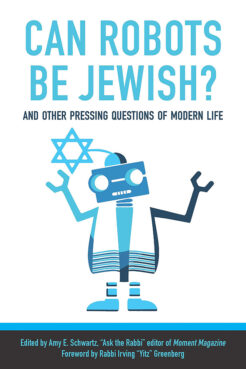
In ‘Can Robots Be Jewish?’ rabbis weigh in on a Jewish pastime: disagreement

The questions in this collection, part of Moment Magazine’s long-running feature ‘Ask the Rabbis,’ offer a model for what is fundamental to Judaism.

(RNS) — It is an axiom of Jewish life that Jews love to disagree.

There’s the famous Jewish joke about a shipwrecked Jewish sailor on a desert island who builds two synagogues — the one where he prays and the one he won’t set foot in.

Or take Hanukkah, the eight-day holiday, which ends Friday (Dec. 18). Some Jews view it as theologically breezy, a “holiday of lights,” full of spinning dreidels and jelly doughnuts. Others view it more seriously, as a ponderous morality tale about the triumph of religious fundamentalism over assimilation.

Just in time for the holiday, a new book now showcases this range of Jewish disagreement on a variety of contemporary issues.

Can Robots Be Jewish And Other Pressing Questions of Modern Life” is a collection of 30 provocative questions, each answered in 200 words or less by 10 different rabbis from different quarters of the Jewish world.

The book is a compendium of some of the previously published “Ask the Rabbis” columns that have appeared in the pages of the Jewish magazine Moment. The magazine, which bills itself as a Jewish take on news, ideas and culture, has been around since the 1970s and continues to publish six print issues a year in addition to its newer web presence.

The “Ask the Rabbis” column, begun in 2005, continues to be one of its popular features.

The questions in the new compendium include: Should we edit our children’s genes? What does the Torah teach us about addiction? What guidance, if any, does Judaism offer transgender people? Is democracy a Jewish idea?

“Can Robots Be Jewish? And Other Pressing Questions of Modern Life” Courtesy image

“As I was editing this collection I realized it was a model of civil disagreement for our time,” said Amy E. Schwartz, Moment Magazine’s book and opinion editor who edited the volume. “There’s more and more distance between views and less and less willingness to argue in an open-hearted way. We like to model that that is fundamental to Judaism. It’s a great value and it’s still possible. “

In the title question, “Can robots be Jewish?” several rabbis begin by delving into Jewish arcana. They point out that the predecessor to the modern robot was created by the 16th-century Rabbi Judah Loew of Prague to protect the Jewish community from blood libels. It was called a golem — a clay creature magically brought to life and later destroyed. One rabbi even posits the golem was the inspiration for Mary Shelley’s novel, “Frankenstein.”

But mostly the rabbis — Orthodox, Conservative, Reform, Reconstructionist, Humanist and others — argue about whether robots have souls. A Reconstructionist rabbi argues if the definition of a Jewish soul is someone who is loved and cared for by other Jews, then yes, robots attended to by Jews, may be called Jewish. Other rabbis disagree.

For the past 15 years, Schwartz said, the editorial team formulated the questions in staff meetings and then sent them off to a group of rabbis. A successful question, she said, is one that yields a variety of answers — or disagreements.

“I like to make the rabbis work a little bit,” she said.

Since many of the questions address modern-day issues, one might conclude the Hebrew Bible and subsequent rabbinic commentaries never considered some of the questions in this volume. Yet in many instances the contributing rabbis, steeped in Jewish texts, demonstrate that the ancient sages actually addressed some of them.

Take the question “What guidance, if any, does Judaism offer to transgender people?” Turns out, the Talmud, the extensive written body of interpretation and commentary by ancient rabbis, addressed “androgynos,” people who are both male and female, as well as those whose genitalia are indeterminate. They even allowed people could transition from one sex to the other.

Rabbi Haim Ovadia writes: “Religious leaders should rise to the task and find ways to welcome transgender or nonconforming people, and perhaps the first step will be to let them define themselves.”

And while the ancient Jewish texts preceded modern-day addiction treatment and recovery programs, the rabbis answering the question “What does the Torah teach us about addiction?” reach back to a host of biblical stories that can offer some lessons, including the story of the golden calf in the Book of Exodus, as well as Noah’s drunkenness in the Book of Genesis.

Conservative Rabbi Amy Wallk Katz writes that the entire Book of Exodus and the Israelite path from slavery to freedom can be viewed as a journey from addiction to recovery.

Reading through all the responses to particular questions won’t give anyone a definitive answer. But then, Judaism is not a top-down religion and there is no ultimate authority.

“If you read all 10 rabbis’ (responses) you come away with a starter-set of what the big arguments have been,” said Schwartz. “It’s a great way to get a casual familiarity with the tradition. You come away with entry-level literacy.”

For those curious about a particular issue, the volume offers “a way in.”

“Sometimes,” she said, “you need an entry book.”

Wednesday, March 06, 2024

How Israel Quietly Crushed Early American Jewish Dissent on Palestine

“Our Palestine Question,” an explosive new book by Geoffrey Levin, delves into American Jewish McCarthyism from the 1950s through late 1970s.
March 4, 2024
Source: The Intercept


At the State House, activists from the Providence community and the University gave speeches, decried Palestinian oppression, denounced Israel for its continued use of force and criticized the U.S. federal government for its financial support of the Israeli Defense Force. Media by Ashley Cai


The Israeli government covertly meddled into American Jewish politics from the 1950s to 1970s, and they did so to quash Jewish criticisms of the 1948 Nakba — the mass dispossession and expulsions of Palestinians during Israel’s founding — and Israel’s oppression of Palestinians. Israeli diplomats who oversaw the furtive campaign were at one point assisted by Wolf Blitzer — today the host of CNN’s primetime show “The Situation Room.”

These are some of the findings of “Our Palestine Question,” an explosive new book by Emory University scholar Geoffrey Levin that offers historical perspective on today’s crisis in Gaza, especially as it plays out today among American Jews.

Since the murderous October 7 attacks by Hamas against Israel, and Israel’s overwhelming retaliatory attacks against Palestinian civilians in Gaza, American Jews have organized dramatic protests. They have demanded everything from a ceasefire and to an end to U.S. military funding for Israel.

This diverse group of American Jews opposed to Israeli policy, and, at times, Israel itself, is drawing on a history of activism in the U.S. that has long since faded into obscurity — and they are bringing it from history into the present day.

Many of these activists explicitly cite earlier political movements as their inspiration. One was the socialist, anti-Zionist General Jewish Labor Bund, founded over a century ago in Eastern Europe, but which had been defunct for generations. The others are a post-1980 agglomeration of U.S. groups including the now-defunct New Jewish Agenda and liberal J Street, which is still around and lobbying politicians, albeit with fewer resources than the Zionist right. These smaller groups were formed after avowed Zionists and anti-Zionists stopped talking to each other, except to scream.

What few activists remark upon, however, is a time within living memory, in the 1950s, when the biggest Jewish organization in the U.S. — the American Jewish Committee, or AJC — was publicly critiquing the Nakba and pushing Israel to afford full civil and human rights to Palestinians. Less noted and lesser known is how this remarkable status quo was erased: From the 1950s to the late 1970s, Israel orchestrated the back-channel attacks on influential individuals and groups, including the AJC, who were pushing for Palestinian rights.

“Our Palestinian Question” pries the lid from this suppressed tale.


American Jewish McCarthyism

Levin picked up the scent of this hidden history a few years ago. He was a Hebrew and Judaic Studies doctoral student then, sifting through Jewish history special collections in Manhattan as well as the Israel State Archives in Jerusalem, when he dug up evidence of the sub rosa American Jewish McCarthyism. He was the first researcher to discover how the Israeli government, through its diplomats and a spy in the United States, pressured American Jewish institutions to ghost a prominent journalist, fire a brilliant researcher, and discredit an organization of Jews who were critiquing Israel’s treatment of Palestinians and trying to open channels for discussion with Arabs.

Take the case of journalist William Zukerman. A respected Yiddish- and English-language writer in the 1930s and 1940s, with clips in Harpers and the New York Times, Zukerman started his own biweekly, the Jewish Newsletter, in 1948. It was highly critical of Jewish nationalism and its destructive effects in the new state of Israel and beyond.

In one story, Zukerman reported about a Holocaust survivor who had recently resettled in Israel, in the former home of an Arab family. The survivor became “openly obsessed” about her morality, Zukerman wrote, after her children found some of the evicted family’s possessions. “The mother was suddenly struck by the thought that her children were playing with the toys of Arab children who were now exiled and homeless,” Zukerman continued. “Is she not doing to the Arabs what the Nazis did to her and her family?”

By the early 1950s, the Jewish Newsletter had a few thousand subscribers, and its work was republished in many other outlets, Jewish and non-Jewish, with much larger circulations — Time magazine, for instance. Not all of Zukerman’s readers, however, opposed Zionism. Each of the hundreds of chapters of the Jewish student organization Hillel had a subscription to the Jewish Newsletter.

According to declassified Israeli Foreign Ministry files found by Levin, the Israeli government was alarmed by Zukerman’s influence on American Jews. It started a campaign to keep him from “confusing” Zionists about Israel and Palestinian rights. Israel aimed a letter-writing campaign at the New York Herald Post to discourage the paper from running more of Zukerman’s work, and hatched a scheme to distribute boilerplate text for Zionists to mail to other editors, asking them not to publish Zukerman anymore. The head of Israel’s Office of Information in New York worked to have the prestigious London-based Jewish Chronicle get rid of Zukerman’s column, and he lost the position. By 1953, his work no longer appeared in the Jewish press.

And there was Don Peretz, an American Jew with generationslong ancestral roots in the Middle East and Palestine. As a young man in the early 1950s, he’d written the first doctoral dissertation about the post-Nakba Palestinian refugee crisis. The study was considered so authoritative that it was published as a book that, for years, was used as a college text. Peretz’s work earned him attention from the AJC. Founded at the turn of the 20th century, the organization had spent decades advocating first for civil and human rights for American Jews and, later, for oppressed groups worldwide. Concerned about the plight of Palestinians and worried that their mistreatment by Israel would increase American antisemitism, the AJC in 1956 hired Peretz as a researcher.

Don Peretz, second from left, in Palestine in February 1949 with fellow volunteers for the Quaker group the American Friends Service Committee. The group was distributing aid to those displaced during the Nakba, the forced expulsion and dispossession of Palestinians during Israel’s founding. Photo: Courtesy of Deb Peretz

Peretz had extensive, friendly contacts with Palestinians. He began writing informational pamphlets and reports. In one, which an AJC leader personally gave to Secretary of State John Foster Dulles, Peretz suggested that Israel might repatriate Palestinians expelled during the Nakba. After Israeli officials read the pamphlet, they asked a worker at AJC to send them on-the-sly intelligence about the author, with the aim of getting him fired. Then Israel asked the AJC to submit all Peretz’s Middle East-related work to the Israeli Embassy in Washington or the Consul General in New York, for pre-publication review. The AJC complied. When Peretz wrote a new book about Israel and Palestine, the Israelis strongly disapproved of it, communicating their displeasure to the AJC. The group demoted Peretz to half-time work. He quit.

It’s probably no coincidence that Peretz’s departure occurred in 1958, the year the novel “Exodus” debuted. It quickly became a blockbuster and, later, a movie starring blonde, blue-eyed Paul Newman as a steely, pre-independence Israeli paramilitary warrior. It seemed by then that Americans, Jewish or not, were loving Israeli Zionism more and caring about Palestinians less.

Meanwhile, diaspora Jews were triumphantly assimilating into mainstream America. Their acceptance came with problems. With weakening ties to traditional religious practice, increasing intermarriage, and mass suburbanization, they grappled with an identity crisis and sought new touchstones. One was communal enactment of Holocaust remembrance. Another was the celebration of Israel — no matter what.

It was a cultural coup for pro-Israel advocates — American Jews were coming around en masse — informed by societal changes in the diaspora, but also with organized elements, much of it orchestrated by Israel, that catalyzed and enforced the shifts. Over the next decade, the trend would only increase, as Israel’s unlikely victory against its Arab neighbors in the 1967 Arab Israeli war reinforced themes of both admirable, scrappy Israel, and a nation badly in need of support from fellow Jews across the world. In the U.S., American Jews increasingly answered the call.

Against Two States


Even as the ubiquity of American Jewish support for Israel grew, Israel and its advocates began to push back not just on anti-Zionism, but even what would become widely known in the U.S. as liberal Zionism. It was in this capacity that Blitzer, the CNN host, became involved in the sorts of efforts Levin covers in “Our Palestine Question.”

Levin discusses an incident from late 1976 where Blitzer, still a young reporter, and Israeli government sources worked together to kneecap an American Jewish peace group called Breira: A Project of Concern in Diaspora-Israel Relations. Breira means “alternative” in Hebrew. The group had first organized in 1973 to protest the hard-line Jewish organizational positions that emerged after the recent 1973 Arab–Israeli War.

Pro-Israel advocates in the U.S. were taking on more right-wing visions of Zionism and reacted to the war by embracing the ideas that Zionist settlements in the occupied territories and ostracization of the Palestine Liberation Organization were essential to Israel’s survival. Instead, Breira wanted to provide the “alternative” and called for Israel to recognize Palestinians’ desire for nationhood; it was the first American Jewish group to advocate for a two-state solution. The New York Times editorialized in early 1976 that Breira was overcoming “the misapprehension of many Jewish Americans that criticism of Israeli policies would be seen as a rejection of Israel.”

Then Israel pushed back.

In November 1976, a handful of people who worked at several American Jewish organizations met secretly and as private individuals with moderate representatives of the PLO. Attendees were affiliated with the American Jewish Congress, American Jewish Committee, B’nai B’rith, the National Council of Jewish Women, and Breira. They would later insist that they had no wish to engage in diplomacy with the PLO, only informal dialogue to discuss peacemaking. One meeting took place in New York City; the other was in Washington. Afterward, some attendees wrote reports and sent copies for informational purposes to Israeli diplomats they knew personally. They trusted that the diplomats would not publicize the meetings.

At the time when the meetings occurred, Blitzer worked as Washington correspondent for the Jerusalem Post. His beat was reporting on how Middle East affairs played out in America, especially regarding Israel. The Jerusalem Post, however, was not his only employer. Blitzer also worked for two publications that, in effect, were the house organs of the American Israel Public Affairs Committee, or AIPAC.

Days after the Washington meeting, Blitzer wrote a hit job about the Washington meeting for the Jerusalem Post and named the American Jewish attendees. Based on details in his coverage and press that followed, attendees said it was clear that Blitzer had received a confidential report leaked by Israel. His piece quoted unnamed “Israeli officials” and an unnamed diplomat expressing “concern” about the meeting as part of novel “PLO propaganda tactics” with the aim of “the destruction of Israel.”

A firestorm ensued among American Jewish groups. All the organizations whose members had attended as individuals denounced the meetings — all, that is, except for Breira. Its continued defense of the gatherings prompted AIPAC to excoriate the group as “anti-Israel,” “pro-PLO,” and “self-hating Jews.” Virtually no influential Jewish organizations publicly countered these denouncements. Breira’s national convention in 1977 was disrupted and vandalized by intruders who left leaflets supporting the vigilante far-right Jewish Defense League. The group lost membership, and internal conflict led its major donor to withdraw funding. By 1978, Breira had sputtered out. Thanks to an AIPAC-linked journalist and Israeli officials, another vein of American Jewish dissent about Israeli policies had been stripped.

Though Levin’s book was already in press months before the October 7 attacks, the mothballed history it airs has become since especially apt. If the Jewish community decades ago had known about Israel’s meddling, “you could have had a broader conversation,” he speculates, “which maybe would have led to less discomfort discussing difficult issues now.”

Levin added that “a lot of really bright people were pushed out of the mainstream American Jewish establishment” for discussing issues that have today been furiously rekindled. Would Jewish America’s Palestine question have stronger answers now if not for Israel’s underhanded attempts, years ago, to silence its U.S. diaspora critics? “You have to wonder,” Levin said, “what the American Jewish community would have looked like if it had welcomed some of these voices.”