France Commits to 10-Ship Naval Deployment to Secure Mideast Shipping
France has decided to dispatch a substantial naval force to the Mideast to protect merchant shipping, President Emmanuel Macron said Monday. It is the second major commitment Macron has announced towards controlling the economic impact of the U.S.-Iran conflict, following his earlier statement that the G7 would tap its strategic oil reserves.
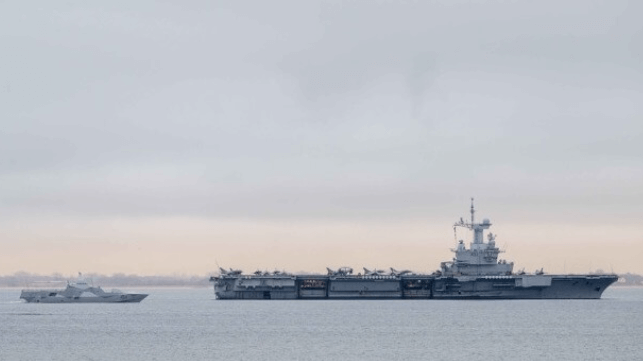
In an "unprecedented" international mobilization, France will dispatch 10 ships to key regions vital to European shipping interests: the Strait of Hormuz, the Red Sea, and the Eastern Mediterranean. The Marine Nationale already has two warships in the Eastern Med; the additional force will include eight frigates and two helicopter carriers. Taken together, it will be by far the largest French naval deployment in recent memory.
Macron is also working with European and Asian partners to contribute additional warships to the mission, which will focus exclusively on "escort and support," he said.
Macron announced the mission at a news conference in Cyprus, and later transferred to the deck of the French carrier Charles de Gaulle, the nation's flagship. The carrier has repositioned swiftly from the Baltic to the Mediterranean to prepare for contingencies and is believed to be located off Crete at present.
In comments to reporters after the speech, Macron predicted that the active phase of U.S.-Iran hostilities could persist for days or weeks.
Brief remarks made by President Donald Trump on Monday suggested that the U.S. may attempt to deescalate on a shorter timeframe, as Trump believes that the war is "very complete" and Iran has "shot everything they have to shoot." Remaining American war aims could include "taking over" the Strait of Hormuz.
On the Iranian side, the first condition for a ceasefire would be "no further aggression," Deputy Foreign Minister Kazem Gharababadi told Reuters on Monday. He added that China and Russia are in contact with current Iranian leadership about steps to reach a ceasefire deal.
Trump Urges Foreign Ships to Resume Oil Deliveries to Asian Markets
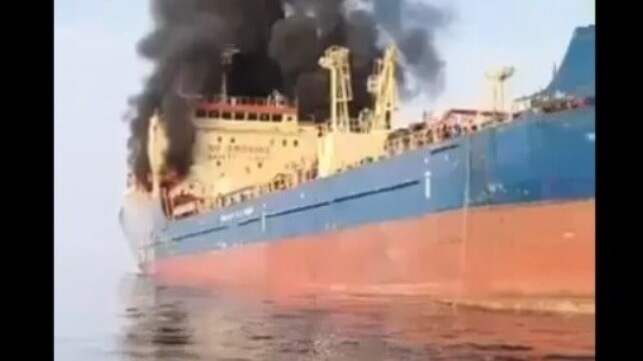
As Brent prices briefly surged past $100 per barrel on Monday, President Donald Trump urged foreign-flag tanker crews to accept the risks of a Hormuz transit and resume oil deliveries for Asian consumers. Iran has threatened to set any passing tankers "on fire" in retaliation for U.S. strikes, and Iranian attacks have killed at least seven seafarers to date, according to the IMO.
"These [merchant] ships should go through the Strait of Hormuz and show some guts, there's nothing to be afraid of! [Iran] has no Navy, we sunk all their ships!" Trump told conservative commentator and Fox News host Brian Kilmeade over the weekend. There are only 150 Iranian "launchers" left in the region to threaten shipping, and the U.S. stands ready to respond quickly to strikes, Kilmeade added.
The Strait of Hormuz normally handles one fifth of all global oil supplies. Over 90 percent of the outward flow through Hormuz is consumed by Asian economies, led by China. As oil is fungible, any shortage in Asia drives up energy prices in the United States, affecting American consumers' bottom line through higher gas prices.
With few exceptions, crude oil exiting Hormuz is carried aboard foreign-crewed, foreign-flag tonnage. U.S.-crewed, U.S.-flagged tankers - responsive to U.S. defense needs in time of conflict - account for about 0.6 percent of the global tanker fleet, and these vessels are heavily concentrated in the product tanker (refined product) category.
So far, Greek and Iranian tankers have been among the most active in transiting the Strait; the Iranian fleet faces a much lesser risk profile and has so far made the passage unhindered. Iran has enforced its blockade using its residual shore-based assets, to meaningful effect: it has attacked and damaged at least three vessels since its announcement of the strait's closure last week, all by drone or missile. Shipping has taken precautions, and large accumulations of tanker tonnage have formed at anchorages on both sides of the waterway, awaiting safe passage.
On Monday, IMO Secretary General Arsenio Dominguez reiterated his call for all parties to respect the safety of seafarers.
"Any attack on innocent seafarers or civilian shipping is unacceptable. These seafarers are simply carrying out their duties and performing an essential service to the global community, ensuring the continued flow of goods and energy, and they must be protected from the consequences of broader geopolitical tensions," Dominguez said. "All parties without exception, and I repeat, without exception, must respect the freedom of navigation, which a fundamental principle of international maritime law."
The bottleneck has created huge earnings opportunities for owners willing to brave the risks to their crewmembers and ships. VLCC earnings now run at $480,000 per day and growing for runs from the Mideast to the Gulf, per Clarksons. Astonishing numbers are available for other routes as well, up to $220,000 for U.S. Gulf-origin or West African exports. Even Suezmaxes are clearing $300,000 per day on the spot market. But those rates could come crashing down if the situation at Hormuz persists too long, warned Poten last week.
"Tanker rates are at record highs due to a significant geopolitical risk premium in combination with a substantial reduction in effective vessel supply. Many ships remain stuck in the Arabian Gulf while others are waiting for cargoes in the Gulf of Oman. However, this situation is not sustainable," commented tanker analysts with Poten & Partners on Friday. "Eventually, the tankers waiting outside will leave the area to look for employment elsewhere. Middle Eastern producers will increasingly be forced to shut in production and lower global oil flows will dent ton-mile demand. Under this scenario, tanker rates will come under severe downward pressure."
The price effects for consumers (and businesses) were blunted Monday after a midday intervention from the G7 economies, which signaled a willingness to release crude from strategic petroleum reserves if crude markets remained tight for an extended period. Oil prices immediately fell by about 20 percent after flirting with the $120 per barrel level early Monday, and were trading below $100 by afternoon.

No comments:
Post a Comment