China Splits Port Investments Between High- and Low-Income Countries
The protracted port dispute in Panama involving the Chinese operator CK Hutchison has revealed how strategic harbors could act as a flashpoint in global power competition. In a world where geopolitical tensions continue to rise, control over critical ports is being seen as a means to assert sea power - particularly when it comes to Chinese control.
Last week, AidData, a research lab at the College of William and Mary, released a new dataset capturing the unprecedented rise of Chinese influence in foreign ports. The report traces Beijing’s global ports footprint spanning over two decades between 2000 and 2025. Over the course of that period, Chinese entities and state-owned enterprises provided loans and grants worth nearly $24 billion for 168 ports across 90 countries.
While AidData has previously investigated Beijing’s financing of ports around the world, the 2026 update provides new data on Chinese-funded shoreside equipment, including cranes and scanners. It also includes proposed port investments which are yet to be funded, including Lobito port in Angola, Sandino port in Nicaragua and Mubarak Al-Kabeer port in Kuwait.
Notably, AidData noted that its research rarely found evidence to support the ‘debt trap’ narrative, popularly used to describe Chinese overseas ports financing.
If anything, this new report strengthens the argument that China does not seek sovereign control of overseas territory as much as it does strategic security,” said Alexander Wooley, AidData’s Director of Partnerships and Communications.
Wooley added that China’s overseas port network provide an anchor for its global maritime supply chains. The network provides a geopolitical benefit: a parallel logistics system that offers Beijing strategic independence, free from interference from rivals, and permits it to contemplate a military counter to potential blockades that could be attempted by an enemy in any future conflict.
Indeed, the report found that Chinese state-owned creditors are increasingly co-locating port financing with other investments vital for China’s national security, such as critical minerals mining. The report identified 22 Chinese-financed mines within a 500-kilometer radius of Chinese-funded seaports. Leading examples include the Port of Chancay in Peru and its proximity to the Las Bambas copper mine, as well as the Port of Morébaya in Guinea, developed by Chinese investors together with the Simandou Iron mining project.
Most importantly, the report clarifies a common misconception that Chinese port investments are focused on developing economies.
"Chinese financing for global seaports is almost evenly split between high-income and low- and middle-income countries,” said Rory Fedorochko, the report’s co-author and Program Manager at AidData. “Some $10.8 billion supports 29 port locations across 20 high-income countries including Greece, Spain, Australia, New Zealand and Singapore- for projects where the intent is generally commercial, rather than geopolitical.”
Some of the ports heavily financed by China include Hambantota in Sri Lanka ($1.97 billion), Port of Newcastle in Australia ($1.32 billion), the Autonomous Port of Kribi in Cameroon ($1.17 billion), the Port of Melbourne in Australia ($1.14 billion) and Haifa Port in Israel ($1.13 billion).
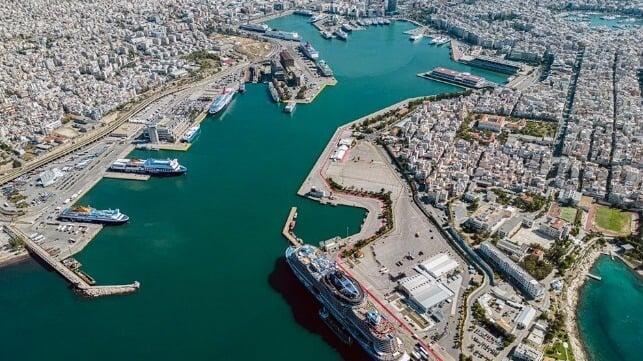
Top image: Apaleutos25 / CC BY SA 4.0
CK Hutchison Seeks $2B in Damages from Panama as It Takes More Legal Steps
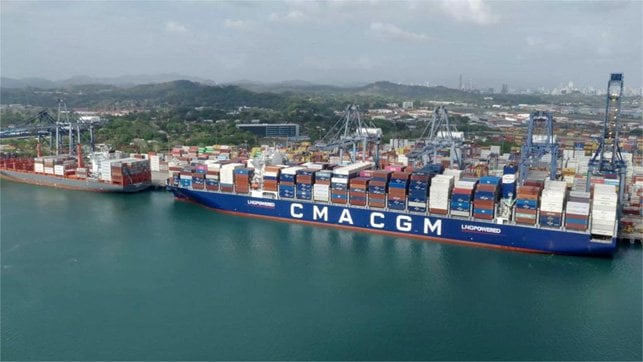
CK Hutchison and its Panama-based subsidiary, the Panama Ports Company, have taken a series of additional legal steps in the ongoing dispute over the concession to operate terminals in the ports of Balboa and Cristobal. As part of the action, the Panama Ports Company (PPC) clarified that under the already filed international arbitration, it is seeking at least $2 billion in damages, a figure it says Panama has been misrepresenting.
Before the Supreme Court decision was published finalizing the ruling that the contracts were unconstitutional, Hutchison had already said it would begin an arbitration under the rules of the International Chamber of Commerce. The ruling was finalized, and Panama seized the two ports on February 23 and immediately entered into temporary contracts with divisions of Maersk and MSC to operate the ports.
Both PPC and its parent company, CK Hutchison, report they have increased the legal actions, saying they will “not relent and they are not coming for some token relief.” They are calling the actions of Panama “radical breaches” while continuing to assert the actions were inconsistent with applicable law, contract, and treaty rights.
CK Hutchison, in today’s statement (March 6), continues to say Panama has a pattern of disregarding communications and discontinuing consultations. They assert it was part of a “state campaign” that had been carried out over the past year. It also accuses the state of “various inaccurate remarks,” which it says have “further aggravated the circumstances.”
The company has filed an administrative petition seeking reconsideration of the decree that empowered what Hutchison calls the “occupation” of the ports and the taking of its property and personnel.
PPC says it is seeking recourse related to the decree based on its extreme scope mandating the taking of all its property. It is also challenging the “radical implementation” of the decree, and the seizure and misuse of property, it says, is unrelated to port operations.
They are asserting that Panama entered a private storage facility and unlawfully seized documents. They are demanding immediate access to and return of property and legally protected documents and information. Investigators for Panama had confirmed they searched the company’s offices, saying it was related to new information about possible crimes.
Panama said when it took over the operations of the port terminals that it was also taking control of all the equipment and information. It, however, was careful not to claim ownership but instead said it was controlling the equipment needed to continue the operation of the terminals.
The Panama Maritime Authority reported that as of February 28, terminal operations were back to 100 percent in Balboa under the management of APM Terminals. It said that operations had been open at Cristobal under the management of Terminal Investment Limited (TiL), a division of MSC, since February 27. The authority has said the country’s intent is to hold new tenders within 18 months and that companies would be limited to operating the terminals in one port to further increase competition.


No comments:
Post a Comment