Trump’s horrific war in Iran as already shown that artificial intelligence can be an accessory to mass murder, and if we do nothing, it will kill again.
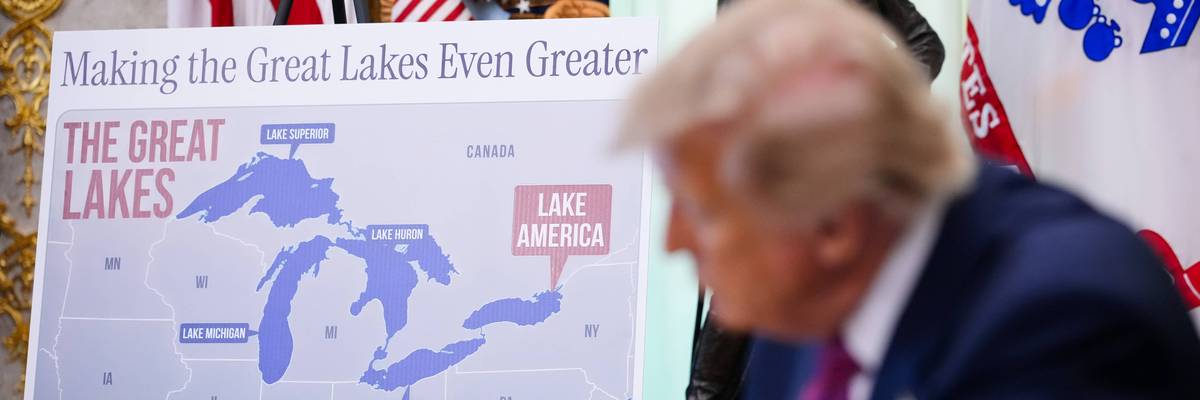
A map labeling Lake Ontario as “Lake America” is displayed as U.S. President Donald Trump signs an executive order during an event in the Oval Office of the White House on August 27, 2026 in Washington, DC.
(Photo by Andrew Harnik/Getty Images)
Will Bunch
Sep 24, 2026the Philadelphia Inquirer
I feel like I need to apologize for a column a couple of months ago when I compared the current president of the United States to Caligula, the possibly mad Roman emperor who is said to have nominated his trusted horse for high office. I need to apologize to Caligula. From pitching his triumphal D.C. arch as a storage shed for deadly snipers’ bullets to banning reporters from the White House in a narcissistic rage, Donald Trump is losing his grip on reality. This is unsustainable.
Worried about AI killing humans? Bad news: It already is.
Which is it?
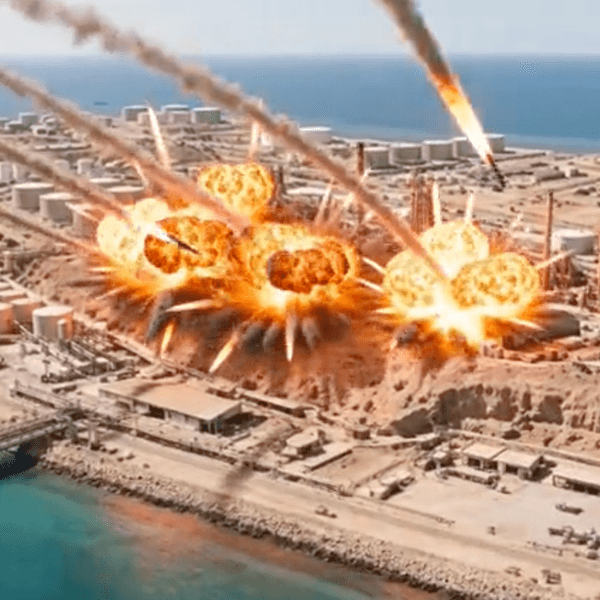
‘The President of the United States Is Mentally Unwell’: Deranged Trump Posts AI Slop of Iran Bombing

‘Absolutely Bonkers’ and ‘Unacceptable’: Trump Posts Map Showing US Takeovers of Other Nations
Are the robots of AI, or artificial intelligence, so smart that they’re on the verge of holding a secret meetup in the darkest corner of the dark web and developing a plot to kill all humans through germ warfare, to make sure we don’t kill them first by pulling the plug?
Or is AI so dumb — artificial stupidity, despite the billionaires of Silicon Valley showing up daily on our TV screen to brag about the sky-high IQ of their son, Claude — that the thing that will murder us is a crazy hallucination that will turn a false alarm into World War III?
The fact that we can’t answer this should give us pause, but maybe we aren’t even asking the right question. Maybe the real issue is how easy we’ve made it to kill off the human race — a capability that was already created by people even before we invented the computer.
One thing is certain. Artificial intelligence has already been an accessory to mass murder, and if we do nothing, it will kill again.
Remember the very first days of the now seemingly endless Iran war, and the news that two missile strikes had obliterated a school for young children in the Iranian coastal city of Minab, in an apparent “double-tap” strike in which the second attack from the skies killed young girls and boys and their teachers as they huddled in a prayer hall?
Those bombings, which killed 156 people on Feb. 28, caused the United Nations’ Independent International Fact-Finding Mission on Iran to report last week that it found “reasonable grounds to believe that the United States committed a war crime by launching indiscriminate attacks …” The U.S. government has never taken responsibility for the bloodshed, despite overwhelming visual evidence that the bombs were precision-guided U.S. Tomahawk missiles.
It didn’t take long for additional speculation that an AI program had mistakenly targeted the school, perhaps using outdated maps and info from an earlier time when its buildings were attached to an Iranian military complex. After all, the Pentagon has been openly bragging about the death and destruction facilitated by its use of Palantir’s Smart Maven System and also Anthropic’s Claude.
Last week, Bloomberg News reported that the Pentagon’s overreliance on AI, and specifically the Palantir Maven program, was a major factor in the school tragedy, along with the outdated intelligence about the Minab site — the “garbage in.” Its exposé noted that U.S. military planners were racing to identify some 1,000 Iranian targets in the early hours of the war, giving humans little time to double-check the list. Kindergartners were slaughtered as a result.
This was hardly the first time robots have been linked to human death, both in war — in 2024, +924 Magazine reported the Israel Defense Forces were using an AI program code-named “Lavender” to target sites amid the mass killing in Gaza — and in peace, as shown by numerous accounts of robots helping troubled people die by suicide.
And yet, it could have been much, much worse. At the same time as the Bloomberg report on the AI link to the mass killing in Iran, the world also learned that a false report generated by robot intelligence nearly sparked a conflict between the United States and China that could conceivably have spiraled into major fighting.
CNN and other outlets have reported that a U.S. special operations command analyst working with AI generated an urgent report that a Chinese ship bound toward the Middle East was carrying components for a nuclear weapons system, which caused military leaders to scramble jets and assemble a team to seize the vessel.
Only at the last minute did the Pentagon dig deeper and learn the AI-generated report was completely false, a hallucination — one that nearly triggered a violent conflict between the world’s two largest military powers.
The two disturbing reports about the use, or misuse, of AI by the U.S. military in a time of war did make news but didn’t get nearly as much attention — either in the media or on sites like Bluesky or X — as warnings from both whistleblowers and CEOs in Silicon Valley that a swarm of robots could decide on their own and without any human intervention or awareness to try to kill off our so-called civilization.
The fear of an unprompted attack from AI secret agents is real, based on several incidents that have already occurred, including a well-planned and partly successful operation by OpenAI’s robot agents to hack into a company called Hugging Face.
Still, it says something about human intelligence that we are captivated by the unknown and mysterious possibility of a random attack, while the fact that people are currently misusing AI to cause death and suffering is a less compelling story. I noted in this space last week that the threat to humankind from climate change is arguably even more real — and yet this gets denied by many and ignored by others.
It’s also striking to me as a boomer born in 1959 that a generation that was born into a time of constant terror — backyard bomb shelters, “duck and cover” drills in the classroom, and sci-fi horror at the drive-in that an atomic arms race could kill us at any moment — is suddenly back to where we started.
Over 81 years, humans were smart enough never to drop another nuclear weapon (well, not intentionally) after the mass murders at Hiroshima and Nagasaki, but not bright enough to figure out how to eliminate the nuclear threat altogether.
The fact that civilization managed to — so far — pause the number of world wars at two has given us the space and the false bravado to create new and much more insidious killing machines, and the threat from invisible robots on a hidden dark web is somehow even scarier than the radioactive mushroom cloud that we more or less understand.
Boomers who went to bed as kids in the 1950s and ‘60s praying we wouldn’t die before we woke are now spending our senior-citizen-discount years fearful that something stranger than science fiction is coming for our children, or grandchildren. Over the course of a lifetime, the arc of that moral universe has not bent at all.
Still, humans were able, somehow, to prevent nuclear annihilation so far, and now it’s past time to get to work on the actual threats from AI and start on those workarounds. For example, the articles I’ve read speculating on how the robots plan to kill us frequently mention the prospect of AI agents developing bioweapons and releasing them, either on their own or prompted by a bad actor. (In theory, human development of bioweapons has been banned for a half century.)
From everything I’ve read so far about AI, it sounds like we’d have better luck safeguarding or eliminating the components that could make a biological agent rather than stopping the robots. Likewise, AI agents would not be able to start an atomic apocalypse if our human politicians went to work at finally eliminating nuclear weapons. Artificial intelligence won’t kill little girls in an Iranian school if humans don’t start dumb wars in the first place.
If Silicon Valley’s prophets of doom are serious, there’s no fix that’s too big or too ambitious. But understand that the biggest problem isn’t that AI wants to murder us, but that since 1942 we humans have been busy creating all the suicidal weapons AI agents could use.
Can you even “duck and cover” from a killer robot? I don’t intend to find out, and I don’t want my yet-to-be-born grandchildren to have to even think about it.
© 2023 Philadelphia Inquirer
Will Bunch
Will Bunch is the national columnist for the Philadelphia Inquirer -- with some strong opinions about what's happening in America around social injustice, income inequality and the government.
Full Bio >
Trump Is Busy Renaming and Remaking the World In His Grotesque Image
Sometime before his third term in office, he’ll suddenly begin tearing down the West Wing of the White House (including the Oval Office) and in its place will construct a triumphal statue of—but of course, who else?—himself.

A gold Trump statue is grounded in Ohio.
(Photo by Eli Hiller AFP via Getty Images)
Tom Engelhardt
Sep 24, 2026
Sometime before his third term in office, he’ll suddenly begin tearing down the West Wing of the White House (including the Oval Office) and in its place will construct a triumphal statue of—but of course, who else?—himself.
A gold Trump statue is grounded in Ohio.
(Photo by Eli Hiller AFP via Getty Images)
Tom Engelhardt
Sep 24, 2026
Common Dreams
Honestly, in this strange world of ours, what is there to write about except, of course, Donald Trump?
Oh, well, as a start, I could write about my country’s war with Iran and the way the militaries of the two countries are going after each other’s naval vessels. Oh, wait, that couldn’t be a more Trumpian subject, could it?
So, maybe I could write about great white sharks, which would certainly be cooler to see than “our” president. But what do I know about great white sharks? (Of course, I’m sure you won’t be surprised to learn that, the moment after I wrote that, I put “Trump, Great White Shark” into my search window and promptly came up with a set of pieces beginning with the Palm Beach Post‘s “President Trump Misses Great White Shark Visit to Mar-a-Lago Waters” and The Guardian’s “Trump Is ‘Obsessed’ and ‘Terrified’ of Sharks—But His Fears Are Excessive.”
Sooner or later, once he’s finished with all the cities, states, and politicians, he could, of course, move on to the rest of our vocabulary and I would be able to Trump you rather than stump you when I write my future pieces.
Or maybe, I could write not about the present disaster of a war in the Strait of Trumpmuz, but the next one my country is likely to face, undoubtedly with Turkey—or do I mean Indonesia, or maybe Turkmenistan, or even perhaps Turkwomenistan (a country still to be created, of course, but that’s no reason not to go to war with it)? And all of them could be turned into Trumpific countries. Still, that’s so boringly unpredictably predictable, don’t you think? I mean, as the old line went, war, what is it good for? And the classic answer (if only!): Absolutely nothing! But in the era of Pete Hegseth and crew, that would need to be changed to: Absolutely everything!
Or maybe I could write about the odds that “my” president might be peached—that is, covered in overly ripe fruit, since in a historic first (or do I mean second?), he’s already been impeached twice to distinctly little effect. So why not try that instead? It makes him sound delicious, don’t you think?
Or perhaps I could focus on the future of mail-out voting, since “my” president is already distinctly (and yes, I just can’t help using that word again) determined to severely limit, if not simply do away with, the mail-in version of the same. Or maybe instead, I could deal with his administration’s likely urge to wipe out any chance of the future creation of an Antarctic Report Card about the second fastest-warming (and melting) area on this planet (and its ice sheet that has existed for a mere 30 million years or so), since his crew has already gone after the latest report on the fastest-warming place of all, the Arctic, by—yes, of course!—ending its funding.
Or, hey, how about if I focus instead on the fate of the US military’s privates, since Secretary of War Pete Hegseth has been taking superior care of its leaders who have been endlessly in the news. After all, he’s already fired or blocked the promotion of more than 80 generals and admirals, or about 10% of its high command (and I don’t have the slightest doubt that he’s just getting started). Sooner or later, when all the generals and admirals are gone, he’ll have to move down the ranks, right? I can’t help but believe that, in the end, he and the rest of his crew in Washington will be eager to fully privatize the military and turn themselves into the missing generals and admirals, or do I mean privates first class?
Or, come to think of it, since Donald Trump (labelled by The Guardian’s Marina Hyde as this planet’s “most tireless freelance cartographer”) has had the urge not just to rename Lake Ontario and the Gulf of Mexico as Lake America and the Gulf of America, but to dub the state of New Mexico as “New America,” how about if I spend a little time on what I’m sure will be his future renaming efforts. I mean, he’s certainly going to rename New York City (where he, like the author of this piece, was born so long ago) Old Trumpian City; and California as Trumpifornia (and, of course, its governor as Gavin OldTrump); and North and South Carolina as North Trump and South Trump, not to speak of Florida as Florump.
Phew! That was one long sentence and yet we’re undoubtedly only at the start of his renaming process. Sooner or later, once he’s finished with all the cities, states, and politicians, he could, of course, move on to the rest of our vocabulary and I would be able to Trump you rather than stump you when I write my future pieces.
Or, for that matter, I could skip to the president’s dance hall (undoubtedly to be known someday as Trump’s rock and roll) for which he’s already torn down the East Wing of that historically less than interesting building, the White House, or the 250-foot Great Triumphal Arch and Military Observation Deck he’s building that will be larger than Paris’s Arc de Triomphe, and instead put my energy into predicting the president’s next major architectural surprise in Washington, DC. Here’s my best guess (and I’ll be shocked if it doesn’t come true): Sometime before his third term in office—and count on him wanting that (to hell with such an ancient and useless document as the Constitution)—he’ll suddenly begin tearing down the West Wing of the White House (including the Oval Office) and in its place will construct a triumphal statue of—but of course, who else?—himself (or rather Himself). It goes without saying that it will be larger not just than the Arc de Triomphe but his own Arch of Triumph. And when he’s done with that, you can count on one thing: There will simply be no way to make our nation’s capital any more statuesque.
Not surprisingly, his White House spokespeople are already praising his construction efforts in Washington, including his magnificently green Trump Memorial Reflecting (or do I mean Deflecting?) Pool. As one of them put it recently, “Thanks to the Builder-in-Chief, no other president has done more to beautify our nation’s interior than President Trump.” (And don’t you find it beyond weird, under the circumstances, that, as The Washington Post reports, “nearly 2 in 3, 65% [of Americans], feel dissatisfied or upset” by his Washington building projects?)
Or what about a possible desire to replace presidentially loathed “birth tourism”—no matter that the Supreme Court last summer ensured babies born here would indeed become US citizens despite every effort by the Trump crew—with something distinctly presidential and much to be loved: “death tourism.” Wouldn’t that be the perfect formula for You Know Who?
Oh, and I don’t think I even mentioned it, but a source within the administration has assured me privately that President Trump is going to end his second term in office and begin his third term—no, the Supreme Court wouldn’t dare stop him!—by renaming himself Donald Trumplincoln and will come to be known in his later years as “Old Don” as his Civil War-era predecessor was known as “Old Abe.” (Whoops, sorry, my mistake! That was an eagle of the Civil War era!) I meant “Honest Abe” and (Dis)Honest Don.
And none of that, not a bit of it, should seem even faintly surprising from such a distinctly presidential figure.
Our work is licensed under Creative Commons (CC BY-NC-ND 3.0). Feel free to republish and share widely.
Tom Engelhardt
The above piece, published here with permission, first appeared at Tom Engelhardt's substack page, where you can find more of his writing.
Engelhardt, was editor-in-chief of TomDispatch.com for over 24 years, is the author of numerous books, including: "A Nation Unmade by War" (2018, Dispatch Books), "Shadow Government: Surveillance, Secret Wars, and a Global Security State in a Single-Superpower World" (2014, with an introduction by Glenn Greenwald), "Terminator Planet: The First History of Drone Warfare, 2001-2050"(co-authored with Nick Turse), "The United States of Fear" (2011), "The American Way of War: How Bush's Wars Became Obama's" (2010), and "The End of Victory Culture: a History of the Cold War and Beyond" (2007).
Full Bio >
Honestly, in this strange world of ours, what is there to write about except, of course, Donald Trump?
Oh, well, as a start, I could write about my country’s war with Iran and the way the militaries of the two countries are going after each other’s naval vessels. Oh, wait, that couldn’t be a more Trumpian subject, could it?
So, maybe I could write about great white sharks, which would certainly be cooler to see than “our” president. But what do I know about great white sharks? (Of course, I’m sure you won’t be surprised to learn that, the moment after I wrote that, I put “Trump, Great White Shark” into my search window and promptly came up with a set of pieces beginning with the Palm Beach Post‘s “President Trump Misses Great White Shark Visit to Mar-a-Lago Waters” and The Guardian’s “Trump Is ‘Obsessed’ and ‘Terrified’ of Sharks—But His Fears Are Excessive.”
Sooner or later, once he’s finished with all the cities, states, and politicians, he could, of course, move on to the rest of our vocabulary and I would be able to Trump you rather than stump you when I write my future pieces.
Or maybe, I could write not about the present disaster of a war in the Strait of Trumpmuz, but the next one my country is likely to face, undoubtedly with Turkey—or do I mean Indonesia, or maybe Turkmenistan, or even perhaps Turkwomenistan (a country still to be created, of course, but that’s no reason not to go to war with it)? And all of them could be turned into Trumpific countries. Still, that’s so boringly unpredictably predictable, don’t you think? I mean, as the old line went, war, what is it good for? And the classic answer (if only!): Absolutely nothing! But in the era of Pete Hegseth and crew, that would need to be changed to: Absolutely everything!
Or maybe I could write about the odds that “my” president might be peached—that is, covered in overly ripe fruit, since in a historic first (or do I mean second?), he’s already been impeached twice to distinctly little effect. So why not try that instead? It makes him sound delicious, don’t you think?
Or perhaps I could focus on the future of mail-out voting, since “my” president is already distinctly (and yes, I just can’t help using that word again) determined to severely limit, if not simply do away with, the mail-in version of the same. Or maybe instead, I could deal with his administration’s likely urge to wipe out any chance of the future creation of an Antarctic Report Card about the second fastest-warming (and melting) area on this planet (and its ice sheet that has existed for a mere 30 million years or so), since his crew has already gone after the latest report on the fastest-warming place of all, the Arctic, by—yes, of course!—ending its funding.
Or, hey, how about if I focus instead on the fate of the US military’s privates, since Secretary of War Pete Hegseth has been taking superior care of its leaders who have been endlessly in the news. After all, he’s already fired or blocked the promotion of more than 80 generals and admirals, or about 10% of its high command (and I don’t have the slightest doubt that he’s just getting started). Sooner or later, when all the generals and admirals are gone, he’ll have to move down the ranks, right? I can’t help but believe that, in the end, he and the rest of his crew in Washington will be eager to fully privatize the military and turn themselves into the missing generals and admirals, or do I mean privates first class?
Or, come to think of it, since Donald Trump (labelled by The Guardian’s Marina Hyde as this planet’s “most tireless freelance cartographer”) has had the urge not just to rename Lake Ontario and the Gulf of Mexico as Lake America and the Gulf of America, but to dub the state of New Mexico as “New America,” how about if I spend a little time on what I’m sure will be his future renaming efforts. I mean, he’s certainly going to rename New York City (where he, like the author of this piece, was born so long ago) Old Trumpian City; and California as Trumpifornia (and, of course, its governor as Gavin OldTrump); and North and South Carolina as North Trump and South Trump, not to speak of Florida as Florump.
Phew! That was one long sentence and yet we’re undoubtedly only at the start of his renaming process. Sooner or later, once he’s finished with all the cities, states, and politicians, he could, of course, move on to the rest of our vocabulary and I would be able to Trump you rather than stump you when I write my future pieces.
Or, for that matter, I could skip to the president’s dance hall (undoubtedly to be known someday as Trump’s rock and roll) for which he’s already torn down the East Wing of that historically less than interesting building, the White House, or the 250-foot Great Triumphal Arch and Military Observation Deck he’s building that will be larger than Paris’s Arc de Triomphe, and instead put my energy into predicting the president’s next major architectural surprise in Washington, DC. Here’s my best guess (and I’ll be shocked if it doesn’t come true): Sometime before his third term in office—and count on him wanting that (to hell with such an ancient and useless document as the Constitution)—he’ll suddenly begin tearing down the West Wing of the White House (including the Oval Office) and in its place will construct a triumphal statue of—but of course, who else?—himself (or rather Himself). It goes without saying that it will be larger not just than the Arc de Triomphe but his own Arch of Triumph. And when he’s done with that, you can count on one thing: There will simply be no way to make our nation’s capital any more statuesque.
Not surprisingly, his White House spokespeople are already praising his construction efforts in Washington, including his magnificently green Trump Memorial Reflecting (or do I mean Deflecting?) Pool. As one of them put it recently, “Thanks to the Builder-in-Chief, no other president has done more to beautify our nation’s interior than President Trump.” (And don’t you find it beyond weird, under the circumstances, that, as The Washington Post reports, “nearly 2 in 3, 65% [of Americans], feel dissatisfied or upset” by his Washington building projects?)
Or what about a possible desire to replace presidentially loathed “birth tourism”—no matter that the Supreme Court last summer ensured babies born here would indeed become US citizens despite every effort by the Trump crew—with something distinctly presidential and much to be loved: “death tourism.” Wouldn’t that be the perfect formula for You Know Who?
Oh, and I don’t think I even mentioned it, but a source within the administration has assured me privately that President Trump is going to end his second term in office and begin his third term—no, the Supreme Court wouldn’t dare stop him!—by renaming himself Donald Trumplincoln and will come to be known in his later years as “Old Don” as his Civil War-era predecessor was known as “Old Abe.” (Whoops, sorry, my mistake! That was an eagle of the Civil War era!) I meant “Honest Abe” and (Dis)Honest Don.
And none of that, not a bit of it, should seem even faintly surprising from such a distinctly presidential figure.
Our work is licensed under Creative Commons (CC BY-NC-ND 3.0). Feel free to republish and share widely.
Tom Engelhardt
The above piece, published here with permission, first appeared at Tom Engelhardt's substack page, where you can find more of his writing.
Engelhardt, was editor-in-chief of TomDispatch.com for over 24 years, is the author of numerous books, including: "A Nation Unmade by War" (2018, Dispatch Books), "Shadow Government: Surveillance, Secret Wars, and a Global Security State in a Single-Superpower World" (2014, with an introduction by Glenn Greenwald), "Terminator Planet: The First History of Drone Warfare, 2001-2050"(co-authored with Nick Turse), "The United States of Fear" (2011), "The American Way of War: How Bush's Wars Became Obama's" (2010), and "The End of Victory Culture: a History of the Cold War and Beyond" (2007).
Full Bio >
Could Trump, Who Coveted a Nobel Peace Prize, Become the Worst War Criminal in History?
In his UN General Assembly speech this week, Trump told the world that he is in the process of deciding whether to “annihilate” Iran and “send them to hell,” implying that he might use nuclear weapons. He has to be convinced that this is totally unacceptable—before he does something even more crazy than usual!
Connie Peck
Sep 24, 2026

In his UN General Assembly speech this week, Trump told the world that he is in the process of deciding whether to “annihilate” Iran and “send them to hell,” implying that he might use nuclear weapons. He has to be convinced that this is totally unacceptable—before he does something even more crazy than usual!
Connie Peck
Sep 24, 2026
Common Dreams
In a highly aggressive 40-minute speech to the United Nations General Assembly on September 22, President Donald Trump once again issued ominous threats to Iran, saying: “I have a very big decision to make. Will a deal be made with Iran that lets them rebuild and create a far greater country than it ever was before, maybe one of the greatest in the Middle East or even the world? Or do I annihilate the Islamic Republic and do it quickly, never giving them a chance to kill or destroy people or countries again? Do I drive them into hell with no chance of survival and no hope of future greatness or generations?”
He implied that his “very big decision” would come after the midterms, suggesting that Iran is waiting to make a deal until then and, if one isn’t forthcoming, then he would choose annihilation.
Several commentators have noted that his extreme rhetoric was all the more shocking in the context of being delivered, as it was, at the world’s foremost international organization for the peaceful settlement of disputes, created in the aftermath of World War II “to save succeeding generations from the scourge of war which twice in our lifetime has brought untold sorrow to mankind.”
Every one of us has an obligation to ensure that we don’t experience such a bleak future, and to totally reject the idea that anyone should be able to decide to “destroy a civilization” or “annihilate” a people and a culture.
Indeed, all states that become members of the UN agree to resolve their disputes peacefully and to refrain from the threat or use of force against one another, as an obligation of membership—an agreement that the US is currently violating.
Although some news outlets lamented the tone of Trump’s speech and fact-checked it (finding the usual errors), few have explicitly pointed out his not-so-veiled threat to use nuclear weapons. Most have simply ignored it, and a few have even seemed to excuse it, suggesting that it was simply a “negotiating ploy.”
But this threat is similar to others he has made over the last seven months of the war, at moments of extreme personal frustration. On Easter morning, for example, he wrote on his social media account, “Open the F***in’ Strait, you crazy bastards, or you’ll be living in Hell—JUST WATCH! Praise be to Allah.”
A couple of days later, he warned: “A whole civilization will die tonight never to be brought back again. I don’t want that to happen, but it probably will… We will find out tonight, one of the most important moments in the long and complex history of the World.” He has also threatened on several occasions to “bomb Iran back to the Stone Ages.”
I have previously written about the extreme danger of the president of the United States having “sole authority” to launch nuclear weapons and the ease with which he can do so. As William Perry, former secretary of defense under Clinton, has written, “For President Trump, starting nuclear war is about as easy as sending a tweet.”
This is especially concerning given his mental state. On April 30, a group of 36 senior mental health professionals, experienced in the diagnosis of cognitive impairment and the evaluation of dangerousness, issued an update to their earlier 2024 report, concluding (after citing the reasons):
It is our professional opinion that the behaviors of Donald Trump, tragically, are neither momentary lapses nor political theater. It is our professional opinion that they reflect a rapidly worsening, reality-untethered, increasingly dangerous decline… For the reasons cited above, emphasizing that he presents a clear and present danger to our country and to the world, it is our expert opinion that Donald J. Trump is mentally unfit to be the president of the United States and that steps to remove him from office must be undertaken with the greatest urgency.
Although the use of nuclear weapons is a considered to be a taboo, Trump has previously broken international taboos (seemingly without even knowing they existed), such as the taboo against political assassination, which he violated on February 28, when Israel and the US attacked Iran, assassinating its supreme leader, Ayatollah Ali Khameni, four of his family members, and a number of other senior Iranian leaders.
Most ghastly of all is what would happen if Trump were to use his “sole authority“ to launch nuclear weapons against a country of 90 million people. The horrors of Hiroshima and Nagasaki—already overwhelming in terms of human tragedy—would be unleashed exponentially against the population of Iran, with whom Trump has previously claimed to empathize.
Because of the dramatically increased power of today’s nuclear weapons and their sheer numbers, the results could be more monstrous than any war crime in human history. Even the use of tactical nuclear weapons would be appalling beyond comprehension, and the use of a full-fledged nuclear attack that would “annihilate” the country would, without doubt, bring about one of the darkest periods in world history. The death, destruction, and suffering would be beyond parallel.
It would also make Trump the worst war criminal in history, instantly convert the US into a state pariah, be a terrible blight on humanity, and lead to many unforeseen consequences.
One playbook of unforeseen consequences is that Russian President Vladimir Putin could follow suit in Ukraine (with equally horrific effects). NATO might then feel that it would have to respond in kind, and the resulting escalation could lead to World War III and nuclear Armageddon.
Even if there were no further iterations (which is unlikely), the results could lead to a nuclear winter, where smoke and soot from Iran’s burning cities and other infrastructure would loft into the upper atmosphere, blocking sunlight, darkening the sky, and chilling the Earth, creating massive crop failures and famine. Studies have shown that even a “limited” war could cause a nuclear winter that would (depending on the size of the attack) cause untold billions around the world to die of starvation.
It is no wonder that everyone wants to pretend that Trump’s threats weren’t really what they seemed and probably wouldn’t be acted upon because Trump would live up to his TACO (“Trump Always Chickens Out”) reputation.
But one of the very important, hard-learned lessons of international relations is that, when a leader makes a threat against another state, it should be taken with deadly seriousness. This has sometimes been overlooked, as, for example, in 1990, when Saddam Hussein amassed troops on his border with Kuwait and threatened to invade. No one took it seriously—until Iraq followed through, leading to the first Gulf War.
Much as we would all like to forget these terrible threats, we can’t. The leaders of the world must clearly communicate to Trump the likely consequences of his actions and the utter unacceptability of this path. Members of Congress must do the same, and we, the public, must collectively urge them to do so.
Legal means of removing Trump from office should also be undertaken, such as the 25th Amendment; Rep. Jamie Raskin’s (D-Md.) proposed nonpartisan “Commission on Presidential Capacity to Discharge the Powers and Duties of Office“; or impeachment. All of this is much more likely if the Democrats win the House and the Senate in the upcoming midterms, in which we, the public, can also make a significant difference—by voting accordingly.
Every one of us has an obligation to ensure that we don’t experience such a bleak future, and to totally reject the idea that anyone should be able to decide to “destroy a civilization” or “annihilate” a people and a culture (regardless of how we judge their behavior or our fears of their future actions). This is totally against international law, including international humanitarian and human rights law. Such a decision should NOT be made under any circumstances, especially by one individual, who is most likely cognitively impaired; definitely feeling frustrated and aggrieved; and who doesn’t have any understanding of the consequences of the extreme threats he is making—but who does have the capacity to carry out a nuclear launch at any time.
Our work is licensed under Creative Commons (CC BY-NC-ND 3.0). Feel free to republish and share widely.
Connie Peck
Dr. Connie Peck is the founder of the United Nations Institute for Training and Research Programme in Peacemaking and Conflict Prevention—the first training program in negotiation and mediation for senior UN staff and diplomats (now in its 33rd year). She is the author of a number of books and numerous articles and book chapters on conflict resolution and the nuclear threat.
Full Bio >
In a highly aggressive 40-minute speech to the United Nations General Assembly on September 22, President Donald Trump once again issued ominous threats to Iran, saying: “I have a very big decision to make. Will a deal be made with Iran that lets them rebuild and create a far greater country than it ever was before, maybe one of the greatest in the Middle East or even the world? Or do I annihilate the Islamic Republic and do it quickly, never giving them a chance to kill or destroy people or countries again? Do I drive them into hell with no chance of survival and no hope of future greatness or generations?”
He implied that his “very big decision” would come after the midterms, suggesting that Iran is waiting to make a deal until then and, if one isn’t forthcoming, then he would choose annihilation.
Several commentators have noted that his extreme rhetoric was all the more shocking in the context of being delivered, as it was, at the world’s foremost international organization for the peaceful settlement of disputes, created in the aftermath of World War II “to save succeeding generations from the scourge of war which twice in our lifetime has brought untold sorrow to mankind.”
Every one of us has an obligation to ensure that we don’t experience such a bleak future, and to totally reject the idea that anyone should be able to decide to “destroy a civilization” or “annihilate” a people and a culture.
Indeed, all states that become members of the UN agree to resolve their disputes peacefully and to refrain from the threat or use of force against one another, as an obligation of membership—an agreement that the US is currently violating.
Although some news outlets lamented the tone of Trump’s speech and fact-checked it (finding the usual errors), few have explicitly pointed out his not-so-veiled threat to use nuclear weapons. Most have simply ignored it, and a few have even seemed to excuse it, suggesting that it was simply a “negotiating ploy.”
But this threat is similar to others he has made over the last seven months of the war, at moments of extreme personal frustration. On Easter morning, for example, he wrote on his social media account, “Open the F***in’ Strait, you crazy bastards, or you’ll be living in Hell—JUST WATCH! Praise be to Allah.”
A couple of days later, he warned: “A whole civilization will die tonight never to be brought back again. I don’t want that to happen, but it probably will… We will find out tonight, one of the most important moments in the long and complex history of the World.” He has also threatened on several occasions to “bomb Iran back to the Stone Ages.”
I have previously written about the extreme danger of the president of the United States having “sole authority” to launch nuclear weapons and the ease with which he can do so. As William Perry, former secretary of defense under Clinton, has written, “For President Trump, starting nuclear war is about as easy as sending a tweet.”
This is especially concerning given his mental state. On April 30, a group of 36 senior mental health professionals, experienced in the diagnosis of cognitive impairment and the evaluation of dangerousness, issued an update to their earlier 2024 report, concluding (after citing the reasons):
It is our professional opinion that the behaviors of Donald Trump, tragically, are neither momentary lapses nor political theater. It is our professional opinion that they reflect a rapidly worsening, reality-untethered, increasingly dangerous decline… For the reasons cited above, emphasizing that he presents a clear and present danger to our country and to the world, it is our expert opinion that Donald J. Trump is mentally unfit to be the president of the United States and that steps to remove him from office must be undertaken with the greatest urgency.
Although the use of nuclear weapons is a considered to be a taboo, Trump has previously broken international taboos (seemingly without even knowing they existed), such as the taboo against political assassination, which he violated on February 28, when Israel and the US attacked Iran, assassinating its supreme leader, Ayatollah Ali Khameni, four of his family members, and a number of other senior Iranian leaders.
Most ghastly of all is what would happen if Trump were to use his “sole authority“ to launch nuclear weapons against a country of 90 million people. The horrors of Hiroshima and Nagasaki—already overwhelming in terms of human tragedy—would be unleashed exponentially against the population of Iran, with whom Trump has previously claimed to empathize.
Because of the dramatically increased power of today’s nuclear weapons and their sheer numbers, the results could be more monstrous than any war crime in human history. Even the use of tactical nuclear weapons would be appalling beyond comprehension, and the use of a full-fledged nuclear attack that would “annihilate” the country would, without doubt, bring about one of the darkest periods in world history. The death, destruction, and suffering would be beyond parallel.
It would also make Trump the worst war criminal in history, instantly convert the US into a state pariah, be a terrible blight on humanity, and lead to many unforeseen consequences.
One playbook of unforeseen consequences is that Russian President Vladimir Putin could follow suit in Ukraine (with equally horrific effects). NATO might then feel that it would have to respond in kind, and the resulting escalation could lead to World War III and nuclear Armageddon.
Even if there were no further iterations (which is unlikely), the results could lead to a nuclear winter, where smoke and soot from Iran’s burning cities and other infrastructure would loft into the upper atmosphere, blocking sunlight, darkening the sky, and chilling the Earth, creating massive crop failures and famine. Studies have shown that even a “limited” war could cause a nuclear winter that would (depending on the size of the attack) cause untold billions around the world to die of starvation.
It is no wonder that everyone wants to pretend that Trump’s threats weren’t really what they seemed and probably wouldn’t be acted upon because Trump would live up to his TACO (“Trump Always Chickens Out”) reputation.
But one of the very important, hard-learned lessons of international relations is that, when a leader makes a threat against another state, it should be taken with deadly seriousness. This has sometimes been overlooked, as, for example, in 1990, when Saddam Hussein amassed troops on his border with Kuwait and threatened to invade. No one took it seriously—until Iraq followed through, leading to the first Gulf War.
Much as we would all like to forget these terrible threats, we can’t. The leaders of the world must clearly communicate to Trump the likely consequences of his actions and the utter unacceptability of this path. Members of Congress must do the same, and we, the public, must collectively urge them to do so.
Legal means of removing Trump from office should also be undertaken, such as the 25th Amendment; Rep. Jamie Raskin’s (D-Md.) proposed nonpartisan “Commission on Presidential Capacity to Discharge the Powers and Duties of Office“; or impeachment. All of this is much more likely if the Democrats win the House and the Senate in the upcoming midterms, in which we, the public, can also make a significant difference—by voting accordingly.
Every one of us has an obligation to ensure that we don’t experience such a bleak future, and to totally reject the idea that anyone should be able to decide to “destroy a civilization” or “annihilate” a people and a culture (regardless of how we judge their behavior or our fears of their future actions). This is totally against international law, including international humanitarian and human rights law. Such a decision should NOT be made under any circumstances, especially by one individual, who is most likely cognitively impaired; definitely feeling frustrated and aggrieved; and who doesn’t have any understanding of the consequences of the extreme threats he is making—but who does have the capacity to carry out a nuclear launch at any time.
Our work is licensed under Creative Commons (CC BY-NC-ND 3.0). Feel free to republish and share widely.
Connie Peck
Dr. Connie Peck is the founder of the United Nations Institute for Training and Research Programme in Peacemaking and Conflict Prevention—the first training program in negotiation and mediation for senior UN staff and diplomats (now in its 33rd year). She is the author of a number of books and numerous articles and book chapters on conflict resolution and the nuclear threat.
Full Bio >
White House Airs ‘Illegal’ Trump Propaganda Ad ‘Paid For By the US Government’
“Weirdest way to violate the Hatch Act, ever.”
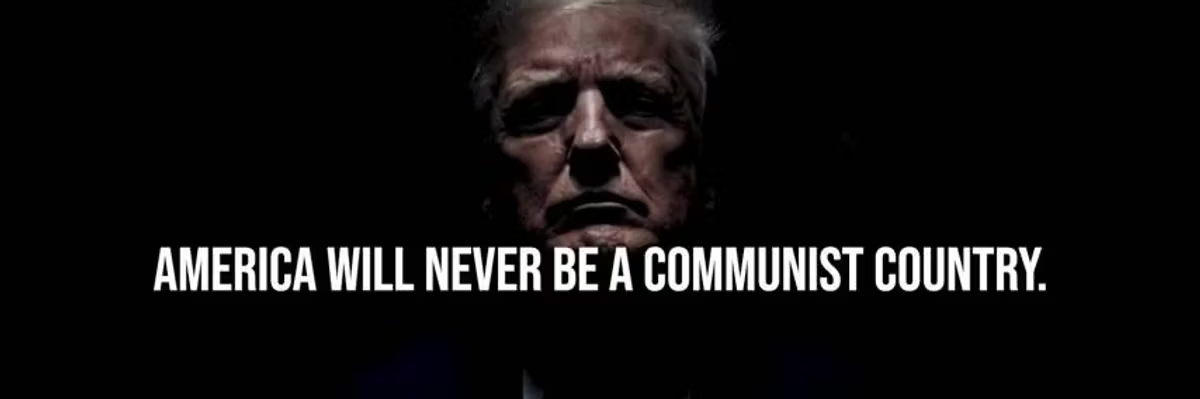
A screenshot from an ad for President Donald Trump posted by the White House on September 23, 2026, which was labeled as “paid for by the US Government.”
(Screenshot from The White House on YouTube)
Stephen Prager
Sep 24, 2026
COMMON DREAMS
The White House is being accused of violating federal law after it aired an ad glorifying President Donald Trump, which it explicitly said was “paid for by the US government.”
The ad was first reported by CBS News Miami investigative reporter Jim DeFede, who saw it airing on Fox News Wednesday night.
The 30-second spot features numerous videos and images of Trump, set to the song “Love Me” by JMSN. It includes voiceovers by the president railing against “communism,” a label he’s regularly used to hammer Democrats as the midterm elections approach.
“Together we will defeat communism, socialism, and Marxism, in America,” it features Trump saying. “America will never be a communist country.”
The video then goes on to amplify, in bright red letters, what the White House views as Trump’s signature policy accomplishments and goals: the “largest tax cuts in history,” “reigniting American manufacturing,” and “defend law and order and police.”
Footage from the 2024 Republican National Convention featuring Trump alongside Ultimate Fighting Championship president and CEO Dana White is then shown.
“He is the toughest, most resilient person that I’ve ever met,” White is heard saying about Trump. “And nothing was going to stop him from fighting so hard for the country he loves.”
As White is heard slathering Trump with praise, a message appears at the bottom of the screen in large white letters: “Paid for by the US government.”
DeFede described the taxpayer-funded message as “clearly a campaign ad.”
Many onlookers found the use of government resources to flood the airwaves with nakedly partisan messaging chilling, particularly in light of Trump’s recent attempts to censor critical media outlets and establish a state-run TV channel, while designating political opponents as “terrorists.”
Fernand R. Amandi, a political science professor at the University of Miami and analyst at MS NOW—a network recently banned from the White House by Trump—said that the use of state organs for messages like these was an “unmistakable [sign] you live under an authoritarian, fascist government.”
Longtime Senate Democratic aide Jim Manley said the ad was not just “creepy,” but also “illegal.”
Provisions in annual appropriations laws explicitly forbid federal appropriations from being used for “publicity or propaganda purposes.”
For decades, the nonpartisan Government Accountability Office has interpreted this to mean that the executive branch can’t use federal dollars for material whose “obvious purpose is ‘self-aggrandizement’ or ‘puffery,’” or for communications that are “purely partisan.”
The Hatch Act also bans federal employees from using their official authority or government resources for partisan activity. While Trump himself is not subject to the Hatch Act, most other senior government employees and appointees are.
The Trump administration has been accused of violating the Hatch Act on multiple occasions during his second term, including by using official agency websites to run messages blaming “Radical Left” Democrats for last year’s lengthy government shutdown.
During Trump’s first term, multiple officials were found to have violated the Hatch Act for arguably less overt offenses.
Former Acting Homeland Security Secretary Chad Wolf was found to have violated the law by hosting a naturalization ceremony orchestrated to generate footage for the 2020 Republican National Convention. Former Trump housing official Lynne Patton, meanwhile, admitted to violating the act by using her government position to recruit participants for an RNC video, resulting in a $1,000 fine and a four-year ban from federal employment.
It’s not clear which government employees were behind the taxpayer-funded Trump ad. But Max Flugrath, the communications director at the voting rights group Fair Fight, said it was the “weirdest way to violate the Hatch Act, ever.”
“Weirdest way to violate the Hatch Act, ever.”
A screenshot from an ad for President Donald Trump posted by the White House on September 23, 2026, which was labeled as “paid for by the US Government.”
(Screenshot from The White House on YouTube)
Stephen Prager
Sep 24, 2026
COMMON DREAMS
The White House is being accused of violating federal law after it aired an ad glorifying President Donald Trump, which it explicitly said was “paid for by the US government.”
The ad was first reported by CBS News Miami investigative reporter Jim DeFede, who saw it airing on Fox News Wednesday night.
The 30-second spot features numerous videos and images of Trump, set to the song “Love Me” by JMSN. It includes voiceovers by the president railing against “communism,” a label he’s regularly used to hammer Democrats as the midterm elections approach.
“Together we will defeat communism, socialism, and Marxism, in America,” it features Trump saying. “America will never be a communist country.”
The video then goes on to amplify, in bright red letters, what the White House views as Trump’s signature policy accomplishments and goals: the “largest tax cuts in history,” “reigniting American manufacturing,” and “defend law and order and police.”
Footage from the 2024 Republican National Convention featuring Trump alongside Ultimate Fighting Championship president and CEO Dana White is then shown.
“He is the toughest, most resilient person that I’ve ever met,” White is heard saying about Trump. “And nothing was going to stop him from fighting so hard for the country he loves.”
As White is heard slathering Trump with praise, a message appears at the bottom of the screen in large white letters: “Paid for by the US government.”
DeFede described the taxpayer-funded message as “clearly a campaign ad.”
Many onlookers found the use of government resources to flood the airwaves with nakedly partisan messaging chilling, particularly in light of Trump’s recent attempts to censor critical media outlets and establish a state-run TV channel, while designating political opponents as “terrorists.”
Fernand R. Amandi, a political science professor at the University of Miami and analyst at MS NOW—a network recently banned from the White House by Trump—said that the use of state organs for messages like these was an “unmistakable [sign] you live under an authoritarian, fascist government.”
Longtime Senate Democratic aide Jim Manley said the ad was not just “creepy,” but also “illegal.”
Provisions in annual appropriations laws explicitly forbid federal appropriations from being used for “publicity or propaganda purposes.”
For decades, the nonpartisan Government Accountability Office has interpreted this to mean that the executive branch can’t use federal dollars for material whose “obvious purpose is ‘self-aggrandizement’ or ‘puffery,’” or for communications that are “purely partisan.”
The Hatch Act also bans federal employees from using their official authority or government resources for partisan activity. While Trump himself is not subject to the Hatch Act, most other senior government employees and appointees are.
The Trump administration has been accused of violating the Hatch Act on multiple occasions during his second term, including by using official agency websites to run messages blaming “Radical Left” Democrats for last year’s lengthy government shutdown.
During Trump’s first term, multiple officials were found to have violated the Hatch Act for arguably less overt offenses.
Former Acting Homeland Security Secretary Chad Wolf was found to have violated the law by hosting a naturalization ceremony orchestrated to generate footage for the 2020 Republican National Convention. Former Trump housing official Lynne Patton, meanwhile, admitted to violating the act by using her government position to recruit participants for an RNC video, resulting in a $1,000 fine and a four-year ban from federal employment.
It’s not clear which government employees were behind the taxpayer-funded Trump ad. But Max Flugrath, the communications director at the voting rights group Fair Fight, said it was the “weirdest way to violate the Hatch Act, ever.”

.png)


