Sunday, March 22, 2020

COVID-19: Nitrogen dioxide over China

by European Space Agency
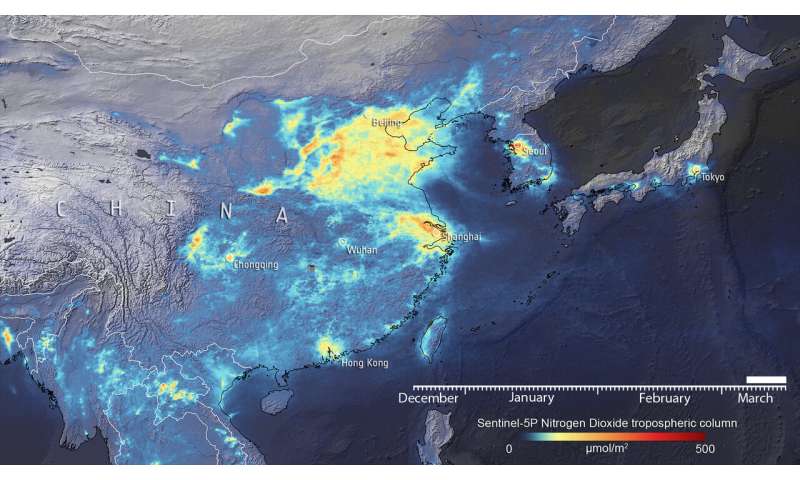
This image, using data from the Copernicus Sentinel-5P satellite, shows the nitrogen dioxide emissions over China from 7 to 16 March 2020. Credit: contains modified Copernicus Sentinel data (2020), processed by ESA, CC BY-SA 3.0 IGO

Recent data have shown a decline of air pollution over northern Italy coinciding with its nationwide lockdown to prevent the spread of the coronavirus (COVID-19). This new map shows the variation of nitrogen dioxide emissions over China from December to March—thanks to the Tropomi instrument on board the Copernicus Sentinel-5P satellite.


As news of the coronavirus broke out in the Hubei province, China, in late December 2019, stricter measures were put in place. As a result, by late January, factories were closed and streets were cleared as Chinese authorities had ceased daily activities to stop the spread of the illness.

This led to the dramatic reduction in nitrogen dioxide emissions—those released by power plants, industrial facilities and vehicles—in all major Chinese cities between late-January and February. The drop in emissions also coincided with Lunar New Year celebrations, which usually sees a similar drop in emissions each year.

The Copernicus Atmosphere Monitoring Service (CAMS) observed a decrease of fine particulate matter—one of the most important air pollutants—in February 2020 compared to the previous three years. By combining satellite observations with detailed computer models of the atmosphere, their studies indicated a reduction of around 20-30% in surface particulate matter over large parts of China.

As the coronavirus epidemic eases in China, many provinces have downgraded their emergency response levels. Schools, factories and other public spaces are starting to re-open and workers are gradually returning to their jobs.
This animation, using data from the Copernicus Sentinel-5P satellite, shows the nitrogen dioxide emissions from 20 December 2019 until 16 March 2020 – using a 10-day moving average. The drop in emissions in late-January is visible, coinciding with the nationwide quarantine, and from the beginning of March, the nitrogen dioxide levels have begun to increase. Credit: contains modified Copernicus Sentinel data (2019-20), processed by ESA, CC BY-SA 3.0 IGO

This animation, using data from the Copernicus Sentinel-5P satellite, shows the nitrogen dioxide emissions from 20 December 2019 until 16 March 2020—using a 10-day moving average. The drop in emissions in late-January is visible, coinciding with the nationwide quarantine, and from the beginning of March, the nitrogen dioxide levels have begun to increase.

Josef Aschbacher, ESA's Director of Earth Observation Programmes, says, "Satellites offer a unique vantage point to monitor the health of our planet. Sentinel-5P is one of seven Copernicus satellites in orbit today. It currently provides the most accurate measurements of nitrogen dioxide and other trace gases from space.


"As nitrogen dioxide is primarily produced by traffic and factories, it is a first-level indicator of industrial activity worldwide. What is clearly visible is a significant reduction of nitrogen dioxide levels over China, caused by reduced activity due to COVID-19 restrictions, but also the Chinese New Year in January."

He continues, "The Copernicus program is a perfect example of how space serves all European citizens by combining the political strength of the EU with the technical excellence of ESA."
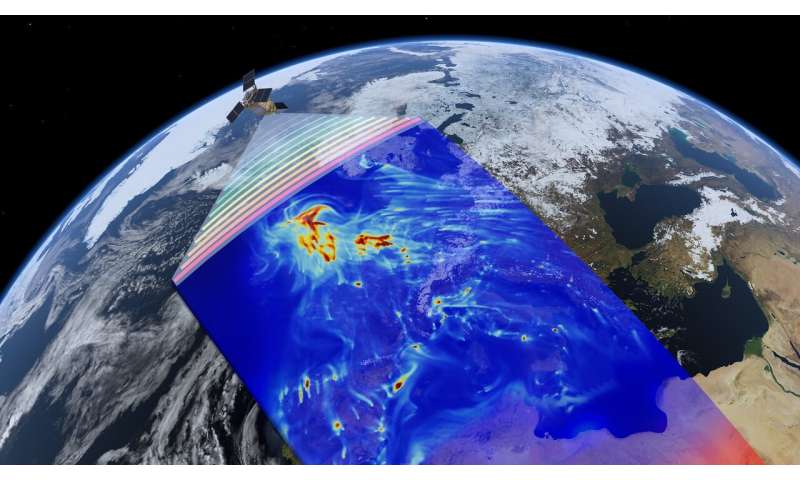
Sentinel-5 Precursor is the first Copernicus mission dedicated to monitoring our atmosphere. With air pollution a major concern, the satellite carries the state-of-the-art Tropomi instrument to map a multitude of trace gases such as nitrogen dioxide, ozone, formaldehyde, sulphur dioxide, methane, carbon monoxide and aerosols – all of which affect the air we breathe and therefore our health, and our climate. Credit: ESA/ATG medialab

Claus Zehner, ESA's Copernicus Sentinel-5P mission manager, comments, "We can certainly attribute a part of the nitrogen dioxide emission reduction to the impact of the coronavirus. We currently see around a 40% reduction over Chinese cities, however these are just rough estimates, as weather also has an impact on emissions.

"We are conducting a detailed scientific analysis which will soon provide more insights and quantified results in the following weeks and months."

The Copernicus Sentinel-5 Precursor mission, also known as Sentinel-5P, is dedicated to monitoring air pollution by measuring a multitude of trace gases as well as aerosols—all of which affect the air we breathe.

pH 

Novel bacterial acid tolerance system sheds light on development of antimicrobials


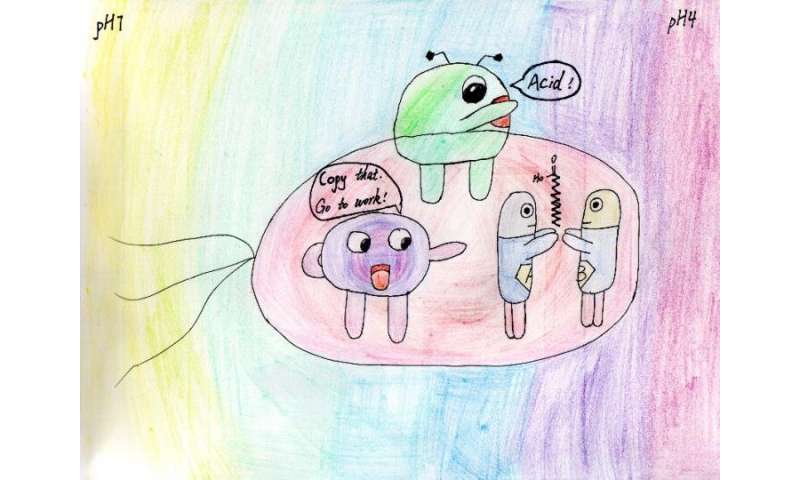
E. coli acid tolerance system regulated by two-component system CpxRA.
Credit: ZHAO Mohan
Growth ability at acidic conditions is important to bacteria. Enteric bacteria such as Escherichia coli and Salmonella can colonize and cause disease in the host's intestinal tract, but they have to combat acidic environments during the whole process of invading the host.

The stomach, with pH value as low as 1.5 to 2.5, is recognized as a natural antibiotic barrier. After entering into the , E. coli will encounter a less acidic environment (with pH value of 4-6), reproduce rapidly, and ultimately cause disease to the host.
Recently, a research team led by Prof. Xian Mo and Prof. Zhao Guang from the Qingdao Institute of Bioenergy and Bioprocess Technology (QIBEBT) of the Chinese Academy of Sciences (CAS) discovered a novel bacterial acid tolerance system that confers the growth capability to E. coli at pH of 4.2.
Up to now, five acid resistance systems have been reported. These acid resistance systems can enable E. coli to survive in  for hours, but they play no role in rapid multiplication of E. coli under moderate .
CpxA, the newly discovered system, can sense acidification directly through protonation of histidine residues. It will also activate its cognate regulator protein CpxRx to stimulate the expression of fabA and fabB genes for biosynthesis of unsaturated fatty acids, increasing unsaturated fatty acid contents in membrane lipid. Changes in membrane lipid composition lower the fluidity and proton permeability of the cell membrane, increasing the intracellular pH homeostasis.
Experimental results showed that E. coli mutants deficient in this system cannot grow in mouse intestine. Besides E. coli, this acid tolerance system also exists in pathogenic bacteria including Salmonella, Shigella, Vibrio cholerae, Yersinia pestis and Pseudomonas aeruginosa, which may be a new target for the development of antimicrobials.
The related findings were published in Nature Communications on Mar. 20.
Dangerous bacteria a true survivor

More information: Ying Xu et al. An acid-tolerance response system protecting exponentially growing Escherichia coli, Nature Communications (2020). DOI: 10.1038/s41467-020-15350-5

Scientists assess the accelerated changes of glaciers in the Yulong Snow Mountain

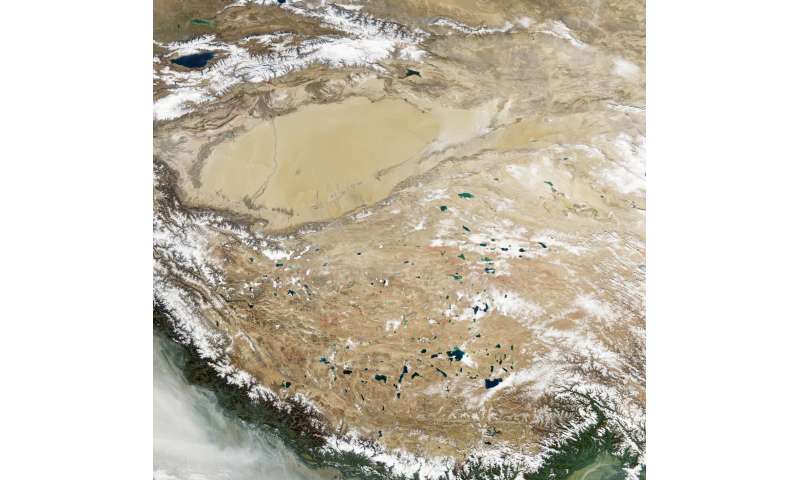
Natural-colour satellite image of the Tibetan Plateau. Credit: NASA
The Yulong Snow Mountain (YSM) is a region of temperate glaciers in the southeast Qinghai-Tibetan Plateau. As one of the most famous tourist attractions in Yunnan Province, the existence of the ice-and-snow landscapes of the YSM is culturally important to the Lijiang ancient town.
Recently, scientists from Northwest Institute of Eco-Environment and Resources, together with their colleagues from other universities in China, systematically assessed the glacier changes of the YSM during the past several decades using ground-based and remotely sensed observations and referencing topographic maps.
They assessed glacier changes in the YSM and their impact on the local glacier tourism. Based on in situ data and remote-sensing images, scientists first evaluated the glacier changes in the study , such as changes in the glacier front, glacier area and glacier mass balance.
Besides, they analyzed the reasons for this glacier change, along with the climate records from a local meteorological station, followed by the major impact factors of the initially rapid glacier retreat.
The findings of the present study help to understand the mechanism between accelerated ablation of temperate  and  in southeast regions of Qinghai-Tibetan Plateau and provide references for local tourism administrations.
This study has been published in Regional Environmental Change in an article titled "Accelerated changes of glaciers in the Yulong Snow Mountain, Southeast Qinghai-Tibetan Plateau."Observational evidence of Karakoram anomaly

More information: Shijin Wang et al. Accelerated changes of glaciers in the Yulong Snow Mountain, Southeast Qinghai-Tibetan Plateau, Regional Environmental Change (2020). DOI: 10.1007/s10113-020-01624-7

Canada's changing coronavirus border policy exposes international students' precarious status

Canada's border closure announcements have thrown international students and other foreign nationals on a roller coaster of anxiety that jeopardizes many people's sense of wellness and security.
Since U.S. President Donald Trump's travel ban on citizens of countries with substantial Muslim populations in 2017, Canada has strengthened its position as a welcoming country for In 2017, there were close to 500,000 international students studying in Canada.
However, on March 16, Prime Minister Justin Trudeau announced that Canada will take aggressive measures to limit the spread of COVID-19. He said Canada would deny "entry to Canada to people who are not Canadian citizens or permanent residents," except Americans.
This announcement raised concerns about why Canada chose to keep its  open to Americans since the United States is Canada's top source of international tourists: in 2015 more than 22 million Americans vacationed in Canada.
Then, two days later, on March 18, Trudeau announced that U.S. travellers will no longer be permitted to cross the border for "recreation and tourism," saying that in both countries, citizens are encouraged to stay home.
Amid a flurry of ensuing anxious social media posts from foreign residents, including many international students, Public Safety Minister Bill Blair said international students, workers with visas and temporary foreign workers will be allowed to enter Canada but will need to self-isolate for 14 days.
But both in the short term, as officials at many levels respond to changing circumstances and messaging, and over the longer term, as our society adapts to the pandemic, it's far from clear that Canada's announcements will provide international students or temporary foreign workers with a sense of security.
Some international students or temporary residents at the border were blocked from coming back to Canada on Monday, Radio Canada reported.
And, on March 18, the Government of Canada officially published a list of people who are exempted from this measure. However, this list does not explicitly mention whether international students or temporary foreign workers are allowed to return to Canada if they are currently abroad.
Key concerns remain unaddressed. How effectively has, or will, Canada communicate its border decisions about international students and temporary foreign workers to border officials, airlines and the students themselves? Do these changing messages in a short time signal that international students should be concerned for the future of their mobility and their studies? How is the well-being of international students and other temporary residents in Canada impacted by wondering if the border could be closed to them?
Potential consequences
It is important to understand how temporary residents—those without permanent residency—such as international students, temporary foreign workers and other precarious status foreigners who have been legally living, studying and working in Canada for months or years —have been affected by these announcements.
Research conducted in Ontario shows that it is important to pay particular attention to how living with precarious legal status may impact the well-being and feelings of belonging and social support of children and families.
Will international students, foreign workers or the Canadian public now be wondering whether temporary residents have become disposable foreigners amid COVID-19 pandemic? Indeed, as they were not addressed in Trudeau's initial announcement, they may be wondering whether their temporary resident status is worthy of Canadian state consideration and protection or it is an item that can be disposed of in times of crisis.
It is understandable that the federal government's aggressive measures aim to protect Canadians and permanents residents of Canada. It is also clear that "we are in a fairly critical period" to slow the spread of COVID-19, as Canada's Chief Public Health Officer Dr. Theresa Tam said.
And it's more than clear that we should follow the federal government's recommendations of social distancing to limit the spread of the virus.
However, talking about closing the border to those who have lived, studied and worked in Canada for months or years raises concerns about how we should help each other amid the COVID-19 pandemic while respecting human rights and dignity.
Respecting human rights
As the United Nations High Commissioner for Refugees recommended, states are of course entitled to take measures to ascertain and manage risks to public health, including risks that could arise in connection with non-nationals arriving at their borders. Such measures must be non-discriminatory as well as necessary, proportionate and reasonable with the aim of protecting public health.
Canada's border closure contradicts WHO's recommendations, which urge all countries to "strike a fine balance between protecting health, minimizing economic and social disruption and respecting human rights."
South Korea, for example, has been recognized for implementing efficient testing, quarantine and tracking measures to slow the spread of COVID-19 without implementing a lockdown.
Relief measures?
What protection and relief measures can international students and temporary foreign workers expect from the federal government as conditions surrounding the pandemic change?
The federal government has, after all, announced that no Canadian should be worried about rent payments, groceries and additional child care because it will help Canadians financially during the COVID-19 pandemic.
International students are clearly concerned about their precarious situations. Will Canada offer any official relief measures or supports for international students too, like rent relief?
Precarious status and well-being
The prime minister's announcement of Canada's border closure to all foreigners may have had a significant impact on the mental and physical health of international students who are temporary residents in Canada, and have been living and working in the country.
Students' health and wellness may have been affected by knowing that if they leave the country, they will not be able to come back to continue their studies, research or work. This may also impact the Canadian economy.
In 2015 and 2016, respectively, international students in Canada spent about $12.8 billion and $15.5 billion on tuition, accommodation and discretionary spending. How will the federal government's changing messaging on the Canadian welcome to international students affect the Canadian economy in the future?
Canadian compassion
Amid the COVID-19 pandemic, Canada has shown compassion to the most vulnerable people. For instance, the federal government halted deportations of precarious status foreigners with the exception of serious criminal cases.
However, Canada's initial lack of consideration for international students and other temporary residents when it announced it was closing the border seems jarringly ill-conceived and insensitive given the country's constant effort to recruit international students to continue enhancing Canada's national economy and international reputation.
Even though it was corrected two days later, Canada's decisions and messaging prompt us to reflect on how we should apply measures of social distancing that are not harmful to others and that still protect human dignity—and to consider how we should account for and help each other in times of crisis. We're also prompted to think about how we should address popular concerns while remaining caring, thoughtful and welcoming to others.Canada-US border likely to be closed by Saturday: Trudeau
Provided by The Conversation 
This article is republished from The Conversation under a Creative Commons license. Read the original article.The Conversation

No work, no money: Self-isolation due to COVID-19 pandemic punishes the poor

Credit: CC0 Public Domain
The spread of COVID-19 continues to unfold across the globe. More than 209,000 people in 168 countries have been infected. The disease has recorded a fatality rate of more than 4% as 8,600 people have died from the disease.
The world's third-largest democracy, Indonesia, has reported more than 300 cases with a higher fatality rate of over 8%.
Since the outbreak, the Indonesian government has made public calls for people to self-isolate if they have symptoms. Self-isolation means staying indoors and completely avoiding contact with other people.
Public  have encouraged the public to self-isolate for at least 14 days to contain the rapid spread of the coronavirus. Research has shown that self-isolation is highly effective, especially when the majority of COVID-19 cases do not show symptoms.
Echoing many  experts, President Joko "Jokowi" Widodo has suggested people "stay, work and pray at home" for two weeks to prevent further spread of the highly contagious disease.
Even though this preventive action is proven effective, it fails to take into account the fact that many poor and low-income people cannot afford to self-isolate.
People working in informal sectors and casuals like online drivers, grocery store assistants and kitchen hands do not have the luxury of working from home as their jobs cannot be done remotely.
In 2019, people working in informal sectors accounted for 57.2% of Indonesia's workforce, or around 74 million people. As many as 25.14 million people live under the poverty line—that's about 9% of Indonesia's population.
Two weeks of self-isolation means these people risk losing their sole income source.
The poor narratives
The COVID-19 pandemic has hurt the economy worldwide. Many companies have reported losses as demand drops. With business slowing down, workers are facing greater risks of losing their jobs and income. It is happening in Indonesia.
"Ohh so sad. No turis [tourists] no job," posted one online driver on his  just three days after the government declared COVID-19 a national disaster.
Online drivers are also prone to coronavirus infections as they meet many different people in the course of their work.
GOJEK, one of the largest online driver platforms in Indonesia, has suspended the account of one of its drivers who was suspected of having COVID-19. But how will the driver get his income?
A similar story involves a 36-year-old casual domestic worker and mother from Yogyakarta, about 500 kilometers from the capital Jakarta.
"I can't afford to self-isolate. I need to go to work," she said. "No work means no money, and no money means no food for my kids."
These accounts illustrate the difficult situations facing many blue-collar workers during the COVID-19 pandemic. They can not afford to take a day off, let alone two weeks.
What can be done
To minimize discriminatory policies against poor people during the COVID-19 pandemic, the government should address the underlying and structural issues that create vulnerabilities in the first place.
This can be done, for example, by strengthening poverty eradication programs and establishing  for low-income households.
universal health coverage system will ensure everyone, regardless of their , has access to high-quality health services and financial risk protection.
The current Indonesian system, known as BPJS, is not adequate to be called universal health coverage as it still requires people to pay a monthly premium. This could be a problem for informal and casual workers who are often unable to pay their monthly charge regularly, resulting in their memberships being canceled.
The government must allocate a budget to provide primary health services to poor people. These services include providing access to health education,safe drinking water, nutrition, immunization and treatment of communicable and non-communicable diseases.
In addition, the government should address more fundamental problems related to the changing nature of work during the pandemic.
One of the strategies required is to provide social assistance and social insurance for people working in informal sectors during the COVID-19 emergency period.
Without adequate support from the government, many of these people face a higher risk of losing their income or contracting the disease and then spreading the virus.
Therefore, any public health measures to mitigate multiple impacts of the COVID-19 pandemic must seriously consider the society's various economic and social backgrounds to ensure preventive measures do not further punish already marginalized and vulnerable communities.
By strengthening the nation's social welfare and health care systems, the government can help keep all citizens both physically and economically healthy and also protect the vulnerable during the pandemicCoronavirus: 10 questions about self-isolation answered

In the wake of bushfires and coronavirus, it's time we talked about human security

MUTUAL AID IS HUMAN SOLIDARITY P. KROPOTKIN

The term "human security" was first adopted by the United Nations Development Program in 1994. We speak far less of it now than we did then. Yet the cataclysmic events of this year should remind us national security is no longer to be thought of in terms of conventional warfare and military expenditure.
Put simply,  encompasses all those threats to survival that are not military or state-sponsored, and therefore tend to fall beneath the radar of those who imagine security in conventionally "hard" terms.
The recent bushfires and the  pandemic reveal imminent threats from climate change and global diseases that threaten the very survival of what we take for granted. Yet governments have been far less willing to commit to responding to these issues than to increasing military budgets.
When the concept of human security emerged it was designed to address seven themes: "economic, food, health, environmental, personal, community and political security". While these terms may seem too broad to be useful, all of them are directly related to the crises now facing the world.
These crises have taken me back to a large research project with several colleagues on rethinking the relevance of human security.
There is a voluminous literature on the meaning and limitations of human security. When he launched the book based on our research, the former foreign minister Gareth Evans defined it as an attempt to link conventional understandings of national security with the needs of human development: "The concept of human security was broad enough to advance both freedom from fear and freedom from want."
In the book, I wrote: "Australia is unlikely to face a military invasion, of the sort we might have experienced in World War II, but its security is threatened by a series of global upheavals around food, water, new epidemics, transnational crime and climate change."
I might now add cybersecurity to that list.
Over the past few years, the Australian government has increased military expenditures to the point where we are now among the top 15 countries ranked on defence spending.
Of course, our expenditure is trivial compared to the United States and China, but there is a powerful lobby pushing to increase it. At the same time, the government has made major cuts to overseas development assistance, is resisting the need to seriously cut emissions and appeared unprepared for the severity of the coronavirus epidemic.
Growing concern about the rise of China and the unpredictability of the United States has meant we ignore the more immediate threats to our security, even as they are looming around us. Most troubling, perhaps, is the government's dislike of global institutions in a period when we need global cooperation more than ever.
Prime Minister Scott Morrison has made several attacks on what he terms an "unaccountable internationalist bureaucracy". In this he appears to be following the lead of US President Donald Trump. Our declining foreign assistance budget is lessening the capacity of countries in our region to respond to health and climate emergencies.
The failure of the United States to provide leadership on either  or the coronavirus has emphasised the importance of great powers grasping that even their survival depends upon global action. Arguably the authoritarian Chinese regime, for all its unpleasantness, understands this better than the Trump administration.
It is a common aphorism that generals always fight the last war. Debates about the rise of China and the need to increase our military capabilities overlook the fact the most immediate threats to national security are not conventional military ones.
There are hints of this in Australia's foreign policy. A statement from Foreign Minister Marise Payne noted: "Australia's longstanding and ongoing security cooperation with Pacific countries covers defence, law enforcement, transnational crime, climate and disaster resilience, border management and human security."
But the shadow minister, Penny Wong, has argued: "'Security' has a much broader connotation than the more threat-based protective and response concepts on which a lot of public policy concentrates."
But these statements stand apart from mainstream debates about "", which remain dominated by concerns about military build-ups and terrorism.
After unparalleled bushfires and coronavirus, the concept of human  gives us the language to reassess the most immediate threats to our survival and the need for global cooperation to respond to them.

Pushing manufacturers to make more resilient products will curb e-waste

Credit: CC0 Public Domain
European lawmakers are considering new regulations that would push manufacturers to design products that last longer. It's part of a global effort to curb "throwaway" culture where people buy products, use them for a short while and then throw them away.
Cliff Davidson, professor of engineering and environmental engineering program director at Syracuse University, commends the move. Instead of a culture centered around buying new things, Prof. Davidson advocates for a  where rentals are more common. He says Americans may rebel against the practice, but serious change is needed to disrupt the status quo.
Davidson says:
"This problem with  is that it's just the tip of the iceberg of all of our wastes… the real problem is about much more than e-waste. One of the key problems is that in order to keep many companies in profit mode, they need to have a continual demand for their product. What that means is they don't want to build a  that lasts forever because there won't be people buying as many new cell phones as there are now. A lot of what we use, even outside of electronics, is built to eventually have problems with the physical device or to become less useful due to obsolescence (such as computers). If you have a laptop for more than a few years, it will probably be out of date because newer versions have more capabilities… it makes consumers want new ones. Manufacturers want to have continuous demand.
"There is one proposal that has been floated by others that I tend to agree with. It centers around the idea is that we shouldn't be purchasing devices, but rather we should be renting them. That goes for everything from cell phones and computers to dishwashers and dryers and washers, , etc. If we practiced renting instead of buying, there would be a tremendous incentive for manufacturers to build products that last. The  would be responsible for repairs and they would build their products so that those repairs were minimal.
"I suspect that in some cultures, people would be willing to go rent rather than buy. But I expect Americans would rebel against that. It's a change in thinking about how you consume items and how you shop.
"Rebellion or not, we can't keep the status quo. We have to make changes and I do think putting more pressure on manufacturers to make more sustainable products is a step in the right direction."
'Right to repair' rules for electronics included in EU's Circular Economy Action Plan
During coronavirus, plunging power demand could signal economic woes

by University of Chicago
How do you measure the economic impact of coronavirus?
 A UChicago economist says to look at power demands. Credit: Shutterstock.com

With Americans largely self-isolating amid concerns about COVID-19, some of the hardest hit areas are already seeing electricity demand begin to weaken. Could this be a sign of things to come?


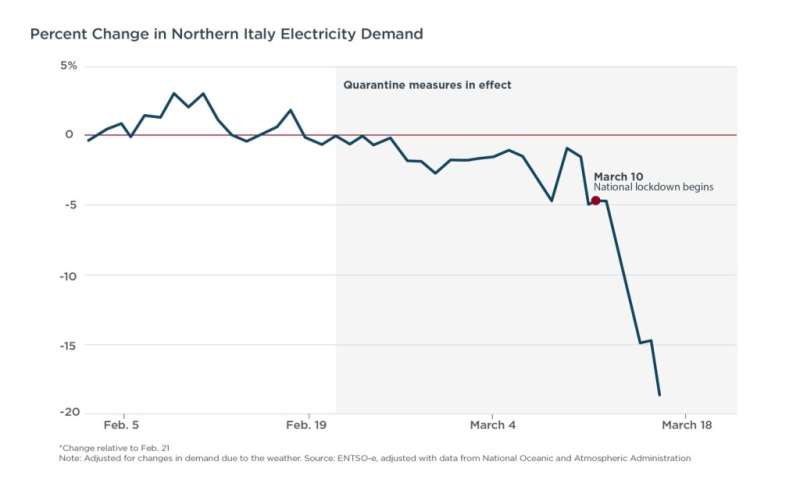
University of Chicago economist Steve Cicala examined what has happened to power demand in Northern Italy, which some say is about 11 days ahead of the U.S. trajectory of the novel coronavirus. An assistant professor at the Harris School of Public Policy, Cicala compiled regional grid data, adjusting for weather changes, and found that power demand has plunged in Northern Italy since the middle of February.

On Friday, Feb. 21, life in the region was largely normal. The following day, the Italian government began to institute quarantine measures. By Monday, power demand began to slow. As the chart below shows, there was then a bump in power just before the government instituted a national lockdown about two weeks later on March 10. About a week after that, power demand had fallen 18% compared to demand just prior to the quarantine measures.

An expert on the economics of environmental and energy policy regulation, Cicala said power demand could be a real-time indicator of the more widespread impacts on the Italian economy. And, what is happening in Italy could point to what the United States could expect in the coming weeks as states issue tighter restrictions on daily life.
Credit: Energy Policy Institute at the University of Chicago

"If paychecks and employment follow what is happening in the electricity-demand data, then there are a lot of people who will need help," said Cicala, a research affiliate for the Energy Policy Institute at the University of Chicago.

When there is a sharp shock in the economy, he explained, other indicators like employment may lag in reflecting the impact. This is because companies often lay off workers as a last resort, after they have already taken other measures like ramping down production or adjusting maintenance schedules. Conversely, electricity demand shows the more immediate change and is a broad measure of economic activity.

This pattern was on display during the last recession in the United States. U.S. power demand began to fall a month before the official start date of the recession in December 2007, according to the National Bureau of Economic Research—a date that was determined after an additional year of data had been collected.

As policymakers today consider which countermeasures may be necessary to buffer the economic effects of coronavirus, a real-time indicator of the economy's strength is of the utmost importance.

Solar energy tracker powers down after 17 years

by Jessica Merzdorf, NASA's Goddard Space Flight Center
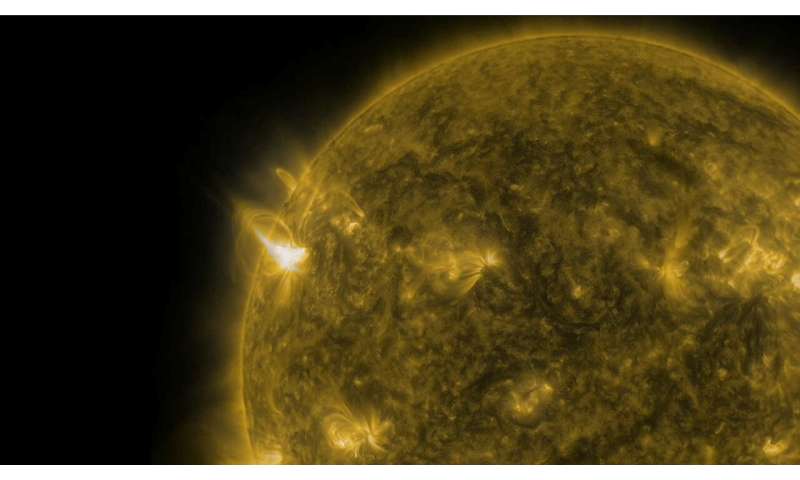
Banner Image: The Sun is Earth's primary power source. Energy from the Sun, called solar irradiance, drives Earth's climate, temperature, weather, atmospheric chemistry, ocean cycles, energy balance and more. Credit: NASA / Scott Wiessinger

After nearly two decades, the Sun has set for NASA's SOlar Radiation and Climate Experiment (SORCE), a mission that continued and advanced the agency's 40-year record of measuring solar irradiance and studying its influence on Earth's climate.


The SORCE team turned off the spacecraft on February 25, 2020, concluding 17 years of measuring the amount, spectrum and fluctuations of solar energy entering Earth's atmosphere—vital information for understanding climate and the planet's energy balance. The mission's legacy is continued by the Total and Spectral solar Irradiance Sensor (TSIS-1), launched to the International Space Station in December 2017, and TSIS-2, which will launch aboard its own spacecraft in 2023.

Monitoring Earth's "Battery"


The Sun is Earth's primary power source. Energy from the Sun, called solar irradiance, drives Earth's climate, temperature, weather, atmospheric chemistry, ocean cycles, energy balance and more. Scientists need accurate measurements of solar power to model these processes, and the technological advances in SORCE's instruments allowed more accurate solar irradiance measurements than previous missions.

"These measurements are important for two reasons," said Dong Wu, project scientist for SORCE and TSIS-1 at NASA's Goddard Space Flight Center in Greenbelt, Maryland. "Climate scientists need to know how much the Sun varies, so they know how much change in the Earth's climate is due to solar variation. Secondly, we've debated for years, is the Sun getting brighter or dimmer over hundreds of years? We live only a short period, but an accurate trend will become very important. If you know how the Sun is varying and can extend that knowledge into the future, you can then put the anticipated future solar input into climate models together with other information, like trace gas concentrations, to estimate what our future climate will be."

SORCE's four instruments measured solar irradiance in two complementary ways: Total and spectral.

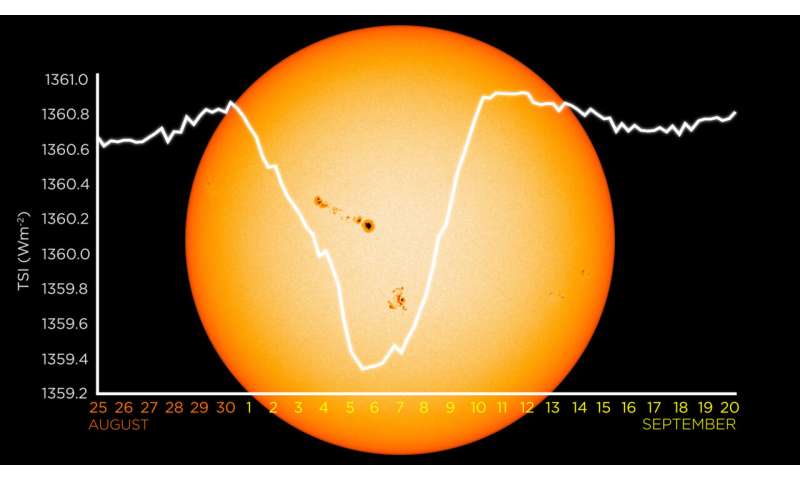
Total solar irradiance, or TSI, is the total amount of solar energy that reaches the Earth's outer atmosphere in a given time. Sunspots (darkened areas on the Sun's surface) and faculae (brightened areas) create tiny TSI variations that show up as measurable changes in Earth's climate and systems. From space, SORCE and other solar irradiance missions measure TSI without interference from Earth's atmosphere.


SORCE's TSI values were slightly but significantly lower than those measured by previous missions. This was not an error—its Total Irradiance Monitor was ten times more accurate than previous instruments. This improved solar irradiance inputs into the Earth climate and weather models from what was previously available.

"The big surprise with TSI was that the amount of irradiance it measured was 4.6 watts per square meter less than what was expected," said Tom Woods, SORCE's principal investigator and senior research associate at the University of Colorado's Laboratory for Atmospheric and Space Physics (LASP) in Boulder, Colorado. "That started a whole scientific discussion and the development of a new calibration laboratory for TSI instruments. It turned out that the TIM was correct, and all the past irradiance measurements were erroneously high."

"It's not often in climate studies that you make a quantum leap in measurement capability, but the tenfold improvement in accuracy by the SORCE / TIM was exactly that," said Greg Kopp, TIM instrument scientist for SORCE and TSIS at LASP.

SORCE's other measurements focused on spectrally-resolved solar irradiance (SSI): The variation of solar irradiance with wavelength across the solar spectrum, covering the major wavelength regions important to Earth's climate and atmospheric composition.

Besides the familiar rainbow of colors in visible light, solar energy also contains shorter ultraviolet and longer infrared wavelengths, both of which play important roles in affecting Earth's atmosphere. Earth's atmospheric layers and surface absorb different wavelengths of energy—for example, atmospheric ozone absorbs harmful ultraviolet radiation, while atmospheric water vapor and carbon dioxide absorb longer-wavelength infrared radiation, which keeps the surface warm. SORCE was the first satellite mission to record a broad spectrum of SSI for a long period, tracking wavelengths from 1 to 2400 nanometers across its three SSI instruments.

NASA's Solar Radiation and Climate Experiment, or SORCE, collected this data on total solar irradiance, the total amount of the Sun’s radiant energy, throughout Sept. 2017. Sunspots (darkened areas on the Sun’s surface) and faculae (brightened areas) create tiny TSI variations that show up as measurable changes in Earth’s climate and systems. Credit: NASA / Walt Feimer

"For public health, ozone chemistry and ultraviolet radiation are very important, and visible light is important for climate modeling," Wu said. "We need to know the solar variability at different wavelengths and compare these measurements with our models."

SORCE observed the Sun across two solar minima (periods of low sunspot activity), providing valuable information about variability over a relatively short 11-year period. But a longer record is needed to improve long-term predictions, Wu said.

Buying Time for an Aging Mission


SORCE was originally designed to collect data for just five years. Extending its lifespan to 17 required creative and resourceful engineering, said Eric Moyer, SORCE's mission director at Goddard.

SORCE's battery began to degrade in its eighth year of operations, no longer providing enough power to support consistent data collection. Unfortunately, the NASA instrument designed to take up its TSI measurements, Glory, was lost shortly after its 2011 launch, and the next instrument, the NOAA / U.S. Air Force Total solar irradiance Calibration Transfer Experiment (TCTE), would not launch until 2013. If SORCE could no longer operate, the ongoing solar irradiance record could be interrupted. Because the Sun changes very slowly—its sunspots and faculae follow an 11-year cycle, and some changes span decades or even centuries—a long, continuous record is essential for understanding how the Sun behaves.

The engineering team switched to daytime-only solar data collection, powering down the instruments and part of the spacecraft during the night part of the SORCE orbit. This plan effectively allowed the satellite to run with no functioning battery, Woods said—a groundbreaking engineering achievement.

"The operation and science teams at our partner organizations developed and implemented a completely new way to operate this mission when it appeared it was over because of battery capacity loss," said Moyer. LASP and Northrup Grumman Space Systems led the development of new operational software in order to continue the SORCE mission. "The small, highly dedicated team persevered and excelled when encountering operational challenges. I am very proud of their excellent accomplishment and honored to have had the opportunity to participate in managing the SORCE mission."

Continuing a Bright Legacy


As SORCE's time in the Sun ends, NASA's solar irradiance record continues with TSIS-1. The mission's two instruments measure TSI and SSI with even more advanced instruments that build on SORCE's legacy, said Wu. They have already enabled advances like establishing a new reference for the "quiet" Sun when there were no sunspots in 2019, and for comparing this to SORCE observations of the previous solar cycle minimum in 2008.

TSIS-2 is scheduled to launch in 2023 with identical instruments to TSIS-1. Its vantage point aboard its own spacecraft will give it more flexibility than TSIS-1's data collection aboard the ISS.

"We are looking forward to continuing the groundbreaking science ushered in by SORCE, and to maintaining the solar irradiance data record through this decade and beyond with TSIS-1 and 2," said LASP's Peter Pilewskie, principal investigator for the TSIS missions. "SORCE set the standard for measurement accuracy and spectral coverage, two attributes of the mission that were key to gaining insight into the Sun's role in the climate system. TSIS has made additional improvements that should further enhance Sun-climate studies."

"Solar irradiance measurements are very challenging, and the SORCE team proposed a different way, a new technology, to measure them," said Wu. "Using advanced technology to advance our science capability, SORCE is a very good example of NASA's spirit."SORCE satellite: A Decade in the Sun

Middle-aged entrepreneurs fare better than twentysomethings

Credit: CC0 Public Domain
Two years ago, MIT economist Pierre Azoulay started a lively discussion when a working paper he co-authored, "Age and High-Growth Entrepreneurship," revealed a surprising fact about startup founders: Among firms in the top 1/10 of the top 1 percent, in terms of growth, the average founder's age is 45. That's contrary to the popular image of valuable startups being the sole domain of twentysomething founders, such as Mark Zuckerberg of Facebook.
The paper, written with Benjamin Jones of Northwestern University, J. Daniel Kim of the University of Pennsylvania, and Javier Miranda of the U.S. Bureau of the Census, has now been officially published, in the journal American Economics Review: Insights. MIT News spoke to Azoulay, the International Programs Professor of Management at the MIT Sloan School of Management, about the finding and the discussion it has generated.
Q: What has been the response of people to the study?
A: We're documenting a fact, and that fact either accords with people's intuitions, or it doesn't. Some people are genuinely surprised because they've lived in the current zeitgeist, and then once they start thinking about it, they say, "Ah, it makes sense." And then there are people who say, "Oh, I knew it all along!" But Silicon Valley venture capitalists have studiously avoided engaging with what we've done. And I don't know why.
I think one line of [venture capitalist] skepticism is to say, "Well, you may well be right, but you're studying the one-in-a-thousand firm, and we're [investing in] the one-in-a-million firm." Which is sort of like restating that Apple, Microsoft, and Google were founded by .
Yes, we already knew it is possible for very large, successful firms to be founded by very young people. The question is: Is it likely?
Q: As you continue to think about this subject, is it possible to say what accounts for the success of relatively older entrepreneurs? Experience, intellectual capital, greater business connections—what matters?
A: All of those things are not mutually exclusive, and they're all likely to play a role. They just need to be studied separately, if you will. We have to remain agnostic. But there is one key point in my view. Forget experience: How about just knowledge? I like to say there is no such thing as a 25-year-old biotech entrepreneur. That person just doesn't exist, because you need a Ph.D. and three postdocs [to gain high-level knowledge]. There are lots of fields where if you want to make a contribution, you have to bring yourself to the frontier of knowledge in a domain, and that takes time. And that's not going to be the realm of the 22-year-old.
Beyond the big platform IT companies, if you're thinking about the broader swath of entrepreneurship across a multiplicity of sectors, then you have to acknowledge this point. In some sense, if you recognize the diversity of startups, the [founder's] age number is going to be higher than if you're only focused on super-high-value Silicon Valley internet companies. So we need a basic attitude adjustment.
Q. Even as people mythologize the young startup founder, there is also a tech-sector ethos that heralds serial entrepreneurship and tolerates failure, because you're taking risks and learning by doing. Isn't that one Silicon Valley notion that might correspond to what you discovered?
A: Yes, one thing that could explain our results is entrepreneurship being an activity you can learn to do better over time. That's certainly something we've heard. We can't pin it down, but if I had to think of the most likely stories, that's certainly one. Even within a particular sector that demands a certain amount of , holding that constant, even within biotech or , you might think there is something about learning by founding, which is going to lead to a correlation between success and a higher age for founders.The 20-year-old entrepreneur is a myth, according to study

This story is republished courtesy of MIT News (web.mit.edu/newsoffice/), a popular site that covers news about MIT research, innovation and teaching.