Friday, July 03, 2020

 UPDATED
Police clear Seattle's CHOP protest zone, at least 32 arrested

July 1 (UPI) -- Police in Seattle were deployed to clear the city's protest zone early Wednesday, following an executive order from Mayor Jenny Durkan calling for protesters to vacate the area.

Durkan signed the executive order on Tuesday night and police began issuing dispersal orders for "anyone who remains in the area or returns to the area," arresting 32 people, the Seattle Police Department wrote on Twitter.


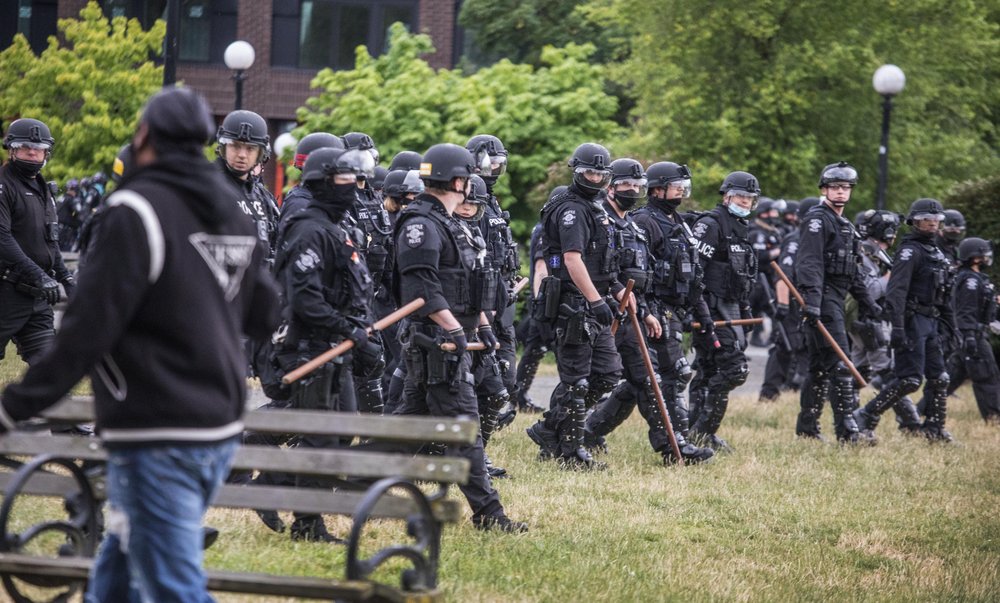
At least 100 police officers equipped with body armor, batons, helmets and weapons entered the area known as the Capitol Hill Organized Protest, or CHOP, as protesters left the area.

Police said that anyone seeking to leave the area without being arrested could exit through the south end of the zone.

Protesters had barricaded several blocks near Capitol Hill and occupied the area previously known as the Capitol Hill Autonomous Zone, or CHAZ, for weeks after police abandoned their nearby East Precinct amid global protests against police brutality and racial injustice sparked by the police-involved killing of George Floyd in Minnesota.

The demonstrations in the area had largely been peaceful but Durkan last week announced plans to clear protesters from the area following at least two fatal shootings in the CHOP in recent weeks.

Police Chief Carmen Best said she supports peaceful protests but on Wednesday declared that "enough is enough."

"The CHOP has become lawless and brutal," she said.

President Donald Trump has condemned the protesters, referring to them as "domestic terrorists," and Attorney General William Barr praised Best and the police department for clearing the area.

"The message of today's action is simple but significant: The Constitution protects the right to speak and assemble freely, but it provides no right to commit violence or defy the law," Barr said.


Seattle cops start clearing ‘occupied’ zone, make arrests
JUST LIKE HONG KONG

 By MARTHA BELLISLE and LISA BAUMANN
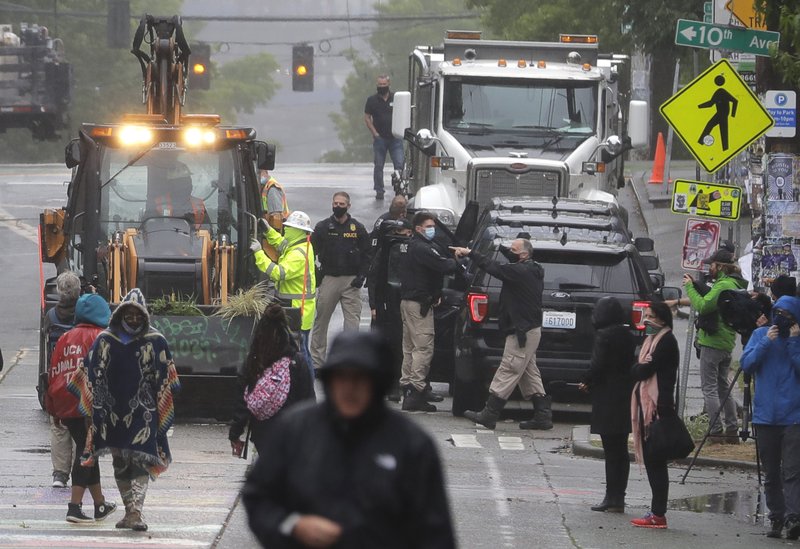
Seattle Police, at right, look on as Department of Transportation workers remove barricades at the intersection of 10th Ave. and Pine St., Tuesday, June 30, 2020 at the CHOP (Capitol Hill Occupied Protest) zone in Seattle. Protesters quickly moved couches, trash cans and other materials in to replace the cleared barricades. The area has been occupied by protesters since Seattle Police pulled back from their East Precinct building following violent clashes with demonstrators earlier in the month. (AP Photo/Ted S. Warren)


SEATTLE (AP) — Seattle police showed up Wednesday in force at the city’s “occupied” protest zone, tore down demonstrators’ tents and used bicycles to herd the protesters after the mayor ordered the area cleared following two fatal shootings in less than two weeks.

Television images showed no signs of clashes between the police, many dressed in riot gear, and dozens of protesters at the “Capitol Hill Occupied Protest” zone that was set up near downtown following the police killing of George Floyd in Minneapolis.

Police swarmed the zone known as CHOP at about 5 a.m. and a loud bang was heard at about 6:15 a.m. followed by a cloud of smoke. At least 13 people were arrested, said Police Chief Carmen Best.


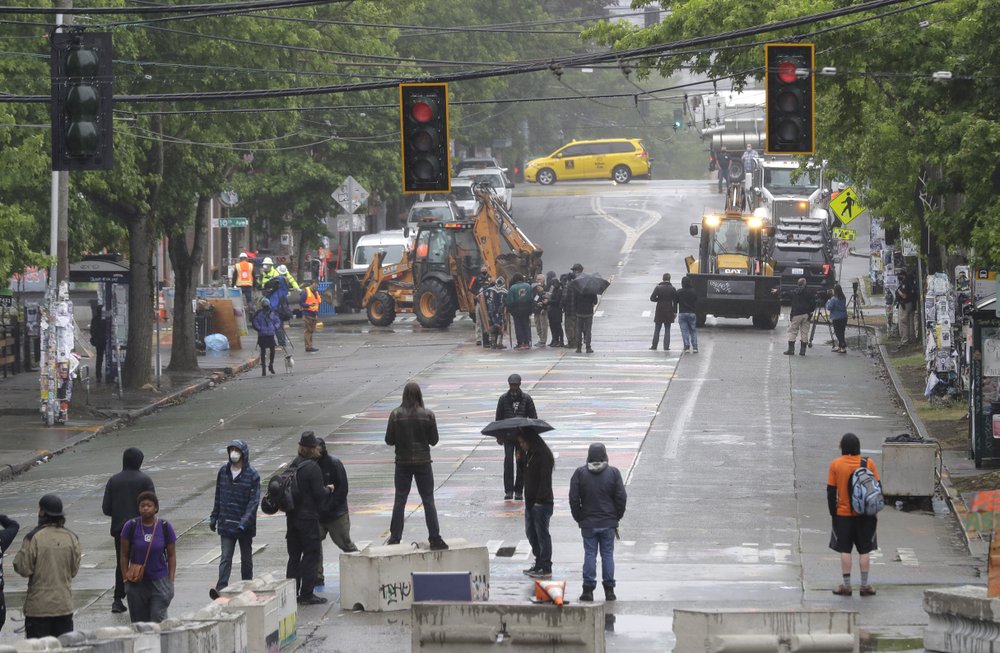
Protesters stand on barricades a block away as Seattle Department of Transportation workers remove other barricades at the intersection of 10th Ave. and Pine St., Tuesday, June 30, 2020 at the CHOP (Capitol Hill Occupied Protest) zone in Seattle. Protesters quickly moved couches, trash cans and other materials in to replace the cleared barricades. The area has been occupied by protesters since Seattle Police pulled back from their East Precinct building following violent clashes with demonstrators earlier in the month. (AP Photo/Ted S. Warren)

“Our job is to support peaceful demonstration but what has happened on these streets over the last two weeks is lawless and it’s brutal and bottom line it is simply unacceptable,” Best told reporters.

Police tore down fences that protesters had erected around their tents and used batons to poke inside bushes, apparently looking for people who might be hiding inside.

Most protesters appeared to have dispersed several hours after the operations started and armed officers looked on from rooftops as clean-up crews of workers arrived to break down tables and tarps that protesters had set up in the zone.

Officers were investigating several vehicles circling the area after police saw people inside them “with firearms/armor,” police said in a tweet, adding that the vehicles did not appear to have “visible license plates.”

The protesters had occupied several blocks around a park for about two weeks and police abandoned a precinct station following standoffs and clashes with the protesters, who called for racial justice and an end to police brutality.

Police said they moved in to protect the public after Mayor Jenny Durkan issued the order for protesters to leave.
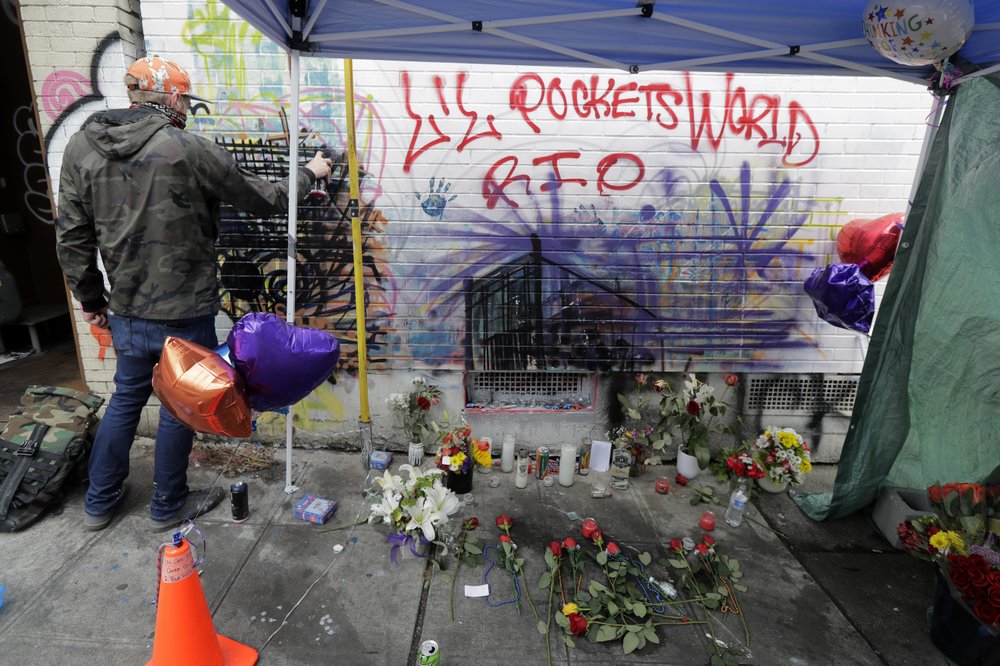


An artist at left works on a piece using spray paint and chalk, Tuesday, June 30, 2020, next to a growing memorial for a 16-year-old boy who was killed nearby in a fatal shooting Monday at the CHOP (Capitol Hill Occupied Protest) zone in Seattle. The area has been occupied by protesters since Seattle Police pulled back from their East Precinct building following violent clashes with demonstrators earlier in the month. (AP Photo/Ted S. Warren)

“Since demonstrations at the East Precinct area began on June 8th, two teenagers have been killed and three people have been seriously wounded in late-night shootings,” Seattle police said on Twitter. “Police have also documented robberies, assaults, and other violent crimes.

The tweet added that “suspects in recent shootings may still be in the area, and because numerous people in the area are in possession of firearms.”

Best said she supports peaceful demonstrations but that “enough is enough.”

“The CHOP has become lawless and brutal. Four shootings–-two fatal—robberies, assaults, violence and countless property crimes have occurred in this several block area,” she said.

There had been mounting calls by critics, including President Donald Trump, to remove protesters following the fatal shootings.

Protesters have said they should not be blamed for the violence in the area.


Seattle police forcibly clear ‘lawless’ protest zone
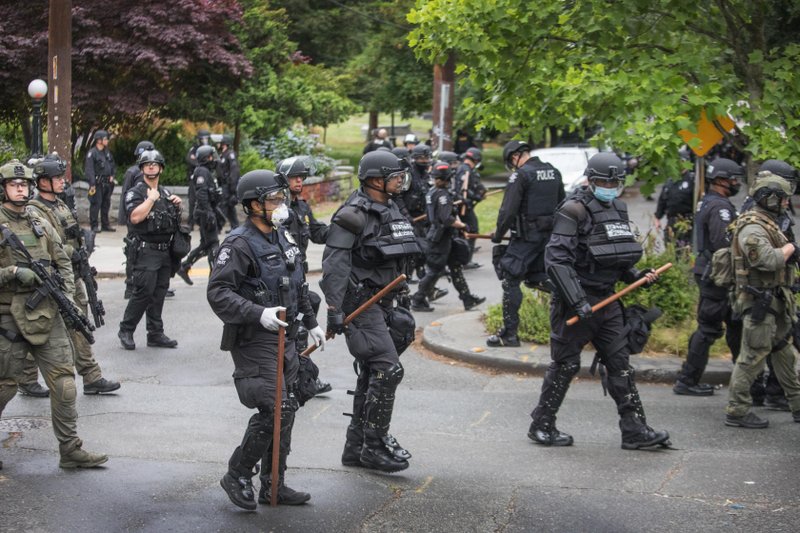

Seattle Police finish their sweep Wednesday, July 1, 2020, on the north end of Cal Anderson Park, sweeping everyone off the grounds. (Steve Ringman/The Seattle Times via AP)
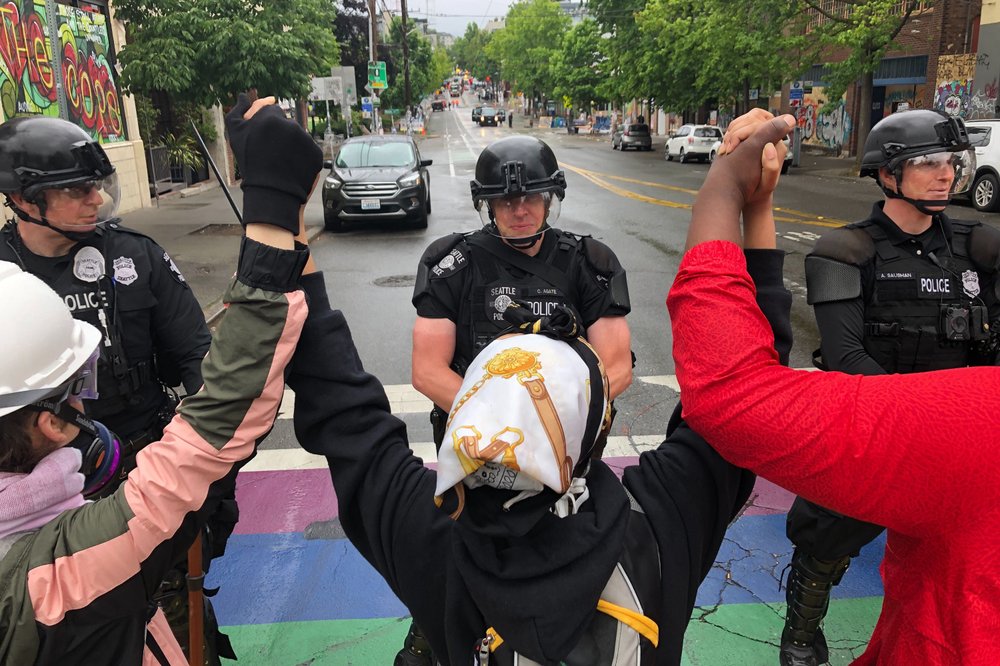


Protesters stand holding up their arms in front of a road blocked by police in the Capitol Hill Organized Protest zone early Wednesday, July 1, 2020, in Seattle. Police in Seattle have torn down demonstrators' tents in the city's so-called occupied protest zone after the mayor ordered it cleared. (AP Photo/Elaine Thompson)
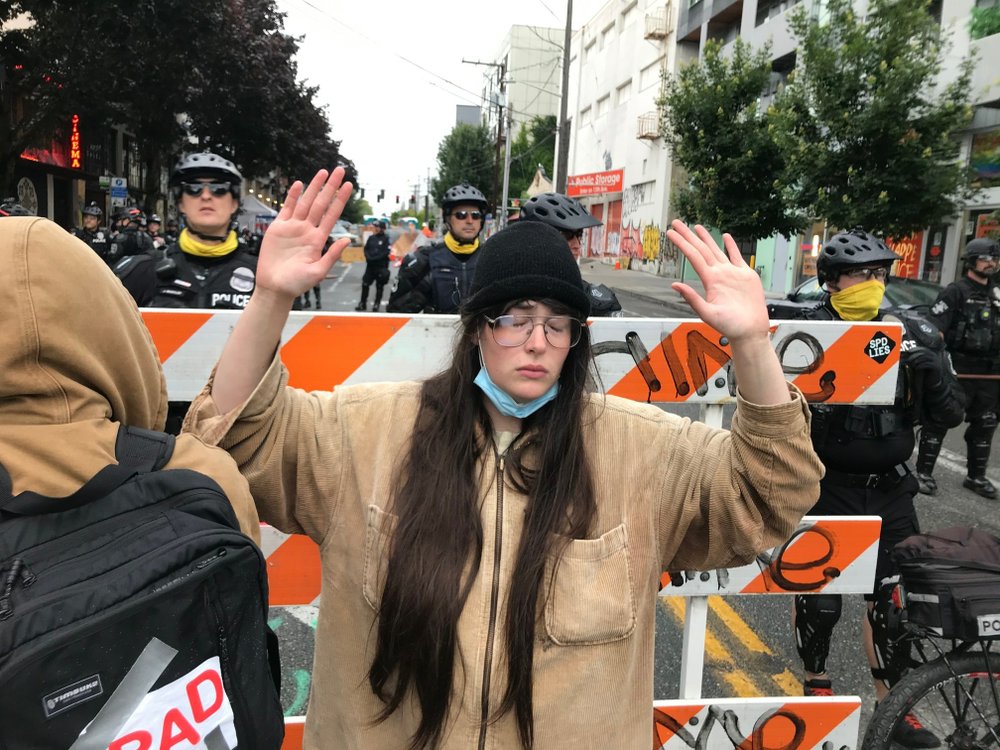
A protester stands with her hand up in front of a road blocked by Seattle police in the Capitol Hill Organized Protest zone early Wednesday, July 1, 2020. Police in Seattle have torn down demonstrators' tents in the city's so-called occupied protest zone after the mayor ordered it cleared. (AP Photo/Aron Ranen)
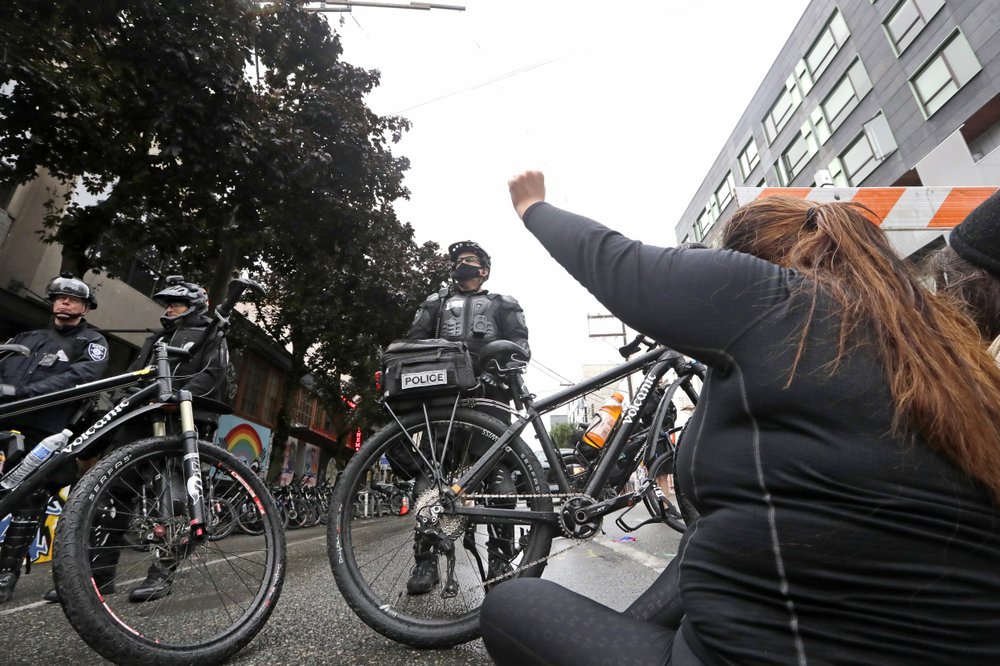
SEATTLE (AP) — Wearing helmets and wielding batons and rifles, Seattle police turned out in force at dawn Wednesday in the city’s “occupied” protest zone after the mayor ordered it cleared following two recent fatal shootings.

Officers stood shoulder-to-shoulder on several streets while others created a makeshift fence with their bicycles, using it to push dozens of protesters back away from the center of the “Capitol Hill Occupied Protest” zone just east of downtown. The group had occupied several blocks around a park for about two weeks after police abandoned a precinct station following standoffs and clashes that were part of the nationwide unrest over the killing of George Floyd in Minneapolis.
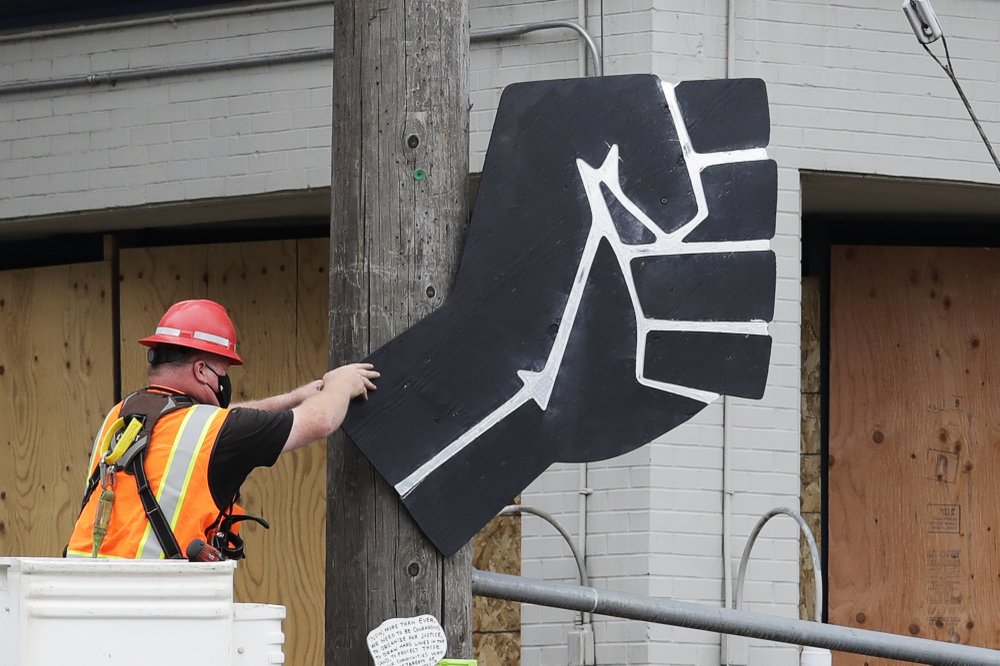
A worker removes a rendering of a clenched fist from a Seattle police precinct Wednesday, July 1, 2020, in Seattle, where streets had been blocked off in an area demonstrators had occupied for weeks. Seattle police showed up in force earlier in the day at the "occupied" protest zone, tore down demonstrators' tents and used bicycles to herd the protesters after the mayor ordered the area cleared following two fatal shootings in less than two weeks. The "Capitol Hill Occupied Protest" zone was set up near downtown following the death of George Floyd while in police custody in Minneapolis. (AP Photo/Elaine Thompson)

As residents in the neighborhood watched from balconies, police cleared out the protesters’ tents from the park and made sure no one was left in the park’s bathrooms.

More than three dozen people were arrested, charged with failure to disperse, obstruction, assault and unlawful weapon possession.
“Our job is to support peaceful demonstration but what has happened on these streets over the last two weeks is lawless and it’s brutal and bottom line it is simply unacceptable,” Police Chief Carmen Best said.

One protest organizer, Derrek Allen Jones II, said some demonstrators attempted to stay but were surprised by the early intervention by officers who were “trampling everything I seen in sight, flipping tables.”
“People were trying to hold their ground but you could see the cops literally storm through people’s beds while they were sleeping. And literally say ‘If you don’t get out, we will force you out or arrest you,’” he said.

One man dressed in black was peacefully led away in handcuffs and other demonstrators sat on the wet ground until their small group was handcuffed and detained.

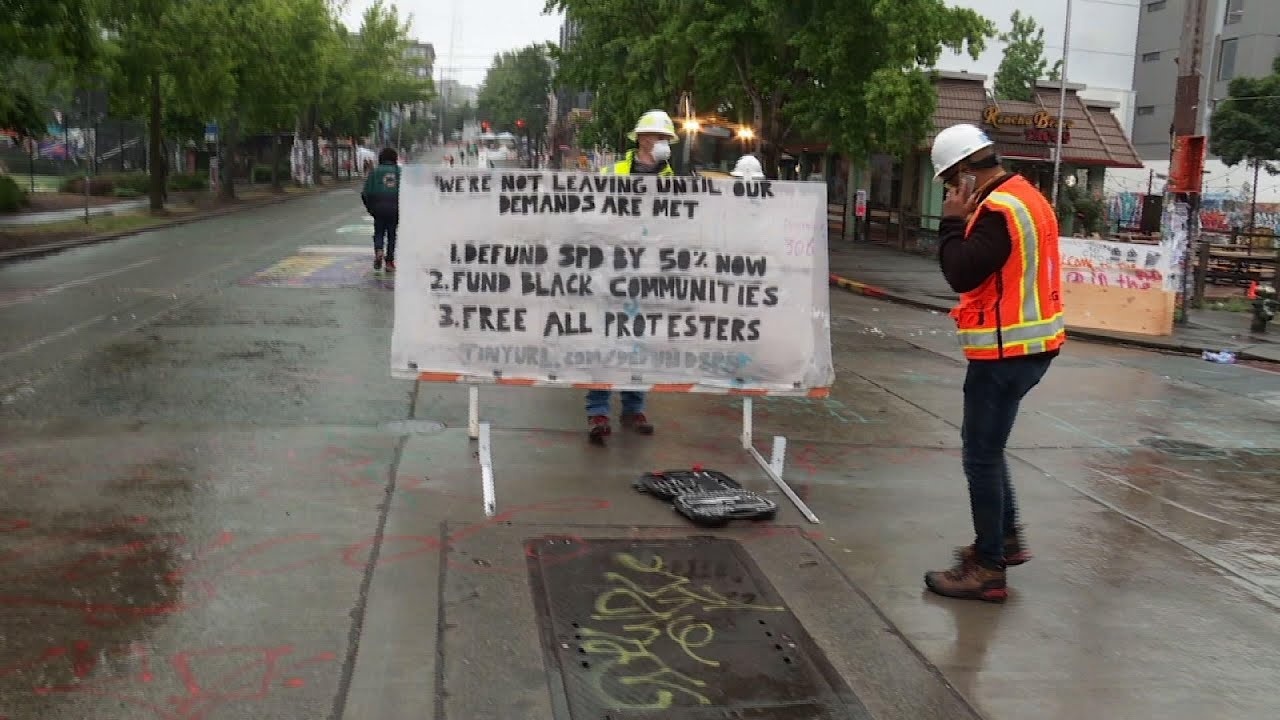
Police also tore down fences that protesters had erected around their tents and used batons to poke inside bushes, apparently looking for people who might be hiding. One officer took down a sign saying “We are not leaving until our demands are met: 1. Defund SPD by 50% now. 2. Fund Black Communities. 3. Free all protesters.”

After police evicted the protesters, heavy equipment was used to remove concrete barriers, cart away debris from the encampments while officers strung yellow caution tape from tree to tree warning people not to reenter.

’I was just stunned by the amount of graffiti, garbage and property destruction,” Best said after she walked around the area.
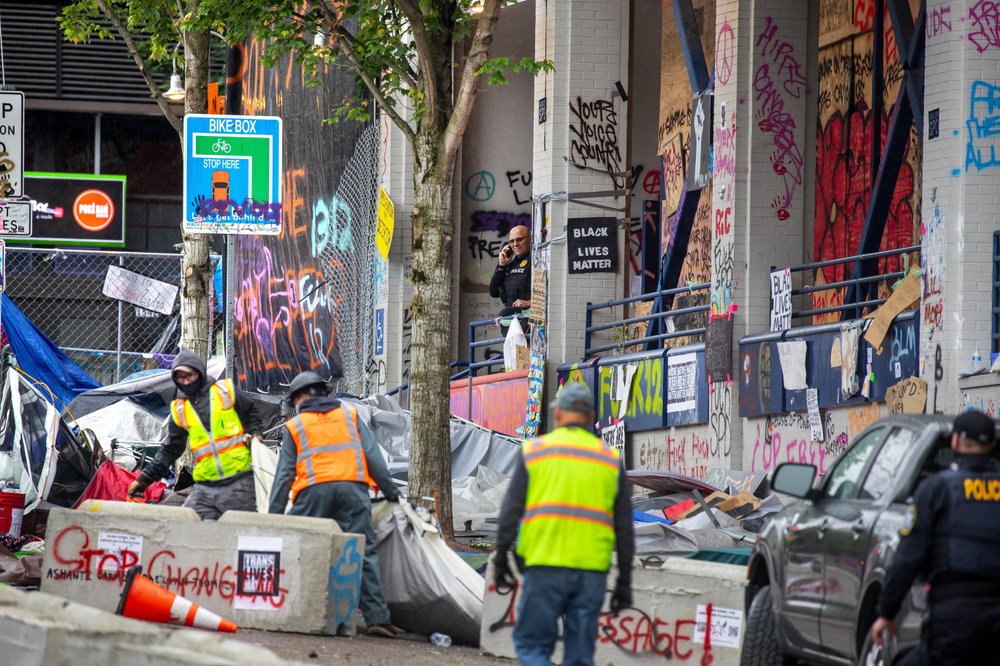


Seattle police take over and re-enter the East Precinct early Wednesday, July 1, 2020 after the area around the police station was occupied by protestors for the last month. (Mike Siegel/The Seattle Times via AP)


“The recent public safety threats have been well documented,” Mayor Jenny Durkan said at a news conference Wednesday afternoon. ”These acts of gun violence resulted in the tragic deaths of two teenagers, with multiple others seriously wounded. Despite continued efforts to deescalate and bring community together, this violence demanded action.”

Durkan also said while she supported the police in making arrests Wednesday, she doesn’t think many of those arrested for misdemeanors should be prosecuted. She also said she was committed to work that would dismantle systemic racism and build true community safety.

“Events in the Capitol Hill Organized Protest zone this morning, while necessary, should not diminish the cause of racial justice,” Gov. Jay Inslee said in an emailed statement.

Best said in addition to the fatal shootings, robberies, assaults, violence and property crimes have occurred in the area in the last few weeks. She said she wanted police to move back into the precinct so officers could better respond to needs in the area. Protesters have said they should not be blamed for the violence in the area.
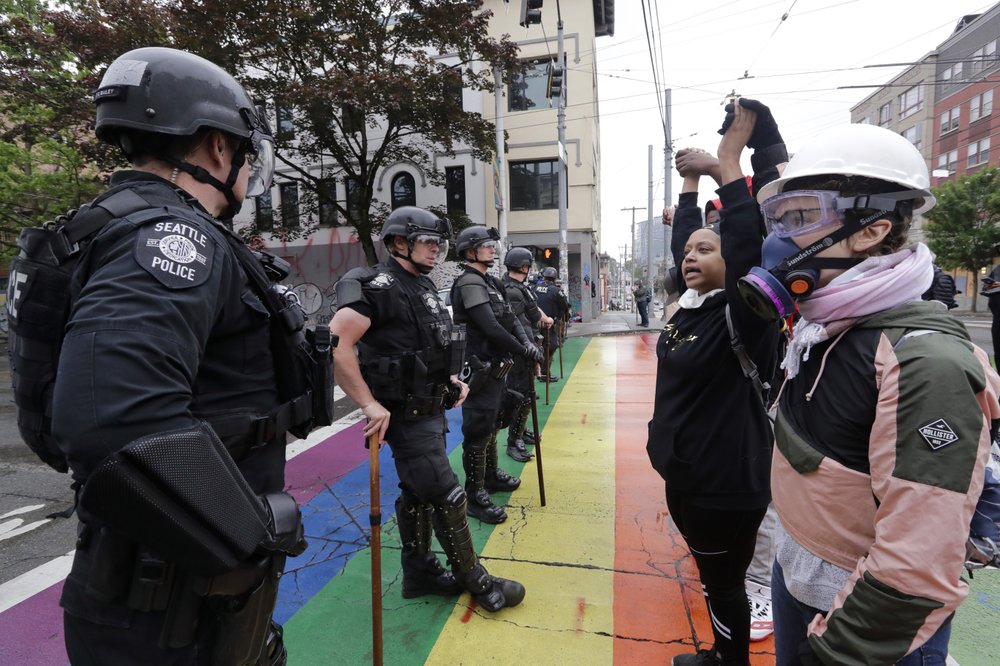


Protesters hold hands in front of a line of police officers blocking a street Wednesday, July 1, 2020, in Seattle, where streets had been blocked off in an area demonstrators had occupied for weeks. Seattle police showed up in force earlier in the day at the "occupied" protest zone, tore down demonstrators' tents and used bicycles to herd the protesters after the mayor ordered the area cleared following two fatal shootings in less than two weeks. The "Capitol Hill Occupied Protest" zone was set up near downtown following the death of George Floyd while in police custody in Minneapolis. (AP Photo/Elaine Thompson)
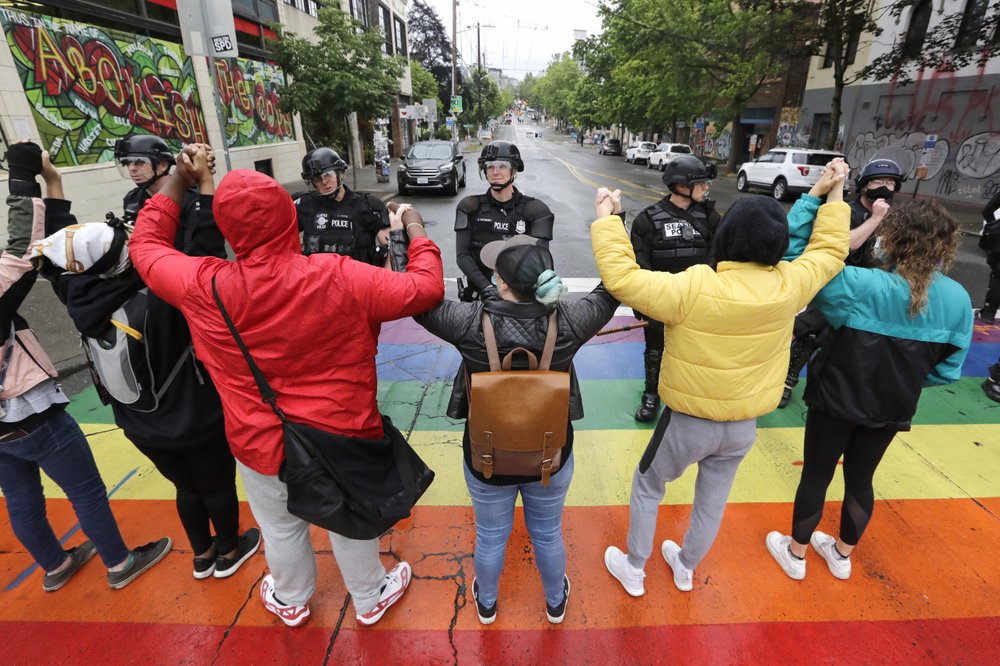


There had been mounting calls by critics, including President Donald Trump, to remove protesters. A group of local business owners sued the city, claiming that officials abandoned the area and made it impossible to run businesses because there was no police or fire protection.

U.S. Attorney General William Barr praised Best for what he called “her courage and leadership in restoring the rule of law in Seattle.”

“Chief Best has rightly committed to continue the substantive discussion while ending the violence, which threatens innocent people and undermines the very rule-of-law principles that the protesters profess to defend,” he said in a statement.

Seattle Black Collective Voice, which was formed by people in the protest zone, said previously that their work would continue even if they were forced out of that area. On Wednesday afternoon the group said via Twitter, “We don’t end with CHOP.”

___
Full Coverage: Racial injustice

Associated Press video journalist Aron Ranen in Seattle and writer Rachel La Corte in Olympia, Washington, contributed to this report.


Police In Riot Gear Raid Seattle’s Autonomous Protest Zone At Mayor's Order

What began as a “No Cop Co-op” has “become lawless and brutal,” Seattle’s police chief said. The area has gained national attention.

By Natalie Daher
Published on 7/1/2020
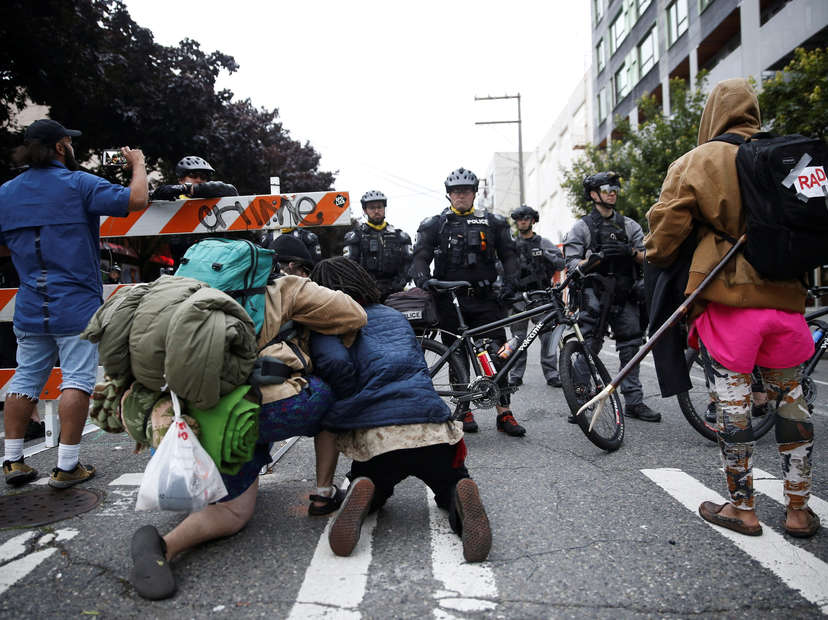
People kneel in front of a line of Police officers on bicycles as Seattle Police retake the Capitol Hill Occupied Protest (CHOP) area, including their East Precinct, in Seattle, Washington, on July 1. | Reuters


The police-free protest zone in Seattle that has drawn the ire of President Trump was raided by police on Wednesday morning after thousands of people have occupied it since early last month.

Seattle Mayor Jenny Durkan issued an emergency order for cops to clear out the zone due to “unlawful assembly,” a week after she announced a forthcoming shutdown along with Police Chief Carmen Best.

The city’s police arrived in riot gear to clear out a stretch of several blocks that’s been dubbed “CHOP,” or the Capitol Hill Organized Protest area. Seattle police said that at least 23 people were arrested during the dispersal.

Seattle police were supported by local FBI and the Bellevue police department, the Seattle Times reported.

Police have cleared #CHOP to Pike @KING5Seattle pic.twitter.com/0GUSkZkFA0
— Michael Crowe (@MichaelReports) July 1, 2020


Protesters have occupied the zone since early June, when police vacated a precinct in the area and demonstrations over the death of George Floyd swept the nation. The New York Times has described CHOP as “part-commune, part-street festival,” and the scene has been reminiscent of the 2011 Occupy protest.


Early Wednesday, a Twitter account that appears to be associated with the zone wrote: “It’s time to officially end the #Seattle #CHOP. We’re commanding all protestors to leave Capitol Hill and let normal operations resume, effective immediately.”


The group’s demands have included defunding and abolishing the police, providing reparations for police brutality victims, and decriminalizing acts of protest, according to a CHOP website. (The area was previously also called Capitol Hill Autonomous Zone, or CHAZ.)

t’s time to officially end the #Seattle #CHOP. We’re commanding all protestors to leave Capitol Hill and let normal operations resume, effective immediately. Stand by for more details. #chazcomms #chopcomms #CHAZCHOP #seattleprotest
— Seattle CHAZ/CHOP Official (@CHAZSeattle1) July 1, 2020

Durkan has attributed her order to empty the zone to violence in recent weeks. Best said in a statement that at least four shootings have occurred in the area, leaving two dead. The Chief also cited other “robberies, assaults, violence and countless property crimes" in the area.


“As I have said, and I will say again, I support peaceful demonstrations,” Chief Best said in a statement. “Black Lives Matter, and I too want to help propel this movement toward meaningful change in our community.  But enough is enough. ”

Best added: “The CHOP has become lawless and brutal.”

In early June, the protests in Seattle attracted President Trump’s attention, and he clashed on Twitter with Durkan and Washington Gov. Jay Inslee after he demanded they intervene. Durkan replied: “Make us all safe. Go back to your bunker.”


On June 23, Twitter flagged as abusive a tweet in which President Trump threatened “serious force” against any protesters who tried to set up an autonomous zone in Washington, D.C.


The Trump administration is targeting homeless trans people in the middle of a pandemic
The proposed rule would allow shelters to ignore a trans person’s gender identity and house them according to their birth-assigned sex.

By Katelyn Burns Jul 2, 2020
A protester holding a Black Trans Lives Matter sign.
The Reclaim Pride Coalition took to the streets of Manhattan for the second annual Queer Liberation March on June 28, 2020. Erik McGregor/LightRocket via Getty Images

The Housing and Urban Development Agency announced a proposed rule Wednesday that would allow homeless shelters that receive federal funding to discriminate against transgender people.

Though the text of the proposed rule is not yet available and the rule has not been posted on the Federal Register, the agency issued a press release announcing it, explaining that while shelters are barred from excluding people based on their transgender status, they are also allowed to ignore a person’s gender identity and house them according to their assigned sex at birth or their legal sex. In other words, a trans woman can’t be turned away from a shelter for being trans, but she can be forced to house in a men’s shelter.

Dylan Waguespack, a spokesperson for True Colors United, an advocacy group that focuses on supporting LGBTQ homeless youth, said that HUD Secretary Ben Carson is “talking out of both sides of his mouth.”

“They are trying to put forward this narrative in which transgender people are protected from discrimination, but in fact, when you read the proposal itself, it does the exact opposite,” he told Vox. “It creates unsafe conditions and unsafe barriers to housing and services for trans people in the midst of a global pandemic.”

The rule, if finalized, would not overrule state and local laws, but it would go into effect in the 38 states that do not already have housing protections for transgender people.

It’s the latest in a long line of anti-trans policies rolled out by the Trump administration. Almost immediately after he took office in 2017, the administration rolled back an Obama-era memo for schools to fairly treat trans students. Then in July of that year, Trump announced he would be ordering the military to ban trans people from serving. The administration went after trans prisoners as well in May 2018, deciding that in most cases, trans people should be housed according to their assigned sex at birth.

“This is a continual angle for the administration to try to do anything to just harm my community,” LaLa Zannell, trans justice campaign manager for the ACLU, told Vox. “With a pandemic going on, the Department of Housing and Urban Development could be focusing on making sure that [trans] people are staying in the houses that they already have, and that they’re in safe and stable housing. They should not invest in resources that could crack down on homelessness for more trans people.”
The rule will allow shelters in most states to ignore a trans person’s gender identity when making housing policies

As Waguespack noted, the text of HUD’s release is confusing. Here’s how it could affect trans people looking for shelter.

“The new rule allows shelter providers that lawfully operate as single-sex or sex-segregated facilities to voluntarily establish a policy that will govern admissions determinations for situations when an individual’s gender identity does not match their biological sex,” the agency said in a statement.

This means that the rule allows shelters to completely ignore a trans person’s gender identity and can instead choose to house them according to their assigned sex at birth, which goes against the 2016 Equal Access Rule established by the Obama administration.

The statement continues: “Each shelter’s policy is required to be consistent with state and local law, must not discriminate based on sexual orientation or transgender status, and may incorporate practical considerations of shelter providers that often operate in difficult conditions.”

What the agency is seemingly trying to do with the rule is define discrimination against trans people as based on their transgender status rather than their gender identity — but for trans people, the two are intertwined. In other words, a shelter provider cannot simply disallow all trans people from utilizing their services, but they can, for example, house trans women in men’s shelters.

There are two main problems with forcing trans homeless people into spaces that correspond with their birth-assigned gender rather than their gender identity. The first is that such a policy exposes trans people, especially trans women, to potential violence and sexual assault inside those spaces. And as a result, trans people are more likely to choose sleeping in the streets rather than risk going to a shelter.

Because of a cycle of discrimination and poverty, trans people are more likely than their cisgender peers to experience homelessness. According to the National Center for Transgender Equality, 29 percent of trans people live in poverty, and one in five trans people in the US will be homeless at some point in their lifetimes. The numbers are even starker for Black trans people: A 2015 report indicated that 34 percent of Black trans people live in extreme poverty, compared to 9 percent of Black cis people.

Rep. Jennifer Wexton (D-VA) has been an outspoken critic of HUD’s rule change ever since the department first said it was pursuing a change last May. “Requiring trans people to be housed according to their birth gender rather than their gender identity is a recipe for harassment and sexual or physical assault,” she told Vox. “This population is already under enough attack. We can’t have them avoid staying shelters.”

Wexton recalled asking Carson during a hearing of the House Financial Services Committee in May 2019 whether he had any intention of changing the Equal Access Rule. “He said he had no plans to do so. And the very next day, [HUD] announced their intention to gut the equal access rule. So they are not being honest.”

The rule’s timing, about two weeks after the Supreme Court ruled that discrimination against transgender people constitutes discrimination on the basis of sex, caught the eye of both Wexton and LGBTQ advocates.

According to a letter obtained by Vox from Wexton and Rep. Maxine Waters (D-CA) to Carson and dated June 29, HUD’s proposed rule was in process before the Supreme Court’s decision in Bostock v. Clayton County.

“The release of a potentially applicable Supreme Court decision during the period of our regulatory review is unique and raises concerns about the applicability and implementation of the proposed rule,” reads Wexton and Waters’s letter, which asked Carson to reconsider publishing the proposed rule before conducting additional legal analysis.

The proposed rule now enters a 60-day public comment period before it can be finalized. “They’re rushing to get it through before they may not be in control anymore,” said Wexton. “It’s disappointing but not surprising that they’re rushing it through in this way, especially given the broad implications of Bostock.”
Fox News host asks how mask-wearing became ‘political’ — after his network spent months politicizing it
HOPING IT WOULD PROD FOX AND FRIENDS GUEST TO BLAME THE DEMOCRATS

July 2, 2020 By Matthew Chapman


On Thursday, in the wake of President Donald Trump announcing that he actually likes the way he looks in a protective face mask, Fox & Friends co-anchor Steve Doocy bemoaned the fact that America ever let mask-wearing become a political controversy. “For some reason, over the last couple of weeks, a month, masks have become political,” said Doocy.

Writing for The Daily Beast, Justin Baragona and Maxwell Tani pointed to a key source of politicization of masks — Doocy’s own network.

“Since the beginning of the coronavirus outbreak in the U.S. months ago, Fox News hosts and guests have repeatedly criticized face coverings—either by openly mocking them or by claiming mandated mask-wearing is an infringement on personal freedom, particularly by Democratic officials eager to control the population,” said the report. “During an April 24 broadcast of Hannity, for instance, guest host Mike Huckabee and Fox News contributor Trey Gowdy — both former Republican elected officials — groused about a then-new Houston mandate that would fine residents up to $1,000 if they didn’t wear a mask in public, calling it an example of local government ‘trampling the constitutional rights of American citizens.'”

In another incident, “primetime star Laura Ingraham — who was actually an early and vocal proponent of mask-wearing — insisted that donning face masks had become a way for Democrats and liberals to enforce incessant panic. ‘Now Rush Limbaugh made a great point, as he always does, on the radio the other day and he said the virus itself as it weakens and states start reopening, the media that have been selling panic, panic, panic for weeks and weeks and weeks, they have fewer images to sell their hysteria to justify continued lockdowns,’ she said on the April 29 broadcast of The Ingraham Angle. ‘But the masks, well they’re kind of a constant reminder. You see the mask and you think, you are not safe. You are not back to normal. Not even close.'”

Fox News’ criticism of masks tracked well with President Donald Trump’s previous refusal to be seen wearing them. Two weeks ago, he even suggested state masks requirements were part of a plot to make him look bad.

Irate Neil Cavuto Confronts GOP Congressman After He Claims ‘Usefulness’ of Fauci and Birx Has ‘Expired’

Rep. Andy Biggs (R-AZ) clashed with Fox News host Neil Cavuto in a tense Thursday interview over Dr. Anthony Fauci and Dr. Deborah Birx’s handling of the coronavirus, saying the two have caused “panic and hysteria” and have “expired”
“I think that Birx and Fauci, have gone well past their — the’ve expired. Their time of usefulness has expired,” Biggs told Cavuto. “What they do is when the president comes out and makes a policy, because he is the president and he is the policymaker, when they make these statements that they make, they engender panic and hysteria and undermine what the president is doing. That’s what’s critical.”
Biggs, who called earlier in the day for the White House Coronavirus Task Force to be Andy, faulted Fauci for being “all over the ballpark” when it comes to wearing a mask amid the coronavirus pandemic, noting that he’s also been inconsistent in talking about the return of sports in the United States.
Cavuto accused Biggs of failing to handle the coronavirus in his state and pointed out the spikes in coronavirus cases in Arizona, adding that the state has the highest coronavirus caseload in terms of percentage and the highest hospital bed use.
Biggs claimed he could refute Cavuto’s claims but admitted his state had the highest number of cases on a per capita basis. “Those are mostly coming from the age 20 to 44 brackets,” he said. “We have also had over the past three weeks a reduction in hospitalizations by 50, excuse me, almost 100 percent. From 11.5 percent, down to 5.6 today. If you take a look at the case fatality, rates, we have moved from over 4 percent, just about 30 days ago now to right at 2 percent.”
Cavuto noted that despite the spike in cases in Arizona, Biggs has encouraged President Donald Trump to dismantle his coronavirus commission because he opposes what Birx and Fauci have to say about the virus.
“Doesn’t he refer to them as the health experts? Doesn’t he have a commission because he defers to them as the health experts?” Cavuto replied. “And they are citing worries and they are citing also that we can get this under control. It needn’t be a panic if people should do what they’re supposed to be doing. But isn’t that what doctors do, look at people’s lives?”
Biggs also questioned the last time Fauci treated a coronavirus patient, prompting Cavuto to ask the same question of Biggs. He noted he isn’t a health expert, so he doesn’t have to handle patients, inciting Cavuto to reply, “But you’re telling the ones who are to get out, get off the commission, ‘We don’t need you.'”
Watch above, via Fox News.    mediaite.com RIGHT WING MEDIA SITE 

Arizona Republican Accuses Fauci of Undermining Trump as His State Reports Record Spike in Coronavirus Cases

BY EMILY CZACHOR ON 7/2/20 NEWSWEEK

Arizona Congressman Andy Biggs suggested Drs. Anthony Fauci and Deborah Birx's warnings about the national COVID-19 outbreak have compromised President Donald Trump's reopening efforts on Thursday.

Arizona is one of several states—including Texas, California and Florida—where health officials have confirmed rapidly increasing case counts and subsequent hospital admissions since the start of June, following the termination of its stay-at-home order in mid-May. Parts of Maricopa County, the region reporting Arizona's highest concentration of virus diagnoses, fall within Biggs' congressional jurisdiction.

In a statement released by Biggs' office, the Republican congressman pointed out that Fauci and Birx's comments "continue to contradict" the economic recovery procedures that Trump prioritizes. Biggs argued the White House's COVID-19 Task Force, of which the doctors are leading members, should be disbanded as a result.

READ MORE
Fauci: U.S. Risks 'Even Greater Outbreak,' Current Spikes Are at 'Worst'
Four States Among First to Reopen, Drive COVID Spike in U.S.
Arizona Reports as Many New Coronavirus Cases as EU, ICUs at 89% Capacity

"As our economy is restored, it is imperative that President Trump is not undermined in his mission to return our economy to greatness," Biggs said in Thursday's statement, referencing the U.S. Department of Labor's latest report decreased nationwide unemployment rates compared to previous weeks.

"Dr. Anthony Fauci and Dr. Deborah Birx continue to contradict many of President Trump's stated goals and actions for returning to normalcy as we know more about the COVID-19 outbreak," the congressman continued. "This is causing panic that compromises our economic recovery. We can protect our most vulnerable from the COVID-19 outbreak while still protecting lives and livelihoods of the rest of the population. It's time for the COVID-19 task force to be disbanded so that President Trump's message is not mitigated or distorted."


Newsweek reached out to Biggs' office and the NIAID for comments but did not receive replies in time for publication.

Fauci, who heads the National Institute of Allergy and Infectious Diseases (NIAID), has warned about the consequences of hasty reopening plans in states reporting spikes in new cases and hospitalizations related to the novel coronavirus. Fauci addressed the relationship between loosened restrictions and elevated virus transmission during a hearing held by the Senate Health, Education, Labor and Pensions Committee on Tuesday.


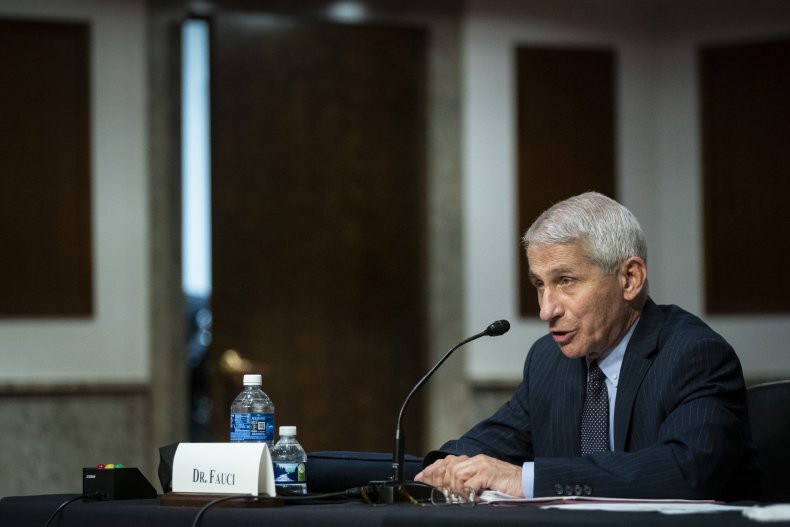
National Institute of Allergy and Infectious Diseases Director Dr. Anthony Fauci addresses reopening efforts during a June 30 Senate Committee hearing. On Thursday, Arizona Congressman Andy Biggs suggested Fauci and Dr. Deborah Birx's warnings about the novel coronavirus outbreak were compromising economic recovery plans. 

AL DRAGO/POOL/GETTY IMAGES

In a testimony before the committee, he urged leaders in states seeing an uptick in COVID-19 cases to consider more moderate reopening strategies as well as ongoing virus mitigation practices.

"We are now having 40-plus thousand cases a day. I would not be surprised if we go up to 100,000 a day if this does not turn around," Fauci told the committee. "It could get very bad."

The Arizona Department of Health Services confirmed the state's highest single-day increase in COVID-19 cases to date on Wednesday with 4,878 new diagnoses. According to the department's data, more than 87,400 people have tested positive for the novel virus and 1,757 have died across Arizona as of Thursday afternoon. Maricopa County has diagnosed more than 54,750 of the state's total infections.

Arizona's overall COVID-19 case count has increased by more than 65 percent over the last three weeks, with the health department's latest report indicating a statewide test-positivity ratio of 12.5 percent.
Exempted from the Caesar Act, the Kurdish-led ‘Autonomous Administration’ negotiates with the US to continue dealing with the Syrian regime

Officials from the Autonomous Administration of North and East Syria discuss measures related to the Caesar Act in a meeting in Hasakah province’s city of Amouda, 6/18/2020 (AA).

By Mohammad Abdulssattar Ibrahim

June 30, 2020
المقال باللغة العربية


AMMAN — Shortly before the Caesar Act went into effect, the United States announced the exemption of the region controlled by the Kurdish-dominated Autonomous Administration of North and East Syria (AA) from the sanctions imposed by the new law. It “will not target the regions of North and East Syria or the Syrian people,” Deputy Special Envoy of the Global Coalition to Defeat ISIS Ambassador William Roebuck said after a meeting with Kurdish officials in Syria on June 16. “Rather, it will target the Syrian regime only,” Roebuck added.

The AA, however, seeks to obtain an additional exemption, allowing it to deal with Damascus “since we were surprised by the mechanism of the law’s implementation,” Salman Barodo, president of the AA’s Commission on Economy and Agriculture, told Syria Direct.

“In practice, it is not possible to apply an exception to the [Autonomous] Administration’s areas from the sanctions, since they are part of Syria and we use the Syrian pound,” said Barodo. There is “economic, social and geographic intertwinement with inner Syria [the regime-held territories],” he added, “and dealings with Damascus cannot be entirely separated when it comes to importing and exporting basic and necessary goods.”

The Caesar Act, which imposes American sanctions on states, entities and individuals dealing with the Syrian government, went into effect on June 17. Afterward, negotiations were revealed between the AA and the Americans to allow the former to deal with Damascus without being subject to sanctions.

“Until now, there is no clear [American] mechanism to exempt the Autonomous Administration from the Caesar sanctions,” said economics expert Chalang Omar.

Omar told Syria Direct that any such mechanism could be expected to provide “direct financial and technical support from the American government, or by way of western governments in the [Global] Coalition [against Daesh (ISIS)], and perhaps also through companies or non-governmental organizations implementing development and infrastructure projects.”

In this context, the co-chair of the Executive Council of the AA, Berivan Khaled, said after the meeting with Roebuck that the “American party assured its continuous support of the Autonomous Administration on economic and political levels.”

Omar did not rule out the possibility of “the AA being granted exemptions or given concessions from the American administration to deal with the Syrian [regime-held territories],” particularly since interaction between the two areas “goes on under the eyes of the Coalition and everyone.” In the case that “America insists on imposing sanctions on internal collaborators,” said Omar, “then they will have to find alternative outlets, markets and sources for goods if they are serious about ensuring the stability of the AA areas.”

Preventive measures

A few days before the Caesar Act came into force, the AA announced that it had formed an economic crisis unit aimed at “avoiding the economic sanctions imposed on Syria under the Caesar Act and improving the standard of living for the workers of the Autonomous Administration,” according to a statement by Salwa al-Sayyed, co-president of the AA’s Commission on Finance.

Before that on May 28, as the Syrian lira fell sharply, The AA announced measures to prevent the exit of US dollars from its territories. The move aimed to control the exchange rate while continuing to use the Syrian lira—in contrast to areas controlled by the opposition and Hayat Tahrir al-Sham (HTS) in northwestern Syria, which has started replacing the Syrian lira with Turkish lira.

Still, both of the moves made by the AA must be accompanied by the“monitoring of food supplies, establishing self-sufficiency projects, developing the economy and raising the level of individual income,” according to Barodo. On June 18, the AA announced a 150 percent increase in the salaries of its workers.

Omar also expressed support for the decision not to replace the Syrian lira with foreign currency because the AA does not have enough foreign currency—like the dollar or the euro—and does not want to use “the currency of neighboring countries, such as Turkey or Iraq, [as that] would leave the AA at the mercy of their economies.”

However, Omar doubts that the moves by the AA “will make a difference in controlling the exchange rate, because this task exceeds the capabilities of the AA. It is the role of the central bank in any country, and the Administration does not have the monetary policy tools that would allow it to perform this task,” he said. Nonetheless, this step aims to “preserve the Administration’s balances of hard currencies in order to conduct its economic policy and secure its need for imported goods.”

In contrast, Suleiman Khalil, Vice President of the Qamishlo (Qamishli) Provincial Council, believes that “controlling the exchange rate can be achieved by exporting and bringing in hard currency,” and that the AA is “able to make a difference in the exchange rate between its region and the other regions in Syria.”

The presence of the “Semalka border crossing [with Iraqi Kurdistan], through which we export some goods, including agricultural products and livestock, and is an outlet that generates dollars for the region,” he explained to Syria Direct. “Additionally, [there is] freedom to deal in dollars in our areas because of supply and demand, and supply in the AA areas is greater than demand, which regulates the exchange rate.”

Pending the outcome of negotiations with the US side regarding an exemption from the Caesar Act sanctions, the AA still has some tools in its pocket to face the repercussions of the law, particularly“ oil and natural gas resources, vast agricultural areas and dams,” said Omar, “providing there is optimal investment.”

This report was originally published in Arabic and translated into English by Mateo Nelson. It reflects changes made on 01/07/2020 at 12:30 pm.


Authors


Mohammad Abdulssattar Ibrahim
Reporter

Trump’s Record on Foreign Policy: Lost Wars, New Conflicts and Broken Promises


On June 13, President Donald Trump told the graduating class at West Point, “We are ending the era of endless wars.” That is what Trump has promised since 2016, but the “endless” wars have not ended. Trump has dropped more bombs and missiles than George W. Bush or Barack Obama did in their first terms, and there are still roughly as many US bases and troops overseas as when he was elected.
Trump routinely talks up both sides of every issue, and the corporate media still judge him more by what he says (and tweets) than by his actual policies. So it isn’t surprising that he is still trying to confuse the public about his aggressive war policy. But Trump has been in office for nearly three and a half years, and he now has a record on war and peace that we can examine.
Such an examination makes one thing very clear: Trump has come closer to starting new wars with North Korea, Venezuela, and Iran than to ending any of the wars he inherited from Obama. His first-term record shows Trump to be just another warmonger in chief.
A Bloody Inheritance
First, let’s look at what Trump inherited. At the end of the Cold War, US political leaders promised Americans a “peace dividend,” and the Senate Budget Committee embraced a proposal to cut the US military budget by 50 percent over the next ten years. Ten years later, only 22 percent in savings were realized, and the George W. Bush administration used the terrorist crimes of September 11 to justify illegal wars, systematic war crimes, and an extraordinary one-sided arms race in which the United States accounted for 45 percent of global military spending from 2003 to 2011. Only half this $2 trillion spending surge (in 2010 dollars) was related to the wars in Iraq and Afghanistan, while the US Navy and Air Force quietly cashed in a trillion-dollar wish list of new warships, warplanes, and high-tech weapons.
President Barack Obama entered the White House with a pledge to bring home US troops from Iraq and Afghanistan, and to shrink the US military footprint, but his presidency was a triumph of symbolism over substance. He won the 2009 Nobel Peace Prize based on a few speeches, a lot of wishful thinking, and the world’s desperate hopes for peace and progress. But by the time Obama stepped down in 2017, he had dropped more bombs and missiles on more countries than Bush did, and had spent even more than Bush on weapons and war.
The major shift in US war policy under Obama was to reduce politically sensitive US troop casualties by transitioning from large-scale military occupations to mass bombing, shelling, and covert and proxy wars. While Republicans derisively dubbed Obama’s doctrine “leading from behind,” this was a transition that was already underway in Bush’s second term, when he committed the United States to completely withdrawing its occupation troops from Iraq by the end of 2011.
Obama’s defenders, like Trump’s today, were always ready to absolve him of responsibility for war crimes, even as he killed thousands of civilians in air strikes in Afghanistan, Iraq, and Syria and drone strikes in Pakistan, Yemen, and Somalia, including the gratuitous assassination of an American teenager in Yemen. Obama launched a new war to destroy Libya, and the United States’ covert role in the war in Syria was similar to its role in Nicaragua in the 1980s, for which, despite its covert nature, the International Court of Justice convicted the United States of aggression and ordered it to pay reparations.
Many senior US military and civilian officials deserve a share of the guilt for America’s systematic crimes of aggression and other war crimes since 2001, but the principle of command responsibility, recognized from the Nuremberg principles to the US Uniform Code of Military Justice, means that the commander in chief of the US armed forces, the president of the United States, bears the heaviest criminal responsibility for these crimes under US and international law.
Is Trump Different?
In January 2017, as Donald Trump prepared to take office, US forces in Iraq conducted their heaviest month of aerial bombardment since the “shock and awe” bombing during the US invasion of Iraq in 2003. This time, the enemy was the Islamic State (IS), a group spawned by the US invasion of Iraq and Obama’s covert support for Al Qaeda–linked groups in Syria. Iraqi forces captured East Mosul from the Islamic State on January 24, and in February, they began their assault on West Mosul, bombing and shelling it even more heavily until they captured the ruined city in July. A Kurdish Iraqi intelligence report recorded that more than forty thousand civilians were killed in the US-led destruction of Mosul.
Trump famously summed up his policy as “bomb the shit out of” the Islamic State. He appeared to give a green light to the military to murder women and children, saying, “When you get these terrorists, you have to take out their families.” Iraqi troops described explicit orders to do exactly that in Mosul. Middle East Eye (MEE) reported that Iraqi forces massacred all the survivors in Mosul’s Old City.
“We killed them all,” an Iraqi soldier said. “Daesh (IS), men, women, children. We killed everyone.” An Iraqi major told MEE,
“After liberation was announced, the order was given to kill anything or anyone that moved . . . It was not the right thing to do . . . They gave themselves up and we just killed them . . . There is no law here now. Every day, I see that we are doing the same thing as Daesh. People went down to the river to get water because they were dying of thirst and we killed them.”
By October 2017, Raqqa in Syria was even more totally destroyed than Mosul in Iraq. Under Obama and Trump, the United States and its allies have dropped more than 118,000 bombs and missiles on Iraq and Syria in their campaign against the Islamic State, while US HIMARS rockets and US, French, and Iraqi heavy artillery killed even more indiscriminately.
The wholesale destruction of Mosul, Iraq’s second-largest city, and other major cities in Iraq and Syria cannot be legally justified under the Hague and Geneva Conventions, any more than the destruction of entire cities in past wars, like Hiroshima or Dresden. Despite the total lack of accountability, it is clear that American bombs, rockets, and shells killed thousands of civilians in each city and town captured. Obama and Trump share responsibility for these terrible crimes, but they are an escalation of the systematic war crimes the United States has committed since 2001 under three presidents.
In Afghanistan, as the Taliban gradually takes control of more of the country, Trump has resisted the temptation to send in tens of thousands more US troops, as Obama did, but he instead approved a major escalation in US bombing that made 2018 and 2019 the heaviest and deadliest years of US bombing in Afghanistan since 2001.
Trump has shrouded his war-making in even greater secrecy than Obama. The US military has not published a monthly Airpower Summary since February 2020, nor official troop deployment numbers for Afghanistan, Iraq, or Syria for nearly three years. But the United States has dropped at least twenty thousand bombs on Afghanistan since Trump came to power, and there is no evidence of a reduction in bombing under the peace agreement the administration signed with the Taliban in February. Some US troops have been withdrawn under that agreement, but the remaining 8,600 are still being replaced as their tours end, keeping US troop strength at about the same level as when Obama left office.
Trump made a great show of repositioning US troops in Syria in October 2019, leaving the United States’ Kurdish allies in Rojava to confront the Turkish invasion alone. But there are still at least 500 US troops in Syria, and Trump deployed 14,000 more US troops to the Middle East in 2019, including to a new base in Saudi Arabia.
Trump has vetoed every bill passed by Congress to disengage US forces from the Saudi war in Yemen and to halt the sales of US-made warplanes and bombs, which the Saudis use to systematically kill Yemeni civilians. He created a new conflict with Iran by pulling out of the nuclear deal, and in January 2020, he capriciously flirted with a full-scale war on Iran by ordering the assassination of Iran’s General Qasem Soleimani and Iraqi military commander Abu Mahdi al-Muhandis in Iraq.
Trump’s bizarre decision to move the US Embassy in Israel to a plot of land that is only partly within Israel’s internationally recognized borders — and partly on Palestinian territory that Israel is illegally occupying — quite literally took US international relations into uncharted territory. Then Trump unveiled a so-called peace plan based on Prime Minister Benjamin Netanyahu’s ambition to annex the rest of Palestine into a “Greater Israel” with vastly expanded — but still unrecognized and illegal — international borders.
Trump has also backed a coup in Bolivia, staged several failed ones in Venezuela, and targeted even the United States’ closest allies with sanctions to try to prevent them from trading with US enemies. Trump’s brutal sanctions on Venezuela, Iran, North Korea, Syria, and Cuba are not a peaceful alternative to war, but a form of economic warfare just as deadly as bombs, especially during a pandemic and its accompanying economic meltdown.
A Boon to the Merchants of Death
Once the large-scale US military occupations in Iraq and Afghanistan ended under Obama, the US military budget fell to $621 billion by 2015. But since then, military spending for procurement, research and development (R&D), and base construction has risen by 39 percent. This has been a huge windfall for the Big Five US weapons makers — Lockheed Martin, Boeing, Raytheon, Northrop Grumman, and General Dynamics — whose arms sales revenues rose 30 percent between 2015 and 2019.
The 49 percent increase to more than $100 billion for R&D on new weapons systems in 2020, part of the enormous $718 billion Pentagon budget, is a down payment on trillions of dollars in future revenue for the merchants of death unless these programs are stopped.
The pretext for Trump’s huge investment in big-ticket, high-tech weapons, including a new Space Force with a $15 billion price tag for 2021, is the New Cold War with Russia and China that he officially unveiled in the 2018 National Defense Strategy. Obama was already trying to shift away from the United States’ lost counterinsurgency wars in the greater Middle East through his “Pivot to Asia,” the US-backed coup in Ukraine, and the expansion of US land and naval forces encircling Russia and China.
But Trump has the same problem as Obama as he tries to wriggle out of the “forever wars”: how to bring US troops home without making it obvious to the whole world that this chronically weak imperial power and its extravagant multitrillion-dollar war machine has been defeated everywhere. Even the most expensive weapons still only kill people and break things. Establishing peace and stability require other kinds of power and legitimacy, which the United States does not possess and which cannot be bought.
Before President Dwight D. Eisenhower left office in 1961, he remarked, “God help this country when someone sits in this chair who doesn’t know the military as well as I do.” Trump is obviously as dazzled by chests full of medals and whizz-bang technology as every other president since Eisenhower, so he will keep giving the Pentagon everything it wants to keep spreading violence and chaos around the world.
Just as Obama co-opted and muted liberal opposition to Bush’s wars and record arms spending, Trump has co-opted and muted conservative opposition to Obama’s wars. Now, with the outpouring of protests against domestic police repression and calls for defunding the police, there is a growing chorus to also defund the military. That is certainly not a call Trump would listen to, but would Joe Biden be more receptive to public calls for peace and disarmament than Obama and Trump?
Probably not, based on his long record in the Senate, his roles in authorizing war on Yugoslavia, Afghanistan, and Iraq, his close ties to Israel, and his failure to rein in US war-making as vice president, despite personally opposing Obama’s escalation in Afghanistan. Biden is also trying to outdo Trump in his opposition to China. Like Obama and Trump, Biden would be mainly a new manager and salesman in chief to sell the military-industrial complex’s latest strategy for war and global military occupation to the corporate media and the American public.
We will not rescue our country from the iron grip of the military-industrial complex by picking the lesser evil and hoping for the best. That has not worked for sixty years, since Eisenhower defined the problem so clearly in his farewell address.
On the other hand, a civil society coalition, led by the Poor People’s Campaign and including CODEPINK, is calling for a $350 billion cut in the military budget to fund human needs and public services, and representatives Barbara Lee, Pramila Jayapal, and Alexandria Ocasio-Cortez have introduced a resolution in Congress to do just that.
At the margins, this campaign could have more impact on Biden than on Trump, but not if people sweep up the bunting on election night and think their job is done, as liberals did with Obama and anti-war conservatives did with Trump. Unless and until the American public applies overwhelming pressure to dismantle the US war machine and its futile bid for “full spectrum” global dominance, the US military will keep losing wars on its own terms, bleeding us dry (metaphorically), and bleeding our neighbors overseas dry (literally), until it loses a major war with mass US casualties or destroys us all in a nuclear war.
The US peace movement has always had huge passive public support, but it will take mass collective action, not just passive support, to secure a peaceful future for our children and grandchildren. Public outrage and activism are starting to take away the license to kill black and brown people with impunity from the militarized RoboCops on our streets. The same kind of collective political action can defund and disarm the US military and take away its license to kill black and brown people everywhere.
Building a new anti-war movement that is connected to the domestic anti-police struggle is the only thing that can rein in US militarism. Because reelecting a president with as much blood on his hands as Trump — or simply transferring the command of the war machine to Joe Biden — certainly won’t.
This piece first appeared in Jacobin.
Medea Benjamin is cofounder of CODEPINK for Peace, and author of several books, including Kingdom of the Unjust: Behind the US-Saudi ConnectionNicolas J. S. Davies is a writer for Consortium News and a researcher with CODEPINK, and the author of Blood On Our Hands: the American Invasion and Destruction of Iraq