Friday, November 06, 2020


Book Review: Jodi Dean's 'Comrade'
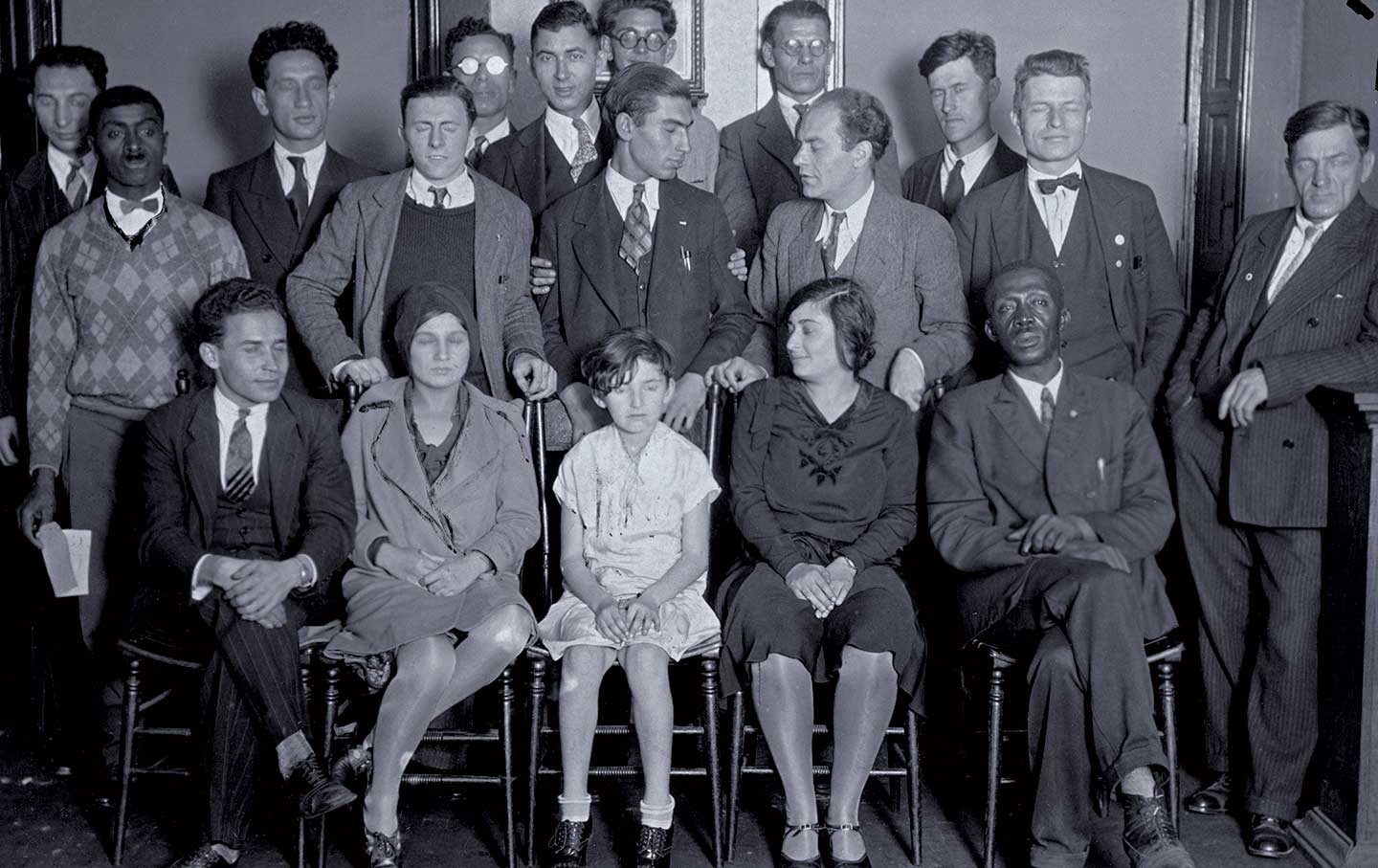
Photo: The Young Communist League, 1929. (Afro American Newspapers / Gado / Getty Images)

By Corey Robin
The Nation

...In Ernst Lubitsch’s 1939 film Ninotchka, three Soviet officials are sent to Paris on a mission. But instead of doing the work, they’re bewitched and bourgeoised by the City of Lights. They drink, they dance, they stay out late. Moscow dispatches an envoy to set the rogues straight. They anxiously await the envoy’s arrival at the train station. When they discover the envoy is a striking woman nicknamed Ninotchka (played by Greta Garbo), they’re enchanted. A “lady comrade!” one exclaims. But Ninotchka is not amused. “Don’t make an issue of my womanhood,” she tells them. “We’re here for work, all of us.”

That struggle—between an identity based on gender (or nation, race, or class) and the solidarity of doing the work—is at the heart of Jodi Dean’s Comrade. One of the most innovative and imaginative political theorists on the contemporary scene, Dean uses this scene in Ninotchka and a thoughtfully curated library of other texts, from the writings of the Soviet avant-garde to oral histories of the Black Belt, to argue for a communism that is stringent yet pleasurable, joyous yet disciplined. Like Ninotchka, Dean’s here for the work. Like Lubitsch, she makes it fun.

Comrade is part of a trilogy of texts Dean has written over the past decade on the political theory of communism. In The Communist Horizon, she identified the transcendence of capitalism as the ambit of the left’s actions. In Crowds and Party, she located those actions in the party form. In Comrade, she examines the relation between members of the party. That relation creates two force fields. The first lies between members of the party, where a regulative ideal of being a “good comrade” not only governs the actions of each but also binds the actions of all. That binding creates a massive amount of power, which then projects a second force field—against the agents and institutions of capitalism that comrades seek to overthrow. The attraction of the first force field is necessary for the repulsion of the second. Seasoned union organizers know the truth of these force fields all too well; as Dean shows, so did anti-communists like George Orwell. Yet it is a truth many on the left ignore or evade. “If the left is as committed to radical change as we claim,” Dean insists, “we have to be comrades.”

All politics require a space—a place where people can assemble, deliberate, and if necessary, move—and domains of action, which may include the economy, religion, sexuality, health, and more. What makes comrades unique is that it is the relationship among them that creates both types of space: where they assemble and what they assemble for. The word “comrade,” Dean explains, “derives from camera, the Latin word for room, chamber, and vault.” (Much like “cadre,” from the Latin quadrum, or square.) Rooms and vaults can be identical and easily reproducible. They provide cover or shelter. They differentiate those within from those without. Comrades create all of these effects by their affect, “a closeness, an intensity of feeling and expectation of solidarity,” and by their activity. Whereas work in a capitalist society is sustained by the coercion of the market, the work of comrades is powered by their commitment to one another, which derives from their close quarters (psychically speaking) and their commitment to the task at hand. The two commitments are mutually reinforcing. “One wants to do political work,” Dean writes, because of one’s attachment to one’s comrades, and one is attached to one’s comrades because one wants to do the work.

Yet comradeship exceeds those affects and attachments. It must, for our sympathies are momentary, our purposes inchoate. Sometimes we fly to the assemblies, ready to do the work of the collective; other times, we laze about at home, succumbing to other desires or hesitation about our aims. Comradeship turns longing into intention and sustains that intention after the originating rush has dissipated. Comradeship extends the life of the crowd. It fulfills the function that labor historians have ascribed to the best union bureaucracies, which prolong solidarity after the strike, and that Arendt ascribed to constitutions, which institutionalize the aims and ambitions of the revolutionary moment after that moment has ceased. Comradeship does that work without the law or the state. It is instead an “ego ideal,” to use Dean’s Freudian language, maintained by the comrades themselves.

That attempt to create a political space without relying on the law or the state is where we find the most intense unity of the ancients in all their outwardness and the moderns in all their inwardness. It is also where communism—and left politics in general—is most vulnerable to criticism and complaint.

The effort of comrades to create and sustain a public space entirely through the psychic mechanisms of the ego ideal puts tremendous, almost inhuman pressure on them and their work. Without the customary supports of public life—whether the institutions of the state (after communism comes into power is a different story) or familiar sources of identity and attachment—comrades must ensure that each and every waking hour of their lives is dedicated to the common work of comrades. It is a demanding and unforgiving ideal, for much is at stake in any one person’s withdrawal from it. Yes, the work is performed in common with comrades, and the force field between them is mighty in its effects. Yet the force field is vulnerable to the competing energy of other forms of identification and attachment.

Our other identities and attachments don’t simply disappear because the comrade declares them gone. They constantly clamor for our attention. Conversely, if those identities and attachments don’t sap the comrade of her energy and commitment, they may become all too tempting substitutes for the true work of comradeship. How many communists and leftists have taken this shortcut, forsaking political argument for simpleminded appeals to a worker’s identity or to national citizenship or gender or ethnic affiliation as the basis for action? How many activists have spoken those words of promise and threat—“You’re one of us”—that are so resonant in families yet so dangerous to politics? Tribalism comes in many varieties, and it would be foolish to think the comrade is not immune to its calls.

That moment of Ninotchka’s arrival in the Paris train station offers Dean another instructive mise-en-scène. As the three Soviets scan the platform, wondering who the comrade from Moscow might be, they spy a passenger who fits their expectations. They’re just about to extend a welcome when the passenger greets someone else, with a salute of “Heil Hitler.” The Soviets freeze. “That’s not him,” one of them says. Their mistake is productive for Dean. They’re assuming the comrade is a specifiable type—a gender, a face, a look—but comrades are “generic”; they don’t look like anyone or anything. They don’t have a specific identity. Comrades can be anybody, though not, Dean adds wryly, with a nod to that fascist, everybody. Anybody can do the work, and anyone who does the work will enjoy the solidarity of comrades. “We don’t even need to know each other’s names,” an activist tells her. “We’re comrades.”

The solidarity of political work is not a subject well examined in the canonical literature of politics—Weber, one of the few theorists to think about politics as work, focused almost exclusively on charismatic leaders, not collectives—but it is a concern of vital interest to the left. Socialists of varying stripes have often looked to the workplace (or warfare) as laboratories of solidarity. So taken by the coordinated nature of modern work were the Saint-Simonians, for example, that they designed vests with buttons in the back so that no one could dress without the cooperation of others. In the physicality of concerted labor, many a socialist has caught a glimpse of a more solidaristic future.

Dean’s model derives from neither the workplace nor warfare but from the political work and testimony of communists themselves, which yields an eclectic blend of voices—part republican, part romantic. On the basis of that testimony, she concludes that comradeship enables us to take on the perspective of others, to see our actions “through their eyes,” which “remakes the place from which one sees.” That enlarged perspective has been the calling card of thinkers ranging from Rousseau and Kant to Arendt and Habermas. Whereas these thinkers often find that perspective in the legislative institutions of the state or the organs of public opinion or the heroic moments of civic action, Dean locates it, as does Gornick, in the slow boring of hard boards, in the work of politics that escapes the limelight but where comrades dedicate themselves to a task and hold themselves accountable to its completion.

Through that work, comrades can come to experience the joy of collective action and the enjoyment of one another. The joy is so intense that it spills onto other entities. Drawing on the work of artists and writers from the early Soviet avant-garde, which she compares to the poetry of Whitman, Dean describes an extension of ecstasy to “comrade objects” and “comrade things.” When the “love and respect” among comrades is “so great that it can’t be contained in human relations,” it “spans to include insects and galaxies (bees and stars).”

Up to the 1990s, Dean’s commitment to the generic nature of the comrade would have raised the hackles of those in the liberal center and on the right, who would have seen it as a threat to the individual. Today, it will press buttons for some on the left, who will see it as a challenge to the claims of certain forms of identity. The comrade, Dean insists, seeks to equalize relationships across race, class, nation, religion, ethnicity, and gender. It creates a sameness, the sameness of those who are doing the work.

The only difference that remains salient is between those who are on one side of the struggle and those who are on the opposite side. The mobility of that metaphor—of being on one side or the other—allows Dean to insist on forms of affiliation and attachment that are neither identitarian nor exclusive. Anyone can be a comrade; all one has to do is move to the other side. Though this quote from a Washington Post report on the Bernie Sanders campaign arrived too late for Dean to use, it offers a helpful instantiation of her claim: “Sanders is a candidate who presents himself less as a personality than a conduit for a movement. And in the Bernie bubble, [Alexandria] Ocasio-Cortez is seen as the future of the movement embodied. What makes her so effective as a surrogate, beyond her star power, is that if you campaign on electing a movement rather [than] a person, there’s no difference between hearing the message from the 78-year-old white male candidate or his 30-year-old Latina supporter.”

The comrade, Dean makes clear, is not a description but an ideal. Comrades do not eliminate gender or race or conflicts. But what they can do is name a common horizon; they can state a destination to which they are collectively heading, an aim toward which they are working. Comradeship is the announcement of another way of being: not one in which difference is eliminated but in which it becomes the stuff of political art, of mediating conflicts in order to do the work for which all have come. Though it is anarchists who are best known for emphasizing the prefigurative elements of radical politics—arguing that how we do the work now will shape the society to come—Dean’s analysis also has a prefigurative element, with Lenin as its seer. The discipline of comrades, he said, “is a victory over our own conservatism, indiscipline, petty-bourgeois egoism, a victory over the habits left as a heritage to the worker and peasant by accursed capitalism.” The comrade contains within herself the defeat of the old regime.

The left has good reason to be wary of the stern antinomies of the comrade. The freedom that goes by the name of discipline, the suppression of difference in the name of solidarity, the words of emancipation as window dressing for authoritarian constraint—we’ve been down this road before. Read More


Automation_and_the_future_of_work

Automation and the Future of Work

A consensus-shattering account of automation technologies and their effect on workplaces and the labor market

Silicon Valley titans, politicians, techno-futurists and social critics have united in arguing that we are living on the cusp of an era of rapid technological automation, heralding the end of work as we know it. But does the much-discussed “rise of the robots” really explain the jobs crisis that awaits us on the other side of the coronavirus?

In Automation and the Future of Work, Aaron Benanav uncovers the structural economic trends that will shape our working lives far into the future. What social movements, he asks, are required to propel us into post-scarcity, if technological innovation alone can’t deliver it? In response to calls for a universal basic income that would maintain a growing army of redundant workers, he offers a counter-proposal.

Reviews

“A powerful and persuasive explanation of why capitalism can’t create jobs or generate incomes for a majority of humanity.”

“An excellent, insightful account of the contours of our present labor crisis. Benanav articulately makes the case for a post-scarcity future.”

“A highly quantitative analysis of the nature of contemporary unemployment flowers into something quite different and unexpected: a qualitative argument for the invention of new collective capacities in a world where work is no longer central to social life.”

“A rare book that manages to soberly assess the contemporary landscape while keeping a clear eye on our utopian horizons. This is an important intervention into current discussions around technology and work—and a must-read for anyone who believes capitalist decay is not the only future.”

“Benanav dissects and disproves the idea that automation is eradicating work … We don’t need to wait for robots to do all the work; we can collectively decide what we need, then plan the economy to achieve it.”

Automation and the Future of Work: a letter from the Editor

Gettyimages-829376866-2-
Justin Sullivan / Getty

It’s actually a rare thing for a writer to be fully at home in both speculative social theory and number-crunching economics, but Aaron Benanav of Humboldt University fits that bill. To adapt a phrase, he combines practicality of the intelligence with optimism of the will. As he argues, ‘our present reality is better described by near-future science fiction dystopias than by standard economic analysis’, and it’s become a matter of urgency for us ‘to slip out of this timeline and into another’. We won’t achieve that, however, Benanav demonstrates, without a proper grasp of the dynamics of actual material production.

Automation and the Future of Work began life as a two-part essay in New Left Review toward the end of 2019. The first instalment questioned whether the much-anticipated rise of the robots really explained the worsening crisis of under-employment in all corners of the globe. ‘There are many reasons to doubt the hype’, he insisted. The second essay, equally heterodox, re-examined the assumptions that led automation theorists to pin their colours on proposals for a Universal Basic Income. UBI was, he insisted, no ‘silver bullet’ for deep-lying socio-economic problems. Taken together, these interventions were highlights of NLR’s publishing year.

Work on expanding the essays into a Verso book continued through the pandemic crisis of the spring. Aaron wrote to me from Chicago, his previous academic posting, in mid-March: ‘How are things over there? Does Verso still exist? Is my March 22 deadline still meaningful?’. To answer each point in turn: pretty bad, yes, and definitely yes. Holed up at home as Chicago prepared to go into lockdown, his emails mixed updates on the manuscript with concern for my Covid symptoms. ‘Sorry to be an American about this, but don't take anti-inflammatories/ibuprofen/aspirin’, he counselled. ‘Take some daily zinc, if you have it, and vitamin D3. Please be careful and keep me updated.’ I hope he felt in safe hands with me; I certainly did with him.

Benanav’s iconoclastic reappraisal of world labour-market dynamics, his systematic critique of the received wisdom around the supposedly decisive effect of technological unemployment, is likely to define the terms of debate; so, too, his plotting of a different, more solidaristic route to post-scarcity economics. ‘Instead of presupposing a fully automated economy and imagining the possibilities for a better and freer world created out of it,’ he writes, ‘we could begin from a world of generalised human dignity, and then consider the technical changes needed to realise that world.’

Among the books that will help us ascend from what Marx termed the realm of necessity to the realm of freedom, this is a pivotal contribution.

Tom Hazeldine, Verso Editor.

London, 2020.

Automation and the Future of Work by Aaron Benanav is one of our November Book Club reads: a carefully curated selection of books that we think are essential and necessary reading. Find out more about our Book Club here.


Solidarity rallies for health-care workers bring out support in Calgary, Edmonton

© Mike Symington/CBC 
Supporters gathered in front of the Foothills Medical Centre at 6:30 a.m. on Thursday.

Several rallies were held across Alberta on Thursday morning to show solidarity for health-care workers who walked off the job last week to protest the provincial government's announcement it would outsource thousands of jobs.

On Oct. 26, hundreds of health-care workers engaged in a wildcat strike after Alberta's Minister of Health Tyler Shandro announced that Alberta Health Services would lay off between 9,700 and 11,000 employees.

They were swiftly ordered back to work by the Alberta Labour Relations Board.

On Oct. 27, Finance Minister Travis Toews told reporters that nursing and support workers who participated in the strike could be fined, suspended or even fired from their jobs.

On Thursday, supporters gathered in front of the Foothills Medical Centre and the Sheldon M. Chumir Health Centre in Calgary, and Edmonton's University of Alberta Hospital, to show their support for the front-line workers.

"We [are here] to thank all of the brave members that walked out on Oct. 26," said Bobby-Joe Borodey, one of the vice-presidents of the Alberta Union of Provincial Employees (AUPE) — the union that represents the health-care workers — at the rally in front of the Foothills hospital.

"We did that to send a message to [Premier] Jason Kenney and the UCP government that this direction that they're heading in with privatization is awful, and it's something that Albertans don't want."
'Make no mistake, they're all front-line workers'

Unions representing Alberta's health-care workers told CBC Edmonton in mid-October that there would be major labour strife if the government follows through on the proposed restructuring plan underpinned by thousands of layoffs.

Most of those who will lose their jobs work in laboratory, linen, cleaning and in-patient food services with AHS, and their positions will be outsourced to private companies.

According to Borodey, there is no overstating the value of their work during COVID-19.

"Make no mistake, they're all front-line workers," Borodey said. "When this pandemic started, they were the heroes that were on the front-line — the first line of defence at keeping Albertans safe at hospitals and health centres across the province.

"And then, when we're in month eight, all of a sudden, they're zeroes. And they're overpaid and replaceable. So, they're feeling pretty deflated and frustrated."
© Mike Symington/CBC Calgary
 'We're in the same risk as these guys. It's high-stress. It takes a lot of dedication, it takes a lot of courage to go to work every day. And then to have the employer treat you with such disregard, it's, you know, it's demoralizing,' Mike Mahar said.

Mike Mahar, the Canadian director of the Amalgamated Transit Union (ATU), said that as fellow essential workers, the ATU wanted to attend the rally at the Foothills show its support.

Mahar, who had strong words for the provincial government, said transit workers understand the intense pressure of working the front-lines during the pandemic.

"We're in the same risk as these guys. It's high-stress. It takes a lot of dedication, it takes a lot of courage to go to work every day. And then to have the employer treat you with such disregard, it's, you know, it's demoralizing," Mahar said.

"To have the carpet pulled out from under you like that, during a pandemic — it's actually reckless. I think it's criminal. Not just putting those people out of work, but doing it right now … it's going to cost people's lives, I bet."

NDP MLA David Shepherd, who also attended the rally at the Foothills, said he is receiving hundreds of emails from people who are tired of the attacks on health-care staff.

"[The UCP government] announced this as our province is entering into the second wave of COVID-19. It's absolutely unacceptable," Shepherd said.

CBC News asked the Alberta government for comment on the rallies but it has not yet responded.

However, in October, Shandro said the cuts are eventually expected to save up to $600 million annually, and there will be a "long-term and gradual" implementation of the plan.

San Francisco voters approve new taxes for wealthy CEOs and tech companies

Any company whose top executive earns 100 times or more than their average worker will pay a surcharge under new law


Associated Press

Thu 5 Nov 2020

 ‘The very wealthy are gaining more and more. They’ve gotten much richer during the pandemic, while everyone else has remained stagnant,’ says the author of the measure. 

In an effort to address economic disparity laid bare by the coronavirus pandemic, San Francisco voters overwhelmingly approved several tax measures targeting property owners and big businesses with CEOs paid far higher than their average workers.

Under the new law, any company whose top executive earns 100 times more than their average worker will pay an extra 0.1% surcharge on its annual business tax payment. If a CEO makes 200 times more than the average employee, the surcharge increases to 0.2%; 300 times gets a 0.3% surcharge and so on.

Voters also agreed to sweeping business tax changes that will lead to a higher tax rate for many tech companies, and a higher transfer tax on property sales valued between $10m and $25m.

“We’re not gonna shed any tears if penthouse dwellers have to cough up,” the San Francisco League of Pissed Off Voters wrote in its voter guide.

The results “show that San Franciscans are concerned about growing economic inequality”, city Supervisor Matt Haney, the author of the measure titled the Overpaid Executive Tax, said on Wednesday. “The very wealthy are gaining more and more. They’ve gotten much richer during the pandemic, while everyone else has remained stagnant.


“We need the wealth that has been generated in the city to be shared more broadly with workers and residents,” he said.

Critics call the surcharge a blatant attempt at redistribution of wealth and criticized raising business taxes in the middle of a recession.

Since March, Covid-19 restrictions have shut down critical elements of San Francisco’s economy. Tourists are scarce, and legions of workers in tech and in the city’s main business and financial districts have left, able to work remotely from anywhere. Office vacancy rates went up while rents in the prohibitively expensive city dropped to their lowest in years.
Advertisement


“The middle of pandemic-fueled shutdown is the wrong time to raise taxes,“ said Jim Wunderman, president and CEO of the business advocacy group Bay Area Council. “The drip, drip, drip of new general taxes is going to erode the already shaky foundations of local economies decimated by the worst downturn in generations.”

The CEO tax is expected to generate between $60m and $140m per year, and Haney said he wants most of the money directed towards health services. He dismisses fears that the surcharge will drive companies out of the city, saying the tax was modest in comparison to the cost of moving a business. He said he hoped the tax would drive companies to re-examine their compensation structure and will ultimately be adopted on a national level.

The tax is somewhat similar to an executive-pay surcharge passed by the city council in Portland, Oregon, nearly four years ago. San Francisco city leaders considered the idea several years ago, and a 2014 state proposal to lower taxes for companies whose executives were paid less than 100 times the median worker did not pass in the California legislature.

“The idea didn’t get a lot of traction because people in San Francisco didn’t feel it made sense to tax CEOs,“ political consultant Jim Ross said. “But now you’re seeing a big segregation between the have and have-nots as executives get absurdly paid while others are struggling.”


Patients reported international hydroxychloroquine shortages due to
COVID-19

AMERICAN COLLEGE OF RHEUMATOLOGY

Research News

ATLANTA -- A new study shows that patients with rheumatic diseases across Africa, Southeast Asia, the Americas and Europe had trouble filling their prescriptions of antimalarial drugs, including hydroxychloroquine, during the 2020 global coronavirus pandemic, when antimalarials were touted as a possible COVID-19 treatment. Patients who could not access their antimalarial drugs faced worse physical and mental health outcomes as a result. Details of the research was presented at ACR Convergence, the American College of Rheumatology's annual meeting (ABSTRACT #0007).

Systemic lupus erythematosus, also called lupus or SLE, is a chronic (long-term) disease that causes systemic inflammation which can affect multiple organs: the skin, joints, kidneys, the tissue lining the lungs (pleura), heart (pericardium) and brain. Many patients experience fatigue, weight loss and fever. Antimalarial drugs are taken regularly by most people with lupus, as well as many with rheumatoid arthritis (RA) and other rheumatic diseases.

In the early weeks of the global SARS-CoV-2 (COVID-19) pandemic, two antimalarial drugs often used to treat lupus and RA, hydroxychloroquine and chloroquine, were touted to potentially prevent or treat COVID-19 infections. Both drugs were suddenly repurposed as COVID-19 treatments despite a lack of data to support this use, leading to worldwide shortages of both. A team of international researchers launched this study to assess the effects of antimalarials on COVID-19 infection and the impact of drug shortages on people with rheumatic disease.

"The COVID-19 Global Rheumatology Alliance's Patient Experience Survey was launched in April 2020 during the early days of the pandemic, when the scientific and research communities were under extraordinary pressure to identify safe and effective treatments for SARS-CoV-2. Since hydroxychloroquine is an essential treatment for RA and lupus, reported drug shortages of antimalarials became a major concern," says the study's lead author, Emily Sirotich, a doctoral student at McMaster Centre for Transfusion Research in Hamilton, Ontario. and Patient Engagement Lead of the COVID-19 Global Rheumatology Alliance. "The aims of this study were to assess the prevalence and impact of drug shortages during the COVID-19 pandemic, and whether the use of antimalarials in patients with rheumatic disease was associated with a lower risk of COVID-19 infection."

Data for the new study was collected using the COVID-19 Global Rheumatology Alliance Patient Experience Survey. The survey was distributed online through patient support organizations and social media. Both patients with rheumatic diseases and parents of pediatric patients anonymously completed the surveys with information on their rheumatic disease diagnosis, medications they take, COVID-19 status and any disease outcomes. The researchers evaluated the impact of antimalarial drug shortages on patients' disease activity, as well as their mental health and physical health.

Of the 9,393 people who responded to the survey, 3,872 were taking antimalarial drugs and 230 said they were unable to continue taking their medications because of a lack of supply at their pharmacy. Antimalarial shortages were worse for people in Africa and Southeast Asia: 26.7% of respondents in Africa and 21.4% of respondents in Southeast Asia reported inadequate supplies at local pharmacies. Patients in the Americas (6.8%) and Europe (2.1%) also reported being unable to fill their prescriptions at their pharmacy due to lack of supply.

The study found that patients on antimalarials and those who did not take these drugs had similar rates of COVID-19 infection. A total of 28 patients with COVID-19, who were also taking antimalarials, were hospitalized. Of 519 patients diagnosed with COVID-19 in the survey, 68 reported that they were prescribed an antimalarial for their coronavirus infection. Patients who could not fill their antimalarial prescriptions experienced higher levels of disease activity and also experienced worse mental and physical health symptoms, the study found.

"The findings from this study highlight the harmful consequences of repurposing antimalarials, without adequate evidence for benefit, on patients who rely on access to their hydroxychloroquine or chloroquine prescriptions for their rheumatic diseases," says Ms. Sirotich. "It is necessary to maintain scientific rigor even in the context of a pandemic and recognize the potential impacts of drug shortages. It is also important to address regional disparities in access to medications, to ensure all people, particularly those living in developing countries, receive fair and equitable access to their essential medications."

###

About ACR Convergence

ACR Convergence, the ACR's annual meeting, is where rheumatology meets to collaborate, celebrate, congregate, and learn. Join ACR for an all-encompassing experience designed for the entire rheumatology community. ACR Convergence is not just another meeting - it's where inspiration and opportunity unite to create an unmatched educational experience. For more information about the meeting, visit https://www.rheumatology.org/Annual-Meeting, or join the conversation on Twitter by following the official hashtag (#ACR20).

About the American College of Rheumatology

The American College of Rheumatology (ACR) is an international medical society representing over 7,700 rheumatologists and rheumatology health professionals with a mission to empower rheumatology professionals to excel in their specialty. In doing so, the ACR offers education, research, advocacy and practice management support to help its members continue their innovative work and provide quality patient care. Rheumatologists are experts in the diagnosis, management and treatment of more than 100 different types of arthritis and rheumatic diseases.

ABSTRACT:

Antimalarial Drug Shortages During the COVID-19 Pandemic: Results from the Global Rheumatology Alliance Patient Experience Survey

Background/Purpose:

Early in the COVID-19 pandemic, hydroxychloroquine and chloroquine were empirically promoted and used for treatment and prevention of SARS-CoV-2 infection. The repurposing of these drugs before robust efficacy data were available led to potentially harmful shortages for people with rheumatic diseases. The aims of this study were to assess (1) whether the use of antimalarials in patients with rheumatic disease was associated with a lower risk of COVID-19 infection, and (2) the prevalence and impact of drug shortages during the COVID-19 pandemic.

Methods:

The COVID-19 Global Rheumatology Alliance (C19-GRA) Patient Experience Survey was distributed online through patient support organizations and on social media. Patients with rheumatic diseases (or the parents of pediatric patients) anonymously entered data including their rheumatic disease diagnosis, medications, COVID-19 status, and disease outcomes. Impact of drug shortages was evaluated for the effect on patient disease activity, mental health and physical health states by comparing mean values with two-sided independent t-tests to identify significant differences.

Results:

From 9,393 respondents (mean age 46.1 (SD 12.8) years, 90.0% female), 3,872 (41.2%) were taking antimalarials (Table 1). Of these, 230 (6.2%) were unable to continue taking antimalarials because of a lack of supply at their pharmacy. 21.4% of patients in South-East Asia and 26.7% in African regions reported an inadequate supply of antimalarials in pharmacies, in contrast to 6.8% of patients in the Americas and 2.1% in European regions. There were similar rates of COVID-19 infection among patients on antimalarials as compared to patients not on these drugs (6.7% vs. 4.7%). A total of 28 patients (10.8%) with COVID-19 who were taking antimalarials were hospitalized. Of 519 patients diagnosed with COVID-19, 68 (13.1%) indicated they were prescribed antimalarials as a treatment for their COVID-19 infection.

Patients who were unable to obtain antimalarials from their pharmacies compared to those who did not experience medication shortages experienced higher levels of rheumatic disease activity (5.1 > 4.3, t(244) = 4.44, p < 0.001) (Figure 1) and poorer mental (5.8 < 6.3, t(252) = 3.82, p < 0.001) and physical health (5.6 < 6.4, t(254) = 5.97, p < 0.001) (Figure 2).

Conclusions:

Patients in African and South-East Asian regions reported greater difficulty obtaining antimalarial drugs to treat their rheumatic disease in contrast to patients in the Americas and European regions. Patients who experienced antimalarial drug shortages reported worse mental and physical health outcomes than those able to obtain their medications. Antimalarials did not protect patients with rheumatic disease from COVID-19 or from hospitalization as a result of COVID-19. The unintended harmful consequences of repurposing antimalarials, without adequate evidence for benefit, highlights the importance of maintaining scientific rigor even in the context of a pandemic. Regional disparities of access to medications should be addressed to ensure all people, particularly those living in developing countries, receive fair and equitable access to these essential medications.

Disclaimer: AAAS and EurekAlert! are not responsible for the accuracy of news releas

Court orders FDA to assess environmental impact of GM salmon

NEW YORK — A federal court judge ordered the U.S. Food and Drug Administration on Thursday to conduct an environmental assessment of genetically modified salmon that he said was required for the agency’s approval of the fish.
© Provided by The Canadian Press

But the judge did not vacate the FDA’s approval of the salmon for human consumption in the meantime, because he said the risk for near-term environmental harm is low.

“The FDA has to go back to the drawing board and do its homework,” said George Kimbrell, legal director for the Center for Food Safety, one of the groups that filed suit challenging the agency's approval of the genetically modified salmon.

The ruling by U.S. District Court Judge Vince Chhabria in San Francisco centres on AquaBounty’s salmon, which are genetically modified to grow faster than normal salmon. In 2015, the fish became the first genetically modified animal approved for human consumption in the U.S. After clearing other regulatory hurdles. AquaBounty began growing the fish in indoor tanks at an Indiana plant last year.

In an email Thursday, a representative for AquaBounty noted that the ruling covered the potential environmental impact of the fish, and not the health and safety of eating them. The company said the salmon are not yet being sold in the U.S.; it had previously said the fish could be in the market by late this year.

The FDA said in a statement that its approval of the salmon remains in place but did not address the judges ruling on the adequacy of its environmental assessment.

To ensure the fish do not escape and breed with wild fish, Massachusetts-based AquaBounty says its salmon are raised in tanks and bred to be female and sterile.

But advocacy groups maintain the company’s own tests have shown it’s not 100% certain the fish would be sterile, and that the risk of fish escaping into waters could grow if the company were to expand operations.

In his ruling, Judge Chhabria noted that the FDA determined the probability of the salmon escaping and surviving in the wild to be quite low. But he said the company's production could expand, and that “with every new facility built, the possibility of exposure grows.” And even if it’s unlikely the fish could get into the wild, he said the FDA was still required to assess the consequences of the possibility.

AquaBounty fish are Atlantic salmon injected with DNA from other fish species that makes them grow faster. The salmon already has been sold in limited quantities in Canada, where it doesn’t have to be labeled as genetically modified, the company has said.

___

The Associated Press Health and Science Department receives support from the Howard Hughes Medical Institute’s Department of Science Education. The AP is solely responsible for all content.

Candice Choi, The Associated Press


Washington Supreme Court: Farmworkers to get overtime pay


SEATTLE — A divided Washington Supreme Court ruled Thursday the state’s dairy workers are entitled to overtime pay if they work more than 40 hours a week, a decision expected to apply to the rest of the agriculture industry.
© Provided by The Canadian Press

For the past 60 years, state law — like federal law — has exempted farmworkers from classes of workers who are entitled to overtime pay, but in a 5-4 ruling the court found that unconstitutional. The majority said the Washington state Constitution grants workers in dangerous industries a fundamental right to health and safety protections, including overtime, which is intended to discourage employers from forcing employees to work excessive hours.

The ruling applied directly only to the dairy industry, but its reasoning covers all of the 200,000-plus farmworkers in the state's $10.6 billion agriculture industry, said Lori Isley, an attorney with the non-profit Columbia Legal Services who represented the dairy workers.

“Since 1983, the Washington Supreme Court has recognized that all farm work is very dangerous work, so it's very easy to see how this will extend to all farmworkers,” Isley said. “We are so happy to see the law in our state moving forward in this direction.”

The decision makes Washington the first state to grant farmworkers overtime protections through the courts. California is phasing in some overtime protections, while New York this year began requiring overtime pay when farmworkers work more than 60 hours in a week. Maryland and Minnesota also offer overtime protections to farmworkers.

The ruling could provide a template for extending overtime in other states, said Charlotte Garden, a Seattle University Law School professor who worked on a friend-of-the-court brief in the case.

“(President) Trump’s remake of the federal judiciary means that federal courts are likely to be hostile to workers for the foreseeable future,” she wrote in an instant message. “That means that in many states, workers and their advocates are going to be looking to state courts to vindicate their rights. The law in this case is obviously WA-specific, but it could still inspire new litigation strategies both inside and outside WA.”

The dissenting justices said there was no right to overtime under Washington law.

Dairies and other agriculture industry groups warned the ruling will mean vastly increased labour costs and that it could prompt more to turn to robotics, especially in the dairy industry. They can’t simply pass on higher costs to consumers because they often compete in national or global markets for their products, they argued.

Washington's farms already have some of the nation's highest labour costs, thanks in part to its high minimum wage and to the nature of the crops grown, including fruit and hops, which require intensive hand-picking.

The industry warned that applying overtime protections would leave farms with three options: limiting their harvest and leaving crops to rot, absorbing the extra labour costs, or hiring additional workers to avoid incurring overtime expenses.

The last option is untenable, since there's already a shortage of agriculture workers, the Washington State Tree Fruit Association and the Hop Growers of Washington said in a friend-of-the-court brief.

Giving the workers OT protections would also have the perverse effect of cutting workers' earnings by limiting them to 40 hours or forcing them to find additional work from a second employer — which means they'd be working longer hours without OT anyway, the organizations argued.

Dan Wood, executive director of the Washington State Dairy Federation, noted that some farms already pay $18 to $20 an hour for all hours worked — paying time-and-a-half would boost that to about $27 to $30 for hours above 40 per week.

“My phone’s been ringing off the hook,” Wood said Thursday. “You can’t operate with those costs. The political climate in Washington is far less favourable to agriculture than the natural climate.”

The court majority found the Legislature had no reasonable basis for excluding agriculture workers from the protections. The justices said agriculture work generally is dangerous, with workers exposed to diseases from animals, physical strain, and pesticides and other chemicals that can increase the risk of neurological conditions and cancer. In 2015, the injury rate for Washington’s dairy industry was nearly one-fifth higher than that of the agricultural sector.

In a concurring opinion, Justice Steven González also noted what he described as the racist origins of the overtime exemption for farmworkers. In the South, a feudal-like state replaced slavery, with Black workers continuing to toil on white-owned farms. When federal lawmakers passed major labour reforms in the 1930s, President Franklin D. Roosevelt made compromises to win the support of Southern Democrats, exempting farmworkers from such protections and preserving the racial hierarchy.

Many states, including Washington, subsequently based their labour laws on the federal Fair Labor Standards Act.

Latinos account for 99% of Washington's farmworkers.

“Excluding farmworkers from health and safety protections cannot be justified by an assertion that the agricultural industry, and society’s general welfare, depends on a caste system that is repugnant to our nation’s best self,” González wrote.

The ruling came in a 2016 lawsuit that two workers, Jose Martinez-Cuevas and Patricia Aguilar, brought on behalf of 300 workers against DeRuyter Brothers Dairy in Outlook, southeast of Yakima. The dairy's milking facilities were operated around the clock, and workers were required to stay until all cows were milked and to help clean the barn.

The dairy paid $600,000 to settle most of the claims, including that it failed to provide meal and rest breaks, but the workers' argument that they were entitled to OT had not been resolved. The dairy has been sold to another operator.

The majority did not say whether the workers would be able to collect back pay; that issue is expected to be addressed in future litigation.

Gene Johnson, The Associated Press
CONSERVATIVES CAN'T MANAGE MONEY
Alberta auditor flags $1.6B in government accounting blunders, oversight problems

EDMONTON — Alberta’s auditor general has flagged $1.6 billion worth of accounting blunders along with other oversight problems by Premier Jason Kenney’s government.
© Provided by The Canadian Press

Auditor general Doug Wylie says the mistakes are on big-ticket files including oil-by-rail contracts and the so-called energy war room.

He says the errors have been or are being corrected by the United Conservative government, but highlights the importance of adhering to accounting rules so people have an accurate picture of what's going on.

Wylie says, among other concerns, the government earlier this year listed 19 oil-by-rail contracts as sold off for accounting purposes, even though fewer than half the deals were completed.

He says that forced a $637-million adjustment.

He says the government also failed to account for falling oil prices earlier this year on its cash-flow model for the Sturgeon Refinery, forcing a $795-million adjustment to expenses.

And he says the Canadian Energy Centre, the war room created by Kenney to fight perceived misinformation on the oil industry, had not been doing proper oversight or documentation on more than $1 million in contracts.

The Canadian Press


CVS Health raises 2020 earnings guidance as plan to offer wide range of medical services pays off
Melissa Repko 

CVS Health reported a better-than-expected 3.5% jump in third-quarter revenue, as its plan to remake the drugstore chain into a health service company paid off.

The health-care company also raised its 2020 earnings guidance.

It announced that Karen Lynch will become its CEO on Feb. 1.

  
© Provided by CNBC A CVS Pharmacy store is seen in the Manhattan borough of New York City, New York.

CVS Health reported a better-than-expected 3.5% jump in third-quarter revenue and raised its 2020 earnings guidance on Friday as its plan to remake the drugstore chain into a health services company paid off.

Offering everything from insurance to Covid-19 testing, the health-care company also named a new CEO. Karen Lynch will become CEO on Feb. 1. She is currently executive vice president of CVS Health and president of Aetna, the health insurer that CVS acquired in 2018.

The company's longtime CEO Larry Merlo will step down from the role, but serve on CVS' board of directors.

Shares were up by about 5% in pre-market trading.

CVS has sought to become singular health-care destination, as competitors encroach on its turf by filling prescriptions and selling drugstore items online. The company is redesigning hundreds of its stores to turn them into a one-stop shops with medical services and products, such as blood testing and sleep apnea machines.

By end of year, Merlo said CVS will have about 600 of the HealthHUBs. It currently has nearly 450 of the stores in 30 states. Starting January, it will add in-person behavioral health services at those stores.

On an earnings call, Merlo said the addition of Covid-19 testing is "a very tangible proof point of our strategy coming to life in a very meaningful way."

"If we told you a year ago that to date 6 million people would have gone to their local CVS pharmacy for a diagnostic test related to some virus, I would probably get an eyeball roll," he said. "The reality is that's happened, and it really speaks to the strategy that we've talked about in terms of meeting people where they are."

Here's how the company reported for the quarter ended Sept. 30, compared with what analysts were expecting, based on a survey of analysts by Refinitiv:
Adjusted earnings per share: $1.66 adjusted vs. $1.33 expected
Revenue: $67.06 billion, vs. $66.66 billion expected

On an unadjusted basis, the health-care company and drugstore chain reported fiscal third-quarter net income of $1.22 billion, or 93 cents per share, down from $1.53 billion, or $1.17 per share, a year earlier.

Revenue rose 3.5% to $67.06 billion, from $64.81 billion a year prior. It also outpaced the $66.66 billion expected by analysts.

At the company's drugstores, sales rose in both the pharmacy and the front of the store as customers filled more prescriptions, got Covid-19 tests and filled up bigger baskets of items of over-the-counter items.

Prescriptions filled increased 4.6% on a 30-day equivalent basis in the quarter compared with the prior year. Front store revenues increase 2.7% in the quarter compared with the prior year.

CVS raised its full-year guidance for earnings per share to between $5.60 to $5.70 from $5.16 to $5.29 and its full-year 2020 adjusted earnings per share guidance range to $7.35 to $7.45 from $7.14 to $7.27.

It said its cash flow for the full year would range from $12.75 billion to $13.25 billion, higher than its previous outlook of between $11 billion to $11.5 billion.

The company cautioned that there was still some uncertainty because of the Covid-19 pandemic.

CVS has expanded Covid-19 testing, administered flu shots and prepared for the rollout of the coronavirus vaccine during the pandemic. It has more than 4,000 drive-thru test sites at its pharmacies and has administered more than 6 million tests. The company said it plans to have nearly 1,000 sites for rapid testing by the end of the year.

In mid-October, CVS and its rival Walgreens announced a deal with the government to administer coronavirus vaccines to the elderly and staff in long-term care facilities when they become available.

Since March, CVS has hired about 76,000 full-time, part-time and temporary employees. It has about 300,000 employees.

Last month, it said it planned to add even more workers. It said it would immediately hire 15,000 people — the majority made up of pharmacy technicians — to prepare for an expected increase in Covid-19 and flu cases this fall and winter.

CRIMINAL CAPITALI$M
Husband of former Amazon.com finance manager pleads guilty to insider trading

By Jonathan Stempel

(Reuters) - The husband of a former Amazon.com Inc finance manager who leaked confidential information about the online retailer's financial performance pleaded guilty on Thursday to an insider trading charge, the U.S. Department of Justice said.

Prosecutors said Viky Bohra, 36, of Bothell, Washington, pleaded guilty to securities fraud, admitting that from 2015 to 2018 he used tips provided by his wife Laksha to make $1.43 million of illegal profit trading Amazon stock.

Authorities said Laksha Bohra had taken advantage of her job as a senior manager in Amazon's tax department to provide the tips, despite repeated warnings against leaking confidential information.


Viky Bohra then used the tips to make successful trades ahead of Amazon earnings announcements, through accounts tied to him and his father Gotham Bohra, authorities said.

A lawyer for Viky Bohra had no immediate comment.

Under a plea agreement, prosecutors will recommend that Viky Bohra serve no more than 33 months in prison, and agreed that Laksha Bohra will not face criminal charges.

Viky Bohra faces a Feb. 8, 2021 sentencing before U.S. District Judge James Robart in Seattle, where Amazon is based.

The Bohras settled related U.S. Securities and Exchange Commission civil charges in September by agreeing to forfeit trading profits and pay a combined $1.11 million in fines.

(Reporting by Jonathan Stempel in New York; Editing by Stephen Coates)