Thursday, April 15, 2021

UNION DRIVE IMPACT
Jeff Bezos Just Signaled A Huge Shift In Amazon’s Mission

Jon Picoult
Contributor


Jeff Bezos, Founder & CEO of Amazon GETTY IMAGES

Amazon CEO Jeff Bezos has released his 2020 Shareholder Letter, and about a quarter of the way into the 4,000-word missive, he signaled an important shift in Amazon’s strategic focus:


“We have always wanted to be Earth’s Most Customer-Centric Company. We won’t change that. It’s what got us here. But I am committing us to an addition. We are going to be Earth’s Best Employer and Earth’s Safest Place to Work.”

(Excerpt from Jeff Bezos’ 2020 Letter to Amazon Shareholders)


Amazon is a perennial leader in consumer experience rankings – a position that’s been earned, in part, through a relentless focus on making everything effortless for customers (dating way back to the company’s patented 1-Click purchase button). As The Atlantic writer Franklin Foer put it in a 2019 feature about Bezos, “Amazon is the embodiment of competence, the rare institution that routinely works.”

But Amazon’s brand image is a complicated one, as the company serves many different constituencies – not just individual consumers, but also institutions (via its Amazon Web Services division), third-party sellers (who list their products for sale on Amazon) and, of course, the company’s own employees. And for at least some members of those other constituencies, there are blemishes on the Amazon brand.

Some third-party sellers have claimed that Amazon engages in anti-competitive behavior, while some employees have criticized the company for its work environment. (Earlier this month, Amazon workers in Alabama rejected an attempt to unionize – the latest organizing effort to fail at the company.)

In his letter, Bezos addresses both of those constituencies, highlighting what he sees as the value they derive from Amazon. It is perhaps a tacit acknowledgment that these groups’ criticism does, at the very least, create a perception problem for the company.

It was to the employee audience, however, that Bezos dedicated an entire section of his letter – largely a defense of Amazon’s employment practices, but also, as evidenced by the quote above, a clarion call for the company to better distinguish itself in the workplace (among employees), just as it has done in the marketplace (among consumers).

Bezos’ laser focus on becoming the planet’s most customer-centric-company is the stuff of legend. To add a parallel, employee-centric component into the mix is a significant development. Bezos even tries to preempt shareholder criticism in the letter, asserting that the company can realistically outperform on both the customer experience and employee experience dimensions.


Critics will surely frame Bezos’ comments as nothing more than good annual report copy – a public relations stunt, rather than an operations strategy. That might be.

However, it’s also possible that Bezos honestly recognizes this as a key challenge for the company. After all, the customer and employee experiences are two sides of the same coin. Happy, loyal employees help create happy, loyal customers, who in turn help create even more happy, loyal employees. The value of that virtuous cycle, in driving sustainable competitive advantage, cannot be overstated.

It’s hard to imagine a company being able to deliver a consistently exceptional customer experience without having employees who are engaged, inspired and equipped to make that happen.

Despised employers might be able to perform well for a period of time, perhaps due to unusual market and/or competitive conditions, but it’s not a sustainable formula. If your employees are miserable, it’s going to catch up with you, in the form of lower productivity, higher absenteeism, and increased turnover – all of which degrades the quality of the customer experience, and eventually makes customers miserable, too.

Bezos even acknowledges this in his own words, writing in the Shareholder letter: “Your goal should be to create value for everyone you interact with. Any business that doesn’t create value for those it touches, even if it appears successful on the surface, isn’t long for this world. It’s on the way out.”

Bezos is a shrewd businessman, and it will be interesting to see if and how Amazon executes on his new employee-centric mission. At the very least, however, it’s clear that one of the world’s most successful CEOs is thinking as much about employee experience as he is about customer experience — and that’s a lead everyone should follow.


Jon Picoult
Jon Picoult’s new book, From Impressed To Obsessed, will be published in October 2021.
I’m Founder & Principal of Watermark Consulting, a customer experience advisory firm, as well as a keynote speaker on CX and leadership topics. I help companies impress…


New Zealand awards Amazon extra $116 mln subsidy for 'Lord of the Rings' TV series

ALL CAPITALI$M IS STATE CAPITALISM
Reuters


The logo of streaming service Amazon Prime Video is seen in this illustration picture taken March 5, 2021. REUTERS/Danish Siddiqui/Illustratio
n/File Photo

New Zealand said on Friday it has agreed to give Amazon (AMZN.O) extra rebates on its
expenses for the filming of "The Lord of the Rings" TV series in the country, hoping to reap multi-year economic and tourism benefits.

Amazon will get an extra 5% from New Zealand's Screen Production Grant in addition to the 20% grant the production already qualifies for, the government said in a statement.

Amazon is estimated to be spending about NZ$650 million ($465 million) filming the first season of the show, for broadcast on its Amazon Prime streaming platform, meaning it would be eligible for a rebate of about NZ$162 million ($116 million), the government said.


"The agreement with Amazon ... generates local jobs and creates work for local businesses," Economic and Regional Development Minister Stuart Nash said in a statement. "It will enable a new wave of international tourism branding and promotion for this country."

The first season entered production in Auckland last year with more than 1,200 people employed. Approximately 700 workers are indirectly employed by providing services to the production, the government said.

U.S.-based Amazon media officials weren't immediately available for comment outside regular U.S. business hours.

($1 = 1.3976 New Zealand dollars)
Junta battalion reportedly defeated by KIA

The Myanmar military’s LIB 320 is gone, the KIA says, as the fight for Alaw Bum continues


Myanmar Now
Published on Apr 15, 2021

KIA troops attend training at the group’s headquarters in Laiza,
 Kachin state, in November 2017 (EPA-EFE)

An entire Myanmar military battalion was defeated by the Kachin Independence Army (KIA) in Kachin State’s Momauk Township, local media has reported on Wednesday.

The regime’s Light Infantry Battalion (LIB) 320 had been engaged in intensifying battles with Kachin forces for four days in an attempt to reclaim the strategic hilltop base of Alaw Bum in Momauk.

“It’s been reported that there were a lot of deaths from the [Myanmar] military’s side,” KIA spokesperson Col Naw Bu told the Kachin Waves news group. “I think the entire battalion is gone. There are only two or three soldiers left,” he said, referring to LIB 320.

LIBs in theory should have at least 700 soldiers, but in practice often have much less– often only a few hundred troops. At the time of reporting, it was not known how many soldiers belonged to LIB 320.

The military has responded by sending troops from four more units to continue the assault on Alaw Bum, a local observer told Myanmar Now, including those from Light Infantry Divisions 77 and 88.

Hundreds of ground troops and at least two fighter jets have been deployed in the regime’s attack on the base, which sits roughly 30km south of the KIA headquarters of Laiza, on the Kachin-China border.

Myanmar’s military lost control of the base to the KIA on March 25. Since April 11, the armed forces have been launching ground attacks and air strikes in effort to reclaim it.

April 12 saw a number of casualties on the Myanmar army’s side, including the head of LIB 387, whose body was reportedly retrieved by the military using a helicopter, a KIA officer reported.

A local man told Myanmar Now that it was estimated that some 30 soldiers were captured by the KIA.

The KIA’s Battalions 24 and 19 launched operations on Wednesday morning that killed 17 Myanmar soldiers, a source close to the KIA added.

As of Wednesday evening, Alaw Bum remained under KIA control.

A source on the ground in Mai Ja Yang– another KIA stronghold on the Chinese border where many internally displaced people live– said the situation on Thursday remained “very tense.”

“We hear the sound of artillery every day. Civilians have been ordered to dig strong bunkers,” he told Myanmar Now, adding, “We are preparing for the worst.”

After the KIA intercepted and ambushed trucks carrying the junta’s reinforcement troops headed for Alaw Bum, the military has reportedly been using domestic passenger airplanes to send forces from Meikhtila in Mandalay Region to Bhamo, Kachin State.

On April 14, these planes were used to fly in around 800 soldiers, sources close to the KIA reported.

On the frontline in Hpakant Township, another battle continued on Wednesday between the KIA and the Myanmar military, with multiple casualties reported from the military’s side. Clashes have also been taking place in Putao, on the Myitkyina-Tanai road, and in Mogok in Mandalay Region.

The number of deaths and casualties from the KIA side is yet to be confirmed.

The military junta, which is also repressing anti-dictatorship protesters nationwide, has not released any reports on the battles with the KIA.
TOTAL CAPITULATION
French oil giant still bankrolling Myanmar junta

Total, which operates Myanmar’s largest offshore gas field, is continuing to provide a revenue stream for the military regime, say company staff


Myanmar Now
Published on Apr 15, 2021

Caption: Employees from Total E&P Myanmar walk along the offshore platform of the Yadana gas field in May 2017 (Supplied)
French oil company Total is still providing significant revenue to Myanmar’s ruling military council, employees say, despite the French government’s condemnation of both the February 1 coup and the regime’s continued deadly crackdowns on protesters.

At the time of reporting, Total E&P Myanmar was under pressure to suspend its operations in the country, where at least 710 civilians have been killed in less than three months by the junta’s armed forces, according to the Assistance Association for Political Prisoners.

Members of Total’s staff spoke to Myanmar Now on the condition of anonymity, and said that income from gas exports continues to be channeled to the state-owned Myanma Oil and Gas Enterprise (MOGE), which is controlled by the military.

“There is no suspension [of operations] at all. Natural gas is still being produced and exported for sale, and the generated income has not been seized. It is being transferred to MOGE. It is surely reaching the junta,” an engineer who has been with Total for nearly 15 years said

The company’s local employees have demanded that oil and gas revenue not be paid into the military’s coffers, in accordance with a March 5 appeal put forward by the Committee Representing Pyidaungsu Hluttaw (CRPH), a body made up of elected lawmakers ousted in the coup.

However, employees told Myanmar Now that Total has refused to honour this request

“We demanded that the company’s management stop gas delivery to Thailand– then there would be no income from gas exports for the junta,” a local employee said, referring to natural gas from the Yadana gas field in the Andaman Sea, the country’s largest.

“Another option is to freeze income from gas sales by at least holding it until the democratic government returns. But the company’s management failed to follow our request,” the employee added.

In late February, Australian oil company Woodside Energy announced it would suspend its drilling operations in Myanmar, including in the A6 offshore block in the Rakhine Basin.

Woodside and Total each hold a 40 percent stake in the project, but Total holds a non-operator role.

Total’s Chief Executive Officer Patrick Pouyanné released a statement on April 4 in response to calls for the company to stop funding the junta, announcing that Total would discontinue drilling in the A6 block.

However, a Total employee in Myanmar dismissed the CEO’s declaration, describing it as a “trick.”

“A6 is operated by Woodside– Woodside suspended operations, not Total,” the staff member said.

Apart from the A6 site, Total’s drilling campaign in the Yadana gas field has continued throughout the current crisis. The staff member explained that company management within Myanmar had said that they would stop drilling for additional wells at the site by May, but the employee noted that the decision was not made in response to the lethal crackdowns carried out by the coup regime.

“The truth is, the drilling was already going to be done by this time,” he added.

The employee pointed out that Total is slated to continue extracting and selling gas from the Yadana field, even as the drilling of new wells halts.

In 2019 alone, the company brought in nearly $230 million in revenue to Myanmar, more than three-quarters of which went to the MOGE and the rest paid in taxes, Reuters reported.

“One thing to note about Total is that they came to Myanmar in 1992, just after the 1988 uprising,” a staff member told Myanmar Now, referring to the widespread pro-democracy movement that was brutally crushed by the military regime. “It is operating in war-torn regions and countries where dictators rule, because it is more beneficial for them,” he added.

Staff have also raised questions about their rights as workers being violated. The company employs some 300 people, an estimated 90 percent of whom are locals. One of these employees who spoke to Myanmar Now reported that management had forced at least one staff member to resign after he asked to take unpaid leave amid the ongoing regime crackdown.

“At the moment, we are on four weeks of work and four weeks of rest at home by rotation. One employee couldn’t resume his work due to the current situation in Yangon,” the staff member said, referring to shootings and arrests perpetrated by soldiers and police across the commercial capital. “He requested unpaid leave. But the management didn’t allow it, and instead made him resign. He had to submit his resignation letter voluntarily.”

Leaders of the CRPH have urged workers across all sectors nationwide to join the Civil Disobedience Movement (CDM) and refuse to work under the military dictatorship. However, participation in the CDM has yet to catch on among Total’s 300 employees, nearly all of whom are locals, a staff member added.

“In early March, we tried to organise to mainly demand that [Total] suspend paying taxes to the junta, but it didn’t happen. Senior staff who have been in the company for so long went to work instead of joining the CDM,” he said.

The employee remained hopeful that if the staff joined the CDM as a united front, they might be able to stop Total’s operations.

“If we all go into the CDM, the company’s operations could surely be stopped. [We] cannot be replaced easily,” he said, adding that Total would likely try to bring in overseas contractors to take over their jobs. “Each offshore platform has a different nature to it, and requires familiarity with the site. They can’t [learn] that all at once,” he explained.

In addition to operating the Yadana gas field and holding shares in the offshore drilling block A6, Total also works on at least three other deepwater blocks in the Andaman Sea, and the Yetagun West Block.


BURMA/ MYANMAR  ANTI-FA

Young protesters hold a banner that says “Abolish Fascism, Unite against the Common Enemy” at an anti-coup rally in Yangon in February 

Myanmar Now
Published on Apr 15, 2021

Young protesters hold a banner that says “Abolish Fascism, Unite against the Common Enemy” at an anti-coup rally in Yangon in February (Myanmar Now)
BURMA/MYANMAR

Thingyan takes a revolutionary turn, as nation refuses to celebrate under a hated regime

The year’s most important holiday is normally a festive time, but this year, few are in the mood for fun


Myanmar Now
Published on Apr 15, 2021

Demonstrators hold pots with flowers to mark the Thingyan Water Festival as they march during an anti-military coup protest in Mandalay on April 13 (EPA-EFE)


Mandalay should be in full party mode right now. As the city where Myanmar’s last king resided, it has long been seen as a bastion of tradition. And no occasion looms larger on the country’s traditional calendar than the Thingyan water festival that ushers in the Buddhist New Year.

But as the holiday kicked off on Tuesday morning, the city’s streets were littered with broken signboards and power lines brought down by heavy rains and strong winds the night before. It was a scene that served as a reminder of another wave of destruction that has swept through the country, leaving few in any mood for revelry.

For the second year in a row, Thingyan has been put on hold—the first time because of a global pandemic, and now because the country’s people are feeling more defiant than festive in the face of brutal repression that has left more than 700 people dead in the past two and a half months.

“This year, we will mark Thingyan only with revolutionary chants,” said poet and Mandalay resident Kyaw Gyi as he marched with thousands of others to protest the return of military rule after a decade of relative freedom.

To make it clear that this was no ordinary Thingyan, many of the protesters carried clay pots—traditional symbols of the holiday—with pro-democracy slogans painted on them. Some called for the creation of a federal union and a federal army, while others urged Myanmar’s citizens to “Never give up.”

As the protesters passed, their procession was blessed by onlookers with water splashed from the branches of Eugenia bushes—another time-honoured custom repurposed for these revolutionary times.

Red_paint_npt.Jpeg


Protesters launch red paint campaign in Naypyitaw on April 14 (Supplied)


Washing away blood

The march was joined not only by local people, but also by groups such as the All Burma Federation of Student Unions, monastic communities, and others who wanted to show solidarity with a city that has borne heavy casualties in the anti-coup struggle.

The junta had hoped to win over Mandalay’s residents by declaring last month that it would allow Thingyan festivities this year, despite the fact that the Covid-19 pandemic is still far from over.

But as the killings continue, few have shown any interest in the regime’s efforts to use the water festival to wash away the blood it has spilled since seizing power.

Thingyan will be quiet in Mandalay this year, Kyaw Gyi told Myanmar Now, because this should be a time to mourn the dead, not to dignify the regime’s lie that the military takeover is merely a return to normal.

In other cities, too, Thingyan has been muted. In Yangon, which has seen massive crowds gather to demand the restoration of civilian rule, many areas are now eerily quiet. Those who do come out into the streets these days do so to protest, not to celebrate.

Meanwhile, a different kind of silence has settled over Bago, a city that is still reeling from a crackdown that killed at least 80 people in a single day last week.

Witnesses said that last Friday’s killing spree by regime forces was carried out with sophisticated weapons of war, indicating that the regime is likely to continue escalating its use of violence against unarmed civilians after Thingyan, if not sooner.

H_56823259.Jpg

Police trucks are parked and block the road in front of the City Hall in Yangon on April 13 (EPA-EFE)


‘Revolutionary Thingyan’


While the junta’s use of terrorist tactics has succeeded to some extent in subduing protests, many remain determined to keep up the fight.

Student activists in particular have taken the lead in maintaining the momentum. Two weeks ago, they began calling for a “Revolutionary Thingyan”, both on social media and in new journals designed to keep the pro-democracy message alive as the junta continues to tighten control over the internet.

Img_7860.Jpeg

An activist hands out a copy of Molotov journal at a market on April 6 in Ye, Mon State


Aung Lay, a former member of the Dagon University Student Union, was one of the people who initiated the campaign.

He said that activists came up with the slogan in recognition of the fact that most people would find it impossible to enjoy Thingyan at a time when so many were still giving up their lives for the sake of a better future for their country.

He said that linking the holiday’s significance as a time of renewal to the nation’s desire for radical change has resonated well with the general public.

“The people are with us. There is no water festival in Yangon now, only protests,” he said.

Tuesday’s clay-pot protests were just the start. It was followed on Wednesday with “blood protests”, which had activists using red paint and ink to depict the regime’s deadly attacks on protesters.

On Thursday, there will be car protests, and on Friday a day of silence. Finally, on Saturday, nationwide prayer ceremonies will be held for the heroes who have been killed.

“People’s blood is still flowing due to the extremely brutal shootings. So this year on Thingyan, we will continue with our revolution,” said Mandalay resident Yin Yin.

“We will not recognize anything that the military does. They will never be able to govern us,” she added.


EXCLUSIVE 
EU agrees to sanction two companies close to Myanmar military, diplomats say

John Irish
Robin Emmott
REUTERS 
4/14/2021

The European Union has agreed to impose sanctions on another 10 individuals linked to the Feb. 1 coup in Myanmar and to target two businesses run by the armed forces for the first time in protest at the military takeover, two diplomats said.

The measures, which the diplomats said could take effect next week, would target two companies that generate revenue for the Myanmar Armed Forces. Reuters first reported preparations for the measures on March 8. read more

While the EU has an arms embargo on Myanmar and targeted 11 senior military officials last month, the decision to target two companies is the most significant response so far for the bloc since the coup that ousted an elected government led by Nobel peace laureate Aung San Suu Kyi.

"A list will be adopted. It's been agreed with 10 individuals and two entities. There was a discussion on which entities to add linked to the junta and two were agreed," one European diplomat said.

A second European diplomat confirmed the agreement among the EU's 27 ambassadors.

EU diplomats told Reuters in March that parts of the military's conglomerates, Myanma Economic Holdings Limited (MEHL) (editors: correct) and Myanmar Economic Corporation (MEC), would be targeted, barring EU investors and banks from doing business with them. Human rights groups have also called for them to be sanctioned.

More details were not immediately available. The EU declined to comment, and no one at Myanmar's mission to the EU in Brussels could be reached for reaction.

The sanctions are expected to be imposed and the names of those targeted made public next week.


The new round of measures follow similar moves by Britain and the United States. The EU sanctioned Senior General Min Aung Hlaing, the armed forces commander-in-chief, and 10 others on March 22.

EU foreign ministers will discuss their strategy on Monday in a regular meeting.

French Foreign Minister Jean-Yves Le Drian said on April that a new round of sanctions, including on companies, were coming.


MILITARY'S FINANCIAL SUPPORT


The conglomerates are spread throughout the economy from mining and manufacturing to food and beverages to hotels, telecoms and banking. They rank among the country's biggest taxpayers and sought partnerships with foreign companies as Myanmar opened up during the democratic liberalization.

A United Nations fact-finding mission in 2019 recommended sanctions against the two companies and their subsidiaries, saying they gave the army extra sources of revenue that could finance human rights violations.

Like several Western powers, the EU has condemned the coup and called for the restoration of civilian rule.

The coup has plunged Myanmar into crisis after 10 years of tentative steps toward democracy, with, in addition to the daily protests, strikes by workers in many sectors that have brought the economy to a standstill.

An activist group, the Assistance Association for Political Prisoners, says the security forces have killed 715 protesters since the overthrow of Suu Kyi's government. read more
Myanmar: Security forces arrest prominent anti-coup activist

Junta forces have arrested 25-year-old opposition activist Wai Moe Naing after reportedly hitting him with a car, drawing a swift response from his supporters and the US government.


Wai Moe Naing speaks to demonstrators during a protest in Monywa, northern Myanmar

One of the most high-profile activists protesting against Myanmar's military junta was arrested on Thursday by security forces as a violent crackdown on opposition movement continues.

Wai Moe Naing, a 25-year-old Muslim man, was reportedly hit by an unmarked police car as he led a protest on his motorbike in the northern city of Monywa, and then was detained by the security forces. Twitter users called for his release with the hashtag #FreeWaiMoeNaing.

Security forces have not yet specified under which charges Naing was arrested.


"This appalling act further demonstrates why the people of Myanmar do not accept the military regime," the US Embassy tweeted in response to the arrest.

"We call for the release of the more than 3,000 people detained by the regime, and we support the people striving for democracy."


EU preparing new sanctions against junta leaders


The arrests come as the EU is reportedly preparing new sanctions that will target 10 further individuals linked to the coup, along with two companies run by Myanmar's military, two European diplomats told Reuters news agency.

Military connected conglomerates cover wide swath of sectors, including mining, manufacturing, food, beverages, hotels, telecoms and banking.

The diplomats said the the measures could take effect next week.

Western countries, including the US, UK and Germany, have widely condemned the coup and expressed solidarity with ousted democratically-elected leader Aung San Suu Kyi.


Watch video 01:28  Myanmar's protesters keep on marching for freedom


Former Myanmar ambassador in London calls for help

Myanmar's military has also cracked down on the opposition working in western countries. The junta took over Myanmar's embassy in the UK over critical remarks from ousted ambassador Kyaw Zwar Minn.

Kyaw Zwar Minn is now locked out of the embassy, and called for help from the British government on Thursday, as he is facing eviction from his London residence. He reportedly had to spend a night in his car after the military barred him from his residence.

Speaking from behind the padlocked gates of his residence in northwest London, he told reporters, he is "not going to go today'' and intends to stay despite orders to move out.

UK Foreign Secretary Dominic Raab last week condemned the "bullying actions of the Myanmar regime in London."

wd/wmr (Reuters, AP, dpa)


Environment, best single


The World Press Photo Awards honor the best visual journalism worldwide. The past year was not only marked by the pandemic, but also the climate crisis and forgotten conflicts.


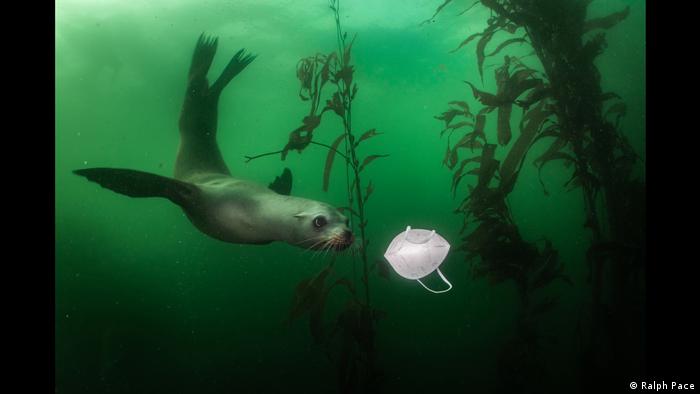
An estimated 129 billion disposable face masks and 65 billion throwaway gloves are being used each month during the pandemic, the BBC reported. With this photo titled "California Sea Lion Plays with Mask," Ralph Pace, a California-based freelance underwater and environmental photographer, illustrates how the waste that lands in nature poses a threat to animals.


11 photos 
The secret world of underwater archaeology

The Cosquer Cave's impressively well-preserved Stone Age paintings were only discovered in 1991. Researchers are always finding new treasures under water.


TREASURES OF UNDERWATER ARCHAEOLOGY
No GPS under water
The research divers in Germany systematically study coastal regions and inland lakes. They also work around the world, such as in Mexico and Indonesia. Historical sources, like old land and sea maps, or actual eyewitnesses, sometimes lead them to a discovery underwater. Coincidence, however, is the biggest factor in discoveries. GPS cannot help researchers, as it doesn't work underwater. PHOTOS 12345678


When the French diving instructor Henri Cosquer discovered in 1985 the access to a flooded cave at a depth of 37 meters (121 feet), during a diving tour in the Mediterranean off the coast of Marseille, he didn't know that it concealed an archaeological sensation.

He and his companions dived down to the entrance of the cave several times over the next few months. But it wasn't until 1991 that he managed to reach the main cave through a tunnel. It would later bear his name.

The narrow, stone-carved space was completely dry, its walls covered with mysterious prehistoric paintings. 

The world's only underwater Stone Age cave


The archaeologists and scientists who later examined the cave found that the drawings were approximately 19,000 to 27,000 years old. The paintings mainly showed animals — seals, fish, horses, bison, mountain goats, sea birds — that were surprisingly lifelike.

"It's the only underwater Stone Age cave that is known to us to date," explains marine archaeologist Fritz Jürgens from the University of Kiel, who also dives to explore such caves. "There are particularly good conservation conditions there."

Towards the end of an ice age, this cave, which is about 11 kilometers (7 miles) off the coast in southern France, was used and painted by Stone Age people. But as the polar ice caps thawed, the sea level gradually rose, and the cave entrance was at some point deep under water. Yet the higher cave itself remained dry.

"That's how these 20,000-year-old and very unique Stone Age cave paintings survived," researcher Jürgens told DW. "They include a stencil painting of a human hand and the only known Stone Age depiction of a penguin."


The stenciled Stone Age hand in the Cosquer Cave


A replica to secure the prehistoric art

The prehistoric Cosquer Cave is now a protected area open only to researchers.

"The Lascaux caves, for example, were opened to visitors after they were discovered," points out Fritz Jürgens. "But within 50 years, the visitors' torches and breathing had damaged the works of art so badly that they had to be closed."

Scientists and specialists are currently building an exact replica of the Cosquer Cave for a maritime museum in Marseille. It is scheduled to be made public in June 2022. The original cave is threatened by rising sea levels, due to climate change.
Shipwrecks are more common


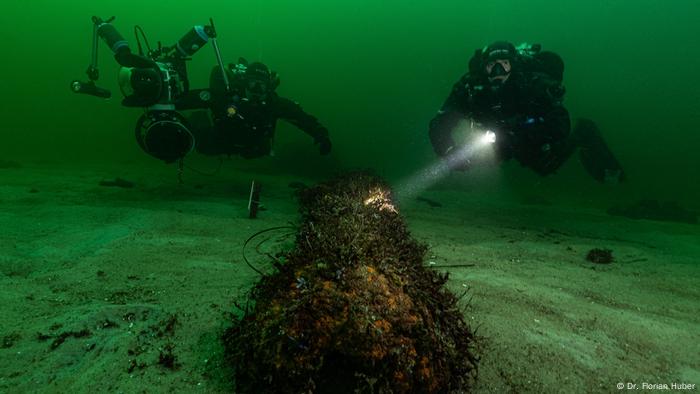
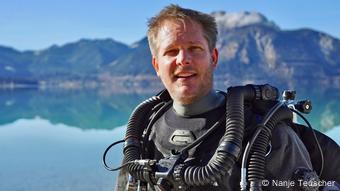
Underwater archaeologist Florian Huber


Underwater archaeology is a special method taught at the Institute for Pre- and Protohistoric Archaeology at the University of Kiel, where Fritz Jürgens also completed his training. Each year, only 10 to 12 students are trained there, and the job opportunities for graduates are limited.

Jürgens' colleague Florian Huber has been working as a professional research diver for many years and dives in the North and Baltic Seas, as well as in large inland lakes in Germany. "As underwater archaeologists, we actually find all kinds of items that were thrown or got into the water at some point, from the Stone Age to World War II," he told DW. "Of course, there are shipwrecks that we find everywhere — in rivers, lakes and seas. And we find submerged settlements that are now under water due to the rise in sea levels."


Excavation of a boat from the 24th-23th century BC, found in Lake Constance


This is an advantage over conventional archaeology, says Jürgens. "Things are preserved under water that would have long since disappeared on land: all organic materials, for example textiles, leather and wood. On land they only survive in the rarest of cases."
Most finds are accidental

Archaeological research under water also has a clear disadvantage: the GPS system, which has already contributed to spotting many sensational terrestrial finds from the air, does not work at greater water depths. "It only goes a few centimeters below the surface of the water. Then it breaks off," says archaeologist Huber.

"What we use in underwater archaeology to track down finds are side scans or multibeams. We scan the seafloor with acoustic signals. These are reflected, come back to the research vessel and are visualized on the computer as converted signals. And then we can see if there is a wreck on the ocean floor."

Historical nautical charts or logbooks are also used by underwater archaeologists, but most finds are discovered by chance, says Huber. "New discoveries are always being made underwater, for instance, when new port facilities are built, but also by recreational divers who go down and discover shipwrecks, remains of boats or stakes underwater somewhere."

As German law specifies that all finds must be notified to authorities, researchers can usually quickly secure new archaeological sites.

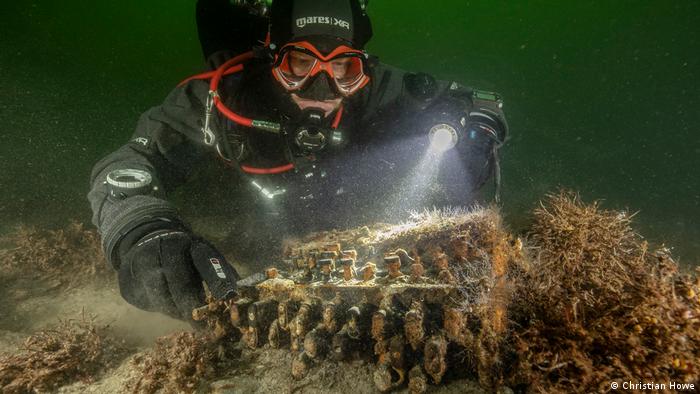
In 2020, Huber found an Enigma machine from World War II

A WWII find while doing environmental work


Underwater archaeologists don't only dive for research purposes. Huber and his company in Kiel often work for the World Wildlife Fund (WWF). "Mainly to salvage ghost nets in the Baltic Sea. These are abandoned fishing nets that have been lost but continue to drift in the sea. And fish, birds, whales, seals or turtles can get tangled up in them and die."

It was on one of those missions that Huber's team made a sensational find in 2020, not from the Stone Age, but from the Second World War. "We found an Enigma machine in one of the nets." The special typewriter was developed and used by the Nazis to encode and decipher their encrypted messages during WWII. The find attracted international media attention. For the team of scientists, it was definitely a more valuable discovery than finding ancient gold coins.


Watch video 04:35 Dive in history – underwater tourism as a future trend

This article was translated from German.