Opinion by Tristin Hopper
NATIONAL POST
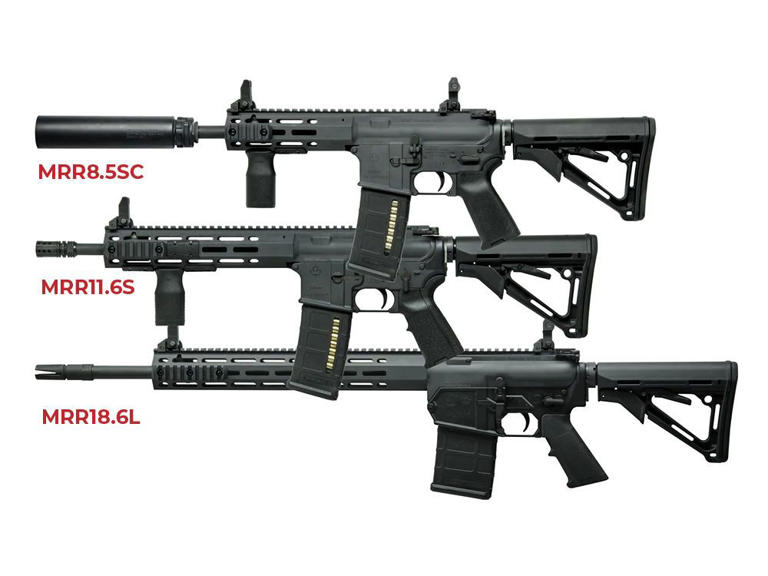
Variants of the Modular Rail Rifle, also known as the C8.
Despite the Department of Defence touting its new “fast-tracked” procurement strategy, a new Canadian-made assault rifle is already equipping Danish soldiers months before a Canadian will ever see one.
The C8 Modular Rail Rifle, first unveiled at an Ottawa military trade show in 2024, is lighter, more accurate and stealthier than the C7 assault rifle currently in Canadian Armed Forces service.
Although it’s made in Kitchener, Ont., the tiny Danish military has managed to secure the rifles first, in larger quantities, and on a faster timeline.
It was last August that the Danish Ministry of Defence Acquisition first announced a contract with Colt Canada to buy 26,000 of the rifles, which Danes are calling the Gevaer M/25.
In February, the order was then expanded to 50,000, with the additional rifles to be delivered by 2027.
As of press time, the rifles are already in Danish service. In January, the Danish government published photos of large crates of the guns, shrouded in bubble wrap, arriving from Canada.
The Government of Canada, by contrast, inked its contract to buy the C8 just last month. On March 19, the newly formed Defence Investment Agency first announced its deal with Colt Canada to “replace current Canadian Armed Forces assault rifles.”
The contract shows that Canada will be buying fewer rifles to start, and will be taking more time to phase them in. Although the eventual plan is to buy 65,402 assault rifles, the initial commitment is for 10,000 rifles per year for three years.
The net effect is that Denmark, which has about 9,000 full-time professional soldiers in its army, is purchasing 50,000 C8 rifles on a timeline of about 18 months.
While Canada, which has 22,500 active personnel in its army, is purchasing its first tranche of 30,000 C8 rifles on a timeline of at least three years.
This is all happening as Canadian troops happen to be serving alongside Danish ones as part of the NATO Multinational Brigade in Latvia. Which means that the first glimpse Canadians get of their next assault rifle could be in the hands of Danes deployed to the Baltic.
In tandem with the Carney government’s massive expansion in military spending has been a promise to speed up the Department of Defence’s infamously slow procurement process.
As the Prime Minister’s Office said in a February statement , “Canada’s defence procurement has long been too complicated, too slow, and too reliant on international suppliers, limiting the growth of our defence industries.”
The glacial pace of Canadian defence procurement was best illustrated by its decades-long odyssey to replace the Browning Hi-Power, a pistol that had been in Canadian service since the Second World War.
Despite the fact that the 74-year-old pistols were so worn out they were constantly jamming, it took a 13-year process for the Department of Defence to eventually swap them out with the German-designed Sig Sauer P320.
The delay was ultimately so long that the Canadian military had to set up an “ Army Interim Pistol Program ” just to cover for the fact that units were running out of functioning pistols.
Compare this with the experience of the British Army, who in 2010 faced the exact same process of phasing out a war-era Browning-made pistol as its official sidearm. In a process lasting no longer than two years, the U.K. Ministry of Defence tested the available substitutes, and then put in an order to buy 25,000 pistols from Austria’s Glock Inc.
The process to acquire the C8 rifle has been much the same.
Denmark simply empowered its Ministry of Defence Acquisition to buy the best available rifle, while Canada launched into a years-long bureaucratic review process.
It was six years ago that the Canadian Army first officially announced its plans to acquire a “Canadian Modular Assault Rifle,” submitting its plans to the Independent Review Panel for Defence Acquisitions in July 2020.
As detailed by the publication Canadian Army Today , the process very quickly slowed to a crawl due to “chronic shortages of specialized staff.”
Prior Canadian procurement odysseys have often been sidelined by political intervention, particularly over the issue of foreign-made equipment.
Canada’s acquisition of a replacement to its CF-18 fighter jets, for instance, remains in a limbo that has now stretched to 10 years, with recent delays being influenced by Ottawa’s hesitance to buy the U.S.-designed F-35.
Assault rifles, however, are one of the very few military technologies that Canada has no problem manufacturing in-house.
Denmark, in particular, has been employing Canadian-made assault rifles since the 1990s. The new C8s will be replacing rifles also made by Colt Canada, the C7.
First Reading is a Canadian politics newsletter curated by the National Post’s own Tristin Hopper.

No comments:
Post a Comment