Tuesday, July 13, 2021


Fight left in Tory premiers?

If an election were called, how much fight do Conservative premiers have left?

Few would disagree that living through a global pandemic for the past 16 months has been draining.

That no doubt includes the country's premiers, who were repeatedly forced to make tough calls on closing schools and shuttering large swaths of the economy to curb the spread of COVID-19 and preserve hospital capacity in their provinces and territories.

So with speculation simmering that Prime Minister Justin Trudeau may trigger an election before long, how much fight do those who usually have a bone to pick with Ottawa have left?

"Everybody is looking for a change, but nobody has the energy to start the movement," said Alise Mills, a Conservative strategist and senior counsel with Sussex Strategy Group.

"Every premier in this country has got a few scars and battle wounds, and some are bleeding heavier than others and know that the focus has to be on holding their ground and winning back what they've lost during the pandemic."

The currentlandscape appears to be a far cry from two years ago when Conservative premiers joined forces over their opposition to the Trudeau government's carbon pricing efforts.

They unanimously criticized the Liberal plan to impose a charge on fuel in provinces that either refused to introduce a carbon-pricing plan of their own or implemented one that didn't meet with federal approval.

The political fight against the carbon tax was coupled with concerns from Saskatchewan Premier Scott Moe and then newly-elected United Conservative Party Premier Jason Kenney in Alberta about the federal Liberal's regulatory approach to energy policies, which they said would hurt growth in the oil and gas and other resource sectors.

Signs of the fight Trudeau had on his hands going into the October 2019 election came to vivid life at the Calgary Stampede that July when Kenney invited Moe, Ontario Premier Doug Ford, New Brunswick's Blaine Higgs and former Northwest Territories leader Bob McLeod for a summit of "like-minded premiers."

Daniel Beland, a political-science professor at McGill University, says Ford and Kenney — the two most prominent figures in the group of Conservative premiers — have damaged their images through their handling of the COVID-19 crisis and are now among the least popular provincial leaders.

"They didn't manage the pandemic well, at least that's how the population perceives it," said Beland.

Another issue is the question of what motivates premiers to rally together against Trudeau like the fight against the carbon tax did, since that battle has largely been settled.

The Supreme Court of Canada earlier this year upheld the federal government's approach, and even federal Conservative Leader Erin O'Toole has since embraced carbon pricing.

"What is really that unifying issue that unifies all the premiers across the board. I'm not sure there is one," said Shakir Chambers, political strategist and principal at Earnscliffe Strategy Group.

"Even on international travel, you have someone like Jason Kenney that's pretty much saying, 'open up the borders,' but then you have Doug Ford that's saying, 'you know what, not just yet.'"

One outstanding demand all premiers seem to agree on is a push for Ottawa to give provinces billions more in health transfers.

The leaders say the federal government's payments only cover 22 per cent of the actual cost of delivering health care. They want to see that share boosted to 35 per cent, which would provide an extra $28 billion a year.

Kenney is also focused on the issue of federal equalization payments and is set to ask Albertans to weigh in on the matter in a referendum to be held later this year.

The referendum question, to be posed as Albertans cast ballots in municipal elections in October, will ask whether the section of the Constitution that commits the federal government to the principle of making equalization payments should be removed.

"Albertans expect to be treated fairly — and we will bring our fight for fairness to the top of the national agenda," Kenney tweeted last week.

Trudeau dismissed Kenney's concerns during a recent visit to Calgary, noting the premier was part of former prime minister Stephen Harper's cabinet when the latest deal was negotiated and suggesting Kenney is best positioned to explain why he now disagrees with his younger self.

Canada's premiers are not scheduled to meet in any official capacity until October in Winnipeg, where Pallister, who now chairs the group, says long-term health care funding will be a priority.

For the public, strategists agree there is anger toward premiers and voters want to see the pandemic get under control and aren't in the mood to watch a fight between Ottawa and the provinces.

As for which leader could stand to benefit from the current situation, Beland believes the advantage will go to Trudeau or the federal NDP. He said the public opinion struggles facing the outspoken Kenney and Ford, who governs a province rife with must-win seats, may ultimately harm O'Toole's cause.

Chambers also noted that Trudeau often refrains from criticizing O'Toole by name when defending priority Liberal causes like climate change, directing his attacks towards conservatives as a general group instead.

"He's clearly trying to make sure that people lump Jason Kenney, Doug Ford, all the other conservative premiers together with Erin O'Toole."

Ford, who's set to face a provincial election next year, previously said he wouldn't campaign for anyone when the federal election is called.

It's unclear what role Kenney, who campaigned for O'Toole during his bid for the federal leadership and proved to be an important ally, will play in the next campaign.

If there is one leader that could pose a threat to Trudeau, Beland said it may prove to be Quebec Premier François Legault.

Beland noted that the Liberals are trying to raise their seat count in the province, where Legault remains popular. He noted that the premier criticized Trudeau's comments around a bill banning public servants from wearing religious symbols at work during the 2019 campaign, a move Beland believes may have hurt the Liberals chances in the province.


Kyrgyzstan moves to nationalise gold mine run by Canadian company

Tensions between Kyrgyzstan and Canada’s Centerra Gold simmer as the president, a longtime critic of foreign ownership, effectively brings the Kumtor mine back into state’s hands.


A worker holds a polished gold alloy bar in a workshop at Kumtor gold mine extraction factory in the Tien Shan mountains, some 350km (218 miles) southeast of the capital Bishkek near the Chinese border March 14 [File: Shamil Zhumatov/Reuters]

Bishkek and Issyk-Kul Region, Kyrgyzstan – In the early 1990s, it was hoped that a large gold mine in eastern Kyrgyzstan, near the Chinese border, would lift the newly independent country’s economy out of the shatters of Soviet central planning.

But 30 years into its operation, Kumtor has for many come to symbolise some of the developing world’s greatest ills: corruption, environmental degradation and neocolonial greed.

In May, it became clear that dark clouds had gathered over Centerra Gold Inc, a Canadian-registered company operating the high-altitude mine, 26 percent of which belongs to the Kyrgyz state.

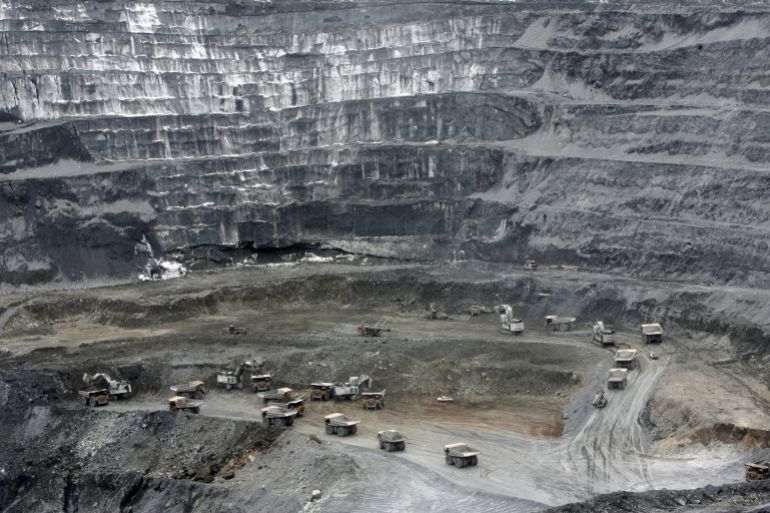
First, a court ruled that the mine had committed environmental violations by dumping
mining waste on glaciers, a move that caused their gradual erosion and cost the state $3bn.

Soon after, the parliament backed a proposal of the special commission on Kumtor to introduce state management at the mine for three months.

Most Kumtor workers come from the Issyk-Kul region, a picturesque lake area, where the mine is based [Agnieszka Pikulicka-Wilczewska/Al Jazeera]
On May 14, President Sadyr Japarov approved the plan, which effectively brought the mine back into the state’s hands.

Later, a number of high-profile politicians accused of financial crimes related to Kumtor were arrested.

In response, Centerra Gold initiated binding arbitration proceedings against the government for what they viewed as a violation of mutual agreements.

Its Kyrgyz units – Kumtor Gold Co and Kumtor Operating Co – applied for bankruptcy in a US court and the company says it will seek compensation from the government.

“In 1994, after the Kyrgyz people gained independence and with your help, we began building the Kumtor Gold Mine with an initial life of 18 years. To this day, what we created together is something special that engineers from all over the world come to study,” Scott Perry, Centerra’s president and CEO, wrote in a statement.

“The seizure of the mine is based on false information and groundless allegations that undermine everything we have built together. We fear that the government’s unjustified action will put thousands of well-paying jobs and the businesses of hundreds of Kyrgyz suppliers at risk.”

Perceived as ‘source of elite enrichment’

Pressure grew on Centerra after January’s presidential elections, which saw Japarov sweep to victory after a campaign promising national revival.

He had been designated to rule the country as interim president and prime minister following an uprising last October against political corruption and a disputed parliamentary election, the third upheaval since the country’s independence.

And it was gold that brought him to power.

Months before winning a landslide, he was freed from prison where he was serving an 11-and-a-half-year sentence for kidnapping a local official during one of his protests against Kumtor.

Since 2013, he has been the main figure in the movement against foreign corporations he accuses of exploiting Kyrgyzstan’s scarce resources.

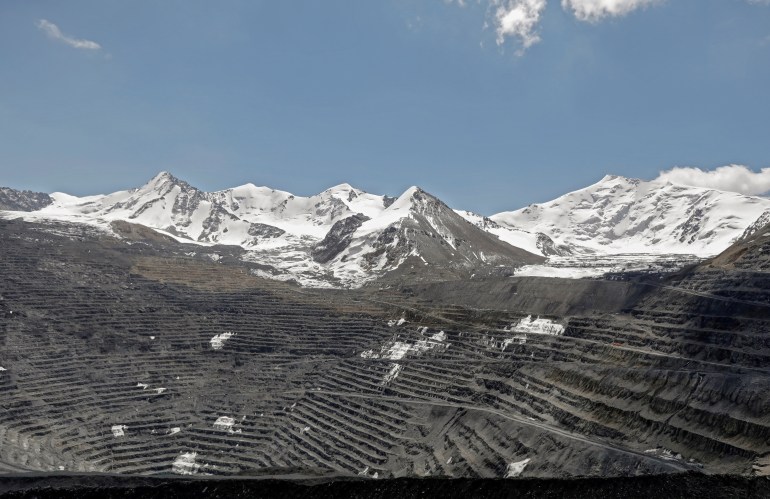
A general view shows the Kumtor open pit gold mine at an altitude of about 4,000 metres (13,123 feet) above sea level in the Tien Shan mountains, Kyrgyzstan [File: Vladimir Pirogov/Reuters]
He believed that the country’s elite were benefitting at the expense of the people and the environment.

Many locals shared his view.

“Over 30 years of mining based economic model, the extraction of natural resources became perceived by the populations as another source of elite enrichment,” Asel Doolotkeldieva, a researcher in the Kyrgyz capital Bishkek focused on the politics of resource extraction, told Al Jazeera.

“They believe that investors, together with the elite, seek to enrich themselves, plunge the resources and go away as soon as the resources are emptied.

“The extractive industry provides only 3 percent of jobs nationwide. The mines are being exploited, the resources are being emptied, the government is getting richer but local communities, despite some development and charity projects, do not see a direct impact on their lives.”

The Issyk-Kul region hosts Kumtor, one of the highest gold mines in the world, and is also the birthplace of President Sadyr Japarov [Agnieszka Pikulicka-Wilczewska/Al Jazeera]
At the same time, there are concerns over the environmental damage caused by the mine.

“The waste is being stored on glaciers, and according to estimates, after the exploitation of Kumtor ends, it will weigh 1.8 billion tonnes. It will remain there and influence the environment. The glaciers are one of the sources of water of the Kumtor River, which flows into Taragai River, and then to Naryn River – Syr Daria, the biggest transboundary river of Central Asia,” Kalia Moldogazieva, an expert in environmental protection, told Al Jazeera.

“We have spoken against the Kumtor project from the very beginning because it is located in the glacier zone. Glaciers melt due to global warming anyway and in Kumtor, they are additionally affected by the anthropogenic factors.”

Miner support for Japarov

In February 1995, Murat was not prepared for the job. The temperature was -45 degrees Celsius (-49 degrees Fahrenheit) when his feet first touched the mountain that was meant to be Kyrgyzstan’s pride.

The dry freezing wind at 4,000 metres (13,123 feet) above the sea level made it hard to breathe.

“I have never seen anything like that before. We felt like we were on another planet,” said Murat, 59, who worked in Kumtor for eight years. “They [company bosses] invited us for dinner in a hall that looked like a restaurant. Then they gave us canned coke. It was the first time I saw it.”

He quit in 2003, and by that time he had managed to build a house at the Issyk-Kul lake, where Japarov hails from, and supported his relatives for many years.

Work in Kumtor was hard, Murat said, but the company was a fair employer.

Overtime was paid double, safety was always a priority and he was grateful that he could work with the newest technology.

“We received medals every five years, clothes, gifts. They were good to us and at the time we
were only thinking about ourselves, our families, money. Everyone wanted to get rich.”

Kyrgyzstan’s President Sadyr Japarov speaks after voting in the constitutional referendum in Bishkek, Kyrgyzstan, April 11, 2021 [File: Sultan Dosaliev/Kyrgyz Presidential Press Service/Handout via Reuters]
But over time, Murat changed his views. Today, he is happy with President Japarov’s nationalist reform agenda.

“Kyrgyzstan was not ready for that. We agreed for gold extraction a bit too early. Our technology was not good enough to operate high up in the mountains, in the cold. Now we deserve Japarov. We’re done with the lies.”

Murat shows pictures from his Kumtor years and a nostalgic mood takes him over.

Soon after, he reaches out for a small book: poems to Japarov written by his supporters when he was still in prison.

“May Sadyr be released! He will get the work done! He was punished for no reason, if someone like him comes to power, he will clean our country of dirt.”

A general view of the Kumtor mine in Kyrgyzstan [File: Vladimir Piragov/Reuters]
Additional reporting by Aigerim Turgunbaeva: @AigiTurgunbaeva

SOURCE: AL JAZEERA


Arrested, abused and accused: wave of repression targets LGBT+ Ghanaians

Opening of community space in Accra, which was quickly shut, has been the trigger for new anti-LGBT+ action

Group of people escorted out of court
Ghanians detained on suspicion of promoting an LGBT+ agenda at an unlawful assembly are escorted out of court by police after a bail hearing in Ho on 4 June. Photograph: Francis Kokoroko/Reuters
Rights and freedom is supported by
Humanity United
About this content
 in Ho City


“All I wanted to do was help vulnerable people,” said Shaun Apong, tears streaking down his face, from behind the bars of a squalid police cell in Ho City in eastern Ghana.

Apong was one of 21 people arrested in early June, charged with unlawful assembly and accused of spreading an LGBT+ agenda, amid a marked and sudden increase in sensitivities around the rights and advocacy of gay and queer people in the west African country.

For years, Apong (not his real name) had held training sessions for paralegals, activists and care workers on how to support vulnerable groups. “We were never afraid to conduct the training because we aren’t breaking the law,” he said.

Apong and the others were arrested during a training session after police were called by local journalists. “They were acting as if we were criminals caught in the crime,” he said, with the reporters harassing attendants and taking pictures of their faces. Pamphlets and books, such as one encouraging parents of LGBT+ people to love their children despite their sexuality, were held up as evidence of a “gay agenda”.

The accused were repeatedly denied bail for three weeks before being released at the end of June pending a trial. Many, including Apong, are now spending their freedom in secret safe houses outside the city. With each week, the toll of the ongoing case mounts, under the glare of national attention.

Ho, a hilly, gently paced city with lush green landscapes, is now the scene of a landmark trial that has caught national attention in Ghana – and upended the lives of those involved.

“I have a business, a family who knows who I am; after this I can survive, but many of these people have lost everything,” Apong said in a second interview from his safe house. “Some of them have been abandoned by their families. One woman’s husband told her never to come home. What about her children? Six of them have kids. Some have already been told by their employers don’t bother coming back to work”

Since early this year, a sudden and chilling wave of repression against LGBT+ people has quickly turned a fraught but negotiable environment for gay and queer advocacy into something more dangerous.

Politicians, Christian and civil groups have led a wave of protest against the rights of sexual minorities in the country, after the opening of a community space in the capital Accra in January. In February the space was shut down, and ever since, arrests of LGBT+ advocates and incidents of abuse have been rising.

The outrage over the community space, fanned by figures capitalising on anti-gay sentiment, may result in lasting change. Lawmakers and government officials in President Nana Akufo-Addo’s administration have vowed to pass new anti-gay laws.

Addo, widely courted by western governments, is often cast as a liberally inclined pro-democracy figure in a region beset by political instability and repression. Yet western diplomats and rights advocates have been urging his government to row back on anti-gay rhetoric, and to scrap proposed anti-gay legislation that would reshape perceptions of his administration.

Nana Akufo Addo and Pedro Sánchez
Nana Akufo Addo in Madrid with the Spanish prime minister, Pedro Sánchez, in March. Photograph: Zipi/EPA

A group of eight lawmakers, led by Sam George, have proposed new anti-gay laws, submitted to parliament on 29 June. “The promotion of proper human sexual rights and Ghanaian family values bill” would be a “landmark legislation” criminalising the advocacy and act of homosexuality, George said.

“Unnatural carnal knowledge” – often interpreted as non-heterosexual sex – is unlawful in Ghana. Prosecutions are rare, yet experiences of the justice system are often in themselves punishing.

In the case against the 21 accused in Ho, as well as denying their bail, the judges continuously adjourned the hearings, leaving the defendants in despair. At hearings, prosecution lawyers cited finding condoms as part of the evidence against the accused. “They were making strange arguments that don’t even make sense,” said an activist at one of the hearings. “Is a condom evidence of criminality?”

In March, a letter signed by Naomi Campbell, Idris Elba and Vogue editor Edward Enninful criticised the treatment of LGBT+ people in Ghana amid global attention on the closure of the community space.

The proposed legislation in itself marks a turning point in Ghanaian life, said Fatima Derby, a feminist writer. “Even discussing the bill signals to people that this is something we need to stamp out,” she said from a cafe in Accra.

“This is maybe the worst period I’ve seen in Ghana, in terms of the safety of LGBT+ people. Many people are very fearful for their lives and their safety,” she said, adding that the events this year had had a chilling effect on various forms of activism in Ghana. “If five or six activists gather in a place like this, it feels like they could storm in and accuse us, too.”

Before this year, ordinary life for many gay and queer people in Ghana was precarious, but managed. “You would see queer Nigerians in Accra for fun,” said Phoebe (not their real name), a non-binary 27-year-old health worker.

“People in Ghana had this idea of ‘Yeah, this person is gay, that person is gay,’ but there was like a distance to it. You do you, I do me,” they said. “There was abuse, for sure, so many dangers, but on the whole, compared to some places, it felt manageable. Now, even to go out to certain places, you’re second-guessing yourself, like, maybe it’s not wise any more.”

Images from the opening ceremony for the Accra community space spread rapidly, some showing the Australian ambassador to Ghana in attendance. They fuelled two linked sentiments that are common in Africa: that LGBT+ groups are establishing a more institutional presence, and that homosexuality is a western construct, despite the long history of multiple sexualities in many African cultures.

Among some advocates, the presence of western officials raised questions about the risks of visible western support for LGBT+ causes in Africa.

Alex Kofi Donkor
Alex Kofi Donkor

The uproar in Ghana over the community space felt unprecedented, said 28-year-old Alex Kofi Donkor, who founded the group that had set it up.

“It was all over TV, the radio stations, talkshows. Politicians, traditional leaders, everyone was being asked about it, knowing that if they don’t say the right answer – that it is wrong, it should be stamped out – they would be made a target,” Donkor said. Yet the outrage also presented an opportunity and spurred activism. “That was the first time we were having a national conversation about LGBT issues, talking to the media squarely.”

For months Donkor has been publicly and fiercely defending LGBT+ rights in Ghanaian media. The approach taken by Donkor’s organisation highlights a significant divergence among activists in repressive countries. Many groups that work on LGBT+ rights in Ghana do so discreetly, organising under more ambiguous or generic causes.

“There’s a generational change. There is this backdoor, quiet approach, then a more confrontational approach, by a younger generation who are more specific about what they want,” Donkor said.

“Some older activists are saying, ‘Maybe be quieter, maybe do things more carefully,’ but people are tired and want to speak out. They don’t want to make subtle steps when in reality their lives are on the line.”


Climate crisis in the American west

‘We live in a desert. We have to act like it’: Las Vegas faces reality of drought

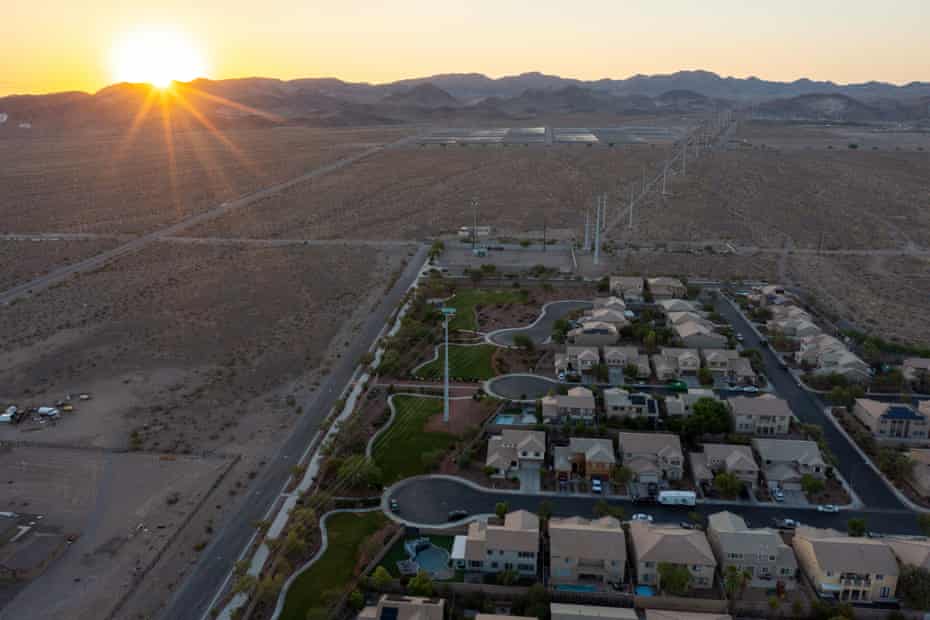
Urban sprawl spreads across the desert and, increasing water demands as drought continues to worsen in Henderson, Nevada, adjacent to Las Vegas. 
Photograph: David McNew/Getty Images


Water investigators track down wasteful homeowners and public turf torn up to conserve scarce water supplies

Supported by
About this content


Oliver Milman
@olliemilman
Fri 9 Jul 2021 

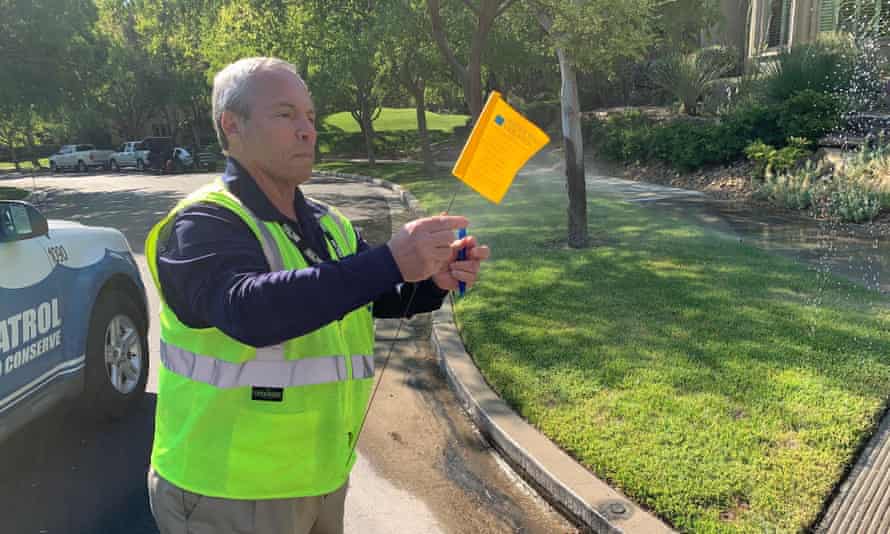
Investigator Perry Kaye jammed the brakes of his government-issued vehicle to survey the offense. “Uh oh this doesn’t look too good. Let’s take a peek,” he said, exiting the car to handle what has become one of the most existential violations in drought-stricken Las Vegas – a faulty sprinkler.

Kaye is one of nearly 50 water waste investigators deployed by the local water authority to crack down on even the smallest misuse of a liquid perilously scarce in the US west, desiccated by two decades of drought. The situation in Las Vegas, which went a record 240 consecutive days without rain last year, is increasingly severe.

Lake Mead, the vast reservoir that supplies Las Vegas with 90% of its water, has now plummeted to a historic low, meaning Nevada faces the first ever mandatory reduction in its water supply next year. This looming cutback is forcing restrictions upon the city that has somehow managed to thrive as a gaudy oasis in the baking Mojave desert.


‘A scourge of the Earth’: grasshopper swarms overwhelm US west


“The lake isn’t getting any fuller at this time so we need to conserve every single drop,” said Kaye, an energetic former US air force serviceman who wears a hi-vis vest and brandishes a badge as he does his rounds searching for violators. He starts his shift at 4am. “A lot of people think because we are government workers we are not out there at that time but we are out 24/7, every day of the year,” he said.

Kaye regularly hands out fines – they start at $80 and then double for each further offense – for the sort of rule-breaking he has spotted in Summerlin, a wealthy Las Vegas enclave where landscapers tend manicured grounds in the soaring heat. Water sprayed on to lawns and plants isn’t allowed to flow off the property, but that day a damaged sprinkler had caused water to cascade into the gutter, where the precious resource is lost.

“Look, we’ve got a little creek or stream here,” said Kaye, as he used his phone to video the water snaking on to the road. “If everyone did this, quite a bit of water would be wasted.”

It’s so hot in Vegas – this July day’s temperature will breach 40C (104F) – that the errant water will evaporate within five minutes. Kaye planted a yellow flag next to the leak as a warning to the homeowners but a few taps on the computer mounted in his cruiser shows this property has a previous warning, so an $80 fine will be on its way.

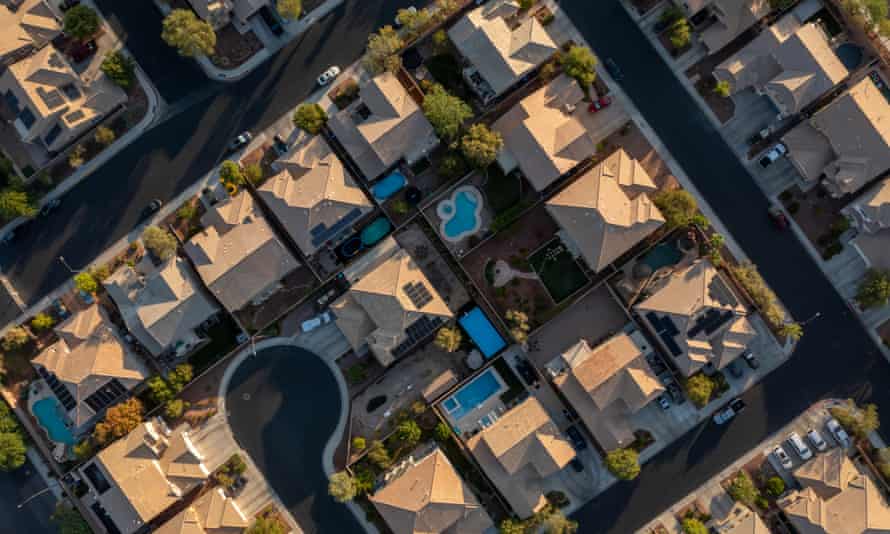
There’s a growing realization, however, that such rules – no watering between 11am and 7pm, none at all on Sundays – won’t be sufficient as Nevada is squeezed by a drought that has escalated dangerously in 2021. In June, the state passed a law to rip up “non-functional” public turf in Las Vegas, such as grass planted beside roads or on roundabouts, over the next five years to save around 10% of city water use.
Perry Kaye, a water waste investigator in Las Vegas, Nevada, issues a yellow warning flag because of a faulty sprinkler. Photograph: Oliver Milman/The Guardian

“That is just wasteful – the only person who walks on that is the person who cuts it,” said Kaye, jabbing a finger at a nearby grass verge median. “Some people just want to recreate home, where they grew up with grass.” The new law, along with a financial incentive given to homeowners to replace thirsty grass with more hardy desert plants and rocks, is an acknowledgment that climate change won’t easily allow the imposition of a verdant green oasis upon a bone-dry desert basin.
Advertisement


A city that contains a huge replica of the Eiffel tower, sprawling golf courses and a simulacrum of Venetian canals complete with gondolas can never be said to fit in with its surroundings. But Las Vegas, called “The Meadows” in Spanish due to its natural springs that were pumped dry by the 1960s, is at least aware of its setting in a place so arid that only a few small creosote bushes and tumbleweeds can survive here naturally.

“We live in the desert. We are the driest city in the United States, in the driest state in the United States,” said Colby Pellegrino, deputy manager of resources for the Southern Nevada Water Authority. “We have to act like it.”

Pellegrino said the recent escalation of the drought has been “very scary” for some Vegas residents, although she insists the water authority has planned for this moment. Lake Mead’s level dropped under 1,075ft in June, barely a third full, triggering what will be the first ever cutbacks under a seven-state agreement on sharing the water from the Colorado River, which is harnessed by the Hoover dam to create the reservoir.

Different states get different water allocations and Nevada is a victim of its depopulated history, getting just 300,000 acre-feet of water a year (by comparison California gets 4.4m acre-feet) under an agreement struck before the Hoover dam was completed in the 1930s. “The joke is that Nevada’s representative was drunk,” said Pellegrino, who was born in 1983, when the state’s population was barely 900,000. It’s now more than 3m and receives tens of millions of tourists a year.

Houses, trees and swimming pools spring from the desert in Henderson, Nevada. Photograph: David McNew/Getty Images

This small water allocation will shrink by 21,000 acre-feet with the new cuts, although Nevada has made impressive strides in keeping below its low cap, slashing its water use despite the population nearly doubling since the early 2000s. Pellegrino is confident that further savings can be made and scrutiny is being placed upon the water used in Vegas casinos’ ubiquitous cooling systems.

But global heating’s impact upon the west’s snowpack and rivers is unrelenting and the city’s water savings will only go so far. Las Vegas only has a supporting role in its own fate. Three-quarters of allocated Colorado River water is used to irrigate thirsty agriculture, and the overall water supply is more dependent upon the amount of snow melting hundreds of miles away in the Rocky Mountains than some extra marginal savings made in the suburbs.

“Vegas has done great things such as ripping out the grass, but we’ve lost 20% of the flow of the Colorado River since 2000 and another 10% loss by 2050 is completely possible,” said Brad Udall, a water and climate scientist at Colorado State University whose research has focused on the stresses facing the river.

“I worry it could be even more than that, and that should frighten everyone.”

Back in Summerlin, Perry Kaye is also relentless. A house opposite the first offender has broken sprinklers splurging water into puddles on the grass and road. Kaye bangs on the ornate door to inform the homeowner, but no one is in.

“These sprinklers haven’t popped up properly, they are just oozing everywhere,” muttered Kaye. He has been policing water waste for the past 16 years, issuing countless fines in that time. “I had hoped I would’ve worked myself out of a job by now. But it looks like I will retire first.”
Wildlife in the frame: photography sale aims to raise $1m for Africa’s parks

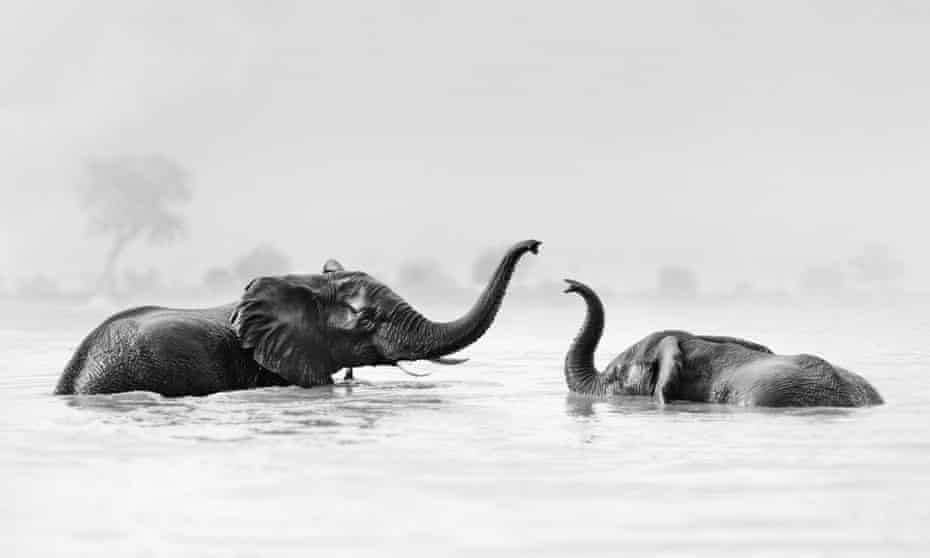
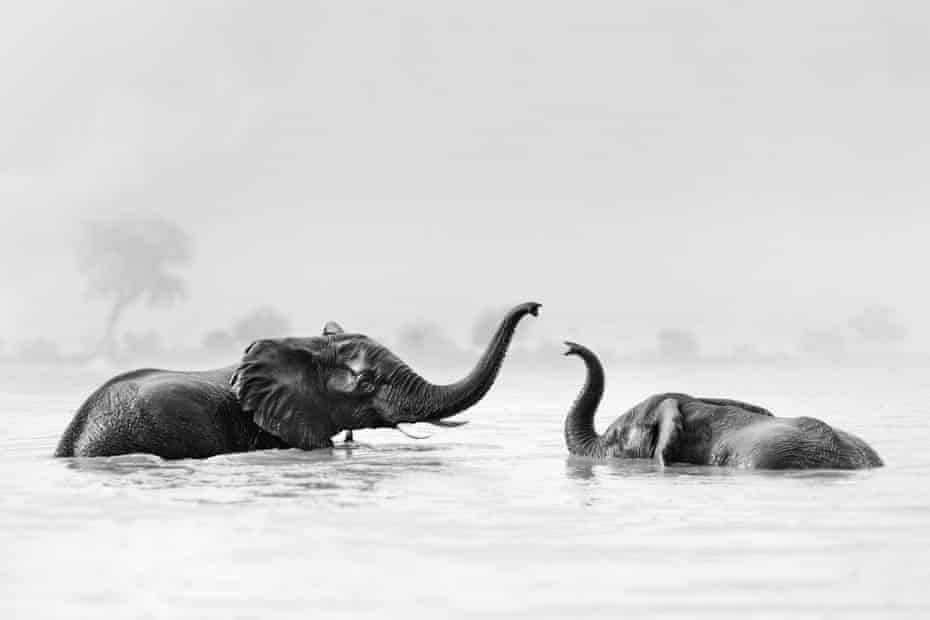
Elephants play at a waterhole in Trunk Puppets, by Tami Walker. All photographs courtesy of Prints For Wildlife


Five photographers share the story behind their shot, as images go on sale to support conservation charity


Graeme Green
Mon 12 Jul 2021


More than 150 wildlife photographers are taking part in a sale of wildlife prints to raise money for African Parks, a South Africa-based conservation NGO. In 2020, the first Prints for Wildlife sale raised $660,200 (£479,000), with more than 6,500 prints sold within 30 days.

This year, the initiative, founded by two photographers, Pie Aerts from the Netherlands and Austrian Marion Payr, is aiming to raise $1m. The prints will be on sale through the online shop printsforwildlife.org until 11 August.

Alongside some of the most respected wildlife photographers in the world, such as Greg du Toit, Beverly Joubert, Suzi Eszterhas, David Lloyd and Steve Winter, the sale also features emerging talent from developing nations, with the aim of promoting greater diversity among wildlife photographers.

The money raised will support African Parks, which manages 19 parks, spanning 14.7m hectares (36.3m acres), in 11 countries on behalf of governments in Africa, for the benefit of local communities and wildlife.

“Conservation was in crisis before the pandemic and continues to be during these unprecedented times,” says Andrea Heydlauff, chief marketing officer of African Parks. “In protecting Africa’s parks, we are securing functioning ecosystems, providing safe refuge for some of the world’s most threatened species, and supporting hundreds of thousands of people through employment, improved livelihoods, food security, education and healthcare.”

Here, five photographers share the story behind their images.


Will Burrard-Lucas – ‘the cubs approached inquisitively’

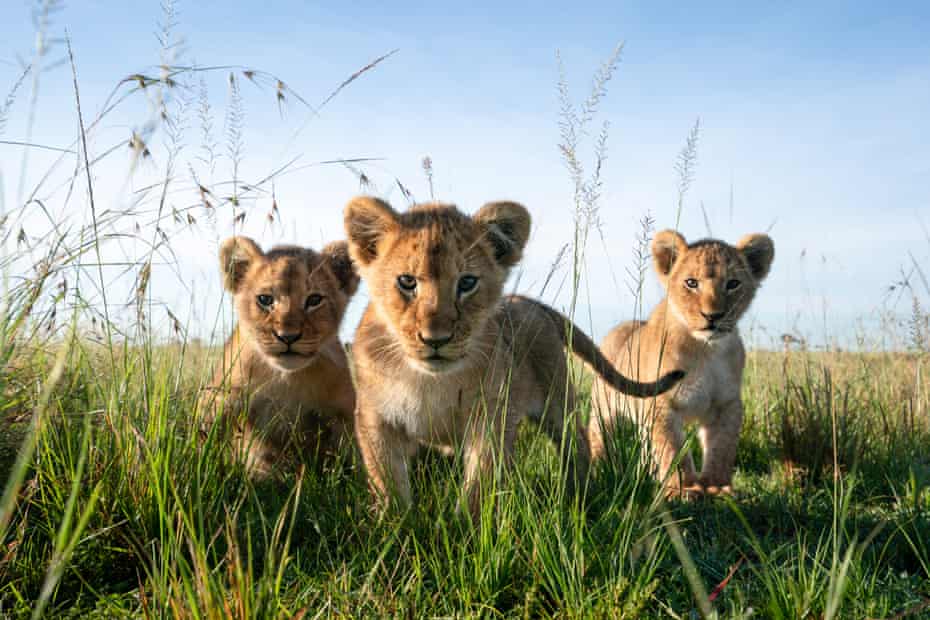
Curious lion cubs are captured by the BeetleCam in this image from Will Burrard-Lucas

I spent the first lockdown of 2020 completely redesigning and rebuilding my remote-control camera buggy, known as BeetleCam, and at the end of last year I took it out to Kenya. My aim was to get started on a new long-term project photographing the lions of the Mara North Conservancy in Kenya.

I introduced the Serian pride to my BeetleCam over a period of several weeks. The lionesses learned to completely ignore the buggy but it was a different story with the cubs. They remained very playful and would often approach to snarl at the camera or attempt to sneak up behind it and knock it over. This image is from an early encounter, as the cubs approached inquisitively through the long grass of the wet season.

Since starting this project, I’ve learned how all lions in the Maasai Mara are threatened by human-wildlife conflict. This often occurs when lions kill livestock on the outskirts of wildlife areas and are then poisoned in retaliation. It’s estimated that there are only about 20,000 lions left in the wild and that these occupy less than 5% of the species’ former range.


Jono Allen – ‘this image was taken on a single breath’

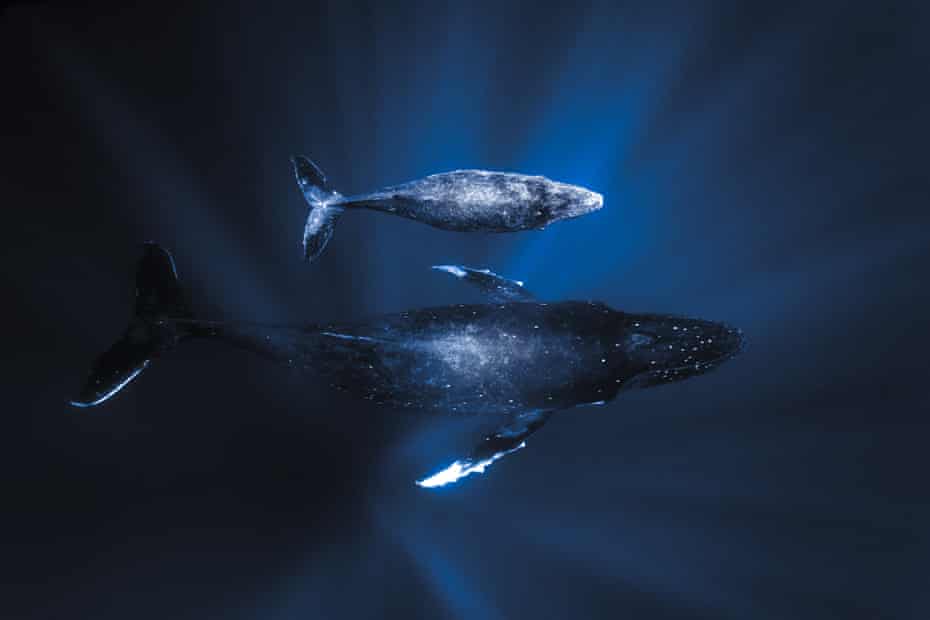
A humpback whale and her calf taken by freediving photographer Jono Allen

My Prints For Wildlife photo is of a mother humpback and calf beginning their enormous journey south from the tropical waters of Tonga to the frozen waters of Antarctica. This image was taken on a single breath while freediving off the small island chain of Vava’u in Tonga, where the whales congregate each year to mate and give birth.
Advertisement


It’s impossible to truly understand these incredible creatures until you’ve been in the water with them. My perception will never be the same. A good biologist friend of mine has studied humpbacks for more than 10 years. She has seen thousands of whales in her time. We swam with these two whales together and within minutes of being face-to-face with them she was moved to tears.

This image is an important one to me because the humpback is one of the greatest conservation stories of our time. During the whaling era, they were brought close to extinction, but through the grace of protection and conservation they’re now back to their original numbers.

Supporting the conservation efforts of organisations such as African Parks is vital. If it wasn’t for such organisations, we would be living in a world without these two beautiful humpback whales.


Tami Walker – ‘frolicking in the water’

Trunk Puppets, Tami Walker’s image of elephants at the waterhole

Here are two elephants frolicking in the water at a pan on the south-eastern side of Hwange national park in Zimbabwe. The elephants seemed to be enjoying every moment: playing, splashing, climbing up on each other and submerging themselves. Several other herds of elephant and other game came to drink at the pan but nothing distracted these two from their fun and games.

During my years of photographing wildlife, I’ve come to realise how much wild animals are in balance with the natural order of things, with their surroundings and the natural cycles in which they survive and proliferate, and how much humanity is having a negative effect on that balance. I’ve come to understand just how vital wildlife is for the welfare and continuance of our great African heritage. The impact of human advancement and pressure on these wilderness areas is a challenge for my generation and those to come.


OK MY FAVORITE 

Nili Gudhka – ‘basking in the sun’

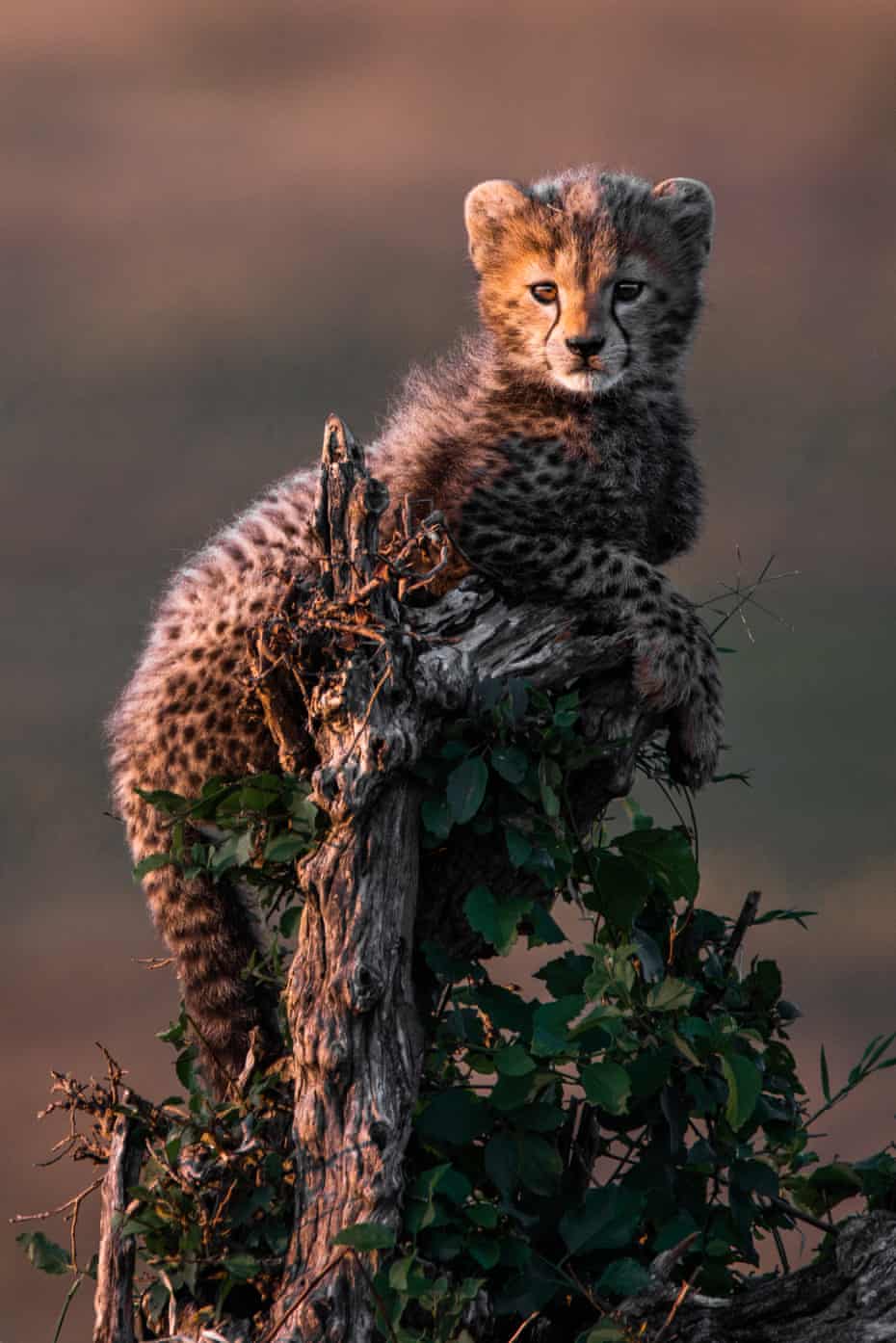
A cheetah cub at sunrise on the Maasai Mara in Kenya taken by Nili Gudhka

Just before sunrise in Kenya’s Maasai Mara national reserve, we found a cheetah mother with two cubs who were about three months old. The cubs became very playful as the sun rose and it got warmer. While the mother was surveying the area for food, the two cubs found a small tree. One of the cubs climbed on top and sat comfortably, basking in the sun.

The cheetah is Africa’s most endangered big cat. In the 19th century, there were 100,000 cheetahs living in the wild and today there are only about 7,000. This is due to human-wildlife conflict, habitat loss, climate change and, to me the most horrific issue, which is trafficking of cubs. Having spent countless hours with these beautiful cats, I’ve grown an emotional attachment to the species and hope that my work will be a means of advocating and conserving their existence.


Ketan Khambhatta – ‘leaving a cloud of dust’

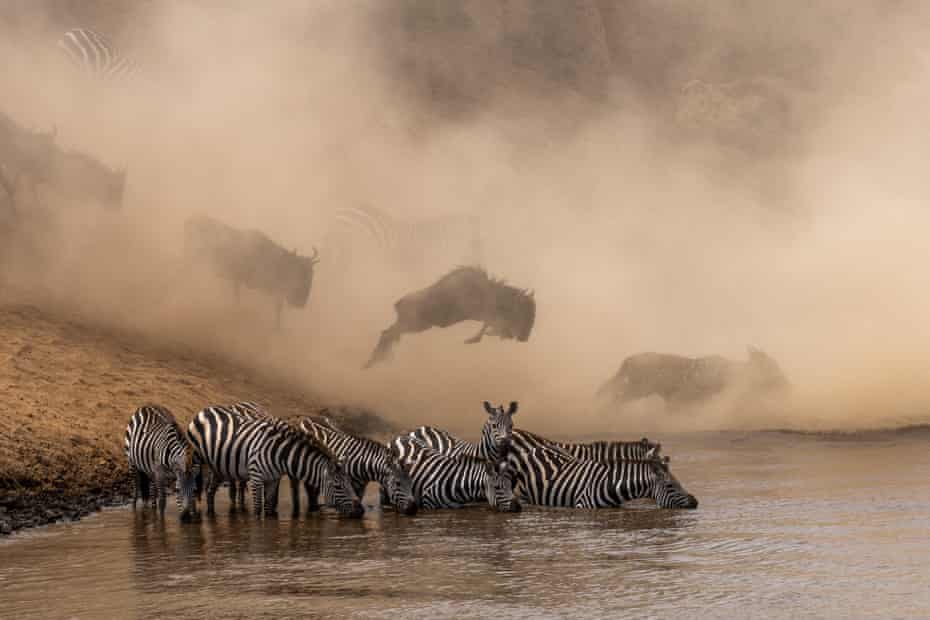
Ketan Khambhatta captures the drama of a river crossing by zebra and wildebeest in the Mara Triangle in Kenya

I took this photograph at one of the river crossing points in the Mara Triangle, during the great migration of the wildebeest and zebras. I had been waiting in our vehicle for the wildebeest herds to cross the river and observed the zebras slowly moving forward to test the waters for crocodiles. But while the zebras were still checking, the wildebeest just started to run and jump into the river, leaving a cloud of dust and creating a dramatic moment that I thought would make for a great photo.

Being in the wild has increased my compassion towards wildlife. What became apparent during my photography trips is the threat that many animals face for various reasons, such as habitat loss, poaching and climate change.

Find more age of extinction coverage here, and follow biodiversity reporters Phoebe Weston and Patrick Greenfield on Twitter for all the latest news and features