Wednesday, July 14, 2021

Hubble Might Survive. 
NASA Is About to Try Its Backup Computer

And if it works, NASA might boost Hubble to a higher orbit.

By Brad Bergan
Jul 13, 2021

The Hubble Space Telescope in orbit.NASA / Wikimedia

Hubble is still in a fight for its survival.

However, NASA just completed a system-wide review to evaluate potential factors and risks involved in switching Hubble to its backup hardware, which could go forward later this week, according to a blog post shared on the agency's official website. And this could save the space telescope's life.

In space, you can't hold your breath. But we're doing it anyway.
NASA's long road to recovering Hubble

NASA is still investigating the world-historical space telescope to uncover the initial cause of the payload computer's issue, which initially shut down the entire observatory in June. On Sunday, June 13, Hubble's computer came to a grinding halt just after 4:00 PM EDT, with initial suspicions circulating on a possibly degraded memory module. This was the latest in an increasingly frequent bout of minor and major issues the aging telescope had faced since it began to expand our understanding of the universe after its successful launch in 1990.

Upon realizing the system failure of Hubble, NASA's flight controllers flung themselves into action at the Goddard Space Flight Center in Maryland, with attempts to restart the computer. But sadly, it just shut down again the next day, and it remained offline while engineers and scientists continued to work around the clock to bring it back to life. A NASA representative said "there is no definite timeline for bringing the computer back online," according to a Space.com report, but the agency did pursue multiple options to save the space telescope from certain doom.

One of the paths to recovery lies in pivoting Hubble to its backup computer. So on in late June and early July, NASA prepared for and completed test procedures on the space observatory. This involved a multi-day test of steps required to activate backup hardware on the space telescope, which was completed on July 8. And, on July 12, the agency was ready to switch Hubble to its backup computer. But while crossing your fingers is merited, it's important to remember that the agency had already planned to phase out the space telescope in the coming years, with the new James Webb Space Telescope (Webb) slated for launch later this year.

Hubble could be boosted to a higher orbit


Despite years of heart-wrenching delays, the Webb telescope is widely regarded as the successor to Hubble. But there are a few shortcomings to the forthcoming space observatory, in comparison to its struggling predecessor. For one, the Webb will be stationed much farther from Earth after launch, which means repairing it will take far greater resources and logistical commitments than a quick lift to lower-Earth orbit. Secondly, the James Webb Space Telescope lacks ultraviolet (UV) capabilities, which is why NASA is urging astronomers to submit as many UV-based studies and applications as possible in recent years.

Hopefully, Hubble will come online when NASA activates its backup computer system. If it doesn't then NASA may move Hubble into position for eventual re-entry and burn up in the Earth's atmosphere. But if it does survive the ordeal of Summer 2021, and the world-renowned space telescope completes several more groundbreaking studies, the agency may elect to boost it to a higher orbit, where it may remain as a testament to revolutionary astronomy for decades.


Hubble telescope beams back picture of a 'soft, woolly' spiral galaxy


Christy Somos
CTVNews.ca Writer
Tuesday, July 13, 2021 


The flocculent spiral galaxy NGC 3521 is seen here in this image posted by NASA on July 13, 2021 (ESA/Hubble & NASA and S. Smartt (Queen's University Belfast) Robert Gendler)


TORONTO -- The Hubble Space Telescope has beamed back a picture of a flocculent spiral galaxy, so called because of its “soft and fluffy” appearance and lack of defined spiral “arms” normally associated with spiral galaxies.

NASA posted the image Tuesday explaining that the galaxy, named NGC 3521, is a “member of a class of galaxies known as flocculent spirals, [and] like other flocculent galaxies, NGC3521 lacks the clearly defined, arcing structure to its spiral arms.”

The space agency also described NGC 3521 as having “patches of stars and dust” showing up here and there throughout the central disk, stating that about 30 per cent of galaxies share the same “patchiness” as NGC 3521.

The galaxy NGC 3521 is located about 26 million light years away and is found in the constellation Leo, NASA said.

NASA has also begun operations to restore the payload computer on the Hubble Space Telescope, providing an update Tuesday to say that the agency had completed a review to see if switching the telescope to its backup hardware is needed.

The investigation into the cause of computer issue that had paused the telescope’s observations is ongoing.


The robot digger worked round the clock at a waste disposal site (Baidu Research Robotics and Auto-Driving Lab)

News

Robot digger works 24 hours on its own in auto-machinery breakthrough

13 July 2021 | By GCR Staff | 

Researchers from Baidu Research Robotics and Auto-Driving Lab (RAL) and the University of Maryland, College Park, have introduced an autonomous excavator system (AES) that can operate with no human intervention for more than 24 hours, shifting as much material as an experienced human operator.

The system was tested at a waste disposal site, a toxic environment where automation is in strong demand.

They say the technology is relevant given the worldwide shortage of skilled excavator operators at a time when the size of the global market for excavators is forecast to grow by some 43% from 2018 to 2026 – from $44.12bn to $63.14bn.

Safety is another factor, with excavation accidents causing around 200 casualties a year in the US, they said.

“This work presents an efficient, robust, and general autonomous system architecture that enables excavators of various sizes to perform material loading tasks in the real world autonomously,” said Dr. Liangjun Zhang, corresponding author and the Head of Baidu Research Robotics and Auto-Driving Lab. 

The system uses LiDAR, cameras, other sensors and algorithms to perceive the environment and identify target materials.

It was tested in winter weather conditions, where vaporisation hampers the sensing performance of LiDAR.

The amount of materials excavated, in both wet and dry form, was 67.1 cubic meters per hour for a compact excavator, which is in line with the performance of a human operator.

“AES performs consistently and reliably over a long time, while the performance of human operators can be uncertain,” said Dr. Zhang.

Researchers also set up ten different scenarios at a closed testing field to see how the system performed in numerous real-world tasks. After testing a variety of large, medium-sized, and compact excavators, AES was ultimately proven to match the average efficiency of a human operator in terms of the amount of materials excavated per hour.

“This represents a key step moving towards deploying robots with long operating periods, even in uncontrolled indoor and outdoor environments,” said Dr. Dinesh Manocha, professor at the University of Maryland.

Image: The robot digger worked round the clock at a waste disposal site (Baidu Research Robotics and Auto-Driving Lab)

Further reading:


Researchers say it could be an important use for emissions captured from industrial processes (veeterzy/Unsplash)

Innovation

Researchers find way to cure concrete with CO2

13 July 2021 | By GCR Staff | 0 Comments

Researchers from Saudi oil company Aramco and the Korea Advanced Institute of Science and Technology (KAIST) have found a way of introducing more CO2 into concrete at the curing stage, saying it could be an important use for emissions captured from industrial processes, including cement-making.

Carbon-cured concrete sets much faster than the industry norm, and is more durable, they say.

We estimate it could recycle more than 63 million tons of CO2 every year– Research scientist Issam Amr

They claim that if the global precast concrete industry implemented CO2 curing technology, it could recycle at least 63 million tons of CO2 every year, the equivalent of taking around 14 million cars off the road.

The actual figure may be as high as 246 million tons of CO2, the equivalent of approximately 53 million cars, they add.

“This is all the more worthwhile given the manufacture of cement—the principal ingredient of concrete—produces around 7% of annual global greenhouse gas emissions,” says Aramco senior research scientist Issam Amr, who led the industry-academia research project, in a note to GCR.

From research that began in 2014, Aramco and KAIST found that by using steam to introduce the CO2, they could store up to 200kg of CO2 in a ton of precast cement.

Researchers chose precast concrete because it was easier to carry out the curing process in a controlled environment.

They say their concrete cures much faster, reaching the industry required strength of 35 megapascals (MPa) in just three days, rather than the usual 28, and that it can be demoulded after eight to 10 hours.

Carbon-cured concrete is more durable, less permeable and showed a greater resistance to sulphate and chlorine, a potential advantage in offshore construction, researchers added.

Image: Researchers say it could be an important use for emissions captured from industrial processes (veeterzy/Unsplash)

Footage of "sinister" police raid on Antepavilion building triggers anger
ahead of tensegrity structure unveiling


Marcus Fairs | 12 July 2021 26 comments

Organisers of the annual Antepavilion architecture charity competition have released footage of police storming their building and arresting staff ahead of the opening of the rooftop tensegrity structure targeted in the raid.


CCTV footage shows more than 40 officers streaming into the canalside Hoxton Docks arts building in east London after the door was forced open with power tools.

Another clip shows eight officers pulling owner Russell Gray off his motorbike when he arrived at the building after being told about the raid. A third clip shows police pushing Gray against a shutter and handcuffing him.

Antepavilion employees jailed overnight

Gray, who heads the Antepavilion charity and owns the building it is based in, was arrested on suspicion of attempted assault and dangerous driving. He and two employees spent a night in jail but were released the next morning.

Russell Gray was pulled off his motorbike by police

Police have issued "no apologies and no charges" following the raid, Gray told Dezeen.

It is thought that police believed the building was being used by environmental protest group Extinction Rebellion to prepare for protests against media groups that are dismissive of climate change.

Installation similar to Extinction Rebellion structures


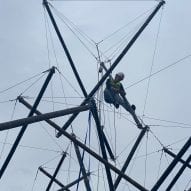
The rooftop installation, called All Along the Watchtower and designed by a collective called Project Bunny Rabbit, is similar to structures used by protesters to block roads during demonstrations. One of two winners of this year's Antepavilion competition, it will open to the public on 23 July.


During its construction, the arts venue hosted workshops that showed members of the public how to assemble similar lightweight, reusable tensegrity structures made of bamboo poles and steel cables. During the raid, police threatened to come back and remove the structure, according to Gray.

Police threatened to remove All Along the Watchtower

Police said the raid and arrests were “proactive action to prevent and reduce criminal disruption which we believe was intended for direction at media business locations over the weekend”.

However, Antepavilion insisted there was no connection between Extinction Rebellion and the installation. "Antepavilion has no links to Extinction Rebellion beyond commissioning the construction of an art installation at their site using long-established ‘tensegrity’ structural principles," it said in a statement.

"Extinction Rebellion has sometimes used the same tensegrity principles to erect temporary structures at protest sites. The raid is clear evidence of the carte blanche powers police have been given to harass and intimidate, in the government’s efforts to crackdown on dissenting voices."

Raid triggers concern among architecture community

The footage of the raid, which Antepavilion organisers have been projecting onto the side of the building, triggered widespread concern. "The more I look at this the more appalled I am," tweeted architect and head of Central St Martins school Jeremy Till in response to the footage. "While the [right-wing] press bleat on about rising crime, 40 police raid innocent artists."
The installation was made using tensegrity structural principles

Architect Julia Barfield described the raid in a tweet as "A shocking misuse of power and resources particularly in a #ClimateEmergency."


"May not be entirely accurate but I count 41 coppers here," wrote Financial Times architecture critic Edwin Heathcote. "Is that not also an insane waste of resources?"

"Utterly mad to hear the Met [police] has arrested the team from this year's Antepavilion, tweeted Open City director Phineas Harper. "The police are out of control."


Related story
Antepavilion building "smashed up" and staff arrested in police raid on design workshops


"This doesn’t seem to have had much attention beyond the specialist art/design press but the sight of 30+ police breaking into a private building to remove an artwork, apparently on political grounds, is….sinister," wrote Simon Hinde, programme director of journalism and publishing at London College of Communication.

"On Friday 25th June 2021, Antepavilion was raided by dozens of police spearheaded by the Territorial Support Group (TSG)," the Antepavilion team said in its statement. "Upon entering, the authorities handcuffed everyone on-site and three people were arrested, held until 4 am the next day and had their phones confiscated."

"The police continued to occupy the site until Saturday night, 26 June."

Antepavilion is a charity that "aims to promote independent thought and symbiosis in the fields of art, craft and architecture". It has organised the controversial annual competition, which commissions designs for temporary structures that challenge planning constraints, every year since 2017.

This year the tensegrity structure was commissioned as a "special early summer commission" alongside the overall winner of the competition. The winner, AnteChamber by Studio Nima Sardar, will be built later this year.

Photography is courtesy of Antepavilion

All Along The Watchtower will be open to the public from 6 to 11pm on Friday 23 July. Tickets cost £10. For details of more architecture and design events, visit Dezeen Events Guide.

Planting trees "doesn't make any sense" in the fight against climate change say experts

Marcus Fairs | 5 July 2021 95 comments

Afforestation is an unreliable way of sequestering atmospheric carbon, according to several key figures interviewed by Dezeen as part of our carbon revolution series.

While trees capture huge amounts of carbon, they need to remain growing for a long time to be effective carbon stores, experts say.

In addition, the timber they produce needs to be put to long-term use to prevent the carbon it contains from quickly going back into the atmosphere when it rots or is burned.

"Planting trees is probably the most difficult potential method from a measurement and verification perspective," said Paul Gambrill, CEO of carbon marketplace Nori in an interview with Dezeen.

"Forests need to have a permanence of 100 years to be effective"

"You plant the forest but you don't start seeing carbon retention and sequestration happening for at least 10 years after they're planted, so there's a long lag time in doing that," explained Gambrill, whose company allows people who capture atmospheric carbon to sell it to people who want to offset their emissions.

"And then you have to maintain that forest and make sure it isn't burned or cut down."Forests need to have a permanence of 100 years to be effective carbon stores", he said.

"So you plant your saplings and then you have to maintain the forest for 100 years. That's multiple generations of people. How many companies last 100 years these days? How on earth is anyone going to afford to maintain that forest, hiring the team of people you need to do that? It doesn't make any sense."Soil sequestration sees carbon removed from the atmosphere to enrich soil

Soil sequestration, whereby atmospheric carbon is drawn into the earth via regenerative agriculture techniques, is a far more effective solution, he argued, since carbon remains in the soil for hundreds of years.

It also acts as a highly effective fertiliser, reducing the need for synthetic fertilisers, the production of which generates large amounts of emissions. "Soil carbon is by far the most affordable and scalable method of carbon removal that we know today," he said.

Afforestation is "a tricky business," according to sustainable design expert William McDonough. "What happens next?" he said in an interview with Dezeen, referring to the question of what happens once the trees have been planted.

"So if you want to say I'm getting a forest here to replace this thing I did and it has all this characterization of capturing carbon over the next X number of years," he said.

"Then you have to legally put that in position, and politically put that in position, to make sure that will happen. So you're betting on a future you hope you can control. We have to make sure the intentions are aligned with various realities."

"More permanent" carbon storage options are required

Christoph Beuttler, head of climate policy at Swiss direct air capture company Climeworks, said "more permanent options" are needed for long-term carbon storage. "Trees remove CO2, but how permanent is it?" he said. "How long do the trees stand? And what happens after? Do they get burned? Are they cut down for use in bioenergy?"

Longer-term solutions, according to Beuttler, include carbon capture and storage (CCS), whereby carbon is removed from the atmosphere mechanically and pumped underground, or carbon capture and utilisation (CCU), whereby the captured carbon is turned into materials.

Other forms of biomass, including fast-growing algae, bamboo and hemp, have been touted as alternative ways of sequestering carbon naturally, with hemp "more effective than trees", according to Cambridge University researcher Darshil Shah.


Related story
Atmospheric CO2 is "our biggest resource" says carbon-negative plastic brand Made of Air


In a recent article for Dezeen, architecture writer Fred Bernstein pointed out the flaws in the argument that constructing buildings from timber is an effective means of long-term carbon storage. "You can't waste any of the wood," he wrote in the article, which examined the sustainability claims of a timber home designed by Perkins&Will.

"That's a problem because converting a tree into lumber usually turns half the wood into sawdust or chips, which could end up being burnt or allowed to decompose. This problem alone suggests carbon sequestration figures should be cut in half."

In addition, he wrote: "The wood has to stay in or on the building for a very long time. If the building needs repairs, and lumber is removed, it may be recycled, but it may also be burnt or allowed to decompose. And who'll be watching in 20 or 50 years?"

Afforestation must be done "in a smart way"

Planting forests can cause ecological damage if not done carefully, according to Jon Khoo, sustainability leader at carpet brand Interface.

"You don't want it to be a monoculture where anything is going to be damaging," said Khoo, who is helping Interface in its drive to be a carbon-negative company. "If someone's going to plant trees, you want them planting in a smart way that recreates the forest that should be in that land and that creates an ecosystem that is balanced."

Khoo added that a whole range of approaches will be needed to remove carbon from the atmosphere, including other natural methods of capture including mangroves and seagrass as well as mechanical methods such as Climeworks' direct air capture machines.

"We're gonna need both," said Khoo. "We're gonna need a lot of carbon sinks to undo what we've done for the last 250 years."

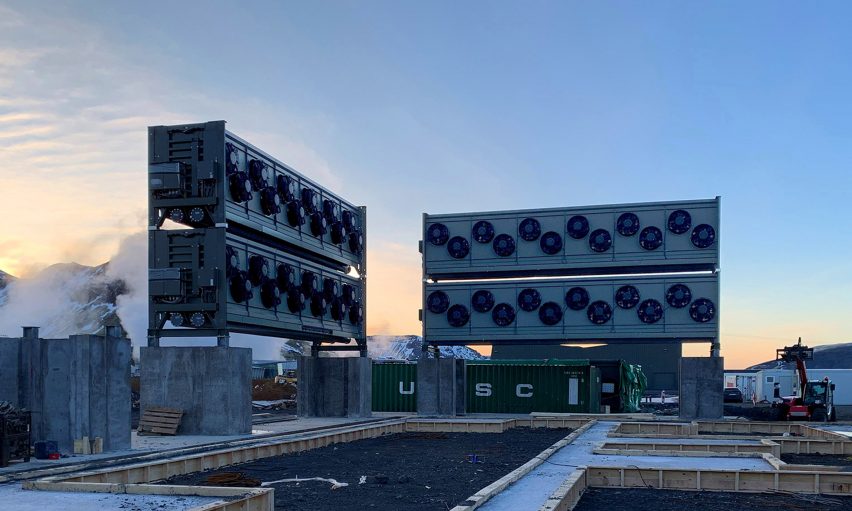
Swiss company Climeworks uses direct air capture machines to remove CO2 from the atmosphere

William McDonough agreed, adding that there are other reasons for creating new forests besides carbon capture. These include protecting biodiversity, conserving water and preventing erosion, as well as serving as cultural and spiritual assets for humanity.

"I think taking care of forests is something that is essential to culture," he said. "There are so many reasons to do it beyond carbon sequestration. It's still worth doing even if the carbon equations are skewed a bit because it's about a 25-year cycle. The tree grows, dies, becomes carbon, goes up, comes back."

Forests aren't the only type of ecosystem that needs to be recreated, he added. "So let's plant mangroves, let's restore ecosystems everywhere we can, all over the planet, all the time."

Offsetting carbon emissions should just be "a first step"

Designer Charlotte McCurdy argued that offsetting emissions by paying for trees to be planted amounted to "holding a forest hostage".

"Does someone holding a forest hostage actually mean that you can go emit and somehow that makes you neutral?" she asked. Offsetting, whereby greenhouse gas emissions are negated by investing in schemes that recapture those emissions, is a lazy way out, she argued.

"The reason there's an emphasis on offsets is that it's easy," said the designer, who is developing carbon-sequestering bioplastics. "Truly decarbonizing and disentangling your industry or your material selection from fossil fuels or fossil carbon that actually takes retooling. "

"And offsets can be a pathway, a first step, but by no means is it a destination in terms of designing an actual system that is decarbonized," she added.

"The majority of our scenarios [for preventing runaway climate change] rely on negative emissions. And negative emissions are not offsets. Negative emissions are pulling carbon out of the air. How do we find and scale those technologies?"


Related story
Hemp "more effective than trees" at sequestering carbon says Cambridge researcher


Nori's Gambrill agreed that offsetting via tree-planting looks like an easy option but in reality is fraught with uncertainty. "Have you ever bought an airfare or something like that and you see a little checkbox, and you check that box and they say we're going to take care of the carbon emissions from this and we'll plant a tree or something?" he asked.

"That's fine and good but you as a consumer have no idea how they're doing that, where it's happening or how it's being measured and verified. You have no insight into that after you check that box and you move on with your day."

"We know that a carbon dioxide molecule basically hangs out in the atmosphere for approximately 100 years," he added. "So it just kind of evolved to a point where people are saying, if I'm going to pay you to offset some emissions, then you should make sure that that carbon is going to stay out [of the atmosphere] for at least 100 years."

"It is impossible to get down to zero with offsets"

Fredrika Klarén, head of sustainability at electric car brand Polestar, agreed that there are "too many insecurities" when offsetting fossil-fuel emissions. Instead, companies have to eliminate emissions from their entire value chain.

"It is impossible to get down to zero with offsets," said Klarén, who is helping Polestar develop a car that aims to be carbon-neutral in every aspect of its production. "The trouble is that not many people are aware of this. You cannot offset emissions from the use of fossil fuels. There are too many insecurities in that."

"It is great to support forest conservation but you cannot do it as a means to try to offset emissions from something that you’ve just produced," she added, pointing out that Polestar is "not going to go down the tree planting route."

"We have to decarbonize our value chain. We have to go for that. Otherwise, we will fail at becoming net-zero."


Power lines in Karachi. Pakistan’s grid is vulnerable to chronic blackouts and load shedding (HovaHe/CC BY-SA 2.0)

Projects

China completes work on $1.7bn project to transform Pakistan’s dysfunctional grid

8 July 2021 | By GCR Staff | 0 Comments

A $1.7bn electricity transmission line on the China–Pakistan Economic Corridor (CPEC), which was begun in December 2018, was inaugurated in a ceremony held in Islamabad and Beijing at the end of last month.

The 660kV Matiari–Lahore high-voltage direct current line will provide Pakistan’s national grid with a new backbone and improve chronic problems with the country’s energy transmission and distribution grids.

The 878km line was financed and built by the State Grid Corporation of China, which will operate it for the next 25 years.

More than 1,300 Chinese and 6,500 Pakistani workers were employed on the scheme.

Hammad Azhar, Pakistan’s energy minister, said the project would bring stability to the country’s power system. Speaking at the online ceremony, he said the project would “enhance transmission capability and bring relief to consumers”.

Electricity generation in Pakistan has increased dramatically in recent years, thanks to the large-scale construction of mainly coal-fired plants funded by China.

As a result the country has an installed capacity of around 37GW and peak demand of only 25GW, although this is growing at a rate of about 5% a year. However the grid is able to handle only 22GW of power, resulting in chronic blackouts and load shedding, particularly in the summer when demand is highest.

However, problems occur in winter as well. In January of this year, the entire country suffered a blackout after a fault at a power station in southeast Sindh province caused the grid to lose its 50Hz frequency, which caused power stations throughout the country to close down.

This makes the reinforcement of the grid, arguably, the single most important infrastructure scheme for the country’s socio-economic development.

Zhang Jianhua, head of China’s National Energy Administration, told those present at the ceremony that the Matiari-Lahore line was the first large-scale transmission project of the CPEC, and would provide “solid assurance” for power transmission in the south and power supply in the north.

Speaking about the economic corridor in general, Azhar added: “The CPEC is of utmost importance for Pakistan. It will enable the country to enhance industrial production, upgrade energy and communication infrastructure and improve connectivity within the region.”

Of Pakistan’s 207 million people, roughly 58 million lacked access to grid electricity in 2018, including 46% of the rural population.

Image: Power lines in Karachi. Pakistan’s grid is vulnerable to chronic blackouts and load shedding (HovaHe/CC BY-SA 2.0

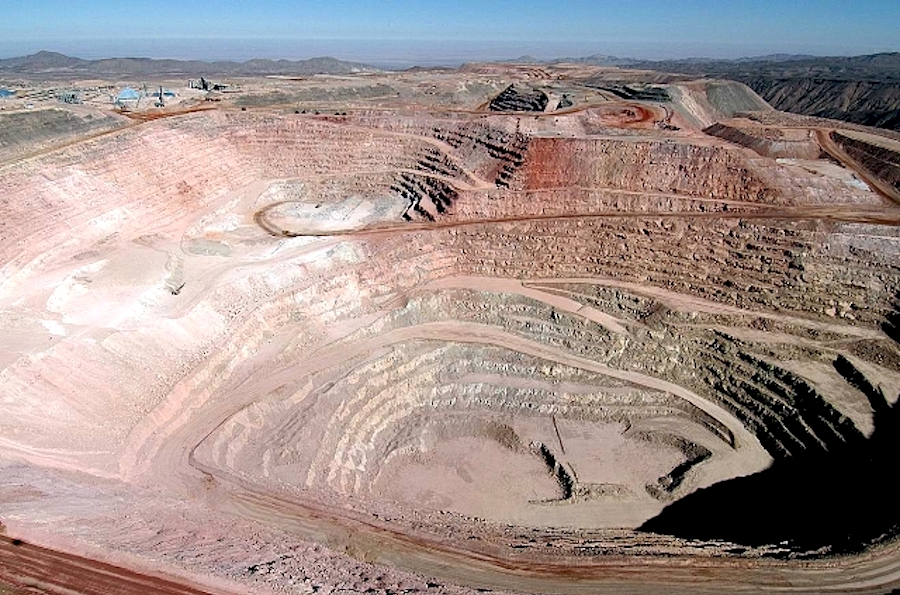
Copper mining is Opec on crack, so why is the price falling?

Frik Els | July 13, 2021 |

The Shah of Iran opens the facilities of International Naval Oil Company of Iran in 1970. File image.

Much like the reference in this piece’s headline, it’s a cliché to call a country the Saudia Arabia of something.


The top search suggestion at the moment is the Saudi Arabia of wind. That’s Boris Johnson’s dream for the UK and from a leader with an affinity for hot air, perhaps not unexpected.


The Saudi Arabia of lithium query takes you to a story about Chile, which is wrong. Neither is it Afghanistan as this article in the NYT would have it. It’s Nevada; Elon Musk confirmed it last year.

The Saudi Arabia of sashimi is… well just google it. (it’s Palau – ed.)

Chile is not the Saudi Arabia of copper either.


It’s the Saudia Arabia, Iraq, UAE, Iran, Kuwait, Nigeria, Angola, Algeria, Venezuela, Libya, Congo-Brazzaville, Gabon and Equatorial Guinea of copper.

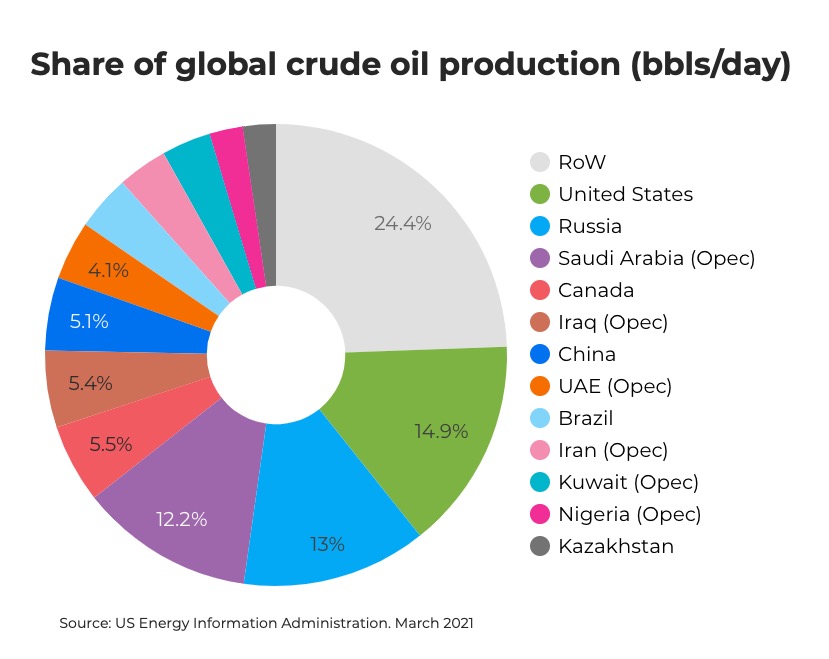
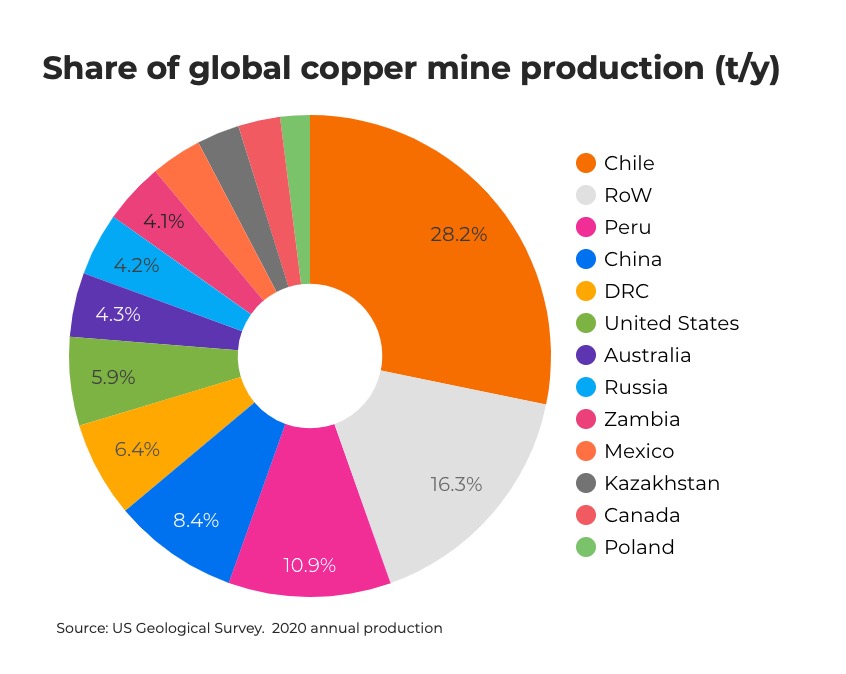
Chile’s share of global copper output is on par with the combined output of the 13 members of Opec in the crude trade.

In 2020 the South American nation produced 5.7m tonnes of copper out of a global total of 20.2m tonnes, according to the US Geological Service. Opec countries were responsible for 24.3m of the 76.1 million barrels per day produced during March this year, according to the US Energy Information Administration.
Chile+

Chile and Peru together constitute close to 40% of world production, which is roughly the share of what is known as Opec+ (add Russia). And consider that Chile and especially Peru suffered frequent covid-related mining disruptions last year (not to mention blockades at some of the biggest mines and transport strikes).


The concentration at the top is only going to increase. The Democratic Republic of the Congo could as soon as next year overtake China as the no 3 producer when the Ivanhoe-Zijin JV, Kamoa-Kakula, adds 400,000ktpa to the country’s total (and doubling its contribution six years later).

Apart from Rio Tinto’s much-anticipated block cave at Oyu Tolgoi (330ktpa) in Mongolia on the Chinese border, the only near-production projects close to this size are in South America.


Anglo American’s greenfield Quellaveco project (300ktpa) in Peru and Teck Resources’ phase 2 at Quebrada Blanca (295ktpa) in northern Chile will further entrench the two countries’ dominance

Playing with monopsony money

As in other spheres, China plays the long game in mining.

It bagged the largest new copper mine to come on stream in decades – Las Bambas in Peru – by making its sale to a Chinese concern a requirement for approving the 2014 Glencore-Xstrata merger.

In 2016, China Moly picked up Tenke Fungurume in the biggest overseas splash since Las Bambas, paying $2.7 billion to take it off Freeport-McMoRan and Lundin’s hands.

In all, China has spent $16 billion on buying copper projects around the world and at the moment owns 30 operating copper mines and 38 exploration projects.

That’s over and above Beijing’s annual foreign direct investment in mining and exploration, which reached $2.2 billion in 2019.
Go downstream, things will be great when you’re downstream

It’s not only primary production that’s highly concentrated, there’s a lock on the midstream.

Overall, 63% of China’s copper concentrate comes from Chile and Peru, and after decades of investment in the sector, the country refines over 40% of the world’s copper, six times its nearest rival, Japan.

The Tenke deal supercharged the 4C supply chain – Congo-Copper-Cobalt-China – as Chinese imports of concentrate from central Africa and elsewhere accelerated towards 2020’s total of just under 22m tonnes per year.


THE BIDEN ADMINISTRATION REPORTEDLY WANTS TO COPY THE CHINESE PLAYBOOK, BUT IN ORDER TO PLACATE ENVIRONMENTALISTS WILL SKIP THE MINING PART


Cobalt is a by-product of copper mining — primarily in the DRC which is responsible for some two-thirds of global output. China owns 82% of global midstream processing of cobalt for batteries. For nickel in the EV supply chain it’s 65%.

The Biden administration reportedly wants to copy the Chinese playbook, but in order to placate environmentalists will skip the mining part.

In the words of one official involved in critical minerals policy, “it’s not that hard to dig a hole. What’s hard is getting that stuff out and getting it to processing facilities.”

Just like all the oil processing facilities in the US shielded it from the Opec-induced oil supply shocks of the 1970s. Right?
Earthquake in Chile

While the Middle-East is a volatile region (to use a well-worn euphemism), its hereditary leaders and pseudo-democracies have a way of keeping the oil flowing regardless of any palace intrigue, proxy wars, or sanctions.


In contrast, Chile and Peru are in the early stage of fundamental political shifts driven by elections fought over income inequality, poverty and the environment – hardly on the political agenda in places like Saudi Arabia and the Gulf states.

A debate between Opec’s crown princes and emirs has sent oil to three-year highs, up 50% in 2021.

Let’s count the ways Chile can cause a copper market meltup:

It’s rewriting its Pinochet-era constitution, new copper windfall taxes and royalties already approved by the lower house, could, to put it mildly, dampen enthusiasm (your last euphemism – ed.) for new projects, so-called tax stability deals for half the country’s mines (including Escondida, the copper world’s Ghawar) expire in 2023 if they last that long, a powerful mining union is lobbying for state-owned Codelco to have dibs on projects, and if the current frontrunner becomes president in November elections he would be the first person from the Communist Party to do so.

Daniel Jadue also has other ideas to increase the state’s take and involvement – creating a Codelco for lithium (gentle reminder: Codelco was created by seizing mines from US companies in the 1970s) and like Indonesia renegotiate state shareholding in private companies like Freeport had to with Grasberg.

Another successful Indonesian strategy Chile and others would want to copy is to force miners to build smelters and refineries in-country by banning ore exports.

A bit like the current US administration’s clever strategy around critical minerals, focusing on processing facilities, except Chile also produces feedstock for said facilities.
Dear prudence

Now take all of the Chilean political and mining trends, turn them up a few notches, and apply to Peru and its new president Pedro Castillo.

At the start of his campaign, Castillo said he wanted to nationalize the mines but later softened his stance by calling for Chile-like royalties in the 70-percents.

This is a recent headline about Castillo’s latest plans for the industry:

Peru’s Castillo expects mining firms to accept “prudent” tax changes, adviser says

You can read that as having a conciliatory tone, or perhaps it sounds more like: “Nice little copper mine you have there. It would be a shame if something were to happen to it. We’ll make you an offer you can’t refuse.”


Ocec nocec


The copper-oil analogy only goes so far.

Captain Copper, Latin American superhero. Image: Codelco

While regional co-operation to align mining rules for Chile, Peru, Argentina, Bolivia and others so as to “not compete for investments” (Jadue again) is being discussed, an Opec-like cartel in copper is never going to happen.

Most Opec disagreements are about how much to up production (the UAE wants to pump more oil now because the assumption is as the world moves away from fossil fuels it would be stuck with stranded oil and gas assets down the line).

Codelco is spending more than $40 billion just to keep output steady. Opec-members output hikes can also hit oil markets within months. For copper it takes years, often decades to bring new supply online.

Low and declining grades and with it ever costlier and bigger mines, uninspiring green discoveries, modest brownfield expansions, thin project pipelines, underinvestment in exploration, and glacially slow permitting processes, have become rules of thumb in the industry. And when tailings reprocessing is being discussed as a significant source of new supply, you know something in the industry has changed.

Depletion is oddly little discussed (must be in miners’ DNA – it’s always about the next discovery, not this old hole in the ground – ed). A recent study found that most porphyries (which supply 80% of the world’s copper) are fast nearing the end of their productive life due to the specific nature of how these deposits are formed.

So why is the price falling? idk


The copper price is down 10% since hitting all-time highs of $10,500 a tonne ($4.75/lbs) in May and forecasts are for further declines.

Two years out among more than 30 investment banks, economists and research houses polled consensus is for an average $8,131 a tonne ($3.68/lb).

Technically, that means copper is entering a bear market.

But it’s worth remembering that the metal also traded at these levels as far back as 2011.

Rapid demand growth and rising risks to supply since then does not seem baked into today’s price, much less in continuing declines.
CHILE
BHP’s Cerro Colorado must start from scratch on environmental plan
Reuters | July 13, 2021 | 

Cerro Colorado is BHP’s smallest Chilean copper operation. (Image: Zwansaurio | Flickr Commons)

BHP’s Cerro Colorado copper mine must start again from scratch on an environmental plan for a key mine maintenance project, a Chilean court ruled on Tuesday, though the company said the decision would not impact operations.


The Antofagasta Environmental Tribunal annulled the 2019 approval for the project, which includes work on a low-grade mineral deposit, internal roads and camps, noting the regulator’s initial evaluation had been tainted by “substantial errors.”

The decision follows a ruling in January by the country’s Supreme Court that upheld local indigenous communities’ complaint that the process had failed to consider concerns about the project’s impacts on natural resources, including a regional aquifer.

BHP told Reuters the mine would continue to operate while the company reviewed the decision to its determine next steps.

“The ruling does not compromise the operational continuity of Cerro Colorado,” the company said.

The court said the initial environmental approvals had failed to “correctly evaluate” the risk of air pollution generated by the project, and expressed special concern for the failure to consult properly with the local communities near the project site.

Cerro Colorado, a small mine in BHP’s Chilean portfolio, produced about 1.2% of Chile’s total copper output in 2020. The country is the largest copper producer in the world.

(By Dave Sherwood; Editing by Dan Grebler)
Battery chain puts lithium’s green credentials under microscope

Bloomberg News | July 8, 2021 | 

Chile holds half of the world’s most “economically extractable” reserves of lithium. (Image: Orlando Neto | Shutterstock.)

A group backed by German car-making giants Daimler AG and Volkswagen AG has started a study into the environmental impact of lithium mining in Chile, the second-largest supplier of the key ingredient in rechargeable batteries.


GIZ, the German development agency running the initiative, is looking into how pumping up lithium-laced brine from beneath the Atacama salt flat is impacting local water supplies and communities. The project will last about two and a half years, a spokeswoman said.

It’s the latest effort by the global battery-supply chain to address growing concern among investors and the general public over the sustainability of industries that will produce the building blocks for the clean-energy transformation.

Albemarle Corp. and Soc. Quimica & Minera de Chile SA are ramping up output in the Atacama, which boasts the world’s largest reserves, in response to a projected tripling of global demand. That’s shining a light on the fragility of desert ecosystems once seen as resilient to the method of pumping up brine into massive evaporation pools.

The salt flat is in one of the driest places on Earth, where copper mines, communities and tourism also compete for water.

“There is a lack of consensus regarding the impacts and risks of lithium mining and other economic activity in the region,” the GIZ spokeswoman said.

The initial phase of the Responsible Lithium Partnership initiative is being funded by Daimler, Volkswagen, BASF SE and Fairphone BV. It will seek input from parties such as copper and lithium producers, indigenous communities and authorities. SQM welcomed the initiative, saying it was aligned with its sustainability vision. Both SQM and Albemarle are working to minimize brine and water use.

The partnership may lack teeth and looks like an attempt to boost supply-chain perceptions from a German auto industry that’s facing its own environmental, social and governance issues, said Alonso Barros, a lawyer who works with communities surrounding Chilean lithium operations.

The study is getting underway at a time of heightened scrutiny for mining companies in Chile, where a new constitution is being drafted that could lead to stricter environmental standards.


(By Daniela Sirtori-Cortina and James Attwood)