Wednesday, July 14, 2021

Qatar’s hotels accused of hospitality workers abuses

UK-based NGO Business and Human Rights Resource Centre finds Qatar’s hotel brands are failing to protect hospitality workers, as the Qatari government encourages workers to report abuses.

A survey has found that hospitality workers in Qatar suffer from 'extortionate recruitment fees, discrimination and being trapped in a job through fear of reprisal and intimidation' [Showkat Shafi/ Al Jazeera]


14 Jul 2021

Luxury hotel brands in Qatar have failed to protect migrant workers, according to the Business and Human Rights Resource Centre, a London-based NGO, saying its annual survey uncovered abuse that “points to forced labour”.

Its report titled “Checked Out: Migrant worker abuse in Qatar’s World Cup luxury hotels” (PDF) published on Wednesday found that migrant workers in the hotels suffer from “extortionate recruitment fees, discrimination and being trapped in a job through fear of reprisal and intimidation”.

The Qatari government said in a reaction that the Gulf country “takes a zero-tolerance approach against violating companies, issuing harsh penalties including prison sentences”.

“Qatar has introduced a raft of major reforms to improve labour standards and protect the rights of all workers. This includes a new national minimum wage, the removal of exit permits, the removal of barriers to prevent workers changing jobs, stricter oversight of recruitment, better accommodation, and improved health and safety standards,” the Government Communications Office (GCO) said in the statement.

To host the World Cup in November 2022, Qatar has massively grown its hotel industry, preparing an additional 26,000 hotel rooms to support the influx of players, supporters and the media.

Migrant workers from East Asia, South Asia and Southeast Asia make up the vast majority of the workforce in the hospitality sector.

After inviting 19 hotel companies, representing more than 100 global brands with more than 80 properties across Qatar to participate in their survey, the rights group found that there is a “widespread lack of action by hotel brands to prevent and exclude forced labour”.

By engaging with partners to interview workers at hotels the Research Centre approached, their testimonies revealed that eight out of 18 workers reported being charged high recruitment fees for jobs.

A kitchen worker from Kenya told the Business and Human Rights Research Centre: “I paid $1,000 commission to secure the job. I have still not paid up in full the loan… No one has asked or offered to reimburse this cost, everyone is just keeping quiet.”

Only IHG Hotels & Resorts, which owns chains such as InterContinental and Crowne Plaza, provided transparent figures for the number of workers it identified had paid such fees. It was the highest ranked company in the survey and the only hotel group to be awarded a three-star rating out of five. All other brands scored below 50 percent.

Ten out of 18 workers interviewed from Africa or Asia said that pay and position were dependent on nationality, according to the findings.

Subcontracted workers reported receiving “substantially less pay for the same work and were subject to the most serious abuses, including passport confiscation and delayed wages with illegal deductions”.

Workers were not able to freely change jobs despite the landmark reform abolishing the No-Objection Certificate (Kafala system), the report said.

Almost all workers reported being scared to request to change jobs when they saw a better opportunity, some fearing the hotels would have them deported.
Qatar labour reforms

In a statement, the Qatari government said it takes seriously all reports of abuse and mistreatment in the country’s labour market.

“Awareness-raising initiatives have been launched to provide workers with information on how to raise complaints against their employer, and new mechanisms have been introduced to facilitate access to justice.”

The Qatari government called on workers to file complaints with the Ministry of Administrative Development, Labour and Social Affairs (ADLSA) through the available channels if they believe a law has been broken, saying most complaints are resolved in a timely manner.

“Addressing the hospitality sector directly, the Ministry of ADLSA has created and distributed a comprehensive employment guide in cooperation with the Institute for Human Rights and Business (IHRB) and the International Labour Organization (ILO) to raise awareness of the new laws and ensure their effective implementation,” the GCO statement said.

However, the Business and Human Rights Resource Centre in its report said much of the practices uncovered by its survey pointed to conditions of “forced labour” as defined by the International Labour Organization (ILO).

“Our findings should make for troubling reading for the national football teams and one million visitors who are planning a joyful month of sport in Qatar in November 2022, but not at the expense of workers’ misery.

“It should also be a red flag for corporate sponsors of the World Cup. Huge profits are set to be made by the multinational and national hotel brands which will host these visitors.”

The report noted that 11 out of 19 hotel companies had responded to their survey, but several high-profile brands including Best Western, Four Seasons and Millenium & Copthorne did not respond, the centre said.

The Research Centre urged hotel brands to ensure protection of migrant workers by putting all workers at the centre of their due diligence monitoring processes, ensuring workers are free to change jobs and addressing recruitment fees.

The GCO added that “Qatar is committed to making further progress to ensure the labour reforms are effectively enforced. Significant progress has been made, but there is also a responsibility on companies to adjust their practices in line with the new legal requirements.

“With new laws and stricter enforcement measures in place, the government is clamping down on labour abuses, including those in the hospitality sector. Shifting the behaviour of all companies will take time, but Qatar is winning the battle against those who think they can bypass the rules,” the GCO said.

KEEP READING


SOURCE: AL JAZEERA
Scientists develop pain-free blood sugar test for diabetics

Australian researchers hope low-cost saliva test will replace current needle-based test for diabetes sufferers.


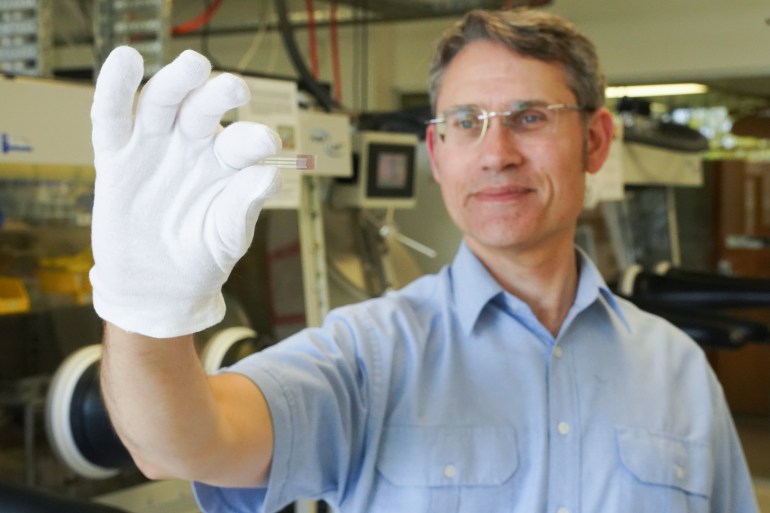
Professor of Physics Paul Dastoor holds up a non-invasive, printable saliva test strip for diabetics at the University of Newcastle, New South Wales, Australia [Courtesy of University of Newcastle via Reuters]

13 Jul 2021

Australian scientists say they have developed pain-free blood sugar testing for diabetics, a non-invasive strip that checks glucose levels via saliva.

For diabetics, managing their blood sugar levels typically means pricking their fingers multiple times a day with a lancet and then placing a drop of blood on a testing strip. Understandably, some diabetes sufferers avoid the painful process by minimising their tests.

However, this latest test works by embedding an enzyme that detects glucose into a transistor that can then transmit the presence of glucose, according to Paul Dastoor, professor of physics at the University of Newcastle in Australia, who led the team that created it.

He said the tests create the prospect of pain-free, low-cost glucose testing which should lead to much better outcomes for diabetes sufferers.

“Your saliva has glucose in it and that glucose concentration follows your blood glucose. But it is a concentration about 100 times lower which means that we had to develop a test that is low cost, easy to manufacture, but that has sensitivity about 100 times higher than standard glucose blood test,” Dastoor told Al Jazeera.

A non-invasive, printable saliva test strip for diabetics is seen at the University of Newcastle, New South Wales, Australia [Courtesy of University of Newcastle via Reuters]Since the electronic materials in the transistor are inks, the test can be made through low-cost printing.

“The materials that we work with are remarkable, they are electronic inks that can act as electronic material, but the difference is that we can print them at massive scale using a reel-to-reel printer, the same that you use to make newspapers,” Dastoor said.

The project secured A$6.3 million ($4.7m) in funding from the Australian government to establish a facility to produce the test kits should clinical trials be passed.

Dastoor says the technology could also be transferred to COVID-19 testing and allergen, hormone and cancer testing.

The university is already working with Harvard University on a test for COVID-19 using the same technology.


From: The Stream

What will a US probe into Indigenous boarding schools uncover?


               SIOUX BOYS ASSIMILATED 

On Tuesday, July 13 at 19:30 GMT:
Beginning in the 19th century, the US government funded a system of boarding schools where hundreds of thousands of Indigenous children were forcibly removed from their families, taught to shun their cultural heritage and assimilate to white Christian customs. Also known as “Indian residential schools”, the system included at least 367 institutions run by various US church groups from 1819 until the end of the 1960s. According to former attendees, children were poorly cared for and many endured physical abuse, sexual abuse and forced labour.

Now the US Department of the Interior wants an investigation with a focus on finding records of children who died while they attended the schools and locating unmarked graves. The investigation’s announcement followed recent discoveries of nearly 1,000 secret graves at three former schools for Indigenous children in Canada.

A modern and comprehensive study of boarding schools and their forced assimilation policies has never been done by the US government, and much of its history – including the official number of schools and its attendees – is still not known. Advocates of boarding school survivors say the institutions have been a major source of intergenerational trauma felt in Native American communities to this day.

In this episode of The Stream, we’ll discuss the legacy of Native American boarding schools and what a federal investigation of its abuses will mean to Native communities.

On this episode of The Stream, we speak with:
Christine Diindiisi McCleave, @C_McCleave
CEO, National Native American Boarding School Healing Coalition

Patty Talahongva, @WiteSpider
Executive Producer, Indian Country Today

Maka Black Elk, @makablackelk
Executive Director of Truth and Healing, Red Cloud Indian School

#BUSHMEAT

COVID or not, ‘the desire to eat wildlife’ continues in Asia

Countries in the region moved to ban the sale and consumption of wildlife after COVID-19 emerged, but coronavirus remains rampant and so does the trade.

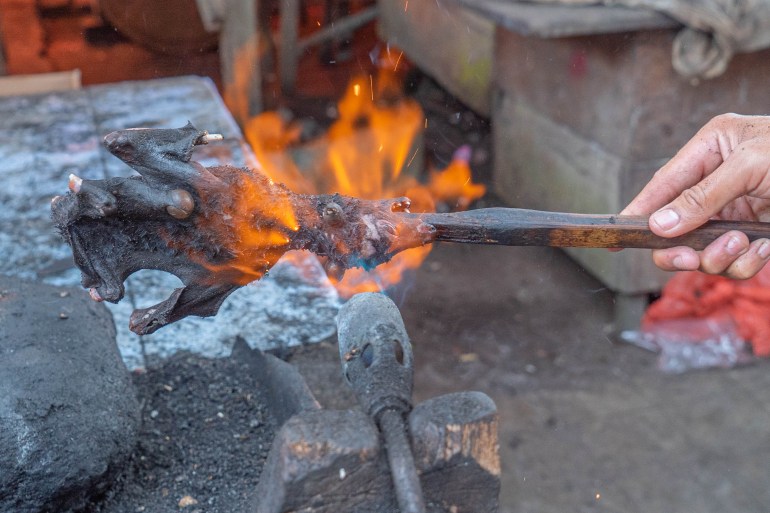
A trader torches a bat at a live animal market in Langowan in the Indonesian province of Sulawesi in June [Courtesy of Four Paws]
By Ian Lloyd Neubauer
13 Jul 2021


Continuing attempts to curb the sale of wild animals and their meat have failed to engender change at wet markets in the Asia Pacific, even as the region struggles to contain the largest and deadliest wave of COVID-19 since the start of the pandemic.

According to the World Health Organization (WHO), nearly three-quarters of emerging infectious diseases that spread to humans originate in animals.

The SARS virus, for example, which killed 800 people between 2002 and 2004, is thought to have started in bats before spreading to civets at a wildlife market in the Chinese city of Foshan.

In April, after its investigative team in China concluded a seafood market in Wuhan was the most likely route by which COVID-19 first jumped to humans, WHO took the unprecedented move of urging countries to pause the sale of captured wild mammals at wet markets as an emergency measure.

Animal welfare groups in Asia have been making the same demands for years, saying the unsanitary and cruel conditions in which wild and domestic animals are kept at wet markets are the perfect breeding ground for zoonotic diseases.

Several Asian countries have passed new laws to curb the sale of ‘bush meat’ and limit activity at wet markets during the pandemic.


But nearly all attempts to stamp out the trade have been hamstrung by the continuing popularity of bush meat among some people in Asia, the sector’s vast economic value and a lack of enforcement.

Stopping the trade “will be a challenging exercise,” said Li Shuo, global policy adviser for Greenpeace in China.
A live animal or ‘wet’ market in Beriman in the Indonesian province of Sulawesi. Despite efforts to crack down on the trade following the coronavirus pandemic, NGO investigators say wildlife continues to be sold and eaten in many parts of Asia
 [Courtesy of Four Paws]


On-again, off-again


Last July, a presidential decree was issued in Vietnam suspending all wildlife imports and introducing much stiffer penalties for violators, including up to 15 years in prison.

But a survey last month by PanNature, an NGO, found no positive changes in the trade of wildlife products had occurred at the local level in Vietnam. Wet markets in the Mekong Delta and other parts of the country were found to still be selling turtles, birds and endangered wildlife species.

In Indonesia, the site of Asia’s worst COVID-19 outbreak with more than 2.5 million cases and at least 67,000 deaths, the Ministry of Environment and Forestry has been trying to convince local officials to close wildlife markets around the country since the start of the pandemic.

Officials in the city of Solo in Central Java were among those who took note, ordering the culling of hundreds of bats at Depok, one of the country’s largest bird, dog and wildlife markets. But the victory proved short lived.

“They brutally exterminated hundreds of bats when COVID-19 first hit and stopped selling them,” said Lola Webber, coalition coordinator at the Dog Meat-Free Indonesia Coalition. “But from what I’ve heard from my sources, it’s now business as usual.”

Marison Guciano, founder of Flight, an NGO protecting Indonesian birdlife, confirms Webber’s claim. “I was there one week ago and they are still openly selling bats as well as snakes, rabbits, turtles, ferrets, beavers, cats, dogs, hamsters, hedgehogs, parrots, owls, crows and eagles.”

Rats for sale in a market in Langowan in the Indonesian province of Sulawesi in June [Courtesy of Four Paws]The same scenario is playing out at wet markets across Indonesia.


To mark World Zoonoses Day last week, animal welfare group Four Paws released photos taken in June showing hundreds of bats, rats, dogs, snakes, birds and other animals for sale at three different markets in Northern Sulawesi Province 2,000km (1,243 miles) northeast of Solo.

History repeats itself


In April and May of last year, a few months after the pandemic began, global animal rights group PETA began visiting wet markets known to sell wildlife in Vietnam, Thailand, Cambodia, the Philippines, Indonesia and China.

“We expected new rules and regulations to have been put in place but we saw it was business as usual, with all different species in filthy cages, some alive, some dead, sometimes in the same cages,” says PETA’s Asia spokesperson Nirali Shah. “These environments are extremely frightening and stressful for the animals, which weakens their immune system and makes them more vulnerable to diseases that can jump across species and then to humans.

“At some markets, we saw animals taken from cages, killed on countertops streaked with blood from other species and workers not wearing gloves, no hygiene at all. This combination of risky factors is like a ticking time bomb waiting for a new pandemic to begin,” she says.

In China, where a total ban on the trade and consumption of wildlife was issued in February last year as the coronavirus surged in Wuhan, the situation has improved but only marginally, according to Shah.

“You can no longer see exotic wildlife for sale openly at wet markets in China. But they still sell all kinds of birds in unsanitary conditions. And in a lot of those markets we found that if you want a certain animal, no matter what it is, vendors can get it for you despite the ban.”

China banned the trade and consumption of wild animals after the coronavirus – thought to have originated possibly in a bat – emerged in Wuhan. NGOs say it is still possible to get banned animals if you know who to ask [Alex Plavevski/EPA]
This is not the first time China has attempted to end the bushmeat trade.


In 2002, wildlife markets were closed because of SARS but reopened later because of economic pressure. In 2016, the Chinese Academy of Engineers valued the country’s wildlife industry at $76bn, with bush meat accounting for $19bn of business activity each year and employing 6.3 million people in China.

Right direction

In Malaysia, captured wildlife and bushmeat was sometimes sold at wet markets before the pandemic. But it was more commonly available through direct sales and restaurants.

In August of last year, now-retired Inspector General of Police Abdul Hamid Bador gave district police chiefs one month to ensure their areas were free of illegal restaurants selling bushmeat. The wildlife department was instructed to assist police.

“Don’t tell me with 300 to 500 personnel in an area, the existence of restaurants and illegal premises selling exotic animals can’t be detected?” Abdul Hamid said at the time.

A series of high-profile wild meat seizures followed at markets, restaurants and private homes.

Elizabeth John, the Kuala Lumpur-based spokesperson for TRAFFIC, an NGO fighting the illegal trade in wildlife, says raids are a signal of both success and failure.


“In forming this joint task force between police and the wildlife officials, it’s definitely a move in the right direction,” she said. “But the fact that we have seen seizures continue even during the pandemic shows that warnings have not changed attitudes among consumers. Despite the risks it poses, the desire to eat wildlife is still out there.”

SOURCE: AL JAZEERA


KEEP READING


Death toll in Iraq COVID hospital fire rises

Prime minister promises accountability after blaze kills hospitalised COVID patients for a second time in less than three months.

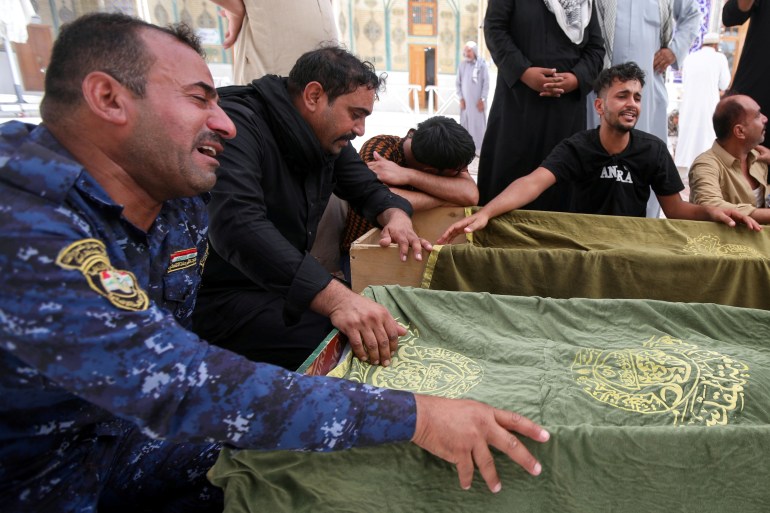
Mourners react during a funeral in Najaf, Iraq, next to the coffins of victims who were killed in the fire [Alaa Al-Marjani /Reuters]
13 Jul 2021

The death toll from a fire that tore through a coronavirus ward at a hospital in southern Iraq has risen to 92, health officials have said, as grieving relatives slammed the government over the second such disaster within three months.

Officials said more than 100 people were injured in the blaze at al-Hussein Teaching Hospital on Monday night in Nasiriya, highlighting the crippled healthcare system in the country amid decades of war and sanctions.

An investigation showed the fire began when sparks from faulty wiring spread to an oxygen tank that then exploded, police and civil defence authorities said.

Prime Minister Mustafa al-Kadhimi convened an emergency meeting and ordered the suspension and arrest of the health director in Dhi Qar province, the hospital director and the city’s civil defence chief. The government also launched a time-bound investigation.

Al-Kadhimi called the tragedy “a deep wound in the consciousness of all Iraqis”. A statement from his office called for national mourning.

In a tweet on Tuesday, President Barham Salih blamed the “catastrophe” at the hospital on “persistent corruption and mismanagement that undervalues the lives of Iraqis”.


A Nasiriya court said it had ordered the arrest of 13 local officials in connection with the fire.

Mismanagement and neglect


Anguished relatives were still looking for traces of their loved ones on Tuesday morning, searching through the debris of charred blankets and belongings inside the torched remains of the ward. A blackened skull of a deceased female patient from the ward was found.

The blaze trapped many patients inside the coronavirus ward who rescue teams struggled to reach, a health worker told Reuters on Monday before entering the burning building.

Rescue teams were using a heavy crane to remove the charred and melted remains of the part of the hospital where COVID-19 patients were being treated, as relatives gathered nearby.

Many cried openly, their tears tinged with anger, blaming both the provincial government of Dhi Qar, where Nasiriya is located, and the federal government in Baghdad for years of mismanagement and neglect.

“The whole state system has collapsed, and who paid the price? The people inside here. These people have paid the price,” said Haidar al-Askari, who was at the scene of the blaze.

Mohammed Fadhil, waiting to receive his bother’s body, said it was a disaster. “No quick response to the fire, not enough firefighters. Sick people burned to death. It’s a disaster,” he said.


DNA tests to identify bodies

While some bodies were collected for burial, with mourners weeping and praying over the coffins, the remains of more than 20 badly charred corpses required DNA tests to identify them.

Al Jazeera’s Mahmoud Abdelwahed, reporting from Nasiriya, said that forensic teams have identified around 39 bodies, while dozens others are still under a “recognition process”.

“We met victims’ families here who cannot find their loved ones. Dozens of body parts cannot be easily identified,” Abdelwahed said.

“Another man we met lost five of his family members – three [were] COVID-19 patients and the others were either visitors or those who rushed to try to save their relatives.”

In April, a similar explosion at a Baghdad COVID-19 hospital killed at least 82 and injured 110.

Iraq has registered more than 1.4 million cases of the coronavirus and upwards of 17,000 deaths as daily infections spike.

The head of Iraq’s semi-official Human Rights Commission said Monday’s blast showed how ineffective safety measures still were in the health system.

“To have such a tragic incident repeated few months later means that still no [sufficient] measures have been taken to prevent them,” Ali al-Bayati said.

The fact that the hospital had been built with lightweight panels separating the wards had made the fire spread faster, local civil defence authority head Salah Jabbar said.

A medic at the hospital, who declined to give his name and whose shift ended a few hours before the fire broke out, said the absence of basic safety measures meant it was an accident in the making.

“The hospital lacks a fire sprinkler system or even a simple fire alarm,” he told Reuters.

“We complained many times over the past three months that a tragedy could happen any moment from a cigarette stub, but every time we get the same answer from health officials: ‘We don’t have enough money’.”
Death sentences in Bahrain ‘dramatically escalated’ since 2011

Death sentences in the small Gulf nation have risen more than 600 percent in the past decade, new report finds.

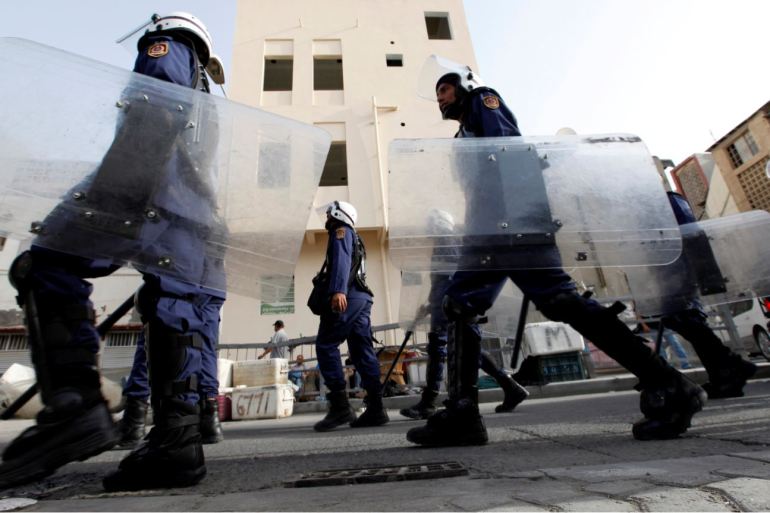
Some 88 percent of men executed in Bahrain since 2011 were convicted of 'terror' charges [File: Hamad I Mohammed/Reuters]

13 Jul 2021

The use of the death penalty in Bahrain has dramatically escalated over the past decade, specifically since the 2011 Arab Spring uprising, a new report has found.

Death sentences in the small Gulf archipelago have risen by more than 600 percent, with at least 51 people ordered executed since anti-government protests erupted in 2011, according to a joint report published on Tuesday by anti-death penalty and human rights group Reprieve and the Bahrain Institute for Rights and Democracy (BIRD).

Seven people were sentenced to death in the previous decade, the report found.

The joint report noted the use of torture, especially in “terror” related death penalty cases, was particularly widespread, despite pledges for human rights reform by the government.

Some 88 percent of men executed in Bahrain since 2011 were convicted of “terror” charges, and 100 percent of these individuals alleged torture, the report found.

Today, some 26 men are facing imminent execution on death row, 11 of whom allege torture by Bahraini authorities. According to court documents, this includes individuals whose convictions were based on false torture “confessions”, the report said.

It noted the United Nations Committee Against Torture raised concerns about “the widespread acceptance by judges of forced confessions” in Bahrain, and recommended that judges “should review cases of convictions based solely on confessions, since many may have been based on evidence obtained through torture and ill-treatment”.

The death penalty has been imposed on a scale “never seen before”, especially targeting those connected to political opposition, it noted, as several had attended pro-democracy protests.

Commenting on the report, Sayed Ahmed Alwadaei, director of BIRD, said: “Sentencing torture survivors to death for their opposition to the government is a heinous act of revenge by Bahrain’s regime.

“For those facing imminent execution, the uncertainty of knowing they could be executed at any time is causing an unspeakable strain on their lives and those of their families.”

Claims of torture


Bahrain has been clamping down on dissent since 2011 when it quashed protests with help from Saudi Arabia.

Bahraini authorities have denied targeting the opposition and say they are protecting national security. The Gulf island kingdom has also claimed Iran trained and backed the demonstrators in order to topple the Manama government – an accusation Tehran denies.

Home to the Middle East headquarters of the US Navy, Bahrain has prosecuted and revoked the citizenship of hundreds of people in mass trials. Most opposition figures and human rights activists have been jailed or have fled.

But many have remained and are facing harsh sentences while their families await the news of their imminent deaths in anguish.

Tuesday marks one year since the Bahraini Court of Cassation decided to uphold Husain Moosa and Mohammed Ramadhan’s death sentences. The pair were tortured and convicted on the basis of a “confession” obtained through torture, according to human rights groups.

Security forces arrested Moosa, a hotel employee, and Ramadhan, a security guard in Bahrain’s international airport, in early 2014 after a policeman was killed in a bombing of a convoy in al-Deir, a village northeast of the capital, Manama.

At the time of their initial conviction, BIRD, as well as Amnesty International, said both men were tortured to extract false confessions, subjected to sexual assault, beatings, sleep deprivation and other abuses – accusations the Bahraini government denies.

According to the report, the men were pursued after attending “peaceful protests” in 2014.

Their so-called “confessions” were used to convict and sentence them both to death, a move that violates international law, the report said.

Mohammed’s mental health has deteriorated, and he has repeatedly expressed to his wife his overwhelming distress that his execution could be carried out at any moment.

Prison guards closely monitor Mohammed and Hussain’s phone calls, which, during the COVID-19 pandemic, are their only means of communicating with their family, who have been banned from visiting them since early 2020, according to the report.

They have suffered reprisals for the attention their case has received, including threats that if they speak with the media, guards will “revoke their phone privileges entirely”, it added.

‘You can’t say everything’


Meanwhile, Zuhair Abdullah, who was sentenced to death in 2018, suffered a wide range of torture techniques upon his arrest in November 2018, including the use of “electric shocks to the chest and genitals, beatings and attempted rape”, according to information gathered from interviews with Abdullah and his family.

He was threatened “further torture” by the former director of the Royal Academy in Bahrain, before agreeing to sign a “coerced confession” that led to the handing down of his death sentence, the report said.

In a phone interview with BIRD director Alwadaei – the edited transcript of which was shared with Al Jazeera – Abdullah spoke about his torture experience and sexual assault.

“They have no proof against me. None at all,” Abdullah said during the call that took place on October 11, 2019.

“I tried to defend myself to death. To death. I tried to stop them from that,” he said, recalling being assaulted as a “hose” was being inserted into his anus.

“I tried to stop them but I sustained some injuries … it was psychological torture and too much beating. It was attempted rape,” Abdullah said.

Upon meeting with a medical examiner, Abdullah said he could not freely talk about details of his assault because he was being monitored.

“You can’t say everything,” he said, adding that six months later he spoke to the same medical examiner but his injuries had healed.

“I explained everything. But I don’t know what his reports were,” Abdullah said.

‘Speak out’


In its recommendations, Reprieve and BIRD urged the Bahraini government to implement an “immediate moratorium on the use of the death penalty, pending a full review of all capital cases to identify allegations of torture”.

They have also called on the courts in Bahrain to “quash all death sentences and overturn any convictions that rely on torture evidence”.

The groups also called on the government of the United Kingdom to halt all assistance to “Bahraini security and justice bodies” that are responsible for carrying out much of the alleged abuses.

“The British government has a moral obligation to speak out against this injustice before it is too late,” BIRD director Alwadaei said.


KEEP READING


Questions after Egyptian workers killed in Cyprus fire

One week after wildfire devastated surrounding countryside – killing four people – residents of a Cypriot village are facing questions over the treatment of farm labourers.

Farmer Antonis Korniotis said: 'If we had waited everyone would be dead now' [Nigel O'Connor/Al Jazeera]

By Nigel O'Connor
13 Jul 2021

Odou, Cyprus – Approaching sunset brings an end to the working day in the farming community of Odou, in Cyprus’s Troodos mountains. As light fades, the quiet village is enlivened with the hum of a series of pick-up trucks returning from the fields, loaded with fresh produce and the Egyptian farm labourers who picked it.

Situated amid abrupt rock faces and terraced farmland, Odou bares the scars of fresh tragedy. The surrounding slopes are entirely blackened, charred by a forest fire – described as the worst in Cyprus’s recorded history – that engulfed the village on July 3.

Four Egyptian workers were killed in the flames and their fate, along with their surviving compatriots, has become the subject of accusations over maltreatment.

“If you don’t respect workers they’re invisible so these things can happen,” Doros Polykarpou, director of the Cypriot human rights organisation KISA, told Al Jazeera.

The remains of Ezzat Salama Youssef, 36, Samwiel Milad Farouk, 22, Maged Nabil Yonan, 23, and Marzouk Shohdy Marzouk, 39, were found among the burned terrain outside of Odou the morning after the fires. They had been employed by a local farmer to pick tomatoes during the summer harvest and were working in the fields when the fire approached and cut off their escape route.

Polykarpou claims the deaths were a direct result of institutional discrimination of migrant workers.


“Again and again the authorities make promises after these incidents but they take no action,” he said.

Calls for governmental action have also been taken up by trade unions.

“We expect the labour ministry to act promptly so they can provide answers to everyone and assign responsibilities where they exist,” The Pancyprian Federation of Labour said in a statement after the deaths.

Smoke from a forest fire is seen in Ora village, Larnaca, Cyprus [File: Andrea Anastasiou via Reuters]

To date, the only arrest in relation to the blaze is that of a 67-year old man suspected of starting the fire when burning grass at his field in nearby Arakapas village. In addition to those killed, 55 square kilometres of countryside and farmland were burned – destroying 50 homes, causing millions of euros in damages, and forcing the evacuation of 10 villages.

Andreas Christou, of the Department of Forests, the responsible agency for fighting forest fires, told Al Jazeera a mixture of high winds, a summer heatwave, and dry vegetation meant conditions prevented the blaze quickly being controlled.

“All factors favoured the fire,” he said. “The narrow agricultural roads prevented quick access of fire vehicles to the fronts.”

He said it took 15 firefighting aircraft to control the fire by July 5.

A usual evening in Odou would see the Egyptian workers shower, change into fresh clothes, and gather along with locals in the village square. However, when Al Jazeera visited five days after the fire, many came directly from work to assemble for an impromptu street-side discussion about labour rights organised by KISA.

“There is no up-to-date framework to regulate salaries or workers’ rights here,” Polykarpou said before questioning the workers about their conditions.

With the smell of smoke still lingering in the air and tree stumps on distant hillsides continuing to smoulder, many of the Egyptian workers at the gathering were more interested in the fate of their lost compatriots and immediate concerns rather than systemic change.

“My boss’s fields were all burned so I don’t know if I will continue to be paid,” said one.

Another questioned the desire to talk about working conditions when the focus should be providing burials for the deceased.

“Their bodies haven’t been returned home yet and the families want to bury them,” he said. “How can we talk about this now?”

They said the average monthly salary was €500 ($590) per month.

The Egyptian workers of Odou form a close-knit group. In the summer months the village’s population of 175 residents is swollen by as many as 150 seasonal workers. Most come from villages around the city of Sohag, in Egypt’s Upper Nile region, many sharing family connections or mutual contacts.

The workers were reluctant to talk openly to the media – fearing reprisal from the Egyptian authorities upon their return or jeopardising their chances of future employment in Cyprus.

Beniamin (not his real name), 28, said he had been coming to Odou for the summer harvest for six years.


“My boss is fine and the work is good,” he said. “I have no issues here. At the end of the season I return to work my farm at home.”

The workers said on the day of the fire they returned to the fields after lunch at 3pm. It quickly became apparent there was a problem as smoke filled the sky. Employers began calling work crews to tell them to find safety.

Everybody who was in Odou on the day of the fire attributes the tragic deaths to the speed of the blaze, which was whipped up by strong winds.

“The fire was so fast it couldn’t be controlled,” said local farmer Antonis Korniotis. “We started making plans to evacuate at about 3:30pm. All of the farmers were calling their workers in the fields to tell them to leave.”

He said villagers took the decision themselves to evacuate and he piled a group of Egyptians into his pick-up to drive them to safety.

“There were no official orders to evacuate,” he said. “If we had waited everyone would be dead now. The village was saved because some people stayed behind to defend it.”


Beniamin confirmed that locals had helped take them to safety. He said it was understood something had happened to the four deceased in the evening when their mobile phones no longer rang. A group of Egyptians began searching the mountains near their accommodation in the darkness, but were forced to call off the search until morning.

“At six o’clock we returned and saw their car crashed in a ditch – fully burned,” he said. “We began walking up a nearby, dry river torrent but some said it was impossible they had come this way as it was too steep and difficult.”

The bodies were found on the mountainside about 400 metres from the abandoned vehicle – a mere 150 metres from where the fire stopped.

The mayor of Odou, Menelaos Phillippou, said everybody in the village was grieved by the loss of life.

“These deaths are a tragedy for us,” he said. “All of us that employ workers are thinking that it could easily have been our employees.”

A firefighter battles the flames in a forest on the slopes of the Troodos mountain chain [File: Georgios Lefkou Papapetrou/AFP]


He rejected any accusations that Egyptian workers are mistreated. As the mayor, he said, each local farmer is required to report the identity and number of employees in order to be charged a fee for municipal services. Everything else is regulated by the national authorities.

“Since the fire we have had people talking about us in the media but nobody has come to ask information about the situation before they accuse us,” he said, adding the Egyptians were a welcome addition to the life of the village. “In the evenings we gather together and play table football or billiards. Each week they hold a service of the Coptic Church in our community centre with a priest coming from Limassol.”

Along with a local recovery package the Cypriot government has announced plans to aid the families of the deceased with payments of €95,000 ($112,200) and additional payments per child. The children of those who died will also receive scholarships to Cypriot universities.

In addition to government efforts Phillippou said villagers had also been fundraising and planned to travel to meet with the families in Egypt. He said a memorial to the victims of the fire would be unveiled in the coming weeks.

“Even after 100 years their names will still be remembered here,” he said.

The bodies were returned to Egypt and funerals conducted on Sunday.


Beniamin related that the delays caused anguish for those at home.

“Everyone at home was going crazy,” he said. “I knew the father of Maged. We spoke just a month ago and he asked how was his son.”

To him the help for the families is welcome but the uncertainty of their position remains the cause of the tragedy.

“The money promised by the Cypriot government is something for those left behind but it won’t bring them back,” Beniamin said. “The biggest problem is the economy in Egypt. If we could be comfortable at home we wouldn’t need to come here.”
Cuba protests: Internet sheds light on anger - until it goes dark

By Cecilia Barría
BBC News Mundo
Published 20 hours ago
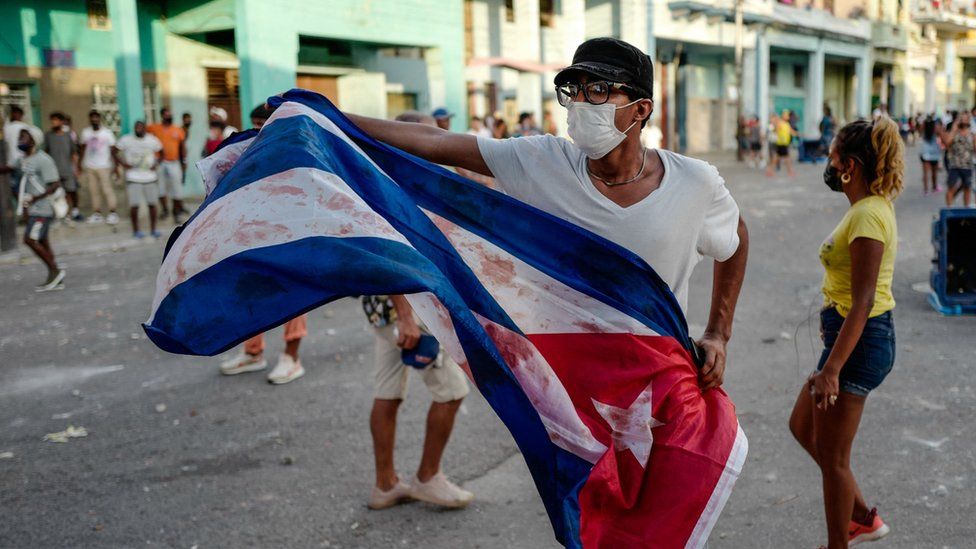
Cubans found out about where the protests were happening on social media


For several hours on Sunday, crowds of angry Cubans took to the streets to protest against the Communist government. They also took to social media, where they not only shared their discontent but tried to galvanise supporters.

The demonstrations, the biggest in decades, were a rare show of dissent in a country where unauthorised public gatherings are illegal.

There was no formal organiser of the rallies, and people found out about where they were happening on online networks. The live broadcast on Facebook of a gathering in San Antonio de los Baños, near the capital Havana, was seen as the starting point for protests that spread quickly across the island.

Until the internet was cut off.

Internet access in Cuba is something relatively new. Access to mobile internet was introduced in December 2018, when many gained the ability to consume and share independent news in a country where almost all traditional media are run by the state.

Since then, smaller events and protests have been held, and the government frequently restricts access to social media, as the telecommunications network is controlled by the state-owned company Etecsa.

This prevents people from sharing information about the gatherings and claims of abuse against authorities known for their repressive tactics to silence criticism.

It is a well-known tactic, used most recently in Myanmar where mass, largely peaceful street demonstrations against a military coup were met by a deadly crackdown, and in Belarus, after a disputed presidential election that was seen as rigged by the opposition.

In Cuba, people were complaining about the collapse of the economy, food and medicine shortages, price hikes and the government's handling of Covid-19. Sebastián Arcos, associate director of the Cuban Research Institute at Florida International University, told the Associated Press the protests were "absolutely and definitely fuelled by increased access to internet and smartphones".

As the demonstrations spread on Sunday, Cuba went offline for less than 30 minutes at around 16:00, said Doug Madory of Kentik, a company that monitors internet traffic. Then, there were several hours of intermittent outages.

"Until very recently, large internet outages were very rare," Mr Madory said. "Internet shutdowns are new to Cuba in 2021."

It meant the opposition was unable to use one of its preferred tools: live broadcasts on social media, known as "la directa". The government cannot easily interfere with them as they happen, unlike posts with recorded videos or pictures, which can be deleted.
Ted Henken, a New York-based author who wrote a book called Cuba's Digital Revolution, said they had been an important development. "The internet was a facilitator in the protests because it allowed people to share pictures in real time on Facebook Live... These videos were made by protesters and not [opposition] personalities."

News of the demonstrations was also shared by independent journalists, influencers and artists with huge numbers of followers, and went viral with the use of hashtags, including #SOSCuba.

President Miguel Díaz-Canel slammed protesters as "counter-revolutionaries" while his foreign minister alleged the demonstrations had been financed and instigated by the United States.

  
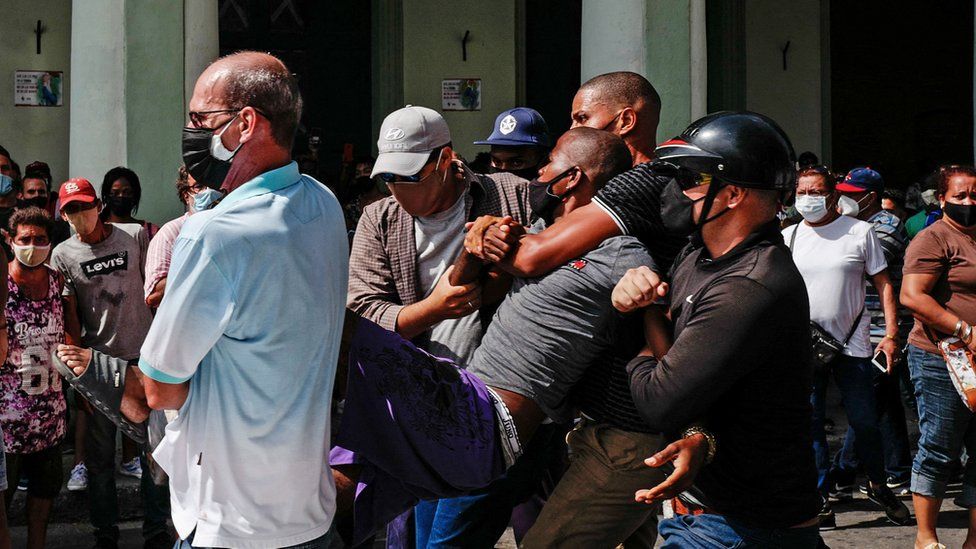
A number of people who had joined the demonstrations were arrested


Facebook, the most popular social platform in Cuba, as well as WhatsApp, Instagram and Telegram remained restricted by Etecsa's servers, according to monitoring site Netblocks. But VPN services, which can work around internet censorship, were effective for many users, it said.


The disruption has contributed to a sense of unease, amid reports that about 100 people had been detained, according to figures compiled by legal help centre Cubalex. They included several high-profile opposition activists.


"Nearly all my friends are without internet," said Alfredo Martínez Ramírez, an activist in Havana. "And we don't know where many of them are."

EXPLAINER: Three key issues that explain protests


Man dies in anti-government protest in Cuba: Interior ministry

Rare demonstrations spurred by a deepening economic crisis and the coronavirus pandemic rock Cuba in recent days.

People react during protests against and in support of the Cuban government in Havana on July 11 [File: Stringer/Reuters]
13 Jul 2021


A man died during an anti-government protest on Monday on the outskirts of Havana, the Cuban interior ministry said on Tuesday, as rare demonstrations spurred by economic inequalities have rocked the island.

Protesters took to the streets of the Cuban capital as well as other cities across the country on Sunday to denounce the government of President Miguel Diaz-Canel amid food shortages and a deep economic crisis worsened by the coronavirus pandemic.


The rallies have been met with a wave of arrests and allegations of police brutality, as authorities cracked down on demonstrators.

The interior ministry said on Tuesday that it “mourns the death” of a 36-year-old man named as Diubis Laurencio Tejeda, who the state news agency said had taken part in the “disturbances”.

The Cuban News Agency said “organised groups of antisocial and criminal elements” had tried to reach the suburb of La Guinera’s police station, with the aim of attacking its officials and damaging the infrastructure.

Several citizens and security officials were injured in the protest, the report also said. It did not say how the man died.


This is the first confirmed death linked to the protests, which are the largest in Cuba in decades.

Waldo Herrera, a 49-year-old resident of La Guinera, told the Reuters news agency that protesters were “marching peacefully, shouting slogans like ‘Down with communism,’ ‘freedom for the people of Cuba,’ ‘we don’t have medicine, we need food.'”

Herrera said the protesters started throwing stones at security forces, who eventually responded with gunfire.

Diaz-Canel has blamed the unrest on the United States, calling on defenders of the Cuban revolution to take to the streets on Sunday to counter the anti-government demonstrators.

The Cuban president also said US sanctions on the country are fuelling misery.

Amnesty International said it had received with alarm reports of “internet blackouts, arbitrary arrests, excessive use of force – including police firing on demonstrators”.

At least 100 protesters, activists, and independent journalists had been detained nationwide since Sunday, according to exiled rights group Cubalex. Some were detained at the protests but others as they tried to leave their homes, the organisation said.

The Cuban government did not immediately comment on the arrests.

Cuba also has seen a recent surge in coronavirus infections, as doctors and nurses urge people to get jabs to stem the spread of the virus. The country has reported more than 250,500 cases and more than 1,600 deaths to date, according to Johns Hopkins University data.

On Tuesday, global internet monitoring firm NetBlocks said the Cuban government has restricted access to social media and messaging platforms including Facebook and WhatsApp.

NetBlocks, based in London, said on its website that Facebook, WhatsApp, Instagram and Telegraph in Cuba were partially disrupted on Monday and Tuesday.

“The pattern of restrictions observed in Cuba indicate an ongoing crackdown on messaging platforms used to organize and share news of protests in real-time,” said the group’s director, Alp Toker. “At the same time, some connectivity is preserved to maintain a semblance of normality.”

People shout slogans against the government during a protest in Havana on July 11 [Alexandre Meneghini/Reuters]

Havana-based journalist Reed Lindsay told Al Jazeera that mobile phone data remained down for most residents on Tuesday.

Meanwhile, Cuba’s foreign minister has blamed the US of waging a “fake news campaign” to stoke the unrest amid a deluge of misinformation on social media, he said.

“It’s very difficult to pin down what is going,” he said. “There are a lot of rumors floating around.”

As the uncertainty in Cuba continues, US Secretary of the Department of Homeland Security Alejandro Mayorkas on Tuesday said migrants considering making a journey to the US irregularly by sea will not be allowed into the country.

“Any migrant intercepted at sea, regardless of their nationality, will not be permitted to enter the United States,” Mayorkas said in a news briefing. “This risk is not worth taking.”

It is not yet clear whether the unrest could lead to even more people trying to flee the island, which is just across the Florida Straits from the US. Mayorkas said 20 people have died in recent weeks during these voyages. “Our priority is to preserve and save lives,” he said.

SOURCE: AL JAZEERA AND NEWS AGENCIES

KEEP READING


Firms From Sony to Noodle Maker Urge Japan to Pursue Moon Business


Pavel Alpeyev, Bloomberg News
Jul 13, 2021

(Bloomberg) -- Japan needs to take commercial development of the moon more seriously if the country is to remain competitive in the budding space economy. That’s the message to the government from a group of Japanese companies ranging from Sony Corp. and top trading houses to an instant noodle maker.

The Lunar Industry Vision Council on Tuesday submitted a white paper to Shinji Inoue, Japan’s minister in charge of space policy, urging closer cooperation between the state and the private sector. The document calls for incentives to boost investment in space ventures, detailed regulations for exploitation of off-planet resources and greater access for companies to lunar mission

Japan is among a handful of countries along with the U.S., United Arab Emirates and Luxembourg that have established a legal framework for commercial activity in space. The Japanese parliament last month passed legislation allowing the nation’s companies to extract and use space resources, given government’s permission. It is also part of the Artemis Accords, an international agreement among the U.S. and its allies allowing countries and companies to establish exclusive zones on the moon.

“There will be a paradigm shift in which the moon will be integrated into the Earth’s sphere of economic activity, forming into one ecosystem for space activities,” the council said in the report. “Japan has been lagging behind other countries in the development of such frontier areas, but now is the time for Japan to take the lead as a front-runner in the ‘Lunar Industrial Revolution’ that will create a new industry led by the private sector on the moon.”

The 33-page document titled “Lunar Industry Vision” is the first public statement by the advocacy group since it was formed in April. The organization comprises representatives from two of Japan’s top universities, several ruling party legislators and about 30 companies, including Sony’s research lab whose software powered the Aibo robot dog. Advertising giant Dentsu Group Inc., general contractor Obayashi Corp., industrial equipment maker Yokogawa Electric Corp. and the popular cup ramen brand Nissin are also members.

Even more than financial support from the government, Japan’s competitiveness in space depends on there being a self-sustaining lunar industry, the group said. The state can help by offering ride-sharing to the moon on public missions and making greater use of private transport providers, it said. Capital gains exemptions, tax deductions for research and development and special economic zones could increase private investment in space startups. The government can also encourage creation of new space ventures by using lunar data to build a simulated environment, the moon’s digital twin.

“I’m very excited to see this initiative from Japan where many non-space players have started activities in the lunar industry,” said Takeshi Hakamada, the founder of Ispace Inc., a Tokyo-based startup planning a mission to the moon. “I hope this activity, which started in Japan, will inspire similar initiatives around the world.”

More than 50 years after the Apollo 11 mission, the moon is once again a subject of geopolitical ambitions. NASA is targeting a return this decade with the Artemis program. Russia and China, whose Chang’e-5 probe brought back a moon sample late last year, announced plans for a joint lunar base. India plans another uncrewed moon landing after an attempt failed in 2019.

What’s different this time is that government-backed space agencies are joined by companies like Elon Musk’s Space Exploration Technologies Corp., Richard Branson’s Virgin Galactic Holdings Inc. and Blue Origin, owned by Amazon.com Inc. founder Jeff Bezos. Thanks to these private launch services, escaping Earth’s gravity is now much cheaper and launching a satellite into orbit costs about a 10th what it would have a decade ago.

Most business activities on the moon in the near future will be limited to assisting state-run missions with data gathering and transportation. Discovery of significant ice deposits, and the hydrogen energy locked inside, could turn Earth’s only natural satellite into a filling station on the way to Mars or beyond. Longer term, helium-3 in the moon’s regolith could be used as fuel for the next generations of spacecraft to explore deeper into space.

“The moon, as well as the area between the Earth and the moon known as cislunar space, will become the frontline of a new space ecosystem,” the Lunar Industry Vision Council said in the report. “It is necessary to start lunar exploration activities with a focus on lunar industrialization from this point forward.”

©2021 Bloomberg L.P.
AS CHINESE WHEELS TOUCH MARTIAN SOIL AND INDIAN ASTRONAUTS WALK TOWARDS THE LAUNCH PAD, CAN WE HOPE FOR ANOTHER SPACE RACE?

by: Jenny List
July 12, 2021


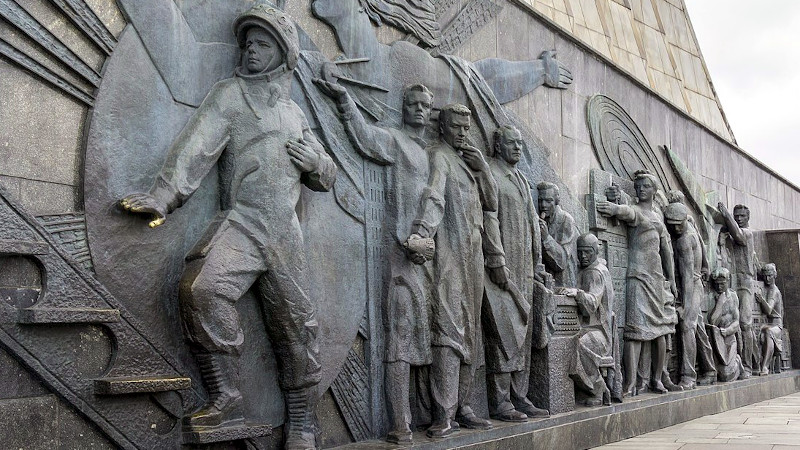
If you were born in the 1960s or early 1970s, the chances are that somewhere in your childhood ambitions lay a desire to be an astronaut or cosmonaut. Once Yuri Gagarin had circled the Earth and Neil Armstrong had walked upon the Moon, millions of kids imagined that they too would one day climb into a space capsule and join that elite band of intrepid explorers. Anything seems possible when you are a five-year-old, but of course the reality remains that only the very fewest of us ever made it to space.

DID YOU ONCE DREAM OF THE STARS?

The Soviet cosmonaut Yuri Gagarin in Finland in 1961. Arto Jousi, Public domain.

The picture may be a little different for the youth of a few decades later though, did kids in the ’90s dream of the stars? Probably not. So what changed as Shuttle and Mir crews were passing overhead?

The answer is that the Space Race between the USA and Soviet Union which had dominated extra-terrestrial exploration from the 1950s to the ’70s had by then cooled down, and impressive though the building of the International Space Station was, it lacked the ability to electrify the public in the way that Sputnik, Vostok, or Apollo had. It was immensely cool to people like us, but the general public were distracted by other things and their political leaders were no longer ready to approve money-no-object budgets. We’d done space, and aside from the occasional bright spot in the form of space telescopes or rovers trundling across Mars, that was it. The hit TV comedy series The Big Bang Theory even had a storyline that found comedy in one of its characters serving on a mission to the ISS and being completely ignored on his return.

A few years ago a Chinese friend at my then-hackerspace was genuinely surprised that I knew the name of Yang Liwei, the Shenzhou 5 astronaut and the first person launched by his country into space. He’s a national hero in China but not so much on the rainy edge of Europe, where the Chinese space programme for all its progress at the time about a decade after Yang’s mission had yet to make a splash beyond a few space watchers and enthusiasts in hackerspaces. But this might be beginning to change.


EVERYBODY’S LAUNCHING ROCKETS, IT SEEMS

The Tianhe core module for the Chinese Tiangong space station, before launch. 中国新闻网, CC BY 3.0.

As we approach two decades since Shenzhou 5, it seems as though the Chinese space program has rarely been away from the news. On the Moon last year the latest in their ongoing Chang’e series of probes successfully retrieved surface samples and sent them back to Earth, while looking forward they have inked a deal with the Russians to co-operate on a manned Lunar outpostin the 2030s.

In Earth orbit the Tianhe module that will form the heart of the next in the Tiangong series of space stations received its first crew, and will be complemented by further modules over the next year. Meanwhile on Mars, their Zhurong rover landed on the red Planet aboard the Tianwen-1 mission and has been wowing us with pictures of its landing site, and there are ambitious plans for sample return missions and an eventual manned presence in the 2030s.

The sheer variety and pace of these parallel missions is immediately reminiscent of the Cold War era space race and at first sight seems far more ambitious than its Western equivalents, but of course the Chinese program is not the only one pointing its rockets skywards. The Russian space agency Roscosmos will no longer be involved with the ISS after 2025 and will bring its many decades of experience to the construction of its own orbiting outpost, while the Indian ISRO agency will continue both its successful Maangalyaan Martian orbiter and Chandrayaan Lunar programmes and is continuing with the test program leading to a planned crew in orbit aboard the Gaganyaan craft in 2022. If we thought that a two-pronged space race was exciting, one with four or even five participants should ignite the world’s interest like nothing before!

So given the likely array of craft heading skywards from China, India, and Russia, how is it looking from the side of the planet in which Hackaday’s headquarters are based? We’ve seen enough coverage of the ISS and the various contenders for ferrying crew and supplies to it, the NASA Mars rovers, and other scientific craft to know that American and European space exploration efforts are alive and kicking. But if we’re in a space race how will their near future compare to the others? For that, the special sauce comes in two forms; international co-operation in the form of the Artemis program, and the craft and parts from private sector companies that will form part of it. This has the lofty aim of returning humans to the Moon by 2024, and its first mission will launch an uncrewed test capsule aboard an SLS rocket to orbit the moon and return home, in November this year.

MAYBE YOU DON’T NEED TO BE A NATION STATE TO RACE INTO SPACE

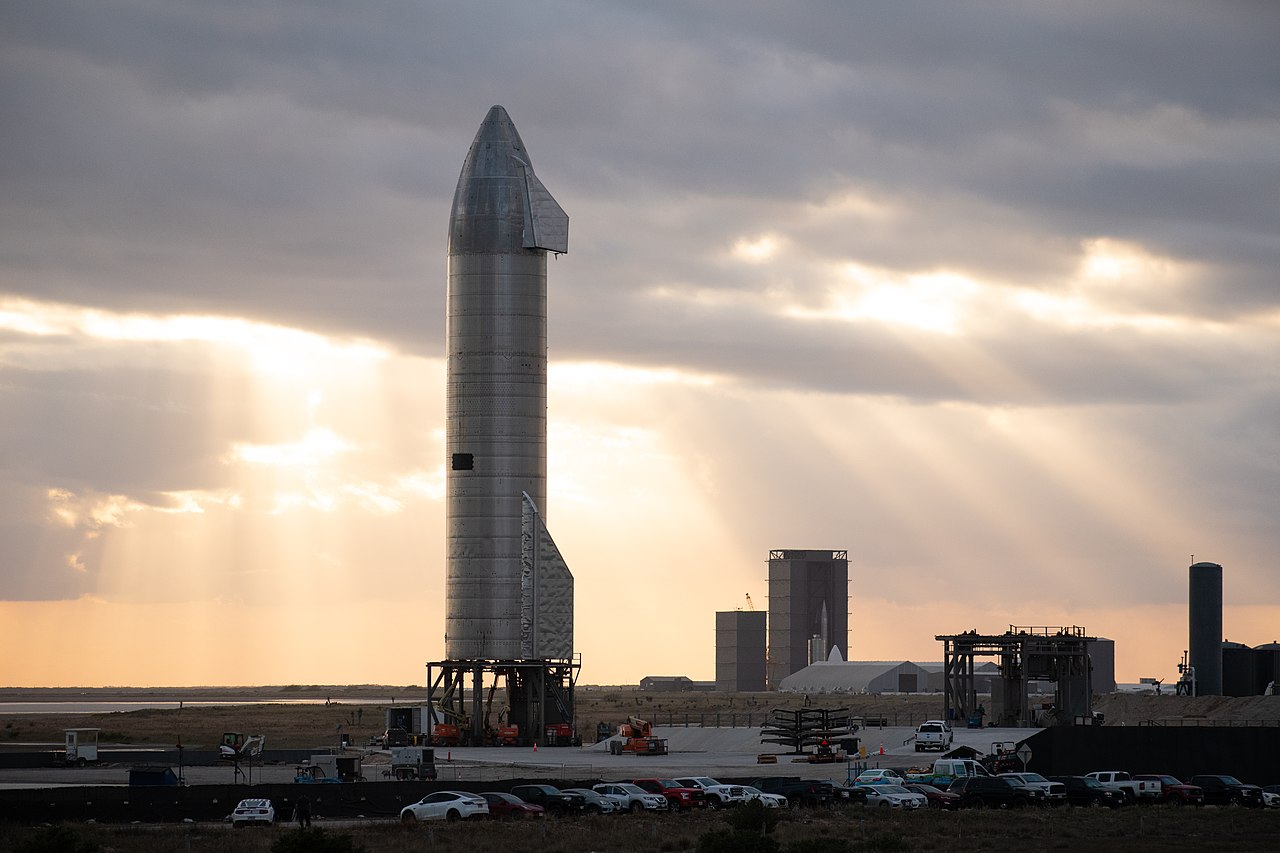
The SpaceX Starship SN9 on the launch pad. Jared Krahn, CC BY-SA 4.0.

Meanwhile there remains all the hype about the Martian plans of Elon Musk, which has at least satisfied any need we might have had to see prototype mega-rockets crash into the Texas countryside. Aside from the jostling between billionaires for the ultimate space toys though, the arrival of SpaceX, Blue Origin, and their host of competitors signals a new and previously unseen aspect to this space race that couldn’t have happened five decades ago. It’s likely that the market for smaller satellite launches will largely move to the private sector over the coming years, but at the space exploration end this increases the number of players outside the realm of nation states. American spacecraft parts have been made by private aerospace contractors for decades, but the work has been done under the auspices of NASA rather than by a company. What will be the effect of a space race between Jeff Bezos and Elon Musk for example, a dystopian corporate nightmare or a fresh and dynamic competition to those other nations? Time will tell, but one thing’s for sure: there will be a lot for space watchers to consume.

It’s said that there was disillusionment among members of the Apollo-era astronaut and cosmonaut corps during the 1970s as the enthusiasm for space exploration fizzled out and humanity’s next stop remained firmly in orbit rather than against a Martian horizon. It’s fitting then that some of them are still alive to see the start of a new space race, and that the seed will be planted in kids worldwide which will take some of them into careers that power space exploration towards the end of the century. Most of us will probably be too old to wish to be an astronaut or cosmonaut by now, but if the last space race is anything to go by we’re in for a treat as spectators with this one.

Header image: L-BBE, CC BY 3.0.Posted in Featured, Interest, SpaceTagged Artemis, china, india, nasa, russia, space race, tiangong, Zhurong