Wednesday, July 14, 2021


How corporate managers try to fix workplace injustices by giving employees secret perks

UNIVERSITY OF BRITISH COLUMBIA

Research News

A new study co-authored by the UBC Sauder School of Business has found that when senior managers mistreat workers, middle managers often attempt to quietly smooth things over.

Robin Hood was known for stealing from the rich and giving to the poor -- but while he may have lived in Sherwood Forest centuries ago, he would have fit right in as a middle manager in today's business world.

Studies have shown that when employees are mistreated by senior leaders, employees can often get back at them by doing things like gossiping, stealing office supplies or calling in sick when they're well. But according to new research from UBC Sauder, middle managers also get in on the act, and attempt to address workplace injustices by secretly helping out their subordinates when they can.

In fact, managers with an especially strong moral code can consider it their duty to right the wrongs they see, and to compensate victims in hidden ways -- out of view of the top brass.

For the paper, titled When Managers Become Robin Hoods: A Mixed Method Investigation, the research team from UBC Sauder, Emlyon, University of Colorado and the University of Toulouse first interviewed 35 middle managers -- 20 men and 15 women -- at a European publishing company that employs roughly 550 workers. There, they confirmed that managers knowingly engaged in "robin hoodism."

In several follow-up studies involving hundreds of participants from countries around the world, the researchers also examined whether co-workers were aware the robin hoodism was happening, when it was most likely to happen, and what drove managers to potentially risk their own jobs to help those beneath them.

What they found was that robin hoodism is not at all unusual, and amounts to a kind of invisible wage system, where middle managers compensate victims under the table in a variety of ways -- from extra vacation time to higher travel allowances to equipment they're allowed to take home -- after they have experienced a workplace injustice.

The type of slight also plays a part: managers were more likely to dole out extra favours when the worker was treated poorly on an interpersonal level as opposed to a bureaucratic one.

"Managers minded if a salary wasn't the highest, or if bureaucratic procedures were a problem," says UBC Sauder Professor and study co-author Daniel Skarlicki (he/him/his).

"But when a victim got cheated out of an outcome like a promotion, or was mistreated interpersonally or insulted, that especially seemed to really trigger managers into action to do something about it. That's when the Robin Hoods really get inspired."

In one example, a woman was given time off to attend her daughter's graduation, but then a senior manager revoked that approval. The woman's immediate manager was sympathetic and took the whole crew out for dinner to help make amends.

But not all managers dispensed their robin hoodism equally. The researchers tested the moral identity -- that is, the degree to which people see themselves as moral -- of 187 managers in an MBA program in France. They found that managers who scored higher on the moral identity scale were more likely to engage in robin hoodism than those who scored lower.

"That gave us additional data that managers' moral concerns really do underlie robin hoodism," says Professor Skarlicki, who has done many studies involving justice in the workplace. "It's an interesting paradox, because some people might view what Robin Hood did as unethical -- and yet managers who do it actually see themselves as doing the right thing."

Middle managers are in an especially tricky position because they can't punish the transgressor -- their boss -- but they want to keep the workers beneath them feel they are treated fairly. At the same time, because senior executives are making financial decisions, and don't account for their managers doling out extra gifts and bonuses, that robin hoodism could put a serious dent in their companies' bottom lines. Still, says Professor Skarlicki, executives who discover Robin Hoods in their midst in some cases might be wise to turn a blind eye.

"When a senior leader has done something that's offensive or mistreats an employee, it's really important that the manager has a bit of wiggle room to be able to fix it. It's really a way of absorbing some of the mistreatment that can happen, even inadvertently," says Professor Skarlicki. But those same leaders probably shouldn't advertise that they're allowing it, he adds.

"You don't want to say, 'Hey, managers, you can go out and give everybody extra bonuses,' because then you don't really have a lot of control over spending and other things."

Professor Skarlicki says he suspected that robin hoodism was happening in workplaces, but was surprised by the pervasiveness of the practice.

"I was surprised that it was so common, and so commonly known that managers do it," he says, adding a final thought for senior leaders. "If you're treating people unfairly, your organization is not running as smoothly as it could, because victims are getting even, and managers are taking it upon themselves to make things right."

###


Encrypting photos on the cloud to keep them private

A new technique can keep images safe on Google Photos, Flickr, Imgur

COLUMBIA UNIVERSITY SCHOOL OF ENGINEERING AND APPLIED SCIENCE

Research News

New York, NY--July 13, 2021--The past decade has witnessed scandal after scandal over private images maliciously or accidentally made public. A new study from computer scientists at Columbia Engineering reveals what may be the first way to encrypt personal images on popular cloud photo services, such as those from Google, Apple, Flickr and others, all without requiring any changes to -- or trust in -- those services.

Smartphones now make it easy for virtually everyone to snap photos, with market research firm InfoTrends estimating that people now take more than a trillion photos each year. The limited amount of data that smartphones hold, and the way in which they are vulnerable to accidental loss and damage, lead many users to store their images online via cloud photo services. Google Photos is especially popular, with more than a billion users.

However, these online photo collections are not just valuable to their owners, but to attackers seeking to unearth a gold mine of personal data, as the case of the 2014 celebrity nude photo hacks made clear. Unfortunately, security measures such as passwords and two-factor authentication may not be enough to protect these images anymore, as the online services storing these photos can themselves sometimes be the problem.

"There are many cases of employees at online services abusing their insider access to user data, like SnapChat employees looking at people's private photos," said John S. Koh, the lead author of the paper, who just finished his PhD with professors of computer science Jason Nieh and Steven M. Bellovin. "There have even been bugs that reveal random users' data to other users, which actually happened with a bug in Google Photos that revealed users' private videos to other entirely random users."

A potential solution to this problem would be to encrypt the photos so no one but the proper users can view them. However, cloud photo services are currently not compatible with existing encryption techniques. For example, Google Photos compresses uploaded files to reduce their sizes, but this would corrupt encrypted images, rendering them garbage.

Even if compression worked on encrypted images, mobile users of cloud photo services typically expect to have a way to quickly browse through identifiable photo thumbnails, something not possible with any existing photo encryption schemes. A number of third-party photo services do promise image encryption and secure photo hosting, but these all require users to abandon existing widely used services such as Google Photos.

Now Columbia Engineering researchers have created a way for mobile users to enjoy popular cloud photo services while protecting their photos. The system, dubbed Easy Secure Photos (ESP), encrypts photos uploaded to cloud services so that attackers -- or the cloud services themselves -- cannot decipher them. At the same time, users can visually browse and display these images as if they weren't encrypted. They presented their study, "Encrypted Cloud Photo Storage Using Google Photos," at MobiSys 2021, the 19th ACM International Conference on Mobile Systems, Applications, and Services, on June 30, 2021.

"Even if your account is hacked, attackers can't get your photos because they are encrypted," said Jason Nieh, professor of computer science and co-director of the Software Systems Laboratory.

ESP employs an image encryption algorithm whose resulting files can be compressed and still get recognized as images, albeit ones that look like black and white static to anyone except authorized users. In addition, ESP works for both lossy and lossless image formats such as JPEG and PNG, and is efficient enough for use on mobile devices. Encrypting each image results in three black-and-white files, each one encoding details about the original image's red, green, or blue data.

Moreover, ESP creates and uploads encrypted thumbnail images to cloud photo services. Authorized users can quickly and easily browse thumbnail galleries using image browsers that incorporate ESP.

"Our system adds an extra layer of protection beyond your password-based account security," said Koh, who designed and implemented ESP. "The goal is to make it so that only your devices can see your sensitive photos, and no one else unless you specifically share it with them."

The researchers wanted to make sure that each user could use multiple devices to access their online photos if desired. The problem is the same digital code or "key" used to encrypt a photo has to be the same one used to decrypt the image, "but if the key is on one device, how do you get it to another?" Nieh said. "Lots of work has shown that users do not understand keys and requiring them to move them around from one device to another is a recipe for disaster, either because the scheme is too complicated for users to use, or because they copy the key the wrong way and inadvertently give everyone access to their encrypted data."

The computer scientists developed an easy-to-use way for users to manage these keys that eliminates the need for users to know or care about keys. All a user has to do in order to help a new device access ESP-encrypted photos is to verify it with another device on which they have already installed and logged into an ESP-enabled app. This makes it possible "for multiple trusted devices to still view encrypted photos," Nieh said.

"The need to handle keys, and handle them properly, has been the downfall of almost every other encryption system," Bellovin said.

The researchers implemented ESP in Simple Gallery, a popular photo gallery app on Android with millions of users. It could encrypt images from Google Photos, Flickr and Imgur without changes needed to any of these cloud photo services, and led to only modest increases in upload and download times.

"We are experiencing the beginning of a major technological boom where even average users move towards moving all their data into the cloud. This comes with great privacy concerns that have only recently started rearing their ugly heads, such as the increasing number of discovered cases of cloud service employees looking at private user data," Koh said. "Users should have an option to protect their data that they think is really important in these popular services, and we explore just one practical solution for this."

A number of companies have expressed interest in the new system. "We have a working implementation that we are releasing to developers and other researchers, but not yet to the general public," Koh said.

###

About the Study

The study is titled "Encrypted Cloud Photo Storage Using Google Photos."

The study was presented at MobiSys 2021, the 19th ACM International Conference on Mobile Systems, Applications, and Services, on June 30, 2021.

Authors are: John S. Koh, Jason Nieh, Steven M. Bellovin

Department of Computer Science, Columbia Engineering

This work was supported in part by National Science Foundation grants CNS-1717801, CNS1563555, CCF-1918400, and CNS-2052947.

LINKS:

Paper: https://www.cs.columbia.edu/~nieh/pubs/mobisys2021_esp.pdf

DOI: 10.1145/3458864.3468220

http://engineering.columbia.edu/

https://www.cs.columbia.edu/

https://www.sigmobile.org/mobisys/2021/

https://www.nytimes.com/2015/07/23/arts/international/photos-photos-everywhere.html

https://www.theverge.com/2019/7/24/20708328/google-photos-users-gallery-go-1-billion

https://en.wikipedia.org/wiki/ICloud_leaks_of_celebrity_photos

https://www.vice.com/en/article/xwnva7/snapchat-employees-abused-data-access-spy-on-users-snaplion

https://www.forbes.com/sites/thomasbrewster/2020/02/04/google-photos-makes-big-screw-up-and-mayve-leaked-your-videos-to-a-random-stranger/

https://www.cs.columbia.edu/~koh/

https://www.cs.columbia.edu/~nieh/

https://www.engineering.columbia.edu/faculty/steven-bellovin

Columbia Engineering

Columbia Engineering, based in New York City, is one of the top engineering schools in the U.S. and one of the oldest in the nation. Also known as The Fu Foundation School of Engineering and Applied Science, the School expands knowledge and advances technology through the pioneering research of its more than 220 faculty, while educating undergraduate and graduate students in a collaborative environment to become leaders informed by a firm foundation in engineering. The School's faculty are at the center of the University's cross-disciplinary research, contributing to the Data Science Institute, Earth Institute, Zuckerman Mind Brain Behavior Institute, Precision Medicine Initiative, and the Columbia Nano Initiative. Guided by its strategic vision, "Columbia Engineering for Humanity," the School aims to translate ideas into innovations that foster a sustainable, healthy, secure, connected, and creative humanity.

Liquid metal sensors and AI could help prosthetic hands to 'feel'

Study first to use liquid metal sensors and machine learning on a prosthetic hand

FLORIDA ATLANTIC UNIVERSITY


 VIDEO: RESEARCHERS USED INDIVIDUAL FINGERTIPS FITTED WITH STRETCHABLE TACTILE SENSORS WITH LIQUID METAL ON A PROSTHESIS TO DISTINGUISH BETWEEN DIFFERENT SPEEDS OF A SLIDING MOTION ALONG DIFFERENT TEXTURED SURFACES. THE FOUR... view more 

Each fingertip has more than 3,000 touch receptors, which largely respond to pressure. Humans rely heavily on sensation in their fingertips when manipulating an object. The lack of this sensation presents a unique challenge for individuals with upper limb amputations. While there are several high-tech, dexterous prosthetics available today - they all lack the sensation of "touch." The absence of this sensory feedback results in objects inadvertently being dropped or crushed by a prosthetic hand.

To enable a more natural feeling prosthetic hand interface, researchers from Florida Atlantic University's College of Engineering and Computer Science and collaborators are the first to incorporate stretchable tactile sensors using liquid metal on the fingertips of a prosthetic hand. Encapsulated within silicone-based elastomers, this technology provides key advantages over traditional sensors, including high conductivity, compliance, flexibility and stretchability. This hierarchical multi-finger tactile sensation integration could provide a higher level of intelligence for artificial hands.

For the study, published in the journal Sensors, researchers used individual fingertips on the prosthesis to distinguish between different speeds of a sliding motion along different textured surfaces. The four different textures had one variable parameter: the distance between the ridges. To detect the textures and speeds, researchers trained four machine learning algorithms. For each of the ten surfaces, 20 trials were collected to test the ability of the machine learning algorithms to distinguish between the ten different complex surfaces comprised of randomly generated permutations of four different textures.

Results showed that the integration of tactile information from liquid metal sensors on four prosthetic hand fingertips simultaneously distinguished between complex, multi-textured surfaces - demonstrating a new form of hierarchical intelligence. The machine learning algorithms were able to distinguish between all the speeds with each finger with high accuracy. This new technology could improve the control of prosthetic hands and provide haptic feedback, more commonly known as the experience of touch, for amputees to reconnect a previously severed sense of touch.

"Significant research has been done on tactile sensors for artificial hands, but there is still a need for advances in lightweight, low-cost, robust multimodal tactile sensors," said Erik Engeberg, Ph.D., senior author, an associate professor in the Department of Ocean and Mechanical Engineering and a member of the FAU Stiles-Nicholson Brain Institute and the FAU Institute for Sensing and Embedded Network Systems Engineering (I-SENSE), who conducted the study with first author and Ph.D. student Moaed A. Abd. "The tactile information from all the individual fingertips in our study provided the foundation for a higher hand-level of perception enabling the distinction between ten complex, multi-textured surfaces that would not have been possible using purely local information from an individual fingertip. We believe that these tactile details could be useful in the future to afford a more realistic experience for prosthetic hand users through an advanced haptic display, which could enrich the amputee-prosthesis interface and prevent amputees from abandoning their prosthetic hand."

Researchers compared four different machine learning algorithms for their successful classification capabilities: K-nearest neighbor (KNN), support vector machine (SVM), random forest (RF), and neural network (NN). The time-frequency features of the liquid metal sensors were extracted to train and test the machine learning algorithms. The NN generally performed the best at the speed and texture detection with a single finger and had a 99.2 percent accuracy to distinguish between ten different multi-textured surfaces using four liquid metal sensors from four fingers simultaneously.

"The loss of an upper limb can be a daunting challenge for an individual who is trying to seamlessly engage in regular activities," said Stella Batalama, Ph.D., dean, College of Engineering and Computer Science. "Although advances in prosthetic limbs have been beneficial and allow amputees to better perform their daily duties, they do not provide them with sensory information such as touch. They also don't enable them to control the prosthetic limb naturally with their minds. With this latest technology from our research team, we are one step closer to providing people all over the world with a more natural prosthetic device that can 'feel' and respond to its environment."


CAPTION

Researchers used individual fingertips fitted with stretchable tactile sensors with liquid metal on a prosthesis attached to a robotic arm.

CREDIT

Alex Dolce, Florida Atlantic University 

Study co-authors are Rudy Paul, FAU Department of Ocean and Mechanical Engineering; Aparna Aravelli, Ph.D.; Ou Bai, Ph.D.; and Leonel Lagos, Ph.D., PMP, all with Florida International University; and Maohua Lin, Ph.D., FAU Department of Ocean and Mechanical Engineering.

The research was supported by the National Institute of Biomedical Imaging and Bioengineering of the National Institutes of Health (NIH) and the National Institute of Aging of the NIH, the National Science Foundation, the Department of Energy and pilot grants from the FAU Stiles-Nicholson Brain Institute and FAU I-SENSE.

About FAU's College of Engineering and Computer Science:

The FAU College of Engineering and Computer Science is internationally recognized for cutting edge research and education in the areas of computer science and artificial intelligence (AI), computer engineering, electrical engineering, bioengineering, civil, environmental and geomatics engineering, mechanical engineering, and ocean engineering. Research conducted by the faculty and their teams expose students to technology innovations that push the current state-of-the art of the disciplines. The College research efforts are supported by the National Science Foundation (NSF), the National Institutes of Health (NIH), the Department of Defense (DOD), the Department of Transportation (DOT), the Department of Education (DOEd), the State of Florida, and industry. The FAU College of Engineering and Computer Science offers degrees with a modern twist that bear specializations in areas of national priority such as AI, cybersecurity, internet-of-things, transportation and supply chain management, and data science. New degree programs include Masters of Science in AI (first in Florida), Masters of Science in Data Science and Analytics, and the new Professional Masters of Science degree in computer science for working professionals. For more information about the College, please visit eng.fau.edu.

About Florida Atlantic University:

Florida Atlantic University, established in 1961, officially opened its doors in 1964 as the fifth public university in Florida. Today, the University serves more than 30,000 undergraduate and graduate students across six campuses located along the southeast Florida coast. In recent years, the University has doubled its research expenditures and outpaced its peers in student achievement rates. Through the coexistence of access and excellence, FAU embodies an innovative model where traditional achievement gaps vanish. FAU is designated a Hispanic-serving institution, ranked as a top public university by U.S. News & World Report and a High Research Activity institution by the Carnegie Foundation for the Advancement of Teaching. For more information, visit http://www.fau.edu.

Extreme heat will soon kill nearly all salmon in Sacramento River, officials say

Alexandra Meeks, CNN 


California officials are warning nearly all juvenile chinook salmon in the Sacramento River could die due to abnormally hot underwater conditions as heat waves continue to bake the West.
 The Sacramento River is too hot for a young species of salmon to survive.

There could be a "near-complete loss" of the young endangered species of salmon because temperatures above 100 degrees for extended periods of time are overheating the river, making it uninhabitable for the fish to grow beyond their egg stage, the California Department of Fish and Wildlife (CDFW) confirmed to CNN on Tuesday.

"This persistent heat dome over the West Coast will likely result in earlier loss of ability to provide cool water and subsequently, it is possible that all in-river juveniles will not survive this season," CDFW said in a statement.

California, among other Western states including Oregon and Washington, has been experiencing extremely high temperatures in recent weeks. But drought conditions in the Golden State are especially taxing, with much of the state under severe or exceptional drought, according to the US Drought Monitor.

The drought is so bad in some parts of that state that a family's well in Clovis in Fresno County ran dry, leaving them without water, CNN reported.

Meanwhile, as temperatures near and surpass triple digits, many reservoirs in California's Central Valley have diverted more water to cities and farmers during the drought, making rivers shallower and too hot for the fish to develop from eggs, a process which can take at least 60 days to complete.

According to CDFW officials, water is more insulated when it is deep. However, since more water is heating up and evaporating, the salmon are losing their insulation blanket, which normally makes it colder at the bottom of the river. The eggs will die when the water temperature rises above 56 degrees, officials said, warning only a few thousand of winter-run Chinook are left.

"It's an extreme set of cascading climate events pushing us into this crisis situation," said CDFW spokesman Jordan Traverso.

Efforts to save salmon are pricy


To combat the poor river conditions in the Central Valley, some fish preservation organizations have tried to save the salmon population by launching large scale trucking operations to transport millions of salmon to the San Pablo Bay, San Francisco Bay and other fish farms where they are more likely to survive, Traverso said.

The CDFW announced Tuesday that it had successfully relocated 1.1 million juvenile salmon from the Klamath River in northern California, where conditions are similarly extreme.

While relocating salmon is an option, there are better alternatives than the high-priced trucking process, a spokesperson for the Golden State Salmon Association said.

John McManus, president of the association, said dam operators could hold on to more water to keep the fish alive, but that would require contracts to be modified between the operators and their federal and state partners who supply water to cities and farmers.

A warmer California recently prompted Gov. Gavin Newsom to call on voluntarily reductions of water use by 15% to protect reserves and to help maintain critical flows for fish and other wildlife.

"We could lose salmon here in California if we continue with business as usual and the climate continues to warm," McManus said. "There's a very real possibility we could lose salmon forever here."
Police break up ‘exorcism’ in lumber aisle of U.S. Home Depot

By Josh K. Elliott Global News
Posted June 25, 2021
In this July 11, 2019, file photo, lumber is stacked at a 
Home Depot store in Londonderry, N.H.
DO YOU SEE THE '666' NUMBERED LUMBER?!
 AP Photo/Charles Krupa

A word of warning to anyone building a deck in Pennsylvania: Your lumber might be possessed by a demon. And if it is, you can blame the meddling local police.


Authorities busted up an attempted exorcism in the timber aisle of a Home Depot in Dickson City, Pa., on Monday, according to a bizarre line included in the police department’s daily crime blotter on Facebook.

Dickson City officers showed up at the Home Depot around 3:30 p.m. on Monday for a call about “disorderly people” at the store, according to the blotter.

Two individuals were “having an exorcism in the lumber aisle for the dead trees,” police wrote.

The would-be exorcists were two men dressed in black, according to Dickson City Police Chief William Bilinski. Both men were “chanting and moaning” in the lumber aisle and “looked like they were trying to do an exorcism,” Bilinski told the Scranton Times-Tribune newspaper.

Another officer told the Philly Voice that it was a “séance type of thing for the dead.”

The humans were escorted out of the building — but it’s unclear if the alleged evil spirits were escorted back to hell.

There is no indication that the exorcism had anything to do with a recent drop in the price of lumber.


READ MORE: Timber! What to expect now that lumber prices have dropped back down to earth

Staff at the store declined to comment.

Authorities did not say why the men thought the wood might be possessed.

No humans or haunted two-by-fours were charged in connection with the incident.
‘We all quit’: Burger King’s disgruntled staff quits via giant sign

Josh K. Elliott 
© Rachael Flores/Facebook A sign outside a Burger King in Lincoln, Neb., is shown during a mass resignation in July 2021.

Fed-up Burger King staff walked off the job in Lincoln, Neb., last week, after giving their boss — and everyone else — an approximately 50-foot-high resignation letter.

"We all quit," the sign outside the Nebraska restaurant read Monday. "Sorry for the inconvenience."

It was a crowning moment for the now-former Burger King employees, who pulled the stunt on their last day of work. They recently gave notice that they were quitting due to poor conditions at the restaurant, including a broken air conditioner and understaffing issues.

Store general manager Rachael Flores told KLKN that she quit over sweltering conditions in the kitchen, where temperatures reached the mid-30s C range. She says she was recently hospitalized for dehydration after working a shift in that heat, and that her boss called her a "baby" after the ordeal.

"We quit (be)cause upper management was a joke and had no care for me or my employees," Flores wrote on Facebook. "I put in my 2 weeks and so did MANY other people."

Flores and eight others showed up early for their last day of work and changed the restaurant sign around 6 a.m., in what Flores says was an attempt to get a "big laugh" at her employer's expense.

Her boss called her a few hours later and demanded that she take the sign down.

"I told him I couldn't do that because we were short-staffed and lunch was starting," Flores said.

Her boss ultimately showed up in person to fire her and take her keys. He then had the sign changed to read: "Now hiring. Flexible schedules."

Multiple employees say the store had been dealing with poor maintenance and low staff for several weeks, and that things boiled over with Flores' hospital visit.

"I just stayed to help Rachael out," said Kylee Johnson, one of the employees involved in the mass resignation. "I knew what was going on, staffing-wise.

"We were just waiting for more people to come and then we got nobody."

Burger King's head office acknowledged the incident in a statement to CNN.

"The work experience described at this location is not in line with our brand values," the restaurant chain said. "Our franchisee is looking into this situation to ensure this doesn't happen in the future."

The restaurant remains open.
Tennessee's Fired Vaccine Chief Called The State's New Rule Barring Vaccine Outreach To Teens "Toxic Leadership"

“We have a legislature filled with people who are not scientists and not healthcare providers who have their own crazy ideas about vaccines," Michelle Fiscus, Tennessee's top vaccine official until she was fired on Monday, told BuzzFeed News.


Dan VerganoBuzzFeed News Reporter
Azeen GhorayshiBuzzFeed News Reporter


Posted on July 13, 2021, 

/ AP
Michelle Fiscus speaking to a reporter on Tuesday, July 13, 2021.


Michelle Fiscus, Tennessee's top vaccine official until she was fired on Monday, condemned a new move by the state's health department severely limiting its vaccine outreach to teens.


The change, first reported by the Tennesseean, will stop all of the health department's vaccine events at schools and will halt all of their communication to teens about vaccines, including postcards notifying them about their second COVID-19 shots. The change, and Fiscus's termination, happened amid pressure from Republican state lawmakers, who have called the health department's vaccine outreach to adolescents an overreach that threatens parental authority.

The Tennessee health department "has been rolling over and appeasing these legislators instead of standing up for public health and the people of Tennessee,” Fiscus told BuzzFeed News. She suggested that Gov. Bill Lee and Lisa Piercey, the Tennessee Department of Health commissioner who reportedly authorized the change, capitulated because of their political ambitions. "Politics has conspired to create toxic leadership."

The state health department's change comes amid growing anxiety over a state law called the "Mature Minor Doctrine," which allows adolescents 14 and up to make medical decisions without parental consent. This could include getting COVID-19 vaccines, which have been approved for kids 12 and over. Republican lawmakers in the state accused the health department of "targeting" youth for vaccinations and then threatened to dismantle the agency to stop its outreach efforts.


But the new move by the state's health department affects outreach on all vaccines, not just those protecting children from COVID-19, severely threatening public health in the state. The agency had previously recommended vaccination against flu, measles, mumps, rubella, HPV, and more.

And the change comes as cases are surging in the state amid the spread of the highly contagious Delta variant. Cases in Tennessee have gone up more than 400% in the last two weeks and deaths have increased by 9%. Only 38% of the state has been fully vaccinated against COVID-19, making Tennessee one of the least vaccinated states in the US.

Fiscus was fired by the Tennessee Department of Health on Monday, allegedly over information that was distributed to medical providers about providing COVID-19 vaccines to adolescents. She later released a public statement saying she was scapegoated because of political pressure. "I am afraid for my state," her statement read.

“We have a legislature filled with people who are not scientists and not healthcare providers who have their own crazy ideas about vaccines," Fiscus said. "When they saw us trying to do our job of educating people, they saw that as undermining parental authority. They began saber rattling about dissolving the Department of Health, in the middle of a pandemic, which is ludicrous, and the department’s leadership absolutely crumbled.”

The Tennessee Department of Health did not immediately respond to a request for comment.

Last week, the CDC recommended that all schools resume in-person learning in the fall and take a leading role in promoting vaccination among eligible students, calling it "one of the most critical strategies to help schools safely resume full operations."
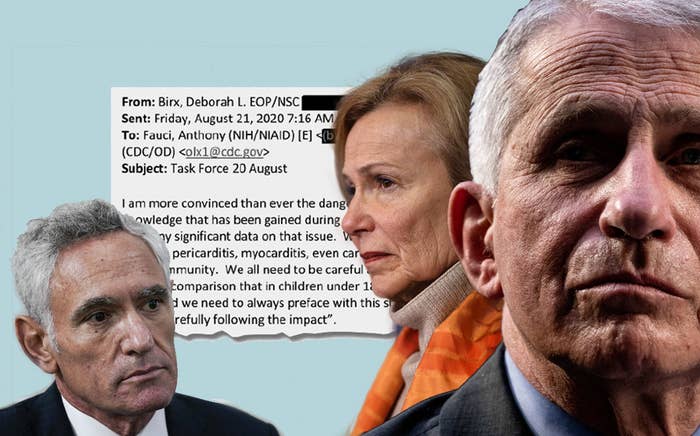
Anthony Fauci And Deborah Birx Warned Top Officials About The “Dangers” Of Scott Atlas Last Summer, Emails Show

“I am more convinced than ever the dangers of Dr. Atlas’ views on the pandemic,” Birx wrote in an August 2020 email to Fauci and others.


Stephanie M. LeeBuzzFeed News Reporter
Dan VerganoBuzzFeed News Reporter
Posted on July 12, 2021, at 5:05 p.m. ET

BuzzFeed News; Getty Images

It only took a few days for Scott Atlas to alarm top US health officials after he became a White House COVID-19 adviser in mid-August of last year.

Anthony Fauci and Deborah Birx had already been sidelined and were struggling to combat falsehood after falsehood spread by former president Donald Trump. Yet the pair quickly realized that Atlas — a senior fellow at Stanford University’s conservative Hoover Institution who routinely downplayed the pandemic on Fox News — was about to make their fight against the virus even harder, according to emails obtained through a public records request and shared with BuzzFeed News.

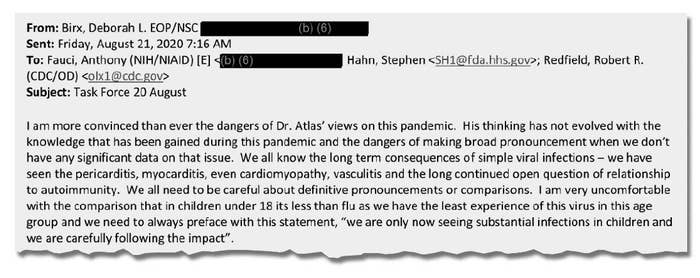
“I am more convinced than ever the dangers of Dr. Atlas’ views on the pandemic,” Birx, the White House’s coronavirus response coordinator at the time, wrote to Fauci and other top health officials in an Aug. 21, 2020, email — 11 days after Trump had announced that Atlas, a neuroradiologist, would be his newest adviser. She accused Atlas of “providing information not based on data or knowledge of pandemics — nor pandemic responses on the ground but by personal opinion formed by cherry picking data from nonpeer reviewed COVID publications.”


Obtained via FOIA


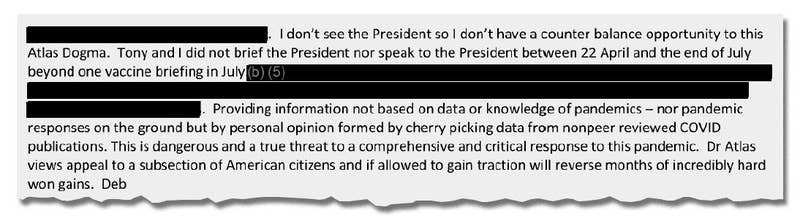
“This is dangerous and a true threat to a comprehensive and critical response to this pandemic,” she added. “Dr Atlas views appeal to a subsection of American citizens and if allowed to gain traction will reverse months of incredibly hard won gains.”


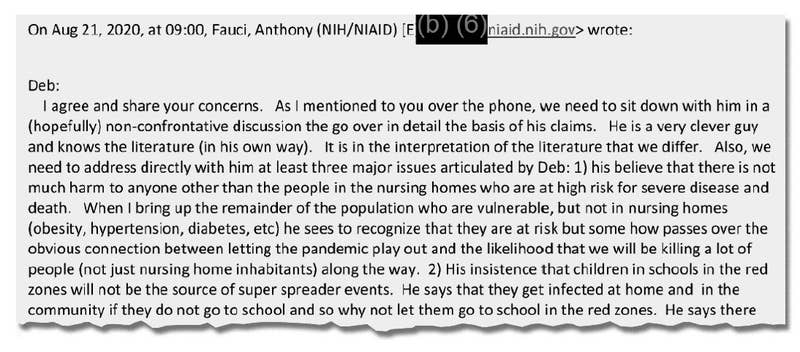
“I agree and share your concerns,” Fauci, the nation’s top infectious disease scientist, responded on a thread that included former FDA head Stephen Hahn and former CDC chief Robert Redfield. He added, “He is a very clever guy and knows the literature (in his own way). It is in the interpretation of the literature that we differ.”


Obtained via FOIA

The emails — obtained by Charles Seife, a New York University journalism professor — show how alarmed Fauci and Birx were about Atlas, who became one of Trump’s most influential advisers and one of the loudest sources of COVID-19 misinformation in the US.

He infamously advocated for a controversial approach to the deadly virus: letting it spread unchecked among non-elderly people in the absence of a vaccine so that the population at large could develop immunity. Infectious disease experts at the time argued that this strategy would be incredibly dangerous, inevitably leading to large numbers of unnecessary hospitalizations and deaths. But the idea held sway with the president: Weeks after Atlas started on the job, Trump proclaimed on TV that the virus would “go away” once people developed “a herd mentality.

Fauci and Birx, meanwhile, were almost entirely shut out of the Oval Office, according to their correspondence at the time. “I don’t see the President so I don’t have a counter balance opportunity to this Atlas Dogma,” Birx wrote. “Tony and I did not brief the President nor speak to the President between 22 April and the end of July beyond one vaccine briefing in July.”


Obtained via FOIA

Atlas joined the White House team with no background in infectious diseases or public health. He promoted a steady stream of unscientific views about how the virus spread, who it harmed, and how to control it — views that were widely condemned by the scientific community, including by dozens of his faculty peers at Stanford.

In August, the US death toll was climbing past 170,000, and it was unclear when any of the vaccines under development would prove effective. In her emails at the time, Birx expressed frustration over Atlas’s unscientific stances. “He is convince[d] that we have reach[ed] herd immunity in the NE. Midwest and now the Sunbelt,” she wrote.

Atlas has denied that he was pushing a “herd immunity” strategy to the virus, but he consistently championed the approach in public, even if he didn’t always use the exact term. And he repeatedly questioned the effectiveness of masks, social distancing, stay-at-home policies, and other public health measures to help slow the virus’ spread.

Atlas and Fauci did not return requests for comment for this story. Birx declined to comment.

In their correspondence, Fauci and Birx discussed Atlas’s repeated claims that the only people who needed to be isolated were the nation’s 1.3 million elderly nursing home residents. What his claims left out, they said, were that the 81 million people with underlying conditions also needed protection, and that if the virus was spreading at high levels, it would certainly find its way into nursing homes in those communities, too.

Fauci noted that when he raised the risks faced by vulnerable people with underlying health conditions to Atlas, the Stanford physician was dismissive. He “passes over the obvious connection between letting the pandemic play out and the likelihood that we will be killing a lot of people (not just nursing home inhabitants) along the way,” Fauci wrote.


Jabin Botsford / The Washington Post via Getty Images

Scott Atlas speaks with then-president Donald Trump during a COVID-19 briefing at the White House on Aug 12, 2020.

At the time, with a new academic year approaching, there was a lot of uncertainty around how much the coronavirus could spread among children and in schools. Even before he joined the White House, Atlas was resolute in his calls to reopen schools because, he asserted, children “almost never” transmit the virus, despite studies at the time that strongly indicated that kids can carry, spread, and, in rare cases, die from COVID-19.

Fauci and Birx were more cautious, wanting to first see the results of studies about transmission risk within schools before offering policy recommendations.

“We are only now collecting data that children actually do get readily infected. We need to do the phylogenetic studies to show (or not) just where they get infected,” Fauci wrote. “However, we cannot assume right now that school is not a source of super spread. That is a dangerous and irrevocable assumption.”

Fauci stressed that they needed to discuss this and other issues with Atlas in person: “As I mentioned to you over the phone, we need to sit down with him in a (hopefully) non-confrontative discussion [to] go over in detail the basis of his claims.”

Whether that particular meeting ended up happening is unclear. But Atlas’s views of the pandemic would remain unchanged and reportedly continued to spark fierce disagreement among members of the coronavirus task force. Before he stepped down in November, he and Alex Azar, then the head of the Department of Health and Human Services, met with a group of scientists who authored the Great Barrington Declaration, a hotly contested petition that criticized lockdowns and promoted the idea that the virus should spread to increase the number of people who are immune.

Fauci and Birx have since made it publicly known that they took deep issue with Atlas’s views. In a mid-November appearance on the Today show, Fauci said, “I don’t want to say anything against Dr. Atlas as a person, but I totally disagree with the stand he takes. I just do, period.”


In a January interview after leaving the White House, Birx said that while she was providing data about the coronavirus to Trump, the president was receiving “a parallel set of data” from other sources, likely including Atlas.

And in a new book, Andy Slavitt, a former COVID-19 adviser to President Joe Biden, wrote that Birx told him last year: “Fighting the virus and Scott Atlas together is the hardest thing I’ve had to do.” ●
The Olympics has a race problem. Athletes everywhere are calling out the sporting body for a history of banning Black women.

ydzhanova@businessinsider.com (Yelena Dzhanova) 
Gwendolyn Berry her Activist Athlete T-Shirt over her head during the metal ceremony after the finals of the women's hammer throw at the U.S. Olympic Track and Field Trials Saturday, June 26, 2021, in Eugene, Ore. Berry finished third. AP Photo/Charlie Riedel

Eurocentric restrictions make it difficult for Black women to fully participate in the Olympics.

Historians say these rules are the lingering byproducts of racism and sexism within the Olympics.

While the Olympics are getting more inclusive, it's athletes themselves that are driving the push.


Olympians this year made headlines not for their incredible athletic feats or victories but for the obstacles standing in their way.

World Athletics, the international sports governing body, barred two Namibian women from running in various races because of their "natural high testosterone level," the Namibia National Olympic Committee said.

Republican lawmakers chastised hammer thrower Gwen Berry for facing away from the US flag.

The US Anti-Doping Agency announced a 30-day ban for American sprinter Sha'Carri Richardson after she tested positive for marijuana use, despite little evidence that the substance has a measurable impact on performance.

And the aquatic sports governing body banned the use of a swim cap designed to accommodate natural Black hair.

These incidents, sports historians say, underscore the deep racism and sexism rooted in the Olympics.

The policies and restrictions themselves aren't racist or sexist, said Dr. Cat M. Ariail, a history professor at the Middle Tennessee State University. But when enforced, they often have racist and sexist implications that hinder Black women's ability to participate fully in the Olympics.

These policies force Black women to alter or accommodate their biological needs or social experiences in ways white people do not have to.

Attempts to control the experiences of Black women

Sha'Carri Richardson's place at the Olympics is in doubt following reports of a positive cannabis test Patrick Smith/Getty Images


Berry, for example, faced sharp criticism for turning away from the US flag in June as the national anthem belted through the speakers. Big-name Republicans lawmakers like Sen. Ted Cruz and Rep. Dan Crenshaw amplified that criticism, indirectly accusing her of hating the US or fervently calling for her swift removal from the Games.

The hammer thrower expected the national anthem to play as she and the other athletes were walking out. But instead, it went off as they stood on the podium. That's when Berry turned toward the stands and began waving a T-shirt that said "Activist Athlete" over her head. It was a peaceful protest that the GOP seized on, characterizing it as an abrasion to democracy and the spirit of the Games.

In response to the backlash, Berry said the comments show a commitment to "patriotism over basic morality," arguing that the public places more value on respect to the country than taking a stand against its racist history. The vitriol, Berry and some writers suggested, is attempting to pressure her into choosing between the country and her lived experience as a Black woman in the US.

"US society, with its deeply embedded racism and sexism, makes it harder for a Black woman to become an elite athlete," Ariail told Insider. "When she beats the odds and reaches such heights, the various policies and practices of sport organizations, many of which are not racist/sexist on the surface but have racist/sexist effects, often make it harder for her to fulfill her potential."

Richardson took responsibility for the marijuana use, saying she did it to cope with the sudden notice of her biological mother's death, devastating news delivered to her by a reporter. The decision shocked the nation, with many individuals asking about the legality of the ban.

Marijuana is legal in more than a dozen states nationwide. The use of medical marijuana is legal in even more. Richardson used it in Oregon, one of the states where it is legal. Studies have found that marijuana does not affect performance, but the substance is on the World Anti-Doping Agency's list of prohibited substances.

"It is a drug [whose] use long has been associated with Black people and people of color, which, in turn, has associated it with an 'immorality' believed to be inconsistent with the moral purity that Olympic and international sporting organizations impose on athletes," Ariail said.

The Olympics has always had a problem with Black women


© AP Photo/Julio Cortez AP Photo/Julio Cortez


These incidents are not the first time the Olympics has discouraged Black women from participating. The history of the Olympics, sports historians say, is littered with examples of racism and sexism.

Gymnast Simone Biles last year spoke of the racism she's experienced as an Olympian. "I was on a world scene, and what made the news was, another gymnast saying that if we painted our skin black maybe we would all win because I had beaten her out of beam medal, and she got upset," she said on the TODAY show. "And that [was] really the news, rather than me winning worlds."

The first time Black women participated in the Olympics was in 1932, according to Linda K. Fuller, a scholar who's written multiple books on the intersection of sports and gender.

Since the 1930s, sports commentators have described Black women in racist terms, referring to them as "dancing monkey," for example, Fuller said. In the 1950s and 1960s, renowned Black sprinter Wilma Rudolph was called the "Black Gazelle," Fuller said, adding to the commentary that isolated her femaleness and Blackness.

Despite the enduring racism, Black women Olympians have continued to accomplish incredible athletic feats. And today, they continue to deal with racist and sexist policies meant to uphold a Eurocentric vision of the Olympics, Ariail and Fuller noted.

Just as racist policies are intrinsic to the Olympics, so is a history of activism and protest. In 1968, for example, Tommie Smith and John Carlos raised their fists to protest racism in the United States, also while the national anthem played in the background.

Non-American athletes have also protested against injustice during the Olympics season.

Czechslovak gymnast Věra Čáslavská turned away from the Soviet flag in 1968 to protest the Soviet Union's invasion into Czechoslovakia.

That historical context makes Berry's demonstration at the podium seem far less unusual

A push for inclusivity


Since the Civil Rights Act of 1964, the Olympics has slowly been becoming more inclusive, Fuller said.

Still, racism and sexism are alive and well. An NBC sports anchor in 2012 praised gymnast Gabby Douglas' accomplishments on air, only for his remarks to be immediately followed by an ad of a monkey doing gymnastics. The public promptly criticized both the ad and its timing.

The more recent examples of Black women barred from competition stir up anger from both the Olympians and the public because in some ways, the policies represent a continuation of these racist and sexist undertones still present in the Olympics.


But it's the athletes - and specifically the Black women athletes - who are driving inclusivity within the Games.

"The success of Black American women, headlined by Wilma Rudolph in 1960, served as an inspiration for Black women and women of color in other countries, especially in then-recently decolonized African nations," Ariail said.

Through a strong combination of protest and victory, Black women like Wilma Rudolph, Serena Williams, Biles, and the Olympians who've been slighted by seemingly arbitrary policies, Ariail said, encourage the diversification of the Olympics.
FOREVER CHEMICALS ARE FOREVER

'This Is a Scandal': Documents Reveal Obama's EPA Approved Toxic Chemicals for Fracking in 2011

"We still don't know the full extent of toxic chemicals that companies are using in their fracking operations. Why is the EPA allowing them to poison our communities without consequence?"


A new fracking oil rig stands behind a family home on February 
10, 2016 in Oklahoma City, Oklahoma. (Photo: J Pat Carter via Getty Images

KENNY STANCIL
July 12, 2021

Between 2012 and 2020, fossil fuel corporations injected potentially carcinogenic per- and polyfluoroalkyl substances (PFAS), or chemicals that can degrade into PFAS, into the ground while fracking for oil and gas, after former President Barack Obama's Environmental Protection Agency approved their use despite agency scientists' concerns about toxicity.

"The Obama-Biden administration approved the use of toxic PFAS chemicals for fracking a decade ago, and all these years later, Biden's practices haven't seemed to change a bit."
—Wenonah Hauter, Food & Water Watch

The EPA's approval in 2011 of three new compounds for use in oil and gas drilling or fracking that can eventually break down into PFAS, also called "forever chemicals," was not publicized until Physicians for Social Responsibility (PSR) obtained internal records from the agency through a Freedom of Information Act request, the New York Times reported Monday after reviewing the files.

According to PSR's new report, Fracking with "Forever Chemicals," oil and gas companies including ExxonMobil, Chevron, and others engaged in hydraulic fracturing, or fracking, have since 2012 pumped toxic chemicals that can form PFAS into more than 1,200 wells in Arkansas, Louisiana, Oklahoma, New Mexico, Texas, and Wyoming.

While the Times noted that the newly released documents constitute some of the earliest evidence of the possible presence of PFAS in fracking fluids, PSR's report warns that "the lack of full disclosure of chemicals used in oil and gas operations raises the potential that PFAS could have been used even more extensively than records indicate, both geographically and in other stages of the oil and gas extraction process, such as drilling, that precede the underground injections known as fracking."

"It's very disturbing to see the extent to which critical information about these chemicals is shielded from public view," Barbara Gottlieb, PSR's Environment & Health Program director, said Monday in a press release. "The lack of transparency about fracking chemicals puts human health at risk."


As the Times reported:

In a consent order issued for the three chemicals on Oct. 26, 2011, EPA scientists pointed to preliminary evidence that, under some conditions, the chemicals could "degrade in the environment" into substances akin to PFOA, a kind of PFAS chemical, and could "persist in the environment" and "be toxic to people, wild mammals, and birds." The EPA scientists recommended additional testing. Those tests were not mandatory and there is no indication that they were carried out.

"The EPA identified serious health risks associated with chemicals proposed for use in oil and gas extraction, and yet allowed those chemicals to be used commercially with very lax regulation," Dusty Horwitt, a researcher at PSR, told the newspaper.

In a statement released Monday, Wenonah Hauter, executive director of Food & Water Watch, called the PSR report "alarming," and said it "confirms what hundreds of scientific studies and thousands of pages of data have already shown over the last decade: fracking is inherently hazardous to the health and safety of people and communities in proximity to it, and it should be banned entirely."

As PSR notes, PFAS—highly potent toxins that accumulate in the body and persist in the environment—pose a threat to human and environmental well-being. Negative health effects linked to PFAS include low infant birth weights, disruptions of the immune and reproductive systems, and cancer.

"The potential that these chemicals are being used in oil and gas operations should prompt regulators to take swift action to investigate the extent of this use, pathways of exposure, and whether people are being harmed," said Linda Birnbaum, board-certified Ph.D. toxicologist and former director of the National Institute of Environmental Health Sciences.

Hauter added that "this says nothing of the dreadful impact fossil fuel extraction and burning is having on our runaway climate crisis. Fracking threatens every person on the planet, directly or indirectly."


According to the Times:

In a 2016 report, the EPA identified more than 1,600 chemicals used in drilling and fracking, or found in fracking wastewater, including close to 200 that were deemed carcinogens or toxic to human health. The same EPA report warned that fracking fluid could escape from drill sites into the groundwater and that leaks could spring from underground wells that store millions of gallons of wastewater.

Communities near drilling sites have long complained of contaminated water and health problems that they say are related. The lack of disclosure on what sort of chemicals are present has hindered diagnoses or treatment. Various peer-reviewed studies have found evidence of illnesses and other health effects among people living near oil and gas sites, a disproportionate burden of which fall on people of color and other underserved or marginalized communities.

"The Obama-Biden administration approved the use of toxic PFAS chemicals for fracking a decade ago," said Hauter, "and all these years later, President Joe Biden's practices haven't seemed to change a bit."

"The Biden administration has claimed to be concerned about PFAS contamination throughout the country," Hauter said. "Biden himself pledged during the campaign to halt new fracking on federal lands. Meanwhile, this administration is approving new fracking permits at a pace similar to Trump, with no letup in sight."

"Fracking is inherently hazardous to the health and safety of people and communities in proximity to it, and it should be banned entirely."
—Hauter

Earlier this month, whistleblowers at the EPA accused the Biden administration of continuing the "war on science," with managers at the agency allegedly modifying reports about the risks posed by chemicals and retaliating against employees who report the misconduct.

As Common Dreams reported, Public Employees for Environmental Responsibility filed a formal complaint on behalf of four scientists with the EPA's Office of the Inspector General, demanding an investigation into reports that high-level employees routinely delete crucial information from chemical risk assessments or change the documents' conclusions to give the impression that the chemicals in question are safer.

Calling Monday's revelations about the Obama administration's decision to greenlight the use of PFAS in fracking "a scandal that should lead every nightly news program," Jamie Henn, co-founder of 350.org and director of Fossil Free Media, noted that "we still don't know the full extent of toxic chemicals that companies are using in their fracking operations."

"Why is the EPA allowing them to poison our communities without conscience?" he asked.

Hauter called on Biden "to immediately make good on his promise to halt new fracking on federal lands," adding that "his administration must take urgent action to contain the use of PFAS chemicals and their deadly spread into our water and our communities."