Monday, July 26, 2021

 The Myth of Daphne, Who Chose Eternal Silence Over Sexual Assault

By Marguerite Johnson & Tanika Koosmen*
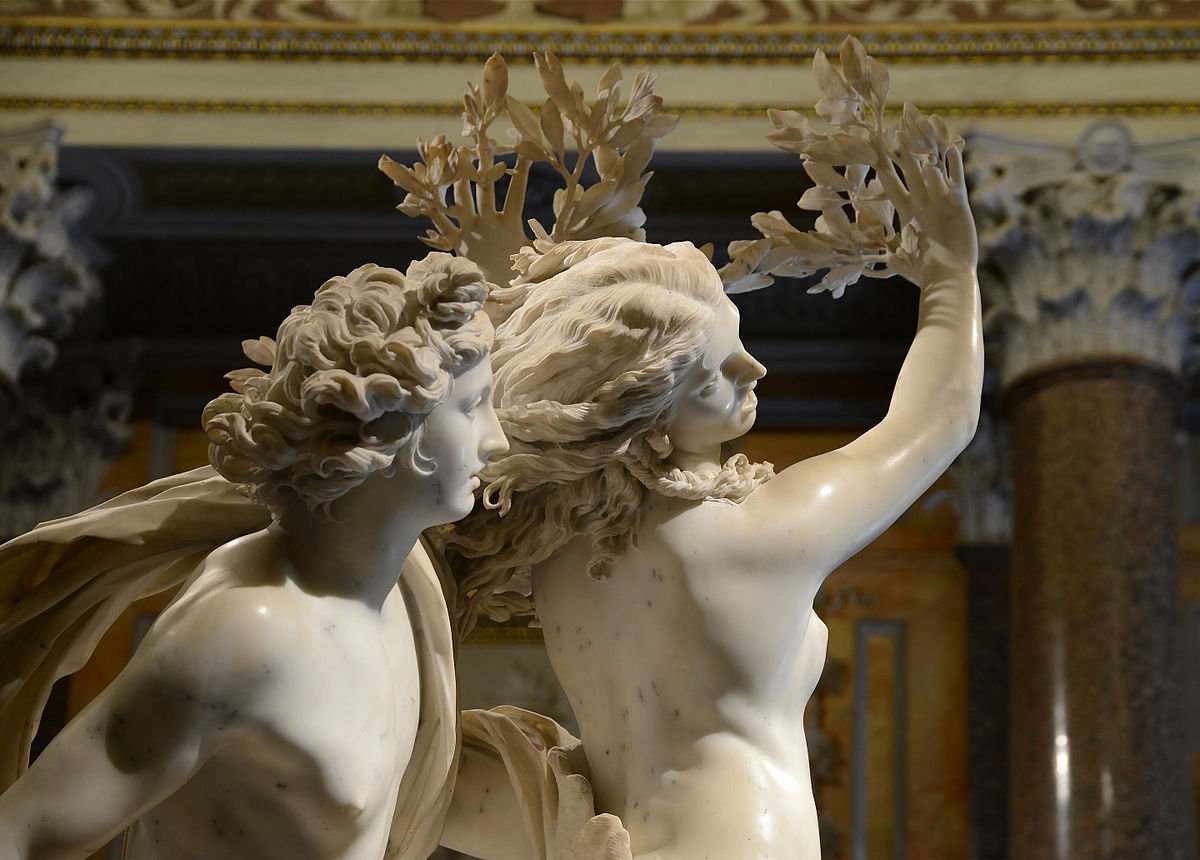
“Apollo and Daphne,” created between 1622 and 1625. Credit: Wikipedia/Alvesgaspar/CC-BY-SA-4.0

This ancient myth of Daphne, in which the nymph transforms herself into a tree to escape the lustful attention of the god Apollo, has inspired countless retellings in art. Its themes resonate today.

Ancient Greek myths and folktales are shaping popular culture, from big-budget films to television series to novels. You can even find advice on how to look like a Greek goddess or heroine on your wedding day, with gowns inspired by Aphrodite and Helen of Troy (among others).

In particular, myths of transformation have appealed to artists and writers who are attracted to the challenge of retelling stories of shifting forms — the strange movements between human and animal or plant. Such states of flux can shed light on our own understanding of identity.

Among the many mythical figures changed through metamorphosis is the nymph or dryad, Daphne. One of the mythical beings who cared for trees, springs and other natural elements, Daphne was the child of Peneus, a Thessalian river god.

Her decidedly sad and violent story, in which she is transformed into a tree to escape the lustful attention of the god Apollo, gives rise to the ancient explanation of the creation of the laurel tree, known as “Daphne” by the ancient Greeks.

Daphne’s plight continues to intrigue artists. Today, new interpretations are finding fresh ways of reading this influential, much-contested myth, with its themes of sexual violence and bodily autonomy.

Parthenius (1st Century BC-1st Century AD) provides the earliest complete extant version of the myth of Daphne and Apollo. As a grammarian, Parthenius collected stories from texts now lost to us. His version of the story can be traced to earlier works dating to the 3rd century BC, suggesting the myth is even older.

Parthenius’ version begins with Leucippus, the son of a mythic king of Pisa, falling in love with the beautiful nymph. Daphne was favoured by the goddess Artemis, who bestowed upon her the gift of shooting a straight arrow. Leucippus contrived to spend time with Daphne by dressing as a woman and joining her during a hunt.

But this enraged Apollo, who also desired Daphne. He encouraged Daphne and her fellow female hunters to bathe in a nearby stream. When Leucippus refused to join them, the women stripped him, discovering his ruse and stabbing him with their spears.

The god Apollo, then took his chance:

“but Daphne, seeing Apollo advancing upon her, took vigorously to flight; then, as he pursued her, she implored Zeus that she might be translated away from mortal sight, and she is supposed to have become the bay tree which is called daphne after her.”

“Destroy this beautiful figure”

The Latin poet, Ovid (43 BC-17 AD) retells Daphne’s story in Book 1 of his epic poem of transformation myths, the Metamorphoses. Ovid explains that Apollo’s desire was caused by Cupid, whom Apollo had slighted. In response, Cupid shot to the god Apollo, causing him to feel intense passion for Daphne. But she was shot with another type of arrow, ensuring she would not reciprocate his attraction.

Ovid’s version depicts a frightened Daphne fleeing her pursuer with language that paints her as a hare hunted by a greyhound. Daphne’s fear of being caught by Apollo as he chases her is evoked with visceral realism. Her transformation comes when she no longer has the strength to run:

“With her strength used up, she went pale with fear and, overcome by the effort of her frantic flight and gazing upon the waters of Peneus, she cried: ‘Bring help, father, if your waters possess divine power! By changing it, destroy this beautiful figure by which I generated too much desire.’

“With her prayer scarcely completed, a heavy torpor took possession of her limbs: her soft breasts were bound by a thin layer of bark, her hair grew into foliage, her arms into branches; her feet, just now so swift, hold fast in sluggish roots, a crest possessed her facial features, radiance alone remained in her.”

Even without human form, however, Daphne is not saved from Apollo’s lust. After her transformation, Apollo reaches out to touch the trunk of the tree, which shrinks from him.

In the final lines of this episode, Ovid reveals what Apollo does with this tree’s leaves: they are woven into a laurel wreath and placed around his quiver and lyre, to be used in rituals performed in his honor.

While Daphne is saved from the assault of her human form, she is nonetheless forcibly objectified for the sake of the god Apollo’s desire.

Loss of self

Since antiquity, the story of Daphne has been retold over and over again – painted, sculpted, performed and analyzed.
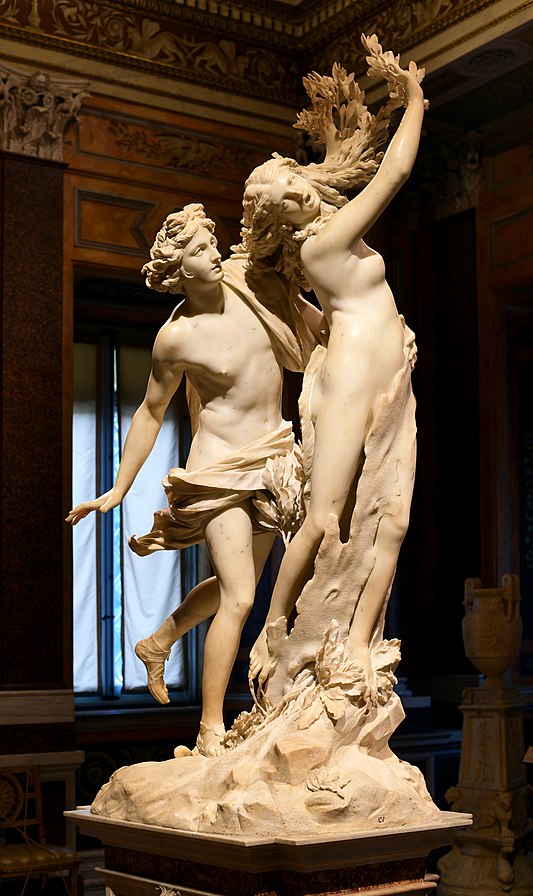
Statue of Apollo and Daphne an interpretations of the Greek Myth
Bernini’s “Apollo and Daphne.” Credit:Wikipedia/Architas/CC-BY-SA-4.0

We can gaze at Daphne in all manner of poses in museums and galleries throughout Europe. The Galleria Borghese in Rome displays Gian Lorenzo Bernini’s Daphne being seized by the god Apollo in a life-size, glowing marble statue.

Completed in 1625, it depicts Apollo’s intense determination as he seizes the nymph by the waist with one hand even though she is in the very process of turning into a tree.

While his face is eerily peaceful, Daphne’s replicates the fear that underscores Ovid’s description.

In this way, Bernini’s sculpture is Ovid’s poetry in material form. Masterpieces of art and literature, respectively, compromise us by the beauty that depicts a narrative of attempted rape.

The Louvre has Giambattista Tiepolo’s version of the Greek myth, dating to approximately 1774. Here, a baby Cupid hoists Daphne as if she were a ballerina while Apollo seems somewhat discombobulated. An aged Peneus slumps on the ground, seemingly exhausted from his transformative magic.

While Bernini’s Daphne is shocked and traumatized, Tiepolo’s nymph — with her attendant narrative of fear and suffering — has been tamed for a genteel Baroque audience. This silly and passive rendition of sexual assault is accentuated by the delicate shoots of foliage that grow from Daphne’s right hand.

Historically, scholarship has shown a deep-seated patriarchal interpretation of the Greek myth, rendering Daphne’s role in her own transformation as secondary to the actions of masculine power, represented by the god Apollo.

The creation of the laurel wreath, for instance, recorded by Ovid, has been interpreted as an act of mourning, turning Daphne’s transformed body into a symbol of Apollo’s grief.

Feminist interpretations, however, remind us Apollo’s intention was to rape Daphne. Thus his grief was firmly based on his failed attempt and nothing more. These interpretations encourage us to consider the intense violence inherent in the Greek myth.

As a tree, leafy and earth-bound, Daphne’s loss of self is both physical and psychological. No longer human, she loses the ability to express herself through her facial features, and the power of speech. Like so many women in the myths of transformation, Daphne is perpetually silenced. She can only “speak” through the rustling of leaves.

The burden of women’s historic experience of sexual harassment, violation and rape is also vividly chronicled in Daphne’s story. Ovid, a master of narratives of violence and abuse, reveals Daphne’s burden by suggesting she sees herself as partly accountable for Apollo’s pursuit of her. In her prayer to her father, she begs to be relieved of her beauty, which she believes has caused the god’s actions.

Her pleas have echoed across millennia in the self-admonishment of many women and their desire to become invisible to the male gaze. Daphne achieves a form of invisibility — or so she thinks — in her new form as a mass of leaves and bark. But, as Ovid tells us, not even as a tree can she escape the god’s persistent lust.

The sheer absurdity of the entire Greek myth begs the question: would a woman prefer to become a tree rather than be raped?

Modern interpretations of the Greek Myth of Daphne

In the 20th century, Salvador Dalí, Paul Delvaux and Ossip Zadkine all reworked Daphne, painting and sculpting her for a modernist audience.

Zadkine’s sculpture of Daphné (1958) mirrors yet mocks Bernini’s work, rendering the nymph as a powerful root-bound tree of monumental grandeur and ungainly defiance. She, however, remains silent.

In a new exhibition opening at Melbourne’s Australian Centre of Contemporary Art, Australian audiences can see some of Daphne’s incarnations over the centuries, including early works, such as Anthonie Waterloo’s etching of Apollo and Daphne (1650s) and Agostino dei Musi’s engraving from 1515.

Traditional works celebrating the so-called grandeur of classical mythology so much in vogue in the Renaissance (and beyond) are joined and contested by competing interpretations. These include Erik Bünger’s Nature see you (2021), a video essay on the world-famous but inherently vulnerable gorilla, Koko; and Ho Tzu Nyen’s 2 or 3 Tigers (2015), a digital projection that meditates on tigers in the Malay context.

In both works, we see the story of Daphne as sentient nature in the form of gorilla and tiger, and nature both mythical and metaphorical. We also see nature as silent and therefore fragile in a world of human gods who are just as ruthless and destructive as their mythical counterparts.

Daphne’s humanity — her womanhood — is also referenced in Wingu Tingima’s paint on canvas, Kawun (2005). Based on the traditional Indigenous Australian story of the Seven Sisters, Tingima’s work suggests the trauma of women as they travel to escape the desires of the Ancestral Being Nyiru, who is determined to take one of them as his wife.

Like Daphne, the sisters escape by ascending to the sky and transforming into the constellation known as the Pleiades.

This rich exhibition approaches the Greek myth of Daphne from many angles. Working back and forth through time, mixing traditional ways of seeing with vital contemporary narratives (including the Anthropocene, #MeToo, and post-humanism), it is an uncomfortable reminder of the power of myth and its own vulnerability to the forces of transformation.

A Biography of Daphne opened at the Australian Centre for Contemporary Art in Melbourne on June 26 and runs to September 5, 2021. 

Marguerite Johnson is a Professor of Classics, University of Newcastle. Tanika Koosmen a PhD Candidate at the University of Newcastle.

This article was published at The Conversation and is republished under a Creative Commons license.

See all the latest news from Greece and the world at Greekreporter.com.

 GREECE

Alonnisos in Shock as Spearfisherman Kills Island’s Mascot Seal

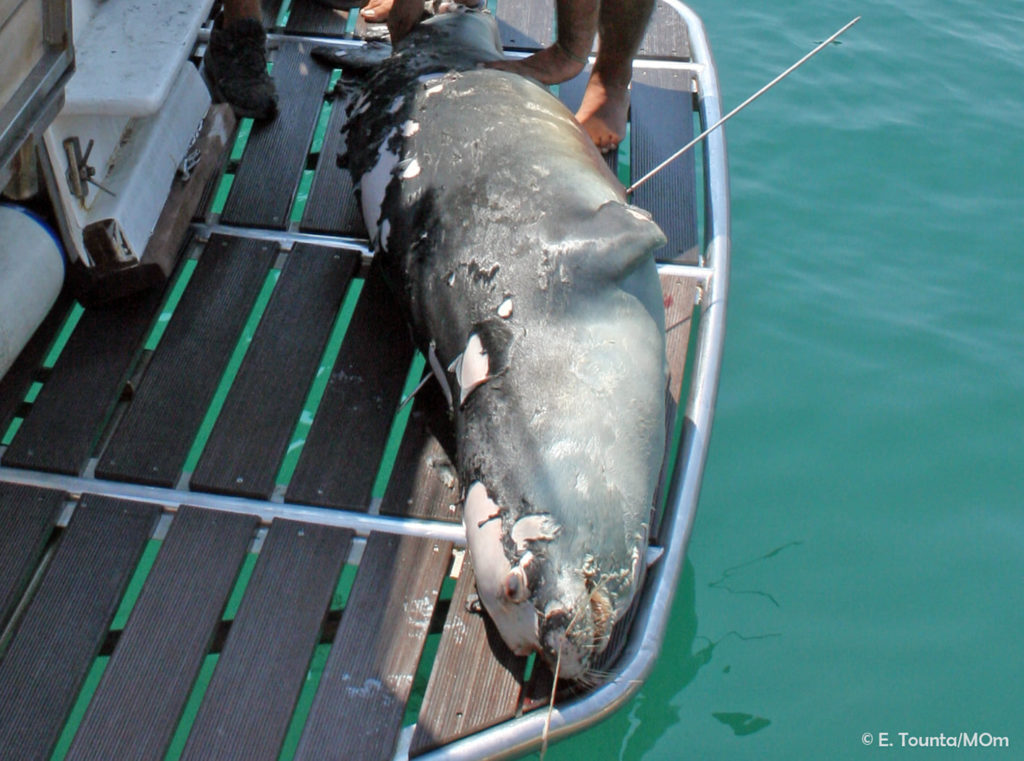
The dead seal. Credit: MOm Monachus Monachus / Facebook

The famous seal of Alonnisos island is gone; residents and tourists are shocked by the news of the death of one of the most famous and beloved seals of the island, who was named ”Kostis.”

The devastating news was made public on Saturday evening by the Environmental Conservation Organization MOm – Monachus monachus.

”Unfortunately, yet again, it is proven that human wickedness and stupidity have no limits!” the announcement of the MOm organization stated in a post on Facebook.

”We have been informed today that the young monk seal “Kostis” (who in recent months had become the mascot of Alonnisos) has been deliberately killed. The innocent and unaware seal was executed at close range with a spear gun that had a large spear for exactly that purpose!” the announcement says.

It is noted that the seal had become very popular on Alonnisos lately due to its very friendly and sociable ways toward people.

”This news was received with great grief and outraged not only the people of MOm (who cared for several months for Kostis during his rehabilitation), but also all the sensitized residents and visitors of Alonnisos who had the luck to admire “Kostis” from close by. The perpetrator obviously won’t have the slightest bit of courage to come forward and admit his idiotic act,” the MOm declared, adding that they will proceed with filing charges against the person responsible for the crime.

”The relevant authorities to take immediate action in order to bring the person(s) responsible for this barbarous act to justice. Any citizen who has any information about the incident to contact the Port Police authorities immediately,” their announcement concludes.

Seal protection on Alonnisos: Who is MOm?

Alonnisos is an island of the Northern Sporades archipelago in the northern Aegean Sea, an area that is home to the Mediterranean monk seal is a monk seal belonging to the family Phocidae.

MOm / The Hellenic Society for the Study and Protection of the Monk seal is a Greek non–governmental environmental organization with the legal status of a Non–profit association. MOm is active in the protection and promotion of the coastal and marine environment of Greece, through the protection of the Mediterranean monk seal, which is the only seal species in the Mediterranean Sea and the most endangered seal on earth.

According to their official website, the financial resources of MOm originate ”from the memberships of our supporters, donations from private entities, selected partnerships with national, European and international bodies, and from nationally and European-funded programs.”

MOm is subject to regular financial auditing by Certified Public Accountants – Auditors.

MOm’s scientific research, conservation and education activities are carried out by a dedicated and highly specialized team of professionals, such as biologists, field technicians, and media officers with the help of numerous volunteers. The organization’s activities include scientific research, rescue and rehabilitation, protection and Management, public awareness and sensitization, as well as environmental education.

Their revenue for 2020 was a bit more than 500,000 euros, with only six per cent of this amount coming from donations.

See all the latest news from Greece and the world at Greekreporter.com.
The Barefoot Fire-Walking Ritual of Anastenaria Lives On in Greece

ByTasos Kokkinidis
July 26, 2021
Anastenaria is a Greek and Bulgarian tradition. Credit: Public Domain

Hundreds of people descend on the town of Langadas, near Thessaloniki, each year in late May to participate in the ancient ritual of “Anastenaria,” in which barefoot people walk on glowing coals.

The communities which celebrate this ritual are descended from refugees who entered Greece from Eastern Thrace following the Balkan Wars of 1911–12 and the harrowing population exchange between Greece and Turkey in 1923.


The origin of Anastenari

The roots of this tradition are steeped in mystery — and a bit of controversy as well.

The Anastenarides hold that the origin of the ritual lies in a fire which took place at Kosti, near the Black Sea in the thirteenth century which set ablaze the church of Saint Constantine. As the empty church burned, the villagers claimed to hear cries coming from the flames and believed that they were appeals from the icons, desperately calling out for help.

Some villagers ran into the burning church to rescue them, returning quickly with the icons — and neither the icons nor their human protectors were burned or injured in any way. This occurrence, according to the fire-walking practitioners, prompted the annual celebration which the Anastenaria holds to commemorate their deliverance from the flames.

However, many scholars do not believe this to be the true origin of the Anastenaria ritual.

It is largely believed that the ceremony is the survival of an ancient Thracian Dionysian ritual which was later given a superficial Christian interpretation in order to be tolerated by the Greek Orthodox Church, which does not support the fire walking ritual since it is viewed as pagan.


“The Anastenaria are religious communities of Orthodox Christians, known for their devotion to Saints Constantine and Helen and the fire-walking rituals they perform in their honour. These rituals are part of an elaborate annual ritual cycle, which culminates with the festival of the two saints every May.

“The festival, which lasts for three days, includes various processions around the village, an animal sacrifice, music and ecstatic dancing. The most dramatic moment of the festival is the fire-walking ritual itself, where the participants, carrying the icons of the saints, dance over the glowing coals,” writes historian Dmitri Xygalatas. He continues:

“This practice is very old. Since the nineteenth century, Greek ethnographers have almost unanimously argued that the Anastenaria derives from the ancient orgiastic cults of Dionysus, constituting a continuous tradition of almost three millennia. This is something that most people who have heard about the Anastenaria know, and to which many Greek anthropologists attest.

“However, such a claim is completely unfounded; a more careful study of the sources reveals that the theory of the Dionysian origins of the Anastenaria has been intentionally constructed and later uncritically reproduced, resulting in a false version of history.”


The Anastenaria ritual, which is also performed in Bulgaria, is an important element of the cultural heritage of the Bulgarian people. In 2009 it was included on UNESCO’s World Heritage list of cultural events.


See all the latest news from Greece and the world at Greekreporter.com.
Did Ancient Greeks Build their Temples Where Earthquakes Struck?

ByTheo Ioannou
July 25, 2021
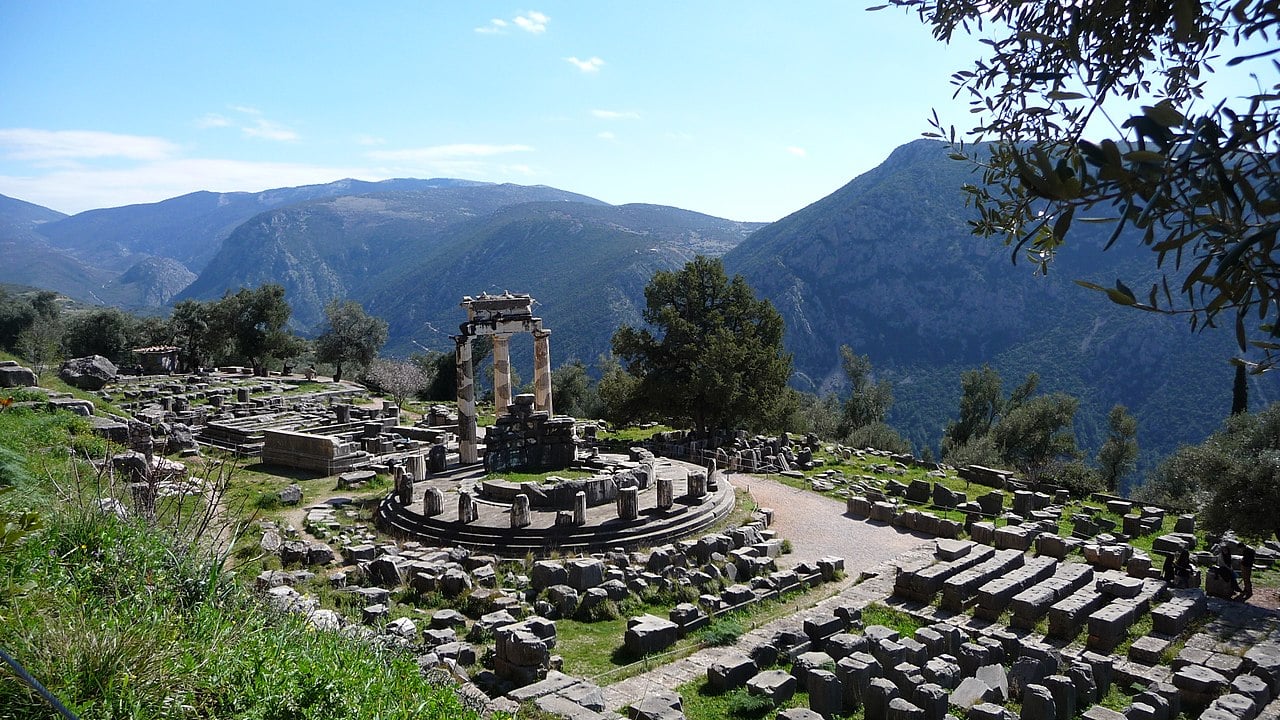
A Tholos at Delphi, Greece. Credit: Tamara Semina/Wikimedia Commons/CC BY-SA 3.0

The ancient Greeks may have built sacred or treasured sites deliberately on land previously affected by earthquake activity, according to a new study by the University of Plymouth.


Professor of Geoscience Communication Iain Stewart MBE, Director of the University’s Sustainable Earth Institute, has presented several BBC documentaries about the power of earthquakes in shaping landscapes and communities.

Now he believes that fault lines created by seismic activity in the Aegean region may have caused areas to be afforded special cultural status, and as such, led to them becoming sites of much celebrated temples and great cities.

Scientists have previously suggested Delphi, a mountainside complex once home to a legendary oracle, gained its position in Classical Greek society largely as a result of a sacred spring and intoxicating gases which emanated from a fault line caused by an earthquake.


But Professor Stewart believes Delphi may not be alone in this regard, and that other ancient Greek cities including Mycenae, Ephesus, Cnidus and Hierapolis may have been constructed specifically because of the presence of fault lines and earthquakes.
Many ancient Greek sites correspond to areas prone to earthquakes

In the study, published in Proceedings of the Geologists’ Association, Professor Stewart says a correspondence between active faultlines and earthquakes and ancient cities in parts of Greece and western Turkey might not seem unduly surprising, given that the Aegean region is riddled with seismic faults and littered with ruined settlements.


Many seismic fault traces in the region do not simply disrupt the fabric of buildings and streets, but run straight through the heart of the ancient Greek settlements’ most sacred structures.

There are prominent examples to support the theory, such as in Delphi itself, where an ancient Greek sanctuary was destroyed by an earthquake in 373 BC, only for its temple to be rebuilt directly on the same fault line.

There are also many tales of individuals who attained oracular status by descending into the underworld, with some commentators arguing that such cave systems or grottoes caused by seismic activity may have formed the backdrop for these stories.
Why Greece has so much seismic activity

Greece lies in a highly seismically active region. The vast majority of earthquakes cause no damage or injuries.

The country is located in a complex boundary zone in the eastern Mediterranean between the African Plate and the Eurasian Plate.

The northern part of Greece lies on the Eurasian Plate while the southern part lies on the Aegean Sea Plate.

The Aegean Sea Plate is moving southwestward with respect to the Eurasian Plate at about 30 mm per year while the African Plate is subducting northward, beneath the Aegean Sea Plate, at a rate of about 40 mm per year.

The northern plate boundary is a relatively diffuse divergent boundary while the southern convergent boundary forms the Hellenic arc.

These two plate boundaries give rise to two contrasting tectonic styles, extension on east–west trending fault zones with strike-slip tectonics on SW-NE trending fault zones throughout west and central Greece, Peloponnese and the northern Aegean and contractional in the southern Aegean, continuing around to the Ionian islands.

The south Aegean is the location of the volcanic arc and is characterized by extension. To the east of Crete along the Hellenic Arc, strike-slip tectonics with some extension become important.


See all the latest news from Greece and the world at Greekreporter.com.
'Can't keep a waitlist': B.C. dog trainer busier than ever with pandemic puppies

A Colwood business owner has never been so busy. She says she's currently working with 60 dogs.


A Vancouver Island business owner is busting with barking clients trying to book in with her and says she’s never been so busy. 

Marjanna Wornell, canine educator and dog trainer at Middle Earth Canine Academy in Colwood, is seeing a lot of pets that were purchased during the COVID-19 pandemic. 

“So many people got dogs and a lot got puppies. They’re overwhelmed by puppy behaviour and adolescent dog behaviour, so there are so many more people coming because they’re not previous dog owners,” Wornell tells Glacier Media.

She offers one-hour, one-on-one sessions out of her academy

“I am inundated I can hardly keep up with it right now,” she says. “I am working six days a week, five classes a day, most days.”

People are booking through November and December and Wornell isn’t even able to keep a waitlist.

“I can’t keep a waitlist because I don’t have time to phone someone back,” she says. 

Most concerning for her right now is people transition back to work. She advises them to slowly introduce this change to their dog.

“People are going back to work so there is the whole issue of helping them prepare the dog for that,” she says. “I am concerned that some people are becoming overwhelmed with their dogs. Without help, they would be re-homing them.”

Wornell currently works with 60 dogs and says it's overwhelming but that she enjoys her job.

“It is my passion to help people and dogs. It has been for years. I was actually born in the year of the dog.” 

Working five days a week was always a goal but says six and seven days was not something she anticipated. 

“I have [cordoned] off time in August that is mine and nobody is getting that from me,” she says with a laugh. 

She hopes that her clients walk away with a well-mannered member of their family when they finish with her 10-session training. 

British Columbians are keeping their pandemic pets: BC SPCA

The animal welfare charity says it's seeing a much lower return rate when compared to non-COVID years.


Purchasing a pet during the pandemic skyrocketed over the last year and unlike our neighbours to the south, it appears most people are keeping their animals as COVID-19 restrictions lift. 

The BC SPCA says the number of returns or surrenders is down compared to other years. 

“We definitely heard stories from other locations in the United States and in some locations in Canada where people were returning their pets to shelters and that was a worrying trend,” says Lorie Chortyk, the organization's general manager of communications. “But here in B.C., we have not seen that at the SPCA at all.” 

Across the non-profit's 36 shelters, there's a return rate of five per cent. This year, Chortyk says it’s even lower. 

“We always do have a low rate but it actually even decreased throughout the pandemic and we are still seeing that very low number,” she tells Glacier Media. 

BC SPCA has a thorough adoption process, she adds, attributing it to the low return rate. 

For Vancouver resident Elizabeth Moffat, adopting a dog has been a smooth transition. 

“The timing was really good,” says Moffat. “She could adjust and I didn’t feel like I had to introduce her to things too quickly.”

Her furry companion, Lexie, is a rescue from Taiwan. The pair was matched in late October and it took until Dec. 30 for her to arrive in B.C. 

“It’s been really good. It really helped when it was cold and you didn’t want to go outside. It makes you take three walks a day,” she says.

Moffat is able to work some days at an office and some days at home, creating a special routine for her dog. 

“Luckily, right now, I have my office space whenever I go in, so she comes in about half the time with me and she’s been a big hit,” she says.

Another pet owner has also been able to adjust her schedule to be flexible for her new puppy.

“I switched to full-time working from home and thankfully our employees are quite happy to let that continue,” says Andrea Curran.

Having a new puppy made the pandemic much more tolerable for the Cowichan Valley resident. 

“It’s OK being home when you’ve got these guys to be home with. I don’t think that I have to stay home because of COVID. I like staying home because I’ve got my dogs at home with me,” says Curran. 

“Raising a puppy during COVID made me think a lot less about COVID for sure.”

Meanwhile, it's a different story for one cat rescue society in Mission.

“We are incredibly busy. We weren’t as busy last year because we were able to have cats going out into homes right away and things have slowed down quite a bit and we are seeing an influx in surrenders and cats in need this year,” says Melina Csontos, executive director of Cat Therapy and Rescue.

On average, they have about 200 cats in their foster care system. Currently, they have 300.

“We are getting the same reasons as we’ve always gotten every year, but we are getting extras that are basically like, ‘We adopted a cat and now we are going back to work and it’s not fitting our lifestyle, it’s not working. The cat needs more than we can offer it.’ That is a very common reason that people are surrendering right now,” she says. 

Csontos asks people to consider fostering if they’re home this summer and are able to do so. 

The BC SPCA, meanwhile, has programs for people if they need help adjusting to their new routines through their AnimalKind program

“I think the most important thing is to help your pets adjust to a new routine and I think to have patience,” says Chortyk. “They will get used to it. Pets always adjust. They just need a little time.” 

Watch NDP leader Jagmeet Singh slay this viral TikTok dance trend (VIDEO)

Singh's using smooth moves to signal young people to "make history in the next election."

jagmeet-singh-viral-tiktok-dance-metro-vancouver-july-2021.jpg'
On July 12, 2021, NDP leader and Burnaby South MP Jagmeet Singh took to TikTok to share his take on the "Alors On Danse" routine. 

The "Alors On Danse" dance video has taken TikTok by storm — but it's not only teenagers and young adults who are copying the viral sensation. 

On July 12, New Democratic Party Leader and Burnaby South MP Jagmeet Singh took to the social media platform to share his take on the world-famous routine.  

The original video was created by a group of  friends who chose the slow-mo version of Belgian singer and rapper Stromae’s popular track "Alors on Danse." 

Usim E. Mang, the 19-year-old who shared the original content under his TikTok handle usimmango, now has over 118 million views, according to BuzzFeed News.

In his version, Singh appears in a grey sleeveless shirt in front of the group. He mimics the simple yet smooth moves by tugging at the corners of his shirt as well as gently shrugging his shoulders while moving his arms to the relaxed rhythm. 

The B.C. politician's video also reads "when they say young people don't vote" followed by "when you know they're going to make history in the next election."

A key part of the viral groove?

Tapping into that confident gaze at the camera, of course. 

Watch the video of Singh dancing on TikTok and watch the original version of the popular dance


Development of a novel technology to check body temperature with smartphone camera

Technology for low-cost, thermal-imaging sensors that operate well at temperatures as high as 100 °C has been developed. Expected to be actively used in thermal-imaging applications in smartphones and autonomous vehicles

NATIONAL RESEARCH COUNCIL OF SCIENCE & TECHNOLOGY

Research News

IMAGE

IMAGE: IMAGE OF ELECTRON MICROSCOPE (LEFT) AND FORMULA (RIGHT) OF BOLOMETER DEVICE view more 

CREDIT: KOREA INSTITUTE OF SCIENCE AND TECHNOLOGY(KIST)

Thermal-imaging sensors that detect and capture images of the heat signatures of human bodies and other objects have recently sprung into use in thermostats to check facial temperatures in a contactless attempt to screen for COVID-19 at several building entrances. Under these circumstances, the smartphone industry is actively considering the incorporation of such sensors as portable features to create the add-on function of measuring temperature in real time. Additionally, the application of such technology to autonomous vehicles may facilitate safer autonomous driving.

A research team lead by Dr. Won Jun Choi at the Center for Opto-Electronic Materials and Devices in the Korea Institute of Science and Technology (KIST) has announced the development of a thermal-imaging sensor that overcomes the existing problems of price and operating-temperature limitations through convergence research with the team of Prof. Jeong Min Baik from Sungkyunkwan University (SKKU). The sensor developed in this work can operate at temperatures upto 100 °C without a cooling device and is expected to be more affordable than standard sensors on the market, which would in turn pave the way for its application to smartphones and autonomous vehicles.

To be integrated with the hardware of smartphones and autonomous vehicles, sensors must operate stably without any difficulties at high temperatures of 85 °C and 125 °C, respectively. For conventional thermal-imaging sensors to meet this criterion, an independent cooling device would be required. However, high-end cooling devices that promise quality come at a price of over two million Korean won; even such devices do not make the sensor suitable for operations at temperatures as high as 85 °C. Therefore, the conventional thermal-imaging sensors have not been applied in these fields.

A joint research team from KIST and SKKU has developed a device using a vanadium dioxide (VO2)-B film that is stable at 100 °C. This device detects and converts the infrared light generated by heat into electrical signals; this eliminates the need for cooling devices, which account for over 10% of the cost of thermal-imaging sensors and consume large amounts of electricity. The device was able to obtain the same level of infrared signals at 100 °C as at room temperature. Furthermore, as a result of fabricating and using an infrared absorber that can absorb as much external infrared light as possible, heat signatures were detected with three times more sensitivity and converted into electrical signals. The device shows around 3 milliseconds of response time even at 100 °C, which is about 3~4 times faster than conventional ones. Such high response speeds enable the device to capture thermal images at 100 frames per second, far exceeding the conventional level of 30-40 frames per second. This makes the device an interesting candidate for use in autonomous vehicles, as well.

Dr. Choi of the KIST said, "By means of our work with convergence research in this study, we have developed a technology that could dramatically reduce the production cost of thermal-imaging sensors. Our device, when compared to more conventional ones, has superior responsivity and operating speed. We expect this to accelerate the use of thermal-imaging sensors in the military supply, smartphone, and autonomous vehicle industries."

###

This research was conducted as KIST's institutional R&D project, supported by the Ministry of Science and ICT (MSIT), and as a project of the KIST-UNIST Ulsan Center for Convergent Materials. It has been published in the latest issue of "Applied Surface Science" (in the top 3.28% of the JCR field).


Extreme heat, dry summers main cause of tree death in Colorado's subalpine forests

UNIVERSITY OF COLORADO AT BOULDER

Research News

IMAGE

IMAGE: DEAD TREES IN SUBALPINE COLORADO FOREST ON NIWOT RIDGE, WEST OF BOULDER. view more 

CREDIT: ROBERT ANDRUS

Even in the absence of bark beetle outbreaks and wildfire, trees in Colorado subalpine forests are dying at increasing rates from warmer and drier summer conditions, found recent University of Colorado Boulder research.

The study, published in the May print issue of the Journal of Ecology, also found that this trend is increasing. In fact, tree mortality in subalpine Colorado forests affected by fire or bark beetle outbreaks in the last decade has more than tripled since the 1980s.

"We have bark beetle outbreaks and wildfires that cause very obvious mortality of trees in Colorado. But we're showing that even in the areas that people go hiking in and where the forest looks healthy, mortality is increasing due to heat and dry conditions alone," said Robert Andrus, lead author of the study and postdoctoral researcher at Washington State University. "It's an early warning sign of climate change."

These deaths are not only affecting larger trees, thus reducing forests' carbon storage, but hotter and drier conditions are making it difficult for new trees to take root across the southern Rockies in Colorado, southern Wyoming and northern parts of New Mexico.

It's well known that rising temperatures and increasing drought are causing tree deaths in forests around the globe. But here in Colorado, researchers found that heat and drought alone are responsible for over 70% of tree deaths in the 13 areas of subalpine forest they measured over the past 37 years. That's compared with about 23% of tree deaths due to bark beetles and about 5% due to wind damage.

"It was really surprising to see how strong the relationship is between climate and tree mortality, to see that there was a very obvious effect of recent warmer and drier conditions on our subalpine forests," said Andrus, who conducted this research while completing his graduate degree in physical geography at CU Boulder. "The rate of increasing mortality is alarming."

With temperatures in Colorado having risen by about 2 degrees Fahrenheit since the 1980s and increasing more quickly at higher elevations, estimates of another possible 2.5 or more degrees of warming in the next few decades due to climate change indicate that the rate of tree deaths will only increase.

Seeing the forest for the trees

Subalpine forests cover over 10,000 square miles in Colorado and are best known by those who ski or recreate in the mountains. Subalpine fir and Engelmann spruce dominate the area above the Peak to Peak Highway in the Front Range, and if you go over any mountain pass in Colorado, you're going into the subalpine zone, according to Andrus.

Previous research at CU Boulder has shown how wildfire, beetle kill and the two combined can affect the mortality and health of Rocky Mountain subalpine forests. This new research isolated the effects of those two common stressors from those of heat and moisture to find out how much of an effect climate change is having on these tree populations.

"As trees die in increasing numbers due to fire, bark beetles and drought, the warmer and drier climate is making it much less likely that new tree seedlings can establish and replace the dead adult trees," said Tom Veblen, co-author of the study and professor emeritus of geography.

Launched by Veblen when he arrived on campus in 1982, this is the longest running study of tree mortality in Colorado with remeasurements made frequently enough to identify the factors causing tree death. Every three years since, graduate students, postdoctoral researchers and undergraduate field assistants have diligently returned to the more than 5,000 marked trees on Niwot Ridge just west of Boulder. In these 13 subalpine forest plots, they recorded that more trees died during summers with higher maximum temperatures and greater moisture deficits.

They found that tree mortality increased from .26% per year during 1982 to 1993, to .82% per year during 2008 to 2019--more than tripling within 40 years.

"It is really challenging because it's not very visually obvious to the casual observer," said Andrus. "But the thing to keep in mind is that while warmer, drier conditions are also causing more fire and bark beetle outbreaks, these slow and gradual changes are also important."

###

Additional authors on this publication include Rachel Chai of the Veblen Lab at CU Boulder; Brian Harvey, previously a postdoctoral researcher in geography at CU Boulder and now an assistant professor at the University of Washington; and Kyle Rodman, previously a graduate student in the Veblen Lab at CU Boulder and now a postdoctoral researcher at the University of Wisconsin Madison.