Sunday, August 01, 2021

Workers at world's biggest copper mine in Chile agree to strike

Issued on: 01/08/2021 - 
Workers of the Escondida copper mine protest during a strike outside BHP Billiton's offices, in May JAVIER TORRES AFP

Santiago (AFP)

Workers at the world's biggest copper mine, Chile's Escondida, have approved a strike after rejecting the final contract offer proposed by multinational owners BHP.

Chile is the world's top producer of copper, making up 28 percent of global output. The mineral accounts for 10-15 percent of the South American country's GDP, with much of it exported to China, the world's biggest consumer.

Following the results of a vote that lasted until Saturday night, the union reported in a statement that there were 2,164 votes in favor of starting the strike against 11 for accepting the employer's offer.

Union and company leaders can initiate a final dialogue with government mediation within five to 10 days.

Escondida workers staged a 44-day strike in 2017, the longest in the history of Chilean mining. The strike caused $740 million in losses for the company.

The workers are asking for a one-time bonus to recognize their work during the Covid-19 pandemic as well as education benefits for their children.


"We hope that this strong vote is the decisive wake-up call for BHP to initiate substantive talks... if it wants to avoid an extensive conflict, which could be the most costly in the country's union history," the union said.


The Escondida mine is located in the world's driest desert, the Atacama in northern Chile, at more than 3,000 meters (10,000 feet) in altitude.

It is the same area where in 2010 some 33 men were trapped 700 meters underground for 69 days following a cave-in at the Copiapo mine.


© 2021 AFP
COFFEE HOUSE CULTURE IN 18TH CENTURY ENGLAND

Coffee houses transformed British society in the 17th and 18th centuries. But who visited coffee houses, and why?

The French writer Maximilien Misson enjoyed visited London’s coffee houses in the late 17th century. “You have all manner of news there,” Misson reported. “You have a good fire, which you may sit by as long as you please. You have a dish of coffee; you meet your friends for the transaction of business, and all for a penny.”

Coffee houses exploded in 17th century England and transformed society in the 18th century. Why did England go crazy for coffee, and how did coffee houses change history?


A London coffee house, c. 1700. © Trustees of the British Museum

THE RISE OF THE COFFEE HOUSE

In 1652, Pasqua Rosée opened the first coffee house in London. Rosée, who came to England as a servant, brought a lifetime of experience drinking coffee in Turkey.

Londoners flocked to the coffee house. They ordered drinks “black as soot, and tasting not much unlike it,” according to trader William Bidulph. By 1675, England boasted over 3,000 coffee houses.

The link between students and coffee began early. Cambridge and Oxford hosted multiple competing coffee houses. Visitors tossed back cups of coffee while debating academic matters. Outsiders even called the coffee houses “penny universities.” For the price of a penny, patrons indulged in their academic interests.

For years, coffee houses were associated with educated men and well-off traders. But soon, London’s coffee houses found an even broader clientele


COFFEE AS MEDICINE


Was coffee harmful––or did it cure? In the 17th century, the English debated the properties of the strange beverage.

Francis Bacon performed experiments on coffee even before coffee houses sold the beverage. According to coffee supporters, the beverage cured “head-melancholy” and drunkenness. Coffee supposedly treated gout, survey, and even smallpox.

Yet in excess, coffee could also harm. The drink caused tremors in high doses and potentially contributed to heart conditions. One experimentalist worried the beverage could cause paralysis.


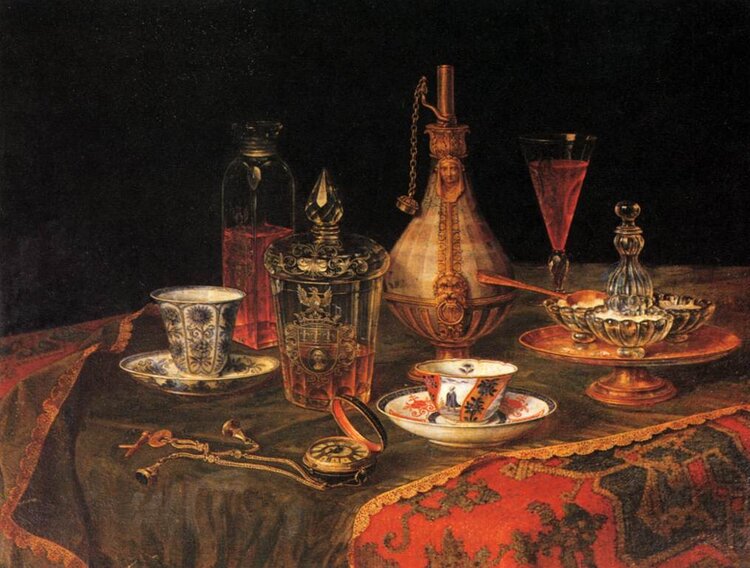
A still life by Christian Berentz, c. 1700. Galleria Nazionale d'Arte Antica


The ills caused by coffee went beyond physical ailments, according to an anonymous pamphlet published in 1674. The Women’s Petition Against Coffee attached the “newfangled, abominable, heathenish liquor called coffee.”

COFFEE HOUSES AS MEETING PLACES


As coffee houses opened across England, they catered to different interests.

Some coffee houses had a reputation for scholarly discussions. Others offered Latin lessons or poetry recitals. Natural philosophers hashed out disagreements on astronomical principles over a cup of coffee.

But not every coffee house focused on learning. Moll King’s coffee house in Covent Garden earned a reputation for welcoming the neighborhood’s prostitutes.


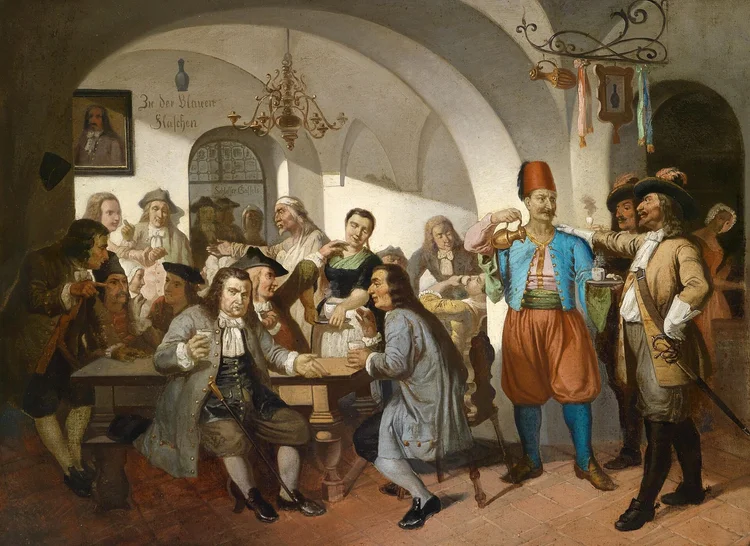
A painting showing an early modern coffee house.


The diarist Samuel Pepys enjoyed visiting London’s coffee houses in the 1660s. Pepys praised the coffee houses as an excellent place to transact business––and hear gossip.

Businessmen turned coffee houses into workplaces. Many established predictable hours at their favorite coffee houses, where clients would pop in to discuss the latest business. Businessmen even received mail at coffee houses.

Tom’s Coffee House, located in the City of London, welcomed bankers. Stockbrokers flocked to Garraways Coffee House and Jonathan’s Coffee House. The Latin Coffee-House by St. Paul’s welcomed book publishers.


A list of rules and orders for visitors at an English coffee house.


Lloyd’s Coffee House became the merchant and sailor destination. Edward Lloyd, the founder, shared news on shipping. Clients bought and sold so many maritime insurance policies that the coffee house eventually evolved into Lloyd’s of London, still a major insurer today.

Other coffee houses welcomed nonconformists. Religious and political dissidents found homes at coffee houses – after the Restoration, King Charles II tried to shut down coffee houses.

According to the monarch, coffee houses “have produced very evil and dangerous effects.” Men plotted against the king over coffee, Charles suspected, leading him to declare coffee houses a “disturbance of the peace and quiet of the realm.”

The proclamation stirred an instant backlash. The king backed down two weeks later.

PRINT CULTURE AND THE COFFEE HOUSE

Coffee houses shared news and distributed pamphlets. London’s first daily newspaper began printing in 1702. Between editions of the London Courant, runners visited coffee houses to share breaking news.

The “Wet Paper Club” at the Chapter Coffee House bragged that their news was so fresh, the pages were still wet with ink.


A pamphlet arguing against coffee and coffee houses from 1674.


Politics and trade dominated coffee house news. But patrons also wanted gossip, satire, and moralizing tales. Many coffee houses offered newspapers and pamphlets for free with the cost of admission. Some read the news out loud to encourage debate.

Coffee houses were more than a place to meet or conduct business. They became libraries with everything from the latest news from the colonies to scandalous broadsheets.
 
WOMEN AND COFFEE HOUSES

Although coffee houses claimed to admit anyone, in practice women were largely excluded.

Rather than an outright ban on women, coffee houses positioned themselves as a space for men to discuss politics, debate ideas, and transact business––topics that did not involve respectable women.

Some women worked in coffee houses as servers, and others even owned coffee houses. Moll King's coffee house became known for its clientele of traders, criminals, and prostitutes.

Women did drink coffee in private. And tea offered a respectable, affordable alternative. By the late 18th century, tea eclipsed coffee as England’s drink of choice. Yet tea shops never rivaled coffee houses as public meeting spaces.


Louis-Marin Bonnet, “The Woman Taking Coffee,” 1774.


Although coffee house culture dwindled in the 19th century, today cafes have taken over London. The number of independent coffee shops skyrocketed 700% in the past decade and Brits can choose from over 25,000 coffee shops.

London’s coffee house culture inspired several scenes in Engaged to an Earl. Elinor Barrett’s pamphlet causes a scandal in London’s coffee houses, triggering a pamphlet war. But when Elinor tries to visit a coffee house, she finds herself in hot water. Check out Engaged to an Earl for even more about 18th century coffee house culture.

SYLVIA PRINCE

July 21, 2021

PART OF 18TH CENTURY COFFEE HOUSE CULTURE
How Italians sold ice cream to the masses in Vienna

Issued on: 01/08/2021 - 
Ice cream consumption among Austrians is higher than in neighbouring Italy JOE KLAMAR AFP/File

Vienna (AFP)

Residents of the Austrian capital have queued for more than 130 years to sample the Italian ice cream of the Molin-Pradel family, one of Vienna's oldest gelato dynasties.

"He helped democratise ice cream, which before was reserved for the wealthy," Silvio Molin-Pradel says of his great-great-grandfather Arcangelo, who began selling it out of pushcarts in Vienna in 1886.

More than a century later, ice cream consumption among Austrians is higher than in neighbouring Italy.

And it was entrepreneurs like Arcangelo Molin-Pradel, born into poverty in northern Italy's Dolomite Alps, who were among the first to benefit from the sweet tooth of the Viennese.

The high cost of sugar, milk and refrigeration -- years before electric freezing was invented -- meant ice cream was long reserved for aristocrats.

But ingenious Italians like the Molin-Pradels changed that, producing ice cream based on water and fruit extract.

- Ice cream migration -

Originally from Zoldo, six hours from Vienna by car these days, the Molin-Pradels, like other families, were so poor that migrating for seasonal work was part of life -- whether to work as seafarers, lumberjacks or ice cream makers.

Vienna became one of the ice cream makers' first destinations outside Italy, says Maren Moehring, a history professor at the University of Leipzig in Germany.

The Italian migrants' "frozen stuff" as some called it quickly became popular with ordinary Viennese.#photo1

This sparked the ire of Austrian bakers, who perceived them as "dangerous competition", Moehring says.

In 1894, the ice cream makers got the right to open shops in Vienna rather than just selling ice cream from carts.

"The Viennese were already used to sweets... so it wasn't hard to then serve this cold product," Molin-Pradel, who keeps his recipes a secret, tells AFP as he stands in the back of his salon at Schwedenplatz.

At the central, tree-lined square in the heart of Vienna, the family still produces artisanal ice cream.

Each day in summer, about 5,000 customers order from dozens of flavours, ranging from traditional ones like chocolate and vanilla to avocado, lavender and hemp.

"Every Viennese will tell you that 'their' Italian ice cream maker is better," says Molin-Pradel.

"The colours must be pastel. It is a guarantee of quality," he says, adding that the business has expanded, including selling their ice cream through some Vienna supermarkets.

- Lasting tradition -


Out of roughly 370 ice cream shops in Austria, about 40 are still run by Italians in the small Alpine nation of almost nine million people, according to the Austrian Economic Chamber.

Its data also show that Austria boasts an average per capita consumption of more than 60 scoops per year, or about eight litres of ice cream -- more than in Italy, with an average consumption of six litres.

From one generation to the next, the gelato makers' skills and knowledge were passed on, "which explains their success", Moehring says.

While ice cream makers in earlier times would typically return to Italy to take care of the harvests in the Alps by mid-August, today the season lasts well into October.

Even today, Pradel-Molin goes on a pilgrimage to his ancestral home of Zoldo at the end of each season.

It's still his source of inspiration to keep up with the latest flavours and other industry secrets, he says.

© 2021 AFP
South Korea's record-breaking Olympic archer fought sexism from day one

Issued on: 01/08/2021 - 
TRIFECTA  An San won three gold medals in Tokyo 
ADEK BERRY AFP/File

Tokyo (AFP)

South Korea's An San was ice-cool as she defied online sexist abuse to seal a hat-trick of gold medals at the Tokyo Olympics, but the ace archer has been fighting discrimination since she was a child.

An's three golds in three archery events -- in mixed teams, women's teams and individual, while also smashing a 25-year-old Olympic record -- wrote her into the history books.

She is the first South Korean to win more than two medals in a single Summer Games. She is also the first woman since 1904 to win three golds in archery at the same Olympics.

Not bad for someone who only turned 20 in February, was competing at the Olympics for the first time and was once told to move schools if she wanted to do archery as a girl.

When An first made headlines last week it was not just because of her startling achievements in Tokyo.

Rather, it was because she was on the end of online abuse from some South Korean men about her short hair, which in turn triggered an outpouring of support from women infuriated at her treatment.

An's male detractors said her hairstyle suggested she was a feminist and some demanded that she apologise -- and even give back her Olympic medals.

But she brushed off the online hate to win gold number three on Friday, this time in a last-gasp shootoff in the individual category.


In a statement, she said she "tried not to care" and instead focus on her sport.

The archers' heart rates, broadcast for the first time at an Olympics, showed An's peaked at 119 beats per minute -- far below the 167 bpm of her Russian opponent Elena Osipova.

It was more evidence of An's remarkable calm under pressure, but she admitted afterwards: "When it was all over, I felt like my heart was going to explode."

- 'Boys only' -


An's journey to the top has been far from easy.

She started archery in primary school, initially because -- according to reports in South Korea -- it came with the offer of free fried chicken.

The school team, newly formed at the time, was only for boys, but the young An insisted she also wanted to learn.

At first, the school principal advised her to move to another school if she wanted to do archery, coach Kim Seong-eun told South Korean radio.

But An would not cave in and eventually the school founded an archery team for girls because of her, said Kim.

The team is still going strong to this day, a legacy of An's refusal to take "no" for an answer.

Kim said that An is usually "very cheerful and has a funny sense of humour", but becomes extremely composed -- and even cold -- when competing.

In 2018, while still in high school, An told a TV reporter that she hoped to become an athlete well known by everyone, "including those who don't know about sports at all", on a par with South Korea's Olympic champion figure skater Kim Yuna.

"It looks like San's wish has come true today," her tearful mother, Koo Myung-soon, said after watching her daughter collect her third gold on television.

© 2021 AFP

APARTHEID STATE COLONIALISM = DEATH
Israeli forces kill Palestinian during West Bank funeral protest

Israeli troops shoot dead Shawkat Awad, 20, during the funeral of a Palestinian boy killed by army fire the previous day.

Palestinians carry the body of Mohammed al-Alami, 12, during his funeral in the village of Beit Ummar, near the West Bank city of Hebron, Thursday, July 29, 2021 [Majdi Mohammed/AP]

30 Jul 2021

Israeli troops shot and killed a Palestinian man in a protest that erupted on Thursday during the funeral of a 12-year-old Palestinian boy shot dead by soldiers a day earlier, the Palestinian health ministry said.

“Shawkat Khalid Awad, 20, died of gunshot wounds to the head and stomach in Beit Ummar,” the Palestinian health ministry said.
KEEP READINGIsraeli army kills Palestinian boy in West Bank: Ministry‘Shocking’: South Africa slams Israel’s AU observer statusIsraeli forces kill Palestinian man in occupied West Bank

Israeli soldiers fired tear gas, rubber-coated bullets and stun grenades at Palestinians attending the funeral procession of Mohammed al-Alami, 12, a Palestinian boy killed the day before in the occupied West Bank.

Alami died on Wednesday after being shot by Israeli soldiers while travelling in a car with his father in the occupied West Bank town of Beit Ummar northwest of Hebron, Palestinian authorities said
.
A masked Palestinian protester shoots in the air following the funeral of Mohammed al-Alaminear the West Bank city of Hebron [Majdi Mohammed/AP]

Videos shared on social media showed the town’s streets trashed with debris and stones following the confrontations between Palestinians and Israeli forces.

Israel investigating the shooting


Nasri Sabarneh, mayor of the town, said on Wednesday that the father was driving with his son and daughter when Mohammed asked him to stop at a shop to buy something.


The father made a U-turn, the mayor said, and Israeli troops nearby began shouting at him to stop. A soldier then opened fire at the vehicle, fatally shooting the boy in the chest.

Sabarneh said he knows the family, who lives in town, and had spoken to the father. The father and daughter were not hurt, he said.
Palestinians clash with Israeli security forces following the funeral of al-Alami, 12, in the village of Beit Ummar, near the West Bank city of Hebron [Majdi Mohammed/AP]

“They took my heart from me, they snatched it from me,” the boy’s father told Haaretz.

Earlier, the Israeli military said it launched an investigation into Wednesday’s deadly shooting of the boy.

A military statement said that senior commanding officers and military police – which investigate suspected misconduct by troops – were also looking into the incident. It said soldiers fired at a car that failed to stop at a checkpoint after they fired warning shots.

“After the vehicle did not stop, one of the soldiers fired towards the vehicle’s wheels in order to stop it,” the army said.

“We are looking into the claim that a Palestinian minor was killed as a result of the gunfire,” it said, adding the incident was being reviewed by senior commanding officers.

Alami was the second young Palestinian killed by Israeli fire in days, after 17-year-old Mohammed Munir al-Tamimi died on Saturday of gunshot wounds suffered the day before in the Palestinian village of Nabi Saleh, northwest of Ramallah.

And late on Tuesday, a 41-year-old Palestinian man was shot dead, also near Beita, the Palestinian health ministry said.

All Jewish settlements in the occupied West Bank are regarded as illegal by most of the international community.

Portland protesters say, ‘Donut cross our picket line’

Portland, Ore.

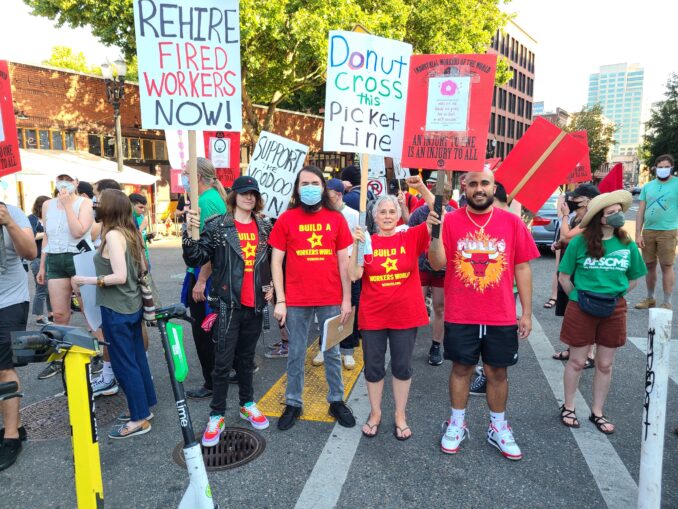
Over 100 workers protested in front of Portland’s Voodoo Doughnuts July 30 for the illegal firing of 11 workers. Joining the picket line were workers representing over half a dozen unions and coming from as far away as Seattle.

July 30 protest. WW PHOTO: Jim Wallace

Workers demonstrate in front of Voodoo Doughnuts. Early this month, when Portland’s record-breaking temperatures hit 116 F, many businesses closed due to unsafe working conditions. But Voodoo Doughnut  workers were expected to keep working inside the kitchen with weak air-conditioning, large southwest-facing windows and deep fryers boiling.

The workers said on their Facebook page that the temperature at the shop was so high that customers stepped inside and immediately departed. “The doughnuts themselves melt in the heat, as the frosting never fully dries.”

When some of the workers started to pass out and show signs of heat exhaustion, the manager told them, “If you’re too hot, you can go home.” (tinyurl.com/9rt5jvk2)

Thirteen workers left for two days until temperatures lowered towards 100 F. But when they returned, 11 of them were fired, some of whom she knew were union organizers.

The workers formed Doughnut Workers United in March of last year, but have not been formally recognized by Voodoo’s corporate office. The union is affiliated with the Portland chapter of Industrial Workers of the World and gets support from Teamsters Local 225. They have filed complaints with the Occupational Safety and Health Administration, Oregon State Bureau of Labor and Industries and the National Labor Relations Board, for unlawful retaliation for an unsafe work refusal.

Voodoo doughnut has locations in 11 cities including Orlando, Houston, Hollywood and Denver.  Mark Medina with IWW told WW: “There were demonstrations in support of the Portland Voodoo Donut wokers in Los Angeles, Houston and Austin, Texas and Eugene, Oregon.”


Thousands of Argentinians condemn US blockade against Cuba

 
Ronald Sanders | Using the OAS to promote discord over Cuba

Published:Saturday | July 31, 2021 
JAMAICA GLEANER

Contributed Sir Ronald Sanders

Much has been written about a meeting, convoked by the present chair of the Permanent Council of the Organization of American States (OAS), to discuss “the situation in Cuba” which he was obliged to defer after objections by several member states.

The present chair is the ambassador of Uruguay, Abdala Washington. He convoked the meeting on July 26 to be held at 10 a.m. on July 28. While the chair has the authority to convene a meeting of the Permanent Council, it is unusual that he did so without consulting member states. After all, he expected member states to participate in a meeting on a subject matter on which he decided; the least he might have done was to consult with the coordinators of the regional members of the OAS to determine their views. This is a normal practice on any matters that would obviously be controversial.

In any event, no consultation was held, and OAS member states were surprised to be given less than 48 hours to discuss Cuba which had not participated in the OAS since 1961, when it was suspended by a general assembly of the OAS. It should be noted that, apart from Haiti, no CARICOM member state was a member of the OAS when that suspension occurred. Heading countries that voted for the 1961 suspension were such notorious figures as Alfredo Stroessner of Paraguay, Nicaragua’s Anastasio Somoza and François ‘Papa Doc’ Duvalier in Haiti.

Since the 1961 suspension, Cuba had been discussed by the OAS only once. It was in June 2009 when the general assembly decided to lift the suspension at its own volition; Cuba had not requested its lifting.

The 2009 resolution itself stated that “the participation of the Republic of Cuba in the OAS will be the result of a process of dialogue initiated at the request of the Government of Cuba”. Cuba’s response was that it had no interest in participation in the OAS.

NO PRODUCTIVE OUTCOME

The de facto position, therefore, is that Cuba has not been a participating member of the OAS for 60 years and has no wish to be a member. A sudden, unexplained decision to discuss Cuba in the Permanent Council troubled member states who could see no productive outcome from it. Indeed, if anything, such a discussion was considered to be harmful to diplomatic efforts to try to improve relations between the US and Cuba, which was one of President Biden’s undertakings during his campaign to be elected President.

Further, on the same day that the chair of the OAS Permanent Council issued his unexpected convocation of the meeting to discuss Cuba, CARICOM heads of government had written to President Biden saying that they were “troubled by the circumstances in Cuba”, referring to protests that had taken place on July 11. They attributed the protests to the 61-year-old US trade embargo, punitive measures imposed by the Trump administration, and the effects of the COVID-19 pandemic. They said: “All of this, together with threats to its national security, have contributed to placing Cuba in conditions of abnormality in which normal criteria and expectation cannot be applied.” They called on President Biden to lift the embargo “so that all the rights to which the Cuban state and its people are entitled can be respected and upheld”, and they recalled that “under a previous US administration of which you were a part, significant strides were made in this direction, and could be advanced to beneficial effect”.

Passing strange was an email sent to many OAS delegations by an organisation called “Youth and Democracy in the Americas”, formed by Venezuelan nationals with help from the OAS Secretary General Luis Almagro. Curiously, this organisation told OAS ambassadors on July 27 that it had “presented a petition to the secretary general of the OAS, Dr Luis Almagro and subsequently our President Cecilia Navas met with the president of the Permanent Council of the OAS and also Uruguayan ambassador, Washington Abdala, to request an extraordinary session to discuss the serious humanitarian situation suffered by our Cuban brothers and sisters and the dangers facing democracy in the Republic of Cuba”. They went on to say, “in view of the fact that the Permanent Council of the OAS has accepted our request and has convened a special session for tomorrow, July 28, with the situation in Cuba as its central theme, we therefore request your participation…”. It was evident from this email message that the chair of the Permanent Council and the secretary general had accepted and consulted with an external group that has a specific political agenda, and not with member states of the OAS, on the holding of a meeting to discuss Cuba. A very odd way to behave, causing more questions to be raised concerning the motives for the meeting.

RECONSIDER


Thirteen CARICOM countries formally urged the chair to reconsider holding the meeting. I was authorised by those delegations to send the letter in my capacity as coordinator of the CARICOM group. Several other countries sent similar letters, and for fear of calling a meeting for which there would be no quorum, the chair decided to defer the meeting, pending an opinion from the legal department of the OAS Secretariat, which is answerable to the secretary general and routinely produces opinions consistent with his views.

The legal opinion has now been produced and, predictably, it concludes that the Permanent Council has “the competence to consider the situation in Cuba” because since Cuba never formally withdrew from the organisation, it remains a member notwithstanding its publicly stated position that it has no interest in participating in it. It seems membership can be conveniently forced on the unwilling.

No possible useful purpose will be served by any meeting to discuss Cuba. The OAS can enforce nothing on it. Any discussion could only satisfy political hawks with an eye on US mid-term elections, where winning South Florida with the backing of Cuban exiles would be a prize. The task of the OAS should be to promote peaceful and cooperative relations in the hemisphere, not to feed division and conflict.


Sir Ronald Sanders is Antigua and Barbuda’s ambassador to the US and the OAS. He is also a senior fellow at the Institute of Commonwealth Studies at the University of London and at Massey College in the University of Toronto. The views expressed are entirely his own. For responses and previous commentaries, log on to www.sirronaldsanders.com
FALLING RATE OF PROFIT

AstraZeneca Lost Money on COVID-19 Vaccine in First Half of 2021

AstraZeneca said losses on Vaxzevria were the main factor that shaved seven percentage points off its Reported Gross Profit Margin, which fell to 73.5 percent in the first half of the year.


July 30, 2021 
This story originally appeared on The Epoch Times

AstraZeneca, which pledged to provide its COVID-19 vaccine at no profit for the duration of the pandemic, said Thursday that losses in the first half of the year on its vaccine shaved 4 cents off the pharmaceutical giant’s earnings per share.

Sales of Vaxzevria, the company’s COVID-19 vaccine, generated $1.17 billion in revenue during the first six months of the year, including $894 million in the second quarter, according to AstraZeneca’s earnings report, released on July 29.

But while these revenues narrowed AstraZeneca’s hit from offering the COVID-19 vaccine at no profit, the company said losses on Vaxzevria were the main factor that shaved seven percentage points off its Reported Gross Profit Margin, which fell to 73.5 percent in the first half of the year.

“The performance predominantly reflected the significant impact of the equitable supply, at no profit to AstraZeneca, of the pandemic COVID-19 vaccine, together with an increasing impact from profit-sharing arrangements,” AstraZeneca said in the report.

AstraZeneca said losses on Vaxzevria shaved three cents off earnings per share in the first quarter, and one cent in the second quarter. According to a Wall Street Journal analysis, AstraZeneca lost $40 million on its COVID-19 vaccine in the first quarter, and $13 million in the second quarter.

The company reported a net profit in the second quarter of $550 million, missing the Factset consensus forecast of $1.19 billion. AstraZeneca’s net profit in the second quarter of 2020 came in at $756 million.

At the same time, net profit in the first half of 2021 came in at $2.1 billion, 42 percent higher than $1.5 billion in the first half of last year.

“AstraZeneca has delivered another period of strong growth thanks to robust performances across all regions and disease areas,” said AstraZeneca CEO Pascal Soriot, in a statement commenting on the results.

On Thursday, AstraZeneca said it intends to seek U.S. approval for its COVID-19 vaccine later this year. The Anglo-Swedish drugmaker said the application has been delayed because the company decided to ask the Food and Drug Administration (FDA) for full regulatory approval, rather than the fast-track emergency use authorization.

Among the concerns AstraZeneca will have to address are reports that the vaccine may be linked to rare blood clots, which have caused some countries to limit its use in younger people.

AstraZeneca has promoted its relatively cheap, easy-to-handle shot as a “vaccine for the world” and has already received authorization from more than 170 countries. The company said it provided about 90 percent of the doses distributed by the COVAX facility for low- and middle-income countries in the first half of the year.

AstraZeneca is the second drugmaker to say it has delivered more than 1 billion doses of COVID-19 vaccine globally, following Pfizer’s announcement on Wednesday.

By Tom Ozimek
The Associated Press contributed to this report.
A week ago Media Matters identified hundreds of anti-vaccine Facebook groups. Most of those groups are still active.

Molly Butler / Media Matters

Facebook’s inaction against anti-vaccine groups is part of the platform's pattern of refusing to combat COVID-19 vaccine misinformation


WRITTEN BY KAYLA GOGARTY

RESEARCH CONTRIBUTIONS FROM CARLY EVANS, KELLIE LEVINE, SPENCER SILVA & JEREMY TUTHILL

PUBLISHED 07/29/21 

Facebook has barely taken any action in response to Media Matters’ July 20 report on anti-vaccine groups spreading COVID-19 vaccine misinformation; nearly 85% of anti-vaccine groups that we identified are still active, new groups have been created, and some were even reinstated after appeal.

On July 20, Media Matters reported that we had identified at least 284 public and private anti-vaccine Facebook groups -- more than double the 117 anti-vaccine groups we reported on in April -- that were spreading COVID-19 vaccine misinformation and/or conspiracy theories to over 520,000 combined members. This report followed the Biden administration’s criticism of COVID-19 vaccine misinformation spreading on social media, particularly Facebook.

A week after our reporting, Facebook has barely taken action against the groups, even though the platform told Fast Company that it was “reviewing the report, and will take action against groups that violate our policies.” Of the 284 private and public groups we identified that contained misinformation and conspiracy theories about the COVID-19 vaccine, 236 groups -- or nearly 85% -- are still active on the platform and have gained nearly 20,000 more members. We have also identified 35 additional anti-vaccine groups, including five groups that were created since July 18. These 271 active anti-vaccine groups have over 456,000 combined members.

In our previous report, Media Matters specifically identified six groups with over 15,000 members apiece. Of these groups, only one -- Canadian Deaths and Adverse Reactions -- is no longer active, and two -- Covid19 Vaccine Victims & Families and The Unvaccinated Arms -- appear to have been briefly taken down and then reinstated.

An administrator for Covid19 Vaccine Victims & Families boasted that the group was reinstated after he appealed Facebook’s decision to remove it. The group has since gained roughly 9,000 members, totaling over 57,000 members.


The Unvaccinated Arms was reportedly taken down but is currently active, with an administrator encouraging members to use a backup group and a moderator of the backup group reminding members to use code words to avoid removal. The group has over 21,000 members, and the backup group, which was created July 18, already has over 11,000 members.


Facebook’s inaction against anti-vaccine groups is part of the company's pattern of refusing to combat COVID-19 vaccine misinformation. Even after the Biden administration publicly criticized Facebook, the platform also has failed to deplatform the “disinformation dozen” -- 12 influencers who reportedly account for 65% of vaccine misinformation on Facebook and Twitter. Nearly all of them have been able to maintain a presence on Facebook and/or Instagram despite their role in regularly spreading misinformation:

Joseph Mercola runs a verified Facebook page with 1.7 million followers and a verified Instagram account with 336,000 followers. He continues to post misinformation about COVID-19 and the COVID-19 vaccine on both platforms.

Sherri Tenpenny has had at least one Facebook page and one Instagram account removed, but she appears to be affiliated with at least one other Facebook profile and one other Facebook page for a website that she owns and operates. She uses both accounts to promote her podcast, in which she and other anti-vaccine figures push COVID-19 vaccine misinformation.

Rizza Islam has had at least one Facebook account and one Instagram account removed, but he appears to still have a Facebook profile with over 30,000 followers.
Rashid Buttar has had at least one Facebook account and one Instagram account removed, but he appears to still have a Facebook profile and to be affiliated with a public Facebook group.

Christiane Northrup runs a verified Facebook page with over 550,000 followers, even though she has had an Instagram account removed.

Robert F. Kennedy Jr. is affiliated with at least two Facebook pages that are still active, even though he has been banned on Instagram. One Facebook page for him has over 300,000 followers, and one Facebook page for his organization Children’s Health Defense has over 160,000 followers.

Ty and Charlene Bollinger are affiliated with at least three Facebook pages and two Instagram accounts that are still active, even though at least one of their Instagram accounts has been removed. The Facebook pages have a combined total of over 1.2 million followers and the Instagram accounts have over 124,000 total followers.

Sayer Ji and his website GreenMedInfo both have Facebook pages, even though Instagram removed at least one account for GreenMedInfo. Ji’s wife Kelly Brogan, who is also considered one of the “disinformation dozen,” still has an Instagram account, which she uses to post anti-mask content and COVID-19 misinformation.

Ben Tapper has at least one Facebook page and one Facebook profile, but he claims that Instagram removed his account and backup accounts.
Kevin Jenkins and his organization Urban Global Health Alliance each have a Facebook page and an Instagram account.

Facebook’s failure to take action against anti-vaccine groups and figures on its platforms is just another example of the company refusing to take any concrete actions to address its persistent, and deadly, problems.