Thursday, September 23, 2021

Afghan women taekwondo fighters feel defeated by Taliban

Issued on: 23/09/2021
Around 130 Afghan girls and women aged 12-25 are members of a taekwondo gym in Herat, but they are not allowed to train
 Hoshang Hashimi AFP


Herat (Afghanistan) (AFP)

Zarghunna Noori has always been a fighter, but the 22-year-old taekwondo champion -- who dreamt of representing Afghanistan at the Olympics -- says she has finally met her match.

"In sports when we lose we are left feeling terrible," she told AFP at her home in the western city of Herat.

"And now we have been defeated by the Taliban."

The Taliban's all-male government has shut down the ministry of women's affairs and replaced it with one that earned notoriety for enforcing religious doctrine during the hardliners' 1996-2001 stint in power.

Although they have yet to publicise a formal policy on women in sport, the Taliban have made comments that indicate serious participation will be impossible.

With women and girls already effectively banned from work and school, fear of reprisal for practising sport is widespread.

"All our lives have been overturned," said Noori, who since joining her provincial team a decade ago has become a national academy star, winning an Afghan title in 2018.

"Each and every member of the national taekwondo team dreamed that one day we would make it to the Olympics and raise the Afghan flag in other countries, in international competitions," she said, surrounded by her medals and a golden trophy engraved 'Best Leader'.

In Afghanistan, women have long faced open hostility to their involvement in sport Hoshang Hashimi AFP

"But now we are all forced to stay home, and become more depressed with each passing day."

Taekwondo's popularity surged in Afghanistan in 2008 after local hero Rohullah Nikpai won bronze at the Beijing Olympics.

Zakia Khudadadi, 22, gave Afghans another reason to watch the Korean martial art last month when she competed in the Tokyo Paralympics.

- Sport 'not necessary' -


In Afghanistan, women have long faced open hostility to their involvement in sport and in rural areas it is extremely rare for them to participate.

Even in cities, many women's leagues are at the fledgling stage.

Around 130 girls and women aged 12-25 are members of a taekwondo gym in Herat, but they are not currently allowed to train and their ability to do so in the future looks bleak.

Zakia Khudadadi gave Afghans another reason to watch taekwondo when competing in the Tokyo Paralympics 
Philip FONG AFP

Last week, the country's new sports chief Bashir Ahmad Rustamzai said the Taliban would allow around 400 sports -- but declined to say if women could participate in any of them.

Ahmadullah Wasiq, of the Taliban's cultural commission, also raised alarm this month by saying it was "not necessary" for women to play sport.

But the regime is under pressure: barring women from participating will likely halt recognition and funding from international sports bodies -- including support for its popular cricket and football teams.

- Desperate to train -


For Noori, a fourth-year student of physical education at Kabul University, the Taliban's draconian interpretation of sharia law is personal.

"Every woman in Afghanistan had a dream to be able to progress and reach a better place in the future," she said, standing alongside seven other members of the national taekwondo academy.

"They all wanted to become role models... so that they could show the world how much we can progress.

Zahra, another member of Afghanistan's national taekwondo team, says she feels 'helpless' 
Hoshang Hashimi AFP

"We all acted, practised and tried our best, but it has now come to nothing -- all of it."

Noori said many young taekwondo athletes are now in hiding, and that when they do leave their homes, they cover themselves from head-to-toe in a burqa.

The athlete is desperate to go back to training, she said, so that "ten years of hard work will not go to waste", but now feels she will be forced to leave Afghanistan.

"No one who lives in their own country wants to ever leave it," she told AFP.

"But the conditions are such that we don't see common ground that will allow us to progress; it doesn't exist in the country."

- 'Help us'
-

Noori called on the global sporting community to help, because "if we raise our own voices in Afghanistan, our voices will be cut off".

"We ask all international, Olympic athletes and members of the Olympic Committee to help us so that we can get to a better place, even if it means to go to another country to continue our activities," she said.

Zarghunna Noori said many women taekwondo athletes in Afghanistan are now in hiding 
Hoshang Hashimi AFP

Zahra, 22, another member of the national team, also feels "helpless".

"Even the men don't have all their freedoms," she said, adding the Taliban were "the same Taliban of the past".

"Just as men are being allowed to study, women should be allowed to do so as well. They shouldn't obstruct the path of girls and women."

© 2021 AFP
At the 'Human Library', everyone is an open book


Issued on: 23/09/2021 - 
At the 'Human Library', you can 'loan' a person to hear their life story 
Camille BAS-WOHLERT AFP

Copenhagen (AFP)

At the "Human Library", you can "loan" a person to tell you their life story, an original concept born in Denmark that is designed to challenge prejudice and which has spread around the world.

Iben -- a quiet 46-year-old sexual abuse victim with mental health issues who doesn't give out her last name -- is one of eight "books" curious people can loan on this autumn day in Copenhagen.

For 30 minutes, you can ask anything you want, either one-on-one or in a small group.

"The Human Library is a safe space where we can explore diversity, learn about ways in which we're different from each other, and engage with people we normally would never meet... and challenge your unconscious bias," explains Ronni Abergel, the project's garrulous initiator.

He created the living library in 2000 during the Roskilde music festival and went on to build a non-profit organisation.

The concept has since found its way into more than 70 countries.

"A reading truly is a conversation," says Abergel.

"I'm going to take a few minutes to explain my topic, my background, and to make sure that you can ask me anything about being HIV (positive) or disabled, or transgender, or a refugee or Jewish or Muslim, or whatever my topic may be."

- Blank pages -


In most cases the conversations flow freely, typically held in a calm environment like a city library, a meeting room, or as today, in the garden of the Human Library's premises.

"Sometimes people ask a lot and the conversation flows. But sometimes I maybe need to tell them a little bit more, ask my readers questions in order for them to reflect or ask new questions," says Anders Fransen, a 36-year-old blind and hearing impaired "book".

The day's list of eight 'human books' is put up on a blackboard at Copenhagen's Human Library 
Camille BAS-WOHLERT AFP

People are encouraged "to ask really difficult questions", Abergel says, stressing that nothing is off limits, no matter how sensitive the subject may be.

People who loan Iben can choose between three of her oral books: sexual abuse victim, living with borderline personality disorder, or severe post-traumatic stress disorder.

She has on occasion refused to answer questions.

"I have said that that page wasn't written yet. So they just smiled and said okay," she recalls.

But she's never had a bad experience in her four years.

"All my readings are different," and they've evolved over the years, she says.

"When I started, I was in a totally different place... I've been working on myself for years."

"It's such a gift (being) a book, you can self-reflect."

Fransen says he's proud to have helped people develop how they think about handicaps.

After a recent 'reading' with some eighth graders, he overheard them talking to their friends.

"They were saying 'hey, this guy is a cool guy, he has a cool story to tell.' So I made an impression on them," he smiles.

- 'Neutral learning space' -

'Loanees' come away with powerful experiences too.

"All the responses we're getting indicate that it's a high impact experience," Abergel says.

He was recently contacted by a reader who borrowed a human book in 2004.

"She was telling us about the impact (the book had) on her view on Muslims... And she had used that information in the 17 years that have passed. So that has been to the benefit of the community, her and other people of Muslim background."

In an increasingly polarised world, Abergel wants his initiative to help people become "less apprehensive, more open, more understanding and accepting of your right to be different."

But, he insists, the organisation is not about promoting diversity or combating prejudice.

"We run a neutral learning space where there is an opportunity for you to engage, learn about yourself and other groups," he says.

"What you learn and what you do with your learning is entirely in your hands."

One of those loaning a book is 41-year-old Karem.

"To see the person and listen to him or her and see the perspective, the whole story that is almost unfolding in front of you" is "very touching", he says.

"It lets people see that at the end of the day we are a lot of titles, but the same flesh and blood and bones."

© 2021 AFP

COLONIALIST REPATRIATIONS

Namibian opposition criticises genocide compensation deal with Germany


During a heated parliamentary debate, Namibian opposition lawmakers on Wednesday criticised a 1.1 billion euro compensation offer from Germany for its 1904-1908 genocide in the southwest African country and called on the government to renegotiate terms.
SCHADENFREUDE
Sri Lanka shaman dies of Covid after touting 'blessed' water cure

Issued on: 23/09/2021 - 
Buddhist monks perform the last rites during the funeral of Eliyantha White, a local shaman who claimed he had super natural powers to end the pandemic
 ISHARA S. KODIKARA AFP

Colombo (AFP)

A high-profile shaman who tried to end Sri Lanka's Covid-19 outbreak with "blessed" water has died of the virus, his family said Thursday.

Eliyantha White, 48, who treated sports stars and top politicians including the country's prime minister, claimed in November he could end the pandemic in Sri Lanka and neighbouring India by pouring pots of his "blessed" water into rivers.

Health minister Pavithra Wanniarachchi endorsed the water treatment, but was infected two months later and ended up in a hospital intensive care unit.

She was later demoted, and lost her portfolio, but remains in the cabinet.

White attracted international attention in 2010 when legendary Indian cricketer Sachin Tendulkar publicly thanked him for treating a knee injury, saying it helped him hit the first-ever one-day international double century against South Africa.

In a 2010 interview with AFP, White claimed he had "special powers" since the age of 12.

He has since treated other Indian cricket stars, including Gautam Gambhir and Ashish Nehra.

White's family said he had refused the Covid-19 vaccine.

His body was cremated at Colombo's main cemetery on Thursday in line with quarantine regulations.

Prime Minister Mahinda Rajapaksa, who was among politicians to have consulted White, said on Twitter: "His legacy will continue to live through all the lives, he touched and healed of various ailments."

But mainstream doctors described White as a fraud and Ayurveda physicians rejected his claims -- even though the shaman said he used methods from the 3,000-year-old Indian medical tradition.

White's family said he had refused the Covid-19 vaccine 
ISHARA S. KODIKARA AFP

Sri Lanka's total coronavirus deaths exceeded 12,000 with more than half a million people infected so far.

Doctors say the real toll is at least twice as high and authorities have resorted to mass cremations to clear bodies piling up at hospitals and morgues.

© 2021 AFP

Delivery robots take the strain out of shopping in UK town

Issued on: 23/09/2021 
Some 200 delivery robots are operating in Milton Keynes and nearby Northampton, 
with plans for more 
DANIEL LEAL-OLIVAS AFP

Milton Keynes (United Kingdom) (AFP)

It's famous for its roundabouts and statues of concrete cows. But the English town of Milton Keynes now has another claim to fame -- a trundling army of shopping delivery robots.

The six-wheeled automated vehicles, launched three years ago, barely get a second glance as they ply the residential streets, some 80 kilometres (49 miles) north of London.

Numbers have grown to 200 in Milton Keynes and nearby Northampton, which introduced the service in 2020, with plans for as many as 500 to be in action in five more places across the country.

According to the robots' operators, the squat white machines came into their own when Britain locked down last year as coronavirus hit the country.

Starship Technologies has signed a deal with the Co-op Group's chain of supermarkets DANIEL LEAL-OLIVAS AFP

"Everyone was so in need of contactless delivery during the pandemic," Andrew Curtis, head of UK operations at Starship Technologies, told AFP.

The US company, which has quadrupled its deliveries in the UK, now makes 1,000 deliveries a day.

"Demand hasn't dropped off," Curtis said, adding that as stay-at-home restrictions were lifted, users became more willing to try the technology.

The company has signed a new agreement with longstanding partner the Co-op Group's chain of supermarkets, to provide 300 new robots by the end of the year and triple deliveries.

Bags of shopping are packed into the robot when an order is made 
DANIEL LEAL-OLIVAS AFP

In front of one of the retailer's shops in Milton Keynes, which was the first to use the delivery machines in 2018, a dozen robots are ready and waiting.

With their antenna topped with an orange flag to aid visibility, they look almost like a queue of empty bumper cars.

- Starship troopers -

An employee emerges from the shop and places the newest order inside one of the robots -- a small bag containing raspberries, yoghurt and a bouquet of flowers.

With its lid locked, the droid immediately dashes out onto the pavement. It turns and moves forward to cross the road before stopping, reversing suddenly to let a car pass.

Fitted with cameras, sensors and a loud alarm if needed, the robots -- first created in 2014 by the two founders of Skype -- are 99 percent autonomous.

The six-wheeled automated vehicles can navigate footpaths to reach their destination DANIEL LEAL-OLIVAS AFP

But if they become stuck, an operator can take control.

Once launched, the robot navigates the maze of footpaths that wind between Milton Keynes' red brick houses.

When the way is clear, it can reach speeds of up to six kilometres (nearly four miles) per hour -- a little more than a reasonable walking pace.

Deliveries reach customers in less than an hour.

The Co-op said the use of the robots is environmentally friendly as well as convenient, with 70 percent of Starship's customers going without a trip in the car to a store or receiving a delivery from a fuel-powered vehicle.

Under the delivery system, the robots remain the property of Starship and orders are placed via an application they developed.

The robots can identify hazards. An operator can take control if they become stuck DANIEL LEAL-OLIVAS AFP

The company manages 1,000 robots, mainly in Britain and the United States but also in Estonia, Germany and Denmark.

The tech firm is not alone in the delivery robot race.

In the United States, for example, where it operates mainly on university campuses, it is jockeying for position with start-ups and logistics giants such as Amazon and FedEx.

- A 'godsend' -

As their numbers grow, the wheeled delivery drones have drawn criticism from unions, who fear they will take jobs from people.

The debate has made its way into US town halls, which are tasked with deciding limits on delivery journeys and rules around sharing the pavement.

"Fortunately, we've not had any accidents so far," Curtis said, adding that in the UK Starship has obtained permission from local authorities for each of its operating locations.

The robot carrying raspberries, yoghurt and flowers continues its journey, hesitating as it encounters a gaping hole, the result of ongoing road maintenance.

Sheila Rose said the robots have been a 'godsend'as she finds it difficult to get to the shops 
DANIEL LEAL-OLIVAS AFP

Roadworkers look non-plussed as they put down planks to bridge the gap.

When the delivery robot finally reaches its destination, Sheila Rose, 71, walks out of her house and unlocks it with her smartphone, to retrieve her groceries and blooms.

"If I can use it, anyone can," she said, leaning on a walking stick.

"Because of my ill health, I have problems getting out to the shops," she said, calling the robots a "godsend".

© 2021 AFP
Lonely toil of Belgium's 'last shale miner'


Issued on: 23/09/2021 - 
Theret uses the slate in decorative masonry and paving, tiles and sinks, for householders who prize its hard-wearing elegance.
 Kenzo TRIBOUILLARD AFP

Vresse-sur-Semois (Belgium) (AFP)

For the past decade, Vincent Theret has worked alone in a deep hole under the wooded Ardennes hills of southern Belgium.

Boasting of being the last of his kind, he harvests slabs of blue-tinged shale, left behind as waste in what was once a thriving slate mine that closed in 1948.

The shale was too hard to be worked as slate, but in the hands of the 61-year-old craftsman it is now used in decorative masonry and paving, tiles and sinks, for householders who prize its hard-wearing elegance.

But as a source of architectural flair, rather than of a mass-market roofing material, the drift mine in Alle-sur-Semois no longer supports a large mining community ... just Theret, who rents access to the cavernous pit from the local council and ventures in alone.

Theret works alone, in the bowels of the rock
 Kenzo TRIBOUILLARD AFP

It's dark, damp and potentially dangerous but, Theret told AFP, "the day I'm afraid to go into the mine, I'll stop."

Inside the gallery, lit by spotlights, he manoeuvres an excavator to load tonnes of stone.

"You have to be careful, you don't go in there like you're going to the fair," he says, recounting that one day when he arrived on the spot he found a 500-tonne block that had broken from the wall.

"I listen to the mine, to the drops of water falling from the vault, to the cracks. You have to listen, you have to observe", explains the man who was first a bricklayer, then worked in an open-cast quarry before bringing this former slate mine back to life in 2012.

Theret was first a bricklayer, then worked in an open-cast quarry before bringing the former slate mine back to life in 2012 
Kenzo TRIBOUILLARD AFP

At the Vresse-sur-Semois site, another old gallery has been fitted out for tourist visits, to tell the story of the daily life of the former miners, driven out of business by competition from foreign slate exporters.

Theret says that he thinks about these miners every day as he recovers their shale waste.

Theret works alone in a vast cathedral-like underground chambe
Kenzo TRIBOUILLARD AFP

"What they are giving me here is great... The good stone, we go and get it from the bottom, that's why the miners went down so deep. The further down you go, the more moisture the stone has and the more beautiful it is, better quality."

- Artistic sculpting -

He judges the quality by ear. "A good stone sounds like a musical note," he says.

In the bowels of the rock, he works alone. He has no time to teach anyone the job, and says he will continue as long as health allows.

After being loaded, the raw material is driven to an outdoor area where Theret sorts it. Some is used to make shale chips for gardens, some becomes tables, tombstones or coping for swimming pool surrounds.

'A good stone sounds like a musical note,' says Theret 
Kenzo TRIBOUILLARD AFP

The best pieces are made to order in his workshop, 10 kilometres (six miles) away. A few years ago, he also started artistic sculpting, encouraged by a client.

"Having a block that weighs many tonnes, splitting it, cutting it, sawing it, shaping it, and getting feedback from my clients who tell me, 'Mr Theret, the stones are magnificent'," he explains.

© 2021 AFP

Wolf hunting ban pits farmers against conservationists in Spain

Issued on: 23/09/2021 - 
Hunting wolves is now illegal in northern Spain PIERRE-PHILIPPE MARCOU AFP
4 min
Listen to the article
ADVERTISING


Puebla de Sanabria (Spain) (AFP)

A 4x4 pulls up on a dirt road in northwest Spain and livestock farmer Ana Vega climbs out, walking over to a ditch where a few days ago a wolf killed a calf.

"They haven't left anything... devoured everything," she said, pointing at the ground. There is nothing left of the carcass, not even the smallest bone.

Wolves have long roamed the valley Ungilde, a paradise for the Iberian wolf near the Portuguese border, four hours' drive from Madrid.

Controlled hunting has helped to keep their numbers down in the area -- and protect livestock -- but on Wednesday a ban on killing the animals came into effect, inflaming farmers but delighting conservationists.

The hot-button ban brings northern Spain in line with the rest of the country, where hunting wolves has long been prohibited.

Many herders and farmers like Vega are dismayed over the new rule, fearing that a proliferation of wolves will put the animals at risk.

But conservationists have long pushed for the ban, saying the species should be protected.

"In this tragic wolf tale, there are three main actors: the herders, the conservationists and the hunters. And each one has his own solution," said forest ranger Carlos Zamora.

- 'Wolves' paradise' -

There are eight packs of wolves in the Sierra de la Culebra, which spans 70,000 hectares in the northwestern tip of the Castilla y Leon region.

Each pack is made up of 10 wolves, and there are several more lone individuals, Zamora explained. The number has remained steady for the past two decades, he added.

Livestock farmer Ana Vega remembers a time when locals took matters into their own hands if a wolf killed a sheep
 PIERRE-PHILIPPE MARCOU AFP

The area is famed for the Iberian wolf -- or canis lupus signatus, a sub-species of grey wolf which lives mainly in northwestern Spain.

Its image is everywhere -- on billboards and t-shirts and plastered all over souvenir shops.

"It's always been a wolves' paradise here," said Zamora from behind his binoculars, scanning the horizon under the morning sun.

Until now, controlled hunting has been allowed north of the Duero river, which flows across northern Spain, to keep numbers down.

In the Cantabria region, they planned to cull 34 wolves this year -- 20 percent of the local population.

But Spain's Socialist government decided to unify the rules, banning wolf hunting throughout the peninsula, following similar moves in France and Italy.

"When you're talking about a unique species like the Iberian wolf, responsibility for its conservation lies with all regions, it can't be just in one area," junior environment minister Hugo Moran told AFP.

The Cantabria region had planned to cull 34 wolves this year, or 20 percent of the local population
 PIERRE-PHILIPPE MARCOU AFP

"It's a shared responsibility."

But the news has angered the regions of Cantabria, Castilla y Leon, Asturias and Galicia, where the vast majority of wolves roam, with officials vowing to appeal.

While ecologists have hailed the ban as "an important step" towards species conservation, farmers are up in arms.

"It is unbelievable that communities that don't have wolves can impose their radical environmental agenda on us," raged Castilla y Leon's UCCL farmer's union.

- Unfair competition -


Vega remembers a time when locals took matters into their own hands if a wolf killed a sheep.

"They would go out and catch it or kill it," she said, her phone full of gruesome images of carcasses and half-eaten animals.

"I'm not saying we should kill them all, but that we all have to exist together," she added.

The government has banned wolf hunting throughout the peninsula 
PIERRE-PHILIPPE MARCOU AFP

Extensive farming where animals graze on local resources involves a big investment to protect them against predators.

Vega has a pack of 15 mastiffs -- dogs as big as ponies which are not cheap to keep, what with vets bills and the huge piles of food they gobble up.

She has also paid for tractors to uproot vegetation where wolves like to hide on the land.

Farmer Jose Castedo has shelled out too, installing electric fencing to safeguard his 450 sheep.

"There are very few farms like this here," said the 62-year-old of his fortified enclosure.

He worries about "unfair competition" from properties where flocks are kept behind one-metre-high fences and monitored for just a few hours a day.

Forest ranger Carlos Zamora scans the horizon for wolves
 PIERRE-PHILIPPE MARCOU AFP

The ecology ministry has pledged to invest and help, with Moran from the environment ministry promising "financial help" to those who live in areas that are home to "large carnivores".

© 2021 AFP
Gay marriage move a giant step for Switzerland

Issued on: 23/09/2021 
Switzerland holds a referendum on Sunday and looks set to allow same-sex couples to marry and grant them the same rights as their heterosexual counterparts 
Fabrice COFFRINI AFP

Geneva (AFP)

While apartment-hunting with his partner 30 years ago, Thierry Delessert was repeatedly asked whether they were cousins, or gay. He knew the latter answer would automatically see their application thrown out.

The 56-year-old historian still recalls his run-ins with "suspicious" real estate agents in Switzerland, where police in some places were still keeping registers of homosexuals.

Three decades later, in a referendum on Sunday, the wealthy Alpine nation looks set to allow same-sex couples to marry, and grant them the same rights as their heterosexual counterparts.

"It is a huge step forward," said Delessert, an expert on the history of homosexuality in Switzerland at Lausanne University.

The country decriminalised homosexuality in 1942, but numerous local and regional police forces continued to keep "gay registers", some into the early 1990s.

These registers were aimed at "controlling deviance and morality", Delessert explained, adding that they had dire impacts on the lives of those listed.

"If a supposed homosexual was convicted of theft, his homosexuality was submitted as additional proof of his immorality," he said.

"If a homosexual applied to rent an apartment, he would not get it. If a homosexual wanted a job in the public sector, he would not get it."

But the causes of the discrimination remained unsaid: the registers were never made public, and those listed there were never informed.

- 'Difficult to comprehend' -


Only Zurich and Basel publicly announced that they were scrapping the registers, in 1979 and 1980, Delessert said, voicing frustration that all the other registers had simply vanished.

He said he had managed to find handwritten notes on police documents where officers requested the creation of "files" on homosexuals arrested after committing an offence.

Delessert said he had also found testimony from a commissioner mentioning that around 200 homosexuals were registered in Zurich each year.

Zurich's official records division told AFP that these registers had been kept for internal police use, and had been destroyed.

An account by a whistleblower published in the Swiss media in April 1990 first alerted the public to the existence of one of these registers, in Bern, with the outcry pushing authorities to halt the practice.

The Swiss parliament voted to legalise same-sex marriage last year 
Fabrice COFFRINI AFP/File

When contacted by AFP, Bern cantonal police said they had searched internally, but "were unable to find information about this register, which apparently existed."

"At an ethical level, it is difficult to comprehend today."

While such statements are welcome, Delessert highlighted that "the political authorities have never apologised" for the practice.

- Zombies and crying babies -


But he hailed the political turnaround in recent years.

A referendum early last year opted to criminalise acts of homophobia, and towards the end of the year, parliament voted to legalise same-sex marriage.

That law aimed to finally bring Switzerland in line with much of Europe on gay rights.

But opponents of the law demanded a referendum within the country's direct democratic system, in a bid to block it.

Recent polls however show that a large majority of Swiss voters back changing the law.

Same-sex couples can already register a civil partnership in Switzerland, but that status does not provide the same rights as marriage.

Allowing same-sex marriage would fix that, enabling foreign spouses in same-sex relationships to apply for citizenship through a simplified procedure, and allowing same-sex couples to jointly adopt children.

And it would controversially give lesbian couples access to sperm donation.

The opponents, mainly drawn from the populist right-wing Swiss People's Party, have plastered Swiss cities with stark posters decrying the commodification of children and warning the law will "kill the father".

Thierry Delessert still recalls his run-ins with "suspicious" real estate agents in Switzerland, where police in some places were still keeping registers of homosexuals Fabrice COFFRINI AFP

One of their posters shows a crying baby with its ear tagged like cattle, and the question: "Babies on demand?"

Another featuring a huge zombie-like head, meant to represent a dead father, was covered over by a nearby primary school in Wallis canton out of fear it would frighten the children.

© 2021 AFP


Polish province overturns 'LGBT ideology free zone'

A province in southern Poland near Krakow overturned its symbolic anti-LGBTQ designation. The EU held up recovery funds because of the discriminatory declaration.


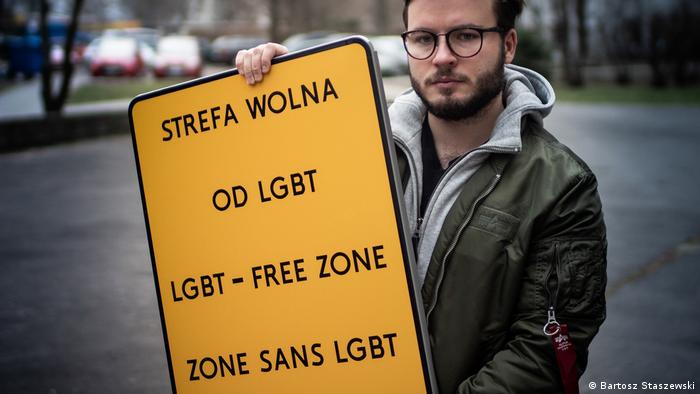
Polish activist Bartosz Staszewski holds up a sign indicating a town or place in Poland has been declared an 'LGBT Free Zone'

The Swietokrzyskie province in southern Poland repealed its resolution declaring itself to be an "LGBT ideology free zone" in an extraordinary session of the provincial assembly.

The 2019 declaration in "opposition to LGBT ideology" was scrapped after the European Commission had suspended negotiations on providing post-pandemic funding to the province. Switeokryzskie was part of a wave of 100 cities and regions that declared themselves "LGBT free" on the urging of the ruling Law and Justice Party.

While no councilors voted against the repeal of the designation, three abstained and 25 voted to support the repeal.

"The European Commission has stressed that it is against Article 2 of the European Treaties to define areas, workplaces or services as LGBT-free," Andrzej Betkowski, head of the Swietokrzyskie provincial administration, made clear during the extraordinary session.

In its place, the assembly supplanted the legislation with a new resolution stating the Polish Constitution guarantees families the right to raise their children in accordance with their beliefs but also provides "a guarantee of equality and fair treatment for all.''

Krakow had already voted Monday to rescind its symbolic homophobic status designation.

Wednesday's vote overturning the "LGBT ideology free zone" designation in Swietokrzyskie dates to mid-July when the European Commission launched legal action against Poland and Hungary for discriminatory laws against the LGBTQ community.

In the Polish case, the European Commission was acting against the proliferation of "LGBT ideology free" cities whereas in Hungary, it was an anti-pedophilia measure that conflated pedophilia with homosexuality in banning the "promotion" of homosexuality and transgender individuals to those under 18 years of age.
Polish civil society reacts

LGBTQ rights activists in Poland welcomed the move and expressed gratitude to the EU, which had reacted to the Polish anti-LGBTQ designations by declaring the entire 27-nation bloc a "freedom zone" for LGBTQ people.

Activist Bartosz Staszewski told AP it was a "great day for Poland and great success of activists and civil society."

Polish newspaper Gazeta Wyborcza hailed the repeal as well, calling it "a good day in the fight against discrimination."

ar/sms (AFP, AP, dpa)

Viability of Large-Scale Hydrogen Storage in Geologic Formations


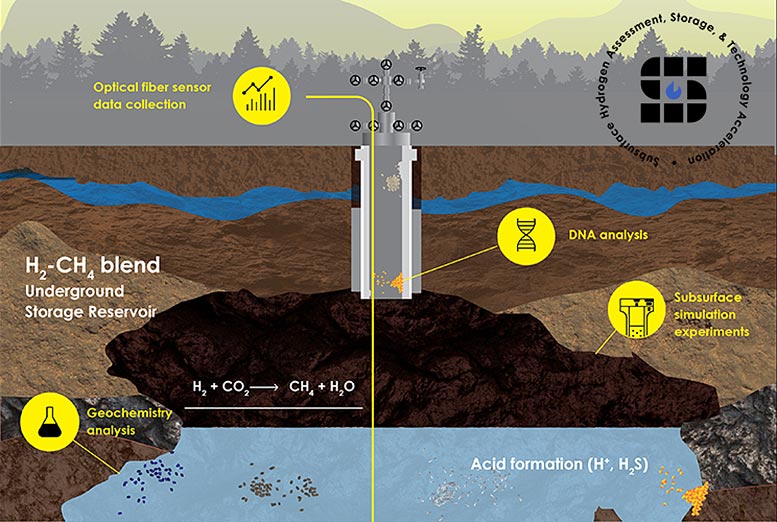
Shown is a schematic description of key processes and operational activities being explored in the SHASTA (Subsurface Hydrogen Assessment, Storage, and Technology Acceleration) project. Hydrogen reservoirs could exhibit complicated flow, transport, geochemical and microbial processes. These interactions will be studied using laboratory experiments, simulations and novel monitoring methods. Graphic courtesy of National Energy Technology Laboratory multimedia team. Element key: H2 = hydrogen; CH4 = methane; CO2 = carbon dioxide; H+ = hydrogen cation; H2S = hydrogen sulfide; H2O = water. Credit: Lawrence Livermore National Laboratory

A team of Lawrence Livermore National Laboratory (LLNL) researchers, in partnership with two other national laboratories, has launched a project studying the viability of large-scale hydrogen storage in geologic formations.

Researchers from LLNL, Pacific Northwest Laboratory (PNNL) and the National Energy Technology Laboratory (NETL) will receive up to $6.75 million over the next three years from the Department of Energy’s Office of Fossil Energy and Carbon Management (FECM).

“This is an exciting project for us because it addresses a timely and critical component of a low-carbon energy future,” said LLNL reservoir engineer and principal investigator Joshua White.

“At the same time, the required expertise builds on LLNL’s decades of experience working in the subsurface on related technologies such as geologic carbon storage, natural gas storage, and geothermal energy.”

Called the SHASTA Project (Subsurface Hydrogen Assessment, Storage, and Technology Acceleration), a key component of the effort involves studying the safety and efficiency of storing blended mixtures of hydrogen and natural gas in subsurface reservoirs.

White and fellow LLNL reservoir engineer Nicola Castelletto will focus on conducting subsurface modeling work, while Lab geochemist Megan Smith will study high-pressure, high-temperature experimental opportunities.

Hydrogen is emerging as a low-carbon fuel option for transportation, electricity generation, manufacturing applications, and clean energy technologies that will accelerate the United States’ transition to a low-carbon economy.

However, a key challenge is to ensure the safe and effective storage of hydrogen. Large-scale hydrogen storage will be required as the nation transitions to a virtually carbon- and emissions-free clean energy economy. Domestically, however, large-volume underground hydrogen storage has been demonstrated as safe and effective only in salt dome structures or caverns.

Not all regions have the proper geological prerequisites for salt cavity storage; however, FECM is exploring storage opportunities in these areas, including in porous media, which are similar to underground natural gas storage reservoirs.

The recently announced project will determine the technical feasibility of hydrogen storage in subsurface systems and quantify the operational risks associated with storage in those systems.

It also will develop technologies and tools that will reduce those risks. At the same time, the research effort will establish the technical basis for using the much larger capacities available in porous media storage, as well as the ability to re-use existing natural gas storage infrastructure for the hydrogen economy.

Finally, the project could help accelerate and expand the use of hydrogen by leveraging existing facilities (e.g., existing natural gas storage reservoirs) at storage sites across the United States.

It will address critical technological hurdles; conduct research to demonstrate the feasibility of emergent technology; and develop tools and technologies to support industry and enable the advancement of subsurface hydrogen storage.

Key questions researchers will address include:

  • How can the technical and operational risks associated with subsurface hydrogen storage be mitigated so that operations are protective of humans and the environment?
  • How can emerging technologies be leveraged to enable a smart, safe and efficient hydrogen subsurface storage system (e.g., sensors, reservoir simulators and screening tools)?
  • What technical, operational and economic insights are needed to enable large-scale subsurface storage for pure hydrogen or hydrogen-natural gas blends?

Both field experiments and simulations will be conducted to study pure hydrogen and blended hydrogen impacts on underground storage systems. The research will focus on quantifying materials compatibility, investigating core- and reservoir-scale performance and characterizing microbial interactions.

Toyota Mirai review: the hydrogen car that 'urinates' 😂

Sep 22, 2021


carwow

Need help buying your next car? Click the following link and my team and I will help you choose your ideal car at a fair price - from Mat Watson! http://bit.ly/-Help-Me-carwow ............................................................. 

This is the Toyota Mirai! Mat’s got his hands on the latest version of Toyota’s hydrogen fuel cell-powered saloon to see if it’s really worth considering over the best-in-class petrol, diesel & EV powered competitors out there! To kick things off, there’s no denying that the latest generation looks much better than its predecessor. The eagle-eyed viewers out there will notice similarities with the LS upfront… And it’s no surprise, given it’s based on the same platform! Anyone who splashes out on the range-topper will also be treated to some gorgeous alloy wheels. So it looks good, but don’t expect the Mirai to go breaking any performance records anytime soon! The hydrogen fuel cell powers an electric motor to deliver 182hp & 300Nm of torque. So it’s not exactly sluggish, but when you consider prices start from £50,000, that’s not that far off the price of a Tesla Model 3 Performance! So does this new Toyota offer enough to turn you away from the EV class-leading Model 3?! 
You’ll have to stick with Mat to find out! 
Chapters 00:00 
Intro 00:45
Fuel Cell & Motor 01:34 
Exterior Design 02:33
Price 03:18 
Interior 05:10 
Back Seats 06:40 
Boot 07:27 
Five Annoying Things 10:09
Five Good Things 11:43 
Driving 14:01 
0-60mph 14:39
Verdict Everything you need to know -


Hydrogen, not electric, the new fuel focus for car-making giants

Car makers developing hydrogen fuel-cell passenger vehicle prototypes as part of preparations to abandon fossil fuels


Audi and BMW are readying hydrogen-fuelled cars as an alternative to electric vehicles.


WED, 22 SEP, 2021 - 
NICK CAREY

Battery power may be the frontrunner to become the car technology of the future, but don't rule out the underdog hydrogen.

That's the view of some major car makers, including BMW and Audi, which are developing hydrogen fuel-cell passenger vehicle prototypes alongside their fleets of battery cars as part of preparations to abandon fossil fuels.

They are hedging their bets, calculating that a change in political winds could shift the balance towards hydrogen in an industry shaped by early-mover Tesla's decision to take the battery-powered road to clean cars.

Global auto hub Germany is in sharp focus. It is already betting billions on hydrogen fuel in sectors like steel and chemicals to meet climate targets, and closely-fought elections this month could see the Greens enter the coalition government and further push the technology.

BMW is hydrogen's biggest proponent among Germany's car makers, charting a path to a mass-market model around 2030.

The company also has one eye on shifting hydrogen policies in Europe and in China, the world's largest car market.

The Munich-based premium player has developed a hydrogen prototype car based on its X5 SUV, in a project already partly funded by the German government.

Jürgen Guldner, the BMW vice president who heads up the hydrogen fuel-cell car programme, said the car maker would build a test fleet of close to 100 cars in 2022.

"Whether this [technology] is driven by politics or demand, we will be ready with a product," he said, adding that his team is already working to develop the next generation vehicles.

VW's premium Audi brand said it had assembled a team of more than 100 mechanics and engineers who were researching hydrogen fuel cells on behalf of the whole Volkswagen group, and had built a few prototype cars.

Hydrogen is viewed as a sure bet by the world's biggest truckmakers, such as Daimler Truck, Volvo Trucks, and Hyundai, because batteries are too heavy for long-distance commercial vehicles.

Yet fuel cell technology — where hydrogen passes through a catalyst, producing electricity — is for now too costly for mass-market consumer cars.

The fact that hydrogen is so far behind in the race to the affordable market also means even some champions of the technology, like Germany's Greens, favour prioritising battery-powered passenger cars because they see them as the fastest way to reach their main goal of decarbonising transport.

The Greens do, however, back the use of hydrogen fuel for ships and planes and want to invest heavily in "green" hydrogen produced solely from renewable sources.

German auto giants bet on hydrogen cars

Sep 22, 2021

Battery power may be the frontrunner to become the car technology of the future, but don't rule out the underdog hydrogen, as a number of large automakers including BMW and Audi are investing in fuel-cell technology


German auto giants bet on hydrogen cars for zero-emission future

Global auto hub Germany has set a target to scale up hydrogen as an alternative to fossil fuels to meet climate targets.  

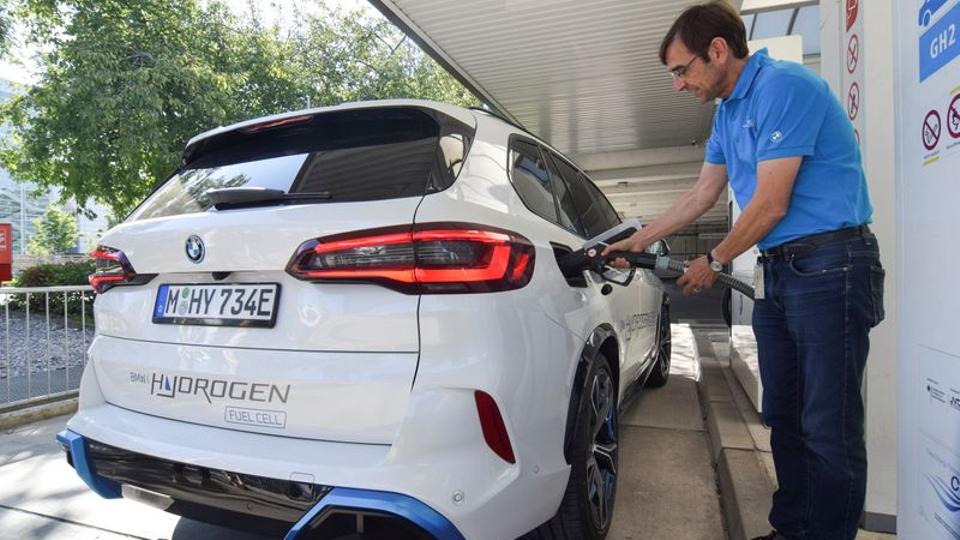
Juergen Guldner, a vice president at BMW in charge of the carmaker's hydrogen car program, fuels a hydrogen fuel-cell prototype SUV at a petrol station in Munich, Germany on September 3, 2021. (Reuters)


Battery power may be the frontrunner to become the car technology of the future, but don't rule out the underdog hydrogen.

That's the view of some major automakers, including BMW and Audi, which are developing hydrogen fuel-cell passenger vehicle prototypes alongside their fleets of battery cars as part of preparations to abandon fossil fuels.

They are hedging their bets, calculating that a change in political winds could shift the balance towards hydrogen in an industry shaped by early-mover Tesla's decision to take the battery-powered road to clean cars.

Global auto hub Germany is in sharp focus. It is already betting billions on hydrogen fuel in sectors like steel and chemicals to meet climate targets, and closely-fought elections this month could see the Greens enter the coalition government and further push the technology.

BMW is hydrogen's biggest proponent among Germany's carmakers, charting a path to a mass-market model around 2030. The company also has one eye on shifting hydrogen policies in Europe and in China, the world's largest car market.

The Munich-based premium player has developed a hydrogen prototype car based on its X5 SUV, in a project already partly funded by the German government.

Jurgen Guldner, the BMW vice president who heads up the hydrogen fuel-cell car programme, told Reuters the carmaker would build a test fleet of close to 100 cars in 2022.

"Whether this (technology) is driven by politics or demand, we will be ready with a product," he said, adding that his team is already working to develop the next generation of vehicles.

"We're on the verge of getting there and we're really convinced we'll see a breakthrough in this decade," he said.

VW's premium Audi brand told Reuters it had assembled a team of more than 100 mechanics and engineers who were researching hydrogen fuel cells on behalf of the whole Volkswagen group, and had built a few prototype cars.


Hydrogen too costly now

Hydrogen is viewed as a sure bet by the world's biggest truckmakers, such as Daimler AG unit Daimler Truck, Volvo Trucks and Hyundai, because batteries are too heavy for long-distance commercial vehicles.

Yet fuel cell technology - where hydrogen passes through a catalyst, producing electricity - is for now too costly for mass-market consumer cars. Cells are complex and contain expensive materials, and although refuelling is quicker than battery recharging, infrastructure is more scarce.

The fact that hydrogen is so far behind in the race to the affordable market also means even some champions of the technology, like Germany's Greens, favour prioritising battery-powered passenger cars because they see them as the fastest way to reach their main goal of decarbonising transport.

The Greens do, however, back the use of hydrogen fuel for ships and planes and want to invest heavily in "green" hydrogen produced solely from renewable sources.

"Hydrogen will play a highly important role in the transport industry," said Stefan Gelbhaar, the party's transport policy spokesperson in the Bundestag.

Politics can be unpredictable though - diesel went from saint to sinner following Volkswagen's Dieselgate emissions-cheating scandal, which came to light in 2015. Some carmakers view hydrogen technology as an insurance policy as the EU targets an effective ban on fossil-fuel cars from 2035.

Last year Daimler said it would wind down production of the Mercedes-Benz GLC F-CELL, a hydrogen fuel-cell SUV, but a source familiar with company plans said the project could easily be revived if the European Commission or a German government with Green participation decided to promote hydrogen cars.

"We're focusing on (battery) electric first, but we're in close cooperation with our truck guys," said Jörg Burzer, Daimler's head of production, when asked about that approach.

"The technology is always available."


180km/h in hydrogen x5


For years Japanese carmakers Toyota, Nissan and Honda, and South Korea's Hyundai, were alone in developing and pushing hydrogen fuel-cell cars, but now they have company.

China is expanding its hydrogen fuelling infrastructure, with several carmakers now working on fuel-cell cars, including Great Wall Motor , which plans to develop hydrogen-powered SUVs.

The EU wants to build more hydrogen fuelling stations for commercial vehicles. Fitch Solutions auto analyst Joshua Cobb said the bloc was only likely to start pushing hydrogen passenger cars in two to three years' time, given it was still figuring out how to pay for its battery-electric car push and how to obtain enough "green" hydrogen from renewable sources.

But he added: "It's not out of bounds to think if the (German) Greens come into power they could accelerate the push to adopt regulations favouring hydrogen fuel-cell cars."

BMW's Guldner acknowledged hydrogen technology was too expensive to be viable for the consumer market today, but said costs would come down as trucking companies invested in the technology to bring fuel-cell vehicles to market at scale.

To demonstrate BMW's hydrogen X5 prototype, Guldner took Reuters for a spin at 180km/h on the autobahn near the carmaker's Munich headquarters and in a few minutes gave it enough fuel to run 500 km using a hydrogen gas pump at a Total petrol station.

Guldner said BMW saw hydrogen fuel-cell cars as "complementary" to its future battery electric model range, providing an alternative for customers who cannot charge at home, want to travel far and refuel swiftly. The motor in the hydrogen X5 is the same as BMW's all-electric iX.

"When the future is zero emissions, we believe having two answers is better than one," he added.


A long and winding road

Yet Fitch Solutions' Cobb said that it would still take years before any European policy support for hydrogen-powered cars translated into significant sales.

Indeed, auto consultancy LMC forecasts that various uses of hydrogen - in commercial vehicles, aviation and energy storage - would spur its adoption in passenger cars, but over the longer term.

"We're just not going to get there any time soon," said LMC senior powertrain analyst Sam Adham.

LMC estimates in 2030 hydrogen fuel-cell models will make up just 0.1% of sales in Europe, and sales will only take off after 2035.

There remain divisions about the technology's prospects in the global car industry, and even within auto groups.

VW's Audi unit might be researching fuel cells, for example, but Volkswagen group CEO Herbert Diess has been scathing about hydrogen-powered cars.

"The hydrogen car has proven NOT to be the solution to climate change," he said in a tweet this year. "Sham debates are a waste of time."

Stephan Herbst, general manager of Toyota in Europe, has a different view.

Speaking in his role as a member of the Hydrogen Council business group, which forecasts that hydrogen will power more than 400 million cars by 2050, Herbst said he was confident that now governments had set ambitious carbon-reduction targets, they would push hydrogen alongside battery electric cars.

"We strongly believe this is not a question of either or," he added. "We need both technologies."