It’s possible that I shall make an ass of myself. But in that case one can always get out of it with a little dialectic. I have, of course, so worded my proposition as to be right either way (K.Marx, Letter to F.Engels on the Indian Mutiny)
Tuesday, February 15, 2022
British Museum exhibition traces rise and fall of Stonehenge
Agence France-Presse February 15, 2022 The exhibition includes the gold and bronze Nebra Sky Disc, the world's oldest surviving map of the stars
Daniel LEAL AFP
A new exhibition on the Stonehenge stone circle in southern England sheds new light on its 4,500-year history, linking its declining influence to the Bronze Age population's discovery of metal working.
Opening Thursday at the British Museum in London, the exhibition called "The World of Stonehenge" traces the development of the UNESCO-protected site -- two concentric circles of huge stone blocks and lintels.
According to Celtic legends of the Middle Ages, the circle was magically created by the mythical magician Merlin.
Construction at the site was started during the Neolithic era by hunter-gatherers without metal tools and continued into the Bronze Age as metal working became widely established.
European metal workers arrived during the early Bronze Age, gradually superseding the local Neolithic population.
"Within a couple of hundred years, those people from Europe replaced the previous population by almost 95 percent," Neil Wilkin, the exhibition's curator, said.
As their culture and beliefs became dominant, Stonehenge lost its original purpose and became used as a cemetery, he added.
The exhibition shows numerous tombs from the time, as well as objects such as large gold necklaces made in France around 2300 BC.
The Nebra Sky Disc, the world's oldest surviving map of the stars, smelted in gold and bronze in 1600 BC in present-day Germany, is also featured.
Altogether there are more than 430 objects from the United Kingdom, Ireland, France, Germany, Denmark and Switzerland at the exhibition, which runs to July 17.
The British Museum also displays 14 wooden poles that were preserved for millennia under the sand of a beach in Norfolk, eastern England, until their discovery in 1998.
These are the remains of a wooden circle called Seahenge, on loan to the museum for the first time.
The 4,000-year-old circle once featured 54 oak piles arranged in a circle 6.6 meters in diameter, with a huge upturned tree in the centre, its roots facing skywards.
This circle would have been used for rituals in a similar way to Stonehenge, but was built five centuries later (2049 BC), using metal axes typical of the Bronze Age, said Wilkin, as the tradition of building such circles dwindled away.
"Seahenge is one of the last monuments of its type built in Britain. It's the very end of a long tradition that spans 1,000 years," he noted.
Cook Islands confirms first coronavirus case — two years into pandemic
PAULINA FIROZI AND JENNIFER HASSAN
• THE WASHINGTON POST
• FEBRUARY 14, 2022
The south shoreline of Rarotonga, the largest of the Cook Islands, which detected its first case of coronavirus on Feb. 13, 2022.
(Walter Nicklin/for The Washington Post)
The Cook Islands, one of the few places left in the world that had not reported any coronavirus infections, detected its first case on Sunday.
Prime Minister Mark Brown said in a briefing Sunday that the individual who tested positive arrived in Rarotonga, the largest of the Cook Islands, on Thursday. The person was tested Sunday after learning that a family member who was a close contact had tested positive in New Zealand the day before. The individual was asymptomatic and was isolating and under observation Sunday at private holiday accommodations, Brown said.
The remote South Pacific nation had been bracing for a potential spate of infections in recent days. Officials announced Saturday that a traveler tested positive for the omicron variant upon returning to New Zealand last week after eight days on the islands — although Brown said the case confirmed Sunday was “not connected” to that visitor.
The individual who was confirmed positive Sunday was “traveling with two others, and they will all remain in isolation until they no longer test positive for COVID-19,” Brown said. Officials did not explicitly say whether the two others had been tested. It was “helpful,” Brown added, that the individual had been staying in private accommodations rather than at a resort or hotel.
The person who tested positive is vaccinated, the prime minister said, and had tested negative before boarding a flight from New Zealand. Officials had begun contact-tracing efforts to track the person’s movements since arriving in Rarotonga and to determine potential close contacts
The islands restarted air travel last month after maintaining strict limits since the start of the pandemic. The Cook Islands government declared on Jan. 13 that the “reopening of borders allows for two-way quarantine-free travel from New Zealand.”
The sandy islands are a self-governing parliamentary democracy but coordinate with New Zealand on international affairs.
“Every step we have taken has led us to the point today where we remain COVID-19 free,” Brown said in a November statement. He said the closure has taken a mental and financial toll and that “keeping our borders closed indefinitely was no longer a viable option.”
It is “futile” to believe that any place can entirely avoid the virus, said David Freedman, president-elect of the American Society of Tropical Medicine and Hygiene.
He noted that travelers to the Cook Islands must still go through New Zealand — which has had some of the world’s most stringent pandemic restrictions and measures.
“And it still got in,” Freedman said. He added: “You can use measures, you can delay, and if there’s a new variant that’s potentially dangerous, you can get ready for the variant ... [but] you’re never going to keep it out.”
Instead of travel restrictions, Lin Chen, director of the Travel Medicine Center at Mount Auburn Hospital in Cambridge, Mass., underlined the importance at this stage of the pandemic of masking, rigorous testing and the continued push for vaccinations and boosters. She added that the confirmed Cook Islands case shows “that the pandemic is not over, and that we need to continue taking precautions when traveling.”
“If we can test rigorously and have plans or policies to have an infected person be quarantined or isolated depending on vaccination status,” she said, “that might allow us to start to go toward normalization.”
The government has hailed its vaccination rate, with the prime minister calling it a “factor that is in our favor as it slows the spread of transmission.” According to the nation’s Health Ministry, 98 percent of the population age 12 and older has received at least a first vaccine dose, with 96 percent having received two doses and 67 percent getting a booster shot.
Until now, the nation of about 17,000 people had been one of fewer than a dozen regions, countries, territories or areas with zero reported coronavirus cases, according to the World Health Organization’s coronavirus tracker.
“I understand that some of you may feel frightened or anxious, but please rest assured that all branches of our government are working together to deal with this situation to protect us all,” Brown said during his Sunday briefing. “We have expected this virus, we have prepared for it, and we are ready to fight it.”
Denver, Colorado, BNSF worker killed in rail yard accident
A BNSF worker was killed in a rail yard accident in Denver, Colorado, on Wednesday, February 9. The worker, whose name has not been released, died after being struck by a train at the company’s Globeville yard, which is north of Coors Field. The National Transportation Safety Board (NTSB) is investigating the accident.
This tragedy took place one day after US District Judge Mark T. Pittman extended a restraining order that forbids BNSF workers to strike over the company’s new Hi-Viz attendance policy. The policy, which the company imposed unilaterally on February 1, allots each worker 30 points and deducts points for every time that a worker takes off from work, regardless of the reason. To earn points back, workers must be on call 24 hours per day for at least two weeks straight. The policy is being used to discipline or fire workers who lose their points and to ensure that workers are available for duty at almost all times.
BNSF Corwith rail yard with downtown Chicago in background (Photo by Richard Hurd, distributed under a CC-BY 2.0 license)
Even before the new policy was enacted, many BNSF workers did not have predictable schedules or assigned days off. The new policy will exacerbate workers’ difficulties in scheduling doctor’s appointments, spending time with their families or even getting needed sleep. An inevitable consequence of the policy will be an increase in workers’ fatigue, which will in turn increase the risk of serious accidents and deaths.
Three BNSF workers have died in the past year alone. In April 2021, conductor Buddy Strieker died in a switching accident while working at a customer facility in Louisiana, Missouri. Strieker was 56 years old and had worked for the company for more than 24 years.
In March, 2021, a worker was killed while working at the La Mirada rail yard near Los Angeles, California. Emergency personnel determined that two trains had converged and crushed the worker. Both deaths became the subject of NTSB investigations.
In 2021, four BNSF workers died on duty. This was half of the total worker fatalities for the entire railroad industry last year.
Many factors contribute to these accidents and fatalities. One factor is the relentless cost-cutting that the railroads, like every other industry, carry out to increase profits for their owners and shareholders. Another contributing factor is the increased deregulation of the industry. One turning point in this process was the 1996 dissolution of the Interstate Commerce Commission (ICC), which had been established in 1887 to regulate the railroads.
This deregulation has abetted an increase in mergers within the industry. BNSF itself is the product of a merger of the Burlington Northern Railroad and the Atchison, Topeka and Santa Fe Railway. This merger was completed in 1996—the year that the ICC was dissolved. BNSF is majority owned by billionaire Warren Buffett.
By requiring workers to be at the company’s beck and call, BNSF’s new Hi-Viz attendance policy will dramatically increase their stress, overwork, and fatigue. These conditions will only make fatal accidents more likely. Data compiled by a BNSF worker indicated that resignations had increased to an average of 31 per week shortly after the policy was introduced, with 57 workers resigning last week. Workers are seeking other jobs, and some are openly expressing thoughts about suicide.
Most BNSF workers are members of the Sheet Metal Air Rail Transportation-Transportation Division (SMART-TD) union or the Brotherhood of Locomotive Engineers and Trainmen (BLET). Opposed to any serious mobilization of workers to the Hi-Viz policy, the unions are enforcing the restraining order that BNSF obtained. Not only are the unions forbidding workers to strike, they also have instructed them not to make any comments at all to the press, essentially stripping workers of their right to free speech.
In addition to acting as policemen for the company, SMART-TD and BLET are diverting workers’ attention to the courts. The unions are filing legal appeals that they know will be fruitless, since the company is “overseen” by the Railway Labor Act of 1926. This act has made strikes illegal, for all practical purposes, for nearly a century. Indeed, in its latest legal filings, BNSF gloated that the courts routinely decide in favor of the railroads and that its victory in this dispute is a foregone conclusion.
To further distract workers’ attention from their treachery, SMART-TD and BLET have appealed to the Biden administration for help. The unions have argued that the company’s new policy compromises worker safety, knowing full well that Biden has subordinated workers’ safety, and even lives, to the interests of profit. His administration is ending the few remaining public health measures put in place to control the pandemic and has even ended its requirement that hospitals report daily COVID-19 deaths to the Centers for Disease Control and Prevention.
The conduct of SMART-TD and BLET during this struggle clearly illustrates that these organizations are engaged in a pantomime to cover up their activity as agents of BNSF. Even if workers’ opposition pushed the unions into declaring a strike, the unions’ leadership would quickly isolate and suffocate the strike to protect the company’s profits. For workers to conduct a genuine struggle, they must form independent rank-and-file committees, controlled democratically by workers themselves, to mobilize BNSF and all railroad workers in a common fight to end these conditions of exploitation.
If you are a railroad worker at BNSF or another company, contact the WSWS with your comments.
Navigating doubts, hopes, and hormone replacement therapy at Princeton
José Pablo Fernández García / The Daily Princetonian
Content Warning: The following essay contains mentions of transphobia.
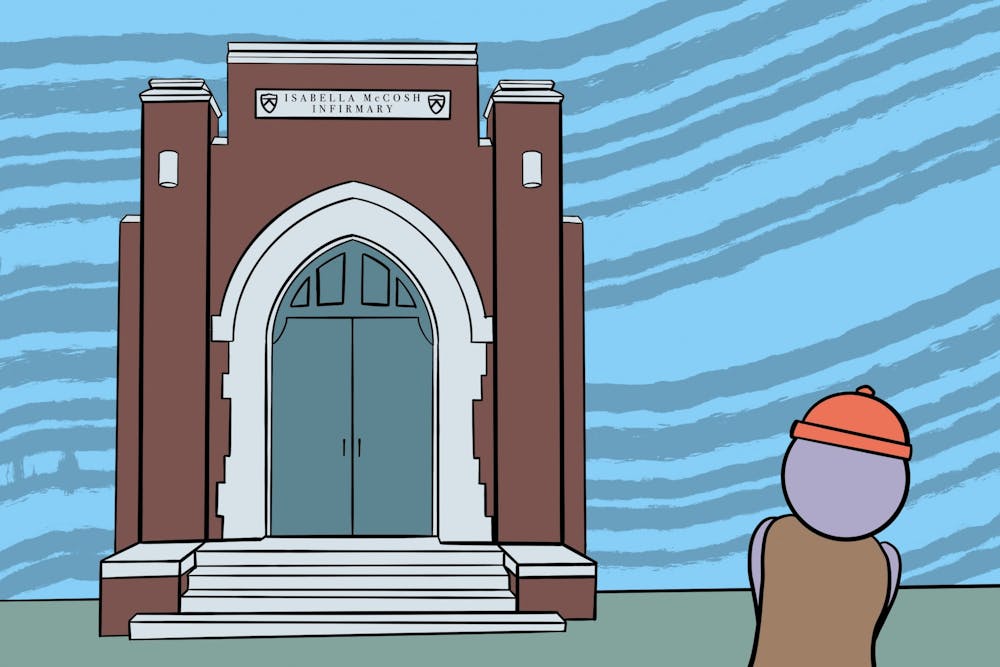
When the intake nurse at University Health Services (UHS) asked my reason for coming in, my heart raced. The person who checked me in that day had referred to me by my legal name — one which I had asked the University to stop using in reference to me at the end of the previous semester (pro tip: changing your name on TigerHub doesn’t change your name in the UHS system). I expected the worst when I blurted out, “Oh, I just had some questions. Um, about gender-affirming care.”
She smiled. “Ah, like a consult?” When I nodded in reply, she took the data and vitals regularly obtained by intake nurses: temperature, blood pressure, any regular medications I was on, etc. When she left the room, I exhaled shakily and held my forehead in my hands. As I waited to be seen by the next practitioner, I thought back through the journey which led me to that room.
Around a year prior, I “came out” to friends as nonbinary on a small social media account. Though the message was framed in a celebratory lens, I cried a bit while writing it. I would keep crying throughout the coming months, as I changed the pronouns I used (twice) and asked my professors to refer to me by a different name.
I was not ashamed of who I was. Still, I was worried about how coming out would affect the way others perceived me. I was raised in an environment where being openly nonbinary was considered unprofessional. I spent several long, lonely nights awake wondering if my peers, employers, and professors would doubt my competency on the basis of my gender expression.
I felt like I had to deal with socially transitioning largely on my own because the COVID-19 pandemic kept me at a distance from large parts of my support network. Changing the pronouns on Zoom, Slack, and Canvas, that I once proudly displayed as a sign of allyship, to ones that acknowledged my transition brought on bullets of sweat. I didn’t know when it was appropriate to correct those who knew of my social transition when they referred to me with gendered terms I didn’t identify with.
No one gave me a roadmap to living authentically, and without one, I felt like I was flying blind, susceptible to so many mistakes along the way.
I wanted so badly to find joy in my social transition. And at times, I did. One day, after a haircut that felt life-changing, I looked in the mirror and felt comfortable with my appearance for maybe the first time. I couldn’t stop smiling.
But at other times, I felt the same way I had felt for much of my life: alien to the way others perceived me. Being referred to with gendered terms that didn’t match my identity took on a new level of pain after having finally admitted to others how I felt inside. Growing up facing expectations around the gender others wanted me to be brought with it panic and anguish — the awfulness of puberty making me look different from my sibling and cousins, the deep discomfort around wearing gendered clothing that I found so hard to explain to my parents. This panic and anguish found new avenues through which to plague me. One moment, I felt joy in expressing who I was. The next, I felt frustrated and confused.
It wasn’t until the summer after I had come out that I was able to settle into my gender expression and learn to navigate the social situations that came with it. I made the conscious choice to be “out” to my employers and the people I was interacting with.
There were moments of embarrassment — awkwardness of trying to insert my pronouns into introductions, a plethora of misgenderings, etc. But they were learning experiences in how to navigate my gender expression in the “real world,” outside of college. I learned patience, graciousness, and honestly, how not to be bothered. My gender identity is a special part of who I am, but at the end of the day, just one small (and beautiful) part.
I learned when it mattered to me to call attention to my gender identity and when it did not. In essence, I learned how to be myself and how to be happy being myself. And then, I really was happier than I had ever been: more confident, more sure of myself, and a whole lot less awkward.
The following fall semester, I found a level of support that I could have only dreamed of previously through actively entering affinity spaces and spending time with an affirming network. The Gender + Sexuality Resource Center’s Gender Group gave me mentors who had been in my shoes and friends who were going through the same challenges. My eating club’s affinity group chat gave me a sense of belonging and no-judgment-camaraderie that I had feared I would no longer have easy access to.
A graduate student mentor of mine generously lent a ridiculously sympathetic ear to me when I first asked her about the prospect of medically transitioning. I had spent years fantasizing about it. From middle school onward, I would spend hours watching Youtube videos of people who had gone through the process and shared their stories. But I was afraid.
The support network that I gained enabled me to finally make the appointment I had spent so long considering. I went into it with so much anxiety. I wasn’t out to my parents, a situation which makes insurance complicated. And I grew up in a religious environment that was generally both anti-gay and anti-trans. (A therapist in high school once told me to consider whether regularly attending church would cure me of my LGBTQ+ feelings.) I had heard more horror narratives of trying to medically transition than positive ones.
When the UHS practitioner finally came into the room where I had been waiting and asked me why I had come in, I started crying. I thought I was about to have to jump through hoops to get the care I wanted — to be diagnosed with “gender dysphoria” or to carefully recount my lifelong struggle with gender. I was afraid I hadn’t been out for long enough to be considered valid or stable, or that a comment would be made about whether my identity was some sort of bandwagoning fad. I hadn’t always had amazing experiences with UHS concerning my regular health problems, and my expectations were low.
None of my fears came to light. I was met with only sympathy, kindness, and a professionalism that I didn’t expect to be granted as a trans person. UHS practices an “informed consent” model of gender-affirming care, which basically means that a practitioner will carefully explain to you the effects of hormone therapy, and if you still want to go through with it, they’ll help you embark upon the process.
After spending a generous amount of time explaining to me what it’s like to be on Hormone Replacement Therapy (HRT) in a friendly manner, my practitioner ordered blood work for me, and after everything came back in order, sent the necessary prescriptions to the local CVS. I found the prescription remarkably affordable without insurance. And I found it insanely relieving that my practitioner had both extensive clinical experience with patients on HRT and personal experience with the process. All my nervous questions were answered with gentleness.
When I filled the prescription, I came back into UHS, and the same practitioner I initially saw coached me on how to self-administer the prescribed hormones through injection. I shook a bit from nerves, but I was allowed to take all the time I needed. It wasn’t scary, and it didn’t hurt.
At the time of writing this, I’m a few months on HRT, and I’m the happiest I have ever been with my body. I’ve found that HRT has not confined me to express myself as the gender often associated with the “opposite” of the one I was assigned at birth, but instead has freed me to feel my best no matter what clothing I’m wearing. Physical changes are slow — I purposefully started on a low dose to make sure of this — but welcome. “Second puberty” is awkward at times, but thanks to the advice and support of friends (cis and trans alike), it’s never felt embarrassing. I look in the mirror, and I see myself. That’s a privilege everyone should enjoy.
It’s not that I never have doubts or anxieties. The nice thing is that medical transition can be stopped at any time. Many changes aren’t as permanent as one might think. Stopping medical transition is not a sign of defeat or not being “trans enough.” Everybody should have the right to explore their gender identity and their options for gender expression. Medical transition is just one option.
I’m writing all of this to say that you are the one who gets to write your story. Socially and medically transitioning can be scary. It has been for me. But it’s not as intimidating as you might think, and it’s not impossible.
Transitioning has led me to love myself in ways I never thought I could. Being trans at Princeton — where student groups still invite transphobic speakers and prominent professors are openly anti-trans — is not always easy. But the easy thing, I’ve been told, is not equal to the right thing.
We are so much more powerful when we live openly as ourselves. The person you are inside — just like the person I am inside — is gorgeous, vibrant, and deserving of love. Do right by the person inside you. It’s our job to love those who live authentically as their authentic selves, and I hope we all do it well. Here’s to doing so, together.
Editor’s Note: The ‘Prince’ granted the author of this essay anonymity due to privacy and safety concerns.
When Nate Tan, a professor of ethnic studies at San Francisco State University, logs on to virtually teach his 8 a.m. class, he sees several dozen students sitting at desks with laptops, some framed by towering bookshelves. But these students aren’t Zooming in from campus dorms. Instead, they’re taking classes in three different youth prisons scattered across California.
The educators involved say it provides culturally relevant curriculum to incarcerated 17- to 25-year-olds, inspiring them to envision themselves in higher education and check off the first few requirements toward a Cal State degree.
In today’s class, students discuss a reading on the role of Black women in the Black Lives Matter movement, then watch a five-part docuseries showcasing the 1Love Movement, a campaign against the deportation of Cambodian Americans. (The CalMatters College Journalism Network was able to sit in on the class after agreeing that students’ full names would not be used to protect their privacy.)
One Asian American student says watching clips of the movement not only uplifted him, but made him reflect on the United States’ role in deporting Asian families.
“I just feel like the US government ain’t doing enough,” he says. “Just deporting families like that, separating them from their families, is just messed up.”
Ethnic studies — the social and historical study of race and ethnicity — was born in the Bay Area in the 1960s as a response from students of color who demanded increased access to higher education and new academic programs that centered their identities.
San Francisco State’s ethnic studies department offers concentrations like Africana studies, American Indian studies, Asian American studies, Latino/Latina studies, and a comparative major called Race and Resistance studies. With its new collaboration with California’s state juvenile justice division, which began this past fall, university officials want to broaden that mission to include youth directly impacted by the justice system.
It’s the first time a four-year university has offered a certificate program in California’s youth prisons. The state has required juvenile facilities to give incarcerated youth who have finished high school access to community college classes since 2019.
To complete the certificate, students must take four ethnic studies classes that meet lower-level general education requirements within the California State University system, including critical thinking and social sciences. The classes span topics ranging from race and gender in science fiction to activism and climate justice.
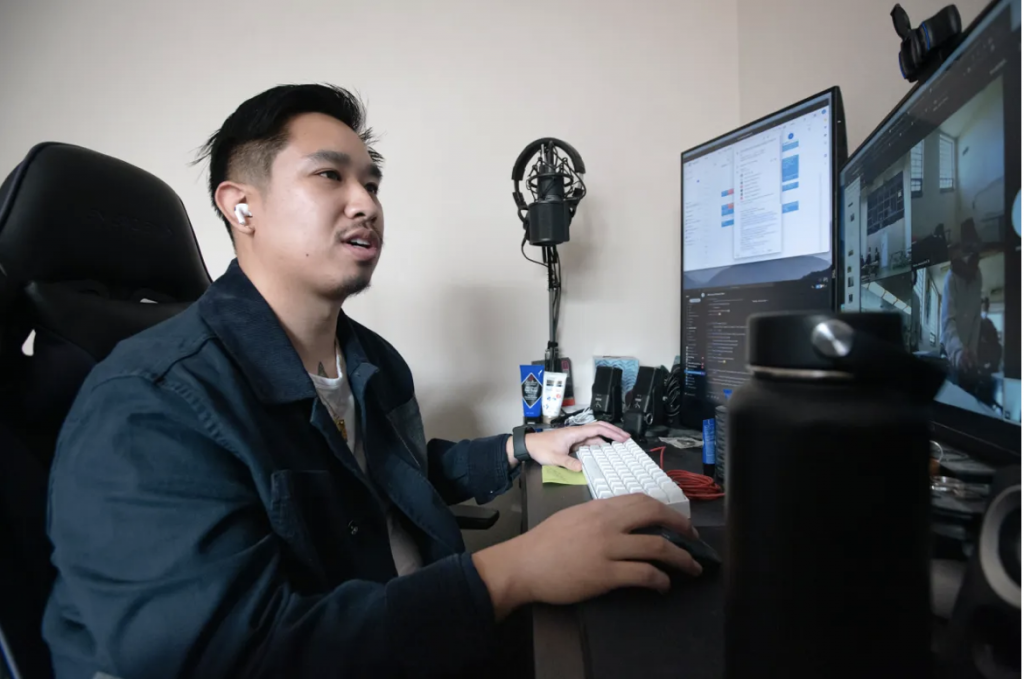
Tan teaches from home, and each facility has staff members who monitor the class and help deliver his lesson plans.
For Alex, 21, learning ethnic studies while incarcerated has helped him understand his own struggles growing up biracial in the United States.
With a white and Mexican background, he says he’s existed in both worlds, but hasn’t felt comfortable in either one. Ethnic studies gave him the language and knowledge to better navigate that complexity, he said.
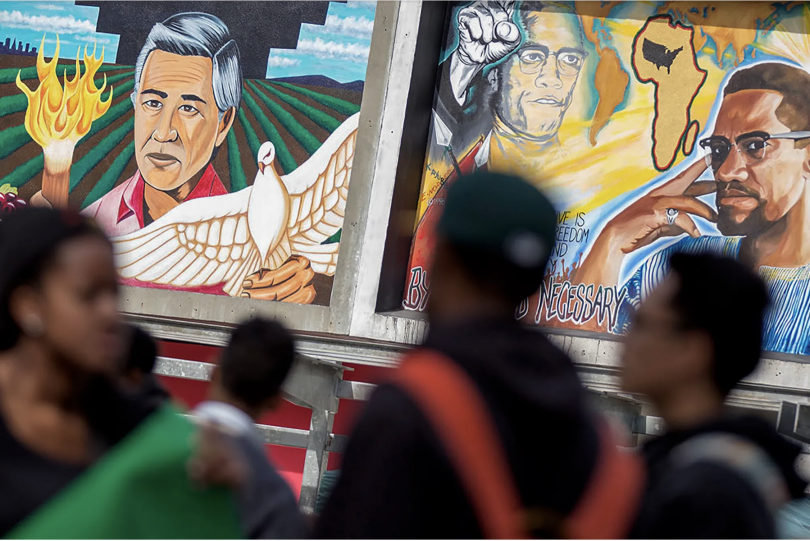
He grew up in San Diego near Chicano Park, a seven-acre park which has over 80 murals dedicated to Chicano heritage. But it wasn’t until his San Francisco State class that he learned the park’s cultural significance.
“It had always been on my radar, it being so close to where I spent time,” Alex said. “I just didn’t really understand the full history.”
Taking ethnic studies helps students develop ownership of their identities, says Tan. For students in their late teens and early 20s, that can be especially important since they are experiencing key development points in their lives, experts say. A study from San Francisco State found students who took an ethnic studies course, regardless of whether it was their major, graduated at higher rates than their peers who did not take the subject.
Ethnic studies could be particularly transformative for incarcerated young people, who are disproportionately of color, says Katie Bliss, project coordinator at the Youth Law Center, a Bay Area nonprofit that advocates for juvenile justice reform and is not involved with the San Francisco State program. Almost 90 percent of the approximately 750 youth in California’s juvenile justice system are Black or Latino, and the San Francisco State program reflects those demographics. Black youth are 31 timesmore likely to be incarcerated in California, with Latino youth almost 5 times more likely, compared to their white peers.
“It’s a change in narrative for students,” says Bliss. “To have the opportunity to start hearing about their own culture and experiences in a way that is very empowering, versus a very Eurocentric perspective, which is what is typically taught.”
Nathaniel Tan gives a virtual lecture on the social construction of race from his home in Newark to incarcerated youth from around the state. Photo by Wangyuxuan Xu for CalMatters
While some states are banning curriculum focused on race, California has been moving toward making ethnic studies a requirement for students of all kinds. Last year, following the lead of individual school districts, the state became the first in the country to require ethnic studies as a high school graduation requirement, starting with the class of 2030.
Proponents of ethnic studies argue that students of color, who are at greater risk of being kicked out of school and into the justice system, can become more invested in their education when they learn about the accomplishments of people who look like them, thus disrupting the school-to-prison pipeline.
“Poverty and over policing in communities of color are a lot of reasons why people end up in the prison system,” Tan said. “I think that’s true for these young people.”
Having experienced racism before and while incarcerated, Tan said, students relate to the course’s content based on their lived experiences and identities.
“The class was able to open my eyes to misconceptions that public schools taught about our history, and the system that I am locked within,” one 17-year-old student from the Ventura Youth Correctional Center in Camarillo wrote in an essay about her experience in the program. “I was able to learn things about society and my own culture that I had not known before.”
There’s also a practical educational benefit to the new coursework San Francisco State is providing in juvenile facilities. It will give students who complete the course college credits that count toward a degree in the Cal State system, which as of 2020, requires ethnic studies for graduation. The program’s leaders hope that will open up a clear higher education pathway for these students.
“We as a discipline are dedicated to serving the public,” said Amy Sueyoshi, San Francisco State’s dean of ethnic studies. “It’s basically sort of the way we view the world, that our curriculum needs to be accessible and relevant to all communities who want a college degree.”
The ethnic studies certificate program was launched at the same time as the Division of Juvenile Justice is being phased out, with California’s three remaining youth prisons set to be shut down entirely by June 2023. Young people will instead be under the supervision of county probation offices.
Sueyoshi says the university considers the current program a pilot that it hopes to replicate in partnership with county juvenile halls, adult facilities, and maybe even other states. It’s currently funded through private donations, but San Francisco State has applied to become one of 200 colleges around the country that receives funding through the Second Chance Pell program, which restored federal financial aid for some people in prison in 2016. Students could then apply for federal grants to pay for their studies.
Alex, the 21-year-old student, says being a part of the ethnic studies program made him feel that education is a world where he belongs.
“It’s a huge self esteem, confidence booster,” he said. “It’s been awesome within the world of academia to feel accepted.”
Once released, he wants to continue his studies and transfer to San Diego State.
The ethnic studies class has “opened up the room to conversation that you might not be able to have on the living unit or maybe in the community among friend groups,” Alex said. “We can have a white person, a Black person, an Asian person, and a Mexican person all talking about racism in that space together.”
AuthorEmma Hall is a fellow with the CalMatters College Journalism Network, a collaboration between CalMatters and student journalists from across California. At Sacramento State, she is studying journalism with a minor in ethnic studies. Hall’s background is in diversity and inclusion, race and ethnicity, and higher education. Her work has been featured on KQED, The Pleasanton Weekly, The State Hornet, The Advocate at Contra Costa College, and The Inquirer at Diablo Valley College. She is also a proud community college graduate.
The mural in the top photo is at the Cesar Chavez Student Center at San Francisco State University. The university’s ethnic studies department, the first in the country, has now launched a certificate program for incarcerated youth. Image courtesy of San Francisco State University.
Norway pledges $124m to UNRWA over 4 years
February 15, 2022
A Palestinian man stands in front of the emblem of the UN Relief and Works Agency (UNRWA) in Gaza City on 31 July 2018 [SAID KHATIB/AFP/Getty Images]
February 15, 2022 Norway has pledged to donate $124 million as part of a four-year funding agreement with the UN Relief and Works Agency for Palestine Refugees.
Foreign Minister Anniken Huitfeldt made the announcement during a meeting in Oslo with Commissioner-General of UNRWA, Philippe Lazzarini, who appealed last month for $1.6 billion to provide life-saving assistance for more than five million Palestinian refugees in Gaza, the West Bank, including East Jerusalem, and countries across the Middle East.
"I am deeply concerned about UNRWA's financial situation. UNRWA plays a key role in ensuring that the rights and basic needs of Palestine refugees are met and promoting stability in the Middle East. This is why Norway is now increasing its funding for UNRWA and will provide a total of NOK 1.1 billion over a period of four years," said Huitfeldt.
The agency's humanitarian operations, added Lazzarini, are a lifeline for the most destitute.
UNRWA was created in 1949 to provide assistance and protection for the Palestinian refugees who were forced out of their homes to make way for the creation of the state of Israel.
The organisation currently offers its services to about 5.3 million Palestinian refugees in the occupied territories, Jordan, Lebanon and Syria.
UNRWA depends almost entirely on voluntary donations from UN member states, however, it has faced severe financial difficulties since the US administration of President Donald Trump stopped donations altogether in 2018. Though some of these funds have been reinstated, they have failed to fill the funding gap.
Moreover, the UK had more than halved its funds to UNRWA from £42.5 million ($57.2 million) in 2020 to £20.8 million ($28 million) in 2021. The UK was the third largest overall donor to UNRWA in 2020, but its latest cut puts it in the second tier of contributors.
"UNRWA's ability to provide services is important for stability in the Middle East. Norway recognises this and will continue to give priority to providing support to the agency, in solidarity with the refugees. These multi-year agreements will provide greater predictability and make it easier for UNRWA to plan its operations and spending. I call on other donors to increase their funding as well," said Huitfeldt.
GM to Resume Bolt Production as Fix Found for Battery Fires
David Welch, Bloomberg News
A Chevrolet Bolt electric vehicle (EV) in West Bloomfield, Michigan, U.S., on Monday, Aug. 30, 2021. General Motor Co. has recalled every Chevrolet Bolt it has built due to the risk of battery fires and warned owners not to park them in their garage--leaving owners frustrated. , Bloomberg
(Bloomberg) -- General Motors Co. will resume production of the Chevrolet Bolt and larger Bolt EUV electric vehicles in April after the automaker and its battery partner, an LG Group company, found a solution to its manufacturing gaffes.
GM stopped production of the Bolt in August and recalled nearly 143,000 of them, which includes every one the company ever made, because a manufacturing defect at LG’s battery plant resulted in at least 13 fires. The company hasn’t made new Bolts because it had been redirecting limited supplies of new batteries to replace the defective storage system in recalled vehicles.
If the fix to the manufacturing process doesn’t result in any new problems, GM will have put a long and embarrassing chapter behind it. Recall costs soared to $1.9 billion, most of which were assumed by LG, but GM still had to manage customer complaints. While trying to find a fix, Bolt owners could not fully charge their vehicles and were advised to park them outside and in some cases, more than 50 feet away from other vehicles.
Suspending Bolt sales also allowed rival Ford Motor Co. to cruise past GM into second place in 2021 in EV sales behind Tesla Inc. as the Mustang Mach-E has caught on with car buyers.
Rae: Beating the Pandemic Requires Global Action on Vaccines
We are facing deep humanitarian and political crises in countries where hardship has always been present, but is now desperate.
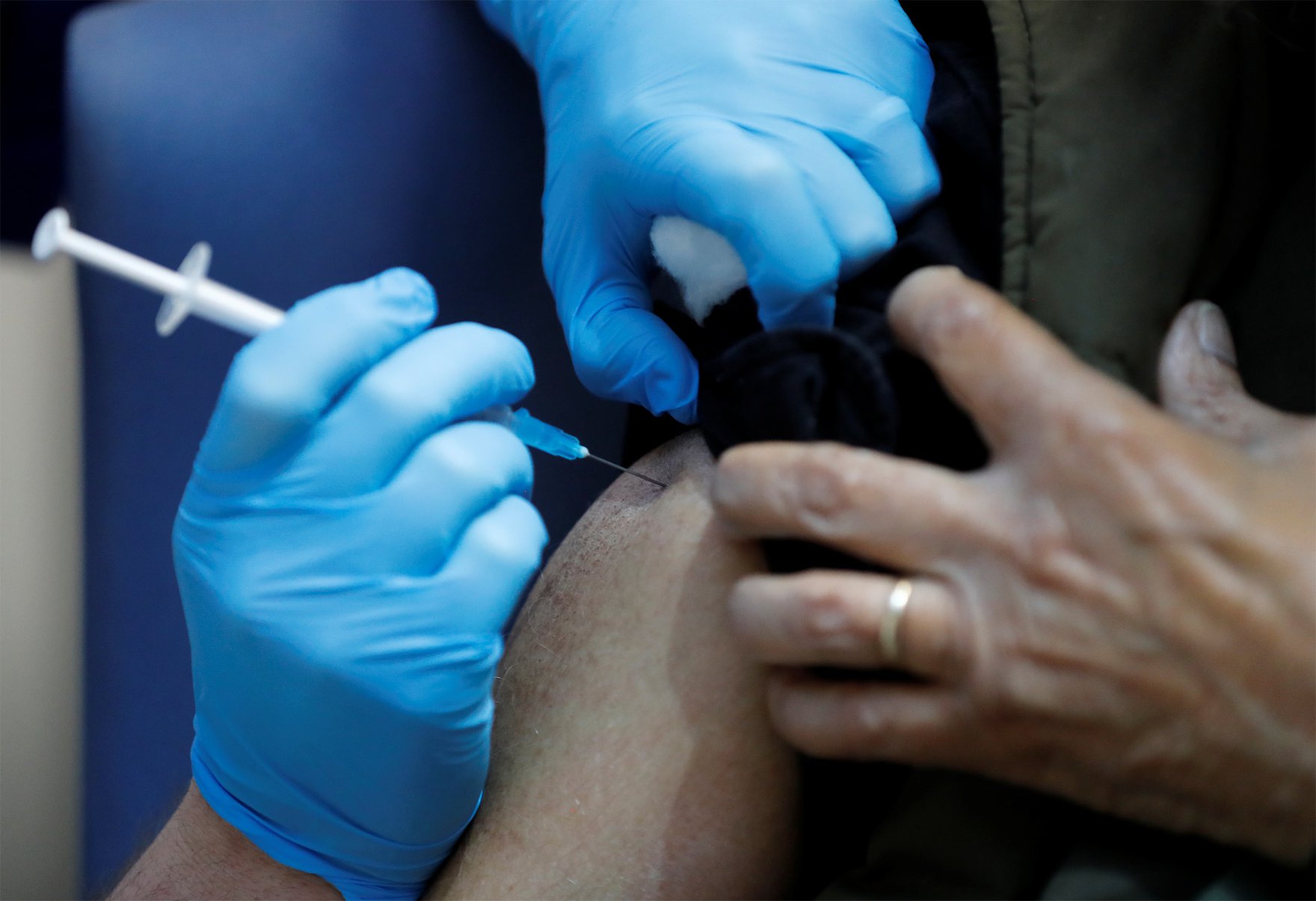
A nurse administers the Pfizer/BioNTech COVID-19 vaccine at Guy’s Hospital in London, UK, on December 8, 2020.
(Frank Augstein/Pool via REUTERS)
Two years ago, Prime Minister Justin Trudeau asked me to serve as his special envoy on humanitarian and refugee issues. My report titled A Global Crisis Requires a Global Response was completed just as I was taking up my duties in New York City as UN ambassador. The thrust of my report can be summarized in this excerpt: “Demonstrating the ability to promote collective and cooperative responses to crises such as the global pandemic is a moment to prove the value of multilateralism as a concept, and to prove the doubters wrong. At a time when many are claiming that the idea of a rules-based international order and collective action is a relic of history, demonstrating the ability of the international community to collaborate to resolve one of the greatest challenges of our time can serve to resuscitate the very notion of collective action over unilateralism.”
The last two years have seen both steps forward and backward as we have tried to cope with all aspects of the coronavirus disease 2019 (COVID-19) pandemic, the loss of millions of lives, health-care systems around the world stretched beyond their limits, vaccination inequity, profound economic and social impacts, and an unprecedented challenge for the world community that has yet to be met. COVID-19’s impacts are far from over; indeed, its effects will be with us for a long time.
Our political leaders are elected, or at least sustained, by people living in 193 countries. But the problems they are being asked to deal with are global. This means our global institutions have to be strengthened, not weakened, and our words must be matched by our deeds.
Let’s start with the positive side of the ledger. There was an agreement to work with two international facilities, COVAX and Gavi, as well as a number of other regional institutions, to allow wealthier countries to share money, vaccines, and various medical supplies and treatments with countries around the world. Billions of dollars have been raised and spent. The scientific community working internationally succeeded in some innovative discoveries that meant vaccines were developed in record time. About half the world’s population has received at least one dose of a vaccine. Global vaccine supply is growing in 2022.
On the economic front, the World Bank, the International Monetary Fund (IMF) and regional development banks have taken steps to avoid a deeper global collapse as a result of the measures required to shut down due to the pandemic. The wealthiest countries, joined de facto by China, agreed to delay interest payments on debts owed by lower-income countries. The IMF agreed to a special allocation of US$650 million in Special Drawing Rights. In addition, donors agreed to create trust funds to allow transfers to lower- and middle-income countries whose revenues had collapsed at a speed previously unknown in the global community. Discussions continue on what further steps might be undertaken.
In addition to these multilateral responses, individual countries have engaged in what has been dubbed “vaccine diplomacy” to transfer vaccines, technology and development assistance on a bilateral and, it must be said, opportunistic basis to offset the health, social, economic and political impact of COVID-19. South Africa recently announced the opening of a drug-manufacturing facility in Cape Town, applying Moderna’s formula.
And yet, these efforts are far from enough. The poorest countries have received the least access to vaccines, the least economic investment, the least help with liquidity and, as a result, have fallen further behind. The gap between rich and poor countries is growing, and so is the digital divide. We are facing deep humanitarian and political crises in countries where hardship has always been present, but where now the situations can only be described as desperate. The consequences of this inequity will be deeply felt for a generation. The much-touted UN Sustainable Development Goals will not be close to achievement by 2030. A billion-and-a-half children around the world have missed school. Millions will not return, especially girls, and this will come at huge costs throughout their lifetimes in lost incomes and opportunities.
The French Revolution was fought for liberty, equality and fraternity — the latter we would now call “solidarity.” The concept of sustainability was little known at that time, but now it is rightly seen as just as important as these other core values. The reality of our time is that the values and targets we endorsed in the UN Charter and any number of covenants, contracts, treaties, resolutions and speeches, are words and hopes that are yet to be fulfilled.
We shall not defeat this pandemic (or fight climate change) without global vaccination, which requires more solidarity, not less, and more globalism and a deeper understanding of what it means to live on a single planet, to share a single atmosphere and to live in a world that is shrinking. Our political leaders are elected, or at least sustained, by people living in 193 countries. But the problems they are being asked to deal with are global. This means our global institutions have to be strengthened, not weakened, and our words must be matched by our deeds.
The opinions expressed in this article/multimedia are those of the author(s) and do not necessarily reflect the views of CIGI or its Board of Directors.
ABOUT THE AUTHOR Bob Rae is Canada's Ambassador to the United Nations.
Turkey's media watchdog censoring free thought, former member says Feb 11 2022
Turkey's media watchdog, the Radio and Television Supreme Council (RTÜK), is now punishing freedom of thought in Turkey, according to former RTÜK member Faruk Bildirici.
Ebubekir Şahin, the head of RTÜK, wants no news to be reported and no criticism to be levelled at the government, Bildirici said in an interview with Bianet on Friday.
"Şahin is now acting like the government's stick hanging over independent and critical channels," he said.
On Thursday, RTÜK launched an investigation against opposition broadcaster Halk TV over journalist Ayşenur Arslan's remarks on Turkish Cypriot businessman Halil Falyalı, who was killed in an armed attack in northern Cyprus on Tuesday.
Şahin, and RTÜK under him, only fines the critical and independent channels but protects pro-government ones, Bildirici said.
On Wednesday, RTÜK also issued a warning to international publications that include the Turkish language websites of Voice of America, Deutsche Welle, and Euronews that they need to receive a national license or risk their content being blocked. RTÜK's power to regulate foreign news outlets stemmed from a 2019 law that provides it with the power to regulate internet platforms in Turkey.
"They created the list to start with the publications that the government dislikes the most. This is likely to spread to the BBC and Sputnik," Bildirici said.
From now on, more severe conditions await the critical media in Turkey, Bildirici said.
"Until now, newspapers have faced the police, the judiciary, and access bans. Now they will also be faced with RTÜK censorship," he said.
Head of Human Rights Center in Ankara resigns as police torture scandal deepens
The head of a Turkish human rights organisation resigned on Wednesday following a report detailing torture by Ankara police officers.
Riza Türmen, the leader of the Human Rights Centre in Ankara and a former judge on the European Court of Human Rights (ECHR), confirmed to Ahval News that he is stepping down from his position. With Türmen’s departure, the number of resignations from the Human Rights Centre has grown to six individuals as a result of the deepening scandal.
The debate was sparked after the Ankara Bar Association, the mother entity for the Human Rights Centre, censored a report prepared by the lawyers of the Human Rights Centre of the that investigated the allegations that the suspects detained over alleged membership of the Gülen Movement were tortured at Ankara Security Directorate.
Ankara designates the Gülen movement, led by U.S.-based cleric Fethullah Gülen, a terrorist organisation over the group's alleged involvement in the failed July 15, 2016, putsch to topple the government of Recep Tayyip Erdoğan. Gülen, a former ally of Erdoğan, denies all accusations of involvement.
After it was revealed that the Ankara Bar Association had worked to prevent the publication of a report, five of its lawyers who worked for the Human Rights Centre announced that they would be resigning. Turmen’s resignation is the highest ranking departure since the scandal began.
The lawyers that chose to resign stated that the decision not to publish the torture report was the “last straw” that pushed them out the door. Several had already been involved in cases that pushed them to consider leaving including the crackdown on the Saturday Mothers, a peace movement seeking the whereabouts of their loved one who disappeared following the May 1980 coup d’teat.
Other were incensed by the decision to ignore the rulings of the ECHR that Turkey falls under the jurisdiction of. The ECHR has ordered that Turkey release political prisoners such a civil society activist Osman Kavala and Selahattain Demirtas, the leader of the pro-Kurdish People’s Democratic Party (HDP).
Kemal Koranel, the head of the Ankara Bar Association, has denied all allegations that his organisation covered up the report.
"We have done our part about human rights and freedoms. We have filed a criminal complaint to the prosecutor's office regarding the allegations of torture upon the related report. Our Human Rights Centre has prepared 13 similar reports so far. Only one of them has been published. We do not have a procedure [stipulating] publication in our directives," Koranel declared in a statement.
Turkish lawyers resign from Ankara Bar Association’s Human Rights Centre claiming censorship of reports
Feb 09 2022
Six members of the Ankara Bar Association’s Human Rights Centre resigned after the body failed to publish a report on alleged police torture in the capital, Bianet reported on Wednesday.
Lawyers, including two vice chairs of the centre who stepped down, accused the bar’s administration of "staying silent to several violations of human rights" and of "censorship", Bianet said.
Similar incidents have been going on for some time and the failure to release the report was the "tipping point" for those who resigned, lawyers said.
The bar’s administration also censored its findings in cases including the health condition of imprisoned Kurdish politician Aysel Tuğluk, European Court of Human Rights (ECHR) judgments against Turkey and on the alleged mistreatment of detained military students, according to the lawyers who have resigned.
Chairman Kemal Koranel dismissed the allegations of censorship, the news website said.
"We have done our part about human rights and freedoms. We have filed a criminal complaint to the prosecutor's office regarding the allegations of torture upon the related report,” Koranel said.
The Human Rights Centre has prepared 13 similar reports, and one of them was published, he said. “We do not have a procedure (to stipulate) publication in our directives," he added.
The vagueness surrounding the definition of the Turkey’s crime of “insulting the president,” leaves the door wide open for anyone to be charged with the crime, German broadcaster Deutsche Welle said on Saturday.
The laws on insulting the president amount to harassment of those even under the age of 18 in a bid to intimidate people and to silence intelligent, political criticism, it cited Yaman Akdeniz, a law professor at Istanbul Bilgi University, as saying.
"Either you keep quiet or you'll be taken to court," according to Akdeniz, who maintains that freedom of expression in Turkey is in grave danger with an increase in attempts at intimidation.
Insulting the president is a crime according to Article 299 of the Turkish Penal Code (TCK) and carries a maximum sentence of four years in prison. Investigations and convictions on Article 299 have skyrocketed since Erdoğan stepped into office as president in 2014.
DW cited the most recent example of well-known journalist Sedef Kabaş, who was jailed last month on charges of targeting the Turkish president with a proverb, which she quoted on live television during a programme on an opposition linked TV network.
The former television host was detained on January 22 in Istanbul and a court ordered her to be jailed ahead of a trial.
The charge against Kabaş stems from her remark “When cattle enters a palace, it does not become king but the palace becomes a stable,” which she made during a discussion programme on TELE 1 on January 14.
Another example of that is former Olympic swimmer Derya Büyükuncu, who is facing years in prison on the same charges, DW said. The athlete in the meanwhile has been permanently suspended from the Swimming Federation of Turkey.
The Turkish state’s arms extend even beyond Turkey regarding the charge, the broadcaster said, pointing to the case of German comedian Jan Böhmermann, who was slapped with lawsuit on allegedly insulting the president in 2016, when Erdogan's lawyers filed a complaint.
Lawsuits over the crime of insulting the president have increased by 9,000 percent since 2010, according to a 2021 report based on Justice Ministry data.