Tuesday, March 15, 2022

CUTENESS OVERLOAD
Newborn white rhino named Queenie in honor of Queen Elizabeth II


March 14 (UPI) -- Cotswold Wildlife Park in Burford, England, has named a newborn white rhino Queenie in honor of Queen Elizabeth II.

The name was given to the white rhino in celebration of the Queen's Platinum Jubilee year, which marks her 70th year on the British throne.

Queenie was born to parents Monty and Nancy, who have also given birth to four other baby rhinos. She is also the ninth white rhino calf to be born at the park.

"We feel very lucky to have another baby female Rhino, which is our fifth female baby in a row. All the rhinos here are named after very special people and I think everyone agrees that 2022 will always be special because of Queen Elizabeth's platinum jubilee," managing director of Cotswold Wildlife Park, Reggie Heyworth said.

"I thought it might be a bit presumptuous to call our new baby Elizabeth so I have christened her Queenie instead. I think it is a perfect name for a young lady Rhino!" he continued.

The park also released video of Queenie after she was freed from an enclosure for the first time.
BUG ARMAGEDON
Insects could kill 1.4 million trees in U.S. cities by 2050, study says

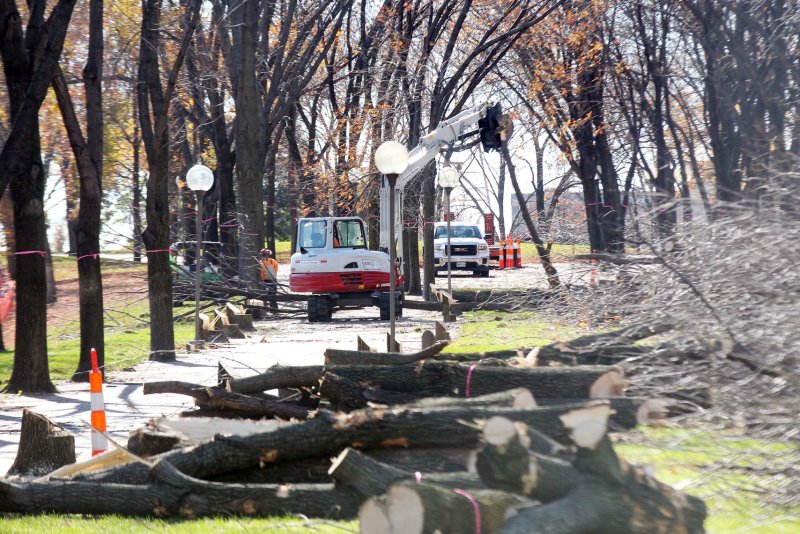
Workers using chainsaws and heavy equipment removed nearly 800 ash trees on the Gateway Arch grounds in St. Louis in November 2014 in advance of the arrival of the emerald ash borer beetle. File Photo by Bill Greenblatt/UPI | License Photo

March 14 (UPI) -- Invasive insects could kill 1.4 million trees by 2050 in cities across the United States, which could cost more than $900 million to replace, according to a new study.

The study, published in the British Ecological Society's Journal of Applied Ecology, used data from around 30,000 urban areas across the country to create the forecast and recommend that cities take steps to plant a variety of trees rather than trees from a single species.

The study was conducted by researchers from McGill University and North Carolina State University with the U.S. Forest Service's Southern Research Station.

"These results can hopefully provide a cautionary tale against planting a single species of tree throughout entire cities, as has been done with ash trees in North America," Emma Hudgins, the study's lead author, said in a press release.

"Increasing urban tree diversity provides resilience against pest infestations. While we know this more intuitively for monocultures of crops, many cities continue to plant what are essentially monoculture urban forests."

The emerald ash borer, a green jewel beetle native to northeast Asia, is projected to kill nearly all ash trees in more than 6,000 urban areas. The beetle, which lays eggs and feeds under the bark of the ash trees, is expected to cause 90% of the 1.4 million urban tree deaths projected in the study.


The U.S. Department of Agriculture and state agencies have long struggled to fight the invasive species, which has already killed millions of ash trees across North America. Last year, the Montana Department of Agriculture issued an emergency quarantine order in an attempt to quell their spread into the state.

The new study found that the death of urban trees will be concentrated into "hot spot" cities that include New York, Chicago and Milwaukee, which have high numbers of ash trees and have been introduced to the emerald ash borer or are in its path.

Researchers also examined the potential impacts of other insect species that have not arrived in the United States. The study found that wood-boring insects from Asia, such as the citrus long-horned beetle, could cost the United States as much as $4.9 billion by 2050 if they are introduced in the country.

"This paper shows that unless we plant a variety of tree species in our cities, urban trees are seriously at risk from invasive pests," said Jane Memmott, an ecologist and entomologist at the University of Bristol, who was not a part of the study.

"The take-home message to urban planners is to plant multiple species in cities rather than focus on just a few familiar species. It'll keep trees wonderful, and it will keep them in our cities."

Hudgins noted that the study specifically researched street trees in the United States because of the availability and accuracy of the data used in the modeling, but that the findings also apply to neighboring countries like Canada.

"We can see a similar situation in Canada, since emerald ash borer arrived here by spreading across the border with the United States, and cities like Montréal are in the process of losing all of their ash trees," she said.

"Colder cities like Winnipeg appear to be seeing delayed impacts of emerald ash borer due to its need to complete a longer life cycle at low temperatures."

SPIDERS ARE NOT INSECTS THEY ARE ARACHINDS
THEY ARE STILL BUGS

'Zillions' of large Joro spiders could invade U.S. East Coast, experts say
By Allison Finch, Accuweather.com


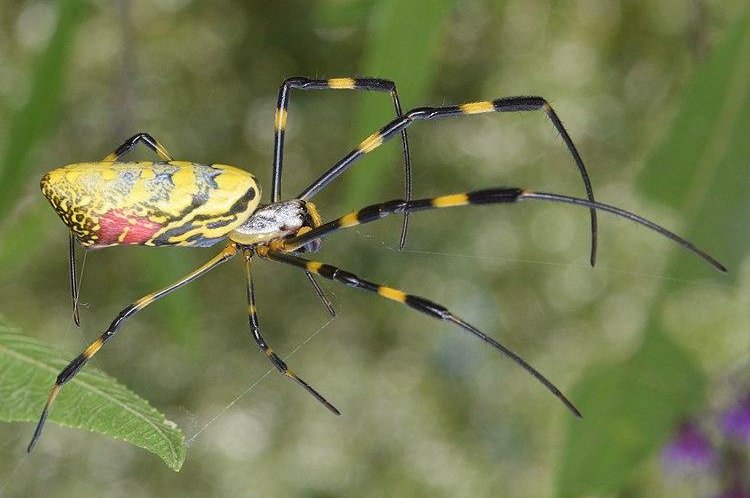
The Joro, which can grow to a size that can span a human palm, is one of only a few spiders that will catch and eat brown marmorated stink bugs, which are serious pests to many crops, and help suppress mosquito and biting fly populations. 
File Photo by Christina Butler/Wikimedia Commons

March 14 -- After rapidly reproducing in Georgia last year, the Joro spider, native to East Asia, could spread to much of the East Coast in the coming year, according to new research from the University of Georgia, which also suggests the insects' ability to survive certain weather conditions will influence just how far north they move.

The Joro spider is a part of the Trichonephila clavata species and is part of a group of spiders known for highly organized, wheel-shaped webs. The females have colorful yellow, red and blue markings on their bodies and can measure up to 3 to 4 inches when their legs are fully extended. The males have a brown body and are much smaller compared to the females.

The Joro spider was first identified in the U.S. almost 10 years ago in 2014 when Rick Hoebeke, a collections manager at the Georgia Museum of Natural History, received a call about an unusual spider. From that first encounter with the unique spider, Hoebeke led an effort to identify the East Asia native spider and has since tracked the species throughout Georgia.

"Our best guess is that it came in a shipping container and dropped off here somewhere on I-85 [near Atlanta] in the Braselton area," Hoebeke said in a statement. "They are great little hitchhikers."

Since 2014, the Joro spider has been found in about 25 different counties across Georgia. The spiders have been spotted suspending themselves in three-dimensional webs on porches, power lines and mailboxes, rattling many residents.

They use a ballooning technique, in which the spider uses its web to catch a current of air, to fly for 50-100 miles before latching onto a tree.

But their ability to launch themselves into the air and fly isn't the only reason they have spread. Humans also factor into the spread of these spiders.

"The potential for these spiders to be spread through people's movements is very high. Anecdotally, right before we published this study, we got a report from a grad student at [the University of Georgia] who had accidentally transported one of these to Oklahoma," undergraduate researcher Benjamin Frick said in a statement.


Residents will have to get comfortable because this new arachnid isn't going anywhere. The spider has been found in nearby states, including Tennessee, South Carolina and North Carolina, and entomologists expect that it will continue to spread throughout the Southeast.

In fact, the new research from the University of Georgia found that this spider has a 77% higher heart rate, double the metabolism and can survive a brief freeze that would typically kill off its relatives. The new data reveals that this spider could potentially survive not just in nearby states but up and down the East Coast and possibly even into Canada.

"It looks like the Joros could probably survive throughout most of the Eastern Seaboard here, which is pretty sobering," study co-author Andy Davis said in a statement.

Joro spiders are native to Japan, which shares a similar climate to the eastern U.S.

Researchers have not noticed any adverse effects from the Joro spider on native species, which is often a significant concern with invasive species.

University of Georgia entomologist Nancy Hinkle said that these "beautiful creatures" offer "free pest control."

"Joro spiders present us with excellent opportunities to suppress pests naturally, without chemicals, so I'm trying to convince people that having zillions of large spiders and their webs around is a good thing," Hinkle said.

The Joro is one of only a few spiders that will catch and eat brown marmorated stink bugs, which are serious pests to many crops. They also will likely help suppress the mosquito and biting fly populations.

For those concerned or perhaps not a fan of the new spider, their lifespan is short, lasting only a year, as they all die off around late November. They leave behind a sac full of eggs that will emerge in the spring.

But experts say Joro spiders are quite harmless to humans and are generally large enough for people to avoid. Almost all spiders are venomous, but the venom from the Joro spider isn't believed to be a threat to humans. In fact, the spiders have such small fangs that a defensive bite from a Joro spider likely wouldn't even break a person's skin.

While running into a spider the size of the palm of your hand could freak you out, it's important to remember that one encounter with a spider could save you dozens of meetings with other insects.

Tour guide photographs rare wolverine in Yellowstone National Park

March 14 (UPI) -- A rare wolverine was photographed walking across a snowy road in Yellowstone National Park by a tour guide that came across its path.

MacNeil Lyons, a former park ranger who owns the tour company Yellowstone Insight, photographed the wolverine from the window of his vehicle while leading a tour group on March 5.

"We felt beyond elated at this chance encounter with this elusive creature," Lyons wrote in a Facebook post.

"We rounded the corner heading westbound and in the oncoming lane was a low-to-the-ground, dark animal loping away from us."

Lyons said his guest initially thought the animal was a young black bear until the group realized it was a wolverine.

"We were able to spend three full minutes in the presence of this unique and rare animal. By its size, I assume that it is a healthy male," Lyons said.

"The wolverine was curious for a bit. It jumped onto the snow berm adjacent our lane twice and returned to the road to size us up as our vehicle was stopped, idle."

He said that the wolverine eventually bounded up a hill when another car approached but when the car passed, Lyons was able to take the prized photographs.

The images are significant because wolverines themselves are rarely seen and only seven have been documented as living in Yellowstone and adjoining national parks, according to the National Parks Service.

The number of wolverines dwindled substantially in the 1930s because of commercial trapping and predator control efforts. Plans to list them as a threatened species under the Endangered Species Act are on hold as researchers determine the effects of climate change on their habitats.

Most images of wolverines in Yellowstone National Park come from researchers using remote cameras to record their activity.

Because of their rarity, conservation groups like Wolverine Watch encourage people who come across them to photograph them and report details of the sighting such as GPS coordinates and descriptions of the animal's behavior.


New Woody Guthrie Exhibit Shuns Spotify Over Joe Rogan Podcast

David Browne 
Rolling Stone
© CBS/Getty Images COMMERCIAL WOODY


Woody Guthrie, the singer, songwriter and writer who spoke truth to power decades before the phrase was invented, was long known to take a political stand. Now, 55 years after his death, he’s still doing just that. As part of a new exhibit of his life and work, he’s joined the list of musicians unhappy with Spotify in light of the company’s affiliation with Joe Rogan’s podcast and his Covid-related opinions and comments.

“Woody Guthrie: The People Are the Song,” on display through May at New York’s Morgan Library and Museum, chronicles Guthrie’s career by way of photos, song lyrics, journals, clothing, instruments and other mementos. An audio guide features narration by Steve Earle — and will also soon include recordings of several dozen of Guthrie’s songs, so museum visitors will be able to listen as they read the lyrics on display around the exhibit.

India.Arie: Spotify Protest Is About More Than Just Joe Rogan

Initial plans involved using Spotify as the platform for the audio tour. But then came Neil Young pulling his songs from the service to protest Rogan’s podcast, followed by Joni Mitchell, India Arie, Nils Lofgren and Young’s sometime bandmates Crosby, Stills & Nash, among others. “When we were considering the idea of a playlist as part of the exhibit, I was aware of Spotify being an evolving conversation in the media, “ says Anna Canoni, vice president of Woody Guthrie Publications (and also his granddaughter). “So I asked the Morgan Library if there was an alternative to Spotify and they said yes. And I said, ‘Let’s do that!’”

Adds Guthrie’s daughter Nora: “My father would have stayed away from them as much as possible.”

According to Morgan Library and Museum curator Philip Palmer, the museum was happy to comply. “Once Neil Young, Joni Mitchell, and Graham Nash pulled their music from Spotify, the family asked if we could choose a different platform for the exhibition playlist,” says Palmer. “Given the musical connections between Guthrie and artists like Mitchell, we just could not in good conscience use Spotify for our playlist.”

AUTHENTIC WOODY

Although the final details are still being worked out, the family and the Morgan plan to license songs from the labels who recorded Guthrie rather than deal with Spotify, and compile with a non-Spotify playlist of their own.

When the playlist is up and running, possibly this week, the recordings will include Woody’s versions of “Do Re Mi,” “Grand Coulee Dam,” “Pretty Boy Floyd,” “So Long It’s Been Good to Know Yuh,” “Union Maid,” “Riding in My Car,” and “Tom Joad,” among others. Guthrie says she is also hoping to include covers of her grandfather’s songs by Wilco, Joan Baez, John Mellencamp and Carlene Carter, the Dropkick Murphys, Woody’s son Arlo, and others.

As of now, Guthrie’s music remains on Spotify: “I’m not pro or anti,” says Canoni, who adds that she and her family are still discussing the matter. “I don’t know where it’s going to land,” she says of the ongoing Spotify controversy. “In general, we’re not in that aspect of the industry. But when in doubt, we err on the side of the artist.”


Hong Kong Watch says it's been accused of violating China's national security law

Pedestrians walk past a billboard for the National Security Law in Hong Kong, China, July 15, 2020. On Monday, Hong Kong Watch said it has been targeted under the controversial law. 
File Photo by Jerome Favre/EPA-EFE

March 15 (UPI) -- A Britain-based non-governmental human rights organization said Hong Kong authorities have accused it of endangering China's national security, and have demanded it remove its website under threat of a hefty fine or jail time for its chief executive.

Hong Kong Watch, which monitors threats to the former British colony's basic freedoms, announced on its website Monday that it is one of the first foreign organizations to be targeted under a controversial law Beijing imposed on the city in July 2020.

The law, which came under widespread international condemnation, criminalizes with lengthy jail terms acts that are widely defined as secession, sedition, subversion, terrorism and working with foreign agencies to undermine China's national security.

In the letter Hong Kong Watch received and published on its website, the region's national security bureau accuses the NGO of violating Article 29 of the new law, which concerns colluding with foreign forces to undermine China's national security.

If the organization does not remove its website, the bureau warns that it could face a fine up to $100,000 or its chief executive, Benedict Rogers, could be sentenced to three years imprisonment.

"Criminal investigation reveals that 'Hong Kong Watch' has been engaging in activities seriously interfering in the affairs of the HKSAR and jeopardizing national security of the People's Republic of China," it said, referring to the Hong Kong Special Administrative Region by its initials.

"Such acts and activities, including lobbying foreign countries to impose sanctions or blockade and engage in other hostile activities against the People's republic of China or the HKSAR, and seriously disrupting the formulation and implementation of laws of policies by the HKSAR Government or by the Central People's Government, constitute the Collusion Offence contrary to Article 29 of the National Security law."

UPI has contacted the Hong Kong's National Security Bureau for comment.

"By threatening a U.K.-based NGO with financial penalties and jail for merely reporting on the human rights situation in Hong Kong, this letter exemplifies why Hong Kong's National Security law is so dangerous," Rogers said. "We will not be silenced by an authoritarian security apparatus.

Liz Truss, Britain's foreign secretary, called the accusation against Hong Kong Watch as an "unjustifiable action" that was "clearly an attempt to silence those who stand up for human rights in Hong Kong.

"Attempting to silence voices globally that speak up for freedom and democracy is unacceptable and will never succeed," Truss said in a statement.

Hong Kong Watch was founded in 2017, and Rogers, a vocal critic of China, was barred entry to the region that October.

Since the national security law was put in place, dozens of protest leaders have either been charged or fled the region. It has also resulted in several independent media organizations to close and, according to Hong Kong Watch, more than 50 civil society organizations to shutter.

While democratic countries, including the United States, have described the law as a cudgel used to silence dissent, Hong Kong officials insist it is ensuring peace in the region is maintained.
Son of Colombian paramilitary chief elected to special seat for victims of conflict

"The son ... is now the representative of the victims left by his father" 


A woman votes at a polling station during parliamentary 
elections in Bogota on March 13, 2022 
(AFP/Raul ARBOLEDA) (Raul ARBOLEDA)


Mon, March 14, 2022, 7:45 PM·2 min read

Colombian officials said Monday that the son of a notorious paramilitary leader has won an election to be a special member of Congress representing victims of the conflict.

On Sunday, Columbia held elections for both the Senate and its lower House of Representatives in which the left finished ahead.

For the first time, victims of the conflict between the government and the ex-guerilla FARC group -- who signed a peace deal in 2016 -- will have their own representatives in Congress.

For the next two legislatures, until 2030, 16 seats will be reserved specifically for victims in the regions most impacted by the conflict.

Those regions in northern Colombia have seen a rise in violence recently, as armed groups battle for control of prized narcotrafficking corridors.

Jorge Tovar, the son of the former paramilitary chief known as "Jorge 40," has been elected to one of those seats.

The lawyer-by-training celebrated his victory on Twitter: "The moment has come to change history."

His father was the leader of a right-wing paramilitary group known as the Northern Block, which wreaked havoc in the 1990s in its battle against left-wing guerillas.

He returned to Bogota in 2020 after serving a prison sentence in the United States for drug trafficking.

While currently living freely, he still faces dozens of lawsuits for massacres and forced displacement.

His son's election drew sharp criticism, especially from victims' organizations such as the Movement of Victims of State-Sponsored Crimes, which alleged "corruption and paramilitarism have taken over" the region, and echoed allegations of vote-buying.

"The son of Jorge 40 is now the representative of the victims left by his father," said leftist Senator Gustavo Bolivar.

Sunday's legislative elections also marked a new setback for the Comunes (Commons) party, which was formed by the former Marxist guerrilla group FARC.

The 2016 peace agreement guarantees the party 10 seats until 2026 regardless of its vote total, but it only received 50,000 votes on Sunday, 35,000 fewer than in 2018.

"The numbers in the legislative elections were not what we expected. As a party, we will make the corresponding analyses," said the far-left party.

das/vel/hba/des/jh
EMOTIONAL PLAGUE
Football violence pandemic spreads in Latin America


Rodrigo ALMONACID
Mon, March 14, 2022


The violence between visiting Atlas supporters and home fans in Queretaro drew global attention (AFP/STR)

A string of outbreaks of violence, several deadly, suggest that fan unrest in Latin American football is spiralling out of control.

Images of a mass brawl at a game in Mexico on March 5 that left 26 seriously injured, and led to 14 arrests went viral and attracted added attention because the country is set to co-host the 2026 World Cup with the USA and Canada.

On the same evening there were savage attacks beside a stadium in Palmira, just outside the Colombian city of Cali between America and Deportivo Cali fans.

The next day, a man was shot dead in a confrontation between fans of Atletico Mineiro and Cruzeiro in Brazil.

While academics who study the issue say that the end of coronavirus restrictions, which have been blamed for increases in violence in French and English football, is a factor, there are underlying problems that are being inadequately addressed by authorities.

"There is no way to end violence in football, that should be very clear," Heloisa Reis, a professor at the Unicamp University of Sao Paulo told AFP.

"But it can be reduced. For that, a very comprehensive public policy is needed," said Reis, the author of a book about the problem.

Argentina, Brazil, Colombia, Ecuador and Peru have enacted laws to quell excesses by punishing hooligans with jail or even cancelling sporting events.

Some of these initiatives replicate steps in Europe to control hooligans, such as biometric identification or video surveillance in and around stadiums.

- 'Toxic masculinity' -


After the riot in Queretaro, Mexico banned travelling fans from games, a measure used in Argentina, Brazil and Colombia, and questioned by experts because, they argue, the fans still travel and the violence moves to the streets.

Despite their best efforts the death toll remains huge: 157 in Brazil between 2009 and 2019, 136 in Argentina in the last 20 years and at least 170 in Colombia between 2001 and 2019.

"The great failure of the policies adopted is that they focus exclusively on the security component," says sociologist German Gomez, a researcher at the Colombian Association of Sports Studies.

Specialists agree that measures tend to ignore academic studies or social background frustrations stemming from unemployment, inequality or drug and alcohol consumption.

Reis argues the root of the problem is "toxic masculinity".

Football matches provide an arena for competition between men to gain power over rivals, especially on their own territory, through physical force.

Reis advocates public policies focused on the education of men but she is not optimistic.

"We have lived under male domination for centuries. The male values reproduced are domination, strength, courage. Is there a prospect of ending that? There is not," she said.

Specialists and fans perceive an increase in violence since covid restrictions ended and fans returned to the stadiums.

"These are the consequences of such a prolonged confinement, in which people when they return to a public event have a need to break out of that confinement," said Gomez.

In Brazil, at least nine incidents have been reported since February 12, including the shooting dead of a Palmeiras fan and the stoning of team buses, in which players were injured.


Press rights groups call for release of French journalist in Mali


RSF projected a picture of Olivier Dubois onto the Pantheon in Paris to highlight the plight of the French journalist held hostage in Mali
(AFP/Alain JOCARD) 

Mon, March 14, 2022

Press rights groups have called for the release of French journalist Olivier Dubois, who was taken hostage by a jihadist group in Mali almost a year ago.

A short video circulating on social media since Sunday appears to show Dubois, but has not been authenticated and its origin is unknown, as is the date it was filmed.

The man, who seems to be in good health in the video, addresses his parents and his partner, from whom he says he receives messages.

He also urges the French government to "continue to do its best" to obtain his release.

The group Reporters Without Borders (RSF) appealed for Dubois' release.


"Reporters Without Borders calls on the French and Malian authorities to redouble efforts to obtain his release," RSF said Monday after the apparent video of Dubois surfaced.

"A reassuring proof of life, the video's appearance on social media came just one week after RSF organised the projection of a huge photo of Dubois on to the side of the Pantheon in Paris as part of its campaign to draw attention to his plight," the Paris-based media watchdog said.

The New York-based Committee to Protect Journalists joined the call.

"Those holding Dubois should release him unharmed without delay, and should cease all efforts to harass and kidnap members of the press," Angela Quintal, the CPJ's Africa programme coordinator, said in a statement.

Dubois, 47, began working as a freelance journalist in Mali in 2015.

He announced his abduction himself in a video posted on social networks on May 5, 2021. In it, he said he had been kidnapped in the northern city of Gao by the Support Group for Islam and Muslims (GSIM), the main jihadist alliance in the Sahel, which is linked to Al-Qaeda.

Dubois is the last known French hostage in the world after the release in October 2020 of Sophie Petronin, a Franco-Swiss aid worker who was also kidnapped in Mali.

President Emmanuel Macron stated in January that France had not forgotten Dubois.

"Tireless work is being carried out by our diplomatic teams, our military and the relevant services" to obtain his release, he said.

emp/sba/mtp/leg
SOMEONE IS GETTING FED IN SUDAN
Once-starving lions roar back to life in Sudan sanctuary


An African lion at the Sudan Animal Rescue Centre in al-Bageir, south of the capital Khartoum, on February 28, 2022

Ahmed Alsawi
Mon, March 14, 2022, 
PHOTOS AFP/ASHRAF SHAZLY

Kandaka the lioness was once sick and emaciated in a rundown zoo in Sudan's capital, but thanks to wildlife enthusiasts she now thrives in a reserve watching her cubs grow.

She was among five lions suffering from starvation and disease with visibly protruding ribs and flaccid skin, held in grim cages with rusty bars in Khartoum's Al-Qurashi zoo.

Conditions worsened as Sudan's economic crisis deepened in the wake of months-long protests in 2019 that led to the toppling of former dictator Omar al-Bashir.

Of the five lions in the ramshackle zoo, two died.

The animals' plight shot to public attention two years ago after an online campaign prompted veterinarians, conservationists and animal enthusiasts the world over to rush to their aid.

Along with the two other surviving lions, Kandaka was moved to the Al-Bageir reserve.

"Their health has since improved greatly," said Othman Salih, who founded the reserve in January 2021.

The site, an hour's drive south of Khartoum, spreads over some four hectares (10 acres), or about the size of six football pitches.

As a testament to her recovery, the five-year-old lioness was called Kandaka -- the name of Sudan's ancient Nubian queens.

It is a term that has come to be associated with the women who played a vital role in the protests that unseated Bashir.

She is now thriving in Al-Bageir, one of 17 lions from across Sudan.

- Daily struggle -

But keeping the reserve up and running comes with its own set of steep challenges.

Volunteers, often juggling full-time jobs with their passion for animal welfare, have been struggling with long commutes, soaring prices and limited resources.

The challenges have increased since last year's military coup led by army chief Abdel Fattah al-Burhan, which triggered regular mass protests and roadblocks.

"The prices are very high," said Salih, who travels to the reserve all the way from Khartoum every day.

The reserve's running costs remain high, including providing more than 100 kilograms (220 pounds) of meat for the big cats daily.

It has so far been kept afloat by donations and tours for schoolchildren and families.

But Sudan, one of the world's poorest countries, has been reeling from a plunging economy due to decades of international isolation and mismanagement under Bashir.

Almost one third of Sudan's 45 million people are estimated to be in need of humanitarian assistance in 2022, according to the United Nations.

"Lots of Sudanese people are hungry," said Salih. "So all aid is funnelled to the people. It's only natural."

But Salih says the government and private businesses have done little to support the reserve.

"We try to get by through charging for entry tickets," he added, with entrance costing between $2-4.

"But it is still not enough, and we often pay from our own money to cover the cost."

- Source of hope -

But the reserve remains a source of hope for many.

"I still go there every day," said volunteer Moataz Kamal, who lives in the capital's twin city of Omdurman. "It's like the world outside doesn't exist when I am here."

He pointed in particular to the survival of a male lion from the eastern city of Port Sudan, after battling years of starvation and severely poor health.

The lion was named Mansour, which translates to the "victor", for overcoming such conditions.

It is not known how many lions survive in the wild in Sudan.

A population lives in Dinder National Park, a UNESCO biosphere reserve, on the border with Ethiopia.

African lions are classified as a "vulnerable" species by the International Union for Conservation of Nature.

Their population dropped 43 percent between 1993 and 2014, with an estimated 20,000 left in the wild.

But Salih still hopes that his reserve will push through hardship and rescue more animals, and remind Sudanese of the wildlife that has been lost from the country.

"Perhaps one day, we will be able to have elephants, giraffes and zebras that have disappeared from Sudan," said Salih.


Lioness Kandaka, on the right, was once sick and emaciated in a rundown zoo in Sudan's capital, but thanks to wildlife enthusiasts she now thrives in a reserve watching her cubs grow 


THE LAW OF PRIVATE PROPERTY IS ALL
Australian court strikes down landmark climate ruling


The court said Australia's environment miniser did not have to weigh the harm climate change would inflict on children when assessing the approval of new fossil fuel projects (AFP/Saeed KHAN) (Saeed KHAN)

Mon, March 14, 2022

An Australian court on Tuesday threw out a landmark legal ruling that the country's environment minister had a duty to protect children from climate change.

Last year's legal win by a group of high school children had been hailed by environmental groups as a potential legal weapon to fight fossil fuel projects.


But the federal court found in favour of an appeal by Environment Minister Sussan Ley, deciding she did not have to weigh the harm climate change would inflict on children when assessing the approval of new fossil fuel projects.


The judgement overturned a July 2021 ruling by a lower court that found the minister had a duty to "avoid causing personal injury or death" to under 18s due to "emissions of carbon dioxide into the Earth's atmosphere".


Anjali Sharma, 17, who launched the legal action in 2020, said the minister's successful appeal had left the students "devastated".

"Two years ago, Australia was on fire; today, it's underwater. Burning coal makes bushfires and floods more catastrophic and more deadly. Something needs to change," she said.

Izzy Raj-Seppings, 15, said the court had accepted that young people would "bear the brunt of the impacts of the climate crisis", which she described as an important step in climate litigation.

However, the federal court found emissions from the mine at the centre of the case -- Whitehaven's Vickery coal mine -- posed only a "tiny increase in risk" to the students.

Minister Ley welcomed the verdict.

"The minister always takes her role as the environment minister seriously," a spokesperson said in a statement.

- 'Disappointed but not surprised' -


Lawyer George Newhouse of Macquarie University said the Sharma decision reflected Australia's lack of a bill of rights.

"We don't have the scope for the successful climate change litigation that we see in Europe because Australia has a constitution that, quite intentionally, contains no human rights," he told AFP.

Newhouse said landmark cases, such as the Urgenda precedent -- in which Dutch citizens successful sued their government to take climate action -- would fail in Australia because of this.

"I am disappointed by the Sharma decision, but not surprised," he said.

Sharma and her fellow students will consider whether to appeal to Australia's highest court.

Climate and environmental law expert Laura Schuijers from the University of Sydney said the High Court may well elect to hear their appeal, given the importance of the questions raised.

Schuijers said Australia's lack of a constitutional protection of human rights made it "a very interesting place for climate litigation".

"It means that litigants are seeking creative ways to test the bounds of the law and to ask the ultimate question: in the face of inaction, who is responsible for picking up the slack?" she said.

The ruling had "put the spotlight on Australia's politicians and policymakers to take the proactive action that the science presented in the courtroom suggests is urgently needed".

Australia has been at the sharp end of climate change, with droughts, deadly bushfires, bleaching events on the Great Barrier Reef and floods becoming more common and intense as global weather patterns change.

mmc/arb/djw/mtp