Tuesday, March 15, 2022

CP NOT BARGAINING  WAITING  FOR BACK TO WORK LAW

Farm groups, manufacturers nervous as date approaches for potential strike at CP Rail


CALGARY — Customers of Canadian Pacific Railway Ltd. are growing increasingly concerned about a labour dispute that the union has said could result in a potential rail strike as early as this week.

© Provided by The Canadian Press

Earlier this month, the Teamsters Canada Rail Conference reported the results of a strike vote by Canadian Pacific employees.

According to the union, more than 96 per cent of members voted in favour of a work stoppage at the Calgary-based railway. While neither CP nor the Teamsters provided an update on the status of talks Monday, the union had previously indicated a strike could begin immediately after midnight on March 16.


The union has said wages, benefits and pensions are the main issues behind the potential job action.

But shippers who rely on rail transport say a strike, if it happens, would come at a time when many industries are already dealing with supply chain disruptions and related fallout from the COVID-19 pandemic.

Dennis Darby, president of the trade association Canadian Manufacturers and Exporters, said a recent survey of industry members showed 90 per cent have experienced problems with the supply chain over the last 12 months.

He said Canadian manufacturers have already lost out on an estimated $10.5 billion in sales because of transportation network disruptions and simply cannot afford another interruption.

"This latest potential disruption is just the latest example of the headwinds the sector has faced," Darby said. "We just don't need another reason for delays."

Fertilizer Canada — which represents manufacturers, wholesale and retail distributors of fertilizers — warned that a rail strike could result in fertilizer production facilities being forced to shut-in production, a situation that would be "crippling" during farmers' crucial spring seeding season.

"The agriculture sector is already experiencing supply challenges compounded by the war in Ukraine and cannot withstand any more disruption to the supply chain," said Fertilizer Canada president and chief executive Karen Proud in a news release.

Seventy-five per cent of the fertilizer used by Canadian farmers is shipped by rail, Proud added, and there is no other transportation method that currently has capacity or can be brought online in time to mitigate the impact of a strike.

Cattle producers also warned of the potential devastating impacts of a CP Rail work stoppage. Last summer's extreme drought has resulted in a widespread shortage of cattle feed in Western Canada, and many producers have been relying on CP Rail for shipments of corn from the U.S. to feed their animals.

"The majority of our members have said they have just one, maybe two weeks of grain left in the bin," said Janice Tranberg, president and chief executive of the Alberta Cattle Feeders Association.

"We don't think there is a lot of alternative grain available if we can't get that U.S. corn, so this is quite disturbing."

This report by The Canadian Press was first published March 14, 2022.

Companies in this story: (TSX:CP)

Amanda Stephenson, The Canadian Press
ANTI MASK ANTI VAX PROTESTERS ARE UCP BASE 

Calgary police chief says officers in no-win situation at weekend protest clash

Calgary's police chief says officers were in a no-win situation when anti-vaccine, anti-mask protesters got into a "standoff situation" with residents and other counter-protesters on the weekend.
© Provided by The Canadian Press
Mark Neufeld held a news conference Monday to respond to concerns from the mayor, city councillors and residents that police have allowed the weekly protest to grow by not enforcing the law.

"It's a very complicated issue and it's not just a Calgary issue," Neufeld told reporters. "We've actually seen these protests in other cities in our province, in other provinces, in our country and even internationally."

Neufeld said rather than blame police, people should be working together to come up with some solutions.

Calgary Mayor Jyoti Gondek said on social media Saturday that the disruption was a parade rather than a protest, yet had no permits or licences. She said it's time to face the fact that the protests require more than crowd control.


People living in and around the Beltline, an area just south of the city's downtown, said the protests have been taking place every weekend since the start of the COVID-19 pandemic.

"It really kicked up a notch with the Ottawa convoy," said Peter Oliver, president of the Beltline Neighbourhoods Association.

Billed as the Freedom Convoy, the demonstration in Ottawa began Jan. 28 as transport trucks and thousands of people converged on Parliament Hill and took over downtown Ottawa for about three weeks. It prompted Prime Minister Justin Trudeau to invoke the federal Emergencies Act. Arrests began Feb. 17, and by the end of the following day, police had charged more than 100 people with various offences.

Oliver said the Calgary protests relocated to Central Memorial Park, which is in the Beltline across from a health centre, and have ballooned to thousands of people every Saturday. They include food and merchandise tables and a "real toxic mix" of people, he said.

Oliver said residents were willing to put up with the disruption for awhile, but they've had enough with the hateful messages and honking horns.

Some residents, he said, tried to take back their community Saturday by blocking the route into the community by the protesters.

Neufeld said officers had the difficult task of managing the two separate but related protests.


He said the "freedom" protesters refused — for the first time — to follow police directions, which led to the two groups coming together in what was seen as a public safety issue.


Police were seen in videos physically moving some of the residents and counter-protesters using police service bikes.

"This was a damned if you do and damned if you don't, no-win for the police," said Neufeld.

"When you get two groups coming together like this who seem to be pitted on having conflict, there is going to be no win."

The Calgary Police Commission, which provides independent civilian oversight and governance of the police, said in a statement it understands the frustrations of downtown and Beltline residents and businesses who have dealt with the protests for the past two years.

"We have been in discussions with the Calgary Police Service and city council to try find a solution that respects people's Charter rights to protest and peacefully assemble, while also stopping the disproportionate impact these protests are having on communities in our city's core," it reads.

"This past weekend's events show a clear escalation in the situation that needs to be addressed, and everyone involved will continue working together this week to find a better path forward."

This report by The Canadian Press was first published on March 14, 2022.

Colette Derworiz, The Canadian Press
UCP blocks proposed Alberta NDP bill to prevent coal mining in Rockies

EDMONTON — Alberta's United Conservative government has refused for the second time to move ahead with an Opposition bill that would have placed legally enforceable restrictions on coal mining in the Rocky Mountains.
© Provided by The Canadian Press

That shuffles the Eastern Slopes Protection Act back to a legislative committee that could rule the bill won't proceed at all.

On Monday, the Opposition New Democrats retabled the private member's bill that would have substituted actual legislation for an order from Energy Minister Sonya Savage restricting coal mining in the Rocky Mountains. NDP Leader Rachel Notley, the bill's sponsor, said a politician's promise isn't enough to protect those much-loved landscapes.

"A ministerial order can be changed overnight without any public oversight," said Notley.

UCP MLAs refused to grant the unanimous consent the bill needed to move directly to second reading. It now returns to the all-party Standing Committee on Private Bills and Private Members' Bills, which vets private member's bills that are brought forward.

Earlier this month, the government announced it would extend a pause on coal mine exploration and development across a long stretch of Alberta's Rocky Mountains and eastern slopes. That pause will continue until land use plans for the areas are complete and lay out specific rules for industrial development.

Those protections, however, rely on the order from Savage that can be revoked without public consultation or legislative debate.

That's not good enough, said Notley.

"The Eastern Slopes Protection Act does in law what the UCP have refused to do," she said. "Protection by legislation as opposed to ministerial order is absolutely critical."

In the legislature Monday, Savage promised that her order would remain in place.

"We have fully protected the eastern slopes," she said.

"Nobody's going to remove that ministerial order. Land-use planning is going to be completed."

Notley's bill would ban all coal development on the most sensitive lands, including lands already leased for exploration, and would cancel leases granted for those lands. It would force any mines proposed for other areas to conform to a land use plan. And it would block the province's energy regulator from issuing any coal permits on those lands.

Other than enshrining its protections in legislation, it's similar to what Savage announced on March 4.

Notley's bill is identical to one she proposed last spring. That bill died on the order paper when the legislature refused unanimous consent to a request for a special debate on the bill.

Notley had hoped the legislature would give consent this time around and continue to second reading. It's failure sends the bill back to the same committee it cleared unanimously in 2021.

This report by The Canadian Press was first published March 14, 2022.

— Follow Bob Weber on Twitter at @row1960

Bob Weber, The Canadian Press
Opinion: It's time ditch to Alberta's 'Frankenstein' draft curriculum

Angela Grace 

It has now been nearly a year since the 2021 draft curriculum was released. The initial public outcry resulted in the immediate development of the 39,000-plus strong Albertans Reject Curriculum Draft Facebook group and the Alberta Curriculum Analysis website , where educational experts submitted their initial reviews of the draft curriculum from educational best practice standards.
© Provided by Edmonton Journal 
FORMER SUNDAY SCHOOL TEACHER Education Minister Adriana LaGrange.

The initial outcry clearly outlined significant problems with the draft: issues of plagiarism , whitewashed content that would contribute to systemic racism , Indigenous leaders felt tokenized and used , the draft was filled with rote memorization and lack of critical thinking , mental health experts and dieticians said it would contribute to eating disorders and poor mental health , and parents are concerned it will not prepare children adequately for their future .

Following the initial outcry, other significant issues emerged. First, there was a 99-per-cent non-confidence vote in the minister of education . A freedom of information and protection of privacy process revealed possible political interference in the curriculum development process . The same people who wrote the elementary draft were re-hired to write the junior and senior high drafts . Fifty-six out of 61 school boards refused to pilot the draft curriculum , meaning that less than one per cent of schools will have piloted parts of the draft for a few weeks. This is insufficient prior to implementing any program, let alone a curriculum that will impact hundreds of thousands of children’s lives for the next 30-plus years.

When the draft was leaked in October, 2020 , the minister of education scrambled to appoint 100 teachers to provide feedback under a non-disclosure agreement. This last-minute scramble indicated there was no prior intention to include teacher input in the draft curriculum. Over a year later when the non-disclosure agreement was lifted, the same teachers reported that they only had 1.5 days to review the entire draft and their feedback was ignored .

Instead of listening to the educational experts, teacher, and parent outcries, the minister of education proceeded with online “Have your Say” surveys, where anyone could anonymously submit feedback. The draft curriculum then became a moving target with wording changes happening daily. This has resulted in a Frankenstein, cut-and-paste draft based on random and anonymous input, most of which will not be grounded in educational best practices. Simple wording changes cannot repair the fundamental flaws of this draft.

In December 2021, significant public pressure led to the “pause” in the implementation of parts of the draft, with the minister of education announcing “significant steps to address feedback from parents, teachers and subject matter experts.” These include an online survey completed by February 2022, piloting by a handful of schools, and the “curriculum engagement sessions” facilitated by the hired Argyle PR firm in February 2022. The report from Argyle is being sent to the minister of education this spring. Will the public have the opportunity to review the results of the online survey, the reports written by the schools that piloted the draft for a few weeks, and the Argyle PR report? These reports need to be made public.

Budget 2022 included $191 million to implement the contentious draft curriculum over the next three years. This is over and above the $64.4-million 2018 draft curriculum that was “ practical, well supported from partners, stakeholders, and Albertans .” The truth is, we don’t actually know how much taxpayer money has been spent on this contentious draft to date.

All of this is very problematic. We now have a Frankenstein draft elementary curriculum that teachers, parents, and subject matter experts declared an epic fail. It is an “ inadequate, cobbled-together draft ” written behind closed doors by a few hand-selected individuals, rather than being a collaborative, nonpartisan effort with our children’s best interests in mind.

In short, this curriculum is absurd. The premier and minister of education are bound and determined to implement it in September 2022. No matter what political party is in power, Albertans need to ask themselves, “Is this really the elementary education we want for our children?” I know for this Albertan, along with every other parent, teacher, and educational expert who has spoken out loud and clear, it’s time to ditch the draft.

Angela Grace is a registered psychologist, former elementary teacher, and steering committee member of the Alberta Curriculum Analysis Website.
CLASS WAR
Alberta government seeking 11 per cent wage cuts for some health-care workers

Janet French 
   
© Chris Beauchamp for Alberta Health Services Huan Zhang, a respiratory therapist at the Queen Elizabeth Hospital in Grande Prairie, Alta., receives the COVID-19 vaccine during the pandemic. Respiratory therapists are among Health Sciences Association of…

Alberta Health Services is seeking "insulting" wage cuts from front-line workers who were most pivotal in responding to COVID-19, the Health Sciences Association of Alberta says.

"Given all that our members have worked through in the last two years in particular, through the pandemic — [it's] very insulting and discouraging," said Leanne Alfaro, HSAA vice-president.

The union, which represents respiratory therapists, social workers, speech language pathologists and other health-care workers, says there is a huge gap between its and the government's opening bargaining positions.

About 20,000 union members have been without a contract since March 31, 2020. Bargaining was delayed by the pandemic and began last October.

HSAA wants four years of wage increases, to help account for inflation: 2.6 per cent the first year, 4.2 per cent the second year, 4.7 per cent in the third year and around 3.7 per cent in the fourth year, Alfaro said.


Members haven't had new wage increases since 2016.

The union says AHS is proposing three years of a frozen wage grid and a one per cent increase across the board in 2023.

But they're also seeking job-specific cuts for 57 per cent of the workers, including nearly 11 per cent rollbacks for social workers and pharmacy technicians. HSAA said the proposal includes an 8.7 per cent cut for speech language pathologists and 8.1 per cent slash for respiratory therapists.


Proposed Alberta Health Services rollbacks

Neither the government nor AHS would confirm the numbers. The finance minister's office won't say how much money such rollbacks would save.

"AHS respects the bargaining process and will not bargain in public or share details of bargaining while it is underway," AHS spokesperson Kerry Williamson said in an email.

In the legislature during question period, Health Minister Jason Copping said the parties' positions are only a starting point. He pointed to an agreement struck last year with the United Nurses of Alberta, in which the government initially sought pay cuts. Nurses wound up with wage increases.

Copping said the United Conservative Party government is investing in the health-care system.

"We are focused on increasing our staff," he said. "We are focused on increasing our investment in health care, and we'll deliver."

Alfaro said the government's rationale for wage cuts is to bring salaries for some professionals in line with colleagues in some other provinces.

She said Alberta is competing globally for some of these professionals and reducing their salaries could exacerbate staff shortages.

NDP mental health and addictions critic Lori Sigurdson said it's foolhardy to cut social workers' pay in the midst of a deadly opioid poisoning crisis, while homelessness grows and workers are handling higher case loads due to program cuts.

"It's demoralizing for front-line staff, so certainly, many are stepping away," she said.

NDP health critic David Shepherd said the proposed wage cuts are counterintuitive for a government that has promised to expand the capacity of the health-care system.

"This is a brutal insult to all Albertans who have put themselves in harm's way throughout this pandemic and who have been working to protect Albertans throughout their entire careers," Shepherd said.

AHS proposing significant pay cuts for social workers as part of contract negotiations

Ashley Joannou 
© Provided by Edmonton Journal The Alberta Health Services building located on Southport Rd. S.W. in Calgary on Feb. 24, 2021.

Alberta Health Services is proposing wage cuts to a dozen professions, including a more than 10 per cent rollback for social workers and pharmacy technicians, as part of its opening bid in contract negotiations with the Health Sciences Association of Alberta.

The health authority is suggesting wage cuts for about 57 per cent of the union’s members covering jobs that also include occupational therapists, respiratory therapists, speech language pathologists and pharmacists.

The chairwoman of the union’s bargaining committee, Leanne Alfaro, said members are feeling disappointed and disrespected by the offer and it won’t be accepted.

“Our members’ mandate has not changed. That was no rollbacks, no concessions, job security, and also to increase workplace health and safety and wellness for our members,” she told Postmedia Monday.

AHS’s collective agreement with HSAA expired at the end of March 2020 and the two sides began collective bargaining in October 2021 after agreeing to hit pause as a result of the pandemic.

Union seeking wage increases


While AHS is proposing rollbacks targeting specific professions, HSAA’s opening offer calls for increases for all members across the board.

Along with cost of living increases, the union is asking for a 1.5 per cent wage increase for members in 2020 followed by a one per cent increase for the three years after that, Alfaro said.

In the legislature Monday, Health Minister Jason Copping said HSAA’s proposal amounts to a 15 per cent increase over four years.

“These are opening positions. I am hopeful that the parties will be able to negotiate through this and reach a fair agreement,” he said.

Alfaro said AHS is arguing that Alberta wages need to be brought in line with pay found in Ontario. But she says almost all jobs across the province have higher wages than in other jurisdictions.

“So we’re not sure why health care would need to be targeted specifically. Particularly after we’re still not out of the pandemic and we’ve been providing vital care for Albertans for over the last two years,” she said.
‘A brutal insult:’ NDP

The Official Opposition took a swing at the government Monday for proposing wage cuts for health-care workers at a time when Finance Minister Travis Toews has approved potential wage increases of between three and 39 per cent for employees of the Alberta Investment Management Corporation (AIMCo).

“This is a brutal insult to all Albertans who have put themselves in harm’s way throughout this pandemic and who’ve been working to protect their fellow Albertans for their entire career. Respiratory therapists, paramedics, lab technicians, so many others, they are heroes and their work isn’t done,” NDP health critic David Shepherd said Monday.

“They continue to step up under significant pressure to support the health and save the lives of Albertans as we recover from the COVID 19 pandemic but the UCP wants to slash their wages at the same time as they want to hand massive raises to executives at AIMCo. I don’t think that’s going to pass the smell test for any Albertans.”
© File photo NDP Health Critic David Shepherd during a news conference in Edmonton on Dec. 13, 2021.

Lori Sigurdson, NDP critic for mental health and addictions, said she was particularly concerned about the proposed cuts to social workers’ wages.

“We’re in the midst of a substance use and mental health crisis in Alberta. The UCP claims to be concerned about this and yet they want to roll back the wages and the pay of Albertans struggling on the frontlines in this crisis,” she said.

HSAA and AHS are set to return to the bargaining table at the end of March.

The full list of proposed wage rollbacks is:
Pharmacy technician — 10.93 per cent
Social worker — 10.90 per cent
Diagnostic sonographer — 1.87 per cent
Dietician — 0.88 per cent
Advanced care paramedic — 0.28 per cent
Health information management professional — 7.49 per cent
Occupational therapist — 5.39 per cent
Pharmacist — 5.10 per cent
Physiotherapist — 2.33 per cent
Respiratory therapist — 8.05 per cent
Speech language pathologist — 8.69 per cent
Therapy assistant — 2.35 per cent


KURDS/TURKEY
KCK Health Committee expresses solidarity with health workers

“The work is yours; the word is yours; this country is yours. Those who are supposed to leave this country are those who look down on your work. Those who are supposed to leave are the fascist AKP-MHP government.”


ANF
NEWS DESK
Tuesday, 15 Mar 2022, 

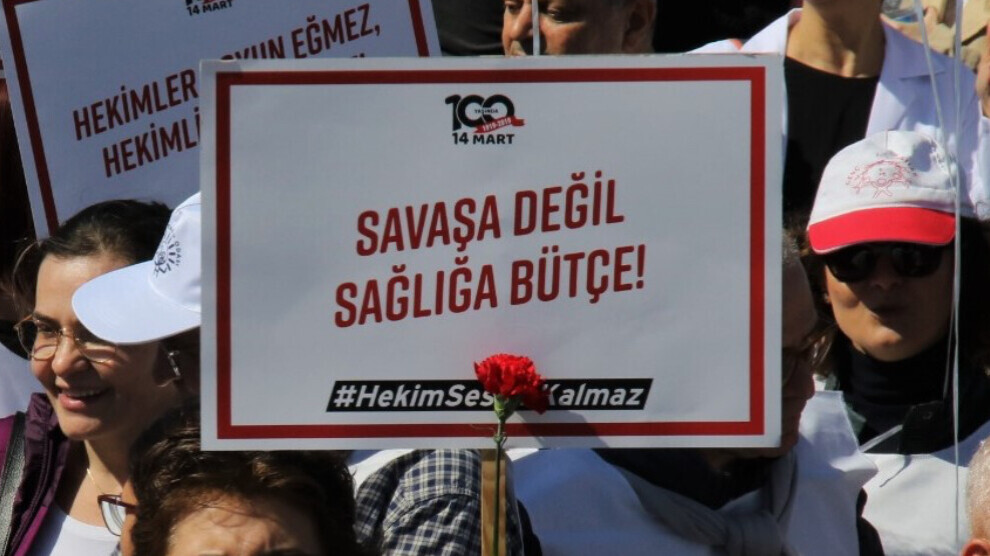
In a written statement on Tuesday, the KCK Health Committee praised the resistance of health workers and doctors who have been raising their voices for months, and celebrated March 14, Medicine’s Day in Turkey.

“The fascist AKP-MHP government should go, not the physicians,” the KCK Health Committee said in a written statement in a reference to Turkish President Recep Tayyip Erdogan's remark “If doctors want to go abroad, just let them go.”

Addressed to the medical professionals and healthcare workers that have been raising their voices, the statement of the KCK Health Committee includes the following:

“We support your actions that have been going on for months to have your voices heard. You have expressed your own demands and goals with the most persistent and revolutionary enthusiasm. The work is yours; the word is yours; this country is yours. Those who are supposed to leave this country are those who look down on your work. Those who are supposed to leave are the fascist AKP-MHP government.

You are honoured members of a profession dedicated to society and have worked to serve citizens based on your hard work, knowledge and years-long professional experience. You are the leading members of this society. Your actions and stance will lead a social revolution.

The struggle you have carried out for a long time is just and meaningful. A public health service based on preventive health care, abolition of privatizations, pay rise and introduction of legal amendments that will eliminate the violence experienced in the health sector are among the most important demands.

Violence against health workers and doctors has become an ordinary thing now. There is no legal mechanism to stop this violence. On the contrary, violence is encouraged by the authorities through social media.

Furthermore, pandemic conditions and the ongoing economic crisis continue to hit health workers and doctors. The government ignores the rights of health workers and doctors and favours capital owners. Like all social segments, you can no longer make a living as health workers. Your struggle is the concrete expression of putting an end to all these injustices.

Access to health services is getting harder and harder. The entire burden of the health system that does not function properly has been on your shoulders. Health workers are overwhelmed by the heavy workload. They are subjected to anti-democratic practices such as governmental decrees (KHK) and investigations, as well as economic problems. You are protesting against all these injustices and violence to protect your rights to freedom and the health rights of citizens.

Your protests are an objection to the fascist attacks of the Erdogan government. The government uses public expenditures over military spending against the Kurdish freedom struggle. Your struggle is also the step to say stop to this brutal war.

This system, which makes you unable to provide health services, has shown that it is not sustainable. Now is the time to enjoy your rights. You have all kinds of mental capacity and work experience to resolve the issues. We support your actions and celebrate your 14 March Medicine Day.”
Canadians sharply and evenly divided over Trudeau's pandemic performance, poll suggests

Nick Boisvert 
© Justin Tang/The Canadian Press 
The survey respondents were sharply divided on the performance of Prime Minister Justin Trudeau during the pandemic, although Canadians were much more likely to say he's done a 'very bad job ' than a 'very good job.'

A new poll says public opinion on the political response to the COVID-19 pandemic in Canada is deeply divided, with those polled split evenly on the question of how Prime Minister Justin Trudeau has handled the emergency.

The poll, conducted by the Angus Reid Institute in partnership with CBC, found that 48 per cent of Canadians say Trudeau has done a "good" or "very good" job during the pandemic so far.

Another 48 per cent said Trudeau has done a "bad" or "very bad" job.


Shachi Kurl, president of the Angus Reid Institute, said the findings appear to confirm what many Canadians have already learned about the political divide exposed by the pandemic.

"Sometimes it's a confirmation of a trend ... it just tells us where we are as a country," she told CBC News.

Trudeau's pandemic performance


Among those who said Trudeau has performed poorly, 31 per cent said he's handled the pandemic very badly — twice the number of respondents who said he's done a very good job.

Four per cent of respondents said they didn't or couldn't say how well Trudeau has performed.

The responses were collected through an online survey conducted from March 1 to 4 on a representative randomized sample of 2,550 Canadians 18 and older who are members of the Angus Reid Forum. For comparison purposes only, a probability sample of this size would carry a margin of error of plus or minus two percentage points, 19 times out of 20.

Fifty-six per cent of respondents said Chief Public Health Officer Dr. Theresa Tam has done a good job during the pandemic, while 34 per cent said she has done poorly.
Responses split sharply along party lines

Opinions about Trudeau's performance were most sharply divided on party lines, with Conservative voters voicing overwhelming dissatisfaction and Liberal supporters offering overwhelmingly positive impressions.

Among Conservatives, 84 per cent said Trudeau has done a bad or very bad job, while 88 per cent of Liberals said the prime minister has done a good or very good job.

Among NDP voters, 67 per cent said Trudeau has done well. Bloc Québécois supporters offered a more negative assessment — 62 per cent of them said Trudeau has done badly.

Do you think Prime Minister Justin Trudeau has done a good job or bad job of handling the COVID-19 pandemic?

Trudeau's performance was rated most negatively in Alberta and Saskatchewan, where 45 per cent of respondents said he has done a "very bad job." Canadians in the Atlantic provinces and British Columbia were most satisfied with Trudeau's performance.

Trudeau and the Liberal government have implemented numerous measures meant to slow the pandemic over the past two years, including the closure of international borders and the enforcement of vaccine mandates for some travellers and federal workers. The federal government was also responsible for procuring vaccines.

Canadians in the Prairies least satisfied with their premiers


Provincial governments and premiers were responsible for most of the restrictions introduced during the pandemic, including the closure of schools and businesses, the enforcement of indoor gathering limits and vaccine mandates, and the distribution of vaccines.

Atlantic Canadians were the most satisfied with their premiers, with seven out of 10 saying their premiers have done well during the pandemic.

The Atlantic provinces have experienced consistently lower case numbers than anywhere else in Canada, something attributed to precautions implemented in that region — including the Atlantic Bubble, which restricted interprovincial travel.

Outside of the Atlantic provinces, B.C. has recorded the fewest number of cases and deaths per 100,000 residents in Canada. Six out of 10 B.C. residents said they were satisfied with Premier John Horgan.

Do you think your provincial premier has done a good job or bad job of handling the COVID-19 pandemic?


Manitoba and Alberta residents were the least satisfied with their premiers.

Nearly eight out of 10 in Manitobans said Premiers Brian Pallister and Heather Stefanson have done badly.

Seven out of 10 Albertans gave Premier Jason Kenney a failing grade. Kurl said in an interview that Kenney consistently angered "a really significant constituency of Albertans" by repeatedly adjusting his approach to the pandemic.


"For Kenney in particular, what we saw is he had almost the reverse Midas touch," Kurl said of the results. "Almost every other premier struck a little bit of grace or found a little bit of extra understanding."

Respondents in Ontario and Quebec were more evenly divided, with a slim majority of Ontarians saying Premier Doug Ford has done a bad job and a majority of Quebecers (57 per cent) saying Premier François Legault has done well.
AP-NORC poll: Many Black Americans doubtful on police reform

By AARON MORRISON and HANNAH FINGERHUT

1 of 5
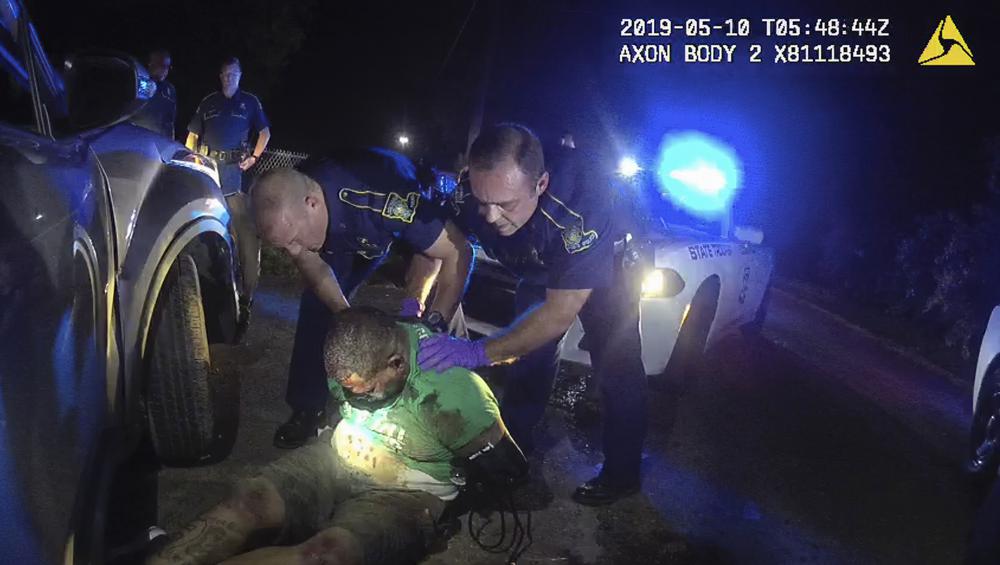
In this image from Louisiana State Police Trooper Dakota DeMoss' body camera video obtained by The Associated Press, fellow troopers hold up Ronald Greene before paramedics arrive on May 10, 2019, outside of Monroe, La. The video obtained by The Associated Press shows Louisiana state troopers stunning, punching and dragging the Black man as he apologizes for leading them on a high-speed chase. Few Americans believe there has been significant progress over the last 50 years in achieving equal treatment for Black people in dealings with police and the criminal justice system. That's according to a new poll by The Associated Press-NORC Center for Public Affairs Research. (Dakota DeMoss/Louisiana State Police via AP)


NEW YORK (AP) — Few Americans believe there has been significant progress over the last 50 years in achieving equal treatment for Black people in dealings with police and the criminal justice system.

Most Americans across racial and ethnic groups say more progress is necessary, according to a new poll by The Associated Press-NORC Center for Public Affairs Research. But Black Americans, many whom may have held hope in Democrats’ promises on racial justice initiatives in 2020, are especially pessimistic that any more progress will be made in the coming years.

Overall, only about a quarter of Americans say there has been a great deal or a lot of progress in achieving racial equality in policing and criminal justice. Roughly another third say there’s been “some” progress. An overwhelming majority of adults say more progress is needed for racial equality, including about half who say “a lot” more.

“There’s more attention around certain issues and there’s a realization — more people are waking up to a lot of corruption in the system,” said Derek Sims, a 35-year-old bus driver in Austin, Texas, who is Black. He considers himself more optimistic than pessimistic that change will happen.

However, Sims said: “People don’t really want to come together and hash out ideas. There’s just too much tribalism.”

Among those who think more progress is needed on achieving fair treatment for Black Americans by police, 31% say they are optimistic about that happening in the next few years, while 38% are pessimistic. Roughly another third say they hold neither opinion.

Only 20% of Black Americans who think more needs to be done are optimistic; 49% are pessimistic.

The AP-NORC poll results reflect what some criminal justice advocates have warned elected leaders about for more than a year: that unless something definitive is done soon to begin transforming police and the criminal justice system, it could become more difficult to mobilize dissatisfied Black voters in the midterm elections.

And already, Democrats’ pivot to the center on racial justice issues has given advocates pause. During his first State of the Union address earlier this month, President Joe Biden said the answer to reported rises in violent crime “is not to defund the police.”

“The answer is to fund the police with the resources and training they need to protect our communities,” Biden said in remarks that have been seen as a clear disavowal of some Black Lives Matter activists’ rhetoric.


In 2020, following the murder of George Floyd by police in Minneapolis, many Americans across racial and ethnic backgrounds called for criminal justice reforms in nationwide protests. On Capitol Hill, consensus on reforms, via the George Floyd Justice in Policing Act, has not been reached nearly two years later.


“What we saw from the George Floyd case, we in the Black community know that those officers were found guilty because of the outcry,” DeAnna Hoskins, president and CEO of JustLeadershipUSA, a New York-based nonprofit criminal justice reform advocacy group, told the AP.

“The only reason why you get results is because there was an outcry that included Black and white people. You’ve got a much larger voter base saying something has to be done,” she said.

Due to vastly different lived experiences, it’s been harder to get Americans across racial and ethnic groups to sustain their outcries and demand an end to systemic racism, Hoskins added.

The poll shows there is common ground on the issue across racial and ethnic groups, but also suggests there is urgency felt among Black Americans more than white Americans. More white Americans than Black Americans say there has already been significant progress toward racial equality in policing, 30% vs. 10%. Among Black Americans, 40% say there has been no progress at all.

And while at least three-quarters of white and Black Americans say more progress is needed, Black Americans are much more likely than white Americans to say a lot more needs to be done, 70% vs. 47%.

Last year marked 50 years since a war on drugs was declared in America. The bipartisan public policy at the federal and state levels saw the nation’s incarceration rate skyrocket to the highest in the industrialized world. Black Americans, in particular, bore the brunt of police militarization and laws that imposed mandatory minimum prison terms.

There were also post-incarceration consequences, such as losing the right to vote, being barred from public housing and certain college financial aid programs, and struggling to find employment with a felony record.

Compared with views on policing and criminal justice, Americans are more likely to think there has been significant progress over the last 50 years in achieving equal treatment for Black Americans in political representation, access to good education, access to good health care and access to good jobs. And there’s more pessimism about progress over the next few years in policing and criminal justice than in the other areas.

Heydy Maldonado, 30, blames how crime is covered by TV and print news outlets — which she said often frame violence in a way that suggests it is only endemic to Black and Hispanic communities — for the lack of hope in reforms.

“We get targeted,” said Maldonado, whose family is Honduran and Salvadoran. “I’m sure there’s more crime out there, and it’s not just our race, it’s not just people of color. It’s an ongoing battle.”

“I do feel like we need to be united and speak to each other and keep fighting for change,” she added. “Eventually, hopefully, this could all be a thing of the past.”

___

The AP-NORC poll of 1,289 adults was conducted Feb. 18-21 using a sample drawn from NORC’s probability-based AmeriSpeak Panel, which is designed to be representative of the U.S. population. The margin of sampling error for all respondents is plus or minus 3.7 percentage points.

___

Fingerhut reported from Washington.

___

Aaron Morrison writes about race and justice for the AP’s Race and Ethnicity team. Follow him on Twitter at: https://www.twitter.com/aaronlmorrison.
Gallup: 90% OF Americans rate Canada, Britain, France, Japan most highly


Canadian supporters cheer on Team Canada during the men's curling bronze medal game against the United States at the Beijing 2022 Winter Olympics on February 18. File Photo by Paul Hanna/UPI | License Photo

March 14 (UPI) -- Americans rated Canada, Britain, France and Japan most favorably when queried about a group of 19 countries in a new Gallup Poll conducted before Russia's invasion of Ukraine.

In contrast, North Korea, Afghanistan, Iran, Russia and Iraq were at the bottom of the list in Gallup's annual World Affairs poll, released Monday.

The survey was conducted Feb. 1 to 17, just before Russian forces began their invasion of Ukraine on Feb. 24.

More than eight in 10 Americans gave favorable ratings to each of Canada, Britain, France and Japan, (MORE THAN 8 IS 90%) while Germany (78%), India (77%) and Israel (71%) also scored highly in the poll.

Meanwhile, China (20%) and the Palestinian Authority (27%) joined North Korea, Afghanistan, Iran, Russia and Iraq in scoring lower than 30%.

Russia's favorability dropped 7 points to a new low of 15% even before its invasion of Ukraine began, while Afghanistan saw the biggest year-over-year drop of 9 percentage points to a record low of 12%. The decline came after the Taliban's quick reconquest of the country and United States' hurried military withdrawal.

In fact, none of the 19 countries saw a significant increase in favorability since last year, including such U.S. allies Germany (down 6 points), Canada (down 5 points) and Britain (down 5 points), although each remained strongly favorable.

The biggest difference between Democrats and Republicans was evident with Mexico, which has a 77% favorable rating among Democrats and only 49% among Republicans.

Read More
CRIMINAL CAPITALI$M
Russian oligarch linked to CAPO Giuliani associates indicted in donation probe


Rudy Giuliani, President Donald Trump's then-campaign legal advisor, speaks at the Republican National Committee headquarters in Washington, D.C., on November 19, 2020. File Photo by Kevin Dietsch/UPI | License Photo

March 14 (UPI) -- A Russian oligarch linked to ex-associates of President Donald Trump's former lawyer Rudy Giuliani has been indicted in connection with illegal political donations, federal prosecutors announced Monday.

Andrey Muraviev, a Russian citizen, is charged with making illegal political contributions as a foreign national and conspiring to make illegal political contributions as a foreign national in the names of straw donors, according to an indictment first returned in 2020 and unsealed Monday in U.S. District Court in New York.

Muraviev "attempted to influence the 2018 elections by conspiring to push a million dollars of his foreign funds to candidates and campaigns," U.S. Attorney Damian Williams said in a statement.

"He attempted to corrupt our political system to advance his business interests. The Southern District of New York is committed to rooting out efforts by foreigners to interfere with our elections," Williams added.

RELATED 
Impeachment: House managers say Trump sought to cheat in 2020 election

Muraviev's name figured prominently last year in the government's cases against Lev Parnas and Igor Fruman, two former associates of Trump's ex-lawyer Giuliani. He was named as the source of campaign donations given to them for the purposes of obtaining licenses for retail cannabis and marijuana businesses.

Prosecutors said funds were sent to several Republican campaigns, including those of former Nevada Attorney General Adam Laxalt for his unsuccessful 2018 campaign for governor and $325,000 for Trump's Super PAC.

It wasn't known until Monday that Muraviev was named as part of the original September 2020 indictment against the others. He is believed to be in Russia and remains at large as U.S. officials attempt to crack down on Russian oligarchs in response to Moscow's invasion of Ukraine.

RELATED 
Jury finds Lev Parnas guilty of campaign finance criminal charges

The Ukraine-born Parnas and another of his associates, Andrey Kukushkin, were convicted last year on the same campaign-finance-related charges after Fruman pleaded guilty to one count of soliciting foreign campaign contributions.

Prosecutors said Parnas gained access to elected officials and candidates through illegal fundraising efforts, showing photos of himself with Trump and Giuliani.

Giuliani has not been charged in the case, but his New York apartment and office were raided by the FBI last year in connection with the ongoing probe.

RELATED 
Giuliani associates plead not guilty to campaign finance charges

Parnas also is connected to events that led to Trump's first impeachment. He provided information to House investigators about his involvement in an effort by Giuliani, Trump's personal attorney at the time, to pressure Ukrainian officials to investigate Joe Biden.