Tuesday, March 15, 2022

Ontario colleges could strike on Friday. Here’s what that means

16,000 faculty at Ontario’s 24 public colleges could strike on Friday unless the College Employer Council (CEC) agrees to voluntary binding interest arbitration, says the union.


By Ivy MakToronto Star
Tue., March 15, 2022

The union representing more than 16,000 faculty members from Ontario public colleges is threatening to walk off the job Friday if its bargaining demands are not met.

In Brampton on Tuesday, Ontario Premier Doug Ford addressed the looming strike deadline, adding he doesn’t like when anyone goes on strike, especially “when we went through such tough times.” He called on Minister of Colleges and Universities Jill Dunlop, who added that the province is monitoring the process closely.

“I've heard from students and from parents who are very upset. Students cannot afford a strike at this time. They're finally back in the classroom. That's where they need to be,” Dunlop said.

Ontario Public Service Employees Union (OPSEU) issued an open letter to college presidents on Monday, saying staff are prepared to strike if the College Employer Council (CEC) does not agree to “voluntary binding interest arbitration” to settle outstanding contract issues.

In response, the CEC notes that its made numerous attempts to reach an agreement, but the union rejected request without discussion, they said in a statement.

Here’s what we know so far.

When is the strike deadline?


Some 16,000 faculty at Ontario’s 24 public colleges could go on strike at 12:01 a.m. on Friday after staff rejected the latest offer from the CEC last month.

The union has been in contract negotiations with the CEC since July around better educational tools and job security. Ontario public college staff have been working without a collective agreement since Sept. 30. Negotiations between the two groups broke down in November.

The faculty have been working to rule since December, instead of picketing, said the union.

JP Hornick, chair of the bargaining team, said, “Our members are fighting for the best education for students,” said Hornick. “We haven’t made any unreasonable demands, and everything we have asked for is easily achievable.”

Who would the strike impact?


The looming strike deadline includes professors, librarians, instructors and counsellors employed by Ontario’s 24 public colleges. It could impact nearly a quarter of a million students. OPSEU represents more than 16,000 public college staff members.

It would impact colleges in the GTA including Centennial College, Durham College, George Brown College, Humber college, and Seneca college.

The College Student Alliance (CSA) is calling on the province to step in now ahead of a possible strike.

“Students should be the priority during this process. CSA encourages college faculty and the colleges themselves to come back to the table and negotiate to avoid a strike,” said Eli Ridder, president of the CSA in an emailed statement to the Star on Tuesday.

College students penned an open letter earlier this month addressed to the CEC, OPSEU, and the Ministry of Colleges and Universities.

The Ontario Students Association expressed fear of a repeat of the 2017 strike, which it says, “left students feeling that the culminating weeks of their year were rushed and incomplete, that they were unprepared for the workforce, and that their relationships on campus were damaged.”

The 2017 strike lasted five weeks before the province passed back-to-work legislation paving the way for students to return to class.

What is the union fighting for?

Bargaining team chair JP Hornick said union members want better job security for faculty who are on partial-load contracts. Hornick said the CEC reported profits of $1.65 billion in the last five years, most of it coming from outside contracts, unpaid overtime and uncompensated work of partial-load staff.

She added that due to Bill 124, which caps public-sector wage increases at one per cent a year for the next three years, the union is not bargaining for additional compensation.

The union is also demanding the following terms:

An improved mechanism to evaluate instructor workload

Increase maximum time they can dedicate to evaluate to 6.8 minutes per student, per week. Right now, this figure stands at five minutes per student.

Preparation time for online learning

Stop contracting out counsellors and other faculty work, especially in the midst of a mental health crisis for students.

Hire full-time academic librarians. There are 11 colleges without a full-time academic librarian and all of them offer degree programs.

Get faculty consent before the sale or reuse of faculty course materials.

Jointly led committees and round tables that can actually study, make and implement changes around workload, equity, and Indigenization, decolonization and Truth and Reconciliation.

What is CEC’s response?

The CEC says it made “numerous attempts to reach an agreement” with the union, and that in March 2021, asked OPSEU to, “extend the current agreement without any changes so that we could complete the school year without interruption and recognize the uncertain times in which we are living.” According to a statement by the CEC, the union rejected the request without discussion.

The CEC says the union is, “demanding changes that they know colleges cannot make,” like, “demands about their workload that violate the law governing compensation.”

“The Union is claiming it had no choice but to strike because the Colleges have refused to bargain and have refused arbitration. This is simply untrue.” read the statement by the council representing colleges.

Binding interest vs. final offer arbitration


In labour disputes, binding interest arbitration is often used in post-secondary education bargaining in order to resolve differences in the proposals from both sides. A third party neutral arbitrator is asked to review both proposals and “creates a compromise from the two proposals,” OPSEUs said. The union says binding interest is an alternative to a strike or a lockout.

The CEC, says the union, uses a different form of arbitration where the arbitrator selects the proposal from only one of the parties and appears to double down on its refusal to enter binding interest arbitration.

“These demands fall well outside any acceptable provision. We can never accept them,” says the CEC.

With files from Joshua Chong and Akrit Michael.

College faculty at Algonquin, across province set strike date of Friday


Ontario college faculty staged a five-week strike in 2017. It ended after the provincial government legislated employees back to work.

Author of the article: Jacquie Miller
Publishing date: Mar 15, 2022 
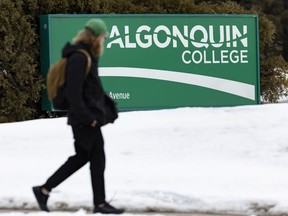
A student walks past an Algonquin College sign at the Woodroffe campus on Tuesday.
 PHOTO BY ERROL MCGIHON /Postmedia
Article content

Faculty at Ontario colleges, including Algonquin and Collège La Cité in Ottawa, are prepared to strike on Friday, says the union representing them.

As the clock ticks toward the 12:01 a.m. Friday strike deadline, each side in the dispute accuses the other of failing to be reasonable and says it wants to avoid disrupting the school year for students.

The Ontario Public Service Employees Union union says they won’t stage a walkout if the colleges agree to use “binding interest arbitration” to settle contract negotiations that have reached an impasse.

That means a third-party arbitrator would settle the dispute, a course of action that is often employed in the post-secondary sector, the union said in an open letter.

“This would end the negotiations without a strike or lockout,” OPSEU’s letter said.

Ontario college faculty staged a five-week strike in 2017. It ended after the provincial government legislated employees back to work.

The College Employer Council, which bargains for management, has proposed “final offer” arbitration, which means both parties submit a proposal and an arbitrator picks one. That is supposed to force both parties to compromise.

The Employer Council, in a statement, said it offered a year ago to extend the current agreement with no changes “so that we could complete the school year without interruption and recognize the uncertain times in which we are living.”

The council says the union’s proposals are unrealistic and some are not possible — for example, a reduction in workload that an independent mediator said would contravene Bill 124, passed by the Conservative government to limit wages of public-sector employees.

Salary increases are not a key issue since that legislation prohibits increases in compensation of more than one per cent annually.


The union’s lawyer provided a different opinion, saying the proposals would not violate Bill 124.

Some major issues in the dispute are the same as they were in 2017: workload and job security and benefits for part-time staff.

Many college courses are taught by contract instructors who have no job security. “Essentially, they have to reapply for their position every (semester),” said Annette Bouzi, president of the OPSEU local at Algonquin.

The workload formula hasn’t changed since 1985, Bouzi said. However, the workload has increased “exponentially,” with changing technology adding things like email, building websites and digital platforms to every-day faculty duties.

Other issues include contracting out of work, the status of academic librarians and equity issues, she said.

The union represents 16,000 faculty, professors, librarians, instructors and counsellors at Ontario’s 24 publicly-funded colleges.

The contract expired Sept. 30, 2021. Negotiations began in July, but went nowhere, according to mediator Brian Keller, who was hired last fall to help the parties reach an agreement.

Keller concluded the unions’s proposals were “highly aspirational and completely unrealistic” and “almost all that was being sought by OPSEU was “unachievable either through direct negotiations with the employer or, if it came to that, in binding arbitration.”

The Employer Council forced a February vote on a final contract offer that union members rejected.

OPSEU members have staged a work-to-rule campaign since December. It includes, among other things, not working beyond the hours for which they are compensated, not entering grades into the college data system and not grading assignments, submitting grades, preparing courses or taking part in college activities or meetings during reading week.

“Faculty have done our best to limit the impact of our strike action on students and to avoid a picket line,” OPSEU’s letter said.

“Now, however, you (management) have again ramped up your threats against individual faculty and appear to be moving toward a lockout instead of negotiating a deal.”

The employer council says it will not lock out staff.

Jill Dunlop, Ontario’s minister for colleges and universities, said she was monitoring the situation. “I’ve heard from students and from parents who are very upset,” she said Tuesday in response to a question at an unrelated media conference.

“Students cannot afford a strike at this time. They are finally back in the classroom. That’s where they need to be, that’s where their best education is, where they are collaborating with their colleagues and their faculty.”

Student association presidents from eight Ontario colleges sent a letter to Dunlop, the union and management on March 4, saying students should not have their lives disrupted by the dispute.

“This is happening alongside various other global events, the most pervasive being the ongoing pandemic and the restrictions and difficulties it poses to students. Students are already experiencing surges in mental health crises, financial insecurity and reduced quality of education.”

The letter said students feared a repeat of the 2017 strike, which “left students feeling that the culminating weeks of their year were rushed and incomplete, that they were unprepared for the workforce, and that their relationships on campus were damaged.”

The student associations at Algonquin and La Cité were not among the signatories to that letter.

jmiller@postmedia.com

Ontario college students are absolutely freaking out over forthcoming strike


If you've been a student in Ontario in the last two years, you've had anything but the normal school experience that one would hope for.

The impromptu switch to completely remote learning has been a disaster for many, with only brief stints of a return to classroom for proper in-person instruction and undeniably vital socialization.

For post-secondary learners, it's been especially frustrating, as many feel that they haven't been getting what they're paying big bucks for. And now, a looming strike has served as the cherry on top of a crummy few semesters.

Approximately 16,000 faculty across the two dozen public colleges in Ontario are set to strike later this week, with the Ontario Public Service Employees Union (OPSEU) saying in an open letter on Monday that members will strike starting this Friday if their demands are not taken seriously.

The union is asking that ongoing labour disputes be taken to binding interest arbitration, in which an impartial arbitrator looks at the wants of both parties and makes the ultimate decision — hopefully some type of fair compromise between the two — with both sides having to stick to their proposed resolution.

The deadline that OPSEU has given the College Employer Council (CEC) to respond is 12:01 a.m. on March 18, at which time employees will walk off the job if the CEC has not accepted.

Staff rejected the CEC's last offer in February, with their union saying in a letter yesterday that their employers have "told us from the outset of bargaining that [they] are unwilling to negotiate unless we drop our proposals that [they] find unacceptable."

"Binding interest arbitration has been the usual way for labour disruptions to be settled in the past when we have not been able to negotiate an agreement. It is the common way for labour disputes in the post-secondary sector to get resolved — common enough that it’s written into several collective agreements," the union's letter continues.

"All you have to do is AGREE... we will not strike if you agree to binding interest arbitration."

At this point, some seem sure that the union will indeed end up striking, while others are more hopeful that it may not happen.

But the threat of such an incident mid-second semester of the academic year is stressing the heck out of a lot of students, especially after what they've already had to deal with in terms of their education during the pandemic.

Instructors started work-to-rule action three months ago as part of the dispute, meaning that they have been deliberately doing the bare minumum required of them instead of going above in beyond — which has, of course, impacted students and their education.

Many are understandably pissed at the prospect of now also having to defer their schooling to a later date or completely lose the work they've done so far.

Those who have co-op and internship components in their programs are freaking out even more at the prospect of completely losing their placements.

And many feel completely in the dark about what a strike would mean for them.

"My college might be going on strike and it’s possibly the worst time to be doing it," one student tweeted in the middle of the night last night.

"If colleges strike I’m gonna lose my fkn mind I swear," another added around 1:45 a.m., also apparently kept awake by the drama.

Toronto institutions impacted include Centennial, George Brown, Humber, and Seneca Colleges, as well as nearby Durham, Conestoga, Fanshawe, Fleming, Georgian, Mohawk and Sheridan.

Students and staff at these schools will unfortunately just have to wait until Friday to see what happens.


Hong Kong's Covid divide: Expats get more perks while domestic workers lose their homes

By Michelle Toh and Lizzy Yee, CNN Business
 Tue March 15, 2022

Hong Kong (CNN Business)Maria was just about to start a new job as a domestic worker in Hong Kong last month when she found out she had Covid-19.

She immediately told her employer, who urged her to get to a hospital. But once she was there, she said she was turned away, with staffers explaining there was no room. They advised her to go home and quarantine.

The problem? Her place of work was her home and "my employer didn't want me to come back," said Maria, noting that they had "kids in the house."

"I said, 'I don't know where I can go. We don't have a place,'" she told CNN Business, breaking into tears. She asked not to publish her real name, for fear of reprisals from current or future employers, and to not worry her family abroad. CNN Business agreed to call her "Maria."

Foreign domestic workers are required to live with their employers in Hong Kong, under a longstanding government mandate that has been contested for years.

Maria, who is from the Philippines, returned to the hospital, where she spent the night sleeping on a chair in the emergency room, along with a friend in a similar situation. But the next day, they were told by a nurse more expressly to "go away," she said.
Not knowing what else to do, they set up camp on the street.


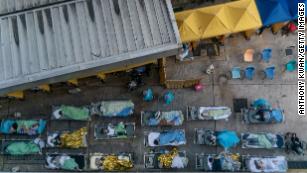
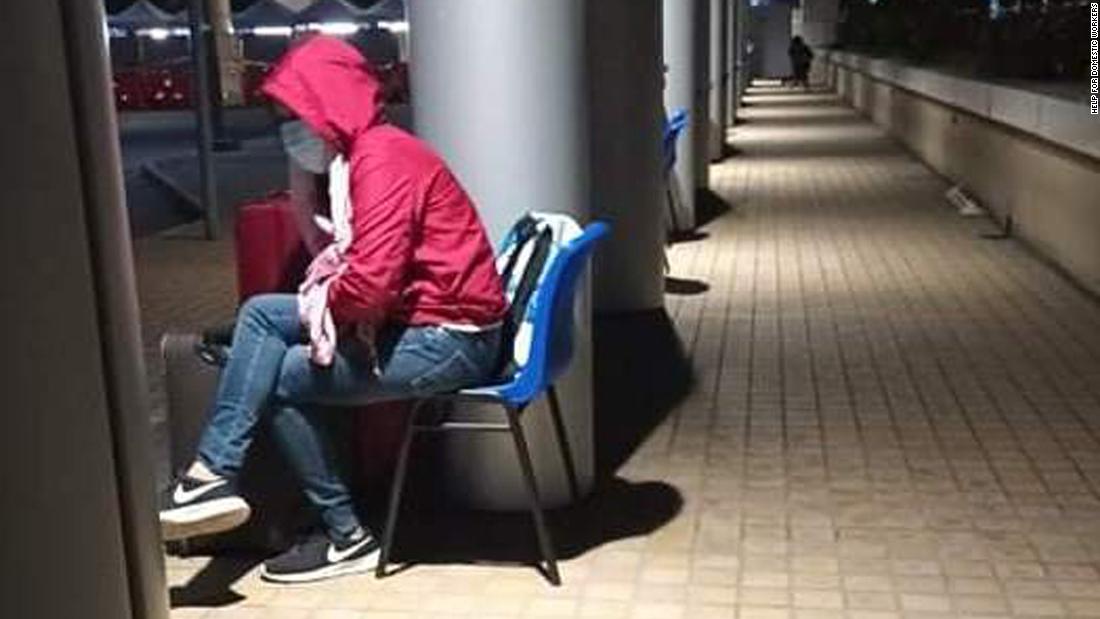
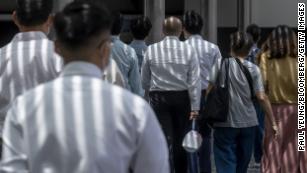
In recent weeks, dozens of domestic workers have been cast out on the streets in Hong Kong after testing positive for Covid-19. One worker, not pictured here, said she was not allowed home with her employer over fears of contagion.

"We cannot express what [we] feel [at] that time — just crying only," said Maria.
Maria and her friend eventually found a shelter to stay in, run by the charity HELP for Domestic Workers.

Maria is one of dozens of migrant domestic workers who have been abandoned — and temporarily made homeless — in Hong Kong after testing positive for the coronavirus, according to the charity. Her story, and others like it, shine a light on deep-seated inequalities in the city that are worsening under a devastating fifth wave of Covid-19.


Pets travel in style as their owners race to get them out of Hong Kong 03:20

To be sure, workers across the spectrum are struggling in Hong Kong, given its rigid pandemic measures.

But as top companies give their employees more flexibility and even help pay for expensive hotel quarantines, local businesses are teetering on the brink of collapse. And while some expatriates can command higher salaries for simply agreeing to move to the city, the city's poorest are struggling just to afford food or basic necessities.

Heading for the exits

The widening gap comes at a time when Hong Kong is facing an exodus of expats, despite the additional benefits on offer, which continues to raise questions about its future as a global business hub.

Many foreigners have had enough of the city's unwavering commitment to its "zero Covid" policy, even as cases surge to record highs and cause more fatalities, overloading the health care system and delivering a huge punch to the economy.

Throughout 2020 and 2021, more residents left Hong Kong than came in, according to official population statistics. That marked a reversal from early 2019, when the population was going up.

Last month alone, more than 94,000 people departed the city, while only about 23,000 came in, immigration data showed.

"The recent wave of emigration is leading to a shortage of skilled workers and impacting businesses of all sizes," the Hong Kong General Chamber of Commerce said in a statement earlier this month.

The group's chairman, Peter Wong, said the city was "facing an exodus of educated workers on a scale not seen since the early 1990s."

"This will have a material knock-on impact on the economy," he added. "There is real cause for concern if we cannot stem the current brain drain."

The city has been largely sealed off from the rest of the world for the last two years, in part because most inbound travelers must quarantine in hotel rooms at their own expense for two weeks. Previously, the requirement was for three weeks.


The issue has increasingly forced companies to rethink where their employees should be based, if only for now.

Last month, Mandarin Oriental (MAORF) CEO James Riley told the Financial Times that the former British colony had become a "very, very poor" base due to the restrictions.
According to the newspaper, the hotel group recently advocated for senior executives to temporarily live abroad, away from its Hong Kong headquarters. Mandarin Oriental declined to comment to CNN Business.

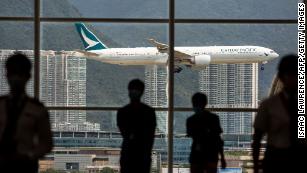
Last year, Cathay Pacific (CPCAY) said that it would consider letting some of its pilots live abroad for a few months as aircrew continued to face arduous self-isolation measures. The carrier later said that its workers spent more than 73,000 nights in government-mandated quarantine in 2021.

French spirits maker Pernod Ricard (PDRDF) has also asked top executives from its Hong Kong office to work abroad for some time, according to unidentified sources who spoke with the FT. The company did not respond to repeated requests for comment.
Meanwhile, other players have moved away entirely.

In November, FedEx (FDX) said it would shut down its crew base in Hong Kong and relocate pilots, citing the city's "pandemic requirements."

From the start of the pandemic through the end of last year, at least 84 companies have either closed or moved their regional headquarters out of Hong Kong, according to CNN Business calculations based on government data.

Asked about the figure, a government spokesperson responded that "Hong Kong remains a competitive city globally and a major regional base for international companies."

The representative also pointed to emerging opportunities in the Greater Bay Area, a zone connecting Hong Kong, the southern Chinese province of Guangdong and the city of Macao as "a market of 86 million people." Many banks have honed in on the area as a key priority in the coming years.

The government, which includes mainland Chinese companies in its annual tally of international businesses in Hong Kong, said that the number had recently "risen to a record high of 9,049."

But the exodus amongst Western players may not slow down this year.

BASF (BASFY), a German chemicals giant, recently relocated its chief for Asia Pacific, excluding Greater China, to Singapore "after careful consideration of her office's strategic location in the region," according to the company.

The decision was based on "the requirement for proximity to relevant stakeholders and markets," it told CNN Business in a statement.

Others may be biding their time. Hong Kong recently brought forward the end of the school year for some institutions to March or April, giving families more time to reevaluate their options before the new term begins in September.

In some sectors, bonus season typically takes place around this period, too.

"I suspect there's a lot of international bankers who may be waiting till then before they decide whether they've had their fill of Hong Kong," said a person working in the finance industry, who spoke on condition of anonymity due to the sensitivity of the matter.

Free flights and country clubs

This exodus means that top companies in the city are working extra hard to attract — and retain — skilled workers.

Two senior headhunters in Hong Kong said that job candidates were increasingly pricing in the inconvenience of living in the city — if they were even persuaded to do so.

"Most of them are just kind of immediately saying no," said John Mullally, regional director of Southern China and Hong Kong financial services at recruitment agency Robert Walters.

"You've got a smaller candidate pool, especially when it comes to those with overseas experience."

Mark Tibbatts, managing director of Southern China and Taiwan for the agency Michael Page, described it as "an ongoing battle" that had made it "nigh on impossible" to lure international talent.


A view of Hong Kong's skyline, captured on Wednesday.

The circumstances have revived the so-called "expat package," which had mostly been scrapped in recent years, according to both recruiters.

"Let's go back a couple of decades. Most of the senior expats in Hong Kong were on a pretty juicy package that might have included flights home, and education, and club memberships and all these types of things," said Tibbatts. "Over the last, let's say, 10, 15 years, most of that's been phased out."

Now, some of those deals are "coming back," he added.

Mullally also described a rising view that Hong Kong was becoming "a bit of a hardship posting" for expats, a term that typically refers to a place with hostile living conditions.
That perception was more common from the 1970s to early 1990s, and back then justified more perks for businesspeople, he said.

Now, companies are "going to have to try to bring that back because ... realistically, if you want to attract people, that's kind of the package you'll have to put together."

Nowhere to go

As international executives jump ship, blue-collar workers an
d the city's poorest are being left behind to face the darkening economic outlook.

It's not just in Hong Kong: Inequality around the world has worsened throughout the pandemic, with billionaires making unprecedented gains in wealth as tens of millions of people fall into poverty.

Despite a growing shortage of domestic workers in Hong Kong, "it is not easy to say whether [the pandemic] has as a whole positively or negatively impacted them," said Manisha Wijesinghe, executive director of HELP for Domestic Workers.

"We definitely have seen a number of domestic workers who are being offered higher than statutorily mandated wages due to the shortage of incoming domestic workers," she said.


Hear how restrictions in Hong Kong are affecting their citizens 02:51

"But we have also seen domestic workers being forced to take on salaries lower than the minimum allowable wage ... there is a power imbalance."

From January 2020 to the end of 2021, the city's number of domestic workers dropped from more than 400,000 to roughly 340,000, according to government statistics.
In a recent blog post, Hong Kong Labor Secretary Law Chi-kwong pointed to flight bans from certain countries as a possible reason for the slump, saying that some workers had likely been stranded abroad.

When asked about the plight of domestic workers, authorities told CNN Business that foreign workers who test positive for Covid-19 "will receive support and medical treatment like local people in Hong Kong." And, if unemployed, they will be admitted to community isolation facilities, they said.

A government spokesperson also said that it "has continuously reminded employers of their statutory obligations and requirements" during the pandemic, and "any breach of such requirements will render them ineligible to employ [a domestic worker] for a period of time."

'Zero income'

While big international firms may have the privilege to up and move, most local businesses have no choice but to hunker down.

As many as 50,000 small businesses could shut down over the city's fifth wave of Covid, estimates Danny Lau, chairman of the Hong Kong Small and Medium Enterprises Association.

That's about one in seven such registered entities across the city — and there could be more, he said.

Despite soaring infections, Hong Kong officials have been holding onto the "zero Covid" strategy in recent weeks, introducing social distancing restrictions that have stifled local activity.

Hong Kong is facing an exodus of educated workers on a scale not seen since the early 1990s.
PETER WONG, CHAIRMAN OF THE HONG KONG GENERAL CHAMBER OF COMMERCE

Many places, such as beauty parlors and fitness studios, have been forced to stop operating for months until the current measures end.

"They don't have any income. Zero income," Lau said of those business owners. He added that some had resorted to operating secretly just to keep making a living.
Like elsewhere, small businesses had already been hit hard earlier in the pandemic, especially by the lack of tourists.

These firms were "almost half dead," said Lau, noting that some entrepreneurs had already taken out significant loans or dug into their reserves just to stay afloat.


"The worst thing is you cannot see the future," he added. "We don't know how long these restrictions will last for."

SHARKS SWIM TOGETHER

Toronto lawyer Jeremy Diamond deserves more than a reprimand, tribunal rules


Jeremy Diamond’s misleading advertising misconduct requires more than a reprimand, a Law Society Tribunal has concluded, rejecting a joint submission between the Toronto personal injury lawyer and prosecutors.

Last year, Diamond admitted before a disciplinary panel that between 2013 and 2017 he had improperly marketed personal injury legal services that he did not provide, failing to disclose “clearly and prominently” that Diamond & Diamond referred thousands of potential clients to other lawyers for fees.

In written submissions, Diamond argued his role was “not dissimilar to that of many senior lawyers who focus on business development and firm management, while serving as a mentor for junior lawyers and maintaining some involvement in individual cases.”

Diamond’s legal team, led by Toronto criminal lawyer Brian Greenspan, and law society prosecutors jointly submitted that a reprimand was the appropriate penalty, proposing Diamond pay $40,000 in costs.

However, Malcolm Mercer, tribunal chair, said he was concerned that the proposed reprimand would amount “to a mere slap on the wrist.”

That triggered more hearings, including over Diamond’s attempt to have Mercer removed as panel chair. That failed, and subsequently more arguments were held last fall on whether a reprimand was a sufficient penalty.

Last week, the tribunal released its decision containing detailed reasons why a reprimand — the most lenient penalty available to the tribunal — would be “unhinged from the circumstances of the misconduct in this case.”

“In our opinion, a reprimand is so lenient, in the context of failures of honesty and integrity in communications to very large numbers of potential clients over a lengthy period of time, that a reasonable and informed person would be concerned that the regulation of legal professions does not take honesty and integrity seriously,” the panel wrote.

After the tribunal indicated last year that it wasn’t prepared to go along with the penalty, Diamond filed a motion to withdraw his admissions of professional misconduct.

“I was never aware and I did not contemplate that a potential penalty could exceed a reprimand here,” Diamond said last year. “Had I known that that was a possibility, I would never admitted to the misconduct, and would have had a hearing.”

There are no minimum or maximum penalties for lawyers found guilty of professional misconduct, and the range can include suspension or even disbarment. Past tribunals have not accepted joint submissions on costs and have increased proposed penalties.

Last year, Greenspan said that for a guilty plea to stand, “an accused must be aware of the criminal consequences as well as the legally relevant collateral consequences.” Since that wasn’t the case here, he argued, “we say there is no alternative but to abort this hearing at this stage and go back to square one.”

Greenspan declined to comment but confirmed arguments will be held on the withdrawal motion later this month.

FIDE President Arkady Dvorkovich speaks out against the war in Ukraine

by ChessBase

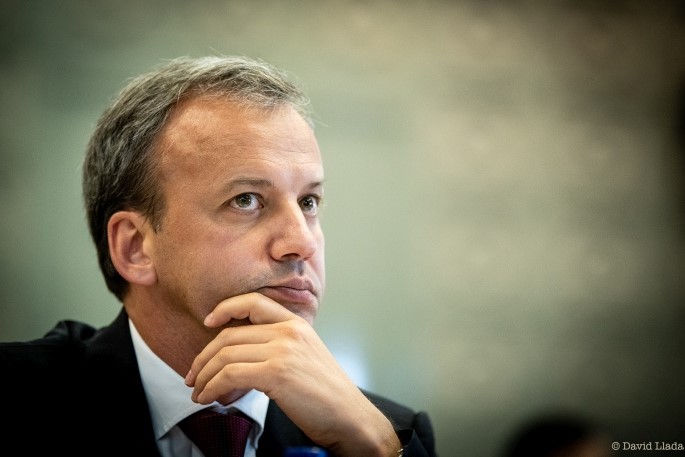
3/15/2022 – The American magazine "Mother Jones", seven times winner of the "Magazine of the Year" award from the American Society of Magazine Editors, just published interviews with 36 prominent personalities from the world of chess about the war in Ukraine. One of them is FIDE President and former Russian Deputy Prime Minister Arkady Dvorkovich, who spoke out against the war: "My thoughts are with Ukrainian civilians. ... Wars do not just kill priceless lives. Wars kill hopes and aspirations, freeze or destroy relationships and connections." | Photo: David Llada

Exclusive: Former Top Kremlin Official Who Chairs Global Chess Federation Decries Russia’s War on Ukraine

"My thoughts are with Ukrainian civilians," says Arkady Dvorkovich.

Daniel King

Note: The author is Mother Jones staff editor Daniel King of the United States, not to be mistaken for ChessBase author and popular chess commentator GM Daniel King.

Fight disinformation. Get a daily recap of the facts that matter. Sign up for the free Mother Jones newsletter.

Two weeks ago, the world’s top chess authorities voted to sharply rebuke Russia for its invasion of Ukraine. The unanimous decision by the International Chess Federation (FIDE) to ban Russians from competing under their own flag, and strip the country of the Chess Olympiad slated for Moscow this summer, is extraordinary not just because it sidelines Russia from the game it had dominated for half a century, but because of who joined the chess world in repudiating Russia: former Russian Deputy Prime Minister Arkady Dvorkovich.

In an interview with Mother Jones, Dvorkovich, who is now president of FIDE, voiced his opposition to the war, becoming one of the very few, or only, former senior Kremlin officials to openly criticize it. "Wars are the worst things one might face in life…including this war," Dvorkovich tells me from Russia, where he says he is "safe with my family and friends."

Dvorkovich, who served at the Kremlin for 10 years, joins scores of chess leaders in decrying Vladimir Putin’s invasion. "My thoughts are with Ukrainian civilians," Dvorkovich tells me. "Wars do not just kill priceless lives. Wars kill hopes and aspirations, freeze or destroy relationships and connections."


Links


Two extremes at the same time: Precipitation trends determine how often droughts and heat waves will occur together

Two extremes at the same time
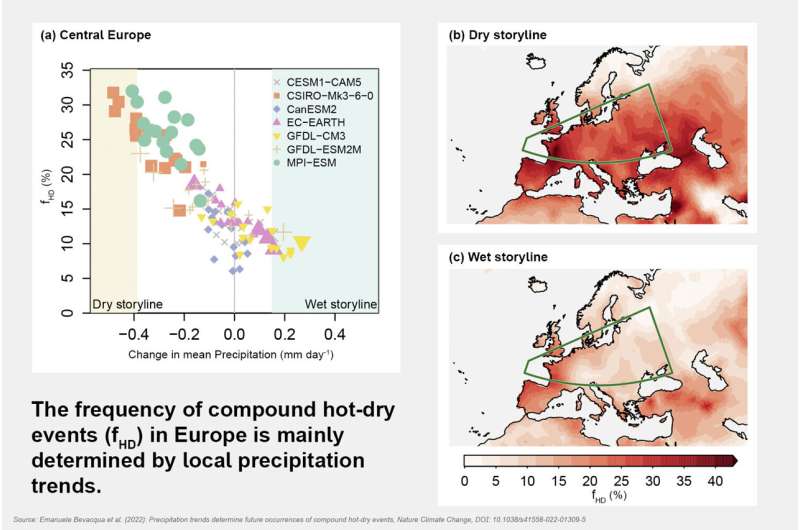
For Central Europe, when using multiple plausible simulations from seven different climate 
models and assuming different precipitation trends, the frequency of compound hot-dry
 events varies. In a future 'dry storyline', these compound events occur significantly more
 frequently than in a future 'wet storyline'. Maps (b) & (c) illustrate this using the example 
of Central Europe: in the case of the 'dry storyline', on average across all simulations, both 
extremes may occur concurrently at least every four years on average, while in the case of
 the 'wet storyline', it is every ten years. In the historical time period from 1950-1980, 
compound hot-dry events occurred every 25 years on average. Credit: UFZ

Prolonged droughts and heat waves have negative consequences both for people and the environment. If both of these extreme events occur at the same time, the impacts, in the form of wild fires, tree mortality or crop losses—to name a few examples—can be even more severe. Climate researchers at the Helmholtz Centre for Environmental Research (UFZ) have now discovered that, assuming a global temperature increase of two degrees in the course of global warming, the future frequency of these simultaneously occurring extreme events is primarily determined by local precipitation trends. Understanding this is important, since it enables us to improve our risk adaptation to climate change and our assessment of its consequences, as they write in the journal Nature Climate Change.

The fact that  will increase temperatures over land masses, increasing the frequency of droughts and heat waves, is a certainty—as is the fact that  will alter the average amount of precipitation on land. However, it has remained unclear until now under what conditions both extreme events will occur together, known as compound hot-dry-events. The UFZ researchers have defined these events as summers in which the average temperature was higher than in 90% of the summers between 1950 and 1980, and precipitation was simultaneously lower than in 90% of those years.

"In the past, periods of drought and heat waves were often considered separately; there is, however, a strong correlation between the two events, which can be seen in the extremes experienced in 2003 and 2018 in Europe. The negative consequences of these compound extremes are often greater than with one single extreme," says UFZ  researcher Dr. Jakob Zscheischler, last author of the study. Until now, however, it was not known what the future simultaneous occurrence of these extremes depends on—the uncertainties in the occurrences estimated via routinely used  were too large to arrive at robust pronouncements.

The researchers have now used a novel model ensemble, comprising seven , to reduce and better understand these uncertainties. Each model simulation was carried out up to 100 times in order to account for natural climate variability. They examined the historical period between 1950 and 1980, comparing the results with those of a potential future climate that is two degrees warmer than preindustrial conditions.

"The advantage of these multiple simulations is that we have a much larger volume of data than with conventional model ensembles, enabling us to better estimate compound extremes," explains Dr. Emanuele Bevacqua, first author and climate researcher at the UFZ. The researchers were able to confirm the previous assumption that the average frequency of compound hot-dry events will increase with global warming: while the frequency lay at 3% between 1950 and 1980, which statistically is an occurrence every 33 years, in a climate that is two degrees warmer, this figure will be around 12%. This would be a four-fold increase compared to the historical period studied.

The  were also able to determine from the simulations that the frequency of compound hot-dry events in the future will be determined not by temperature trends, but by precipitation trends. The reason for this is that, even with a moderate warming of two degrees, local temperature increase will be so great that in the future, every drought anywhere in the world will be accompanied by a , regardless of the exact number of degrees by which the temperature increases locally. The uncertainty in the warming leads to an uncertainty in the prediction of compound hot-dry event frequencies of only 1.5%. This discounts temperature as a decisive factor for uncertainty. For precipitation, however, the researchers calculated an uncertainty of up to 48%.

"This demonstrates that local precipitation trends determine whether periods of drought and heat waves will occur simultaneously," explains Emanuele Bevacqua. For Central Europe, for example, this implies that in the case of a 'wet storyline' with increasing precipitation, concurrent droughts and heat waves will occur on average every ten years, whereas in the case of a 'dry storyline' with decreasing precipitation, they will occur at least every four years. For Central North America, these events would be expected every nine years ('wet storyline') and six years ('dry storyline'). These regional storylines for precipitation trends can be used as a basis for decisions on adaptation (for example, to evaluate best and worst case-scenarios).

However, even if we know that precipitation trends are decisive for the occurrence of concurrent droughts and heat waves, it is still difficult to predict them any more reliably: "Climate change may shift the distribution of precipitation in certain regions. The pattern of  depends on atmospheric circulation, which determines regional weather dynamics through numerous interactions over large parts of the globe," says Emanuele Bevacqua. Since the dynamic of many of these processes is not yet fully understood, it is difficult to reduce these uncertainties any further.

This finding—that a trend in one variable determines the future occurrence of two simultaneous extreme events with a global temperature increase of two degrees—may also be used for other compound extremes. For example, it can be applied to the interaction of tropical storms and heat waves, or of marine  and acidity extremes in the oceans. "In these cases, it is the trend in storm frequency or ocean acidification, respectively, that is the deciding factor which determines the concurrence rates of the two  in the future," says Jakob Zscheischler.Global warming intensifies precipitation extremes in China

More information: Emanuele Bevacqua, Precipitation trends determine future occurrences of compound hot–dry events, Nature Climate Change (2022). DOI: 10.1038/s41558-022-01309-5. www.nature.com/articles/s41558-022-01309-

Journal information: Nature Climate Change 

Provided by Helmholtz Association of German Research Centres 

Twenty-first century hydroclimate: A continually changing baseline, with more frequent extremes | PNAS

IT'S A MYTH
Every tool in the toolbox: Why we need carbon capture, utilization and storage in the fight against climate change

By Jonathan Wilkinson & Steven Guilbeault | Opinion | March 14th 2022

Natural Resources Minister Jonathan Wilkinson (left) and Environment Minister Steven Guilbeault make the case for carbon capture utilization and storage, a technology with its supporters and detractors. Photos by Alex Tétreault and Josie Desmarais

When it comes to climate change, here’s what we know:

Science tells us that emissions must go down — urgently. Steadily, we have to chart a path to net-zero emissions, meaning we put fewer polluting emissions in the air than we take out. And realistically, this can only happen if we use every tool at our disposal.

Later this month, our government will release a detailed plan for how Canada will cut emissions on the road to net-zero by 2050. This plan will be ambitious — after a devastating year of forest fires, flooding, deadly heat waves and more, Canadians are calling for nothing less. But it will also be achievable. And alongside a whole range of measures to cut emissions, that’s where innovative technologies like carbon capture, utilization and storage (CCUS) come into play.

What is CCUS? Basically, it’s the deployment of technologies that capture carbon dioxide from heavy industries — think cement, steel, fertilizer, oil and gas — and then either permanently store it deep underground by inserting it into rock formations or completely repurpose it to make new products like soap or cement.

Since too much carbon dioxide (CO2) in the air is what drives climate change, taking it out of the air is an intuitive solution. And as Canadian industry shows, it works.

Take for example the cement plant CO2MENT in Richmond, B.C., that uses a CCUS “capture unit” to pipe the airborne pollution through a rotating set of filters that screen out the carbon particles from the air and reuse them for CO2-cured concrete, thus storing it permanently.

According to the International Energy Agency’s (IEA) Net‐Zero Emissions by 2050 scenario, the scale-up of CCUS needs to be rapid and immense — with 1.6 gigatonnes of carbon dioxide per year captured globally by 2030, rising to 7.6 gigatonnes per year in 2050. This is approximately 15 per cent of total greenhouse gas reductions and 190 times what is captured today. Moreover, the IEA finds that without CCUS, the cost of reaching global 2050 net-zero goals will increase by approximately US$15 trillion.

With our abundance of natural resources and skilled labour, Canada is well-positioned to lead global growth in CCUS. And since Canada is warming at twice the rate of the rest of the world, it’s in our national interest to do so. As we continue to use fossil fuels in our cars and in our homes over the short- to medium-term, CCUS needs to be a key part of the transition to a net-zero economy.

Canada is already among the global leaders in this startup industry. We now host five of the world’s 21 CCUS facilities. One out of every six tonnes of CO2 that have been captured globally with CCUS is Canadian. We’re fourth in the number of CCUS patents granted, behind the U.S., China and the European Union. This technology is still in its early stages, but is already employing thousands of Canadians. It has the potential to make a big dent in cutting pollution, while creating sustainable jobs and economic growth across the country.

As a government, we want to make sure we support this innovation. That’s why we’re proposing a tax credit to help drive the growth of Canadian CCUS technologies in industries like concrete, steel, plastics, fuels and hydrogen. The oil and gas industry, which contributes 26 per cent of Canada’s overall emissions but also employs over 70,000 people directly, shouldn’t — and won’t — be excluded. That said, the tax credit cannot be used for CCUS activities designed to extract more petroleum.

In their opinion, carbon capture utilization and storage has the potential to make a big dent in cutting pollution, while creating sustainable jobs and economic growth across the country. By @JonathanWNV and @s_guilbeault. #NetZero

The tax credit is an important part of our plan to mobilize substantial private capital towards clean technologies. To those who view CCUS as being too expensive, the tax credit will accelerate the private investment, driving down costs and encouraging widespread market adoption.

When it comes to climate change, there’s no magic bullet. So let’s use every tool in the toolbox. We have the ambition, the know-how, and the plan to build a bright, healthy future for everyone.

So let’s keep at it.


THE REALITY IS THAT CCS IS NOT GREEN NOR CLEAN IT IS GOING TO BE USED TO FRACK OLD DRY WELLS SUCH AS IN THE BAKAN SHIELD IN SASKATCHEWAN
https://plawiuk.blogspot.com/2014/10/the-myth-of-carbon-capture-and-storage.html

ALSO SEE https://plawiuk.blogspot.com/search?q=CCS


SMERSH WAS NEVER LIKE THIS
Russian spies in spotlight over Ukraine shortcomings


An aerial view shows the headquarters of the Federal Security Service (FSB), the successor agency to the KGB, and Lubyanka Square in front of it in central Moscow on February 25, 2021. (AFP/AFP photographer) (AFP photographer)

Stuart WILLIAMS, Didier LAURAS
Mon, March 14, 2022, 12:07 PM·4 min read


The stuttering progress of Russia's invasion of Ukraine has thrown an unwanted spotlight on the Russian intelligence services, who observers say failed to prepare the Kremlin for the realities of the assault.

Several reports have suggested that a shadowy section of Russia's powerful Federal Security Agency (FSB) has come under particular scrutiny with its leader interrogated and reportedly even under house arrest.

This has led several commentators to question if all is well at the ominous headquarters of the FSB on Lubyanka Square in Moscow, once the home of the KGB in the USSR.

Observers believe Russia had expected to make far more rapid progress in the invasion after it was launched on February 24, with forces that were welcomed rather than face fierce resistance from Ukrainians.


"People did not make clear to (President Vladimir) Putin the reality of the situation," said a French intelligence source, who asked not to be named.

"The system is hardening up, bunkering down so that Putin does not receive too much bad news," added the source.

- Claims of arrests -


In a report first carried by Latvia-based Russian news site Meduza, Russian intelligence experts Andrei Soldatov and Irina Borogan wrote that the first consequences of the espionage failings were now being felt.

The head of the so called 5th Service of the FSB, Sergei Beseda, and his deputy, Anatoly Bolukh, had both been placed under house arrest in an investigation, the report said.

The 5th Service is a hugely powerful branch of the FSB which oversees its operations outside Russia, notably in ex-Soviet states such as Ukraine.

It is distinct from Russia's specialist Foreign Intelligence Service (SVR), headed by the longstanding Kremlin insider Sergei Naryshkin.

The head of Russia's national guard Viktor Zolotov was quoted by Russian news agencies this weekend as saying that the invasion was "not going as fast as we would like" but claimed this was in a bid to avoid civilian casualties.

France-based Russian dissident Vladimir Osechkin, who runs the gulagu-net.ru site which has exposed abuses in Russian jails, also reported the house arrests which he said were officially part of an investigation on the embezzlement of funds earmarked for Ukraine.

"But the real reason was the inadequate intelligence and incomplete and false information on the political situation in Ukraine," he said.

Osechkin's site has meanwhile also been publishing a series of letters from a purported whistleblower called "Wind of Change" claiming a climate of fear at the FSB due to its failure to warn of the resistance to the Russian invasion.

"Putin is likely carrying out an internal purge of general officers and intelligence personnel," the US-based Institute for the Study of War (ISW) said.

"He may be doing so either to save face after failing to consider their assessments in his own pre-invasion decision-making or in retaliation for faulty intelligence he may believe they provided him."

- 'Poor analysis' -


FSB Dosye, an investigative site that specialises in the work of the FSB, said Monday that the reports of a full scale purge were exaggerated. Beseda had indeed been interrogated by investigators but was still in his job and not under arrest.

Bolukh had also been interrogated but had for some years no longer been the number two of the 5th Service, it said.

Beseda, according to FSB Dosye and other reports, was present in Ukraine in 2104 in a bid to assist then president Viktor Yanukovych face down a pro-Western uprising. The leader eventually fled to Russia.

The senior FSB operative was targeted by EU sanctions in July 2014 after the annexation of Crimea and outbreak of fighting in the east of Ukraine with pro-Moscow separatists.

The sanctions order says Sergei Orestovich Beseda, born in 1954, "heads a service which oversees intelligence operations and international activity."

Questions also lurk over the the role of the SVR after its chief Naryshkin was subjected to a bizarre humiliation by Putin on television on the eve of the invasion.

Western sources say it appears incontestable that the strength of Ukrainian resistance and the unwillingness of local populations to welcome Russia took Moscow by surprise.

"Before such an operation, you should start by looking at the state of the population, in what situation you are going to operate," said a high-ranking French official, asking not to be named.

"There was a very poor analysis of the state of the morale of the Ukrainian and Ukraine as a whole," added the source.

dla-sjw/jh/rlp


https://en.wikipedia.org/wiki/SMERSH


SMERSH (Russian: СМЕРШ) was an umbrella organization for three independent counter-intelligence agencies in the Red Army formed in late 1942 or even earlier, but officially announced only on 14 April 1943. The name SMERSH was coined by Joseph Stalin. The formal justification for its creation was to subvert the attempts by Nazi German forces to infiltrate the Red Army on the Eastern Front.


https://jamesbond.fandom.com/wiki/SMERSH
  • SMERSH (a portmanteau of the Russian Smyert Shpionam - Смерть Шпионам - which means "Death to Spies") is a fictional Soviet counterintelligence agency featured primarily in the early James Bond novels by Ian Fleming. While modelled on the real SMERSH organisation (which existed 1943-1946), Fleming's SMERSH expa…

COMING FOR KENNEY'S JOB
Brian Jean back in the Alberta Legislature after claiming byelection win


Sean Amato
CTV News Edmonton
Updated March 15, 2022 

The man working to swipe Premier Jason Kenney’s job took a big step towards that ultimate goal Tuesday night, winning a byelection while carrying the United Conservative Party flag.

Former Wildrose Party leader Brian Jean won the riding of Fort McMurray-Lac La Biche receiving roughly 60 per cent of the vote.

Jean has been calling for the resignation of Kenney for months, insisting that the first-term premier will lose to the opposition NDP in a general election scheduled for May 2023.

The Fort McMurray-based lawyer and businessman has been rallying people to vote against Kenney in an April 9 leadership review, even turning down door knocking help from UCP MLAs in favour of that cause.

Jean, a former MLA and MP, defeated NDP candidate Ariana Mancini Tuesday.

She also finished second to Jean in the 2015 provincial election. Mancini captured roughly 17 per cent of the vote Tuesday.

Jean resigned as a UCP MLA for the area in 2018 after he lost a leadership vote to Jason Kenney in 2017.

Kenney was asked at a news conference in Edmonton Tuesday morning who he'd be rooting for in the contest.

"Well, obviously the United Conservative Party. And obviously I encourage people to get out and vote," he said, not mentioning Jean by name.

Wildrose Independence Party leader Paul Hinman finished third with roughly 11 per cent.

The byelection was triggered when UCP MLA Laila Goodridge resigned to run for a federal seat.

With files from CTV News Edmonton’s Chelan Skulski


Brian Jean after winning Fort McMurray-Lac La Biche byelection on Tuesday March 15, 2022. (CTV News Edmonton/Sean Amato)
WILL FOX WANT THEM TO COME IN
Anxious wait for Ukrainian asylum seekers at Mexican-US border


Ukrainians Sasha and Julia wait at the San Ysidro border crossing in Tijuana in northwestern Mexico hoping to enter the United States
 (AFP/Guillermo Arias)

Mon, March 14, 2022, 

After fleeing Ukraine by train and flying to Mexico via Spain, Natalia Poliakova found herself stuck at the border with the United States 10,000 kilometers (6,200 miles) from home seeking asylum.

"The US government says 'we'll help you' but now we've been on the street for days," Poliakova told AFP at a border crossing where a dozen Ukrainians and a handful of Russians and Belarusians were waiting.

"We're welcome (in the US) but we are not allowed" to enter, she said.

Poliakova feels the same frustration as the thousands of Central American migrants who are turned away at the southern US border each year.

In 2014, another Russian invasion had forced the 25-year-old graphic designer to leave her native Crimea and take refuge in Kyiv.

Just two months ago she had found a well-paid job in Ukraine, but left in a hurry again when Russia attacked on February 24.

After reaching the Ukrainian border, she continued to Budapest, Barcelona, Bogota and Mexico City before finally arriving in Tijuana, which borders San Diego in California.

Poliakova has used her English to help fellow Ukrainians communicate with US authorities at the San Ysidro border crossing, one of the world's busiest.

In recent days, Tijuana has seen a growing number of Ukrainians arriving to ask US border officials for asylum.

But the wait is long with a trickle of families and adults accompanied by children allowed through.

Poliakova hopes to join an aunt who lives in the United States, but said she planned to return to Ukraine in the future.

"We all want to go back home to rebuild" the country, she said.

Artem, a 23-year-old Ukrainian sailor, was in the Arctic aboard an Italian ship when Russia invaded, so he too traveled to Tijuana hoping to join family in the United States.

"I only came here because my sister lives there. If my sister lived in any other place I'd go there," he said.


A Russian woman waits on the Mexican side of the San Ysidro border crossing in Tijuana to see if she will be allowed into the United States 

Ukrainians talk to a US border officer at the San Ysidro crossing in Tijuana in northwestern Mexico
(AFP/Guillermo Arias)


According to figures from the US Customs and Border Protection, arrivals of Ukrainians at the Mexican-US border have increased in recent months after a drastic drop in 2020 and 2021 amid the Covid-19 pandemic.

In January, 248 Ukrainians crossed the southern US border, according to official data.

A 40-year-old from Russian ally Belarus, who identified himself as Andrei, said that he left his country with his wife on February 7, fleeing political persecution.

He wants to be reunited with relatives in the United States.

"If I go back to Belarus, I go to prison," he said.

pho-sem-dr/jh