Monday, June 20, 2022

Who’s Behind Russian Failures in Ukraine? Russians Ask. Jewish Bankers or the Pope?

Paul Goble


Monday, June 20, 2022

            Staunton, June 2 – Given that Russian forces have failed to capture Kyiv yet, even committed Russian patriots are beginning to ask, some Russians joke, who is to blame? The majority seem inclined to suggest that it is either Jewish bankers or the Pope, Tatyana Pushkareva reports in her latest compilation of Russian anecdotes.

            Among the best of the rest (publizist.ru/blogs/107374/43069/-) are the following:

·       Regardless of whether the ruble exchange rate goes up or down, prices in Russia rise, the result of what the Kremlin calls the steady growth of the well-being of its population.

·       The same Kremlin media that tracks a two percent increase in the price of computer chips in Britain manages to ignore that hundreds of thousands of Russian pensioners are now dumpster diving for food.

 ·       Having been told that no Russian leader has assets abroad, anyone who asks about their wives and children having such possessions is obviously a scoundrel who has been zombified by Western propaganda.

 ·       One in every three Russians entering university want to study computer programming because there is no profession which makes it easier to find work abroad. 

 ·       It is not true that the new Russian youth organization is the same as the Soviet Pioneers, its backers insist. Those in the Pioneers were “true Leninists;” those in the new one will be called “true Putinists.”

 ·       Russians who live on less than 150 US dollars a month aren’t poor, the Kremlin says. The real poor are those in Europe who have to make do on several thousand euros a month. And why are they poor? Because they don’t live under Putin.

 ·       No Jewish masons could discredit the Russian Orthodox Church as completely as Patriarch Kirill with his toadying to the Kremlin does.

 ·       Dmitry Peskov, Kremlin spokesman, has gone too far. When asked if Putin plans to close “the window on Europe” Peter the Great opened, Peskov said “no one plans to close anything.” Calling Putin a nobody is overkill even for Peskov.

 ·       “Instead of developing a country with great potential, they plundered it. They closed unwanted mass media, they killed independent journalists, and they banned political parties. No one in the corrupt government thought about the people.” This is what Vyacheslav Volodin, Duma speaker, says about Ukraine; but not about the country you thought he was referring to.

The World Dancing on The Heads of Snakes
Monday, 20 June, 2022 - 


Ghassan Charbel
Ghassan Charbel is the editor-in-chief of Asharq Al-Awsat newspaper

The world has deceived us. We assumed that we had learned the lessons of the two world wars, of smaller yet brutal collapses, of mass graves, and of waves of emigrants, who drifted away from their homeland.

We thought we had drawn the lesson from wrecked states, armies and cities, and of coffins returning home, accompanied by the woes of widows and the tears of orphans…

We believed that we had realized the huge budgets squandered on the dreams of daredevils…

This century has deceived us. It looked promising, with its successive technological revolutions, its tireless communications development, and its major conferences that call for attention to climate warming…

We thought that the era of massive crimes had passed… that it was impossible to cover them up, with our smartphones spying, filming, broadcasting and exposing crimes whenever they occurred.

We were confident that the time for transparency had come… that accountability was a basic principle... that institutions will prevent the intransigence of the powerful and will stop them from unleashing great tragedies.

We had the impression that the institutions and public opinion would discipline the corrupt empires, and that the era of failed governments was subjected to severe blows.

We believed we were on the way to a less brutal world… That living in the “global village” would be less painful with the influx of goods, ideas and investments. We thought that generals of technology would replace generals of armies, and that giant companies would advance on the arsenals.

We thought that books on Hitler, Mussolini, Stalin, Pol Pot and the like had burdened the bookshelves in our homes. We felt it was necessary to give some space to books about the creators who set out with their inventions and discoveries to change the fate of the inhabitants of the planet.

We considered that we should give more room to politicians who are preoccupied with improving the health and education sectors, combating unemployment, desertification and drought, and reducing harmful emissions.

It seemed to us that the world would move from the era of rulers who intoxicated their people with illusions of victories to the era of rulers who involved their citizens in the workshop of achievements and improving people’s lives.

Here we bid farewell to our illusions. On February 24, Vladimir Putin launched a “smart” missile that killed the world we had been living in since the fall of the Berlin Wall and the disappearance of the Soviet Union. The Russian army crossed out the international borders and penetrated the Ukrainian map. The scene is horrific by all accounts. The country that launched the invasion is a major state protected by a nuclear arsenal, and a permanent member of the UN Security Council.

Soon the Council seemed to be out of operation. The positions of the secretary-general of the international organization seemed closer to the pleas of a drowning world, than to a willingness to impose an even timid presence of the international law. The world was reminded that Ukraine was naked and does not enjoy the umbrella of the NATO alliance. The message was awful. No one will come to your protection if a strong assailant attacks you and you are not part of a military alliance. No one will risk sending his army to save you from the aggression of a nuclear state.

Europe seemed weak and frightened by the smell of smoke and the sights of ruined cities. The most it can do is supply weapons to the Ukrainians in a war, the consequences of which are already known.


What’s dangerous about Putin’s war is the fact that it is not the result of a Russian-Ukrainian dispute. It is part of a broader battle. Ukraine is just an arena that Putin considered appropriate for launching a massive military and political uprising against the balance of power that has prevailed in the world for three decades. This is why he was keen to announce that the “era of domination is over.”

Thus, it can be said that we are facing a major war. A Russian war targeting the American leadership of the world and with it the Western model that succeeded in abolishing the Soviet Union. Only the European continent is suitable for launching major coups by virtue of its location, history and influence. Putin spoke of a new world whose rules would be established by “strong” states that enjoy undiminished sovereignty.


It is no exaggeration to say that the world is mired in a dilemma from which it is difficult to get out. Forcing Russia out of Ukraine under military pressure does not seem possible. Such an option would entail a long and costly war, militarily, economically, and politically, which the “Western Front” does not seem capable of bearing.

The missile war mixed with the conflict for oil, gas and wheat threatens to suffocate many countries. The rise of prices, inflation and stagnation, and fear of what is to come portends a wave of instability in the world. If forcing Russia to withdraw is unlikely, offering Ukraine as a gift to the Kremlin master is also difficult, because he wants much more than Ukraine.

The Ukrainian episode is clearly the spark that opened the gates of hell. There is no exaggeration in this statement. The world is again betting on arsenals and armies, not on the United Nations and international law. Small countries feel they need their army and alliances to convince their powerful neighbor not to attack them under many pretexts. It is enough to fear for products that the world thought the belligerents would not consider involving in their wars.

In the past three decades, the American administration has lacked humility and realism in the world. It made many mistakes in dealing with Russia and others. It acted arrogantly, imposing its method and dictating its rules. But American mistakes never justify the exorbitant coup that Putin launched with iron, fire, gas and wheat.


It’s a few months that changed the world. We are almost used to seeing millions of Ukrainians fleeing their country and Ukrainian cities under fire. We can almost accept that Taiwan is the next station to complete the coup. And here we see China rising with a third aircraft carrier, after it was dreaming of the Belt and Road Initiative. Governments near and far are preparing for the worst. Billions of dollars are being spent on arsenals, which could have been spent on health, education and refugee assistance. These are the scenes of a sinking world. If the Ukrainian map can be torn into pieces, why can’t other maps be dismantled? And what if the regional wolves escaped to redraw the features of their neighbors?

It is clear that the world will face difficult years. It would not be surprising for Guterres to borrow the famous expression from late Yemeni President Ali Abdullah Saleh, in order to say that managing the world is like dancing on the heads of snakes. Snakes bite the dancers, no matter how skilled they were at appeasing and taming them.

Daughters and Sons of Gastarbeiters writers′ collective
"When I go to Germany, I will buy a red tractor"

Daughters and Sons of Gastarbeiters is a writers′ collective made up of children of the first generation of "Gastarbeiter" (guest workers). Their short stories tell of their personal experiences of migration to Germany, illuminating a hitherto neglected part of German history. By Ceyda Nurtsch

Ok-Hee Jeong was eight when her parents sent for her and her two brothers, bringing them to Germany. Her arresting short story, told from a child′s perspective, describes her reunion with her mother at the airport. They had not seen each other for years. A pair of shoes that her mother had sent to her and her grandmother, who had brought her up, was the only evidence that the thousands of kilometres between South Korea and West Germany had not shattered the bond of love between mother and daughter.

And now here was this jaded, overtired woman standing in front of her. Was this really her mother? Perhaps it was safer to use the formal style of address with this woman. As a child, says Ok-Hee, this separation from her parents seemed normal. It was only later that she confronted her mother about it. How could she bear to leave her and her sister behind?

The "suitcase children"

Ok-Hee′s story is far from unique. In fact, among children of the first generation of "guest workers", who came to Germany from all over the world, it is the norm. Families and fates torn asunder. So-called "suitcase children", who were sent back and forth between Germany and their family′s homeland. Parents who only wanted the best for their families, but discovered that they had distanced themselves from their homeland, without having found a new one.


Son and daughters burning to tell their stories: ″love letters or indictments, 
a search for answers or collections of droll anecdotes, the authors′ texts 
pay respect to their parents′ generation, who built a life for themselves, 
usually under extremely difficult conditions,″ writes Nurtsch

The authors′ families come from countries such as Turkey, Serbia, Greece and Pakistan. Their stories draw on what their parents have told them, their own experiences, memories and diary entries. The authors′ stories are very personal and revealingly honest.

Sentences such as "When I go to Germany, I will buy a red tractor" from the author Cicek Bacik, writing about her father, give an idea of the unrealistically high expectations that made their parents′ generation leave their homeland behind. The short stories make up a mosaic of incredibly different experiences which, however, have a core of similarity. Above all, they illuminate a fundamental component of post-war German history, the different facets of which remain unknown to many of us.

Cicek Bacik is the initiator of the writers′ collective. The first reading took place at the start of 2015, to great acclaim. Initially, she says, their primary aim was to explore their own stories. "To reflect in a purposeful way on what our parents achieved. That′s something we have neglected for years." 

Against "them" and "us"

Logo of the "Daughters and Sons of Gastarbeiters" writers' collective (source: gastarbeiters.de)
Initiator of the writers′ collective ″Daughters and Sons of Gastarbeiters″, Cicek Bacik, says that initially their primary aim was to explore their own stories. "To reflect in a purposeful way on what our parents achieved. That′s something we have neglected for years"

Firstly, then, the authors′ stories explore their own personal history. And secondly, they are also adding their own voices to the discourse in Germany.  Even today, Bacik says, she still observes an "us" and a "them" in German society. She still sees people emphasising the differences between Germans and those who moved to Germany later.

The authors want to write against this black and white picture. "It′s finally time to reflect on this element of the last 60 years and to make our perspective, our views, part of this discussion and have them reflected in the history books, too," she says.

The stories of migration are as different as the people themselves. There is a factory worker who plans to spend a few years working in Germany before returning to his Anatolian village, but who soon sees that life has other plans for him.

There is Shlomit Tulgan′s mother, Melek, an Islanbul Jew who boards a train in search of adventure and travels to Germany, where she meets another Istanbul Jew at a demonstration and marries him.

On a mission to belong

Then there is Zoran Terzic′s family. His father is a doctor and his mother a doctor′s assistant from the former Yugoslavia. In 1974, the family moves to the small Bavarian town of Kirchenlamitz. Terzic draws an intelligently observed and darkly humorous picture of the bourgeois environment in which he grew up.

His parents, who are on a "mission to belong, no matter where," do their best to lead a bourgeois life and alienate the "aborigines", who have specific ideas and expectations of what foreigners should be like. To the point that an old lady, seeing the bourgeois furnishings of the family′s flat, reacts in such a way that in little Zoran′s eyes, she goes "from being a nice German to being a typical German."

So far, twenty authors have contributed to the project and more continue to join. It looks as if a whole generation of new Germans are burning to tell their stories, as well as those of their parents and grandparents. The texts are love letters or indictments to their parents, a search for answers from their own childhoods, or collections of droll anecdotes.

But above all, the authors′ texts pay respect to their parents′ generation, who built a life for themselves, usually under extremely difficult conditions. The authors are putting down on paper stories that were passed down orally – thus making their own voices and those of their forebears heard.

Ceyda Nurtsch

© Qantara.de 

Translated from the German by Ruth Marti

Djinns, migration and racism
"You don't have to be Huseyin or Emine to understand"

Columnist and editor Fatma Aydemir is one of the most scintillating voices in new German literature. In her latest novel, "Djinns", she tells a migrant family story from six different perspectives. Interview by Schayan Riaz

Ms Aydemir, when your new novel "Djinns" was initially announced, social media was flooded with funny comments about the supposedly scary title. What did you think of that?

Fatma Aydemir: Once I knew I would call the book "Djinns", I didn't even think about people’s reactions. But I too found the title a bit spooky. It does something to you when you deal with the theme of djinns night after night. Then again, my novel really isn’t a ghost story. The comments were funny, especially the many nazar (‘evil eye’) emojis beneath my posts.

In Turkish, people try not to utter the word at all, which is a nice motif, because my story is also about things that are unspoken, that remain hidden. At the same time, it was important to me to write this word and break with the fear, which has a lot to do with ignorance and superstition. Djinns are not fundamentally evil. But people are always afraid of what they cannot see themselves. 

"Djinns" tells the story of a family from the different perspectives of its members. How did you approach narrating the story in this way and, above all, creating the different levels?

Aydemir: At first I only had the chapter about Huseyin, the head of the family. While I was asking myself who this character was and how I wanted to continue telling the story, I came up with the idea of going through the family chapter by chapter and giving each member their own perspective. That then became the structure. During the writing process, I realised that it wasn't that easy, because the characters had different relationships to each other, and it became more and more complicated. I then put everything aside and imagined the whole thing like a wall made of bricks. There were gaps in this wall that I had forgotten to fill. So I went back to those parts of the text and threw things out. I re-wrote everything that was crooked.

Cover of Fatma Aydemir's "Djinns" (published in German by Carl Hanser)
In "Djinns" Fatma Aydemir tells the story of Huseyin, his wife Emine and their four children. Huseyin dies of a heart attack when he enters his apartment in Istanbul for the first time. At the funeral, the family comes together and reflects on the past. In the process, each of these six characters brings their own perspective to the story of a migrant family in three generations. A good novel is universal, Aydemir says. "It is also important to me that my writing appeals to as many people as possible. You don't have to be called Huseyin or Emine to understand the concerns of these characters"

A novel is not a political statement

A few years ago you published the anthology "Your Homeland is Our Nightmare" with Hengameh Yaghoobifarah and the title still works as a statement. The image of Germany in "Djinns" is also rather bleak, something that German-language critics will likely pick up on. Does that bother you?

Aydemir: I don't mind when the anthology "Your Homeland is Our Nightmare" is mentioned in reviews and at events, or even quoted from my old columns. But sometimes all that is read into the novel, which tells a completely different story. A fictional one at that. It annoys me when everything gets mixed up and my novel is only read under this one aspect. "Germany" per se or "the Germans" don't play such a big role in "Djinns". Migration, on the other hand, does.

But I think it's strange when people focus solely on the image of Germany, or count how many German characters appear in a story and how well or badly they come off. What kind of approach is that to literature? I think that says more about the people, than about my work.


Maybe it has something to do with the fact that the majority of critics are white? How does a non-white person move in the literary world? You are also an editor with the taz newspaper. How do you work with white colleagues, editors, especially when you tell stories from a non-white perspective?

Aydemir: A good novel works universally. It shouldn't matter where you come from, what social background an author has. If it touches you, you will always find a way in. My editor is a white cis-hetero man, I had already worked with him on my debut novel "Elbow". He's insanely good because he has a good eye and gets involved with texts. It also helps to have someone at your side who is far removed from your own reality, because he asks questions when editing that I would never have thought of myself. It is also important to me that my writing appeals to as many people as possible. You don't have to be called Huseyin or Emine to understand the concerns of these characters. 

So you don't write for a specific readership?

Aydemir: I am my own first reader. That's the only thing I can do. I write what I would like to read myself and I think I can reach quite a diverse readership with that. I spoke to a bookseller from Franconia who recognised her own mother in Emine, the mother figure in the novel. And then there are readers who ask me, puzzled, whether Turkish and Kurdish families are really so strictly patriarchal or queer-hostile. Yet you only have to look at Germany’s top opinion-makers to see what a state the country’s emancipatory discourse is in. 

All the characters are haunted by inner demons

Your novel examines many different themes. Reviewers have complained that it is too ambitious. Is that fair?

Aydemir: It is not unusual for a novel to deal with many themes. Every historical novel does that. And yes, I too asked myself whether it might be too much. But when you tell a story from six different perspectives, there are a lot of aspects to it. Maybe I just have a tendency to overload. I like stories that have a hundred other stories hidden in them.

I would like to ask another question about Emine. In "Djinns" there is a brief moment when the devout mother doubts her faith. Why was that important to you towards the end of the novel? Did you deliberately portray the older generation as more religious than the younger generation?

Aydemir: I am surrounded by many religious people, I wouldn't call myself religious, but I don't fundamentally reject it either. I find it interesting to observe people of faith and to talk to them. And I am convinced that religious people always struggle with their faith. You can't live your whole life according to one thing and never doubt it.

I myself don't act according to religious principles, but of course there are ethical and political values that are important to me. And these also change over time because I question them and have to renegotiate them for myself because I make mistakes. The character Emine also has to re-negotiate many things for herself. That's why it was important to me to make Emine's break perceptible. In the end, it is the rupture that makes her come alive. 

You write about a racially motivated arson attack and about racial profiling. In addition, the book was published on the second anniversary of the Hanau attack – have we made any progress at all on the topic of racism or right-wing extremism in Germany in all these years?

Aydemir: I think the biggest progress is that these issues have much more space in the mainstream than they did twenty or thirty years ago. Anti-racist discourse is much more accessible today. That has a lot to do with social media, but also with a changing media industry. I can take up these issues in my taz column, my parents couldn't do that. Or I can talk about racial profiling or arson attacks in my novel. Of course, this still meets with resistance today, especially criticism of police violence. Incidentally, Hakan, whose chapter is about a violent encounter with the police, is the character most readers find disturbing. I wonder if this is a coincidence.

Armin Kurtovic, the father of Hanau victim Hamza Kurtovic, said he only understood what racist police checks can do to a young person after his son's death. 

Aydemir: That is very sad. But sometimes it is also one's own parents who talk down experiences of racism or don't want to hear about them because they have no place in their self-image and their view of the world. In "Djinns" it is similar between Hakan and his father Huseyin. The father doesn't want to hear how his son has been the victim of an assault because it shows him his own powerlessness.

I think the strength of the younger generations is that we talk more about racism. We know that our struggles are not just individual problems, but collective struggles. We are no longer alone in this. 

Interview conducted by Schayan Riaz

© Qantara.de 2022


Electioneering in Turkey
Turkish right-wing populists on the rise


Right-wing radicalism and nationalism have dominated Turkish politics for decades. Now a new right-wing populist grouping is stirring things up: enter the "Victory Party". 

By Elmas Topcu

19 May is a bank holiday in Turkey. It is a day rich in symbolism, dedicated to Turkish youth by the country's founder Mustafa Kemal Ataturk. On 19 May 1919, the father of the country launched the war of liberation against Western powers, which lasted until the founding of the Republic in 1923 – or so it says in Turkish history books.

For Umit Ozdag, leader of the new Victory Party, 19 May provided the perfect opportunity to bang the nationalist drum. The 61-year-old visited the mausoleum of Ataturk in the Turkish capital Ankara with a group of supporters and posed with passers-by in front of the large monument. People who recognised him were keen to catch a selfie. A man walking past called out to him, "My teacher, it’s good you exist." One woman even kissed Ozdag on the forehead.

Umit Ozdag is the shooting star of recent weeks. Wherever he appears, a crowd quickly forms. Everyone wants to see him, many want to express their support. Because Umit Ozdag deliberately addresses the issues that are worrying many Turks: galloping inflation, dwindling purchasing power, existential fears and alleged "alienation" in their own country due to refugees.

Scapegoating the Syrian refugees


According to official figures, there are currently 3.8 million Syrian refugees registered in Turkey. How high the actual number is remains uncertain. In addition, there are refugees from Afghanistan, Iraq, Pakistan and other countries, whose number according to the UNHCR is said to be around 320,000. The number of unreported cases is suspected to be much higher.

"We don't want our people to struggle with hunger and poverty while our taxes are spent on Syrians, Afghans and Pakistanis," Umit Ozdag has been heard to rail at numerous events in recent weeks. Refugee bashing goes down well with many Turks. Because people are afraid. Inflation recently reached around 70 percent. The population is suffering under the enormous increase in prices. And there is no end in sight.


End of the welcome culture: Turkey, with its population of almost 85 million, currently hosts around five million refugees. More than 3.6 million of them are Syrians. They fled to their southern neighbour following the outbreak of civil war in 2011. In the wake of the severe monetary and economic crisis in Turkey, sentiment toward Syrian refugees in particular is intensifying. Last year saw violent attacks on Syrians, their homes and their businesses in the capital Ankara

Ideological proximity to the "Grey Wolves"

Actually, Umit Ozdag is no new " saviour" either, he has been part of the political establishment too long for that. But the tone he strikes is a new one.

Umit Ozdag comes from a politically active family. His father was a close confidant of Alparslan Turkes, founder of the Nationalist Movement Party (MHP). Better known in Germany for its "Grey Wolves" organisation, which also has boasts networks in Germany and is under surveillance by the German Office for the Protection of the Constitution. Ozdag's mother was also active in the MHP. She was the very first chairperson of the party’s women's branch.

Ozdag was born in Japan, where his father worked in the diplomatic service in the early 1960s. Ozdag studied political science, philosophy and economics at the Ludwig Maximilian University in Munich.

Ozdag was also a member of the MHP. First in the youth organisation, then in the executive committee. Until he was expelled from the party in 2016 after openly criticising its leadership. A year earlier, the MHP had entered into an alliance with Erdogan, enabling the AKP to gain a majority upon re-election. To Ozdag, the idea of propping up Erdogan's government was a source of serious displeasure.

He and a handful of other MHP dissidents subsequently founded the conservative-nationalist Iyi Parti, in English "the Good Party". Having fallen out with the leadership, he resigned in 2021 and ultimately founded his own party: the "Victory Party".
Right-wing agitation meets with widespread approval

His new party only really took off a few months ago, however, after he started issuing right-wing extremist, racist and anti-refugee statements. Since then, his approval ratings have improved dramatically. In the latest polls at the beginning of May, support for the party even exceeded the two-percent mark, which by Turkish standards is already quite high.


Zafer Partisi – " Victory Party ": Turkey’s new nationalist party borrows from the legacy and ideology of the Pan-Turkish-Turanian movement, which in the 1930s and 40s was still closely linked to the official national ideology of Kemalism in the youthful republic. The party's founder, Umit Ozdag, draws on these nationalist elements. Panturkism, and/or Panturanism play an important role in Ozdag’s ideology, confirms Turkey expert Kemal Bozay from the International University of Duesseldorf and Cologne


For Professor Kemal Bozay of the International University of Applied Sciences in Dusseldorf and Cologne, who has been observing the Turkish ultranationalists for years, the ideological colour of the Victory Party is clear: "Its party agenda is ultranationalist; its rhetoric and forms of presentation extremely right-wing populist," says Bozay in interview. Ozdag draws on certain folk-nationalist elements. Panturkism, or Panturanism, plays an important role for him, Bozay adds. For Turkish ultra-nationalists, Turan is the ideal of an ethnically homogeneous state of all Turkic peoples from the Balkans to Western China, to be established under the leadership of Turks.

According to expert Bozay, Ozdag also presents these historical folk-nationalist elements in his party manifesto. It is worth noting that, having founded his party, Ozdag immediately visited the grave of Alparslan Turkes, the former leader of the Grey Wolves, linking his party directly to the legacy of the latter.

Ozdag – scathingly critical of the AKP

Umit Ozdag pulls no punches when it comes to the ruling party, either. Most recently, he clashed with Turkish Interior Minister Suleyman Soylu. Soylu had strongly criticised Ozdag for his party’s financing of an anti-refugee film called "Silent Conquest". The situation between the two men came to such a head that Ozdag, to the amazement of the Turkish public, practically challenged the interior minister to a duel: were the interior minister man enough, he would come out, Ozdag threatened.

Thanks to such statements, Ozdag suddenly began to score points with many government critics, even those calling themselves social democrats. A heated debate broke out on social media. Ozdag was not racist at all, many said. He was defending the values of a healthy Turkish patriotism. As a result, Ozdag also received support from the largest opposition party, the Republican People's Party (CHP).


‎Turkish right-wing extremists dream of empire: Defending the state is the practical expression of the Gray Wolves' dream of "Turan": An empire that unites all Turkic peoples - from Asia to Europe to North Africa. People from different Turkish societies live there. This is not about the Republic of Turkey, but about the cultural and ethnic tribe of the Turks. Her distinguishing mark is the wolf, which is revered in the old Turkish, shamanic mythology as a magic helper. 

‎Difference to the MHP or BBP‎

‎Can Ozdag's Victory Party establish itself? For political scientist Berk Esen of Sabanci University, it is still too early to say. It will take a few years to assess the party's potential, once it has adopted policies in other areas. ‎

‎Historically, the Turkish ultra-nationalists have split once before. Their right-wing Islamist wing broke away in 1993 to found the "Great Unity Party" (BBP). To them, Islam is an essential part of Turkish identity. ‎

‎For Umit Ozdag and his party, this does not play a major role, says Kemal Bozay. Another difference to the ultra-nationalists is the Victory Party’s anti-government stance. While the MHP and BBP support Erdogan and the AKP government, Ozdag opposes the government, Bozay reminds us. ‎

‎Moreover, these old ultra-nationalists, the MHP and BBP, have always maintained close ties to the so-called deep state, Turkey's "state within a state" and its paramilitary underground structures. Umit Ozdag, on the other hand, has clearly distanced himself from them, Bozay notes. ‎

‎Similarities with European right-wing populists‎


‎For political scientist Berk Esen, the Victory Party displays ‎‎similarities with European populists‎‎. Not only because of the anti-refugee theses, he says, and goes on to explain: for Ozdag, Turkey consists of two camps; on the one side are the government and the opposition as the political elite, who tacitly accept Turkey being overrun by refugees. The rest are the people, whom Ozdag wants to save with his Victory Party. Indeed, it is surprising such a populist party took so long to emerge. ‎

‎Here, Esen is referring to the alliance between the ruling AKP and the ultra-nationalist MHP and BBP. Both have supported Erdogan since 2018 and go along with his refugee policy, despite the rumblings of dissent among their supporters. Whether they can continue to keep the party faithful in line or stand to lose them to the Victory Party is currently hard to tell. One thing however is certain: the issue of refugees will continue to preoccupy Turkish society. ‎

‎Elmas Topcu‎
‎© Deutsche Welle / Qantara.de 2022‎

‎You may also like:‎

‎Criticising Erdogan: Don't romanticise the Kemalist legacy!‎‎ ‎

‎Creeping authoritarianism: Turkeyʹs one man band‎

‎The Nazi glorification of Ataturk: Ankara's shining star‎

‎"The Turkish Malaise": Why is Erdogan gambling away Turkey's future?‎

Jul 3, 1983 — The Gray Wolves, said to number about 18,000 in Europe, serve as the ... Gray Wolf, Mehmet Ali Agca, before he shot Pope John Paul II in St.

Grey Wolves — On 13 May 1981, in St. Peter's Square in Vatican City, Pope John Paul II was shot and wounded by Mehmet Ali AÄŸca while he was entering the ...
In the 1970s, Agca joined a right-wing Turkish terrorist group known as the Gray Wolves. The group is held responsible for the assassination of hundreds of ...


KOREA
BTS Break Sparks Debate on Activism, Military Exemptions

June 20, 2022 
Associated Press
 Japanese fans of K-pop boy band BTS, Hori, Tanaka Rina and Ohkubo share a moment at a cafe featuring BTS goods in Seoul, South Korea, June 15, 2022.

SEOUL —

The surprise announcement by BTS last week that they were taking a break to focus on members’ solo projects stunned their global fanbase, shaking their label’s stock price and leaving many questions about the K-pop supergroup’s future.

HYBE, the company behind the band, denied the group was taking a hiatus — a word used in a translation of the group’s emotional dinnertime video announcement. In the days since, band members have remained active on social media, continuing the stream of posts, photos and assurances that the band wasn’t breaking up.

Despite the immediate impacts — HYBE’s stock initially dropped more than 25% and has yet to fully recover — several factors may still affect BTS’ future. One is looming military enlistment for older BTS members, as well as how engaged the group and their devoted fans, known as ARMY, will continue to be in social issues.

In 2020, at the height of BTS’ success, the South Korean government revised the country’s military law that requires able-bodied South Korean men to perform approximately two years of military service. The revised law allows top K-pop stars — including Jin, the oldest member of BTS — to defer their military service until they turn 30 if they’ve received government medals for heightening the country’s cultural reputation and apply for the postponement. All BTS members meet the criteria as recipients of government medals in 2018.

“Obviously, there’s a looming military enlistment so they might have thought it’d be good to do something individually before it’s too late and that’s why I think military enlistment was the biggest factor,” said Lee Dong Yeun, a professor at Korea National University of Arts.

There have been calls — including from South Korea’s former culture minister — for an exemption for BTS because of their contribution to heightening South Korea’s international reputation. But critics say that such an exemption would be bending the conscription rules to favor the privileged.

Jin, 29, is expected to enlist this year unless he receives an exemption.

Military enlistment of members has always been a headache for HYBE; BTS once accounted for 90% of the label’s profit. Currently, the group makes up 50%-60% of the label’s profit according to a report from eBest Investment & Securities.

The eBest report noted that the rapid stock plunge might have resulted from an “anticipation that the activities as the whole group might be uncertain after being discharged from the military.”

HYBE has been attempting to diversify its portfolio by debuting new K-pop bands, making online games, and rolling out Korean language tutorials.

As the most successful K-pop band to date with hits like “Dynamite” and “Butter,” BTS has for years commanded tremendous attention on social media and with each new music release. They recently performed several sold-out shows in the United States, became the first K-pop act to get a Grammy Award nomination, released an anthology album, “Proof,” and channeled their global influence with an address at the United Nations and a trip to the White House to campaign against hate crimes directed at Asians.

“Once you achieve success like BTS achieved success, then it means there’s a constant expectation to continue doing something that is connected to what you’ve already done, where you’ve already been. In the most recent releases that BTS has brought out, also we can see how they continually reflect back on where they have been,” said CedarBough Saeji, professor of Korean and East Asian Studies at Pusan National University.

She said Tuesday’s announcement signaled the band’s intention to figure out “where they are going for themselves without interference from other people” and “being able to choose their own path forward as artists.”

Last week’s announcement also leaves in doubt the group’s social justice efforts, which have included vocal support for the Black Lives Matter movement and anti-violence campaigns. BTS’ legions of fans have embraced the causes, matching a $1 million donation to Black Lives Matter after George Floyd’s death.

But the group has faced mushrooming questions about why it isn’t as vocal about discrimination in their own country.

A leading South Korean newspaper recently published a column in which the author mused why South Korea, despite having BTS — “the ambassador of anti-discrimination and human rights” — has struggled to enact an anti-discrimination law for 15 years.

“It’s an irony,” the writer said. “South Korea needs their force for good.”

The country’s lack of an anti-discrimination law has led to unfair treatment against women and foreigners, among others.

Jumin Lee, the author of the book “Why Anti-Discrimination Law?” told the Associated Press that there’s a dire need for the anti-discrimination law in the country.

“South Korea is in essentially the same situation legally as America’s Jim Crow South. Equal protection exists as a constitutional concept, but there is no implementing legislation that allows the government to force private businesses to comply,” Lee said. “What that means in practice is that if I’m a business owner, I could post a sign on my door tomorrow that says, ‘no gays’ ‘no blacks’ or ‘no old people,’ and absent extraordinary intervention by the Constitutional Court, there’s very little the law can do to stop me.”

Lee recently expressed disappointment in the band for not speaking up about the important domestic issue.

“BTS and their business folks know that speaking up in the U.S. is profitable but doing the same back home would be more trouble than it’s worth. So, they don’t,” tweeted Lee after the band’s visit to Washington.

Despite that, Lee said the band’s silence is understandable, stating that BTS would be met with “indifference at best and hostility at worse” from politicians if they did speak up.

Some South Korean celebrities like singers Harisu and Ha:tfelt have been speaking out on touchy subjects such as the anti-discrimination law and feminism, despite backlashes.

After speaking out about the 2014 sinking of the Sewol ferry, which killed 304 people in one of the country’s worst disasters, Cannes-winning actor Song Kang-ho and director Park Chan-wook were blacklisted by the administration of the ousted President Park Geun-hye, noted Areum Jeong, a scholar of Korean pop culture.

“So, although many idols might be politically conscious, they might choose not to discuss social issues,” Jeong said.

Several BTS members said during last week’s announcement that they were struggling with the group’s successes and having trouble writing new songs.

“For me, it was like the group BTS was within my grasp until ‘On’ and ‘Dynamite,’ but after ‘Butter’ and ‘Permission to Dance,’ I didn’t know what kind of group we were anymore,” member RM said. “Whenever I write lyrics and songs, it’s really important what kind of story and message I want to give out but it was like that was gone now.”

While that clouds what BTS’ next steps might be, Saeji said their continued candor was necessary because of how much the group has impacted their fanbase.

“They’re meeting the fans with that same honesty and saying to them, ‘You had my help when I needed it. And now I need my help,’” she said. “‘I need to be on my own. To think for myself, to know what I want to write a lyric about, to understand my own mind, to become inspired on my own.’”
India calls off hundreds of trains as more protests loom over controversial recruitment policy

Reuters Published June 20, 2022 - 
Activists from Democratic Youth Federation of India (DYFI) shout slogans and burn placards with pictures of India's Prime Minister Narendra Modi during a protest against the government's new 'Agnipath' recruitment scheme for the army, navy, and air forces, in Chennai on Monday. — AFP


Authorities in India cancelled more than 500 trains services on Monday because of calls for protests by young men angry with a military recruitment plan that they say will rob them of the opportunity of a career in the armed forces.

Prime Minister Narendra Modi's government last week unveiled the plan called Agnipath, or “path of fire”, aimed at bringing more people into the military on short, four-year contracts to lower the average age of India's 1.38 million-strong armed forces.

Analysts say the scheme will also help cut burgeoning pension costs.

But the protesters say it will deprive them of the opportunity of a permanent job in the military, and with it a guaranteed pension, other allowances and social status.

Police detain activists from Democratic Youth Federation of India (DYFI) during a protest against the government's new 'Agnipath' recruitment scheme for the army, navy, and air forces, in Chennai on Monday. — AFP

Top defence officials said on Sunday the plan was aimed at modernising the forces and would not be withdrawn despite protests by many thousands of young men who have attacked and torched trains and clashed with police since last week.

One person has been killed and police have arrested more than 300 protesters.

The railway ministry said in statement more than 500 trains had been called off on Monday in view of calls for protest strikes.


In the eastern city of Kolkata, a protester held a placard with the message “Boycott Agnipath” and demanded the plan be scrapped.

“I want the defence ministry to stop this experiment. I need a secure job and they have no right to offer temporary arrangements,” the young man told a television news channel.

Under the scheme, 46,000 cadets will be recruited this year on four-year terms and 25 per cent of them will be kept on after the four years. Hiring starts this month.

In a bid to end the protests, the government has adjusted parts of the plan to offer more soldiers federal and state government jobs after their service.

One policy analyst said a key part of the plan was aimed at reducing government expenditure on pensions.

“The Agnipath scheme will reduce the lifetime cost of manpower by several crore (tens of millions) rupees per head,” Nitin Pai, director of the Takshashila Institution centre for research on public policy, wrote in the Mint newspaper.


PERSECUTED UNDER MODI'S HINDUTVA
Rohingya families in Kashmir fear separation as India cracks down

Refugees say the fear of separation from families is greater than the fear of being deported back to Myanmar.

A Rohingya woman with her children at a refugee camp in Jammu, Indian-administered Kashmir
 [Al Jazeera]

By Al Jazeera Staff
Published On 20 Jun 2022

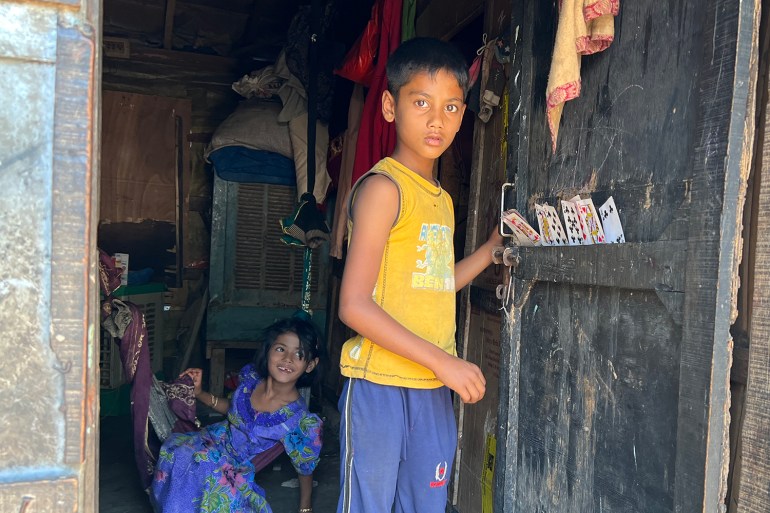
It has been more than a year since the mother and sister of 12-year-old Inayat Rehman were detained by the Indian police along with 150 Rohingya refugees in the southern city of Jammu in India-administered Kashmir.

Their arrest was part of a government crackdown against Rohingya following a persistent campaign against the mainly Muslim ethnic group, with local politicians and media reports calling them “illegal” residents, “parasites” and a national “security threat”.

The United Nations says nearly 40,000 Rohingya fled to India from Myanmar, most of them in 2017 when a military crackdown in the Buddhist-majority country began against them. The UN said the crackdown was carried out with “genocidal intent”.

The refugees, many of them believed to be undocumented, took shelter in camps and slums in several Indian cities, including capital New Delhi. Approximately 5,000 of them settled in Jammu, including Rehman’s family.

But Rehman is now alone after his mother and sister were detained and sent to a local jail in order to be deported back to Myanmar.

“I miss my mother,” Rehman told Al Jazeera as he sat outside the shanty of a Rohingya neighbour who is now taking care of him.

“Our house was also demolished after my mother and sister were taken away,” he said, referring to the removal of their shanty by the owner of the land as there was no one left behind to pay the $13 rent.
Fears of separation

Many other Rohingya have been separated from their family members following the crackdown and deportation against the community.

In March this year, Haseena Begum, 37, was separated from her three children and husband and was sent back to Myanmar after yearlong detention at Jammu’s Hira Nagar prison, where Rehman’s family members are also detained.

Another Rohingya man, Jafar Alam, was also detained and deported back to Myanmar recently, activists told Al Jazeera, adding that he was separated from his six children and wife.
Rohingya children in a makeshift school in a refugee camp in Jammu [Al Jazeera]

According to the Rights and Risks Analysis Group (RRAG), an independent rights group based in New Delhi, at least 354 Rohingya are currently detained in India on charges of “illegal entry”. The highest number of such detentions are in Jammu.

Rohingya rights groups tell Al Jazeera the Indian government has deported 17 refugees since 2017 and is planning to deport more in violation of the principle of non-refoulment which states that refugees should not be deported to places where they may face persecution.

Rehman’s neighbour told Al Jazeera his mother had pleaded with the police to detain him as well so that the family could stay together in detention. “But they refused,” she said.

In fact, the fear of separation from families is greater among the refugees than the fear of being deported back to Myanmar. The fear has forced many to leave Jammu, with many families unsure where their destination would land them next.

A Rohingya woman cracking walnuts at her shanty in Jammu [Al Jazeera]

In the last three weeks, dozens of Rohingya families have fled Jammu on their way to neighbouring Bangladesh, home to nearly a million Rohingya in the world’s largest refugee camp.

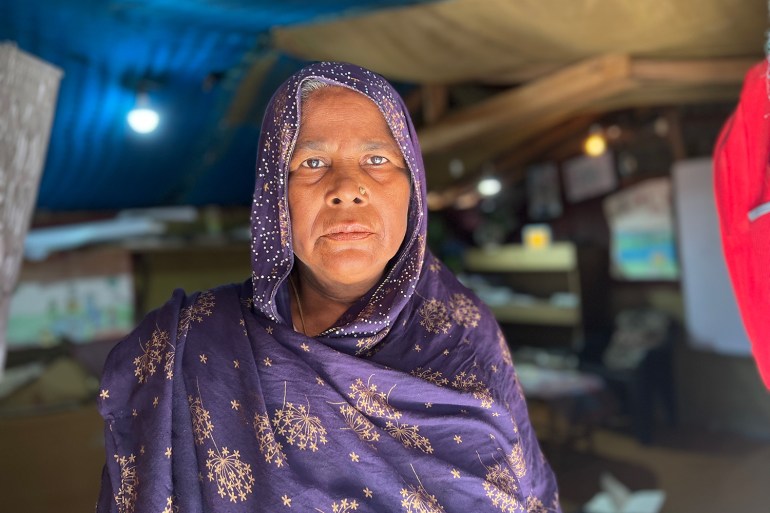
“Most of us are planning to leave,” Muhammad Arif told Al Jazeera in Jammu, adding that the Rohingya families are spending “sleepless nights”, fearing the police could detain them anytime.

“After the police arrive, the shanties are emptied. People do not want to be separated from their children as many have already. Separation is the most inhumane part of this crackdown,” said Arif, a father of three small children.

Arif arrived in Jammu in 2012 with his father, brother and cousins. On April 1 this year, his father, brother and two of his cousins were detained and taken to a detention centre at Hira Nagar prison.

“My father is above 70 and ailing. When I met him in jail, he told me to leave with my family immediately as they could detain us anytime. This pain of separating families from each other is worse than death,” Arif said.

“We know we are not safe anywhere. When we leave we could be detained anywhere. For us, there is no justice, no voice in this cruel world, no condemnation, no leader,” he said.

Religious profiling

In India, Rohingya are facing a rise in strict surveillance, arbitrary detentions, questioning and summons from security agencies. They say they are being targeted for their religious identity since they are predominately Muslims.

The crackdown against Rohingya blends with the larger xenophobia and hate campaign against India’s Muslims by the governing Bharatiya Janata Party (BJP) and Hindu supremacist groups affiliated to it.

India has defended the crackdown and deportations by arguing that it is not a signatory to a 1951 UN convention which details the rights of the refugees and the legal obligations of countries to protect them.

Last year, India’s top court refused to intervene after activists moved a petition against the government’s decision to deport the Rohingya.

The BJP-led government defends the move, saying the refugees are “involved in criminal activities” without offering any proof.

“They came here from far away land and we cannot allow them to settle here. This is a security threat for us,” Ashok Kaul, a BJP politician in Jammu, told Al Jazeera.

“We will pack them in vehicles and send them back. The process to deport them will continue. Our party’s stand is clear on it.”  

Rohingya children playing at a makeshift shelter in a refugee camp in Jammu [Al Jazeera]
‘Can’t think of losing him’

The persistent threat of deportation has left the displaced ethnic minority with an uncertain future.

Muhammad Javed, 15, came to Jammu when he was three after his parents fled the persecution in Myanmar. His father, a sanitation worker, died in 2018 following a long illness. After passing his Class X board exams despite the hardships, Javed says he does not dream to become a doctor or an engineer like other people of his age.

His only dream is to live with his mother Sajida Begum. And to do that, he must leave Jammu.

“I do not fear death. I only fear I might be separated from my mother if any of us is detained,” Javed told Al Jazeera at his makeshift house in Jammu’s Narwal area.
Sajida Begum at her shanty in a refugee camp in Jammu, Indian-administered Kashmir [Al Jazeera]

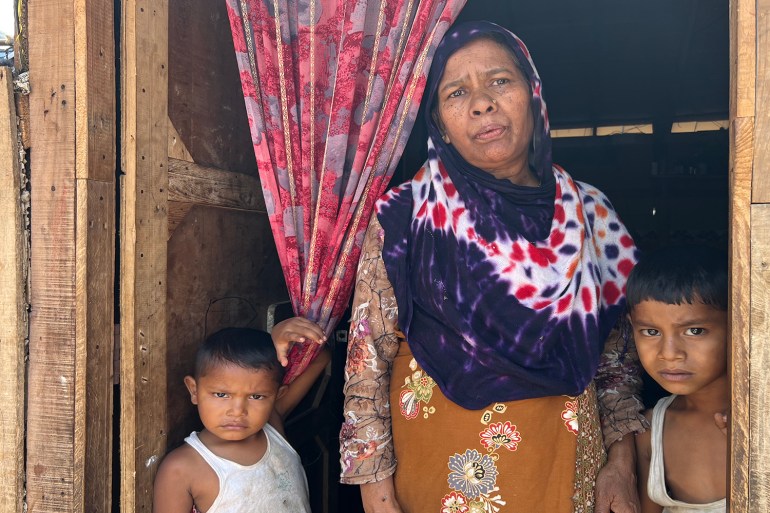
Begum says she is equally worried. “He is my whole family in this world. I can’t think of losing him,” she told Al Jazeera. “I am not able to do anything due to this worry. I am not able to work as I stay around him to protect him.”

Many Rohingya Al Jazeera spoke to in Jammu said they are not being given the refugee status despite being registered with the UN refugee agency, the UNHCR. As a result, they are treated as “illegal immigrants” and face further displacement.

Dozens of temporary houses across Jammu where Rohingya had been living for years now lie flattened after the refugees fled the crackdown by Indian agencies. Many of them had to sell all their belongings.

Muhammad Islah, 70, says six of his family members left the city to flee the crackdown but he does not know their whereabouts.

“We don’t have any contact with them. We don’t know where they are and whether they have reached any safety,” he said.

Ali Johar, co-director of the Rohingya Human Rights Initiative told Al Jazeera that by making deportation arrangements with Myanmar where a military coup took place last year, India is violating international laws.

“It is sad that India is doing this with Rohingya when the world is seeking justice for them. We are afraid that these deportations are separating families,” he told Al Jazeera.

“Additionally, they are legitimising the Myanmar military coup group who are an occupying force and do not represent the people of Myanmar.”

Meenakshi Ganguly, the South Asia head of Human Rights Watch (HRW), said the Rohingya are among the most oppressed communities in the world.

“Instead of protecting the Rohingya who sought shelter in India and joining international efforts in ensuring their safe and voluntary return to their homes, the Indian authorities are targeting them and causing them further suffering,” Ganguly told Al Jazeera.

SOURCE: AL JAZEERA