Monday, June 20, 2022

Why a Rhodes Scholar's Ambition Led Her to a Job at Starbucks

Noam Scheiber
Sun, June 19, 2022

Jaz Brisack, a Rhodes scholar and a barista who helped unionize Starbucks workers, at her home in Buffalo, N.Y., Feb. 26, 2022. (Brendan Bannon/The New York Times)

Most weekend mornings, Jaz Brisack gets up around 5, wills her semiconscious body into a Toyota Prius and winds her way through Buffalo, New York, to the Starbucks on Elmwood Avenue. After a supervisor unlocks the door, she clocks in, checks herself for COVID symptoms and helps get the store ready for customers.

“I’m almost always on bar if I open,” said Brisack, who has a thrift-store aesthetic and long reddish-brown hair that she parts down the middle. “I like steaming milk, pouring lattes.”

The Starbucks door is not the only one that has been opened for her. As a University of Mississippi senior in 2018, Brisack was one of 32 Americans who won Rhodes scholarships, which fund study in Oxford, England.

Many students seek the scholarship because it can pave the way to a career in the top ranks of law, academia, government or business. They are motivated by a mix of ambition and idealism.

Brisack became a barista for similar reasons: She believed it was simply the most urgent claim on her time and her many talents.

When she joined Starbucks in late 2020, not a single one of the company’s 9,000 U.S. locations had a union. Brisack hoped to change that by helping to unionize its stores in Buffalo.


Improbably, she and her co-workers have far exceeded their goal. Since December, when her store became the only corporate-owned Starbucks in the United States with a certified union, more than 150 other stores have voted to unionize, and more than 275 have filed paperwork to hold elections. Their actions come amid an increase in public support for unions, which last year reached its highest point since the mid-1960s, and a growing consensus among center-left experts that rising union membership could move millions of workers into the middle class.

Brisack’s weekend shift represents all these trends, as well as one more: a change in the views of the most privileged Americans. According to Gallup, approval of unions among college graduates grew from 55% in the late 1990s to 70% last year.


I have seen this firsthand in more than seven years of reporting on unions, as a growing interest among white-collar workers has coincided with a broader enthusiasm for the labor movement.


In talking with Brisack and her fellow Rhodes scholars, it became clear that the change had reached even that rarefied group. The American Rhodes scholars I encountered from a generation earlier typically said that, while at Oxford, they had been middle-of-the-road types who believed in a modest role for government. They did not spend much time thinking about unions as students, and what they did think was likely to be skeptical.


“I was a child of the 1980s and 1990s, steeped in the centrist politics of the era,” wrote Jake Sullivan, a 1998 Rhodes scholar who is President Joe Biden’s national security adviser and was a top aide to Hillary Clinton.

By contrast, many of Brisack’s Rhodes classmates express reservations about the market-oriented policies of the ’80s and ’90s and strong support for unions. Several told me that they were enthusiastic about Sens. Bernie Sanders and Elizabeth Warren, who made reviving the labor movement a priority of their 2020 presidential campaigns.

Even more so than other indicators, such a shift could foretell a comeback for unions, whose membership in the United States stands at its lowest percentage in roughly a century. That’s because the kinds of people who win prestigious scholarships are the kinds who later hold positions of power — who make decisions about whether to fight unions or negotiate with them, about whether the law should make it easier or harder for workers to organize.


As the recent union campaigns at companies like Starbucks, Amazon and Apple show, the terms of the fight are still largely set by corporate leaders. If these people are increasingly sympathetic to labor, then some of the key obstacles to unions may be dissolving.

Then again, Brisack isn’t waiting to find out.

The Fight in Buffalo

Brisack moved to Buffalo after Oxford for another job, as an organizer with the union Workers United, where a mentor she had met in college worked. Once there, she decided to take a second gig at Starbucks.

“Her philosophy was get on the job and organize. She wanted to learn the industry,” said Gary Bonadonna Jr., the top Workers United official in upstate New York. “I said, ‘OK.’”

In its pushback against the campaign, Starbucks has often blamed “outside union forces” intent on harming the company, as its CEO, Howard Schultz, suggested in April. The company has identified Brisack as one of these interlopers, noting that she draws a salary from Workers United. (Bonadonna said she was the only Starbucks employee on the union’s payroll.)

But the impression that Brisack and her fellow employee-organizers give off is one of fondness for the company. Even as they point out flaws — understaffing, insufficient training, low seniority pay, all of which they want to improve — they embrace Starbucks and its distinctive culture.

They talk up their sense of camaraderie and community — many count regular customers among their friends — and delight in their coffee expertise. On mornings when Brisack’s store isn’t busy, employees often hold tastings.

A Starbucks spokesperson said that Schultz believes employees don’t need a union if they have faith in him and his motives, and the company has said that seniority-based pay increases will take effect this summer.

One Friday in February, Brisack and another barista, Casey Moore, met at the two-bedroom rental that Brisack shares with three cats to talk union strategy over breakfast. Naturally, the conversation turned to coffee.

“Jaz has a very barista drink,” Moore said.

Brisack elaborated: “It’s four blonde ristretto shots — that’s a lighter roast of espresso — with oat milk. It’s basically an iced latte with oat milk. If we had sugar-cookie syrup, I would get that. Now that that’s no more, it’s usually plain.”

That afternoon, Brisack held a Zoom call from her living room with a group of Starbucks employees who were interested in unionizing. It is an exercise that she and other organizers in Buffalo have repeated hundreds of times since last fall, as workers around the country sought to follow their lead. But in almost every case, the Starbucks workers outside Buffalo have reached out to the organizers, rather than vice versa.

This particular group of workers, in Brisack’s college town of Oxford, Mississippi, seemed to require even less of a hard sell than most. When Brisack said she, too, had attended the University of Mississippi, one of the workers waved her off, as if her celebrity preceded her. “Oh, yeah, we know Jaz,” the worker gushed.

A few hours later, Brisack, Moore and Michelle Eisen, a longtime Starbucks employee also involved in the organizing, gathered with two union lawyers at the union office in a onetime auto plant. The National Labor Relations Board was counting ballots for an election at a Starbucks in Mesa, Arizona — the first real test of whether the campaign was taking root nationally, and not just in a union stronghold like New York. The room was tense as the first results trickled in.

“Can you feel my heart beating?” Moore asked her colleagues.

Within a few minutes, however, it became clear that the union would win in a rout — the final count was 25-3. Everyone turned slightly punchy, as if they had all suddenly entered a dream world where unions were far more popular than they had ever imagined. One of the lawyers let out an expletive before musing, “Whoever organized down there …”.

Brisack seemed to capture the mood when she read a text from a co-worker to the group, “I’m so happy I’m crying and eating a week-old ice cream cake.”

A Black Antifa T-shirt at the Formal

Brisack once appeared to be on a different path. As a child, she idolized Lyndon Johnson and imagined running for office. At the University of Mississippi, she was elected president of the college Democrats.

She had developed an interest in labor history as a teenager, when money was sometimes tight, but it was largely an academic interest. “She had read Eugene Debs,” said Tim Dolan, the university’s national scholarship adviser at the time. “It was like: ‘Oh, gosh. Wow.’”

When Richard Bensinger, a former organizing director with the AFL-CIO and the United Automobile Workers, came to speak on campus, she realized that union organizing was more than a historical curiosity. She talked her way into an internship on a union campaign he was involved with at a nearby Nissan plant. It did not go well. The union accused the company of running a racially divisive campaign, and Brisack was disillusioned by the loss.

“Nissan never paid a consequence for what it did,” she said. (In response to charges of “scare tactics,” the company said at the time that it had sought to provide information to workers and clear up misperceptions.)

Dolan noticed that she was becoming jaded about mainstream politics. “There were times between her sophomore and junior year when I’d steer her toward something, and she’d say, ‘Oh, they’re way too conservative.’ I’d send her a New York Times article, and she’d say, ‘Neoliberalism is dead.’”

In England, where she arrived during the fall of 2019 at age 22, Brisack was a regular at a “solidarity” film club that screened movies about labor struggles worldwide and wore a sweatshirt that featured a head shot of Karl Marx. She liberally reinterpreted the term “black tie” at an annual Rhodes dinner, wearing a black dress-coat over a black antifa T-shirt.

“I went and got gowns and everything; I wanted to fit in,” said a friend and fellow Rhodes scholar, Leah Crowder. “I always loved how she never tried to fit in to Oxford.”

But Brisack’s politics didn’t stand out the way her formal wear did. In talking with eight other American Rhodes scholars from her year, I got the sense that progressive politics were generally in the ether. Almost all expressed some skepticism of markets and agreed that workers should have more power. The only one who questioned aspects of collective bargaining told me that few of his classmates would have agreed and that he might have been loudly jeered for expressing reservations.

Some in the group even said they had incorporated pro-labor views into their career aspirations.

Claire Wang has focused on helping fossil fuel workers find family-sustaining jobs as the world transitions to green energy. “Unions are a critical partner in this work,” she told me. Rayan Semery-Palumbo, who is finishing a dissertation on inequality and meritocracy while working for a climate technology startup, lamented that workers had too little leverage. “Labor unions may be the most effective way of implementing change going forward for a lot of people, including myself,” he told me. “I might find myself in labor organizing work.”

This is not what talking to Rhodes scholars used to sound like. At least not in my experience.

I was a Rhodes scholar in 1998, when centrist politicians like Bill Clinton and Tony Blair were ascendant, and before “neoliberalism” became such a dirty word. Though we were dimly aware of a time, decades earlier, when radicalism and pro-labor views were more common among American elites — and when, not coincidentally, the U.S. labor movement was much more powerful — those views were far less in evidence by the time I got to Oxford.

Some of my classmates were interested in issues like race and poverty, as they reminded me in interviews for this article. A few had nuanced views of labor; they had worked a blue-collar job, had parents who belonged to a union or had studied their Marx. Still, most of my classmates would have regarded people who talked at length about unions and class the way they would have regarded religious fundamentalists: probably earnest but slightly preachy and clearly stuck in the past.

Kris Abrams, one of the few U.S. Rhodes scholars in our cohort who thought a lot about the working class and labor organizing, told me recently that she felt isolated at Oxford, at least among other Americans. “Honestly, I didn’t feel like there was much room for discussion,” Abrams said.

By contrast, it was common within our cohort to revere business and markets and globalization. As an undergraduate, my friend and Rhodes classmate Roy Bahat led a large public-service organization that periodically worked with unions. But as the “new” economy boomed in 1999, he interned at a large corporation. It dawned on him that a career in business might be more desirable — a way to make a larger impact on the world.

“There was a major shift in my own mentality,” Bahat told me. “I became more open to business.” It didn’t hurt that the pay was good, too.

Bahat would go on to work for McKinsey & Co., the city of New York and the executive ranks of News Corp., then start a venture capital fund focused on technologies that change how business operates. More recently, in a sign of the times, his investment portfolio has included companies that make it easier for workers to organize.

On some level, Bahat and Brisack are not so different: Both are chronic overachievers; both are ambitious about changing society for the better; both are sympathetic to the underdog by way of intellect and disposition. But the world was telling Bahat in the late 1990s to go into business if he wanted to influence events. The world was telling Brisack in 2020 to move to Buffalo and organize workers.

Reaching Howard Schultz

The first time I met Brisack was in October, at a Starbucks near the Buffalo airport.

I was there to cover the union election. She was there, unsolicited, to brief me. “I don’t think we can lose,” she said of the vote at her store. At the time, not a single corporate-owned Starbucks in the country was unionized. The union would go on to win there by more than a 2-1 ratio.

It’s hard to overstate the challenge of unionizing a major corporation that doesn’t want to be unionized. Employers are allowed to inundate workers with anti-union messaging, whereas unions have no protected access to workers on the job. While it is officially illegal to threaten, discipline or fire workers who seek to unionize, the consequences for doing so are typically minor and long in coming.

At Starbucks, the NLRB has issued complaints finding merit in such accusations. Yet the union continues to win elections — over 80% of the more than 175 votes in which the board has declared a winner. (Starbucks denies that it has broken the law, and a federal judge recently rejected a request to reinstate pro-union workers whom the labor board said Starbucks had forced out illegally.)

Though Brisack was one of dozens of early leaders of the union campaign, the imprint of her personality is visible. In store after store around the country, workers who support the union give no ground in meetings with company officials.

Even prospective allies are not spared. In May, after Time ran a favorable piece, Brisack’s response on Twitter was: “We appreciate TIME magazine’s coverage of our union campaign. TIME should make sure they’re giving the same union rights and protections that we’re fighting for to the amazing journalists, photographers, and staff who make this coverage possible!”

The tweet reminded me of a story that Dolan, her scholarship adviser, had told about a reception that the University of Mississippi held in her honor in 2018. Brisack had just won a Truman scholarship, another prestigious award. She took the opportunity to urge the university’s chancellor to remove a Confederate monument from campus. The chancellor looked pained, according to several attendees.

“My boss was like, ‘Wow, you couldn’t have talked her out of doing that?’” Dolan said. “I was like: ‘That’s what made her win. If she wasn’t that person, you all wouldn’t have a Truman now.’”

(Dolan’s boss at the time did not recall this conversation, and the former chancellor did not recall any drama at the event.)

The challenge for Brisack and her colleagues is that while younger people, even younger elites, are increasingly pro-union, the shift has not yet reached many of the country’s most powerful leaders. Or, more to the point, the shift has not yet reached Schultz, the 68-year-old now in his third tour as Starbucks’ CEO.

Schultz has long opposed unions at Starbucks, but Brisack, for one, believes that even business executives are persuadable. She recently spoke at an Aspen Institute panel on workers’ rights. She has even mused about using her Rhodes connections to make a personal appeal to Schultz, something that Bensinger has pooh-poohed but that other organizers believe she just may pull off.

“Richard has been making fun of me for thinking of asking one of the Rhodes people to broker a meeting with Howard Schultz,” Brisack said in February.

“I’m sure if you met Howard Schultz, he’d be like, ‘She’s so nice,” responded Moore, her co-worker. “He’d be like: ‘I get it. I would want to be in a union with you, too.’”

© 2022 The New York Times Company
RIGHT ON!
'Breaking Bad' actor says Americans should 'stfu' about gas prices if they
'love capitalism so much'


Landon Mion
FOX
 Sun, June 19, 2022

Actor Dean Norris criticized people who are complaining about soaring gas prices across the United States.

The "Breaking Bad" star said current gas prices are "fair market" and urged anyone who "love[s] Capitalism" to "stfu," an acronym for shut the f--- up.

"You're not getting 'robbed' at the pump," Norris wrote in a tweet on Wednesday. "You’re paying fair market price for a commodity. If you love Capitalism so much then stfu."


Dean Norris attends the 9th Annual Unbridled Eve Kentucky Derby Gala at The Galt House Hotel on May 06, 2022 in Louisville, Kentucky. 
Photo by Michael Loccisano/Getty Images for Unbridled Eve

The tweet garnered more than 7,200 retweets and 66,000 likes as of Sunday morning.

The tweet also garnered some pushback from people who pointed out that Norris is wealthy.

"Easy to say when you have a net worth of 5 mil" one person commented.

Norris' social media post comes as Americans are seeing record-high gas prices.


661 pounds, 13 feet long and a mouth 'the size of a banana': The largest freshwater fish ever caught

Evan Bush
Mon, June 20, 2022,

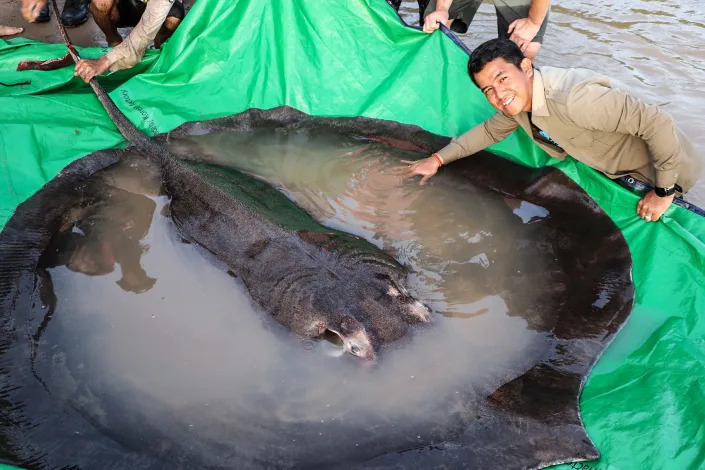
A fisherman in northern Cambodia hooked what researchers say is the world’s largest freshwater fish — a giant stingray that scientists know relatively little about.

The fisherman, 42, caught the 661-pound fish — which measured about 13 feet in length — near a remote island on the Mekong River in the Stung Treng area. A team of scientists from the Wonders of Mekong research project helped tag, measure and weigh the ray before it was released back into the river. The research group believes it was healthy when released and expects it to survive.

The tag — which emits an acoustic signal — will allow researchers to track the fish’s movements and, they hope, learn more about its species’ behavior in the Mekong.

The catch “highlights how little we know about a lot of these giant freshwater fish,” said Zeb Hogan, a fish biologist at the University of Nevada. “You have a fish that’s now the record holder for the world’s largest freshwater fish, and we know little about it.”

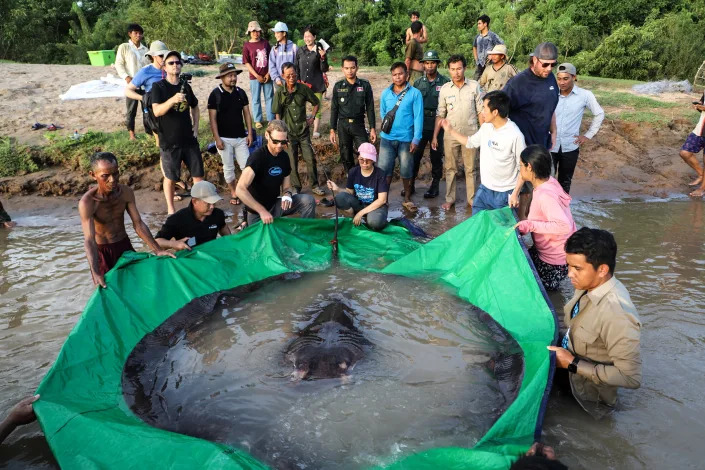
The giant freshwater stingray was captured the night of June 13, 2022 near Koh Preah island in the Mekong River in northern Cambodia. It was accidentally hooked by a 42-year-old fisherman named Moul Thun. (Chhut Chheana / Wonders of the Mekong)

The fisherman, Moul Thun, caught the giant stingray with a hook and line on the evening of June 13, and then contacted researchers the next morning.

Researchers with the Wonders of Mekong were already in northern Cambodia to install underwater receivers as part of a project to track migratory fish in the river.

“It’s a particularly healthy stretch of the river with a lot of deep pools — pools up to 90 meters deep,” said Hogan, who is also the host of National Geographic’s “Monster Fish” television series. “We started focusing on this area as a stretch of river that’s particularly important for biodiversity and fisheries, and as a last refuge for these big species.”

For several months, the research group has been in contact with local fishermen, asking them to get in touch if they landed a significant catch. The group has helped with two other large giant freshwater stingray releases in recent months. The fisherman who caught the record ray was paid market price for his catch.

“It works because the fish is not a highly prized food fish,” Hogan said.

Hogan said little is known about the giant freshwater stingray. The creature has a mouth about “the size of a banana” with no teeth, but with “gripping pads” used to crush prey.

“They’re on the bottom finding shrimps, mollusks and small fish. They can suck them up with this banana-shaped mouth and crush them,” Hogan said.

Wonders of the Mekong team members, Cambodian fisheries officials, and villagers took photos with the giant freshwater stingray. (Chhut Chheana / Wonders of the Mekong)

Fishermen have reported three catches of female stingrays in the area during the past two months, Hogan said. The scientists suspect the site could be an important seasonal gathering site for giant freshwater stingrays, and might serve as a pupping ground for young.

The research group plans to tag and track a few hundred big fish in the Mekong River to better understand fish migrations and local habitat in the upper Cambodian Mekong.

“There’s potential for hydropower development right where these stingrays were caught,” Hogan said. “We want to understand the importance of this area before there’s development, potentially in an unsustainable way.”

Hogan said the Cambodian government has expressed interest in developing a conservation plan for the giant freshwater stingrays.

The upper Mekong is also habitat for Mekong giant catfish and other species of large freshwater fish.

Worldwide, “most of these species of big fish are in trouble, their populations are declining. The Chinese paddlefish was declared extinct in 2020,” Hogan said. “We need to do more to protect these freshwater habitats.”

The former world record holding fish — a 646-pound Mekong giant catfish — was also caught on the Mekong River in 2005, in Thailand.

There are other, larger recorded catches of fish that spend time in both fresh and saltwater, such as the beluga sturgeon.

“This is the record for the largest fish that has spent its entire life in freshwater,” Hogan said of the recently caught ray.

Cambodian catches world's largest recorded freshwater fish

JERRY HARMER
Mon, June 20, 2022

BANGKOK (AP) — The world’s largest recorded freshwater fish, a giant stingray, has been caught in the Mekong River in Cambodia, according to scientists from the Southeast Asian nation and the United States.

The stingray, captured on June 13, measured almost four meters (13 feet) from snout to tail and weighed slightly under 300 kilograms (660 pounds), according to a statement Monday by Wonders of the Mekong, a joint Cambodian-U.S. research project.

The previous record for a freshwater fish was a 293-kilogram (646-pound) Mekong giant catfish, discovered in Thailand in 2005, the group said.

The stingray was snagged by a local fisherman south of Stung Treng in northeastern Cambodia. The fisherman alerted a nearby team of scientists from the Wonders of the Mekong project, which has publicized its conservation work in communities along the river.

The scientists arrived within hours of getting a post-midnight call with the news, and were amazed at what they saw.

“Yeah, when you see a fish this size, especially in freshwater, it is hard to comprehend, so I think all of our team was stunned,” Wonders of the Mekong leader Zeb Hogan said in an online interview from the University of Nevada in Reno. The university is partnering with the Cambodian Fisheries Administration and USAID, the U.S. government’s international development agency.

Freshwater fish are defined as those that spend their entire lives in freshwater, as opposed to giant marine species such as bluefin tuna and marlin, or fish that migrate between fresh and saltwater like the huge beluga sturgeon.

The stingray's catch was not just about setting a new record, he said.

“The fact that the fish can still get this big is a hopeful sign for the Mekong River, ” Hogan said, noting that the waterway faces many environmental challenges.

The Mekong River runs through China, Myanmar, Laos, Thailand, Cambodia and Vietnam. It is home to several species of giant freshwater fish but environmental pressures are rising. In particular, scientists fear a major program of dam building in recent years may be seriously disrupting spawning grounds.

“Big fish globally are endangered. They’re high-value species. They take a long time to mature. So if they’re fished before they mature, they don’t have a chance to reproduce,” Hogan said. “A lot of these big fish are migratory, so they need large areas to survive. They’re impacted by things like habitat fragmentation from dams, obviously impacted by overfishing. So about 70% of giant freshwater fish globally are threatened with extinction, and all of the Mekong species.”

The team that rushed to the site inserted a tagging device near the tail of the mighty fish before releasing it. The device will send tracking information for the next year, providing unprecedented data on giant stingray behavior in Cambodia.

“The giant stingray is a very poorly understood fish. Its name, even its scientific name, has changed several times in the last 20 years,” Hogan said. “It’s found throughout Southeast Asia, but we have almost no information about it. We don’t know about its life history. We don’t know about its ecology, about its migration patters.”

Researchers say it’s the fourth giant stingray reported in the same area in the past two months, all of them females. They think this may be a spawning hotspot for the species.

Local residents nicknamed the stingray "Boramy,” or “full moon,” because of its round shape and because the moon was on the horizon when it was freed on June 14. In addition to the honor of having caught the record-breaker, the lucky fisherman was compensated at market rate, meaning he received a payment of around $600.
Why Is The United States Still Exporting Fuel?


Editor OilPrice.com
Sun, June 19, 2022

As the U.S. national average price of gasoline hits $5 per gallon, higher fuel exports out of America are additionally sapping domestic fuel inventories, which are already at multi-year lows.

Reduced refining capacity since the start of COVID, low inventories, and strong post-COVID demand, alongside $120 a barrel crude, have sent U.S. gasoline prices soaring over the past months to reach a record-breaking $5 a gallon on average.

The White House is desperate to lower gasoline prices, which are the most important election issue for many Americans ahead of the mid-term elections in November. Ideas juggled by the Biden Administration range from invoking the Defense Production Act to boost refining capacity and output, to restrictions on oil exports. President Joe Biden also stepped up rhetoric toward oil companies, telling them in a letter sent this week to increase fuel production and noting that “refinery profit margins well above normal being passed directly onto American families are not acceptable.”

Refiners have boosted exports of refined petroleum products this year, especially to Latin America, which isn’t getting much fuel these days from Europe, which in turn is grappling with its own set of fuel supply troubles with the sanctions and embargoes on Russian oil after Putin’s invasion of Ukraine.


Exports of gasoline, diesel, and jet fuel from the U.S. Gulf Coast were up by 32 percent in March, April, and May compared to those three months of 2021, and up 11 percent compared to those months in the pre-pandemic 2019, data from market-intelligence firm Kpler cited by The Wall Street Journal showed.

So far in June, seaborne shipments of gasoline and diesel from the Gulf Coast have jumped on track to be the highest since at least 2016, per oil analytics company Vortexa quoted by Bloomberg.

Higher fuel exports have contributed to lower inventories in the U.S., although this is not the primary reason for multi-year-low stockpiles of products.

Related: The Energy Crisis Has Been A Boon For Argentina’s Dead Cow Shale Patch

U.S. motor gasoline inventories are about 11 percent below the five-year average for this time of year, the EIA said in its latest weekly inventory report. Distillate fuel inventories, which include diesel, are some 23 percent below the five-year average.

“With refiners already running at full tilt, something has to give,” BloombergNEF analyst Danny Adkins told Bloomberg. “We either need a redirection of exports, or prices will need to rise enough for more significant demand destruction.”

President Biden slammed oil companies for passing record profit margins onto consumers and asked for solutions to the refining constraints in the letter to major oil companies and refiners.

The President is also “open to all reasonable uses of the federal government’s tools to increase output and lower costs at the pump, including emergency authorities like the Defense Production Act,” White House Press Secretary Karine Jean-Pierre said this week.

The White House is even considering restrictions on gasoline and diesel exports, and discussions on such a move have intensified in recent days, sources with knowledge of the talks told Bloomberg this week.

However, a partial ban on petroleum exports would backfire as it would create additional supply shortages globally, driving oil prices higher.

Restrictions on exports would also send a mixed message to U.S. allies in a divided world, especially to allies in Europe, which is looking to phase out Russian seaborne oil and refined products imports within eight months when the EU embargo on Russian oil officially kicks in.

After all, crude oil prices are the single biggest factor determining U.S. gasoline prices, accounting for over 53 percent of the average retail price per gallon. In addition, some 1 million bpd of U.S. refinery capacity has been shut permanently since the start of the pandemic, as refiners have opted to either close money-losing facilities or convert some of them into biofuel production sites. U.S. operable refinery capacity was at just over 18 million bpd in 2021, the lowest since 2015, per EIA data.

By Tsvetana Paraskova for Oilprice.com
FROM ONE HELL TO ANOTHER
Ten weeks after escaping Kabul, a women's rights activist found herself in Texas without food, money and three of her kids


Anna Schecter and Kenzi Abou-Sabe and Cynthia McFadden
Mon, June 20, 2022, 1:00 PM·9 min read

Roshan Mashal had been fighting for women’s rights in Afghanistan for more than a decade when the Taliban took over in August. Their lives in peril, she and 18 other prominent activists targeted by the Taliban were given seats on a flight and airlifted with their families out of Kabul. Their evacuation was arranged with the aid of women’s rights organizations and the State Department.

Ten weeks after she escaped to safety in the U.S. as part of the Biden administration’s Operation Allies Welcome, Mashal found herself out of food and money in a Texas apartment, with no access to health care or transportation and separated from three of her children.

Mashal, her husband and her children were among the more than 76,000 evacuees who poured into the U.S. after the Taliban took control of Afghanistan. Her family’s bumpy first year in the U.S. highlights the cracks in the resettlement system that have left whole families stuck in hotel rooms for months, overwhelmed by the paperwork needed to start their lives in America.

“We are struggling with this complicated system,” Mashal said. “There is one caseworker with 60 clients.”

The case worker at her local resettlement agency was swamped by Afghans needing assistance in the Dallas area. Most of the families had fled Afghanistan with only a single small bag, many not speaking English or knowing how to apply for Social Security or Medicaid or register their kids for school.

The Biden administration had instructed the departments of State and Health and Human Services to coordinate with 200 local resettlement agencies to help Afghans rebuild their lives here. But the system was so overwhelmed by the sheer number of refugees that the “welcome” many received was less than ideal. Mashal's family was just one of many that slipped through the cracks.

Texas was the unexpected endpoint of their harrowing journey from Kabul to America. The family’s first stop was at Fort McCoy, Wisconsin, a military base recast as a refugee camp for nearly 13,000 Afghans. For more than a month evacuees stood in long lines for food and clothing, and there was little privacy in the barracks.

Mashal asked that she and her family be resettled in the Washington, D.C., area, like other prominent activists, so she could continue her work on behalf of Afghan women. She said she was told her family of seven — her, her husband and five children — was too large to be resettled there. She said she was told that if she went to Texas, instead, the family could stay together.


Women's rights advocate Roshan Mashal, center, and Hillary Clinton receive awards from Refugees International, a nonprofit organization promoting human rights for refugees, on May 11. (Laurence L. Levin / Refugees International)

But she said that when she and her husband were abruptly put on a plane to Dallas, only her two youngest children were allowed to go with them. The three older children, all over 21, had to stay in Wisconsin. Two made it to Dallas in late October, and the third arrived in January.

Within 10 days of their having moved into an apartment north of Dallas, the groceries the resettlement agency provided Mashal had run out.

“In the camp they say we are working so that when you resettle you have your own apartment, food stamps, Medicaid, Social Security and work permit, but that’s not the case,” she said. Every member of her family, she said, experienced delays in getting social services.

Her son had an eye infection but was turned away from two clinics because he didn’t have Medicaid. A caseworker from the resettlement agency had to drive him to the emergency room for treatment.

Her husband, who asked not to be named in this article, didn’t get a work permit until February, four months after he arrived in Texas, Mashal said. He had been a member of the professional class in Kabul. In May he started working at a minimum-wage job.

Congress had passed an emergency funding bill that included $6.3 billion to help Afghans and resettlement agencies pay for housing and other basic services.

As part of the program, the federal government provided money to resettlement agencies for services for every evacuee, sometimes referred to as “welcome money.” But the welcome money ran out fast for many. Mashal said she soon had trouble buying her family food.

It also took until February, six months after her arrival in the U.S., for Mashal to receive the card she needed to buy food via the Supplemental Nutrition Assistance Program, the program once known as “food stamps.” But the first time she used it at a grocery store checkout counter, she learned it wouldn’t cover all her groceries. While she was grateful to be in America, she was frustrated by her struggle to care for her family.

It was a low moment, she recalled. “Morally, it was stressful and shameful.”

After Mashal told the resettlement agency about her family’s lack of food, she said, a caseworker started bringing supplies every 10 to 15 days. A local nongovernment organization, DFW Refugee Outreach Services, also distributed food to Afghan families several times.

Ultimately, Mashal was able to gather her children, arrange for food and health care and find employment. She has a one-year fellowship at the University of Texas at Arlington Women’s and Gender Studies program, which was arranged with the help of the Georgetown Institute of Women, Peace and Security and the Texas International Education Consortium. She is one of 16 Afghan women who have received fellowships through the Georgetown institute.


Roshan Mashal put photos of women in Afghanistan on the walls of her office at the University of Texas at Arlington. They are reminders of the ongoing struggle back home, she said. 
(Kenzi Abou-Sabe / NBC News)

For the first few months of the job, she commuted three hours each way by trains, a bus and an Uber to get to the university. She and her family have since moved to an apartment closer to work.

But the son who had an eye infection is still without Medicaid. Her 25-year-old daughter, who studied medicine in Kabul, doesn’t yet have papers that would let her work, even though the application process began back at Fort McCoy.

A State Department spokesperson declined to comment on Mashal’s family or any Afghan’s individual case, citing privacy considerations.

Mashal said she is concerned for Afghan refugees who don’t speak English and who don’t have connections to American NGOs as she does thanks to her years working alongside U.S. organizations to promote equality for women in Afghanistan.

“I worry about women and girls here. Many of them are illiterate and don’t understand the transportation system,” she said. “It is so different from Afghanistan. They need support.”

Chris George, the executive director of the Integrated Refugee and Immigrant Services resettlement agency in Connecticut, said resettlement agencies across the country struggled to do more with less for Afghan evacuees after they were weakened during the Trump administration.

“Many of them had closed down. And then, suddenly, we were asked to do something that was really unprecedented, which is to resettle 76,000 people in a matter of three or four months,” George said.

“There were too many cases, too many families coming in too short a period of time. We did the best we could. And in some cases, families suffered.”
Volunteers and veterans

During the chaos of the first months of Afghan resettlement, volunteers, NGOs and military veterans stepped in to help with the absorption of so many people with language and cultural barriers all needing help at the same time.

Retired Green Beret Matthew Coburn of Pennsylvania operated as a one-man resettlement agency for weeks as he assisted the evacuation of four Afghan commandos he’d fought alongside over multiple tours in Afghanistan.

But in an example of bureaucratic wire crossing, an able-bodied former Afghan commando whom Coburn helped to evacuate is still waiting for a work permit while the man’s baby son inexplicably received employment authorization in the mail.

“It has been chaotic, overwhelming and disorganized from the get-go,” Coburn said. “Once the resettlement agency got up to speed, it took a lot of the burden off me, but the government’s bureaucracy” — which provides things like employment authorization and Social Security cards — “still hasn’t caught up.”

At times tensions have bubbled up between unaffiliated volunteers trying to help Afghans and the refugee resettlement agencies tasked to do so.

In Iowa a volunteer group called Des Moines Refugee Support, which wasn’t officially part of the refugee resettlement agency network, started getting calls from desperate Afghan evacuees. The group stepped in to buy food and clothing and provide rides to doctor’s appointments. Volunteers asked local resettlement agencies for evacuees’ information to help fill out medical forms and register children in school. The group said two agencies refused, citing privacy concerns.

“There were kids sitting in hotel rooms for months, not registered for school, because they had no permanent address,” said Alison Hoeman, the founder of Des Moines Refugee Support, who said many of evacuees said they struggled to get enough food.

One of the Iowa resettlement agencies declined to comment, and the other didn’t respond to a request for comment.

Mashal’s resettlement agency also didn’t respond to a request for comment.

Women fleeing the repression of the Taliban, like Mashal, have also gotten specific help from volunteers and NGOs. As the Taliban closed in on Kabul, Mina’s List, an NGO that helps women run for office in places around the world where women are marginalized, realized the U.S. government was focused on evacuating military contractors who had helped U.S. armed forces.


Roshan Mashal, center, leading a march for women’s rights in Afghanistan before the U.S. withdrawal from the country. (Courtesy Roshan Mashal)

“Just knowing the demographics, we realized those are mostly men,” said Teresa Casale, the executive director of Mina’s List, who helped flag Mashal and other female human rights activists to the U.S. government as being at risk.

A majority of Afghan evacuees are male, and the majority of Afghan women who made it to the U.S. are dependents, according to NGOs that work to support the evacuees.

“I do believe that the U.S. government’s overall approach did fail Afghan women and Afghan women leaders in particular. Everything from the peace process to the withdrawal to evacuation and resettlement,” Casale said.


The next hurdle for Mashal will be to clear the way to live and work here legally once the two-year grace period ends for Afghans who came to the U.S. as humanitarian parolees. She and her family are applying for asylum, but the system is backlogged, and it could take years.

“Every day all I think about are the people left behind in Afghanistan,” she said. “I am committed to continue my work fighting for women and human rights. I will never accept the Taliban’s ideology for women and girls and will continue our struggle.”
Understanding Juneteenth

Brigid Kennedy, Staff Writer
Mon, June 20, 2022

A father and daughter. Illustrated | Getty Images, iStock

The U.S. will observe the federal Juneteenth holiday on Monday, June 20, though the actual celebration fell on Sunday, June 19. Here's everything you need to know:
What is Juneteenth?

The 157-year-old holiday, the name of which is a combination of "June" and "nineteenth," commemorates the day in 1865 when a group of enslaved individuals in Galveston, Texas, finally learned they were free from slavery. The announcement, delivered by Maj. Gen. Gordon Granger, arrived two months after the effective end of the Civil War, and almost two-and-a-half years after President Abraham Lincoln signed the Emancipation Proclamation

But even with Granger's General Order No. 3 — which informed Galveston residents that slavery would no longer be tolerated, all slaves were free, and any slave that opted to remain on a plantation must be treated as a hired worker — the remaining enslaved individuals were not freed immediately or even soon there afterwards, NPR notes. Some owners refused to give up their slaves until they were forced to, while others opted to wait until the end of the harvest. And prior to Granger's arrival, "many slave owners in Confederate states simply chose not to tell their slaves about the Emancipation Proclamation and did not honor it," writes NPR. So as much as the holiday represents freedom, "it also represents how emancipation was tragically delayed for enslaved people in the deepest reaches of the Confederacy," writes Vox's Fabiola Cineas.

Ultimately, the end of slavery was officially materialized with the ratification of the 13th amendment.

How do people celebrate Juneteenth?


The first Juneteenth celebration took place in Texas in 1866, with community gatherings featuring cookouts, prayers, and dances. In time, however, white people in certain areas began restricting Black people from celebrating the holiday. To get around one such instance, for example, Black community leaders in Houston in 1872 purchased a plot of land intended specifically for Juneteenth celebrations, NPR notes. The area is still known as Emancipation Park.

Nowadays, Juneteenth celebrations often involve cookouts, parades, church services, and other public events, per NPR. In 2022, for example, Galveston plans to celebrate the holiday with a banquet, poetry festival, parade, and picnic, The New York Times writes, while Atlanta is planning a parade and a music festival. Similar festivities are scheduled in Baltimore, Brooklyn, Los Angeles, and Tulsa, Oklahoma.

For those looking to celebrate or pay tribute to Juneteenth but unsure where to start, try visiting a local or national museum, diving into relevant readings and documentaries, checking for and attending local festivities in your area, or getting involved with a Black organization in your community, The Washington Post suggests, per organizers and activists.

When and how did Juneteenth become a federal holiday?


President Biden signed into law a resolution to make Juneteenth a federal holiday on June 17, 2021. But Texas had already beat the administration to it, having been the first to create a national Juneteenth holiday back in 1980. New York, New Jersey, Virginia, Massachusetts, Pennsylvania, Washington, Oregon, and Delaware all eventually followed Texas' lead, also before the federal government.

Though activists — including the 95-year-old "grandmother of Juneteenth," Opal Lee — had been pushing for federal recognition for years, the movement gained new momentum following the death of George Floyd and racial justice protests in the summer of 2020. Juneteenth Independence Day is now the 11th holiday recognized by the federal government.

Why do some critics oppose Juneteenth?

Though both chambers of Congress overwhelmingly cleared the resolution that Biden later signed, there was still some opposition toward creating a federal Juneteenth holiday. For example, of the 14 Republicans who voted against the measure in the House, some worried that calling the new holiday "Juneteenth Independence Day" would create confusion with July 4 and push Americans to choose a celebration based on race. Others thought adding another paid holiday for federal employees to be "fiscally irresponsible."

Which major companies are giving employees the day off?

At least last year, a number of large, private companies — including Allstate, Google, and Nike — opted to recognize Juneteenth as a paid holiday for their employees. T-Mobile, Yelp, and Zillow did the same. Starbucks, which officially recognized Juneteenth as a holiday beginning in 2020, paid hourly employees time-a-half, and gave support partners the day off; salaried partners who were required to work received a holiday back in return. Target in 2020 started offering working employees time-and-a-half.

All that said, a recent survey found that though more companies are now giving employees Juneteenth off, they're also not always offering pay, Bloomberg reports. Of the 1,030 American workers surveyed by job-search database Randstad USA, half of the 43.5 percent of the respondents who said they have off Monday, June 20 also said they wouldn't be paid. Another 9 percent said they must use their own vacation time to observe the holiday.

Why is federal recognition of Juneteenth so important?


Classifying Juneteenth as a federal holiday — one that's meant to be celebrated by everyone — helps counter the stigma that it's just a holiday for the Black community.

"It's a national holiday, an American holiday that we all should lean in and really acknowledge and support," Alicia Austion, executive director of the Juneteenth Foundation, told the Post. Nationwide recognition also provides the U.S. the opportunity "to come to terms with how slavery continues to affect the lives of all Americans today," which is "something for everyone, of every race, to engage in," Cineas writes for Vox.

Of course, federal holiday status was never expected to just put an end to racism, Cineas continues. But advocates have argued it would "help foster dialogue about the trauma that has resulted from the enslavement of 4 million people for more than 250 years."
THIRD WORLD USA
Sweltering streets: Hundreds of homeless die in extreme heat


ANITA SNOW
Mon, June 20, 2022,

PHOENIX (AP) — Hundreds of blue, green and grey tents are pitched under the sun’s searing rays in downtown Phoenix, a jumble of flimsy canvas and plastic along dusty sidewalks. Here, in the hottest big city in America, thousands of homeless people swelter as the summer’s triple digit temperatures arrive.

The stifling tent city has ballooned amid pandemic-era evictions and surging rents that have dumped hundreds more people onto the sizzling streets that grow eerily quiet when temperatures peak in the midafternoon. A heat wave earlier this month brought temperatures of up to 114 degrees (45.5 Celsius) - and it’s only June. Highs reached 118 degrees (47.7 Celsius) last year.

“During the summer, it’s pretty hard to find a place at night that’s cool enough to sleep without the police running you off,” said Chris Medlock, a homeless Phoenix man known on the streets as “T-Bone" who carries everything he owns in a small backpack and often beds down in a park or a nearby desert preserve to avoid the crowds.

“If a kind soul could just offer a place on their couch indoors maybe more people would live,” Medlock said at a dining room where homeless people can get some shade and a free meal.

Excessive heat causes more weather-related deaths in the United States than hurricanes, flooding and tornadoes combined.


Around the country, heat contributes to some 1,500 deaths annually, and advocates estimate about half of those people are homeless.


Temperatures are rising nearly everywhere because of global warming, combining with brutal drought in some places to create more intense, frequent and longer heat waves. The past few summers have been some of the hottest on record.

Just in the county that includes Phoenix, at least 130 homeless people were among the 339 individuals who died from heat-associated causes in 2021.


“If 130 homeless people were dying in any other way it would be considered a mass casualty event,” said Kristie L. Ebi, a professor of global health at the University of Washington.

It’s a problem that stretches across the United States, and now, with rising global temperatures, heat is no longer a danger just in places like Phoenix.

This summer will likely bring above-normal temperatures over most land areas worldwide, according to a seasonal map that volunteer climatologists created for the International Research Institute at Columbia University.

Last summer, a heat wave blasted the normally temperate U.S. Northwest and had Seattle residents sleeping in their yards and on roofs, or fleeing to hotels with air conditioning. Across the state, several people presumed to be homeless died outdoors, including a man slumped behind a gas station.

In Oregon, officials opened 24-hour cooling centers for the first time. Volunteer teams fanned out with water and popsicles to homeless encampments on Portland’s outskirts.

A quick scientific analysis concluded last year’s Pacific Northwest heat wave was virtually impossible without human-caused climate change adding several degrees and toppling previous records.

Even Boston is exploring ways to protect diverse neighborhoods like its Chinatown, where population density and few shade trees help drive temperatures up to 106 degrees (41 Celsius) some summer days. The city plans strategies like increasing tree canopy and other kinds of shade, using cooler materials for roofs, and expanding its network of cooling centers during heat waves.

It’s not just a U.S. problem. An Associated Press analysis last year of a dataset published by the Columbia University’s climate school found exposure to extreme heat has tripled and now affects about a quarter of the world’s population.

This spring, an extreme heat wave gripped much of Pakistan and India, where homelessness is widespread due to discrimination and insufficient housing. The high in Jacobabad, Pakistan near the border with India hit 122 degrees (50 Celsius) in May.

Dr. Dileep Mavalankar, who heads the Indian Institute of Public Health in the western Indian city Gandhinagar, said because of poor reporting it’s unknown how many die in the country from heat exposure.

Summertime cooling centers for homeless, elderly and other vulnerable populations have opened in several European countries each summer since a heat wave killed 70,000 people across Europe in 2003.

Emergency service workers on bicycles patrol Madrid’s streets, distributing ice packs and water in the hot months. Still, some 1,300 people, most of them elderly, continue to die in Spain each summer because of health complications exacerbated by excess heat.

Spain and southern France last week sweltered through unusually hot weather for mid-June, with temperatures hitting 104 degrees (40 Celsius) in some areas.

Climate scientist David Hondula, who heads Phoenix's new office for heat mitigation, says that with such extreme weather now seen around the world, more solutions are needed to protect the vulnerable, especially homeless people who are about 200 times more likely than sheltered individuals to die from heat-associated causes.

“As temperatures continue to rise across the U.S. and the world, cities like Seattle, Minneapolis, New York or Kansas City that don’t have the experience or infrastructure for dealing with heat have to adjust as well.”

In Phoenix, officials and advocates hope a vacant building recently converted into a 200-bed shelter for homeless people will help save lives this summer.

Mac Mais, 34, was among the first to move in.

“It can be rough. I stay in the shelters or anywhere I can find,” said Mais who has been homeless on and off since he was a teen. “Here, I can stay out actually rest, work on job applications, stay out of the heat.”

In Las Vegas, teams deliver bottled water to homeless people living in encampments around the county and inside a network of underground storm drains under the Las Vegas strip.

Ahmedabad, India, population 8.4 million, was the first South Asian city to design a heat action plan in 2013.

Through its warning system, nongovernmental groups reach out to vulnerable people and send text messages to mobile phones. Water tankers are dispatched to slums, while bus stops, temples and libraries become shelters for people to escape the blistering rays.


Still, the deaths pile up.

Kimberly Rae Haws, a 62-year-old homeless woman, was severely burned in October 2020 while sprawled for an unknown amount of time on a sizzling Phoenix blacktop. The cause of her subsequent death was never investigated.

A young man nicknamed Twitch died from heat exposure as he sat on a curb near a Phoenix soup kitchen in the hours before it opened one weekend in 2018.

“He was supposed to move into permanent housing the next Monday,” said Jim Baker, who oversees that dining room for the St. Vincent de Paul charity. “His mother was devastated.”

Many such deaths are never confirmed as heat related and aren't always noticed because of the stigma of homelessness and lack of connection to family.

When a 62-year-old mentally ill woman named Shawna Wright died last summer in a hot alley in Salt Lake City, her death only became known when her family published an obituary saying the system failed to protect her during the hottest July on record, when temperatures reached the triple digits.

Her sister, Tricia Wright, said making it easier for homeless people to get permanent housing would go a long way toward protecting them from extreme summertime temperatures.

“We always thought she was tough, that she could get through it," Tricia Wright said of her sister. “But no one is tough enough for that kind of heat."

___

AP Science Writer Aniruddha Ghosal in New Delhi and AP writers Frances D’Emilio in Rome and Ciaran Giles in Madrid contributed to this report.

Follow Snow on Twitter: https://twitter.com/asnowreports

___

Read more of AP’s climate coverage at http://www.apnews.com/Climate
Dams, taps running dry in northern Mexico amid historic water shortages


Mon, June 20, 2022
By Laura Gottesdiener

MONTERREY, Mexico (Reuters) - Her elderly neighbor is hard of hearing so Maria Luisa Robles, a convenience store worker in the northern Mexican city of Monterrey, shouted the question a second time: Have you run out of water?

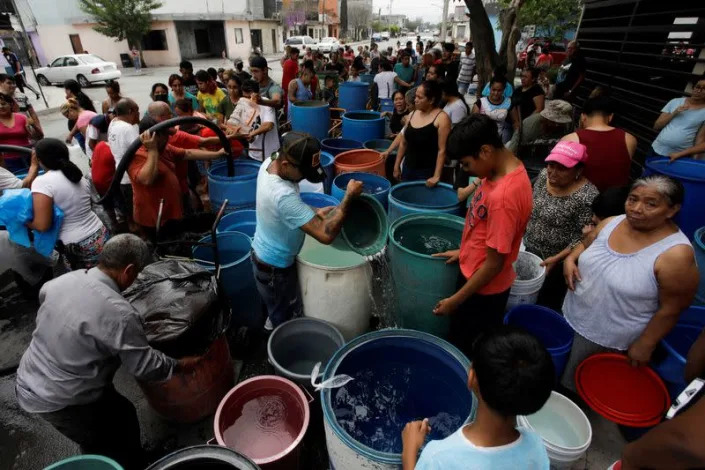
She had - and it wasn't just her. The taps across this working-class neighborhood of Sierra Ventana dried up over a week ago amid a historic shortage that's gripped the most important industrial city in Mexico.

"We're all struggling because there's no running water," said Robles, 60.

Desperate, Robles and her neighbors have resorted to climbing atop a nearby municipal water tank, filling up jugs, and lugging them back to their homes in order to drink, cook, clean, and wash bedsheets and school uniforms.

More than half of Mexico is currently facing moderate to severe drought conditions, according to the federal water commission CONAGUA, amid extreme heat that scientists blame on climate change.

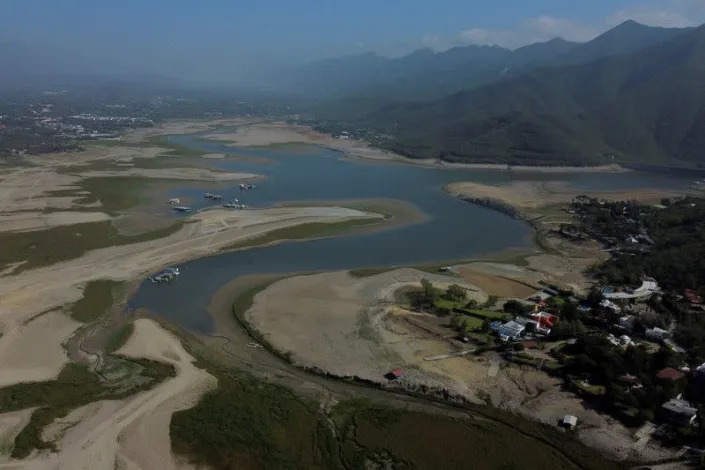
In the sprawling metropolitan area of Monterrey, home to some 5.3 million people, the drought and years of below-average rainfall have led to citywide water shortages.

"We're in an extreme climate crisis," Nuevo Leon Governor Samuel Garcia said at a news conference last week. "Today, we're all living it and suffering."

The city in June began limiting water access to six hours a day, forcing schools to adjust class schedules and sparking panic buying of bottled water that emptied supermarket shelves.

Protests and public anger are also growing against soda and beer companies whose federal concessions have allowed them to continue to extract water even as residents go without.

The state government says it is conserving water by repairing pipe leaks and installing pressure valves, while cracking down on farms, companies, and slaughterhouses caught pilfering water from rivers or clandestine wells.

With the hottest months ahead, the crisis is expected to continue. The hope is that summer brings some consistent rainfall to this arid climate.

As early as Tuesday, two of the main dams that supply the metropolitan area, Cerro Prieto and La Boca, could be empty, according to the head of the water and sewage agency, Juan Ignacio Barragan. A third dam, El Cuchillo, stands at 45% capacity.

Running water has stopped flowing in a few neighborhoods, Barragan acknowledged in a news conference last week.

One of them is Sierra Ventana, where Robles lives with her elderly mother, two siblings with disabilities, and a niece with a motor impairment.

Caring for them requires plenty of water, so multiple times a day, in termperatures approaching 40 degrees Celsius (104 Fahrenheit), Robles trods back and forth from the water tank, alongside fellow residents hauling buckets or pushing baby strollers filled with jugs.

One afternoon last week she'd just finished her last trip when she remembered her hard-of-hearing neighbor.

"What else can we do?" she asked, before heading to the tank a final time. "We need water to live."

(Reporting by Laura Gottesdiener and Daniel Becerril in Monterrey; Editing by Mark Porter)
Colombia ELN rebel group open to peace talks with next president Gustavo Petro


Mon, June 20, 2022

BOGOTA (Reuters) - Colombian leftist guerrilla group the National Liberation Army (ELN) is open to advancing peace talks with the incoming government of President-elect Gustavo Petro, it said on Monday, and called for reforms to tackle social exclusion and inequality.

Leftist Petro and his vice president-elect, Francia Marquez, won 50.4% of the vote in Sunday's election.

"The ELN remains active in its fight and political and military resistance, but also its disposition to advance in a peace process to further talks which started in Quito in February 2017," the ELN said in a statement.

Petro, who takes office on Aug. 7, has pledged to fully implement the 2016 peace deal with the former Revolutionary Armed Forces of Colombia (FARC) guerrilla group and to seek talks with the still-active ELN rebels.

The incoming president, a former member of the M-19 guerrilla group, has called for a rapid negotiation with the ELN, and has also suggested applying the 2016 peace deal with the demobilized FARC to those combatants who reject the agreement and formed dissident groups.

If Petro promotes changes to overcome political violence and develops plans for employment and entrepreneurship, agrarian reform, and continuity of the peace process, among others, he will have popular support, the ELN said. The group called for expanding economic inclusion for Colombia's marginalized communities.

Peace talks between previous governments and the ELN -- which is accused of financing itself with kidnapping, extortion, drug trafficking and illegal mining -- did not advance due to the group's radical positions, a diffuse chain of command and dissent in its ranks.

The ELN, which has some 2,400 fighters, began peace talks with the previous government of former President Juan Manuel Santos, but negotiations fell apart after a car bombing in Bogota, while current President Ivan Duque demanded that the group release all its hostages.

LIBERATION THEOLOGY

The ELN, founded by radical Roman Catholic priests in 1964, is widely considered to be less centrally controlled than FARC was.

(Reporting by Luis Jaime Acosta; Writing by Oliver Griffin; Editing by Jonathan Oatis)
Colombia elects first Black woman VP Francia Marquez, who vows to stand for 'nobodies'


Mon, June 20, 2022

By Oliver Griffin

BOGOTA (Reuters) - Francia Marquez, a single mother and former housekeeper, will be Colombia's first Black woman vice president after a historic vote on Sunday https://www.reuters.com/world/americas/colombias-first-leftist-president-targets-inequality-leaves-investors-edge-2022-06-20 saw the Andean country pick its first leftist president, Gustavo Petro.

Marquez and Petro won https://www.reuters.com/world/americas/colombians-head-polls-tightest-election-recent-memory-2022-06-19 50.4% of the vote in Sunday's election.

In front of a background emblazoned with the phrase "change is unstoppable," Marquez thanked supporters from across Colombia for assisting her and Petro's campaign in a speech broadcast from Bogota.


"After 214 years we have achieved a government of the people, a popular government, a government of people with calloused hands ... the government of the nobodies of Colombia," she said.

Colombia's new vice president-elect https://www.reuters.com/world/americas/hometown-looks-aspiring-colombia-vp-marquez-deliver-inequality-promises-2022-06-16 

hails from the municipality of Suarez, a rural area of Colombia's Cauca province. Around 80% of Cauca's population lives in some form of poverty.

Marquez is a celebrated environmental activist whose opposition to gold mining in her home municipality of Suarez saw her receive the prestigious Goldman Environmental Prize in 2018 - as well as death threats from illegal armed groups.

As well as serving as Petro's vice president, Marquez is slated to lead a new equality ministry to build on her core ideas of improving women's rights and helping the poor access health and education.

Marquez actually came second to Petro in their coalition's March primary election with 783,000 votes, when she tallied more ballots than the winner of the Colombia's centrist primary.

Her political rise during the campaign follows broad demands for change and increasing concern about socio-environmental topics, Daniela Cuellar of FTI Consulting told Reuters.

"The political popularity of Francia Marquez was part of a trend in Colombia where the population is looking for a change and where socio-environmental issues are becoming more and more relevant," she said.

(Reporting by Oliver Griffin; Editing by Nick Zieminski)


Colombian voters elect country's first Black vice president


MANUEL RUEDA and ASTRID SUAREZ
Mon, June 20, 2022

BOGOTA, Colombia (AP) — As Colombia's voters put aside a longtime antipathy to leftists and chose one as their new president, they also carved out another milestone — electing the country's first Black vice president.

When former leftist rebel Gustavo Petro takes office as president on Aug. 7, a key player in his administration will be Francia Marquez, his running mate in Sunday's runoff election.

Marquez is an environmental activist from La Toma, a remote village surrounded by mountains where she first organized campaigns against a hydroelectric project and then challenged wildcat gold miners who were invading collectively owned Afro-Colombian lands.

The politician has faced numerous death threats for her environmental work and has emerged as a powerful spokeswoman for Black Colombians and other marginalized communities.

“She’s completely different than any another person that’s ever had a vice presidency in Colombia,” said Gimena Sanchez, the Andes director for the Washington Office on Latin America, a human rights group.

“She comes from a rural area, she comes from the perspective of a campesino woman and from the perspective of areas of Colombia that have been affected by armed conflict for many years. Most politicians in Colombia who have held the presidency have not lived in the way she has,” Sanchez said.

She said Marquez will likely be given the mandate to work on gender issues as well as policies affecting the nation’s Afro-Colombian population.

In several interviews. Petro has discussed creating a Ministry of Equality, which would be headed by Marquez and would work across several sectors of the economy on issues like reducing gender inequalities and tackling disparities faced by ethnic minorities.

Marquez said Sunday that part of her mission as vice president will be to reduce inequality.

“This will be a government for those with calluses on their hands. We are here to promote social justice and to help women eradicate the patriarchy,” she said on stage while celebrating the election results with thousands of supporters at a popular concert venue.

Marquez grew up in a small home built by her family and had a daughter when she was 16, whom she raised on her own. To support her daughter, Marquez cleaned homes in the nearby city of Cali and also worked at a restaurant while studying for a law degree.

She was awarded the 2018 Goldman Environmental Prize for her successful efforts to remove gold miners from the collectively owned Afro-Colombian lands around her village.


A man walks near a campaign banner of Historical Pact coalition presidential candidate Gustavo Petro and his running mate Francia Marquez, ahead of weekend elections in Bogota, Colombia, Monday, June 13, 2022. Elections are set for June 19.
 (AP Photo/Fernando Vergara

Marquez entered the presidential race last year as a candidate for the Democratic Pole party, though she lost out in an inter-party consultation in March to Gustavo Petro. But she gained national recognition during the primaries and received 700,000 votes, topping most veteran politicians.

In speeches calling for Colombia to confront racism and gender inequalities and to ensure basic rights for the poor, Marquez energized rural voters who have suffered from the country's long armed conflict as well as young people and women in urban areas.

“All of us who work with her now believe in the power of women,” said Vivian Tibaque, a community leader in Bogota who worked on Marquez’s campaign. “We believe we can also defend out rights like Francia has defended hers.”

Political analysts said Marquez contributed to Petro’s campaign by reaching out to voters who felt excluded by the political system but did not trust the leftist parties that Petro, a former member of a rebel group, has been a part of throughout much of his career.

They said her presence on Petro's ticket also motivated Afro-Colombian voters along the Pacific coast, where Petro won by big margins Sunday even as he barely won the contest by three percentage points.

“I don’t think Petro could’ve won the presidency without her.” Sanchez said. “There is a lot of distrust and suspicion towards the left in Colombia, partly because a lot of the left has been armed at some point in time.”