Tuesday, June 21, 2022

Australia power crisis forces manufacturers to eye offshore moves, production cuts


By Byron Kaye

SYDNEY (Reuters) - Australia's biggest building materials manufacturers are cutting back operations, hiking prices and considering moving production offshore to manage a spike in power and gas bills, adding to pressure on the government to resolve the country's energy crisis.

The CEOs of Brickworks Ltd, the country's largest brickmaker, and Boral Ltd, the top maker of most other construction materials, flagged the changes even as Australia's new Labor government scrambles to try to beef up power supplies and bring down electricity prices.

Power prices have surged in Australia amid a shortage of coal-fired generation due to planned and unplanned outages, which has driven up demand for gas-fired generation at the same time as gas demand for heating jumped during a cold snap.

The price jump has been exacerbated by record high global coal and gas prices, stoked by sanctions on Russia.

That has left Australia's A$100 billion ($70 billion) manufacturing sector, a major power and gas consumer, exposed to soaring costs, especially those whose cheaper, long-term energy contracts are expiring.

Brickworks, for example, has gas contracts with Santos Ltd averaging A$10 per gigajoule, locked in for two years, compared to the current government-mandated price cap of A$40.

"If we had to pay, when our contract rolled over, (the current spot price), we would no doubt be shutting plants down and moving production offshore," said Lindsay Partridge, managing director of Brickworks.

Brickworks pays just $3 per gigajoule for gas in the United States, where it owns Pennsylvania-based brickmaker Glen-Gery Corp.

"If we rolled over and you had to pay A$40, and I could buy gas in the U.S. for $3, then it's a pretty easy equation to work out," added Partridge.

The United States generates just one-sixth of Brickworks' earnings from building materials, but the company could save money by shipping product back to Australia, he said.

Boral, which downgraded its annual profit forecast in May partly due to energy costs, told Reuters it has cut back on operations due to "the speed and magnitude of the change in energy prices".

"We have been forced to temporarily curtail some areas of our operations and unfortunately have been left with no other option than to pass increases onto customers directly," said Chief Executive Officer Zlatko Todorcevski in an email to Reuters, without specifying the size or products affected by the cuts. "We have also had to accelerate plans to review our overheads as we offset these inflationary challenges."

Boral welcomed a move last week by the Australian energy market operator to cap wholesale power prices and take control over power supplies, but Todorcevski said those temporary measures "do not provide long-term confidence for large manufacturers".

The Business Council of Co-Operatives and Mutuals said this month manufacturers were choosing between shutting "uneconomic operations" and passing higher costs to consumers as energy bills jumped more than 600% in a few months.

Incitec Pivot, Australia's top fertiliser maker, has said it would close its Brisbane plant at the end of 2022 because it was unable to line up an affordable gas contract.

GAS EXPORT CONTROLS

The latest crisis has highlighted the need for more gas supply in the domestic market, for a country which is the world's biggest exporter of liquefied natural gas (LNG).

Manufacturers have long clamoured for gas export controls or a reservation of gas for the domestic market. Gas prices have more than tripled in price since 2014, when Australia started exporting LNG from the east coast.

In Western Australia, where 15% of gas is reserved for local consumption, domestic prices are a fraction of the capped east coast price.

"There's certainly a strong call from many quarters for something to be done and a lot of people point to gas export controls," said Tennant Reed, energy policy director at the Australian Industry Group.

Australia's new resources minister, Madeleine King, has said all options are on the table for dealing with gas supply challenges.

Successive governments have previously opposed a gas reservation on the east coast, under pressure from gas producers which say the structure would deter further investment.

"It was something I raised 10-12 years ago with the previous Labor government about allowing all the gas to be exported, and connecting up the east coast of Australia into international markets," said Partridge, the Brickworks managing director.

"Now it's all come home to roost."

($1= 1.4388 Australian dollars)

(Reporting by Byron Kaye; Additional reporting by Sonali Paul in Melbourne; Editing by Lincoln Feast.)


79 years after a brutal battle to oust the Japanese, a remote piece of US territory is the center of attention again

Attu Aleutian Alaska invasion Japan World War II
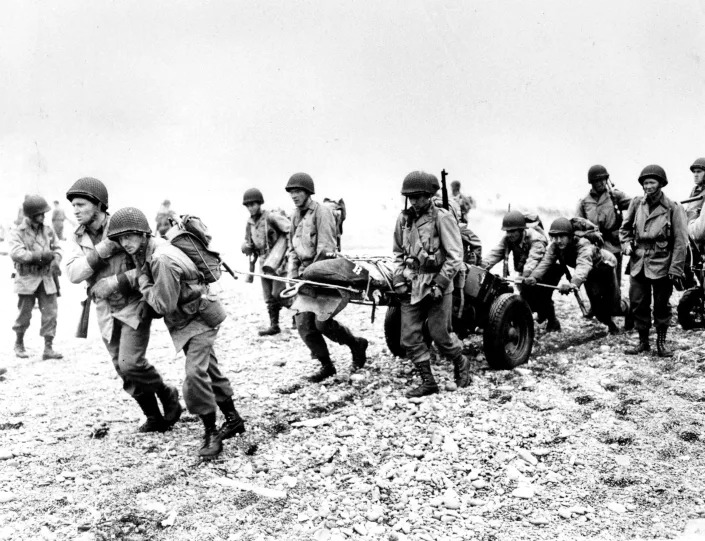
US soldiers and equipment land on the beach at Massacre Bay on Attu Island, May 26, 1943.(AP Photo/US Navy)
  • In May 1943, US soldiers launched a brutal fight to retake the islands of Attu and Kiska from the Japanese.

  • The remote islands, part of Alaska's Aleutian chain, were important for operations in the Pacific.

  • Now, with the US focusing more on the Pacific and the Arctic, Alaska has renewed military importance.

On May 11, 1943, American soldiers began landing on the island of Attu, which, along with the neighboring island of Kiska, had been seized by Japanese troops a year earlier.

Attu is the westernmost point in Alaska's Aleutian Island chain, some 1,500 miles from Anchorage. Its occupation by Japan was the first time since the War of 1812 that US territory had been seized by a foreign power.

The Japanese troops who landed on the islands were the northernmost arm of a larger operation that included the forces sent to attack and occupy Midway Island in the Central Pacific. Having turned back the Japanese advance, the US sent a massive force to retake the islands in mid-1943.

Instead of the three days of fighting that the Americans expected, the battle for Attu turned into a three-week slog.

Now, 79 years later, the Aleutian Islands and Alaska have renewed importance for the US, as the increasing accessibility of the Arctic is making the region a venue for competition with Russia and China.

Aleutian Islands campaign

Aleutian island
US military bases in the Aleutians as of August 1942.Wikimedia Commons

Japan seized Kiska and Attu in June 1942, exactly six months attacking Pearl Harbor. Their landings were preceded by air raids on nearby Dutch Harbor, which killed 43 US personnel and destroyed 11 planes.

Japan's goals in the Aleutians were twofold: distract the Americans before the planned invasion of Midway and prevent them from using the sparsely populated islands as forward outposts.

Within months of arriving, the Japanese had deployed thousands of troops to the islands and built fortifications and critical infrastructure, including bunkers and tunnels. Harbor facilities and an airstrip were also built on Kiska.

The US military increased its footprint in Alaska when it realized the importance of the area and its lack of defenses there. When Kiska and Attu were seized, Alaska Defense Command had just 24,000 troops at its disposal. By January 1943, it had 94,000.

By the end of February 1943, US troops had landed on nearby islands and built airfields from which to conduct bombing raids on Attu and Kiska. By mid-March, a US Navy blockade had cut the Japanese garrisons off from resupply and reinforcement.

On April 1, US commanders authorized the invasion of Attu. Dubbed "Operation Landcrab," the objective was to defeat the smaller Japanese garrison on Attu before turning to Kiska.

'Attacking a pillbox by way of a tightrope'

Attu Aleutian Alaska Japan invasion World War II
US soldiers with guns and grenades close in on Japanese troops in dugouts on Attu Island in June 1943.(AP Photo)

The first landings on May 11, which were preceded by air and naval bombardment, were unopposed, leading many to believe victory was imminent.

In fact, the garrison of more than 2,500 Japanese troops had prepared defenses farther inland and waited for the Americans to advance before ambushing them in small groups — a preview of what American troops would face on Iwo Jima and Okinawa a year later.

Making matters worse, the Americans soon found that they were fighting two enemies, the Japanese and the weather. Attu is covered in fog, rain, or snow for about 250 days of the year, with winds up to 120 mph.

Many US troops were without appropriate winter gear and suffered frostbite, gangrene, and trench foot. "It was rugged," Lt. Donald E. Dwinnell said. "The whole damned deal was rugged, like attacking a pillbox by way of a tightrope … in winter."

The Americans pressed on, seizing the high ground and pushing the Japanese into a few areas along the shore.

Attu Aleutian Alaska Japan invasion world war ii
US Army reinforcements land on a beach in Attu, June 23, 1943.(AP Photo)

On May 29, with defeat looming, the last Japanese troops able to fight conducted a massive banzai charge with the goal of seizing high ground, using captured artillery against American troops, and retreating back to their own fortifications with captured food and supplies.

In what one American soldier described as "a madness of noise and confusion and deadliness," some 800 Japanese soldiers penetrated the main American line and reached rear areas. The fighting was intense and included hand-to-hand combat, but the Americans rallied and pushed the Japanese back.

By May 30, the Island was secure. At least 2,351 Japanese bodies were recovered and buried by the Americans. As on other islands recaptured from the Japanese, many defenders killed themselves rather than accept defeat. Only 28 Japanese soldiers surrendered.

The fighting was so intense that the Japanese secretly withdrew from Kiska under the cover of fog and darkness at the end of July. Despite the Japanese departure, US and Canadian troops still took casualties from booby traps, friendly fire, and the harsh environment when they landed on Kiska in mid-August.

In total, 549 US soldiers were killed and 1,148 wounded during the Aleutian Campaign.

Newfound importance

During a routine maritime patrol in the Bering Sea and Arctic region, U.S. Coast Guard Cutter Bertholf spotted and established radio contact with Chinese People’s Liberation Army Navy (PLAN) task force in international waters within the U.S. exclusive economic zone, Aug. 30, 2021
US Coast Guard cutter Bertholf trailing Chinese navy ships in international waters in the Bering Sea, August 30, 2021.US Coast Guard photo by Ensign Bridget Boyle

Given its proximity to the Soviet Union, Alaska remained important during the Cold War, especially for air and missile defense, but memories of the World War II campaign largely faded over the following decades.

Today, with the US reorienting toward great-power competition, and with the region growing more accessible, Alaska's significance for military operations is getting renewed attention, which has been reflected in recent activity there.

In 2007, Russia restarted long-range bomber patrols that sometimes enter the Alaskan Air Defense Identification Zone, which surrounds the state but is not US territorial airspace. In 2020, US officials said intercepts of those flights were at the highest level since the Cold War.

Russian naval activity around Alaska has also increased. A massive drill in 2020 saw 50 Russian warships operating in the US exclusive economic zone, which stretches some 200 miles from the US coast, where they had run-ins with US fishing vessels.

China has also expressed interest in the Arctic. It has declared itself a "near-Arctic state" and is growing its icebreaker fleet. Chinese warships operated off Alaska for the first time in 2015, and four Chinese warships appeared off the Aleutian Islands again in August 2021.

US special operations with Stinger on Shemya
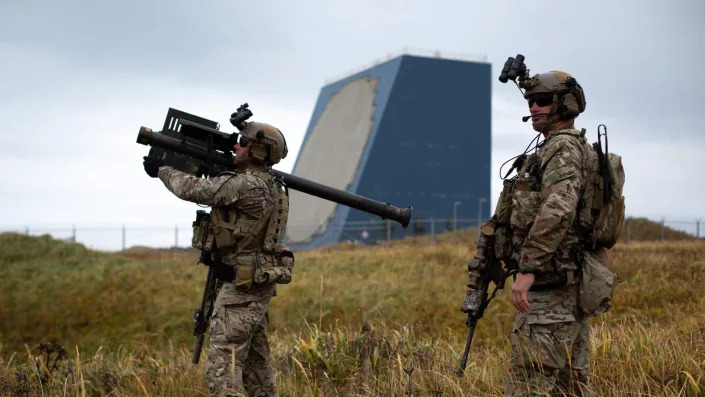
With the Cobra Dane radar in the background, US special-operations troops train with a Stinger missile on Shemya Island, October 2021.US Special Operations Command

The US military is bolstering its posture in Alaska. The Army has revamped its forces there, reestablishing the 11th Airborne Division and investing in new equipment and expanded training.

The Air Force, which has long had the largest Arctic presence of any US service branch, has added dozens of fifth-generation fighter jets to bases there. The Marine Corps has expressed interest in increasing its training in Alaska, and the Navy is looking to build out its operations there with a new deep-water port in Nome.

Alaska's renewed importance extends to the Aleutians. In 2019, US sailors and Marines trained on Adak Island, which is south of the increasingly busy Bering Strait and once housed a major US Navy base.

In late 2020, US special operators deployed to Shemya Island — which is closer to Russia than to the mainland US — to practice "securing key terrain and critical infrastructure."

With Arctic ice receding and Russian and Chinese activity increasing, Alaska's importance for the US military will only grow in the years ahead.

Fox News to Pay $15 Million Settlement to Ex-Host Who Raised Concerns About Gender Pay Gap


Harper Lambert
Sun, June 19, 2022

Fox News has agreed to pay former host Melissa Francis a $15 million settlement after she accused the network of gender pay disparity and was ultimately taken off the air, the Washington Post reported Sunday.

The news comes six months into the New York State Department of Labor’s investigation into her complaint that Fox News retaliated against her for speaking up about the discriminatory practice.

In 2012, Francis left her post covering financial news for CNBC to become an anchor at Fox Business. About five years into her tenure, she was promoted to co-anchor of Fox News’ midday show “Outnumbered,” while continuing to co-host Fox Business’ “After The Bell” and making occasional appearances on “Tucker Carlson Tonight.”

Francis told the Post that the meager salary increase she was offered prompted her to start gathering information about her male and female coworkers’ salaries. During a contract negotiation meeting in 2019, Dianne Brandi, former EVP for business and legal affairs at Fox News informed Francis that she would not receive a pay raise. Francis alleged that when she presented the data she had collected, Brandi said, “That’s how the world works. Women make less. It’s just a fact.”

A spokesperson for Fox on behalf of Brandi called Francis’ version of that conversation “untrue and patently absurd – furthermore, it is illogical that anyone with Dianne Brandi’s level of experience in negotiating talent contracts for a living would make such a ludicrous statement.”

“We parted ways with Melissa Francis over a year and a half ago and her allegations were entirely without merit,” a Fox spokesperson said. “We have also fully cooperated with the New York State Department of Labor’s investigation and look forward to the completion of this matter.”

According to the Post, Francis was effectively taken off the air on Oct. 7, 2020, the day Fox was ordered to turn over salary information by an arbitrator. She officially resigned in February 2021.

Her attorney, Kevin Mintzer, said Francis filed the Labor Relations complaint “not for herself but for the women of the company who remain behind.”

In the post-#MeToo upheaval that saw the ousting of Fox News mainstays like Roger Ailes and Bill O’Reilly, female accusers were paid upwards of $20 and $30 million as settlement.


“Fox News has always been committed to the equitable treatment of all employees which we have demonstrated consistently over our 26-year history, and we are extremely proud of our business,” the Fox News spokesperson said.

Monday, June 20, 2022

Sri Lankan students demand government resign over crisis


ERANGA JAYAWARDENA
Mon, June 20, 2022

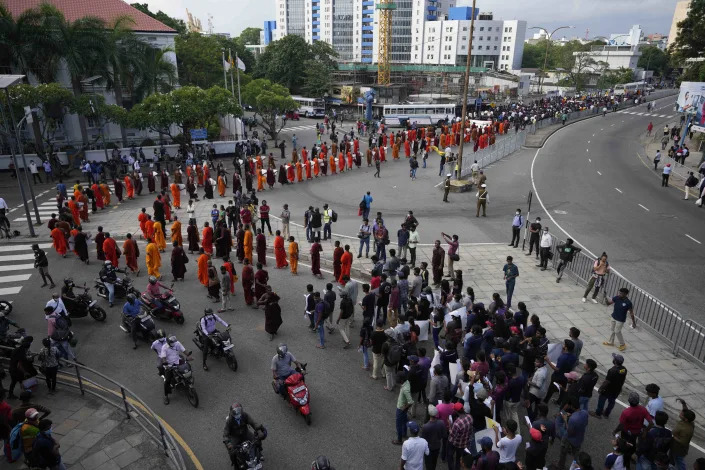
COLOMBO, Sri Lanka (AP) — Thousands of students from state universities marched in Sri Lanka’s capital on Monday to demand the president and prime minister resign over an economic crisis that has caused severe shortages of essential supplies and disrupted people's livelihoods and education.

The students say President Gotabaya Rajapaksa is responsible for the economic crisis, the worst since independence in 1948, and that Prime Minister Ranil Wickremesinghe, who took over the position a little more than a month ago promising to end shortages, has not delivered on his pledges.

Sri Lanka is nearly bankrupt and has suspended repayment of $7 billion in foreign debt due this year. It must also pay back more than $5 billion every year until 2026. Its foreign reserves are nearly gone and it is unable to import food, fuel, cooking gas and medicines. A lack of fuel to run power stations has resulted in long daily power cuts.

In recent months people have been forced to stand in long lines to buy fuel and gas, and the country has survived mostly on credit lines extended by neighboring India to buy fuel and other essentials.

With that credit also running out, authorities have shut schools and instructed teachers to teach online, and have asked non-essential government employees to work from home for one week to preserve limited stocks of fuel.

Officials from the International Monetary Fund are currently in Sri Lanka to discuss a bailout package.

Monthslong protests have nearly dismantled the Rajapaksa political dynasty that has ruled Sri Lanka for most of the past two decades.

One of Rajapaksa's brothers resigned as prime minister last month, and two other brothers and a nephew quit their Cabinet posts earlier.

President Rajapaksa has admitted he did not take steps to forestall the economic collapse early enough, but has refused to leave office. It is nearly impossible to oust a president under the constitution unless he resigns on his own accord.


Sri LankaSri Lankan student Buddhist monks shout slogans as they march demanding President Gotabaya Rajapaksa resign over the economic crisis in Colombo, Sri Lanka, Monday, June 20, 2022. (AP Photo/Eranga Jayawardena)

What Happened When France Sent Low-Income Kids to Wealthy Schools


Peter Yeung
Mon, June 20, 2022,


In 2004, Maxence Arcy moved with his family to Bellefontaine, a poor suburb of the French city of Toulouse. Limited by what he could afford, the father of six bought a place on a sprawling housing estate in the neighborhood which had catchment schools with the worst educational record in the region.

“At the time, there were only Mahgrebians and Africans living on the estate and going to these schools,” says Arcy, who originally migrated from Morocco in search of work in 1984. “It was a kind of segregation in the 21st century.”

But in January 2017, local authorities closed those schools in France’s fourth biggest city and instead bussed the 1,140 affected pupils to high-achieving facilities in the prosperous downtown in an attempt to write a new chapter of education equality.

The theory, according to Georges Méric, president of the Haute-Garonne region that includes Toulouse, was that a “rising tide lifts all boats.” Put another way, by inserting the students from Bellefontaine and two other suburbs, La Reynerie and Mirail, into schools of proven success, social determinism would be countered and all children would benefit.

“There are districts in Toulouse with 90 or 95 percent immigrant populations,” says Méric, who helped develop the scheme. “They are very poor and opportunities are hard to come by. But the young children living there have the right to success in life.”

Under Méric’s €56 million project, buses take the pupils — aged 11 to 15 — to nearly a dozen different schools in the city center in journeys that take less than an hour. The school principals and teachers are supported by six “social mix masters” who help facilitate logistics such as transport and tackle any problems that arise, such as dealing with parent concerns.

Five years on, the test results have been noteworthy. Before the bus scheme began, the drop-out rate for students living on the three estates after taking the Brevet — France’s national diploma for 15-year-olds — was almost 50 percent. That rate has now fallen to less than six percent and grades have risen by nearly 15 percent on average. Some 94 percent of pupils have stayed in the same school, calming fears that the scheme would lead wealthier families to move their children into the private sector.

“The welcoming colleges had a very good academic level already, that was important,” says Méric. “It’s worked very well. There has not been segregation in them and it’s promoting the wider acceptance of diversity across the city.” (Middle school is the U.S. equivalent of what is called college in France.)

Eduardo Mosqueda, a professor who specializes in access to education at the University of California, Santa Cruz, acknowledges the successes of the Toulouse project. But, he says, consideration must be given to the amount of funding it requires.

“I can’t help to wonder what the differences are in resources [that were] available to students in Bellefontaine compared to students in the schools where they are being bussed in terms of quality curriculum and adequately prepared teachers,” he says. “If the project to bus students costs €56 million, how much would student achievement improve if that money was invested into improving the schools that were closed?”

Even so, despite their poor academic performance, the Bellefontaine schools already had a high student to teacher ratio of around four to one, which came at a significant cost.

Mosqueda also believes bussing might lead to added pressures on pupils. “Students that are bussed are also in new school environments where it may be difficult to integrate given the racial, income, cultural and linguistic differences,” he says.

Yet Maxence Arcy’s 13-year-old son, Adam, who switched from a Bellefontaine school to one in Saint Aubin, has had few issues to date. “There’s a bus that comes to pick him up 200 meters from our house,” says Arcy. “He’s mixing with other students. He’s happy, he has improved his grades. He wants to be an engineer.”

For Arcy, the initiative is a textbook example of how to improve social diversity and the opportunities of future generations. “We were always for the project,” he says. “We wanted our child to see other nationalities and cultures. We were just concerned about the distance to the new school, but the bus works well.”


One crucial learning from the scheme has been the need for extensive dialogue between all parties involved. As many as 80 meetings, including 50 public meetings, were held before the bussing project was launched, helping address the concerns of those who voiced opposition to the project.

The latter included parents worried about the distances the children would have to travel and a handful of teachers who were resistant enough to the idea of changes in the student makeup that they went on strike to try and prevent it.

“It wasn’t comfortable at the beginning,” says Méric. “There was resistance both through administration and the local level. But we listened to their concerns.”

These lessons could be invaluable, according to Malika Baadoud, director of L’École et Nous, a Bellefontaine-based parents association, given that schooling segregation is present across France and other countries. Often resulting from societal divides, she says, it has led to high dropout rates, school violence, racism and teacher burnout. “In certain areas of France, social and racial diversity simply doesn’t exist,” says Baadoud, who has held her role since 2003 and was last year awarded the prestigious National Order of Merit for her work.

One of the initial concerns for parents whose children were set to be bussed further afield, according to Baadoud, was the fact that many families don’t own cars. But that was resolved by providing parents with free bus passes to travel from the estates to the schools to meet their children. “Slowly it was proved that all of these fears were unfounded,” says Baadoud. “They know it’s an opportunity for their children. It’s something that is unprecedented.”

The project is here to stay. Already this year two new schools have been built away from the estates’ traditional catchment areas in other, more privileged parts of Toulouse to ensure permanent social mixing in the classrooms and promote a more diverse staff.

Encouraged by the results, several other cities and towns across France are now studying ways to launch their own bussing initiatives, according to Méric, with the Ministry of National Education helping to coordinate.

“Others have contacted us — regional departments and ministerial officials have come to see us,” he says. “I hope the scheme multiplies.”
WELL IT'S ABOUT TIME, IT'S LATER THAN THEY THINK
PG&E moves power underground in plan to bury 10,000 miles


California Buried Power Lines
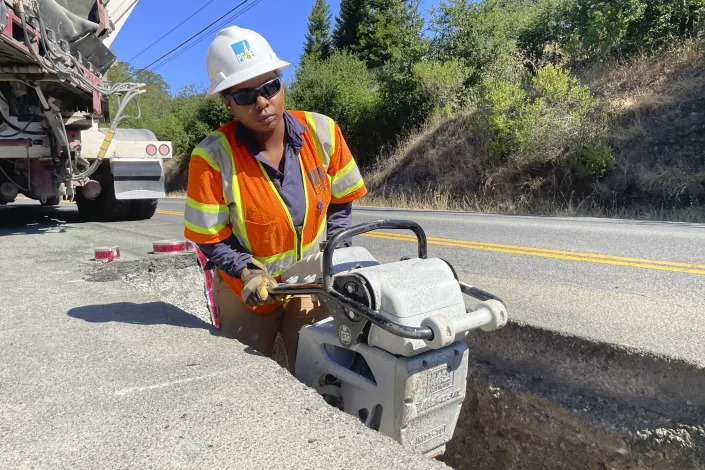
A PG&E crew works at installing underground power lines along Porter Creek Road in Sonoma County, Calif., site of the 2017 Tubbs Fire, on Monday, June 13, 2022. Pacific Gas & Electric Co. has started an ambitious project to bury thousands of miles of power lines underground in an effort to prevent igniting fires with its equipment and avoid shutting down power during hot and windy weather. (AP Photo/Haven Daley)

HAVEN DALEY
Wed, June 15, 2022, 10:34 PM·4 min read

SANTA ROSA, Calif. (AP) — Pacific Gas & Electric Co. is working on an ambitious project to bury thousands of miles of power lines in an effort to prevent igniting fires with its equipment and avoid shutting down electricity during hot and windy weather.

PG&E announced last year that it planned to bury 10,000 miles (16,000 kilometers) of power lines in the next decade at a projected cost of $15 billion to $30 billion. The announcement came just days after PG&E informed regulators that a 70-foot (23-meter) pine tree that toppled on one of its power lines ignited a major fire in Butte County, the same rural area about 145 miles (233 kilometers) northeast of San Francisco where another fire sparked by its equipment killed more than 80 people and destroyed thousands of homes in 2018.

Since 2017, the aging equipment of the nation's largest utility has been blamed for more than 30 wildfires that wiped out more than 23,000 homes and businesses and killed more than 100 people. In 2019, PG&E filed for bankruptcy after facing billions of dollars in wildfire fines and lawsuits.

In addition to preventing wildfires, PG&E says burying power lines underground will lead to fewer disruptive public safety power shutoffs, which have become more frequent in the last few years due to dry weather and high wind events linked to climate change.


PG&E previously has buried power lines as systems are rebuilt in the wake of destructive wildfires, such as the massive blaze that wiped out most of the town of Paradise in 2018. This month, it started work on a plan to place 175 miles (280 kilometers) of power lines underground this year in central and Northern California, said Deanna Contreras, a PG&E spokeswoman.

The company has said it plans to bury as many as 1,200 miles a year to meet its goal.

“Undergrounding reduces ignition risk by 99% so we are starting in the areas of the highest fire risk, high fire threat district areas, and also prioritizing areas where we can reduce the number of public safety power shutoffs,” she said.

She said burying power lines costs $3.75 million per mile.

“As we increase the line miles every year and we scale up, we expect those costs to come down to about $2.5 million a mile by the end of 2026,” she added.

But some critics of PG&E’s plan say it’s too expensive and will take too long to complete. The plan calls for ratepayers to finance the project through higher utility bills.

The Utility Reform Network, or TURN, a consumer advocacy organization, questions whether PG&E will be able to continue properly maintaining its power lines while it focuses on the burying power lines, which will take at least a decade to complete.

“This would take years upon years and we need to be sure that the company is focusing on its compliance in the meantime,” said Katy Morsony, a TURN staff attorney. “By also trying to engage in this huge capital investment program at the same time, it’s unclear that they can both properly manage compliance in the meantime, as well as successfully and efficiently complete the undergrounding program.”

PG&E, a 117-year-old company, generates about $20 billion in revenue annually while serving a 70,000-square-mile (181,300-square-kilometer) service area in the northern and central part of California that includes farmland, forests, big cities and the world’s technology hub in Silicon Valley.

One of the places where lines are currently being buried is near the Sonoma County site of the 2017 Tubbs wildfire that killed at least 22 people and destroyed thousands of homes in and around Santa Rosa.

Supporters say burying the lines also provides a more aesthetically pleasing California landscape.

Tom Sullivan, who rebuilt after losing his home in the 2017 Tubbs wildfire, said he’s willing to pay a little more for his power if it means there’s less chance of another devastating wildfire.

"It’s something that has to be done, so we’re just all going to have to pay for it. Either that or we’re going to end up with more fires," Sullivan said.
NASA discovers mysterious balanced rock on Mars, igniting debate over how it happened

Mark Price Sun, June 19, 2022,

NASA’s roving camera on Mars has discovered another oddity in the 750-mile-wide Jezero Crater, and it has some people wondering if aliens are yanking our chain.

A rock about the size of bowling ball was photographed precariously balanced atop a leaning boulder.

The find was announced just one day after NASA questioned whether “the wind” blew a piece of rocket insulation 1.2 miles away from the Perseverance Rover’s entry point on Mars.

A photo of the formation was shared June 16 on Facebook, and NASA says it’s in an area named “Hogwallow Flats.” Rocks in the area are believed to be “as old as 3.6 billion years.”

https://www.facebook.com/NASAPersevere/photos/a.110522540557599/537483164528199/?type=3

“The nearby rocks are a sight to behold,” NASA reported. “Take a look at some of these close-ups. Tons of potential targets for study.”

NASA didn’t address the balanced rock specifically, likely knowing social media would point it out and raise questions. The post has since gotten 14,000 reactions and nearly 300 comments as of the morning of June 19, including some who called it “a Martian basketball.”

“Who balanced that rock!?” Stephen Bukowski asked.

“The shape of this rock is not natural,” Ahmad Ahmad Alawaj posted.

“Did you see an alien sitting on the rock?” Ravindu Nimsara asked.

Some noted this formation resembled a “snake head” sticking out of a Mars cliff.

Some speculated the rock was connected to the boulder under it, and was simply an example of weaker stone weathering away around it over the centuries. A few swore they even saw a pedestal.

The space and astronomy news site Universe Today marveled that it had somehow become “perfectly balanced.”

“Knowing the history of that rock would certainly provide an interesting story, geologically speaking,” the site wrote.

“What process or processes could bring a rock to be in such an unlikely position? ... It’s very unlikely the rock was ‘dropped’ into its current location. More probable is that the rock was part of the original bedrock formation and over millennia, wind erosion wore it down to its present shape.”

NASA has cited weathering as a likely cause for several other odd formations seen on Mars, including a series of “spikes” photographed last month at Gale Crater.

Rocks near the “Martian basketball” formation appeared honey-combed with holes, and Universe Magazine Space Tech noted one resembled a snake head jutting out of a rock wall.

Fox Poll Triggers GOP Senator Into Blaming Ignorant Americans for Supporting Assault Weapons Ban

Mike Lee responded by essentially saying the American people don’t know their rights, so they need lawmakers to defend them.


Peter Wade
Sun, June 19, 2022


Faced with the news that a significant majority of Americans support a number of gun control measures, including a ban on assault weapons, Republican Senator Mike Lee struggled to defend his party’s staunch opposition to some of those policies. Instead, he blamed Americans, claiming they don’t understand their rights or know what an assault weapon is.

“Fox’s polling shows that there is a lot of strength behind some of these proposals,” host Shannon Bream said on Fox News Sunday as a graphic on-screen showed 82 percent support for raising the legal age to purchase an assault rifle to 21; 81 percent support for flagging people who are a danger to themselves or others; and 63 percent support for banning assault weapons altogether.

“There is a lot of momentum, at least among the public sphere, for doing this. Are you out of step with your constituents?” Bream pointedly asked the senator.


Lee responded by essentially saying the American people don’t know their rights, so they need lawmakers to defend them. “OK, so, first of all, what’s important is we look out for the rights of constituents,” he said. “Constituents are asked poll questions, they’re not asked questions about specific language within legislative text. It’s the job of the lawmaker to look out for the interests and the rights of the law-abiding citizens they represent.”

Yes, according to Lee, it’s up to the lawmaker to carefully and condescendingly explain that the right not to have your body torn apart by an AK-47 in a grocery store or public school is less important than a gunman’s right to yield a rapid-firing weapon of war equipped with a high capacity magazine.

Lee continued, “With each of those provisions, I understand how they could get high popularity ratings when they don’t define them. For example, you talk about banning assault weapons, there is no universal definition of what an assault rifle is.”

The senator then went on to babble about how whether an assault rifle is made of “wood, or of plastic, or of composite” can change its status as an assault weapon. But, of course, we do have a clear definition of a semiautomatic assault weapon contained in the 1994 assault weapons ban, which lasted 10 years (and reduced mass shooting fatalities) until the George W. Bush administration allowed it to lapse.

Lee, unsurprisingly, has an “A” lifetime rating from the National Rifle Association, meaning he regularly supports legislation endorsed by the pro-gun group. During his 2016 re-election bid, Lee received more than $23,000 from the gun lobby, including $3,000 from the CEO of a gun silencer manufacturer. He later introduced a bill to eliminate all federal regulations on silencers.
This May Be the COVID Variant Scientists Are Dreading

David Axe
Mon, June 20, 2022

Photo Illustration by Thomas Levinson/The Daily Beast/Getty

COVID-19 cases are increasing again in the United Kingdom, potentially signaling a future surge in infections in the United States and other countries.

A pair of new subvariants of the dominant Omicron variant—BA.4 and BA.5—appear to be driving the uptick in cases in the U.K. Worryingly, these subvariants seem to partially dodge antibodies from past infection or vaccination, making them more transmissible than other forms of the SARS-CoV-2 virus.

There are also some suggestions that the new subvariants have evolved to target the lungs—unlike Omicron, which usually resulted in a less dangerous infection of the upper respiratory tract.


But there’s good news amid the bad. While cases are going up in the U.K., hospitalizations and deaths are increasing more slowly or even declining so far. “This could mean higher transmissible variants, BA.4 or 5, are in play, [and] these variants are much less severe,” Edwin Michael, an epidemiologist at the Center for Global Health Infectious Disease Research at the University of South Florida, told The Daily Beast.

The trends could change, of course, but the decrease in deaths is an encouraging sign that, 31 months into the pandemic, all that immunity we’ve built up–at the cost of half a billion infections and tens of billions of dollars’ worth of vaccines—is still mostly holding.

As far as COVID goes, things were really looking up in the U.K. until recently. COVID cases steadily declined from their recent peak of 89,000 daily new infections in mid-March. Deaths from the March wave peaked a month later at around 330 a day.

The Massive Screwup That Could Let COVID Bypass Our Vaccines

By early June cases and deaths were near their pandemic lows. Then came BA.4 and BA.5. The grandchildren of the basic Omicron variant that first appeared in the fall of 2021, BA.4 and BA.5 both feature a trio of major mutations to their spike protein, the part of the virus that helps it to grab onto and infect our cells.

Eric Bortz, a University of Alaska-Anchorage virologist and public-health expert, described BA.4 and BA.5 as “immunologically distinct sublineages.” In other words, they interact with our antibodies in surprising new ways.

The European Center for Disease Prevention and Control—the European Union’s answer to the U.S. Centers for Disease Control and Prevention—labeled BA.4 and BA.5 “variants of concerns” back in mid-May. Two weeks later the two new subvariants began the gradual process of overtaking older forms of Omicron in the U.K. That’s when cases began increasing again.

It doesn’t help that the U.K. like most countries—China is a big exception—has lifted almost all restrictions on schools, businesses, crowds and travel. Those restrictions helped to keep down cases, but were broadly unpopular and came at a high economic cost.

“There’s a disconnect between the actuality of how infections are happening… and how people are deciding not to take very many precautions,” John Swartzberg, a professor emeritus of infectious diseases and vaccinology at the University of California-Berkeley's School of Public Health, told The Daily Beast. He described it as “COVID fatigue… 100 percent of the world’s population must have it by now.”

The combination of a fully reopened economy and new COVID subvariants had an immediate effect. The U.K. Health Security Agency registered 62,228 new infections in the week ending June 10, a 70 percent uptick over the previous week. COVID hospitalizations grew more slowly over the same period, spiking 30 percent to 4,421.

COVID fatalities actually dropped, however—sliding 10 percent to 283. Deaths tend to lag infections by several weeks, of course, so it should come as no surprise if the death rate flattens or bumps up later this month or early next month.

But it’s possible it won’t. Yes, BA.4 and BA.5 are more transmissible, owing to that mutated spike protein. But that doesn’t mean they’re going to kill a lot of people. Despite their unusual qualities, it could be that BA.4 and BA.5 aren’t actually more dangerous than previous subvariants.

Bortz sketched out one possibility, that BA.4 and BA.5 are “immune-evasive enough to infect, but generally not evasive enough to counteract acquired immunity from vaccines and/or prior infection.”

Of course, immunity varies from community to community, country to country. The U.K.’s 67 million people have, for their part, built up pretty serious immunity over the past two-and-a-half years.

Tens of millions of U.K. residents have natural antibodies from past infection. 87 percent of the population is fully vaccinated. 68 percent is boosted. All those antibodies might not prevent breakthrough infections, but they do tend to prevent serious breakthrough infections.

How bad the current surge in cases gets depends to a great extent on the durability of those antibodies. Immunity, whether from past infection or vaccines, tends to wane over time. But how fast it wanes, and to what effect, is unpredictable.

It’s possible widespread immunity holds and the swelling BA.4 and BA.5 wave in the U.K. crests in a few weeks without making a whole lot more people sick—or killing them. That’s the best-case scenario given the lack of political will, and public support, for a new round of restrictions. “If higher cases would not lead to significant disease or deaths, then we may be able to live with this virus,” Michael said.

The worst-case scenario is that BA.4 and BA.5 prove more capable of evading our antibodies than experts currently anticipate. Keep an eye on the hospitalization stats. If COVID hospitalizations start increasing in proportion to the growth in cases, it’s a sign the new sublineages are dodging our hard-won immunity.

In that case, a big spike in deaths is sure to follow.

That could be a big red flag for the Americas. COVID variants tend to travel from east to west, globally. New variants and subvariants tend to appear in the United States a few weeks after becoming dominant in the U.K. At present, BA.4 and BA.5 account for just a fifth of new cases in the U.S. Expect that proportion to increase.

The problem for Americans is that they’re much less protected than Britons. Yes, Americans have a lot of antibodies from past infection, but they’re also a lot less likely to be vaccinated—and even less likely to be boosted. Just 67 percent of Americans are fully vaxxed. A little over a third of the U.S. population has gotten a booster.

So if BA.4 and BA.5 end up causing a surge in deaths in the U.K., they’re likely to inflict an even greater death toll on the other side of the Atlantic Ocean. “We’re sort of in this zone now, betwixt and between,” Swartzberg said. “It’s unclear which way things are going to go.”
A Somali boy's mission to find food as climate change takes its toll


Kalmole Moalin Aden, 11, stands with classmates at the the Kabasa Primary School in Dollow

Mon, June 20, 2022, 
By Katharine Houreld

DOLLOW, Somalia (Reuters) -Each morning in this Somali border town, 11-year-old Bashir Nur Salat plots his day's mission behind a crooked wire fence. Armed with only a friend's yellow school shirt, a borrowed book and toothy grin, he eyes his prize through the mesh: lunch.

Bashir lives where three crises converge - global warming, spiralling food prices and war. He, like millions of others in Somalia, are in the crosshairs of what some aid workers are calling the "The Three Cs": climate change, costs and conflict.

The worst drought in four decades in war-torn Somalia forced his family to leave their farm three months ago and to move about 100 kilometers (62.5 miles) north to the town of Dollow, on the border with Ethiopia.


Now, he leads a pack of younger children who gather when the Kabasa Primary School serves its students food. Through the school's wire fence, the children stare at students inside gulping warm porridge or plates of beans and corn served as part of a U.N.-supported program, one of the few regular sources of food in the town.

Many of the gang were among the latest influx of people into Dollow, too late to register for schooling. One by one, they slink through the broken gate and dart across the dusty schoolyard to grab a meal when the teachers aren't looking.

"When I don't get food, I'm so hungry: I lie down and I can't sleep," Bashir said quietly. He had eaten no dinner the night before nor breakfast that morning. His eight brothers and sisters at home were all hungry, he said.

The drought, which began last year, is predicted to worsen, exacerbated by climate change, many scientists and humanitarian organizations say. A third of livestock is already dead from thirst or hunger. Crops and fruit trees have withered.

Somalia, riven by a long-running Islamist insurgency, needs to import more food but people can't afford to buy it. Foreign aid is dwindling and food prices spiking because of war in Ukraine, the world's fourth-largest grain exporter.

At least 448 children have died since January while being treated for acute malnutrition, the United Nations said. The figures are likely a fraction of the true deaths since many will have been unable to reach help.

The United Nations warned this month that more than a third of Somalia's 16 million people need food aid to survive. Some areas could face famine this month. Aid in some places will run out in June.

(For a graphic on spreading hunger in Somalia please click https://tmsnrt.rs/3QxOydu)

NO TIME TO RECOVER

Bashir's family had never before left their home in south-central Somalia, even when famine in 2011 claimed more than a quarter of a million lives, most of them children. Aid workers say deaths may approach those levels again in this drought.

Bashir's family did not move then. Some livestock survived, so they stayed in their farm near Ceel Bon village.

Not this time. The drought took all of their 12 cows and 21 goats – a small fortune in a country where wealth is counted in animals. The family once enjoyed three meals a day: creamy milk from the family cows now reduced to scattered bones; and beans and sorghum from fields now parched and cracked.

"I've never seen a drought like this before," said Bashir's 30-year-old mother. She and her nine children now sleep on two mattresses in Dollow.

On a good day, Bashir's father may make $2 selling charcoal in a nearby town, but since May 2 he has managed to send only $10 because of lack of work. The family has not received any food aid, she said.

Such desperation is set to become more common in Somalia, and beyond, as rising temperatures fuel more natural disasters, many scientists say. In the last 50 years, extreme weather events have increased five-fold worldwide, according to the U.N.'s World Meteorological Organization (WMO).

The Horn of Africa, including Somalia, is at its driest on record. This year's March-to-April rains – the first of two annual rainy seasons - have been the smallest in 70 years, and the second rains from October to December are also predicted to be unusually dry, according to a warning last month from a group of 14 meteorological and humanitarian associations, including the WMO.

"We've never seen a four-season drought before, and now we're likely to see a fifth" in October, said climatologist Chris Funk from the Climate Hazards Center at the University of California, Santa Barbara.

"This drought has been made much more likely due to climate change," Funk said.

The El-Nino-La Nina weather cycle halfway across the world in the Pacific is partly influencing the warm, dry air over Somalia, as is the Indian Ocean Dipole climate pattern. (For a graphic on how La Nina affects weather please click https://tmsnrt.rs/3zNnC3q)

When the Dipole is positive, it is warmer in the west of the Indian Ocean and more rain falls in East Africa. Now, the Dipole is forecast by the WMO to go negative until the end of the year, causing dryness over the Horn.

But those alone don't explain the steep decline in springtime rains over the last 20 years, said Funk.

Ocean warming may also play a part. Climate scientist Abubakr Salih Babiker of the WMO Regional Office for Africa said the Indian Ocean is among the fastest-warming water bodies in the world.

With oceans absorbing much of the increasing atmospheric heat, scientists believe warming Indian Ocean waters may be evaporating and raining down more rapidly over the ocean before reaching the Horn of Africa, leaving dry air to sweep across the land.

Another factor: air temperatures in Somalia have increased an average 1.7 degrees Celsius from the preindustrial average – faster than the global average of 1.2 degrees, said Babiker. Warmer air speeds up evaporation from soil and plants.

The Horn of Africa has seen other climate-linked disasters in recent years - damaging floods, a record number of cyclones and vast locust swarms - leaving the region staggering from one crisis to the next, he said.

"There's no time for recovery," Babiker said.

CLIMBING COSTS

The children's ward at Dollow's hospital was full of listless patients, as were the maternity and outpatient wards.

Every bed was occupied when Reuters visited in May, with age-height-weight ratios sometimes veering into the red. Weakened by severe malnutrition, some children had serious infections, including measles.

At the school where Bashir hunts for food, 10-year-old Suleko Mohammed says she lost three siblings to measles in six weeks – two brothers, aged 2 and 3, and her older sister who used to help her with homework.

They now lie under piles of rubble and thorn branches in a graveyard next to the playground. As she spoke between classes, mourners were digging another small grave.

Down the road, market stalls displayed watermelons, mangoes, beans, and bags of flour and wheat – too costly for many.

Food prices have jumped by up to 160 percent in parts of Somalia, due to the drought and global supply disruptions from the conflict in Ukraine. Even in good times, Somalia imports over half its food.

The government has become alarmed by what it says is the slow international aid response, with its special drought envoy Abdirahman Abdishakur Warsame saying countries need "to pay attention to this drought before it becomes a famine."

"All human lives are equal," he told Reuters. "The international community, particularly the Western nations, are paying more attention to Ukraine than the other crises."

To date, Somalia has received just 18% of the $1.46 billion it needs in humanitarian aid this year, according to U.N. figures - well below the level of response last year. Ukraine, by contrast, has received 71% of its requested $2.25 billion for six months. Senior U.N. officials have repeatedly sounded the alarm about the shortfall of aid in the Horn of Africa to tackle the worsening drought.

RELATIVE SAFETY

Dollow is better served by aid agencies than most Somali towns and is among the safest places from the al Qaeda-linked insurgency, one of the world's longest-running conflicts.

More than 520 aid workers have been kidnapped, injured or killed over the last 15 years – the majority of them Somali. In Dollow, Ethiopian soldiers patrol the streets and keep order.

The Kabasa Primary School was established to cope with the influx of families ravaged by the 2011 famine. Admissions swelled again during the 2016-17 drought, when early humanitarian intervention kept the death rate low.

About one fifth of students typically leave school during hard times and never return, said Rania Degesh, deputy director of East and southern Africa for the United Nations Children's Fund (UNICEF).

"When you uproot children, you expose them to incredible risks: exploitation, gender-based violence, early marriages, recruitment, neglect," Degesh said.

The meal program entices them to stay in school. Schools in Somalia get 41 U.S. cents per child for two meals a day, said the U.N.'s World Food Programme.

But dwindling funds have already forced cutbacks to the program supporting 110,000 Somali children. Schools have just started a two-month break; there is no funding for when classes resume in August.

Teachers said Bashir and his gang were among at least 50 unenrolled children who appeared daily hoping for meals. Sometimes, teachers pushed them back. Sometimes, they offered leftovers. Sometimes they turned a blind eye.

"If they eat the food, then there is not enough for the students," said Kasaba's principal, Abdikarim Dahir Ga'al, as he watched Bashir's gang slip into the schoolyard.

Ga'al pretended not to notice. It was the last day of term.

"I am a teacher," he said. "But I am also a parent."

Outside, Bashir scrambled among the last students to receive their meals, emerging triumphantly from the scrum with a metal plate of bean and corn mash.

His grin was wide and his head held high. At last, he would eat.

(Additional reporting by Gloria Dickie in London; Editing by Katy Daigle, Mike Collett-White and Daniel Flynn)