Tuesday, June 21, 2022

Millions of years ago, the megalodon ruled the oceans – why did it disappear?


Michael Heithaus, Executive Dean of the College of Arts, 
Sciences & Education and Professor of Biological Sciences, Florida International University
 THE CONVERSATION
Mon, June 20, 2022


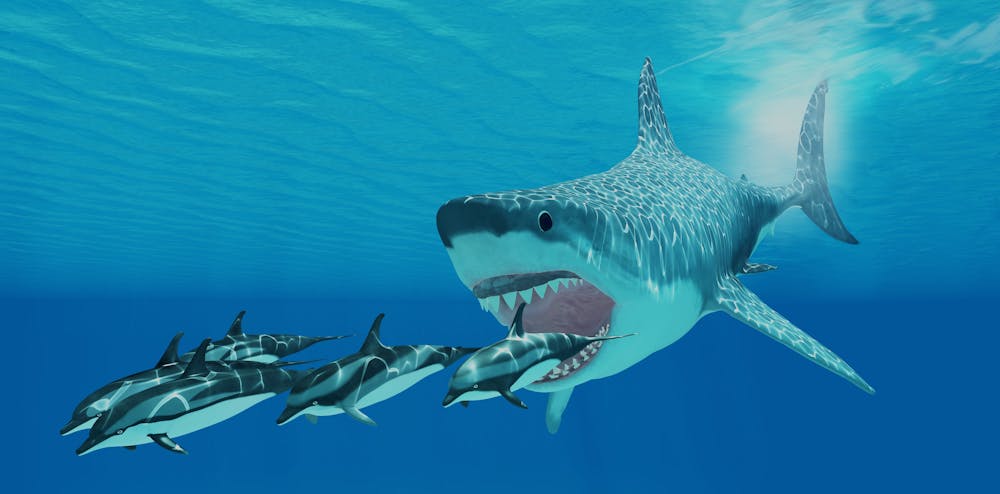
Roaming the ancient seas eons ago, the megalodon shark eviscerated its prey with jaws that were 10 feet wide. Warpaintcobra/iStock via Getty Images Plus

Curious Kids is a series for children of all ages. If you have a question you’d like an expert to answer, send it to curiouskidsus@theconversation.com.


When did the megalodon shark go extinct, and why? – Landon, age 10


Imagine traveling back in time and observing the oceans of 5 million years ago.

As you stand on an ancient shoreline, you see several small whales in the distance, gliding along the surface of an ancient sea.

Suddenly, and without warning, an enormous creature erupts out of the depths.

With its massive jaws, the monster crushes one of the whales and drags it down into the deep. Large chunks of the body are ripped off and swallowed whole. The rest of the whales scatter.

You have just witnessed mealtime for megalodon – formally known as Otodus megalodon – the largest shark ever.


About the megalodon

As a scientist who studies sharks and other ocean species, I am fascinated by the awesome marine predators that have appeared and disappeared through the eons.

That includes huge swimming reptiles like ichthyosaurs, plesiosaurs and the mosasaurs. These incredible predators lived during the time of the dinosaurs; megalodon would not appear for another 50 million years.

But when it did arrive on the scene, about 15 million to 20 million years ago, the megalodon must have been an incredible sight.

A fully grown individual weighed about 50 metric tons – that’s more than 110,000 pounds (50,000 kilograms) – and was 50 to 60 feet long (15 to 18 meters). This animal was longer than a school bus and as heavy as a railroad car!

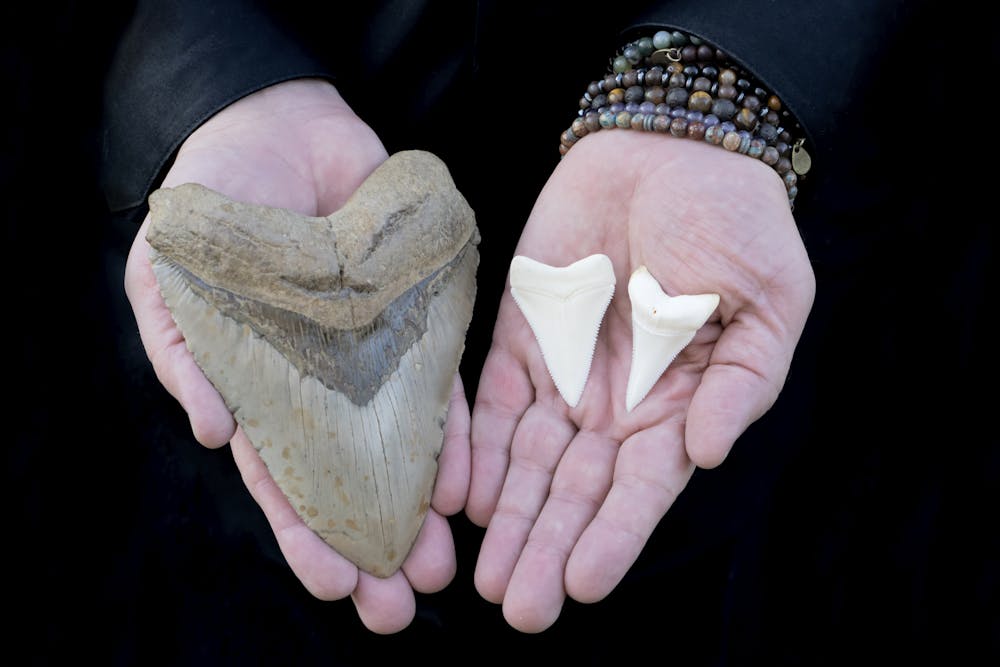
Its jaws were up to 10 feet (3 meters) wide, the teeth up to 7 inches (17.8 centimeters) long and the bite force was 40,000 pounds per square inch (2,800 kilograms per square centimeter).

Not surprisingly, megalodons ate big prey. Scientists know this because they’ve found chips of megalodon teeth embedded in the bones of large marine animals. On the menu, along with whales: large fish, seals, sea lions, dolphins and other sharks.


Are scientists sure megalodon is extinct?

Internet rumors persist that modern-day megalodons exist – that they still swim around in today’s oceans.

But that’s not true. Megalodons are extinct. They died out about 3.5 million years ago.

And scientists know this because, once again, they looked at the teeth. All sharks – including megalodons – produce and ultimately lose tens of thousands of teeth throughout their lives.

That means lots of those lost megalodon teeth are around as fossils. Some are found at the bottom of the ocean; others washed up on shore.

But nobody has ever found a megalodon tooth that’s less than 3.5 million years old. That’s one of the reasons scientists believe megalodon went extinct then.

What’s more, megalodons spent much of their time relatively close to shore, a place where they easily found prey.

So if megalodons still existed, people would certainly have seen them. They were way too big to miss; we would have lots of photographs and videos.


Why megalodon disappeared


It probably wasn’t one single thing that led to the extinction of this amazing megapredator, but a complex mix of challenges.

First, the climate dramatically changed. Global water temperature dropped; that reduced the area where megalodon, a warm-water shark, could thrive.

Second, because of the changing climate, entire species that megalodon preyed upon vanished forever.

At the same time, competitors helped push megalodon to extinction – that includes the great white shark. Even though they were only one-third the size of megalodons, the great whites probably ate some of the same prey.

Then there were killer sperm whales, a now-extinct type of sperm whale. They grew as large as megalodon and had even bigger teeth. They were also warmblooded; that meant they enjoyed an expanded habitat, because living in cold waters wasn’t a problem.

Killer sperm whales probably traveled in groups, so they had an advantage when encountering a megalodon, which probably hunted alone.

The cooling seas, the disappearance of prey and the competition – it was all too much for the megalodon.

And that’s why you’ll never find a modern-day megalodon tooth.


Hello, curious kids! Do you have a question you’d like an expert to answer? Ask an adult to send your question to CuriousKidsUS@theconversation.com. Please tell us your name, age and the city where you live.

And since curiosity has no age limit – adults, let us know what you’re wondering, too. We won’t be able to answer every question, but we will do our best.


This article is republished from The Conversation, a nonprofit news site dedicated to sharing ideas from academic experts. It was written by: Michael Heithaus, Florida International University.

Read more:

Making a megalodon: the evolving science behind estimating the size of the largest ever killer shark


Giant ancient sharks had enormous babies that ate their siblings in the womb


AMNESTY INTERATIONAL


Highlighting issues affecting Indigenous and LGBTQ2S


 communities  

Wedzin Kwa - "the blue and green river" - in Wet'suwet'en yintah.
Image credit: Michael Toledano.   
 

June 1st marked the beginning of Indigenous History Month* and Pride Month**, a time for members of these communities to celebrate their accomplishments and cultures. It is also one of the many opportunities for us to learn more about their histories and to support the continued advocacy of their rights.  


This month, Amnesty International has curated a series of guest essays directly from the perspectives of community activists and leaders of Indigenous-led and queer-led organizations to highlight various human rights issues affecting both the LGBTQ2S and Indigenous communities, such as the current barriers to justice for Two Spirit, trans, and gender non-conforming individualsthe challenges of displacement for LGBTQI+ Afghans; and the continued systemic barriers towards ending violence against Indigenous women and girls.

Conversations about missing and murdered Indigenous women and girls*** cannot be separated from the 231 Calls for Justice in the 2019 National Inquiry Final Report, which included the demand for “a world within which First Nations, Inuit, and Métis families can raise their children with the same safety, security, and human rights that non-Indigenous families do, along with full respect for the Indigenous and human rights of First Nations, Inuit, and Métis families.” Despite the legal obligation for governments to fully implement the Calls for Justice, this demand still has not yet been fully realized. 

One of the core themes explored within the Report is upholding the agency and expertise of Indigenous women, girls, and 2SLGBTQQIA people. Our guest essay series is guided by the intent to centre their perspectives and knowledge. For National Indigenous Peoples Day, we are pleased to share two new essays, Epimotew Tastawayik Niso Askiya - Walking in Two Worlds written by Rachel Wuttunee who shares her personal and professional insights as an Indigenous Community Planner; and Industry, Police and MMIWG2S in Wet’suwet’en Yintah, by Jennifer Wickham, who writes on the gendered impacts of resource development and the actions of the RCMP in the Wet'suwet'en territory.

This past month, we have been grateful to support the visibility of organizations like JusticeTransRainbow Railroad, and the Native Women’s Association of Canada and invite you to support their current campaigns, Safe Way Out and the Faceless Dolls Project.

The final essay in our series is about the lived experiences of queer Muslims and the intersections of Islamophobia and homophobia, and will be released on our blog and shared on our Twitter and Instagram accounts on June 29th.

We remain grateful for all opportunities to foster dialogue, awareness and action.

Miigwech, Nakummek. Misiyh. Thank you.

Habibah Haque
Gender Rights Campaigner
Amnesty International Canada 


*Featured in this email's graphic, the Progress Pride flag was developed in 2018 by non-binary American artist and designer Daniel Quasar. The flag includes black and brown stripes to represent LGBTQ2S communities of colour, along with the colours pink, light blue and white, which are used on the Transgender Pride Flag. 

**Bridget Tolley, from Kitigan Zibi Anishinabeg First Nation in Quebec, beaded the eagle earrings featured in this email's graphic. She runs Families of Sisters in Spirit, a volunteer-run, grassroots initiative supporting the loved ones of missing and murdered Indigenous women, girls, and Two Spirit people across Canada.

***This image depicts Indigenous women who are honouring and paying tribute to Missing and Murdered Indigenous women, girls, and two-spirit people, and was generously provided by NWAC. 

ANOTHER NIXON ERA LAW
Women's rights are on the chopping block. Is Title IX also failing at age 50?


Terrance Sullivan
Mon, June 20, 2022

I love and support women’s sports. I believe the best pure basketball is women’s basketball and have become especially spoiled by Coach Jeff Walz and U of L. I also am an inaugural season ticket holder for Racing Louisville of the NWSL and serve on the board of a supporters group for the team.

I want to always be an advocate for women in sports because quite often they seem to have the most passion for the sport, possibly the mentality of proving doubters wrong, but also the sports themselves are often less publicized, less funded, less of everything but skill and deservedness.

In June of 1972, the proverbial (and literal) playing field was supposedly made more level. Fifty years ago, Congress emphatically stated:

No person in the United States shall, on the basis of sex, be excluded from participation in, be denied the benefits of, or be subjected to discrimination under any education program or activity receiving Federal financial assistance.

This law, Title IX of the Education Amendments of 1972 was a breath of fresh air and a continuance of the fight for civil rights that started years earlier. To some, this law was seen as an end to sexism and the problems stemming from it.


Title IX 50 years later

The purpose of Title IX was to equalize the opportunity to access programs, activities and employment within educational institutions receiving federal funds. It doesn’t require that identical sports be created but does require creation of the same amount of opportunities for participation in sports programs and amounts of scholarship funds awarded. This is what people think of when they think of Title IX.

But it goes beyond that. A vital, yet less discussed portion of Title IX, requires schools to designate at least one employee as responsible for coordinating the school’s compliance with Title IX as well as require them to adopt and publish grievance procedures for students to file complaints of sex discrimination, including complaints of sexual harassment or sexual violence.

As with any law, there have been challenges and changes. It is probably assumed that 50 years later, we are much more advanced in the application of the law and how it applies to sports and beyond. An assumption that unfortunately is not entirely accurate.

Years after its passage, numerous legislators sought to weaken or completely strike down Title IX, arguing the unfair advantage it gave women’s sports to the detriment of the men—or the fan-favorite ‘reverse sexism’ that seems similar to some other complaints we hear today. In 1976, even the NCAA sued to challenge the legality of the law itself.

In 1984, the Supreme Court got in on the fun in Grove City College vs. Bell, 465 U.S. 555 which basically limited the application of the law to specific programs and called to question the applicability to athletics. This was remedied in later laws, namely the Civil Rights Restoration Act in 1988—much to the chagrin and veto of Ronald Reagan.

More: Bellarmine softball coach placed on leave for possible Title IX violation


UofL women's basketball held its Media Day on Tuesday at the KFC YUM! Center. Above, Monique Reid (right) jokes around as she and teammates Asia Taylor (left) and Shelby Harper (center) get their picture taken. Oct. 30, 2012

What seems like ancient history, however, is also in our present. Inequities in sports are still pervasive, and this became illuminated in the 2021 NCAA Women's Final Four (can I call it that? That is part of the issue) and the disparities seen in facilities. I am sure we all remember the viral video of the disparities in the weight rooms for the tournament. Women were given the equivalent of a budget hotel weight room, whereas the men got Olympic-level lifting options. 2021…

In 2020, the US Department of Education released regulations around sexual harassment and sexual assault that weakened Title IX application under the guise of ‘due process’ and placed strict limits on application requiring current enrollment of a student for protection as well as the incident take place strictly in the US. I guess what happens in study abroad or the trip to Cancun…

And we all are well aware of the current barrage of legislation targeting trans athletes in states across the country. Kentucky itself passed its own this past legislative session. Legislation like this singles out students who may be transgender and thusly violates constitutional guarantees of equal protection while also discriminating on the basis of sex and transgender status in violation of the right to equal protection guaranteed by the Fourteenth Amendment of the United States Constitution and also Title IX.

More: Here's what to know about the Kentucky legislature's passage of the transgender sports ban

As a bit of a bright spot, the current iteration of law should be viewed as more inclusive. On June 15, 2020, the Supreme Court held in Bostock vs. Clayton County that sex discrimination under Title VII of the Civil Rights Act of 1964, encompasses discrimination on the basis of sexual orientation and transgender status. In 2021, the Principal Deputy Assistant Attorney General for the Civil Rights Division issued a memorandum to federal civil rights offices and general counsels addressing the application of Bostock to Title IX, determining that Title IX’s prohibition on discrimination “on the basis of sex” includes discrimination on the basis of gender identity and sexual orientation.

We are at a point where application and interpretation are paramount. As many rights of women appear to be on the chopping block, the least we can do is preserve the law that on its face guarantees equal opportunities. Title IX is an integral law that has had its share of detractors, but much like women in sports, it has persevered.


Terrance Sullivan is the executive director for the Kentucky Commission on Human Rights.

Terrance Sullivan is the Executive Director of the Kentucky Commission on Human Rights (KCHR). KCHR is the state agency charged with enforcing the Kentucky Civil Rights Act, a protector of the civil rights of Kentucky citizens. KCHR hears cases on discrimination across the state and offers trainings and educational opportunities for all Kentucky citizens. KCHR also empowers local commissions to do local-level civil rights work. Terrance is also a member of The Courier Journal's Advisory Board.


This article originally appeared on Louisville Courier Journal: Women's rights are on the chopping block. Is Title IX also failing?


What is Title IX? An impactful law that’s often misunderstood

Henry Bushnell and Payton Titus
Mon, June 20, 2022,

Title IX, the 37-word statute that helped spur a decades-long women’s sports boom, turns 50 years old on Thursday.

And yet, roughly 87% of American adults say they’ve heard a little or nothing about the watershed piece of civil rights legislation, according to a Pew Research Center survey. A similar Ipsos poll found that 71% of kids aged 12-17 know nothing about Title IX.

With its 50th anniversary near, experts and gender-equity advocates sought to educate the public about its power. Here’s what you should know about the law, its impact, its application in sports, its shortcomings, and more.
What is Title IX?

Title IX is a federal law that was passed as part of the Education Amendments of 1972. It reads: “No person in the United States shall, on the basis of sex, be excluded from participation in, be denied the benefits of, or be subjected to discrimination under any education program or activity receiving Federal financial assistance.”
Is Title IX a sports law?

Title IX is in part responsible for the increased participation of girls and women in sports, because almost all secondary schools and colleges receive federal funding, and sports count as education programs. But Title IX aims to protect all persons, regardless of gender, from various forms of prejudice and mistreatment. Title IX protection areas include:

Admissions


Recruitment


Financial aid


Academic programs


Housing


Employment


Comparable facilities


Counseling


Health and insurance benefits and services


Marital or parental status


Athletics


Textbooks and curricular material


Sexual harassment and sexual violence
How does Title IX apply to sports?

Title IX requires almost all colleges and high schools to provide equitable treatment to athletes in three broad categories:

Participation opportunities


Scholarships


Other benefits

These “other benefits” are sometimes called the “laundry list,” and include:

Equipment and supplies


Games and practice times


Travel


Per diem allowance


Coaching


Academic tutoring


Assignment and compensation of coaches and tutors


Locker rooms


Practice and competition facilities


Medical and training facilities


Housing and dining facilities


Publicity and promotion


Recruitment


Support services

Contrary to popular belief, equity under Title IX doesn’t mean 50-50 equality. Differences that can be explained by sport-specific characteristics or other circumstances might not be discriminatory. Rather than comparing team to team, investigators look at an athletic department’s entire program, and examine all the men’s squads alongside all the women’s squads to see whether treatment is equitable. (More on the investigators and the specific criteria later.)
What impact has Title IX had on sports?

Only 15% of college athletes (fewer than 30,000) were women in 1971-72, the season before Title IX’s passage. Back then, women received just 2% of their schools’ athletic budgets and scholarship funds were virtually “nonexistent,” according to the National Coalition for Women and Girls in Education.

Now, about 44% of NCAA athletes (218,122) are women, according to the governing body.

Title IX inspired a similar surge at lower levels. In 1972, some 300,000 girls played high school sports; they were 7% of all high school athletes, the NCWGE reported. In 50 years, according to the most recent National Federation of State High School Associations participation survey, that number has risen above 3.4 million — roughly 43% of high school athletes. Girls, however, still have fewer participation opportunities than boys did pre-Title IX (3.6 million).

A common misconception surrounding Title IX is that it has hurt men’s sports. While women’s sports have grown at a faster rate than men’s over the last 50 years — because they were starting from a societal suppressed baseline — men’s sports continue to grow, too. NCAA men’s sports participation has risen from 169,800 in 1982 to over 275,000 last year. Numbers for both men and women rose steadily each year from 2002 through the outbreak of the COVID-19 pandemic.

The effects of this participation boom have been vast. Title IX has indirectly contributed to the dominance of U.S. women at the Olympics and other international sporting events, like soccer’s World Cup. Of the 400 American athletes at the 1972 Olympic Games in Munich, Germany, just 84 were women. At London 2012 — two months after Title IX’s 40th birthday — the U.S. women outnumbered the men for the first time in both participation (269 women, 261 men) and medal count (58 to 45). The same happened in 2016 in Rio, when the U.S. sent the largest female contingent in Olympic history, according to Team USA. In Tokyo last year, American women would have finished fourth in the medal standings (66) if they were their own country.

Louisville women's basketball players wearing adidas “More Is Possible” tees which celebrates the 50th anniversary of Title IX. 
(Andy Lyons/Getty Images for adidas)


What hasn’t Title IX accomplished?

Title IX only applies to educational institutions. Media organizations and professional sports leagues don’t fall under its jurisdiction. As a result, there’s no mechanism to help guarantee equal coverage of women’s and men’s sports or equal opportunity for investment in professional leagues.

A study by professors at Purdue University and the University of Southern California, for example, found that women benefit from just 3-5% of total sports media coverage — roughly the same percentages as 30 years ago. In 2019, women’s sports received just 5.4% of total airtime. In 1989, the number was 5%; in 1993, it was 5.1%. If the 2019 Women’s World Cup were removed from the 2019 figure, it would drop to 3.5%. The study also found that coverage of women athletes is of lower quality and production value.

Now with name, image and likeness rights, women athletes are able to set their own screen time and command their own audiences through social media without having to rely solely on TV networks. Three of the top five sports by NIL compensation belong to women (No. 3 women’s basketball, No. 4 women’s volleyball, No. 5 softball), according to Opendorse. While not part of Title IX, the 1-year-old NIL era has made headway for women in ways that Title IX has been unable to. But the disparities in coverage still limit their visibility and, thus, their earning potential.

Women’s professional sports leagues get the same kind of lackadaisical interest from investors as they do from mainstream media. While men’s leagues were given decades of grace throughout the 20th century to endure red ink, women’s sports haven’t been afforded the same patience.

For example, the Women’s United Soccer Association launched in 2001 on the heels of the 1999 World Cup’s success. The league lost $90 million through its first three seasons ($46 million after the first year, $24 million in the second and between $18 million and $19 million in the third), and folded. On the other hand, Major League Soccer, the men’s league founded in 1996, lost about $250 million in its first five years and still operates today.

Similar incongruities show up in other sports. The NBA lost between $15 million and $20 million as recently as 1982, its 35th year. Meanwhile, the following women’s sports leagues didn't survive 20 years to figure it out before fading into nonexistence: The Women’s Professional Basketball League (WBL), National Women’s Football League (NWFL), National Pro Fastpitch, Major League Volleyball and the WUSA’s successor, the Women’s Professional Soccer league.
So Title IX applies to schools. Do all major colleges comply with it?

No. In fact, most data, testimony and estimates suggest that anywhere between 50% and 100% of Division I athletic departments are noncompliant.

A Yahoo Sports analysis of 2020-21 Equity in Athletics Disclosure Act data found that over 80% of D-I schools did not offer women participation opportunities that were “substantially proportional” to the makeup of their student bodies — one of the primary tests to measure compliance.

Some Power Five powerhouses — most notoriously, the University of North Carolina — would need to add hundreds of women athletes to match their school’s broader gender demographics. Yahoo Sports’ analysis found that, in total, 308 (of the 348 D-I schools) would need to add a total of 35,796 women’s roster spots to achieve full proportionality.

And that number is likely an underestimate. Many schools artfully manipulate their rosters and use reporting tactics that make the EADA data look less flagrant than inequities actually are.
How is Title IX compliance measured in college sports? And what is the ‘three-prong test’?

Ever since the 1970s, the U.S. Department of Education (DOE) has used a so-called “three-prong test” to assess whether colleges are meeting the first of three broad requirements — equity in participation opportunities.

A school, whether Power Five or NAIA, must do at least one of the following three things:

Serve male and female athletes “in numbers substantially proportionate to their respective enrollments.” So, if a school’s student body is 52% women, then roughly 52% of its roster spots should be for women. As long as any discrepancies are smaller than an average-sized college sports team, the school is complying with Prong 1, and needn’t worry about the other two.

“Show a history and continuing practice of program expansion” for “the underrepresented sex.” In the early days of Title IX, many schools satisfied Prong 2 as they emerged from the Dark Ages and added women’s teams. But after 50 years, many experts question whether any school, if they still haven’t reached Prong 1 proportionality, can reasonably argue that they have both a “history” and a “continuing practice” of expansion.

“Fully and effectively” accommodate “the interests and abilities” of the underrepresented sex. To gauge this, the DOE looks at a variety of indicators, including high school and youth participation rates in sports that a school doesn’t offer; sports offered by other colleges in their region or conference; and requests made by students to add sports or elevate club teams to varsity status.

Over the years, schools have tried to meet Prong 3 by surveying their current students, and likely finding that everyday non-athletes aren’t interested in playing the varsity sports that the college doesn’t offer. But advocates have countered, and courts have often agreed, that, well, there are 3.4 million girls playing high school sports, and there’s this thing called recruiting.

“If the school wants to add a women's sport, they will find women to participate in that sport,” attorney Jill Zwagerman said. The entire history of women’s sports proves that, essentially, “if you build it, they will come.” The opportunity creates the interest, not vice versa, and so Prong 3, like Prong 2, has become outdated. Most schools must comply via Prong 1.
Colleges also have to offer equitable financial aid and other benefits, right?

Yep. The “three-prong test” is actually only one of the three buckets. Schools also must do two other things:

Offer scholarship money to male and female athletes proportional to the number of male and female athletes on rosters, within 1%, and accounting for non-discriminatory factors that might affect numbers. Essentially, if 47% of a university’s athletes are women, it must give 46%-48% of its athletics scholarship dollars to women.


Treat men and women equitably in the “laundry list” of areas mentioned above.

The “other benefits” category is the most qualitative of the three. Some experts argue that massive spending gaps are clear evidence of inequities. A USA Today analysis found that, for every dollar spent on travel, equipment and recruiting for select men’s teams, FBS schools spent just 71 cents on the corresponding women’s teams. A Yahoo Sports analysis of 2018-19 EADA data found that D-I schools, on average, reported 49 cents in women’s basketball operating expenses for every dollar in men’s basketball operating expenses. They also allocated just 28% of their overall recruiting budgets to women’s teams, and paid their head coaches in women’s sports 48 cents-on-the-dollar compared to counterparts on the men’s side.

Title IX, though, does not require equal spending. The DOE’s 1979 policy interpretation, which remains the key interpretive document, lays out the factors to consider. “Identical benefits, opportunities, or treatment are not required,” it clarifies, “provided the overall effects of any differences is negligible.”
Who enforces Title IX?

The Department of Education, and specifically its Office for Civil Rights (OCR), is responsible for enforcing Title IX. But its approach is more reactive than proactive. By law, it can randomly select colleges and secondary schools for sports-specific compliance reviews, but most of its investigations occur in response to complaints, and some can take years to complete.

The burden, therefore, falls on complainants, and often on the historically marginalized, powerless people whom the law is meant to protect: female students, and in this case, athletes.

When they feel discrimination, they have two legal routes: file an OCR complaint, or sue their school. The lawsuits are often successful, but come with stress and fear, because they require challenging the most powerful people at powerful institutions. “Even though Title IX has a provision that prohibits retaliation, the fact of the matter is, kids are not gonna bring a Title IX complaint unless you drop their sport,” said Donna Lopiano, a longtime administrator and former Women’s Sports Foundation CEO. “Otherwise, they have too much to lose — the starting position, the attention of the coach, the renewal of the scholarship.”

The OCR, meanwhile, technically has the power to pull federal funding from noncompliant schools, but it has never done so. By law, it must give the schools multiple opportunities to voluntarily comply before imposing the lone penalty at its disposal. Instead, it signs resolution agreements with colleges who’ve violated the law. The colleges agree to move toward compliance, but generally proceed without fear of consequences — and thus, noncompliance across the board persists.

Catherine Lhamon, the DOE’s assistant secretary for civil rights, admitted in an interview that it was “very rare” for a Title IX investigation to find full compliance, and, when asked specifically about Division I athletic departments, that “most schools across the country have some room for growth.”
Does the NCAA enforce Title IX?

It could, but no, it doesn’t. In fact, in the early years, the NCAA fought against Title IX’s application to athletics. Its first executive director, Walter Byers, argued that Title IX could cause the “possible doom of intercollegiate sports.”

Those days are gone, and the NCAA now “encourages our membership to follow all laws,” according to a spokeswoman. But Title IX does not apply to the NCAA because it is an association of federally funded educational institutions, not a federally funded institution itself. Those member institutions make the rules, and, perhaps because many of them don’t comply with Title IX, they have not made a rule that requires compliance. Instead, the NCAA defers to the DOE.

And separately, it is working to correct inequities at its national championships. After Sedona Prince and women’s basketball coaches exposed those inequities at the 2021 NCAA women's tournament, independent investigators put together a scathing 118-page report that detailed the NCAA’s underinvestment in women’s hoops.
What are some of Title IX’s other flaws?

Some scholars argue that, as a “single-axis law,” Title IX has disproportionately benefited white women, because it fails to address additional barriers that Black, Indigenous and other women of color face.

Whereas Black men are roughly 20% of NCAA male athletes, according to the governing body’s demographics database, Black women are just 11% of NCAA female athletes. While 60% of the U.S. population is non-Hispanic white, 68% of female NCAA athletes are white. Those demographics are likely a product of wealth gap stemming from centuries of systemic racism, which have left families of color without the resources required to put their kids in many of the girls sports that have risen during the Title IX era.

The numbers are even more stark in college athletics leadership. Currently, 7% of women’s head coaches are women of color, while 34% are white women. Only 4% of athletic directors are BIPOC women, while white women make up 20%. In 2021, only 15 of the 351 Division I athletic directors were women of color.
How does Title IX apply to transgender and nonbinary athletes?

The DOE last year issued a Notice of Interpretation reaffirming that Title IX’s protections applied to “discrimination based on sexual orientation” and “discrimination based on gender identity.” The Washington Post reported in March that the DOE would soon issue regulations codifying those protections — which would clash with state laws banning transgender women and girls from competing in women’s and girls sports.

The regulations haven’t yet materialized, but Lhamon, the OCR leader, said at an Aspen Institute summit in early May: “In court, in litigation, we've taken the position that schools cannot have a categorical ban on transgender students' participation in sports. It violates Title IX. So those are very, very clear rules. And I think it's important for all our school communities to understand, every student has value, every student is protected by the law. The text that Congress wrote in Title IX is that no person shall be subject to discrimination. And there's absolutely no question that transgender people are people. So they're protected by the law, and we and I are prepared to protect them.”
Could Title IX be amended, strengthened or weakened in the future?

Yes. All three branches of the federal government have that power.

Throughout its 50 years, Title IX, and especially its sports-specific regulations, have withstood countless challenges in Congress and in court. There were proposed amendments that would have exempted football or all college sports, but that didn’t pass. There was the George W. Bush-era commission that threatened to weaken the law, but that caved to political pressure. There was the 2005 policy clarification that did weaken the three-prong test, but the Barack Obama-era DOE walked it back. With a relatively high approval rating among American adults familiar with Title IX, the law now seems to stand on solid ground.

But feminists and women’s sports advocates often remind one another to stay vigilant. Some of them worried for Title IX’s future when the Supreme Court’s impending decision on abortion rights leaked. “Part of the affront there is a reversal of precedent,” said Ellen Staurowsky, an Ithaca College professor who has studied gender equity in sports for decades. “If there's a takeaway there, it would be that for all of the successes that Title IX has had, primarily on behalf of female complainants, over the years, there is a possibility that they can be reversed. So I think we need to proceed with caution.”

“I wish I could say that we're safe,” said Judy Sweet, a pioneering NCAA administrator and gender-equity advocate. “But given what has happened recently in the world, I don't have confidence in anything at this point.”


John Oliver Laughs Off GOP Claim That Democrats Have ‘Satanic Agenda': ‘That Would Require Having an Agenda’ (Video)


Andi Ortiz
Mon, June 20, 2022, 8:07 AM·2 min read

John Oliver used the top of his HBO show on Sunday night to tear through the America First Secretary of State Coalition and its entire platform. The “Last Week Tonight” host got a particular kick out of the idea that Democrats are operating on a “satanic agenda” — or even have a plan at all.

The America First Secretary of State Coalition is a conservative coalition created to support a specific slate of candidates in secretary of state elections nationwide. That specific slate is largely made up of people who believe the 2020 election was stolen from Donald Trump.

Among them is Kristina Karamo, who is running for secretary of state in Michigan, and who has made a slew of baseless claims about Democrats and the 2020 election. During one podcast appearance, she claimed that the Democratic party “has totally been taken over by a satanic agenda.”


“OK, obviously, Democrats don’t have a satanic agenda. Mainly because that would require having an agenda in the first place,” Oliver joked.

The late night host then poked a little more fun at Karamo’s words, homing in on the time she called Michigan’s current secretary of state a “very evil, evil, evil woman.” 

“For the record, Michigan’s current secretary of state Jocelyn Benson is not evil, evil, evil. In fact, just go to her Wikipedia page and look for the section entitled ‘Horrible Acts of Evil.’ It is just not there. Although, you will find that she has completed 23 full marathons since 2005. But that’s not evil, is it? It’s just annoying.”

Oliver also made some time to mock a few other members of the coalition, but in the end, he boiled it down for viewers.

“There are many, many others, which should frankly give everyone pause,” he said. “Because the January 6 committee is reminding everyone just how close we came to democracy basically collapsing. It was a handful of people in the right position, choosing to do the right thing that saved us from a constitutional crisis.”

He continued: “But there are multiple candidates running for consequential positions right now on the platform of basically ‘Let’s do the coup again, but better next time’. And if you’re not worried about that — if I may quote a man with the world’s most chaotic Zoom backdrop — ‘you’re out of your f—ing mind.'”

Tony Perkins Thinks Biden Is DEMONIC

Electric pickup trucks in the works: Coming soon, on-sale and questionable

And there are probably some coming we have yet to hear about


Not long ago, pickup drivers who wanted to go electric had exactly zero options to choose from. Now there are but a few with more on the way -- some we know about and other still to be revealed. There are also certainly some electric trucks currently planned that sadly won’t see the light of day. Here are the EV pickups we’ve officially been told to expect, along with some rumored products. For good measure, we’ve included those few success stories that have already begun making their way into customers’ garages, as well as those that have been abandoned by their makers.

 LOTS OF TRUCK PICS

Electric pickup trucks in the works: Coming soon, on-sale and questionable (autoblog.com)


·Writer

Brittney Griner tried to call her wife Cherelle Griner 11 times on Saturday through the American embassy in Russia, but the embassy wasn’t properly staffed, Cherelle Griner told The Associated Press on Monday.

Cherelle and Brittney haven’t spoken in more than four months since Brittney was arrested in Russia. The two were set to talk over the phone Saturday to celebrate their wedding anniversary. Yet Brittney never called, at least that’s what Cherelle initially thought.

On Monday, Cherelle learned that Brittney called 11 times over several hours to a number she was given by the United States embassy in Moscow, per the AP report. The embassy was then going to patch the call through to Cherelle in Phoenix.

But nobody was at the desk in the embassy Saturday to connect the couple.

“I was distraught. I was hurt. I was done, fed up,” Cherelle told The Associated Press. “I’m pretty sure I texted BG’s agent and was like, ’I don’t want to talk to anybody. It’s going to take me a minute to get my emotions together and just tell everybody I’m unavailable right now.’

“Because it just knocked me out. I wasn’t well, I’m still not well.”

The State Department said that “we deeply regret that Brittney Griner was unable to speak to her wife because of a logistical error.” Cherelle said that someone in the U.S. government called to apologize.

While the number Brittney was given is typically used during the week, Cherelle said the call had been on the books for quite some time.

“This phone call had been scheduled for almost two weeks, with a weekend date,” Cherelle told The Associated Press.

Brittney was first arrested in Russia in February after officials claim they found vape cartridges with hashish oil in her luggage at a Moscow airport. She has been detained ever since, and her detention was extended through at least July 3. The State Department classified Brittney as a wrongfully detained citizen, and pressure has been mounting on the government to bring the Phoenix Mercury star home.

Though she wants Brittney home as soon as possible, Cherelle was looking forward to the next best thing Saturday.

“This was such a big moment because this would have been the first time where I truly could tell if she’s OK,” Cherelle said, via The Associated Press. “This would have been the first time for me to actually just hear her in real time and to truly know if she’s OK or to know if she’s seconds away from not being in existence anymore.”

Cherelle said she has starting to lose hope that President Joe Biden and his administration can help bring Brittney home, and that even hoping to talk with Biden about the situation is “starting to feel like a no.”

After all, she said, a phone call is a much easier ask than getting her wife released from foreign custody.

“I find it unacceptable and I have zero trust in our government right now," Cherelle said, via The Associated Press. "If I can’t trust you to catch a Saturday call outside of business hours, how can I trust you to actually be negotiating on my wife’s behalf to come home? Because that’s a much bigger ask than to catch a Saturday call.”

Brittney Griner
Brittney Griner tried to call her wife 11 times to celebrate their anniversary on Saturday, but the American embassy in Moscow apparently didn't have anyone working the phones to connect them. (Gregory Shamus/Getty Images)
Canada is banning the sale, production and import of some single-use plastics


Monicah Mwangi / reuters

Igor Bonifacic
·Weekend Editor
Mon, June 20, 2022

Canada is banning companies from producing and importing a handful of single-use plastics by the end of the year, Reuters reports. Among the items the country won’t allow the production of include plastic shopping bags, takeout containers and six-pack rings for holding cans and bottles together.

The federal government will subsequently prohibit the sale of those same items in 2023, with an export ban to follow in 2025. The one-year gap between the initial ban and the one that follows is designed to give businesses in Canada enough time to transition their stock of the listed items. Over the next ten years, the federal government estimates the new regulation will eliminate approximately 1.3 million tonnes of plastic waste, Prime Minister Justin Trudeau said on Twitter.

Not targeted by Canada’s new regulations are plastic fishing nets and lines, which can be far more problematic than single-use plastics like straws and shopping bags. Discarded fishing gear leads to ghost fishing, a phenomenon where those tools continue to trap and kill marine life. With more than 640,000 tons worth of fishing nets discarded every year, it’s a problem that’s only getting worse and one Canada’s plastics ban doesn’t address.


"It's a drop in the bucket," Sarah King, the head of Greenpeace Canada's oceans and plastics campaign, told the CBC. "Until the government gets serious about overall reductions of plastic production, we're not going to see the impact we need to see in the environment or in our waste streams."

The ban follows a similar one enacted by France last year and is part of a broader move by governments across the world to curb the production of single-use plastics. In March, the United Nations agreed to begin work on a first-ever global plastic pollution treaty. While the agreement won’t be complete until 2024 at the earliest, it could be among the most significant efforts to curb climate change since the Paris agreement in 2015.

Canada lays out rules banning single-use plastics

Tracey Lindeman in Ottawa
Mon, June 20, 2022

Photograph: Canadian Press/REX/Shutterstock

Canada laid out its final regulations on Monday spelling out how it intends to apply a ban on plastic bags, straws, takeout containers and other single-use plastics.

“Only 8% of the plastic we throw away gets recycled,” said federal health minister Jean-Yves Duclos in French, adding that 43,000 tonnes of single-use plastics a year find their way into the environment, most notably in waterways.

Duclos was joined by the environment minister, Steven Guilbeault, on a beach in Quebec City to announce the final regulatory text, which includes banning single-use plastic bags, cutlery, straws, stir sticks, carrier rings, and takeout containers.

The ban on manufacture and import of those six types of items will begin in December 2022, and the ban on sale a year later. By the end of 2025, Canada will also ban export, making it “the first among peer jurisdictions to do so internationally”, according to a government news release.

“The Canadian population was very clear with us,” he said of the prevalence of plastic in soil, air, drinking water and food. “They’re tired of seeing plastic trash in parks, streets [and other locations].”

The regulations have a few notable exceptions. Retailers will be allowed to sell single-use plastic flexible straws if it is packaged alongside a beverage container, and as long as the packaging was done off-premises.

They’ll also be permitted to sell packages of 20 or more single-use straws, as long as they’re kept out of customer view.


Also absent from the new regulations are bans on plastic packaging for consumer goods – the leading source of plastic waste worldwide, though Canada has promised to ensure all plastic packaging contains at least 50% recycled content by 2030.

In 2018, Canada led the creation of the international Ocean Plastics Charter, which has since been signed by 28 countries including France, Germany and Costa Rica. The pledge includes steps to reduce plastics usage, and to work with industry to increase rates of plastics recycling.