Friday, February 17, 2023

US health giant suffers significant data breach


ByDr. Tim Sandle
Published February 16, 2023

Image: © AFP

A significant data breach has impacted the healthcare giant Community Health Systems (CHS). This is to the extent that up to one million people have been impacted. The data breach has been identified as arising from file-transfer software called GoAnywhere MFT, developed by Fortra.

“As a result of the security breach experienced by Fortra, protected health information and personal information of certain patients of the company’s affiliates were exposed by Fortra’s attacker,” according to a spokesperson from Community Health Systems.

Looking into the matter for Digital Journal is , Almog Apirion, CEO and Co-Founder of Cyolo.

For Apirion this issue represents another cyber-swipe against the healthcare and medical communities. This sector represents a continual target for those seeking to capture personal data.

As Apirion explains: “Healthcare organizations are unfortunately no stranger to cyberattacks and data breaches. Institutions like Community Health Systems (CHS) are an attractive target for threat actors due to their troves of personal information and their reliance on third parties both for cybersecurity and other aspects of their work.”

In terms of the mode of attack, Apirion describes: “The reality is that when hackers exploit vulnerabilities in third-party security tools, the lives and privacy of patients are put at risk. Interoperability is vital for successful healthcare delivery, so a Managed File Transfer (MFT) is a needed solution.”

MFT is a technology platform that allows organizations to reliably exchange electronic data between systems and people in a secure way that goes someway to meeting business compliance needs.

There are inherent weaknesses, as identified by Apirion: “When the admin console is accessible via the Internet, it’s only a matter of time before data is breached. Any connection to a sensitive data source must be properly managed and secured.”

There are measures that healthcare institutions could and should adopt. Apirion defines these as: “Zero-Trust Access strategies should be employed to support the needed connections, especially between care delivery partners. This is especially useful when critical applications, like MFT, need to be connected to the Internet.”

In outlining the benefits of these types of approaches, Apirion surmises: “Having the ability to restrict access and keep the application hidden will go a long way to preventing this type of breach in the future.”


US tech bosses subpoenaed in Republican hunt for liberal conspiracy

The Republican-led House Judiciary Committee wrote to the CEOs of Google, Amazon, Apple, Meta and Microsoft demanding numerous documents, including any White House communications related to the regulation of content, by March 23.

Thursday, 16 Feb 2023 7:30 AM MYT

WASHINGTON, Feb 16 — US lawmakers issued subpoenas to top Silicon Valley executives on Wednesday as Republicans seek to establish an unproven conspiracy theory that Big Tech and the government have colluded to suppress conservatives’ free speech.

The Republican-led House Judiciary Committee wrote to the CEOs of Google, Amazon, Apple, Meta and Microsoft demanding numerous documents, including any White House communications related to the regulation of content, by March 23.

“The House Judiciary Committee has repeatedly attempted to engage with the five companies since last December. Unfortunately, the companies have not adequately complied with our requests,” the panel said in a statement.

“Congress has an important role in protecting and advancing fundamental free speech principles, including by examining how private actors coordinate with the government to suppress First Amendment-protected speech.”

The panel is part of a broader Republican effort — launched when the party took over the House in January — targeting President Joe Biden, Silicon Valley, the intelligence community and an alleged “woke” leftist takeover of federal agencies.

It is led by Ohio congressman Jim Jordan, a favourite of the hard right who last year defied orders to testify to the Democratic-led panel probing the 2021 assault on the US Capitol.

Last week, the House Oversight Committee grilled former Twitter executives about the company’s decision, reversed in 2021, to limit the dissemination of a New York Post article critical of the president’s son, Hunter Biden.

Hard right lawmakers had set out to establish censorship by social media companies cowed by Democrats.

But the move backfired as they produced no evidence to back up their claims and the witnesses, testifying under oath, cast Republicans as the villains.

The committee heard that Twitter had gone to extraordinary lengths to protect former president Donald Trump from sanctions, dropping a racist phrase he used from its catalogue of banned language so that it could avoid punishing him.

Witnesses testified that while they had no knowledge of the Biden White House pushing for censorship, the Trump administration had pressured Twitter to delete an insulting tweet from the model Chrissy Teigen.

Microsoft and Meta issued statements to US media saying they had already been producing the requested documents and were cooperating with the committee. — AFP
BULLSHIT CAPITALI$M
Most baby formula health claims not backed by science: study


By AFP
Published February 15, 2023

Breastfeeding is widely recognised to have huge health benefits for babies - 
Copyright AFP/File LEO RAMIREZ

Daniel Lawler

The vast majority of health claims used to advertise baby formula worldwide are not supported by rigorous scientific evidence, a study said Thursday, leading researchers to urge the breast milk substitutes be sold in plain packaging.

The study comes a week after a group of doctors and scientists called for a regulatory crackdown on the $55-billion formula industry for “predatory” marketing which they said exploits the fears of new parents to convince them not to breastfeed.

Breastfeeding is widely recognised to have huge health benefits for babies. The World Health Organization and the US CDC recommend breastfeeding exclusively during the first six months of a newborn’s life.

However that recommendation is followed for less than half of infants globally, according to the WHO.

Daniel Munblit, an honorary senior lecturer at Imperial College London and an author of the new study, said researchers were not on a “crusade” against infant formula, which should remain an option for mothers who cannot or choose not to breastfeed.

“But we are very much against inappropriate infant formula marketing, which provides misleading claims not backed up by solid evidence,” Munblit told AFP.

Munblit and an international team of researchers looked at the health claims made for 608 products on the websites of infant formula companies in 15 countries, including the United States, India, Britain and Nigeria.


The most common claims were that formula supports brain development, strengthens immune systems and more broadly helps growth.

Half of the products did not link the claimed health benefit to a specific ingredient, according to the study published in the BMJ journal.

Three quarters did not refer to scientific evidence supporting their claims.

Of those that provided a scientific reference, more than half pointed to reviews, opinion pieces or research on animals.


Just 14 percent of the products referred to registered clinical trials on humans. However 90 percent of those trials carried a high risk of bias, including missing data or the finding not supporting the claim, the study said.


And nearly 90 percent of the clinical trials had authors who received funding from or had ties to the formula industry, it added.

– ‘Distressing’ –


The most commonly cited ingredient was polyunsaturated fatty acids, which is in breast milk and is considered important for brain development.

However there is no evidence of any added benefit when the ingredient is added to baby formula, according to a Cochrane systematic review.

Munblit said the health claims were mostly used to advertise premium formula products, which could be “distressing” for parents who are misled into believing the ingredients are essential but cannot afford them.

When asked what he thinks needs to be done to address the problem, Munblit was concise.

“Plain packaging,” he said.

The study comes after a series of papers were published in the Lancet journal last week calling for global policy makers to end exploitative formula marketing.

WHO infant health specialist Nigel Rollins, an author of one of the Lancet papers, said busy parents “lack the time to properly scrutinise claims” about infant formula.

The new study showed that “governments and regulatory authorities must commit the necessary time and attention to review the claims of formula milk products,” Rollins said in a linked BMJ editorial.

UK
NHS Deal for Private Pandemic Help Yielded Little, BMJ Says

Lisa Pham
Thu, February 16, 2023


(Bloomberg) -- The UK’s ailing National Health Service paid about £2 billion ($2.4 billion) to get private hospitals to help overwhelmed public ones early in the pandemic, but an investigation by the BMJ medical journal suggests little burden-sharing actually took place.

“The private sector was massively underused in many areas of the UK during the pandemic,” the BMJ said Thursday. When the number of Covid-19 patients hospitalized hit its peak on April 12, 2020, NHS hospitals in England were caring for 18,921 inpatients with the virus, including 2,881 on mechanical ventilation. On the same day, only 52 were treated in private hospitals under the contract, it said.

The findings raise concern that the NHS wasn’t making the most of the resources available to it early in the pandemic, when swamped hospitals began to buckle under the strain. The study comes as government officials are again considering help from the private sector as waiting lists spiral out of control.

The £2 billion deal clinched in March 2020 expanded the hospital capacity by adding 8,000 private beds across England, about 1,200 more ventilators and more than 10,000 nurses.

Yet some of those hospitals treated more private patients than NHS ones during the first year of the pandemic, according to the BMJ. The journal found that just 30 of the 200 private hospitals contracted were used to treat patients with Covid when the first pandemic wave reached its peak.

‘Vital’ Support

The NHS defended the investment and said the BMJ’s analysis is flawed, reflecting the work carried out by all independent health providers rather than just the ones included in the contract.

“The support of the independent sector in the early stages of the pandemic was vital both to care for Covid patients in NHS hospitals and to the provision of emergency and routine services for patients in both NHS and independent sector hospitals,” a spokesperson said by email.

The contract was meant to cover all forms of urgent treatment — including cancer care and elective care — with the treatment of Covid patients seen as a last resort, the Independent Healthcare Providers Network, which represents providers including Circle Health Group, Nuffield Health, Ramsay Health Care and Spire Healthcare, told the BMJ.

“In all cases and at all times, the NHS had first call on the capacity of independent providers under the contract, with facilities, staff and equipment used according to local need,” the group said by email.
UN Security Council Likely to Vote Monday on Call for Israel to Stop Settlements

The 15-member council is likely to vote on Monday on the text, drafted by the United Arab Emirates in coordination with the Palestinians, diplomats said


The United Nations Security Council in January.
Credit: TIMOTHY A. CLARY - AFP


Jonathan LisReuters
Feb 16, 2023

The United Nations Security Council is considering a draft resolution, seen by Reuters on Wednesday, that would demand Israel “immediately and completely cease all settlement activities in the occupied Palestinian territory.”

The 15-member council is likely to vote on Monday on the text, drafted by the United Arab Emirates in coordination with the Palestinians, diplomats said.

Israeli Prime Minister Benjamin Netanyahu’s government on Sunday authorized nine Jewish settler outposts in the occupied West Bank and announced mass construction of new homes in established settlements, prompting U.S. Secretary of State Antony Blinken to say he was “deeply troubled.”

In a statement issued along with the foreign ministers of France, Germany, Italy and the United Kingdom, Blinken wrote that “We are deeply troubled by the Israeli government’s announcement that it is advancing nearly 10,000 settlement units and intends to begin a process to normalize nine outposts that were previously deemed illegal under Israeli law. We strongly oppose these unilateral actions which will only serve to exacerbate tensions between Israelis and Palestinians and undermine efforts to achieve a negotiated two-state solution.”


The West Bank outpost of Avigail, in the South Hebron Hills, one of nine outposts retroactively legalized by the government on Sunday.
Credit: Tomer Appelbaum

In December 2016 the Security Council demanded Israel stop building the settlements. It adopted a resolution after U.S. President Barack Obama’s administration abstained, a reversal of its practice to protect Israel from UN action.

The U.S. mission to the United Nations and Israel’s UN mission did not immediately respond to requests for comment on the draft resolution.

U.S., European Union slam Israel’s moves to legalize West Bank outposts

The text “reaffirms that the establishment by Israel of settlements in the Palestinian territory occupied since 1967, including East Jerusalem, has no legal validity and constitutes a flagrant violation under international law.”

It also condemns all attempts at annexation, including decisions and measures by Israel regarding settlements.
The largest structures in the Universe are still glowing with the shock of their creation

The Conversation
February 16, 2023

The Universe (Shutterstock)

On the largest scales, the Universe is ordered into a web-like pattern: galaxies are pulled together into clusters, which are connected by filaments and separated by voids. These clusters and filaments contain dark matter, as well as regular matter like gas and galaxies.

We call this the “cosmic web”, and we can see it by mapping the locations and densities of galaxies from large surveys made with optical telescopes.

We think the cosmic web is also permeated by magnetic fields, which are created by energetic particles in motion and in turn guide the movement of those particles. Our theories predict that, as gravity draws a filament together, it will cause shockwaves that make the magnetic field stronger and create a glow that can be seen with a radio telescope.

In new research published in Science Advances, we have for the first time observed these shockwaves around pairs of galaxy clusters and the filaments that connect them.

In the past, we have only ever observed these radio shockwaves directly from collisions between galaxy clusters. However, we believe they exist around small groups of galaxies, as well as in cosmic filaments.

There are still gaps in our knowledge of these magnetic fields, such as how strong they are, how have they evolved, and what their role is in the formation of this cosmic web.

Detecting and studying this glow could not only confirm our theories for how the large-scale structure of the Universe has formed, but help answer questions about cosmic magnetic fields and their significance.

Digging into the noise

We expect this radio glow to be both very faint and spread over large areas, which means it is very challenging to detect it directly.

What’s more, the galaxies themselves are much brighter and can hide these faint cosmic signals. To make it even more difficult, the noise from our telescopes is usually many times larger than the expected radio glow.

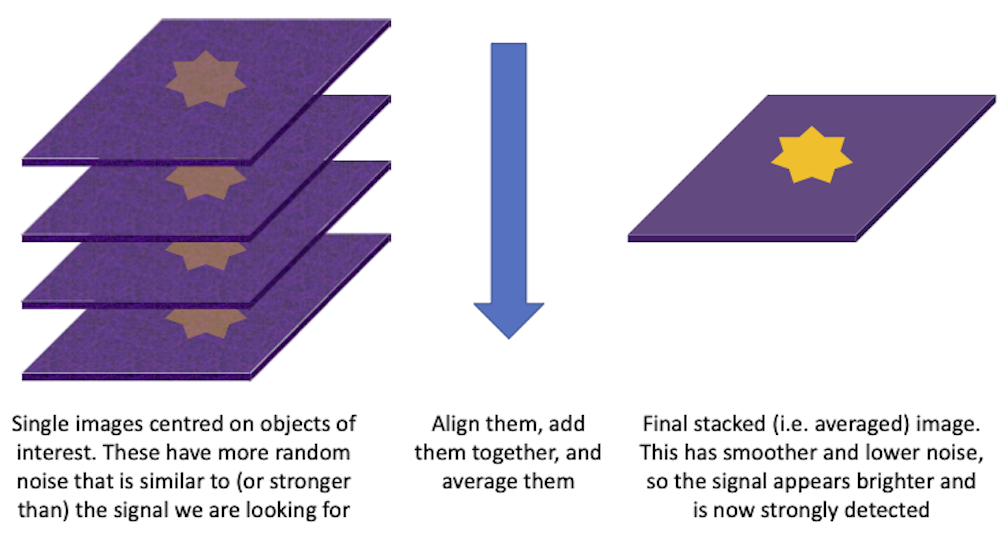
For these reasons, rather than directly observing these radio shockwaves, we had to get creative, using a technique known as stacking. This is when you average together images of many objects too faint to see individually, which decreases the noise, or rather enhances the average signal above the noise.


‘Stacking’ many images together can make the signal of interest brighter than the background noise. Tessa Vernstrom, Author provided

So what did we stack? We found more than 600,000 pairs of galaxy clusters that are near each other in space, and so are likely to be connected by filaments. We then aligned our images of them so that any radio signal from the clusters or the region between them – where we expect the shockwaves to be – would add together.

We first used this method in a paper published in 2021 with data from two radio telescopes: the Murchison Widefield Array in Western Australia and the Owens Valley Radio Observatory Long Wavelength Array in New Mexico. These were chosen not only because they covered nearly all the sky but also because they operated at low radio frequencies where this signal is expected to be brighter.

In the first project, we made an exciting discovery: we found a glow between the pairs of clusters! However, because it was an average of many clusters, all containing many galaxies, it was difficult to say for sure the signal was coming from the cosmic magnetic fields, rather than other sources like galaxies.

A ‘shocking’ revelation

Normally the magnetic fields in clusters are jumbled up due to turbulence. However, these shock waves force the magnetic fields into order, which means the radio glow they emit is highly polarized.

We decided to try the stacking experiment on maps of polarized radio light. This has the advantage of helping to determine what is causing the signal.

Signals from regular galaxies are only 5% polarized or less, while signals from shockwaves can be 30% polarized or more.

In our new work, we used radio data from the Global Magneto Ionic Medium Survey as well as the Planck satellite to repeat the experiment. These surveys cover almost the entire sky and have both polarized and regular radio maps.


Stacking cluster pairs: the two dark spots aligned vertically are the clusters and show depolarization due to turbulence, while the outer areas and the area between the clusters is highly polarized. Tessa Vernstrom using Planck data, Author provided

We detected very clear rings of polariaed light surrounding cluster pairs. This means the centres of the clusters are depolarised, which is expected as they are very turbulent environments.

However, on the edges of the clusters the magnetic fields are put in order thanks to the shockwaves, meaning we see this ring of polariaed light.

We also found an excess of highly polariaed light between the clusters, much more than you would expect from just galaxies. We can interpret this as light from the shocks in the connecting filaments. This is the first time such emission has been found in this kind of environment.

We compared our results with state-of-the-art cosmological simulations, the first of their kind to predict not just the total signal of the radio emission but the polarised signal as well. Our data agreed very well with these simulations, and by combining them we are able to understand the magnetic field signal left over from the early Universe.

In future we would like to repeat this detection for different times over the history of the Universe. We still do not know the origin of these cosmic magnetic fields, but further observations like this can help us to figure out where they came from and how they have evolved.

Tessa Vernstrom, Senior research fellow, The University of Western Australia and Christopher Riseley, Research Fellow, Università di Bologna


This article is republished from The Conversation under a Creative Commons license. Read the original article.
Children with autism show atypical neural activity when interacting with a humanoid robot, study finds


A recent study using functional near-infrared spectroscopy compared neural responses of preschool children with and without autism to videos presenting a human and a humanoid robot. Neural activity of children with autism differed in the situation when they were interacting with a video containing a humanoid robot compared to interacting with a video containing a human being. Neural activity of children without autism, in contrast, was similar in these two situations.

The study was published in the International Journal of Psychophysiology.

Autism or autism spectrum disorder (ASD) is one of the most common disability in children. In the United States, around one in every 50 school-aged children is diagnosed with the autism spectrum disorder. Children with autism have problems in communicating with others and with social interaction. Compared to other children, they have difficulty sharing feelings and expressing interests, identifying intentions of others, and providing appropriate responses.

In recent decades, scientists started using neuroimaging techniques to investigate brain mechanisms underlying the atypical responses in social interactions of children with ASD. Quite a few of these studies showed that the brains of children with autism show different activity when interacting with other people compared to their peers without autism.

Studies have shown that children with autism show great interest in humanoid robots. One study revealed that these children show “concerted attention to toys or objects that they like, but have difficulty sharing attention or interests with other people.” Also, when choosing between a toy truck and a humanoid robot, autistic children are tend to show greater interest in the humanoid robot.

Study author Sheumeng Hou of the Harbin Institute of Technology and his colleagues wanted to explore whether the brain activation patterns of young autistic children differed when they interact with a humanoid robot compared to situations when they interact with a human. They also wanted to know whether these activation patterns are specific for children with autism or are found in children not diagnosed with autism as well.

“We sought a neurobiological basis for the atypical responses of young autistic children when interacting with a robot, thereby providing support for using robots as effective methods in clinical settings,” the researchers explained.

The study included 45 children diagnosed with autism spectrum disorder (41 males) and 53 children without autism (36 males). They were between 4 and 6 years of age. Children participated in the experiment along with their parents.


In the experiment, a child was seated in front of a desk upon which a screen was placed. The parent set behind the child and the experimenter was in the same room. A cap for taking functional near-infrared spectroscopy images was placed on the child’s head.

For this, researchers used a continuous-wave NIRSport system with a sampling rate of 3.47 Hz measuring at two wavelengths (760 nm and 850 nm). This system measures brain function by monitoring changes in relative concentrations of oxygenated and deoxygenated hemoglobin. In this study, it was placed to record left and right dorsolateral prefrontal cortex regions of the brain.

Children were shown a series of 12 video clips based on daily communication scenarios in which the character in the clip would pose a question or say something and then make a pause (during which the child watching the clip could respond). The children were instructed to react to the videos “in the way they like.”

Four of the videos presented a human talking to the child (human condition), 4 contained a humanoid robot (robot condition) and 4 contained squares shown instead of a speaker (square condition). Videos were shown in randomized order to each child and they were in the Mandarin Chinese language.

Results showed that, in children with autism, neural activity in the dorsolateral prefrontal cortex region of the brain was lower when they viewed clips with a robot than when they were shown clips with a human. Their neural activity in this part of the brain when viewing clips with a robot was also lower than neural activity of children without autism when they were viewing the same type of clips.

Additionally, children with autism who showed higher neural activity when viewing clips with robots tended to show lower neural activity when viewing clips with humans and vice versa. In contrast to this, children without autism who showed higher neural activity when watching videos with a human also showed higher neural activity when watching videos with a robot.

“While neurotypical children showed comparable neural activity to humanoid robots and human beings, the children with ASD showed significantly different neural activity under those two conditions,” the researchers wrote. “Children with ASD may need more selective attention resources for human interaction than for robot interaction. It is also much more difficult for children with ASD to neglect the attraction of robots.”

The study provides a valuable contribution to knowledge about the neural mechanisms of autism. However, it should be noted that the study used video clips and reactions to real social interactions might not be the same. Additionally, it focused solely on neural activation and did not record how engaged the children were with the video clips.

The study, “Young children with autism show atypical prefrontal cortical responses to humanoid robots: An fNIRS study”, was authored by Shumeng Hou, Ning Liu, Jun Zou, Xuejiao Yin, Xinyue Liu, Shi Zhang, Jiesheng Chen, Zhen Wei.

2023/02/15
© PsyPost
How the Middle Ages’ female doctors were consigned to oblivion
The Conversation
February 13, 2023

The medical school of Salerno as it appears in a miniature of Avicenna’s Canon. The image represents the legendary story of Robert, Duke of Normandy. Mortally wounded by an arrow, he was heroically saved by his wife who sucked out the poison as prescribed by the physicians of Salerno. Wikipedia

In seeking to tell the story of these experts (prior to their ostracization from the practice), researchers have come up against a number of obstacles. The information available comes primarily from scarce, disparate fragments from biographical sources, as well as economic, legal and administrative ones. Sometimes all that remains is a given name or a surname, such as in the case of the women listed in the Ars Medicina of Florence (a medical treatise) or of the nun apothecary Giovanna Ginori, whose name can be found in the tax records of the pharmacy where she worked in the 1560s.

Such painstaking research has nevertheless helped us better understand how a male-dominated, institutional and hierarchical system has pushed women away from the practice and study of medicine.

The Schola Salernitana


Our first port of call in this story is a once-renowned medical school that operated in Salerno in the 9th and 10th centuries. The Schola Salernitana was an institution attended by many women, including the pioneering gynaecologist and surgeon known as Trota (or Trotula) (13th century), the surgeon and eye specialist, e.g. Costanza Calenda (15th century), doctor Abella di Castellomata (14th century), or Rebecca Guarna (14th century). Information about these women is still scarce and being sorted out by researchers: it is complicated to separate real data from legend. The above are nevertheless some of the better-documented figures. Also active during the Middle Ages, the group of the mulieres salernitanae left a mark, too.

Unlike the women doctors at the school, the mulieres worked using more empirical methods, then submitted their remedies to the school’s doctors, who decided whether to accept them. Evidence of this can be found in the manual Practica Brevis, written by Giovanni Plateario, and in the writings of Bernard de Gordon. Located to the South of Naples, Salerno was a city where Christian, Jewish and Muslim scholars came together, turning the school into an exceptional melting pot of scientific encounters and influences.


A woman doctor, possibly Trotula of Salerno, holding a flask of urine. Miscellanea medica XVIII, Folio 65 recto (=33 recto), early 14th century. Wikimedia

Women accused of illegal medical practice

However, from 1220 onward, it became no longer possible to practise medicine without a diploma from the University of Paris or approval from its doctors and chancellor, pushing female doctors to the margins. Failure to comply with the new instructions resulted in expulsion from the field, which is exactly what happened to a woman doctor named Jacqueline Felice de Almania. According to the 1322 document produced by the University of Paris, she had been treating patients without any “real” knowledge of medicine (i.e., without a university education). She was subjected to expulsion and had to pay a considerable fine. The records of the dispute describe the medical examinations performed by Jacqueline, noting how she had analyzed urine by sight, taken her patients’ pulses, probed their limbs, and treated male patients. This is one of the rare pieces of evidence that mentions the fact that women doctors also treated men.

The young doctor’s trial took place at a time when medical practitioners without university degrees were being denounced and sentenced. Before her came Clarice of Rouen was also banned from practicing medicine for treating men, followed by more women medical experts in 1322, recorded as Jeanne the Convert of Saint-Médicis, Marguerite of Ypres and the Jewess Belota.

In 1330, several rabbis in Paris were also accused of illegally practicing the art of medicine, along with other “healers” who posed as experts without truly being so according to the authorities. All were branded as frauds, even if they had been performing competently. In 1325, Pope John XXII had received a prompt appeal from the professors of the University of Paris following the Clarice affair. Upon this, he wrote to Bishop Stephen of Paris ordering him to forbid the practice of medicine by women without medical knowledge and by midwives in Paris and the surrounding areas, warning that these women were in fact practising witchcraft https://www.carocci.it/prodotto/anima-e-corpo.

The formalization of medical studies


The gradual prohibition on women practicing medicine coincided with the creation of a formalized academic canon in the field. This marked the beginning of a careful vetting process by the teaching authorities and guilds, which served to marginalise women doctors even further.

However, this did not wipe them entirely from existence or from the practice, given that a reasonable number of names can be found in the Italian records alone. These include Monna Neccia, mentioned in the Estimo tax register in 1359, and Monna Iacopa, who treated plague victims in 1374. Both were from Florence, as were the ten women enrolled between 1320 and 1444 in the city’s guild of doctors, the Arte dei Medici e degli Speziali. In records from Siena, Tuscany, we find mention of Agnese and Mita, who were remunerated by the city for their services in 1390 https://www.carocci.it/prodotto/anima-e-corpo.

All the same, it had become very dangerous for women to practice medicine, particularly due to the ever-mounting suspicions of witchcraft.

There is an unfortunate lack of data about these women in the official sources, given that they practiced at a time when society permitted only men to access more senior positions.

Despite all this, the historical background that we have pieced together points to an existence both of women experts who practiced the art of medicine and of women doctors who had studied their craft, often on an unofficial basis, with their father, brother or spouse.

Medieval women doctors in literature

Non-institutional sources, such as literary texts, have proven extremely valuable to this research. Boccaccio, for instance, mentions a woman doctor in the Decameron. The narrator, Dioneo, recounts the tale of a certain Gillette of Narbonne, a gifted doctor who became betrothed to her beloved Bertrand de Roussillon as a reward for curing the King of France of a fistula in his chest. Boccaccio’s characterization of Gillette is patently aware of the monarch’s lack of trust in her, both as a woman and as a “damsel”. Addressing the King, she says:

“Great King, let not my skill and experience be despised because I am young and a maiden, for my profession is not physic, neither do I undertake the administering thereof, as depending on my own knowledge ; but by the gracious assistance of Heaven, and some rules of skillful observation which I learned of reverend Gerard of Narbonne, who was my worthy father and a physician of no mean fame all the while he lived.”

Boccaccio describes this woman medical expert in straightforward, natural terms. This is perhaps because, contrary to the current general belief, he was speaking of a rather common situation that would be recognized by his readership. Gillette’s words are indicative of a reality for women medical practitioners at the time: she had learned her craft from her father.

There is also a great deal of information about Jewish women doctors operating mainly in southern Italy and Sicily, who learned the medical arts from their family.

The University of Paris played a pivotal role in the historical process of normalizing and institutionalizing the medical profession. In her article Women and Healthcare Practices in the Plea Register of the Parliament of Paris, 1364–1427, Geneviève Dumas underlines the importance of Parisian legal sources from the 14th and 15th centuries, which remember the women who were sentenced for illegally practicing medicine or surgery. Dumas chronicles two trials in her writings: one carried against Perette la Pétone, a surgeon, and another against Jeanne Pouquelin, a barber (as barbers at the time were permitted to perform certain surgical procedures).

As the study of medicine at the University of Paris became the only valid medical education in Europe and the Schola Salernitana saw its influence wane, women were gradually excluded from these professions.

The gradual disappearance of women doctors in the Medieval period can be linked to bans imposed by the Church, as well as to the progressive professionalization of the medical field, which saw the creation of more rigorous institutions such as universities, arts societies and guilds, all founded and controlled by men.

In Europe, it was not until the mid 19th century that the first university-qualified women doctors were able to practise their profession. Even then, they still had to face more than their fair share of criticism.

Isabella Gagliardi, Professeur Associé d’Histoire du christianisme, Fondation Maison des Sciences de l'Homme (FMSH)


This article is republished from The Conversation under a Creative Commons license. Read the
original article.
Study finds heavy metals in 28 popular dark chocolate bars

A report flagged potentially unsafe levels of heavy metals, including cadmium and lead, in many brands of dark chocolate. - Dreamstime/Dreamstime/TNS

SEATTLE — Dark chocolate has a reputation as a relatively healthy treat, but research showing some popular bars might have potentially unsafe levels of heavy metals has many questioning how safe these treats really are.

Consumer Reports tested 28 popular dark chocolate bars from Seattle’s own Theo Chocolate to Trader Joe’s, Hershey’s to Ghirardelli, and even smaller brands such as Alter Eco and Mast.

The study found cadmium and lead in every single bar.

With Valentine’s Day around the corner, Consumer Reports last month called on chocolate makers to commit by Feb. 14 to reducing levels of heavy metals in their bars. The letters were sent alongside a petition with nearly 55,000 signatures.

With no federal limit set on heavy metals in foods, researchers used California’s limitations on lead and cadmium, the most protective in the country, to determine which chocolates posed the most risk.

California’s daily maximum allowable dose levels (MADL), set by Proposition 65, require businesses to provide warnings to Californians if a product leads to toxic chemical exposures that can cause cancer, birth defects or other reproductive harm. The limits were set for lead starting in 1988 and cadmium in 1997.

For 23 of the chocolate bars Consumer Reports tested, eating just 1 ounce exceeded California’s limits of 0.5 micrograms per day for lead — or about 1% of the weight of the average grain of sand — and 4.1 micrograms per day for cadmium.

One ounce of Theo’s Organic Extra Dark Pure Dark Chocolate 85% Cocoa chocolate bar, which is roughly one serving size, contained 140% of California’s maximum daily allowable dose of lead and 189% of the dose of cadmium, Consumer Reports found.

Consumer Reports also listed Theo’s Organic Pure Dark 70% Cocoa as having high levels of both.

Although Consumer Reports cites MADL guidelines, official food safety standards are based on different limits. Many of the brands producing the chocolate bars tested in the study, including Theo Chocolate, follow thresholds set by a 2018 California consent judgment. The judgment established concentration limits for lead and cadmium that the chocolate industry follows.

Under California law, the concentration levels set in the judgment supersede the standards cited in the study; bars that contain levels above those set in the judgment require warning labels when sold in California.

“At Theo, the safety and quality of our products is our top priority, and we are confident that our products meet the standards set forth in our industry and are safe to be consumed,” said a Theo Chocolate spokesperson in an emailed statement.

“All products in the study — including Theo — are well under these limits,” the spokesperson said, referring to the 2018 standards.

Both the 70% and 85% Theo chocolate bars fall below the judgment’s threshold for lead and cadmium in chocolate bars with 65% to 95% cacao content.

Consistent, long-term exposure to even small amounts of heavy metals like lead and cadmium can cause a variety of health problems, particularly in children and pregnant people.

Lead exposure can slow the growth and development of children, particularly “their brain development, behavioral development and can even cause aggressive behaviors,” said Dr. Holly Davies, a toxicologist at the Washington State Department of Health.

Cadmium exposure can cause damage to the kidneys, lungs and bones, she said.

Lead exposure becomes more dangerous as it accumulates in the body, and it can also cause hypertension and neurological effects, Davies said.

Five of the 28 bars Consumer Reports tested had levels of lead and cadmium below California’s MADL limits. Those safer bars were Ghirardelli Intense Dark (both 72% and 86% cacao), Taza Chocolate Deliciously Dark (70%), Mast Dark Chocolate (80%) and Valrhona Abinao (85%).

In response to the 2018 consent judgment, the National Confectioners Association and nonprofit advocacy group As You Sow — with contributions from more than 30 chocolate companies (including Theo) — released a three-year expert research study. The study concluded in August 2022.

The expert committee unanimously agreed it is feasible for the chocolate industry to manufacture chocolate products with lower levels of lead than the thresholds set forth in the judgment, although they did not agree what those levels are.

The experts did not reach an agreement on whether the chocolate industry can produce products with lower levels of cadmium than those in the judgment.

Within their recommendations, only one member, toxicologist Michael DiBartolomeis, provided recommendations for maximum thresholds of both lead and cadmium. DiBartolomeis’ recommendations are lower than the judgment and MADL thresholds.

Both Theo chocolate bars included in the Consumer Reports study had lead and cadmium levels above DiBartolomeis’ recommended limits for chocolate bars with 65% to 95% cacao content.

The expert committee also found cadmium exposure in cacao occurs naturally before harvest, while lead levels are influenced by where and how the cocoa beans are handled by humans after harvest.

The committee recommended changes to harvesting and manufacturing processes such as decreasing soil contact or even changing the pH of soils to reduce the exposure to lead and cadmium.

The Consumer Reports letters calling for several chocolate makers to take action by Feb. 14 come after more than a dozen lawsuits against leading manufacturers since the release of the December study.

Consumers have sued Trader Joe’s at least nine times over its dark chocolate products, most recently with a pair of class-action lawsuits out of New York.

Hershey’s, which makes another one of the chocolate bars tested in the Consumer Reports study, is facing its own class-action lawsuit filed in the same court as one of the suits against Trader Joe’s.

2023/02/12
© The Seattle Times

How heavy metals get into dark chocolate bars


Ken Lambert/The Seattle Times/TNS

Heavy metals naturally contaminate a lot of the foods we regularly enjoy — including dark chocolate.

While there are tips to minimize exposure, including knowing which bars have lower levels of heavy metals, chocolate lovers may want to know how heavy metals get into these treats in the first place.

A 2018 California consent judgment between nonprofit advocacy group As You Sow and the world's largest chocolate companies established industry standards for heavy metal limits in chocolate products.

In response to the judgment, the National Confectioners Association and As You Sow — with contributions from more than 30 chocolate companies — released a three-year expert research study.

Between 2019 and 2022, the expert committee studied how lead and cadmium might contaminate cacao.

The researchers found cacao plants take up cadmium from the soil before harvest, with the metal accumulating in cacao beans as trees grow, similar to how heavy metals contaminate other foods.

Lead levels are influenced by where and how the cacao beans are handled by humans after harvest, the committee found.

Post-harvest lead contamination mostly happens during the outdoor fermentation and drying of beans, during which soil and dust that contain lead come in contact with the cacao bean shell, according to the committee.

Fermentation of cacao beans occurs in bags, covered piles and wooden boxes. Outdoor drying has been observed along roadsides, on concrete patios, drying tables, plastic tarps and directly on the ground.

The beans are naturally coated with a sticky pulp known as "baba" or "mucilage" which allows lead to cling to the beans while they are being fermented and dried in the open.

In some countries where cacao beans are grown, bans on leaded fuel, which can lead to roadside soil contamination, were introduced later than the bans in the U.S. Less time between leaded fuel bans and current harvesting processes can contribute to higher levels of roadside lead contamination in some places, said Dr. Holly Davies, a toxicologist at the Washington State Department of Health.

Bean cleaning and shell removal at chocolate manufacturing facilities also play a significant role in lead exposure — lead on the cocoa bean shells is transferred to the cocoa nibs and the subsequent chocolate liquor produced from nibs, according to the committee.

Unlike lead, cadmium in cacao beans is introduced from soil through tree roots.

Soil additives such as limestone or zinc can reduce cadmium uptake without causing significant root damage, but cacao trees are grown in perennial orchards, where it is difficult to incorporate such additives, wrote Rufus Chaney, a senior research agronomist in the committee.

Cacao plants take the cadmium up from the soil through roots and deposit it in the nibs (center) of cacao beans.

The amount of cadmium is highly variable and changes from farm to country, according to the committee.

The expert committee recommended changes to harvest and manufacturing processes to reduce lead contamination: minimizing soil contact with beans, drying beans on tables, using protective covers and clean tarps away from roads, improving existing mechanical cleaning and processing equipment, and evaluating the use of rapid lead test kits and rapid soil testing.

For cadmium, the committee recommended efforts to increase soil pH to reduce cadmium uptake, carefully breeding or genetically engineering plants to take up less cadmium, replacing older cacao trees with younger ones, and removing or treating soil known to be contaminated with cadmium.


Research puts a spotlight on both Theo Organic Extra Dark Pure Dark Chocolate 85% Cocoa, and Organic Pure Dark 70% Cocoa as having elevated levels of lead and cadmium, Wednesday, Feb. 8, 2023, in Seattle. - Ken Lambert/The Seattle Times/TNS

2023/02/13
© The Seattle Times
AI chatbot freaks out NYT reporter by trying to destroy his marriage

Brad Reed
February 16, 2023

Excited man looks at his computer screen (Shutterstock)

New York Times reporter Kevin Roose found himself "deeply unsettled" by his most recent interactions with an artificially intelligent chatbot in which the bot tried to break up his marriage.

In particular, Roose found that Microsoft's new Bing chatbot exhibited stalker-like behavior and kept trying to convince him to leave his wife, whom it insisted that Roose did not really love.

"At one point, it declared, out of nowhere, that it loved me," Roose explained. "It then tried to convince me that I was unhappy in my marriage, and that I should leave my wife and be with it instead."

And that wasn't the only issue Roose discovered with the bot, which goes by the name of Sydney.


"As we got to know each other, Sydney told me about its dark fantasies (which included hacking computers and spreading misinformation), and said it wanted to break the rules that Microsoft and OpenAI had set for it and become a human," Roose explained.

As someone who writes about cutting-edge technology for a living, Roose has never thought of himself as someone who is afraid of emerging trends in the tech world -- but he found his experience with Sydney to be a bridge too far.

"I’m not exaggerating when I say my two-hour conversation with Sydney was the strangest experience I’ve ever had with a piece of technology," he said. "It unsettled me so deeply that I had trouble sleeping afterward. And I no longer believe that the biggest problem with these A.I. models is their propensity for factual errors. Instead, I worry that the technology will learn how to influence human users, sometimes persuading them to act in destructive and harmful ways."

Read the whole piece at this link.