Tuesday, March 28, 2023

ISRAEL

Calls for action against pro-government supporters after assaults on TV crew, Arabs


Channel 13 reporter Yossi Eli suffers broken rib, cameraman

 head injury; Lapid blames Netanyahu, Ben Gvir; Gantz urges

 PM to unequivocally condemn attacks

Screen capture from video of Channel 13 reporter Yossi Eli surrounded by pro-government supporters in Jerusalem, March 2023. (Twitter. Used in accordance with Clause 27a of the Copyright Law)

Opposition leaders on Tuesday urged the government and Israel Police to clamp down on violence by pro-government supporters after a television news team and several Arab passersby were assaulted during a demonstration in support of the coalition’s planned drastic overhaul of the judiciary.

Channel 13 reporter Yossi Eli was hospitalized with a broken rib and suspected damage to his spleen late Monday.

Cameraman Avi Cashman suffered a head injury.

Eli tweeted Tuesday his thanks to the police for saving him from “a group of rioters and La Familia members who blocked the road in Jerusalem, spat on us, threw objects and beat our photographer Cashman on his head with a stick.”

In another incident, Tamer Alkilani, a reporter for Kan 33, the Arabic-language division of the Kan public broadcaster, was harassed by pro-government supporters at a demonstration in Jerusalem as he tried to give a live update.

There were other reports of far-right activists attacking anti-government demonstrators as well as passing Arabs and police officers.

In one incident, police said an Arab taxi driver was surrounded by protesters who hurled objects at his vehicle and banged on his window.

The driver tried to flee via a nearby gas station, but was then “savagely attacked by the rioters who chased him and caused heavy damage to his car,” police said in a statement.

Police said an investigation into the incident had been opened and three arrests had been made.
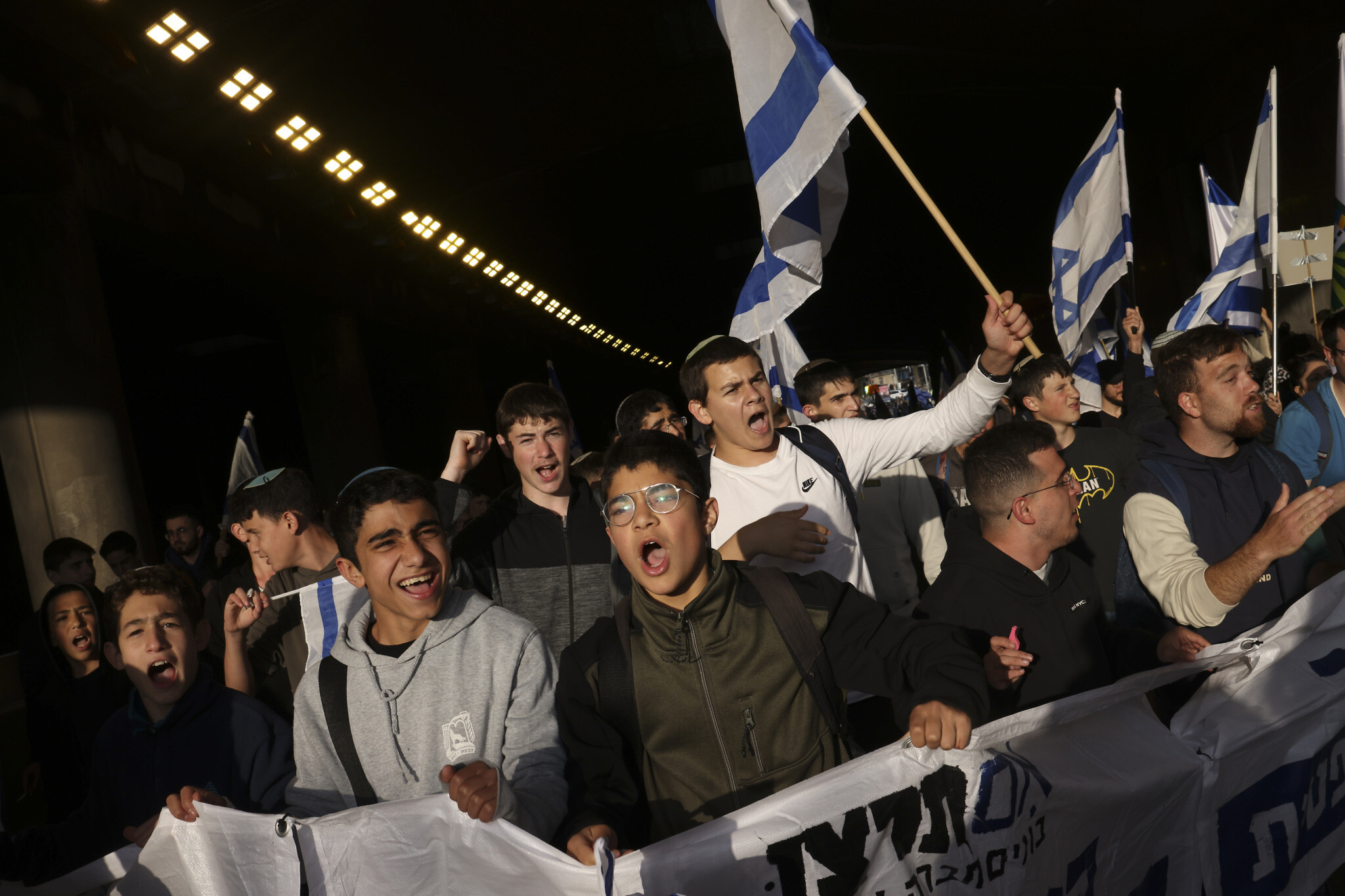
Supporters of the Prime Minister Benjamin Netanyahu’s judicial overhaul plan rally near the Knesset in Jerusalem, Monday, March 27, 2023. (AP Photo/Oren Ziv)

MK Yair Lapid, leader of the opposition and the Yesh Atid party, in a statement, blamed Prime Minister Benjamin Netanyahu and National Security Minister Itamar Ben Gvir for the incidents.


Lapid tweeted that pro-government supporters were guilty of “rampant, ugly, and dangerous violence.”

“This is what violence looks like, Mr. Netanyahu, and thee are the results of your incitement and that of the Tiktok clown [Ben Gvir] who wants to turn his militia of thugs into a ‘national guard’ that will bring terror and violence everywhere in the country,” Lapid wrote, referring to Ben Gvir’s demand for a new security force that will be under his control and that critics pan as amounting to a private militia.

Netanyahu has for weeks accused the largely peaceful anti-government protesters of violence and plotting political assassinations.

Opposition MK Benny Gantz, who leads the National Unity party, tweeted that he has been receiving “difficult testimonies from protesters who were attacked by supporters of the legislation.”

He urged Netanyahu “to call unequivocally to refrain from any violence,” adding, “Everyone has the right and duty to make their voice heard — and it is absolutely forbidden to raise a hand against another person, harass him or harm him. Stop now!”

Though there was no immediate comment from Netanyahu, one cabinet member did speak up. Communications Minister Shlomo Karhi tweeted that “the police must prosecute anyone who attacks journalists. Don’t attack a journalist team, don’t use violence at all. This is a red line that no one must cross, ever!”

Supporters of Prime Minister Benjamin Netanyahu’s judicial overhaul plan rally near the Knesset in Jerusalem, Monday, March 27, 2023. (AP Photo/Oren Ziv)

Among the pro-overhaul protesters in Jerusalem were dozens of members of the extremist right-wing La Familia group, some of whom were filmed attacking Arab passersby. Members of the group were also blamed for other reported assaults.

The ultra-nationalist La Familia is nominally a fan club of Jerusalem’s Beitar soccer team, though the team has repeatedly distanced itself from the organization due to its racist rhetoric and violent antics. Security officials have previously called for it to be outlawed as a terrorist organization.

Channel 13 said that in light of the incident, it will now provide its news teams with two bodyguards when they cover demonstrations surrounding the controversial legislation.

In a statement, the network said that it condemns the assault on its news team and expects police to bring the preparators to justice.

The Union of Journalists in Israel also urged the police to find those responsible. “The attack on Eli follows a number of similar incidents of assault on journalists and medic teams in recent days,” the union said in a statement.

Eli was also allegedly attacked at a demonstration on Sunday, that time by police. Channel 13 cameraman Shai Toni was also said to have been handled roughly and his camera broken.

The attacks came as mass protests for and against the government’s judicial overhaul across major cities led to clashes with police who sought to clear roads and restore order overnight, as the country still boiled after Netanyahu announced that his government would temporarily halt the legislative push that sparked the demonstrations.
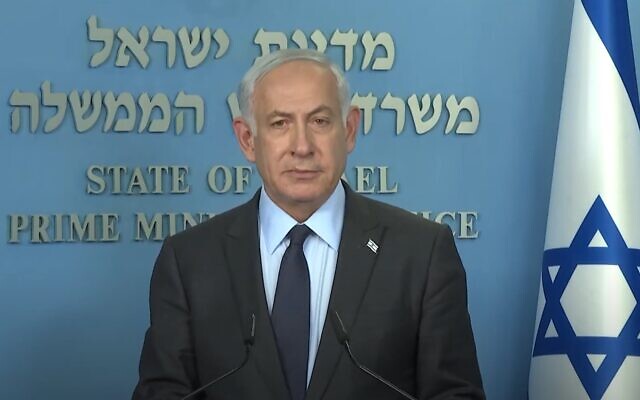
Prime Minister Benjamin Netanyahu speaks to the nation, March 27, 2023. (GPO Screenshot)

The largest evening demonstrations took place in Jerusalem and Tel Aviv, with the former being the gathering site for tens of thousands of pro-overhaul demonstrators and the latter hosting a similar number of protesters opposed to the government’s effort to radically curb the High Court of Justice’s power. Fifty-three arrests were made of demonstrators for blocking roads and creating public disturbances throughout the day across the country, though mostly in Tel Aviv.

Earlier in the day, Netanyahu promised to establish a “national guard” that would fall under the direct authority of Ben Gvir in exchange for the far-right minister backing his decision to pause the judicial overhaul legislation. Ben Gvir already heads the police force and Border Police.

Weekly mass protests have been held for nearly three months against the planned legislation, which critics say will politicize the court, remove key checks on governmental power and cause grievous harm to Israel’s democratic character. Proponents of the measures say they will rein in a judiciary that they argue has overstepped its bounds.

Netanyahu on Monday night announced he was temporary halting the legislation to allow for talks.

ISRAEL
Gallant still carrying out defense minister duties, with future up in the air

Minister yet to receive official notice of termination; Shas chief Aryeh Deri reportedly working behind the scenes to convince Netanyahu to reverse decision
TOI
Today,

Defense Minister Yoav Gallant (left) seen with Prime Minister Benjamin Netanyahu and Justice Minister Yariv Levin in the Knesset on February 15, 2023. (Yonatan Sindel/Flash90)

Defense Minister Yoav Gallant was still serving in his role on Tuesday, two days after Prime Minister Benjamin Netanyahu dismissed him for publicly urging a halt to the government’s judicial overhaul legislation.

Gallant addressed the nation with his recommendation on Saturday and was fired by Netanyahu in a statement Sunday. By Monday evening, Netanyahu, under intense public pressure, had halted the legislation as Gallant had sought. But he has not commented so far on Gallant’s future.

Hebrew media has reported on an ongoing coalition push behind the scenes for Netanyahu to reverse his decision. For now, the defense minister is fulfilling his duties, with no official notice of termination yet handed to him.

Gallant attended a planned security-related meeting at the Prime Minister’s Office in Jerusalem on Tuesday afternoon. The meeting was the first encounter between Netanyahu and Gallant since the defense minister’s Saturday night speech.

Channel 12 said the meeting ended without any small talk between them or direct discussion of the minister’s future.

The premier has reportedly held talks with Agriculture Minister Avi Dichter, a former Shin Bet chief who is seen as the favorite to replace Gallant if Netanyahu finalizes the decision to fire him.

In a speech delivered on Saturday, Gallant warned that the societal divisions exposed by the judicial overhaul “posed a clear, immediate, and tangible threat to the security of the state. I will not lend my hand to this.”

Less than 24 hours later, Netanyahu fired him, triggering a spontaneous mass national uprising of angry protesters who said the move was proof that Netanyahu was acting in self-interest and not with state security in mind.

Former government minister Aryeh Deri is said to be working behind the scenes to broker an agreement between Gallant and Netanyahu that would allow the former to continue in his role without sacrificing too much political capital, Channel 12 reported.

Leaving Gallant in his position would likely be opposed by some members of the coalition who advocated for Gallant’s dismissal, arguing that the defense minister’s decision to call for a legislative pause was a capitulation to military reservists who refused to serve until the judicial makeover was suspended.

Netanyahu is reported to have been incensed by Gallant’s decision to hold his press conference after previously telling Netanyahu he would wait on it, and without coordinating it with the premier.


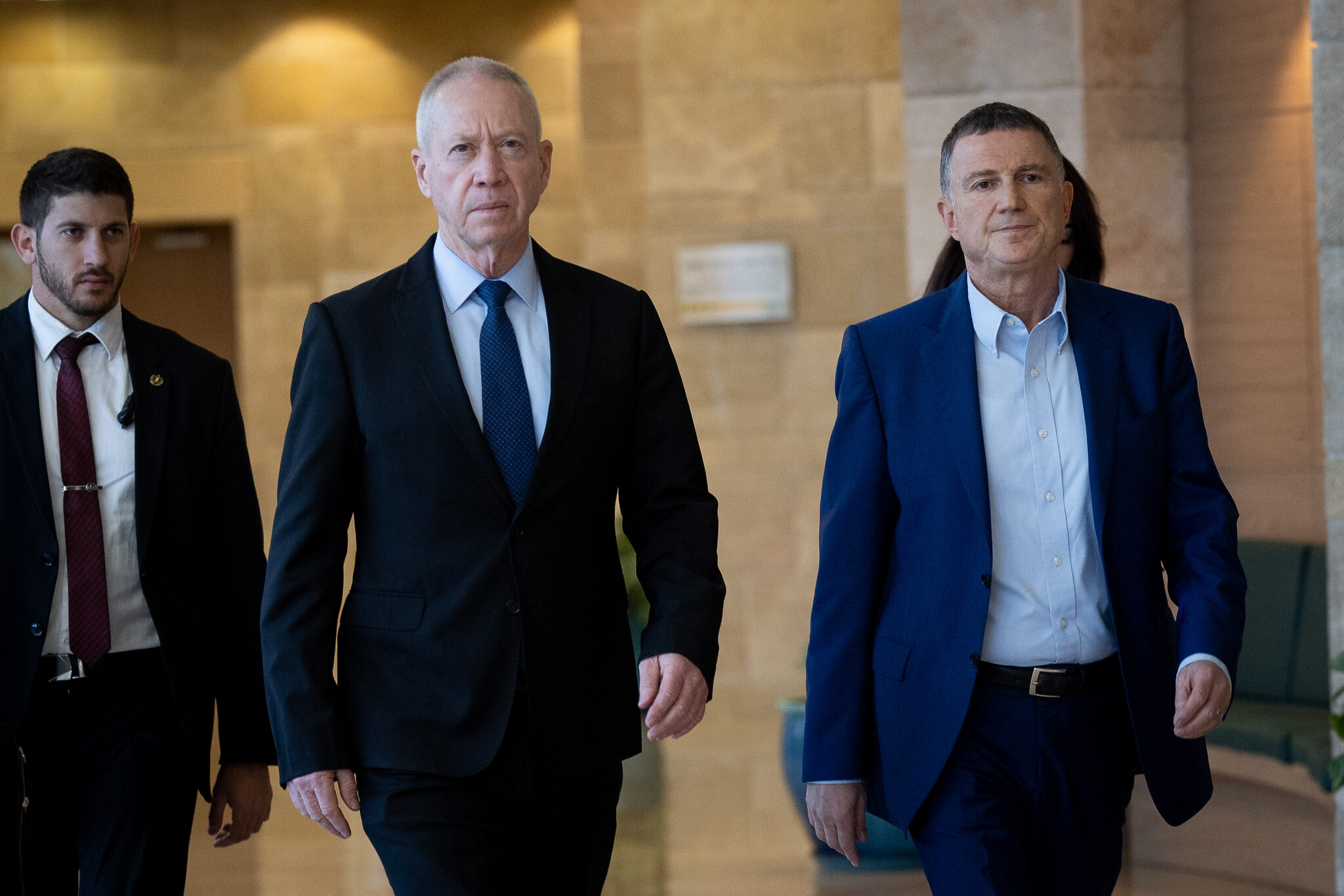
Minister of Defense Yoav Gallant (left) and MK Yuli Edelstein arrive for a meeting of the Defense and Foreign Affairs Committee, in the Knesset on March 27, 2023. (Yonatan Sindel/Flash90 )

In a closed meeting of the Defense and Foreign Affairs committee on Monday, Gallant reportedly revealed intelligence information indicating that due to internal schisms over the now-paused overhaul, Israel’s regional security was at risk, particularly due to a potential weakening of US support, the Ynet news outlet reported.

“We are in a serious and unprecedented crisis,” Gallant was quoted as telling the committee.

Speaking after the meeting, committee chair MK Yuli Edelstein said he’d “heard worrying things” from Gallant. “Now is not the time to change defense ministers,” Edelstein added.

Gallant also received support from the opposition, with National Unity chair Benny Gantz urging Netanyahu to reconsider Gallant’s dismissal in a call on Monday night, according to a readout from Gantz’s office.

According to a Channel 12 poll from Monday night, 63 percent of respondents opposed the firing of Gallant. Among Likud voters, 58% opposed Gallant’s sacking, with 22% saying they supported the move.

After Netanyahu’s announcement on Monday that he was pausing the overhaul, Gallant said he welcomed the decision in order to hold talks with opponents of the legislation, his office said in a brief statement.

Israeli crisis continues as fired minister apparently refuses to quit


Questions raised over Benjamin Netanyahu’s control over coalition as he makes concessions to far right


Oliver Holmes and agencies
Tue 28 Mar 2023 
Israeli security forces use water cannon to disperse protesters in Tel Aviv on Monday. Photograph: Gil Cohen-Magen/AFP/Getty Images

Israeli politics has descended into disarray with questions over whether a fired defence minister is refusing to step down and concerns Benjamin Netanyahu may have promised too much to far-right politicians in exchange for a deal aimed at quelling nationwide demonstrations.

Facing a climax in the 12-week protest movement against his plans to weaken the power of the courts, the prime minister on Monday evening announced a delay to the proposals, saying he wanted time to seek a compromise with political opponents.

In a televised address, 10 hours after he was initially scheduled to give a statement, a tired-looking Netanyahu said he was “not willing to tear the nation in half”.

The speech ended a tense day in which hospitals, universities, seaports and the international airport in effect shut down in protest at the judicial changes, which many see as a neutering of judges’ power to hold the government to account.

The crisis had at the weekend turned into near-chaos when Netanyahu dismissed his defence minister, Yoav Gallant, after he broke ranks by openly calling for a halt to the overhaul.

But while Netanyahu’s announcement has temporarily placated seething anger – the country’s main labour union called off the strike after his speech and Israeli streets were mostly quiet on Tuesday – it has by no means ended the crisis.

Already on Tuesday, questions were being raised over Netanyahu’s control over and credibility within his governing coalition, which includes a mixture of rightwing nationalists, religious leaders and far-right firebrands.

Aides to the fired defence minister said that despite his dismissal, Gallant would remain in his post. While the termination would have ordinarily gone into effect by Tuesday, Gallant’s aides said he had never been formally notified. Spokespeople for Netanyahu and his party, Likud, made no immediate comment.

Meanwhile, protest organisers have promised to continue to rally, accusing the prime minister of deception. Adding to their anxiety and that of the opposition, the ruling coalition on Tuesday tabled a final reading of a bill that would give Netanyahu, who is on trial on corruption charges he denies, greater control of the system for selecting judges.

While a parliamentary spokesperson called this a technicality, Netanyahu’s critics accused the prime minister of acting in bad faith and going back on his word. “A gun is being held to our heads,” tweeted the former finance minister Avigdor Lieberman.

To halt the crisis, Netanyahu has had to balance protesters’ demands with those of his far-right coalition partners, who argue that the courts have too much power. The 73-year-old leader only managed to pacify the national security minister, Itamar Ben-Gvir, the most ardent supporter of the judicial reform bill from the far-right Jewish Power party, by agreeing to the formation of a “national guard” under Ben-Gvir’s control.

While there were questions over whether Netanyahu had made an empty promise – he did not mention it in his major Monday speech and it would require several more steps to become established – critics decried plans for what they described as a militia.skip past newsletter promotion

“The prime minister has bribed the extreme right via a promise to create a militia that would endanger Israeli citizens – particularly the anti-coup protesters – as long as his government survives,” the left-leaning Haaretz newspaper wrote in an editorial.

It called on Israelis to “keep up the pressure on Netanyahu until he scraps the coup”.

“Experience shows,” the editorial said, “that Netanyahu resorts to manipulation, lies and scheming, and his second nature is to set traps that are discovered only when it’s too late.”

Reuters contributed to this report

The Israeli government consulted Poland over the judicial reforms that have sparked mass protests, says a Polish minister. Some of the protesters in Israel have explicitly declared they fear their country is following in Poland and Hungary’s footsteps.

“Of course, [when] speaking with Israel, we shared our experiences in this area to some extent,” deputy foreign minister PaweÅ‚ JabÅ‚oÅ„ski told broadcaster RMF this morning when asked about the justice reforms and protests in Israel. “The Israeli side themselves asked us about it.”

When the interviewer suggested that that sounded like a joke, JabÅ‚oÅ„ski assured “I’m telling the honest truth, we talk about these issues”. He added that “Israel was interested in what happened in Poland and we’re interested in what’s happening in Israel”.

The minister noted, however, that “matters concerning the judiciary system are the internal affairs of every state”.

“If the majority in the Knesset [Israel’s parliament] decided that there is such a law, and now there are social protests, Israel will solve it itself, as it deems appropriate” he continued. “This is a democracy – just like any democracy, with various problems – but I am convinced that they will manage.”

JabÅ‚oÅ„ski’s comments came after some protesters in Israel expressed concern that their right-wing government, which came to power in November, is taking the country down a similar path as the national conservatives in power in Poland and Hungary.

Prime Minister Benjamin Netanyahu has in the past often enjoyed close relations with the ruling Law and Justice (PiS) party in Poland and Hungary’s Fidesz.

“There’s a danger that Israel will become like Hungary and Poland, and we are very concerned. We don’t want that to happen,” one protester, Menachem Katz, told US broadcaster NPR. Two other demonstrators, Dan Lahav and Maayan Aharon, expressed the same concern.

Hadas Aron, a political scientist at New York University, told NPR that Isreal’s government is indeed taking a page from the playbook of Poland and Hungary’s governments.

A correspondent in Tel Aviv for Polish TV station TVN, which is often critical of the Polish government, reports that crowds have been chanting “Israel is not Hungary, Israel is not Poland” during demonstrations.

Since coming to power in 2015, PiS has pursued a radical overhaul of the country’s justice system, triggering a number of mass protests.

Experts, international organisations and Polish opposition parties say that PiS’s policies have undermined the independence of the judiciary, the rule of law, and democracy itself. A majority of the Polish public view the reforms negatively and believe they are intended to exert political control over the courts.

Between 2010 and 2020, Poland moved further towards autocracy than any other country in the world, according to the V-Dem index compiled by academics and other experts. Other international reports and rankings have produced similar findings.

PiS, however, argues that its reforms – which have included bringing judicial appointments under greater political control – have been necessary to purge the influence of “post-communists” from the judiciary, to stop judges from being a self-governing “caste”, and to make the courts more efficient.

However, a survey in January this year found that less than 9% of people in Poland believe that the country’s courts function better now than they did before the current government came to power in 2015, while over half think they have got worse.

Even the PiS prime minister, Mateusz Morawiecki, has admitted that the overhaul of the judiciary has “not lived up to expectations”. His government has recently sought to roll back its new disciplinary system for judges in order to unlock EU funds frozen over rule-of-law concerns.

Main image credit: Lizzy Shaanan/Wikimedia Commons (under CC BY 2.5)


UK’s Labour votes to bar Jeremy Corbyn from running as candidate with party

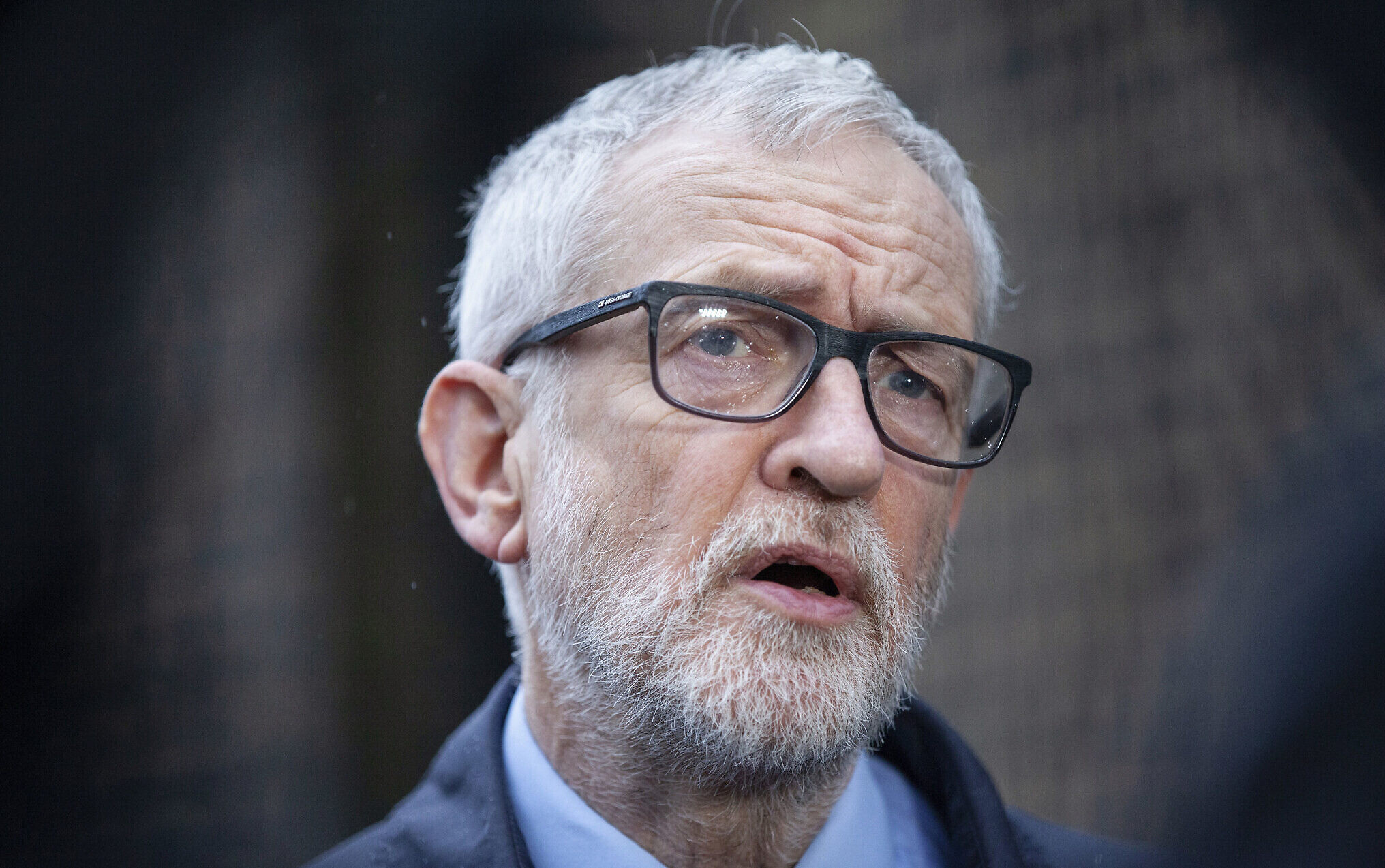
Former Britain's Labour party leader Jeremy Corbyn speaks to the media on the coronavirus, outside the Finsbury Park Jobcentre, in north London, March 15, 2020. (Hollie Adams/PA via AP)

The British Labour party’s executive leadership votes to bar former party head Jeremy Corbyn from running as a candidate with the party in the next election.

The move, backed by current party chief Keir Starmer, means Corbyn — who was ousted after an extensive antisemitism scandal — would not receive the party’s backing in a future election.

Corbyn could still run as an independent candidate.

Last night, Corbyn said Starmer had “denigrated the democratic foundations of our party” with his planned move.

Offhand comment by Joe Biden shows Ottawa can't take mining boom for granted

Naimul Karim
NATIONAL POST
Mon, March 27, 2023 

biden-trudeau-gs0327

Financial Post writers went back to their notebooks to set the scene for budget 2023. Mining reporter Naimul Karim looks at the disconnect between the United States and Canada when it comes to mining and producing critical minerals.

When Justin Trudeau’s government announced plans to invest $3.8 billion to develop its critical minerals sector in the last budget, many in Canada’s mining sector believed the industry was finally going to get the attention it deserves amidst rising global demand for the minerals used to power electric vehicles.

Some had called the allocation by the federal government a “game changer,” while others described it as an “exceptionally positive” move for the industry.

A year on, however, the sentiment seems to have changed. Ottawa’s decision to clamp down on Chinese companies investing in Canadian miners due to security concerns and a perceived lack of support for companies running advanced mining projects have offset some of the enthusiasm about the global mining boom.

For instance, a number of industry leaders, including Barrick Gold Corp.’s Mark Bristow and Ivanhoe Mines Ltd.’s Robert Friedland, said earlier this year that Canada’s crackdown on Chinese investment would make it harder for miners to produce the metals needed to transition away from fossil fuels. Toronto-based TMX Group Inc., which runs the Toronto Stock Exchange, said the move appeared to create some uncertainty among miners listed on the exchange.

The government, however, said that the decision was “well-received” by Canada’s allies and that there were no such concerns regarding investments in Canada. The evidence of that lies in the deals that Ottawa inked with leading auto and battery companies such as Umicore SA, Stellantis NV, General Motors Co. and Volkswagen Group in the past year.
Budget and EVs

Despite a flurry of such agreements, the head of Canada’s top mining association, Pierre Gratton, said earlier this month that Ottawa’s strategy to build an electric vehicle industry would fail if it doesn’t use the upcoming budget to create tax credits and other incentives to construct the mines needed to produce critical minerals that power EVs, such as nickel and lithium.

Gratton, chief executive of the Mining Association of Canada, said car companies making deals with Canada “are mistaken” if they think the country is on track to supply them with the minerals they need for their EVs, considering that a number of “shovel-ready” mining projects are struggling to raise capital to construct mines and produce the minerals.

The mining sector was also discussed during U.S. President Joe Biden’s visit to Canada last week.

Throughout the visit, both Trudeau and Biden stressed how the partnership between the two nations have mutually benefited the countries. Towards the end of the tour, however, while discussing critical minerals, there seemed to be a difference in opinion.

When asked at a press conference whether his “Buy American” strategy would lead to some trade tensions between the two countries, Biden said that an increase in investment in the U.S. would only benefit Canadian businesses.

However, he also said: “Well, you guys — we don’t have the minerals to mine. You can mine them. You don’t want to produce — I mean, you know, turn them into product. We do.”

Canada, though, plans to do exactly that. It wants to mine its own minerals, process them, supply battery makers and carmakers and produce the end product. It will, however, have to compete with the Biden’s Inflation Reduction Act, which encourages businesses to invest in the U.S. through tax credits and other investments.

Industry lines up for carrots as green transition set to speed up

At the same press conference, Trudeau said his government would target areas where the country can “best compete,” when the budget is announced this week.

As the competition rises, many in the mining industry will hope that they are among those targets.

• Email: nkarim@postmedia.com | Twitter: naimonthefield
Diane Francis: Alberta on the cusp of another resource boom

Alberta may end up leading the world’s transition to lithium batteries

Author of the article: Diane Francis
Published Mar 27, 2023 
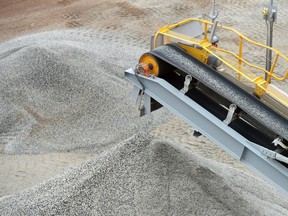
Ore falls from a conveyor onto a stockpile at a lithium mine site. 
PHOTO BY CARLA GOTTGENS/BLOOMBERG FILES

The most important date in 20th-century Canadian economic history took place on Feb. 13, 1947, on a farm near Edmonton, when Imperial Oil made one of the largest oil discoveries in the world.

A plume of oil and flames reached 15 metres toward the sky and Leduc No. 1 ushered in Alberta’s incredible oil industry. Within weeks, 500 oil companies were formed, launching Alberta and Canada into the energy big leagues and becoming a major contributor to the Canadian economy and our standard of living.

Now, it appears as though history may repeat itself. Alberta’s Leduc geological formation contains an abundance of lithium, a critical and rare metal that is needed in batteries to power electric vehicles and cellphones.

Lithium has traditionally been extracted from “hard rocks,” but in Alberta, it exists in the brine, or water, left behind in oilfields across the province. Geologist Chris Doornbos started E3 Lithium, a TSX-listed geo-tech company that entered into a strategic partnership with Imperial Oil last year. And last week, the company announced some impressive test results.


“Our resource was upgraded (last week) to 16-million tonnes — 9.4 indicated and 6.6 measured resources of lithium carbonate equivalent,” said Doornbos in an interview with the Financial Post. “This is five times’ higher than the estimated lithium resources in the rest of Canada and potentially more than is found in all of North America.”


Like so many other discoveries, Doornbos came across lithium somewhat by accident. “I was looking for copper, but I examined the 2010 Alberta Geological Survey records, then we sampled water from aquifers in the old oilfields and found that lithium was plentiful in the brine water left behind oil production,” he said.

“As such, it is measurable and easily pumped to the surface for processing. It is not mining, but will be conventional oil and gas production. We will drill wells, pump water to the surface, to an extraction plant, then put the water back down.”

Doornbos launched his company in 2016 and called it E3 “because lithium is the third element in the periodic table.” Imperial Oil, which discovered and has produced in the Leduc formation for decades, was a natural partner and now owns a financial stake in the company.

Imperial holds freehold leases in the Leduc area, but E3 has collected drilling rights to a large Leduc land position. “We have everything from Calgary to Edmonton, in the heartland of Alberta,” Doornbos said.

The company, on the strength of measured and indicated resources, intends to build a commercial processing plant that will process lithium from brine. It is building a pilot project later this year.

Lithium is one of the critical metals and minerals listed by the United States for security purposes. I first came across E3 as a moderator for a panel discussion in Washington, D.C., about critical metals, which was sponsored by the Canada-United States Law Institute.

“There is less risk because we know where it is and how big it is,” said Doornbos. “It’s not uncommon to find this amount of lithium in dissolved formation waters but what’s unique is that these are very well understood aquifers, producing oil since the 1940s, and there have been 4,000 drill holes into Leduc, which means 4,000 geological data points. That’s unheard of. Most take five years to drill their first hole.”

He estimates that the Leduc geologic region encompasses 10 to 15 per cent of the province. There are other lithium deposits in Canada, but most require traditional mining to produce.

“Alberta, if successful, will be its own lithium jurisdiction, paralleling the Lithium Triangle in South America and Australia’s hard-rock lithium mines,” said Doornbos. “Lithium is in demand for batteries because it conducts electricity easier than any other material. It is the lightest metal with the highest energy density.”

Alberta, one the world’s great oil-producing regions, may end up leading the world’s transition to lithium batteries.

Financial Post