‘Iran Is Not Gaza’: Read Arundhati Roy’s Scathing Speech on the US-Israeli War

The award-winning Indian novelist warns that the world is on the brink of nuclear calamity and economic collapse, and laments her own government’s gutlessness.
Arundhati Roy, was in conversation in New Delhi on Monday about her recent book ‘Mother Mary Comes To Me.’ At the end of the event, Arundhati delivered impassioned remarks on the war in Iran, US imperialism, and India’s own role in all of this.
I know we are here today to talk about Mother Mary Comes To Me. But how can we end the day without talking about those beautiful cities – Tehran, Isfahan, and Beirut that are up in flames? In keeping with my Mother Mary’s spirit of candour and impoliteness, I would like to use this platform to say something about the unprovoked and illegal attack by the United States and Israel on Iran. It is, of course, a continuation of the US-Israeli genocide in Gaza. It’s the same old genocidaires using the same old playbook. Murdering women and children. Bombing hospitals. Carpet bombing cities. And then playing the victim.
But Iran is not Gaza. The theater of this new war could expand to consume the whole world. We are on the brink of nuclear calamity and economic collapse. The same country that bombed Hiroshima and Nagasaki could be readying itself to bomb one of the most ancient civilizations in the world. There will be other occasions to speak of this in detail, so here, let me simply say that I stand with Iran. Unequivocally. Any regimes that need changing, including the US, Israel, and ours, need to be changed by the people, not by some bloated, lying, cheating, greedy, resource-grabbing, bomb-dropping imperial power and its allies who are trying to bully the whole world into submission.
Iran is standing up to them, while India cowers. I am ashamed of how gutless, how spineless our government has been. Long ago, we were a poor country of very poor people. But we had pride. We had dignity. Today, we are a rich country with very poor, unemployed people who are fed on a diet of hatred, poison, and falsehoods instead of real food. We have lost pride. We have lost dignity. We have lost courage. Except in our movies.
What sort of people are we whose elected government cannot stand up and condemn the US when it kidnaps and assassinates heads of state of other countries? Would we like that done to us? For our prime minister to have traveled to Israel and embraced Benjamin Netanyahu just days before he attacked Iran – what does it mean? For our government to sign a groveling trade deal with the US that literally sells our farmers and textile industry down the river, only days before the US Supreme Court declared Trump’s tariffs illegal – what does it mean? For us to now be given ‘permission’ to buy oil from Russia – what does it mean? What else do we need permission for? To go to the bathroom? To take a day off work? To visit our mothers?
Every day, US politicians, including Donald Trump, mock and demean us publicly. And our prime minister laughs his famous, vacuous laugh. And hugs on. At the height of the genocide in Gaza, the government of India sent thousands of poor Indian workers to Israel to replace expelled Palestinian workers. Today, while Israelis take shelter in bunkers, it is being reported that those Indian workers are not allowed into those shelters. What the hell does all this mean? Who has put us into this absolutely humiliating, shameless, disgusting place in the world?
Some of you will remember how we used to joke about that florid, overblown Chinese communist term, “Running Dog of Imperialism.” But right now, I’d say, it describes us well. Except, of course, in our twisted, toxic movies in which our celluloid heroes strut on, winning phantom war after war, dumb and over-muscled. Fueling our insatiable bloodlust with their gratuitous violence and their shit for brains

The Long War: Iran’s Oldest Strategy
Photograph Source: Cattette – CC BY 4.0
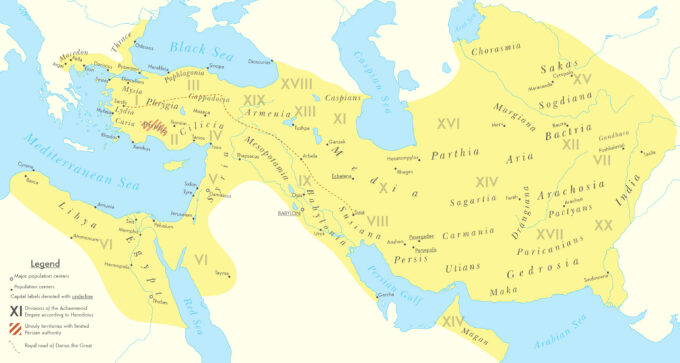
Most discussions of Iran revolve around oil, escalation, and regime change. Yet Iran today feels easier to understand as part of a much older pattern. For more than 2,500 years, states on the Iranian plateau have favoured patience, distance, and endurance over any kind of immediate full-on confrontation with stronger enemies.
To understand Iran today, it therefore helps to trawl through Persian military history.
Iran has been described, unfairly, as two deserts—one with salt and one without, though it is also forested and full of mountains. From all this has emerged one of the world’s most durable martial traditions.
From the chariot nobles and “Immortals” of the Achaemenid Empire to the armoured cavalry of later dynasties—and ultimately to the modern Islamic Revolutionary Guard Corps (IRGC)—Iranian military institutions have repeatedly adapted.
During the Iran–Iraq War, Iraqi forces saturated the battlefield with chemical weapons while much of the world looked away. Yet Iranian forces endured. That experience still shapes the country’s strategic thinking.
Today, Iran famously emphasises asymmetric warfare—indirect and comparatively inexpensive methods designed to offset the technological advantages of powers such as the United States and Israel. But across the centuries, Persian warfare has often favoured similar patience, mobility, and indirect pressure.
Long before the Persian Empire came about, Indo-Iranian tribes spread like seeds across the Eurasian steppe. The ancestors of Persians, Medes, and Scythians were nomadic pastoralists whose warrior culture centred on horse archery and mobile raiding.
I will always remember the late Iran expert Michael Axworthy telling me at the French House in central London how Persian culture liked to preserve the memory of its warrior elites in the Shahnameh, where heroes famously fought knowing that “a man’s renown is what remains of him.”
Over time groups such as the Medes and Persians formed states. Emerging from these tribal warrior societies, they became more than capable administrators and empire-builders, though their romantic steppe heritage—particularly elite cavalry—continued to shape Iranian warfare.
The first great Persian imperial conqueror was Cyrus the Great. His empire, founded around 550 BC, became one of the largest the ancient world had ever seen. Achaemenid armies fielded archers and spearmen supported by cavalry and elite guards such as the Immortals—a 10,000-man corps whose ranks were continually replenished to that exact number. [It was pointed out to me that part of the weird Christian Zionist hagiography of Trump hailed him as a modern-day Cyrus the Great.]
During the Greco-Persian Wars, these armies brought together Egyptians, Babylonians, Greeks, and Central Asians under one single imperial command. One encounter remains especially famous: the Battle of Thermopylae, where Leonidas I’s Greek force resisted Xerxes I’s invading army. The episode has been retold so many times in Western culture, most recently in the film 300, where Persians appear less as soldiers than as grotesques—an example of how easily enemies become caricatures.
“From childhood we are taught to ride and to shoot,” declares the hero in Gore Vidal’s novel Creation. Vidal uses this idea repeatedly to show that Persians were raised as horsemen and warriors from youth, not trained later as professional soldiers. The Greeks admired individual glory in battle, Vidal is saying, while Persians value order, discipline, and organisation.
When the Achaemenid Empire collapsed under Alexander the Great, however, Persian political power fragmented with it. Yet they say the military traditions of the Iranian plateau did not disappear. If anything, they evolved.
The Parthian Empire developed one of the ancient world’s most distinctive fighting styles. Its armies relied on highly mobile horse archers this time supported by heavily armoured cataphracts. Like the great horse warriors of the Native American Plains, the Parthians were legendary riders, able to twist in the saddle and fire arrows backwards in the famous ‘Parthian shot.’
These tactics proved devastating at the Battle of Carrhae, where Parthian forces destroyed a Roman army commanded by Marcus Licinius Crassus. Later writers claimed molten gold was poured into Crassus’s mouth—perhaps apocryphal, but too memorable to be lost.
The broader lesson was familiar on the Iranian plateau. Stronger enemies could often be worn down through distance, manoeuvre, and patience.
The Sasanian Empire refined this. Its elite warriors, the Savaran, were heavily armoured noble cavalrymen armed with long lances and swords, forming the backbone of a state that for centuries rivalled Rome and Byzantium.
Exhausted by long wars with Rome, however, the Sasanian state did eventually collapse under the Arab conquest in AD 651. The empire fell, but Persian administrative and military traditions continued. Early Islamic rulers adopted many of these, just as later conquerors—from the Seljuks to the Mongols—also found that governing Iran meant working within Persian traditions of statecraft and war.
A distant echo of this pattern perhaps appears today in the IRGC’s increasingly challenged support for regional militias from Hezbollah and Hamas to the Houthis in Yemen and the Muslim Brotherhood in Sudan.
Under the Qajar dynasty, attempts to modernise the army included the creation of the Persian Cossack Brigade, a Russian-trained unit that became Iran’s most effective military force. After the Russian Revolution the brigade passed into Iranian hands, and its commander, Reza Khan, used it to launch the 1921 coup that brought the Pahlavi monarchy to power—an event quietly tolerated by Britain.
Today, long after the overthrow of the Shah, Iran fields two main military institutions: the national army and the earlier mentioned, still powerful IRGC created after the 1979 revolution.
The Islamic Republic was immediately tested by war. Saddam Hussein’s invasion in 1980 forced Iran into an eight-year struggle fought under isolation and repeated Iraqi chemical attacks. Iran’s conventional forces struggled against Iraq’s better-equipped army.
Yet the war delivered a crucial lesson: survival itself could count as success.
Basically, endurance and mobilisation allowed the Islamic Republic to outlast what many expected would be swift collapse. The conflict left a deep imprint on Iranian military thinking, reinforcing a threatening preference for attrition and indirect pressure rather than conventional confrontation with technologically superior enemies. The pattern will be familiar.
The Iranian warrior is no longer a horseman but a modern soldier equipped with missiles, drones, and cyber capabilities. Yet the imagery of the past remains relevant. Heroes like Rostam from the Shahnameh appear alongside Sasanian cavalry and the martyr traditions of the Iran–Iraq War in Iran’s modern military imagination.
Their current strategy is therefore less an anomaly than the latest expression of a long tradition. The steppe archers who once hassled and harried their enemies, the Parthians who exhausted Roman legions through manoeuvre and distance, and later Persian states that absorbed new technologies while preserving older traditions all find an echo in Iran’s reliance today on missiles, drones, proxy militias, and dispersed forces.
Rather than seeking immediate battlefield triumph, Iran appears today to be preparing for something else. This is a long contest of attrition.
The “distance” once commanded by the Parthian horse archer has not disappeared—it has simply changed form. Where a nomad once used the range of a bow, the modern state uses missiles or the geopolitical buffer of proxy militias.
The principle remains the same: this is to keep the enemy at arm’s length and wear down their resolve.
Geography reinforces this strategy. Don’t forget Iran sits astride the Persian Gulf and the Strait of Hormuz, surrounded by mountains and deserts that favour defence and attrition.
If history tells us anything, Iran will not try to win quickly. Instead it will aim to ensure that any enemy drawn into conflict finds itself fighting a long war.
Foreign powers have underestimated Iran for more than twenty-five centuries—and repeatedly discovered that Iranian states possess a stubborn capacity to endure, adapt, and outlast stronger enemies. What we are witnessing today may therefore be the opening phase of a highly regrettable conflict shaped not by decisive battles, but by endurance.
Clouds of War in the Middle East
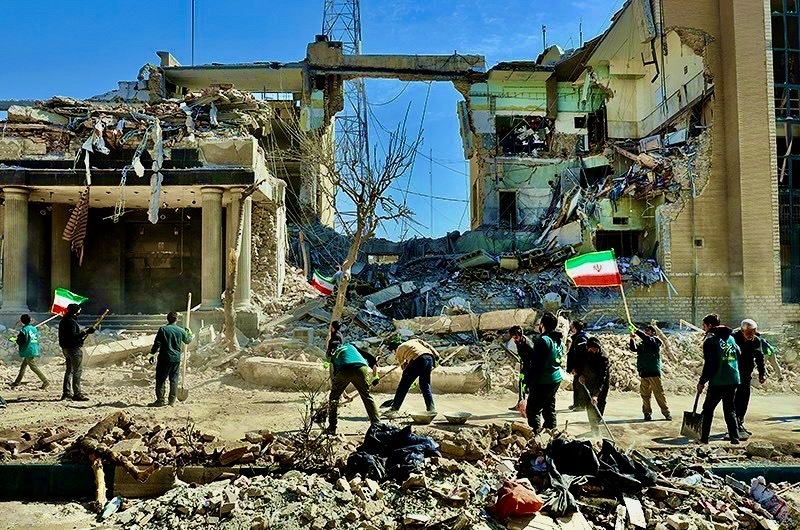
Israeli or American bombing of Tehran. Photo: Hossein Zohrevand, Tasnim News Agency. Creative Commons, Wikipedia.
The war of the Trump administration and Israel against Persia / Iran is bringing humanity ever closer to catastrophe. Both Israel and Iran are theocratic regimes designed to overcome each other, no matter the consequences. They replay the crusades of the dark ages. They have sacred books promising paradise, should they exterminate their enemy. But why is the United States in this deadly war? It knows Israel very well. It is its arms supplier. But should it also fight its wars? I don’t think Americans want such a state of subordination.
Second, the raging war in the Middle East is certain to exacerbate the use of artificial intelligence (AI) in the management of nuclear weapons, other military plans, strategies and conventional weapons. That means the war Israel provoked against Iran becomes even more dangerous. Israel and the US have nuclear bombs. And Israel is determined to destroy Iran. In such paroxysms of hubris, logic, history and justice take a vacation. Passions rule. Thus this unnecessary, destabilizing and destructive war will delay world nuclear disarmament and peace for a very long time. In fact, the war against Iran may become global with unforeseeable calamities and other adverse consequences. Russia has already expressed support for Iran. And China probably has done the same thing. So, without knowing, we may be on the eve of World War III.
War in the Middle East
Trump campaigned for peace. Yet American and Israeli missiles are raining on Tehran. A US Airforce strike over the Iranian capital, Tehran, killed school girls. On March 8, 2026, Senator Chris Murphy (D-Conn.) said that killing children is “unforgivable under any circumstances.” He is a member of the Senate Foreign Relations Committee. “But the fact that this was one of our first targeting decisions, that this mistake was made on the first day of war, I think speaks to the incompetence of our leadership at the Department of Defense.”
However, the US and Israel cannot win. Persia is a large country with a large population of 90 to 100 million people. But Persia’s greatest asset is that Persians know who they are. Their theocratic government may be divisive but, in general, Persians love their country. Persia / Iran is thousands of years old. The war against it violates international law and the Charter of the United Nations. It is also thoughtless. And it is unconscionable that a giant country like America is fighting Iran on behalf of a tiny state like Israel. This is no speculation. The Secretary of State, Marco Rubio, and the House Speaker, Mike Johnson, admitted that this is Israel’s war. Israel led the United States into war.
The war against Persia / Iran by the United States and Israel started on February 28, 2026. No one expected the war because for several days Iranian and American officials were talking how to avoid the war. And yet, in the midst of negotiations, Trump unleashed the US-Israeli bombing of Tehran, killing Iran’s Supreme Leader and several other officials. The rhetoric of Trump and his Secretary of War, Pete Hegseth, made no sense, suggesting that Iran was a national security threat that had to be disarmed and destroyed. The prime minister of Israel, Benjamyn Netanyahu, kept repeating that Iran had to be destroyed because its nuclear program was an existential threat to Israel. Of course, he never suggested that nuclear-weapons armed Israel was a much greater threat to the entire Middle East.
The war the US and Israel against Iran “has unleashed chaos across the Middle East.” According to Iran’s Islamic Revolutionary Guard Corps, Iran has attacked at least 27 US bases in the Middle East, including military installations in Israel. Iran has also launched missile strikes against Bahrain, Iraq, Jordan, Kuwait, Oman, Qatar, Saudi Arabia, United Arab Emirates. In addition, an Iranian drone struck a British military base in Cyprus.”
Israeli and American hegemony
Oil is one of the reasons why the US joined Israel’s hegemonic attack on Iran. “America’s economy is more than 40 percent more oil-intensive than China’s.” It’s also the disappearing of trust and professionalism. There are “profound apprehensions about the military strikes in Iran. We can’t trust that they got the degree of deliberation that war demands.” This mirrors the corrupt plutocratic culture of the Trump administration: Senior government officials showing off “their fundamental sloppiness, selfishness, disregard for proper procedure, evasion of accountability. They simply don’t do their jobs — or at least don’t do them earnestly, maturely or competently.”
However, in the midst of this disterbing chaos, hegemony of the planet is the ultimate goal of US foreign policy. Jeffrey Sachs, professor of economics and advisor to world leaders, described the hegemonic ambitions of America this way:
“Let us be clear about what the United States and Israel are pursuing. The US objective is not the security of the American people. The objective is global hegemony. The attempt is to destroy the UN and the international rule of law—an attempt that will fail. Israel’s objective is to establish a Greater Israel, destroy the Palestinian people, and assert its hegemony over hundreds of millions of Arabs across the Middle East (from the Nile to the Euphrates, as US Ambassador Huckabee recently asserted).
“The United States’ delusional efforts at global hegemony are proceeding region by region. The US has recently claimed, in a wholly twisted supposed revival of the Monroe Doctrine, that it controls the Western Hemisphere and can dictate how Latin American countries conduct their economic and political affairs…. Today’s war against Iran aims to prove that the US similarly owns the Middle East. The war is part of a 30-year campaign, initiated by the Clean Break doctrine, to overthrow all governments that oppose US and Israeli hegemony in the region.”
Epilogue
Hegemony has been tempting politicians and states for millennia. But hegemony demands kings, emperors or tyrants. Hegemony of a state over another is colonialism. The institution thrived for centuries before and after the invention of democracy by the ancient Greeks.
The US-Israel war against Iran is unjust and illegal. Netanyahu and Trump are responsible for this unprovoked conflict harming the entire Middle East, including America. If America’s NATO steps into this war, then we will have a World War III. Russia and possibly China are helping Iran. With the Biblical slogans about a greater Israel and the second coming of Christ, we resurrect darkness. Therefore, this war against Iran takes a religious and theocratic crusading vision and purpose that has no end before the annihilation of Iran.
But higher prices of petroleum and the disruption of energy markets might bring the American war in the Middle East to an end. On March 9, 2026, Trump said the war was “an “excursion” that would be over soon,” primarily because of “spiking oil prices, troop casualties, allies under attack and low support among the American public.” A commentator of PBS News Hour, Tamara Keith, zeroed in on gas prices that explain Trump talking about his Iranian war as an excursion. She said:
“I think [rising price for gas] is very clearly weighing on the president, whether he admits it or not, and that is oil and gas prices. That is something that affects voters immediately the second they go to fill up their gas tanks. And it undercuts the affordability agenda that the president has been talking about. I mean, he’s mostly been dismissing affordability and he has repeatedly, including in his State of the Union, touted these… very low gas prices… were going to be the solution to all of the ailments, everything that ails everyone on affordability. And he’s saying that they knew that oil prices would rise as a result of this war. But they are rising now, and he is suddenly talking about this as, oh, this is just an excursion, this is a very short-term excursion. We are going to fix this because we need to fix the oil prices.”
Keith is right. Low gas prices are certainly important to Trump. Rising gas prices are even affecting Australia. But the war is more that rising gas prices. It is corruption, hubris, hegemony, ignorance of history and destruction. Iran was preparing for such a war for decades. Its missiles are harming Israel and US military bases in the Middle East. “Satellite imagery,” said Jeremy Scahill of Drop Site News in an email, March 10, 2026, “has shown that Iranian attacks have damaged or destroyed advanced AN/TPY-2 and PAC-3 missile defense radars for the THAAD and Patriot systems as well as other radar domes at U.S. bases in the Gulf. In addition to reducing ballistic missile defense effectiveness for the entire region, the disabling of defensive facilities at airbases may force operations to be carried out farther from Iran, further reducing the number of sorties that the U.S. can carry out on a daily basis.”
So, Trump has more than rising oil prices in mind in considering an exit from the war. Bit in order to prevent this abuse of power, Americans must strengthen their constitution to prevent a president from becoming a tyrant. At the same time, they should take money out of elections and politics. And the government should stop giving tax cuts to billionaires. These superrich Americans are fueling a huge gap between rich and poor. These steps of preventing the undermining of democracy rejuvenate democracy. Democracy matters. It’s the civilized link to living together in peace and security. And on issues of war, the Constitution says Congress should be the sole deciding factor, not the president.
For reasons of justice and truth and national security, the Trump war against Iran should end. Trump even called Vladimir Putin of Russia for facilitating an exit from this war. Finally, the US must tell Israel it does not support its Biblical vision / nightmare of hegemony over the Middle East.
The Iran War is Killing Private Credit

Photograph Source: Christopher Michel – CC BY 2.0
As the world grapples with the intensifying war in the Middle East, where U.S. and Israeli forces have been pounding Iranian targets since late February, another storm is brewing far from the battlefield. This one is in the quiet corridors of global finance, specifically in the realm of private credit. It’s a sector that has grown enormously over the past decade, promising steady returns to everyday investors. But recent events show how fragile that promise can be, especially when geopolitical shocks meet economic headwinds.
The United States and Israel are into the second week of active warfare, with Iranian retaliatory missiles targeting U.S. bases in the Gulf and Israeli positions. Iran has raised a red flag of revenge over a key mosque and issued ultimatums to Gulf states to expel American forces. The Strait of Hormuz, through which a fifth of the world’s oil passes, is under threat, with tanker traffic slowing and reports of attacks on ships. Oil prices have surged: WTI crude hit above $110 mark, up from around $71 just days before the strikes. This isn’t just about energy; it’s rippling through markets, wiping out trillions in value and stoking fears of broader economic pain.
The private credit market—a $2 trillion industry that lends funds directly to companies that can’t easily tap public markets—is showing cracks. This week, major players like BlackRock and Blackstone
These aren’t isolated incidents. Private credit has boomed because it offered retail investors access to higher yields from loans to mid-sized firms, often with the allure of liquidity like a stock. But those loans are long-term, typically three to seven years, and tied to assets that aren’t easy to sell quickly. When panic hits—as it has with oil jumping over $90 and markets tumbling—investors want out. Funds then face a tough choice: dump assets at a loss or restrict withdrawals. Most are choosing the latter, exposing the mismatch at the heart of this model.
The Iran war didn’t start this problem, but it accelerated it. Higher oil prices mean higher costs for companies, squeezing their cash flow. In addition, there are signs of a U.S. economic slowdown: the Atlanta Fed’s GDPNow estimate for the first quarter was slashed to 2.1 percent on March 6, down from 3.0 percent just days earlier. The Labor Department February jobs report, released on March 6, showed a contraction of 92,000 jobs, with unemployment ticking up to 4.4 percent. This combination—rising energy costs and cooling growth—hits private credit hard, as many borrowers are in sectors like manufacturing or tech that feel the pinch first.
Commentators are sounding alarms. Analysts at Fitch note default rates in private credit climbing to 5.8 percent by January, the highest tracked, with warnings of up to 15 percent if sectors like software falter. Economists argue that while private credit eases pressure on traditional banks, its illiquidity creates risks for insurers and pensions heavily invested there. On X, discussions highlight how funds like those from BlackRock and Blackstone are gating redemptions, with users noting, “You get out when they let you.” This opacity—manager-reported values, delayed data—makes it hard to gauge the full extent, but it’s clear: distress is building, with more payment deferrals and restructurings.
Regulators bear some responsibility here. They’ve allowed these products to spread to retail investors through structures like business development companies, often without enough emphasis on the risks. The pitch was “democratizing” private markets, but that shouldn’t mean ignoring basic truths about liquidity. Investors, too, need to remember there’s no such thing as high returns without trade-offs. Many assumed these funds were as safe as bonds, but they’re not.
The Middle East war could drag on, with UN reports of ongoing strikes and Iran’s regime activating succession plans. If the Strait of Hormuz stays disrupted, the price of oil could climb higher, worsening the squeeze on borrowers. Private credit managers might face more redemptions, forcing sales that reveal true asset values, which are potentially lower than reported. For the broader economy, this could mean tighter credit for mid-sized firms, slowing growth just as the United States shows weakness.
The Iran conflict is a reminder that global events don’t stay contained. They echo through markets in very unexpected ways.
From Tehran to the World: What an Iran War Reveals About Global Fragility

The idea of war carries a strange rhythm. For long stretches, it moves slowly, almost invisibly, as tensions accumulate beneath the surface of ordinary life. Then, at moments that appear sudden and inexplicable, the rhythm accelerates, and the world convulses. In the contemporary age—where geopolitics, energy systems, and nuclear technologies interlock in uneasy proximity—envisioning a worst-case scenario involving Iran is not simply an exercise in speculation; it is a way of probing the fragility of the global order itself. To imagine catastrophe is to examine the structures that might enable it.
The Middle East has long stood at the center of modern geopolitical tension, a region shaped by the collapse of empires, the rise of new nation-states, and the enduring consequences of colonial borders drawn with little regard for cultural realities. The 20th century saw cycles of war that repeatedly defied lasting peace. The Iran–Iraq War of the 1980s devastated both countries and demonstrated how prolonged modern conflict could grind down societies without producing a clear resolution. The Gulf War of 1991 reshaped the balance of power in the region, while the 2003 U.S. invasion of Iraq destabilized political structures whose consequences are still unfolding today.
Iran emerged from this landscape as both a regional power and a political paradox—simultaneously constrained by sanctions and empowered through a network of alliances and proxy relationships stretching across Lebanon, Syria, Iraq, and Yemen. For Israel, Iran’s ambitions have long been interpreted through the lens of existential threat. For the United States, decades of involvement in the Middle East have produced a complicated mixture of strategic entanglement and domestic exhaustion. The relationship between these actors exists in a permanent state of tension: not open war, but rarely genuine peace.
To imagine a worst-case war scenario today requires stepping back into history. In 1914, the assassination of Archduke Franz Ferdinand—an act of violence carried out by one man against another—ignited a global war that reshaped the 20th century. The event itself was small in scale, yet it occurred within a volatile system of alliances, militarization, and nationalist anxieties already poised for eruption. The true lesson of that moment lies not in the assassination alone but in the fragile architecture it exposed. A continent that appeared stable collapsed almost instantly into catastrophe.
The parallel in the modern era is unsettling. When political systems concentrate power in the hands of a single leader—particularly when that leader operates with limited institutional restraint—the potential for impulsive decisions increases dramatically. In such circumstances, a rhetorical flourish, a strategic gamble, or even a momentary whim can reverberate through a global system already under strain. History and political theory suggest that when volatile structural conditions intersect with individual agency, the consequences can be wildly disproportionate to the initial act.
World War I did not end the cycle. Two decades later, unresolved grievances, economic collapse, and rising authoritarianism produced World War II, a conflict that dwarfed the first in scale and devastation. Entire cities were destroyed through aerial bombardment, civilian populations became deliberate targets, and the war concluded with the detonation of nuclear weapons over Hiroshima and Nagasaki. The resulting trauma reshaped the international system. Institutions such as the United Nations were established to prevent future wars, while treaties such as the Nuclear Non-Proliferation Treaty sought to restrain the spread of the most destructive technologies ever created. These frameworks represented an attempt to build guardrails around the impulses of power. The United Nations Charter articulated principles against aggressive war, while the Geneva Conventions codified protections for civilians and prisoners. Yet the decades since their adoption have demonstrated a persistent tension between aspiration and enforcement. International law relies on political will, which often falters in the face of national interest.
Against this backdrop, a military confrontation with Iran would unfold within a dense web of historical precedent, strategic rivalry, and fragile norms. The immediate consequences might resemble familiar patterns: targeted strikes, retaliatory missile attacks, and the mobilization of regional proxy groups. Civilian populations in Iraq and Syria could once again find themselves caught in overlapping conflicts. Yemen, already suffering one of the worst humanitarian crises in the world, might experience further devastation. Yet the conflict would almost certainly not remain regional for long. One of the most immediate global consequences would involve energy markets. Iran occupies a strategically critical position along the Strait of Hormuz, a narrow waterway through which a significant portion of the world’s oil supply passes. Even a temporary disruption—whether through naval confrontation, mining operations, or attacks on tankers—could send shockwaves through global energy markets.
The modern global economy remains deeply dependent on stable energy flows. Sudden price spikes ripple through supply chains with remarkable speed, affecting transportation, agriculture, manufacturing, and food production. The oil shocks of the 1970s showed how swiftly energy scarcity can trigger inflation, economic stagnation, and political unrest. A prolonged disruption in the Strait of Hormuz could generate similar dynamics on a global scale. For countries already struggling with economic instability, rising energy prices would intensify existing vulnerabilities. Import-dependent nations might face severe inflation, while governments confronted with public anger could experience political upheaval. Financial markets, hypersensitive to uncertainty, would amplify these disruptions, turning localized conflict into global economic turbulence. In this sense, a regional war becomes something larger—a stress test for the interconnected systems that sustain modern life. Trade networks, financial institutions, and political alliances all depend on a certain degree of stability. When that stability fractures, consequences propagate far beyond the initial point of conflict.
The strategic dimensions of such a war would be equally complex. Iran’s military capabilities, including ballistic missile systems and asymmetric naval strategies, are designed to complicate conventional warfare. Proxy networks across the region could transform a bilateral confrontation into a multi-front conflict stretching from Lebanon to the Persian Gulf. Israel, already engaged in persistent security challenges, would face heightened pressure to respond decisively to perceived threats.
Global powers would inevitably become entangled. Russia and China, both pursuing strategic influence across the Middle East, might exploit the situation to expand their geopolitical leverage. Meanwhile, the United States—already navigating domestic political divisions—could find itself pulled deeper into a prolonged conflict with uncertain objectives.
The medium-term consequences of such escalation could extend far beyond the battlefield. Wars often produce unexpected political realignments. Alliances that appear stable in times of peace may fracture under the pressure of prolonged conflict, while new partnerships emerge among states seeking stability or advantage. The international system has repeatedly demonstrated this capacity for rapid transformation.
Beyond geopolitics lies the human dimension of war, a dimension that literature and philosophy have long attempted to capture. The Greek historian Thucydides described the Peloponnesian War as a tragedy born from fear, honor, and self-interest. His analysis remains startlingly relevant in the modern era. War, he suggested, emerges not only from rational calculation but from the deeper impulses of human societies. The Prussian military theorist Carl von Clausewitz famously described war as the continuation of politics by other means, yet he also warned that once unleashed, war acquires a momentum of its own. Miscalculations accumulate. Plans collapse. What begins as a controlled exercise of force can quickly expand into something far more destructive.
Philosophers and writers have wrestled with this dynamic for generations. Hannah Arendt explored how systems of ideology can obscure individual responsibility, allowing ordinary people to participate in extraordinary violence. Wilfred Owen’s poetry from the trenches of World War I captured the brutal intimacy of modern warfare, while T. S. Eliot’s The Waste Land reflected a civilization spiritually disoriented by mass conflict. Other writers examined the bureaucratic and psychological absurdities of modern war. Joseph Heller’s Catch-22 revealed how military institutions can entrap individuals within an impossible logic, while Joe Haldeman’s The Forever War imagined conflict spanning generations, with its participants unable to return to the societies they once knew. George Orwell’s 1984 offered a darker vision still: a world in which perpetual war sustains systems of power, reshaping truth and perception themselves. These works remind us that war is not merely a geopolitical event but a cultural and psychological rupture. Societies emerging from conflict often carry invisible scars for decades. Memory becomes a landscape of mourning and myth, shaping national identity and political behavior long after the guns fall silent.
The economic consequences of a major regional war would unfold over similar timescales. Infrastructure destroyed in conflict takes years to rebuild. Investment shifts toward defense spending, diverting resources from social development. Inequality widens as vulnerable populations bear the heaviest burdens of disruption. Over decades, such effects accumulate into structural change. Entire generations may grow up in environments shaped by instability, migration, and scarcity. Cultural narratives adapt accordingly, reflecting both resilience and trauma.
Looking further into the future—half a century or more—the consequences of catastrophic conflict could reshape the institutions that govern global affairs. Previous world wars forced humanity to construct new frameworks for cooperation and restraint. The League of Nations emerged from the devastation of World War I, and the United Nations from the ruins of World War II. Each represented an attempt to prevent the recurrence of global catastrophe. Whether such institutions succeed depends on their ability to address underlying tensions rather than merely containing them. History suggests that political structures built after war are only as strong as the collective commitment to maintain them.
From a century-scale perspective, the possibility of war intersects with broader discussions of global catastrophic risk. Nuclear proliferation, environmental degradation, pandemics, and technological instability all interact within an increasingly interconnected world. None of these threats exists in isolation; they reinforce one another, forming a dense network of vulnerability. In such conditions, a regional war involving Iran could accelerate processes of instability already underway. Strategic waterways, nuclear technologies, and global supply chains converge in ways that amplify systemic strain. What begins as a localized confrontation could quickly become part of a much larger transformation in the global order.
Responding to this possibility requires more than military planning. It demands ethical reflection and leadership capable of anticipating extreme scenarios. The legal frameworks established after World War II represented an attempt—however imperfect—to restrain humanity’s capacity for organized violence. Strengthening those frameworks remains one of the few viable strategies for preventing catastrophic escalation. Seen through the lenses of history, philosophy, literature, and cultural memory, the politics of modern America and the wider world cannot be separated from the health of the planetary system that sustains them. Political decisions reverberate through economies, ecosystems, and societies with consequences that unfold over decades and centuries. The assumption that war is inevitable has often been used to justify preparations that make it more likely. Yet history also offers counterexamples: moments when diplomacy, restraint, and foresight interrupted cycles of escalation. Peace is not simply the absence of conflict but the deliberate management of tension.
Considering the worst-case scenario for a war with Iran is therefore not an exercise in pessimism. It is a form of diagnosis. By tracing the fault lines that run through the present moment, such analysis reveals how small decisions intersect with volatile structural conditions.
History offers no guarantees that catastrophe can be avoided. It does, however, illuminate the pathways through which catastrophe has occurred before. To contemplate the worst is also to recognize the responsibility embedded in the present moment. Escalation rarely emerges from a single cause; it develops through a chain of decisions, fears, ambitions, and miscalculations. Each link in that chain represents a point at which another choice might have been possible. Whether the world moves toward deeper fragmentation or renewed cooperation will depend on how those choices are made—and how quickly societies recognize the stakes. History’s rhythms are not inevitable. They emerge from decisions, the accumulation of tension, and moments when restraint—or even imagination—can interrupt the momentum toward catastrophe.
The War Iran Prepared For: How Tehran Is Raising the Cost of War
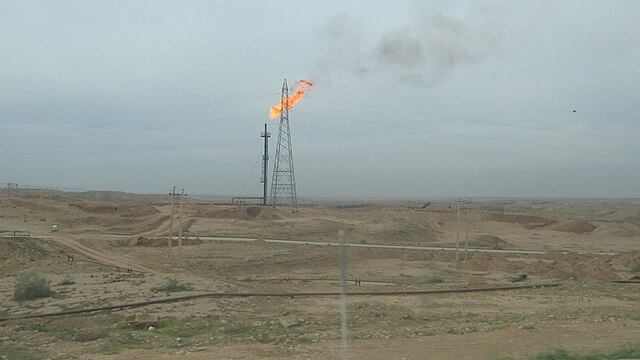
Iran’s Strategy in the Current War
As the war on Iran continues to expand across multiple fronts, Tehran appears to be pursuing a complex strategy that combines military escalation, economic leverage, domestic mobilization, and diplomatic signaling.
Rather than relying on what Iranian officials once described as “strategic patience,” the current approach suggests that Iran is attempting to fundamentally reshape the battlefield by increasing the costs of the war for the United States, Israel, and any regional actors that choose to participate.
The strategy appears to rest on several interconnected pillars designed not only to respond to military attacks but also to prevent the broader objective that Iranian leaders believe lies behind the war: regime change.
Overwhelming the Battlefield
The most visible element of Iran’s strategy has been its attempt to expand the battlefield geographically and operationally.
Rather than focusing solely on Israeli territory, Iran has targeted a wide range of US and allied assets across the region. These include military bases, intelligence facilities, radar systems, and logistical infrastructure that support American operations.
The aim appears to be twofold.
First, Iranian strikes are intended to impose a form of “strategic blindness” on opposing forces by degrading radar systems, surveillance networks, and early-warning capabilities. Such attacks reduce the ability of the United States and Israel to monitor Iranian movements and respond effectively to missile launches or other military operations.
Second, by targeting US bases in multiple countries across the region, Iran is sending a clear message that the conflict will not remain geographically contained.
In practical terms, this means that any country hosting American military facilities risks becoming part of the battlefield.
Iranian officials have repeatedly emphasized that these strikes are directed at US military infrastructure rather than the sovereignty of host nations. Nevertheless, the message is unmistakable: if regional territory is used to launch attacks on Iran, that territory may also become a site of retaliation.
This approach reflects a major shift away from Iran’s previous policy of measured responses and limited escalation.
Instead, Tehran appears to be pursuing a strategy designed to overwhelm the enemy on multiple fronts simultaneously, raising the political and military cost of continuing the war.
Economic Warfare
Alongside its military operations, Iran is also leveraging one of the most powerful tools at its disposal: the geography of global energy supply.
The Strait of Hormuz—through which roughly a fifth of the world’s oil supply passes—has effectively become a war zone. Although Iran has not formally declared a blockade, the conditions created by the conflict have produced a functional shutdown of the waterway.
Missile exchanges, naval deployments, maritime attacks, and the growing threat environment have drastically reduced the willingness of commercial shipping companies to operate in the area. Insurance costs for tankers have surged, while several shipping operators have suspended or rerouted voyages altogether.
In practice, this means that the strait is not closed by decree but by the realities of war.
This distinction is important. Iran does not need to announce a blockade to achieve the strategic effects of one. The instability itself disrupts energy flows, drives oil prices upward, and injects uncertainty into global markets.
The consequences are felt far beyond the Gulf.
European economies—already weakened by energy shocks following the war in Ukraine—are particularly vulnerable to renewed volatility in oil and gas markets. Rising shipping costs, supply disruptions, and market speculation all compound the economic pressure.
For Tehran, this dynamic serves as a powerful form of indirect leverage.
The longer the war continues, the greater the economic consequences for the global system that underpins Western power. In this sense, the Strait of Hormuz functions not merely as a geographic chokepoint but as a strategic pressure valve capable of transmitting the costs of the conflict far beyond the battlefield.
Domestic Cohesion
Another key pillar of Iran’s strategy lies within the country itself.
Western analysts had widely speculated that sustained military pressure—or a leadership decapitation strategy—could produce internal instability or even trigger a political crisis within Iran.
The killing of senior political and military figures, including high-ranking officials, appeared to be designed in part to create such a vacuum.
Yet the anticipated fragmentation has not materialized.
Instead, Iranian authorities have focused on projecting unity and political cohesion. Mass rallies and public demonstrations have taken place across multiple cities, with large crowds gathering in public squares to express support for the government and condemnation of the attacks.
These displays serve an important political function.
By filling public spaces with supporters, the government is attempting to pre-empt the emergence of alternative movements that might claim to represent a popular response to the war.
In effect, the strategy denies external actors the ability to argue that military intervention is intended to support domestic opposition or restore democratic governance.
For Washington and Tel Aviv, the assumption that internal unrest could become a decisive factor appears to have been a significant miscalculation.
Calibrated Diplomacy
Despite the widening military confrontation, Iran has also sought to maintain a careful diplomatic balance with Arab governments.
Iranian officials have repeatedly emphasized that their strikes are directed at US military installations rather than the countries that host them.
This distinction is important.
Tehran’s broader objective appears to be preventing Arab states from becoming full participants in the conflict. While warning that any government enabling US military operations could face retaliation, Iran has simultaneously signaled that it does not seek confrontation with the region as a whole.
The message to Arab governments has therefore been dual-layered: do not allow your territory to be used for attacks on Iran, but if you avoid direct involvement, Iran does not consider you an enemy.
Such messaging reflects Tehran’s understanding that regional alignment could dramatically reshape the war’s dynamics.
Strategic Weaknesses
Despite the coherence of Iran’s overall approach, several weaknesses remain.
One of the most significant challenges lies in the realm of communication.
Iranian media outlets, operating under heavy pressure and frequent targeting, have struggled to project their narrative effectively to global audiences. Compared with the sophisticated international media infrastructure available to Western governments and Israel, Iran’s messaging often fails to reach wider international publics.
This limits Tehran’s ability to frame the conflict on its own terms.
A second challenge concerns the global anti-war movement.
While protests against the war have emerged in various cities around the world, they have not yet reached a scale capable of exerting decisive political pressure on governments supporting the conflict.
For Iran, the expansion of such protests could become a critical factor in constraining the military options available to Washington and its allies.
A War of Strategy
Taken together, Iran’s actions suggest a leadership attempting to wage war according to a clearly defined strategic framework.
Military escalation, economic disruption, domestic mobilization, and diplomatic signaling all appear to function as parts of a single integrated approach designed to raise the cost of the conflict beyond what its adversaries may be willing to bear.
Whether the strategy ultimately succeeds remains uncertain.
What is increasingly evident, however, is that the war is evolving into a contest not only of military capabilities but also of strategic coherence.
For now, Iran appears to be operating according to a calculated plan, while its adversaries continue to search for a sustainable path forward in a rapidly expanding conflict.
Dr. Ramzy Baroud is a journalist, author and the Editor of The Palestine Chronicle. He is the author of eight books. His latest book, ‘Before the Flood,’ was published by Seven Stories Press. His other books include ‘Our Vision for Liberation’, ‘My Father was a Freedom Fighter’ and ‘The Last Earth’. Baroud is a Non-resident Senior Research Fellow at the Center for Islam and Global Affairs (CIGA). His website is www.ramzybaroud.net

No comments:
Post a Comment