It’s Israel, Stupid!

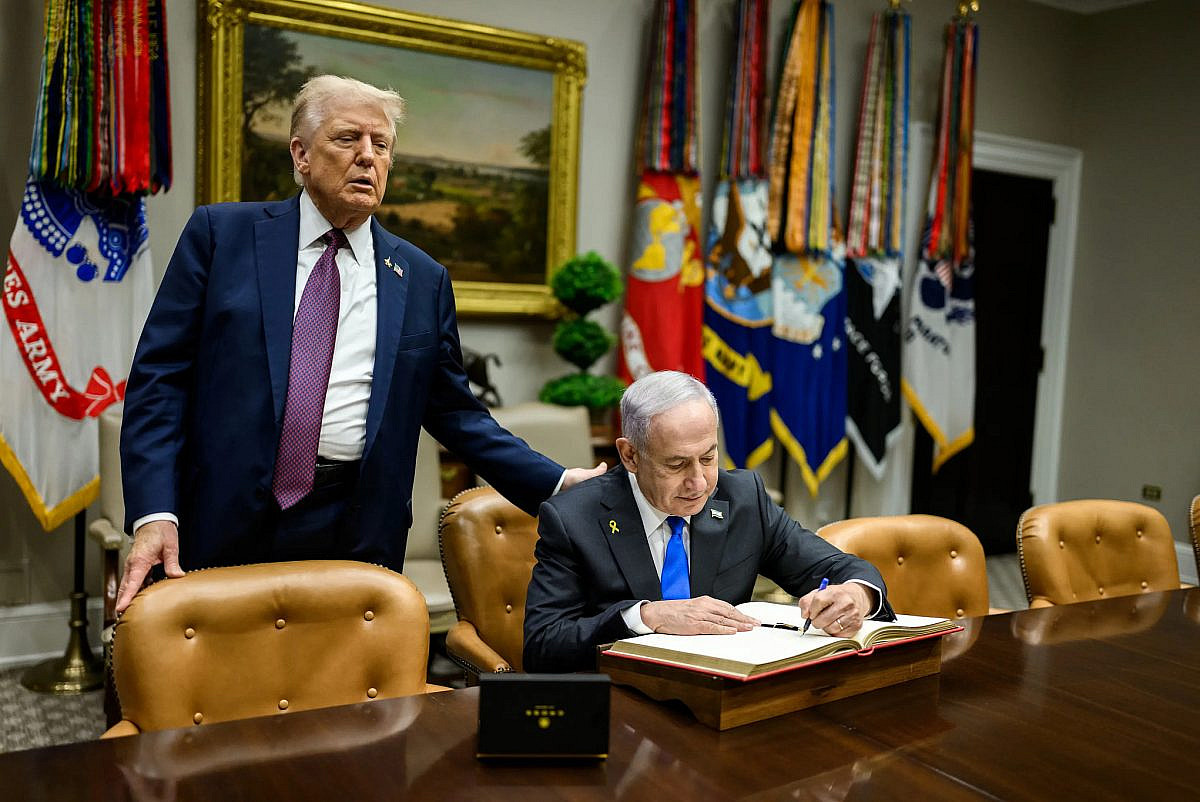
Photograph Source: The White House – Public Domain
The second US war on Iran in less than a year has raised a burning question in popular media: What is the rationale for the war and why is it changing? Is it because negotiations with Iran over its nuclear program were not progressing? Is it because Iran was close to developing nuclear weapons? Is it because Iranian ballistic missiles were going to reach the US soon? Is it because Israel was going to attack Iran and the US took pre-emptive measures to ensure the safety of Americans? Is it because the Iranian government was violating human rights? Or is it something else? The press in the US has not been able to make sense of this changing justification. But this is curious. Was the media asleep over the past few decades?
A quarter of a century ago, I delivered a presentation on US foreign policy towards Iran at an economics conference. My presentation concluded by stating that US policy in the Persian Gulf region had been a series of “regrettably shortsighted policies,” borrowing a phrase from former US Secretary of State, Madeleine Albright. I argued that these policies had served to prolong the life of the theocratic government in Iran. I believed that without the constant threat of foreign enemies, this government would have had no one to blame for its social and economic problems but itself.
In my paper, I outlined how Israel and its lobbying groups in the US were the primary architects of US policy. I explained how they had developed three justifications, or “sins” as I referred to them, to justify punishing Iran:
1) the proliferation of weapons of mass destruction,
2) support for “terrorism,” and
3) opposition to the Oslo “peace process” between Israel and the Palestinians.
However, I contended that Israel’s true objective had always been to overthrow the Islamic Republic, a goal now commonly known as a “regime change.” The rationale behind this objective was that Iran and Iraq were the only two countries in the Middle East that posed a barrier to the creation of Greater Israel (Eretz Yisrael), which was intended to encompass the West Bank, Gaza, and potentially more.
The conference paper was published as an article in an economics journal and, later expanded into a two-volume book. In the book I discussed the original three sins and noted that Iran’s opposition to the Oslo peace process was eventually abandoned as Israel itself moved away from the process. However, over time more sins were added to the remaining two. I referred to it as a “menu option” for overthrowing the Iranian government. For instance, the neocons in the George W. Bush Administration expanded the menu to include accusation of Iran destabilizing Afghanistan, harbouring Al-Qaeda, lacking democracy, being ruled by unelected individuals, violating human rights, not protecting the rights of women, not being forward-looking and modern, etc.
I also argued that the neocons had used a menu option to attack Iraq as well, even though Israel was pushing them to attack Iran instead. But they could not get Bush, an intellectually challenged president, to go along and bomb Iran. Afterall, before attacking Iraq Bush had visions of talking to God.
As I have written in my academic works, and in CounterPunch, Netanyahu, Israel’s chief devil incarnate and the butcher of Gaza, did not take no for an answer and kept pushing every US administration to attack Iran. He had no success, until a deranged man, surrounded by conduits for Israel, including his son-in-law and a real estate friend, took control of the US government.
A man who to this day, cannot even pronounce the name of the Iranian general he ordered to be assassinated in 2020, or the name of the “supreme leader” of Iran whom he helped to be murdered in 2026, finally did what Netanyahu wanted to be done: attack Iran on behalf of Israel. The first attack, as I wrote in my July 2025 essay for this journal, did not accomplish Netanyahu’s goal of a “regime change” and restoration of monarchy in Iran. So, Netanyahu kept up the pressure. He visited the White House multiple times since July 2025 to plan death and destruction in Iran.
By now, as many astute observes have noticed, the goal post had shifted to include not only “regime change” but the disintegration of Iran, something that Israel had toyed with previously, as I had argued in my works. Separating Kurdistan, and possibly Baluchistan, Azerbaijan, Khuzestan, etc., from Iran would ensure that there would be no country in the region that could spoil the dream of Greater Israel.
The madman in the White House, as well as his CIA, soon followed the advice of the Israeli butcher and scrambled to foment an uprising in Kurdistan, a cruel game that has been played on Kurds many times before, including in Iraq and Syria. But this time, the Kurds did not fall into the Israel-US trap, and the idea appears to have been scrapped. So, for now, the madman in the White House and his blood thirsty friend in Jerusalem continue to kill and destroy everything in sight in Iran. What comes next, as this essay is being written, is beyond prediction. When madmen are on the loose, anything can happen.
So, if you don’t already know, the US attacked Iran for one reason and one reason only: Israel. Israel, that Frankenstein monster created by the US and Europeans, has been urging the US for decades to wage a destructive war against Iran. The Israelis have finally achieved their desired outcome. If you think this is an exaggeration, just listen to Netanyahu one day after the second attack on Iran:
We are in a campaign in which we are bringing the full strength of the IDF to the battle, as never before, in order to ensure our existence and our future. But we are also bringing to this campaign the assistance of the United States, my friend, US President Donald Trump, and the US military. This coalition of forces allows us to do what I have yearned to do for 40 years: smite the terror regime hip and thigh. This is what I promised – and this is what we shall do. (Statement by PM Netanyahu – 1 March 2026)
All the other justifications that have been given are pure nonsense. Iran does not have a nuclear weapon and does not even have a plan to develop one. According to the US’s own intelligence community, Iran halted its nuclear weapons program in 2003. In recent years they enriched uranium to nearly 60 percent as a bargaining chip to remove stifling sanctions that had been imposed on the country for more than four decades by the US and its European partners. They tried repeatedly to reach an agreement with the US to limit the level of enrichment and dilute their highly enriched uranium in exchange for sanctions relief, but to no avail. Iran also does not have ballistic missiles that can reach the United States. Iranian missiles can at best reach Southern Europe.
Thus, Iran does not pose a threat to the US with either nuclear weapons or ballistic missiles. Yes, the Islamic republic is brutal when it comes to dissent. But the most brutal force and the greatest purveyor of violence in the world today is Israel, and the US is not far behind. It is hard to believe that these forces would ever worry about dissidents in Iran. Afterall, the US and Israel had no objection to the violation of human rights by the Shah’s regime prior to the 1979 revolution.
I concluded my presentation in 2001 by stating that the US’s “regrettably shortsighted policies” were only serving to prolong the life of the theocratic government in Iran. It appears that after a quarter of a century, we have moved beyond shortsighted policies into the realm of insane and criminal policies. Regardless of how one labels the US policies, the outcome has been to ensure the longevity of the theocracy in Iran. Consider this: an 86-year-old “supreme leader” was succeeded by his 56-year-old son, a scenario that would have been unlikely without the actions of the madmen in Washington and Jerusalem!
Why I’m Fed Up With Zionism
March 13, 2026

Photograph by Nathaniel St. Clair
I’ve never cared for Zionism. I’ve always considered Zionists later day Pilgrims: obnoxious, strident, unpleasable, and desperate to find a country on which they could inflict their particular brand of self-absorption.
Correction, I meant a second country. For good or ill, Zionists have imposed their worldview on the United States since the day Harry Truman took a meeting with Eddie Jacobson. And perhaps I’m being unfair to the Pilgrims. At least they conceded that native Wampanoag existed on the land attached to Plymouth Rock, whereas Zionists would’ve declared the land people-free. An approach which streamlined the process of dividing the Palestinians of Palestine into terrorists and corpses.
Until very recently, these were the kind of thoughts a Gentile kept to himself. On Israel, he confined his views to Love it or Fund it, lest he run the risk of being called an antisemite.
It’s easy to be called an antisemite. Especially since no leading Jewish organization seems to know what antisemitism is – current definitions conflate religion, ethnicity, and nationhood into an amorphous trinity intended to stigmatize any act or utterance which hinders arms shipments.
But an amazing thing is happening. More and more, Jews and Gentiles alike are realizing that if Israel is “a light unto the nations” the primary glow is coming from incendiary fires caused by American 2000 pound bombs. So as someone whose first “antisemtic” Op-Ed was published in The Philadelphia Inquirer more than a quarter century ago, I think I have some useful thoughts to offer now that Trump’s Honest Brokerage and its chosen people are once again smiting everything in sight.
To begin with, I am not a “Jew hater”. I hate specific Jews for the specific reason that they attempt to wield their Jewishness to either close off candid conversation regarding Israel, or give hogwash divine sanction. Also, I did not set out to be labeled an antisemite. It’s just that, as a satirist, I’ve always considered unacknowledged hypocrisy to be the wellspring of biting satire… Israel did the rest.
But I had to put in the work and educate myself. I had to read the Bible and histories of the Ancient Near East. I had to learn about Herzl and the Balfour Declaration and the Irgun and the Stern Gang and the Nakba. For events like Sabra and Shatilla and both Intifadas, I was old enough to have experienced the news coverage in real time. Then too, I was fortunate to casually know the late great Gore Vidal, whose work was a major influence.
And as a fellow “antisemite”, I’d like to think Gore would agree with the following observation regarding how Israel is treated by the United States. Namely that – from ambushing the crew of the USS Liberty – to deliberately crushing Rachel Corrie beneath an armored bulldozer – to remorselessly slaughtering the women and children of Gaza – no other nation on earth has garnered unlimited weaponry and a lenient press by combining pathological savagery with pleadings of victimhood.
The world is an unjust place. If it weren’t, Benjamin Netanyahu’s only concern would be how to conceal a cyanide capsule in his navel to cheat getting hanged by the neck until dead while the desiccating carcass of Joe Biden rotted in an adjacent cell. The Congress would not be AIPAC owned and useless, with pro-Israel platitudes dripping from lips and shekels bulging from pockets.
Above all, an honest examination of Israel’s press coverage would penetrate journalism’s holy of holies – the editing room. Tangible, discussable views would no longer be summarily dismissed as tropes, double standards and blood libels. Accuracy would be granted a moment.
For if it’s antisemitic to say rich Jews control the media, it’s accurate to say a Zionist billionaire sold Paramount literally so she could devote more time to Israel. That Paramount was bought by a Zionist billionaire who turned it over to his son, who immediately hired a reactionary Zionist millionaire to run CBS News. Meanwhile, the Zionist father and son purchased WarnerBros.Discovery, thereby guaranteeing run-of-the-war docility at CNN and job security for Dana Bash and Jake Tapper.
If it’s antisemitic to say Jewish opinion is monolithic, it’s accurate to say that on March 1st and 2nd the Opinion page of The New York Times was occupied by Bret Stephens, Thomas Friedman and Ben Rhodes. That respectively, they provided readers with the maniacal Zionist, militaristic Zionist and milquetoast Zionist rationale for the unprovoked war with Iran. All were content to see what happens after lots of innocents died, and the basic preconception of a nuclear-armed Israel’s perpetual right to exist without defined borders or a constitution went unchallenged.
A piece like this is a vanity project. It solves nothing. It’s a despairing shout into a void best described by Jean Renoir: “The awful thing about life is this: Everyone has their reasons.” Words seem worthless in times of madness, and today’s madness is uncharted. Humanity is precariously balanced between possibility and the Iron Age, and the greatest negative weights on the scale are not Jews – who comprise less than 3% of the population of the United States – but Donald Trump and Christian Zionists.
Yet perhaps the least we can do is cling to two truths, one factual, the other biological, through which we may, even now, summon common sense: Nowhere in the annals of recorded history has killing people resulted in the subservience of their surviving relatives; and eventually every last one of us, not just Iranian Revolutionary Guards, face certain death.
Everyone in This Country Has Gone Insane

Israel, 2026: Not a single voice of reason to be found among the pundits, politicians and general public, who all run to the shelters on an hourly basis but smile when they emerge, praising the Iran war and the blessings it brings. It almost makes you miss 1967
Where was it determined that wartime is also a time for stupidity? Who wrote that when the cannons roar, the muses are not only silent but ought to be ashamed? It’s been a long time coming, but what has happened to the public discourse in Israel this week is shattering all record lows.
It is impossible not to miss the victory albums and the songs of glory of 1967. “Nasser is waiting for Rabin, ay, ay, ay” is subtle compared to the garbage today. And who would have thought that we would miss, “Oh Sharm el-Sheikh, we have returned to you again.” Today, it’s “Finally we’ll be able to live free, finally we’ll be able to breathe, Israel is free, Iran is free, everyone hears the roaring lion, Hallelujah to the air force, Hallelujah to the army … You’re our great pride” (lyrics by Pnina Rosenblum).
Except we are not just talking about songs, but the public and media discourse. Ultanationalist, we’re used to it already; militaristic, that’s normal too. Everything is right-aligned, there is no room for doubt, for opposition, for question marks or anything less than respect and praise for the Israel Defense Forces – that’s also a characteristic of wartime. Silence – we’re shooting. Only patriotism in the TV and radio studios and on social media. What’s different this time is the level of the discourse, or, we should say, its unfathomably low level – never before has it been so hollow, cliched and stupefying.
A former soccer player is considered the voice of wisdom, a military-police officer the voice of morality. Every Persian Jew is a pundit. To the sock puppets otherwise known as military correspondents and their peers covering foreign affairs, who have also joined the chorus, a new cadre of analysts has been added, a type that never before filled the airwaves and social media so densely and with such exclusivity; barrages of brainwashing the likes of which have never been seen here before. That’s how it is after two and a half years without real journalism, without even minimal coverage of the war in Gaza.
Try to find even a single voice of reason, someone with something to say, who actually knows something. Not a one. For Purim, media personality Avri Gilad is an air force pilot, and the children’s entertainer Yuval Shem Tov sings in Farsi. Everyone is so gleeful: Why? Or maybe it will all end in tears. It’s unacceptable even to raise the possibility. The orgy of assassinations is in full swing, every hit a cause for celebration.
In journalist Sharon Gal‘s studio, the party is in full swing: Israeli arms sales will reach new heights, and everyone is buzzing in delight. “Assembly lines all over India. … We took India. … We need 1.4 billion Indians to manufacture for us.” What a promising, new world this war will open for us. Now it isn’t only about the redemption of the land but about money, lots of money.
The incitement knows no bounds. A protester passing a TV broadcaster at breakneck speed is a national scandal that requires severe punishment. A settler who kills two farmers elicits nothing but a yawn. A tiny European donation to a human rights organization is depicted as foreign interference in state affairs. An attempt to overthrow a regime in a foreign country by bombing it is a legitimate democratic move. How far will we go?
Any desperate attempt to hear even one intelligent voice is doomed to failure. While intelligent discussions about the war are taking place on foreign networks, here only stupidity and ignorance speak. While there, they are telling what is really happening in Iran and Lebanon; here, they are reporting from a wedding in a parking lot – unending nonsense is the main point, without substantive discussion. This is how the stupidity of the masses spreads like a radioactive cloud, destroying everything in its path.
It could get worse. Watch U.S. President Donald Trump’s “spiritual adviser,” who was appointed head of his “White House Faith Office.” An evangelist for holy war: “I hear the sound of victory. I hear the sound of shouting and singing. I hear a sound of victory. The Lord says it is done. I hear victory! Victory! Victory!” she screams in ecstasy. Soon it will be here.

Let’s Talk About Israel’s War Crimes
On the Warpath
Here is a conundrum. While stock exchanges across the world react nervously to the onslaught on Iran, the Tel Aviv Stock Exchange is booming. Here is another: while millions of people in the region dread the US-Israeli military operation and its consequences, Israeli society is jubilant. According to the latest polls, 93 per cent of the Jewish population support the war. Writing in Yedioth Ahronoth, one journalist captures the euphoric mood:
While we are getting rid of the monstrous Iranian Octopus, I walk down the street, the shops are open, Wolt couriers are rushing to deliver sushi, shawarma and overpriced chocolate cakes to Israeli citizens, people are jogging in the park, and at home I have electricity, hot water and internet. The Pilates studio is open, and the Israeli stock exchange is breaking records. And at this very moment, over my head in the lowlands, Air Force fighter jets take off for another sortie . . . They destroy with impossible precision another home of a mid-ranking officer in the Revolutionary Guards . . .
This is what the most critical war since the founding of the state looks like? This is what it looks like because the State of Israel is a miracle that cannot be explained.
He goes onto suggest that Israel has the great leadership of Netanyahu to thank, along with the exceptional qualities of its people and divine assistance. In Israel Hayom, another prominent journalist offers another jingoistic encomium to Israel’s Prime Minister. Even Netanyahu’s detractors must admit that he is possessed of ‘patience, cunning, determination and unwavering focus’ in his steady destruction of the enemy – total war on Hamas, then Hezbollah, now Iran – and curtailment of Trump’s foolish attempts to negotiate with the Mullahs and devise a peace plan for Gaza.
The strategy certainly seems to be one shock and awe campaign after another. Iran is currently in the crosshairs, but the message is directed at all Middle Eastern states: do not dare challenge Israel’s bid for regional hegemony or ethnic cleansing of Palestine. Achieving the first would give Israel the immunity it needs for the second: rectifying the mistake the historian Benny Morris lamented when he criticized Ben Gurion for not expelling all the Palestinians in 1948. As Bezalel Smotrich said to Palestinian members of the Knesset in 2021, ‘you are here because Ben Gurion did not finish the job’. In the eyes of the government, and the political elite in general, the moment seems to have arrived to finish the job.
This marks a break from the pre-state Zionist strategy and then Israeli regional policy, which was based on covert operations combined with crypto-diplomacy. I am often asked whether the current war is aimed at implementing what is known as the Yinon Plan. Oded Yinon was an adviser to Sharon, and in 1982 he co-authored an article outlining a strategy of divide and rule of the Arab world. Sectarianism serves Israel well, he argued, and should be promoted. This was at the time when Sharon sought to sow division in the ranks of the Palestinian resistance, including by encouraging Islamist forces in Gaza. When that failed, Sharon launched a direct assault on the PLO in Lebanon, which was widely criticized in Israel as a strategic mistake. The recent news about an attempt to facilitate a Kurdish land invasion from Iraq to complement the aerial bombardment of Iran may seem to confirm that these tactics are still in operation. But this is not the case. The old strategy was far less dramatic: clandestine intervention in the domestic politics of other states is not policy that is boasted about; nor is it based on dragging the region into a war.
Evidently, this is no longer the modus operandi of the state of Israel. Ironically, the best interpretative schema here may be that which orientalists have typically applied – not always very accurately – to the Islamic Republic: that this is a power not acting according to a ‘Western’ rational and humanist approach to politics but a fanatical ideology. Those determining the present Israeli strategy are explicit about its roots in the teaching of messianic Zionism and their vision of the present war as divine fulfilment. Netanyahu may be less ideological than his allies, and more narrowly concerned with his own political survival, but there is little doubt he accepts his glorification as both a strategic genius and messenger of God. For this camp, Israeli society itself needs to become far more theocratic. It is not yet, laments Smotrich, the ‘state of the Cohanim’, but is on its way to being ruled by a harsh biblical version of the Halachic law: ‘The State of Israel, the country of the Jewish people, with God willing, will go back to operating as it did in the days of King David and King Solomon.’ Much of the government’s domestic legislation is devoted to pursuing this end. Second, there is a need to resolve the Palestine question. Gaza is the model. Smotrich again: ‘There are no half-measures. Rafah, Deir al-Balah, Nuseirat – total destruction. “Thou shalt blot out the remembrance of Amalek from under heaven. There is no place for them under heaven.”’
Speaking in October 2024, Smotrich declared that ‘once in a generation, there is a rare opportunity to change history, to change the balance of power in the world and reshape the future. Soon we will have to take fateful decisions that will lead to a new and better Middle East.’ For most Western political commentators, messianic proclamations – unless by Islamists – sound irrelevant to politics. But these are not hollow statements. This is a worldview that now dominates both the political and military establishments, which provides the underpinning for much of the present jubilation and unconditional endorsement by the media. The war against Iran is also supported by those with a more secular – and allegedly more rational – approach to politics, in the Mossad and academia, as well as the only politicians who can potentially defeat Netanyahu in October’s elections, Avigdor Liberman and Naftali Bennet. The justification is that Israel had to act because it faced an existential threat – a claim as plausible as Colin Powell’s justifications to the UN of the invasion of Iraq. Even more absurd is the argument that a state which systematically violates the rights of the Palestinians is fighting a war for the sake of human rights.
Judged from an economic perspective, despite the exuberance of the Israeli stock market, the course of the Israeli state is highly questionable. It costs a great deal of money – two billion NIS a day in direct expenditure and five to six billion indirectly – and will require significant continued American financial aid. The government’s logic is that this will be balanced by the economic dividends: sky-rocketing profits from arms sales, now that cutting-edge Israeli weapons are being showcased on the battlefield, not to mention the prospect of Iranian oil reserves and greater access to those of the Gulf states, as they come to realize they need Israel’s protection. Yet there is no certainty this will make up for the financial strain; the same goes for money spent on settlements and the promotion of messianic Judaism in lieu of healthcare and other social priorities.
There are further reasons why Israel will struggle to pursue its strategy over the long term. Campaigns like this in the past were abandoned the moment they faced difficulties. Loss of American life, pressure from other countries in the region, public opinion in the US, the potential resilience of the Iranian regime and continued resistance of the Palestinians may all shift the balance. An invasion of Lebanon, judging by past attempts, will benefit no one. Much depends on the global coalition that fortifies Israel’s wars: the arms industry, multinational corporations, megalomaniac leaders of powerful states, Christian and Jewish Zionist lobbies, the timid governments in the global north as well as corrupt Arab regimes in the Middle East. What is certain is that before this fiasco ends, Israel will inflict a great deal of suffering – on the Iranians, the Lebanese and the Palestinians.


No comments:
Post a Comment