Where’s The Resistance To The Iran War?

A majority of Americans already oppose the war in Iran, but the bombs won’t stop until public opinion is converted into real pressure.
Like many of you, I’ve spent the last week hyper-anxious, refreshing feeds, trying to stay level-headed. Except this time — unlike the many other wars started or supported by the United States — I have family in the central firing zone. I’ve encountered images of explosions and chaos and tragedy that I can’t unsee, on streets I’ve walked. Some of it from videos sent by family, filmed from their balcony. It’s awful, it’s real, and it’s here.
A majority of Americans opposed the war in Iran before the U.S. first attacked — nearly 60 percent of Americans disapprove. That’s never happened at this scale with a major U.S. military operation. For context, the Iraq invasion in 2003 launched with 72 percent public support. Afghanistan in 2001 had 90 percent. In Europe, majorities in Spain, Germany, Italy and the UK also oppose the strikes on Iran. The opposition is there, and it’s strong.
So why isn’t there more pushback? The first “day of action” during the war drew small numbers in most U.S. cities. London managed 50,000, which is an OK figure. But compare that to the million who marched against Iraq in 2003. The raw material for opposition exists — but it’s not converting into pressure.
What could be blocking that conversion? Three things: narrative, organization and the conditions organizers are working in.
Narrative
With Iran, the usual antiwar frame doesn’t stick. This is a messaging problem that movements haven’t solved.
Recall that Trump’s central justification for attacking Iran was the regime’s killing of thousands of its own protesters in January — a massacre Khamenei himself acknowledged, even as he blamed it on foreign agents. That gave this war a human rights framing that was more immediate than Iraq in 2003.
Holding two ideas at once — that the regime is brutal, and this war is illegal and catastrophic — is a tension movements need to learn to communicate. It shouldn’t be hard, but right now it is. The frame that’s winning is, as ever, the simpler one: Bad regime gets what it deserves. Until the antiwar side finds language that holds both truths without collapsing into either, the other side’s story wins by default.
Also, to Western audiences, Iran is not a sympathetic state. Much more than Iraq, the regime carries decades of baggage in Western public memory — the U.S. hostage crisis, Salman Rushdie and proxy wars. When London’s antiwar marchers get headlined as “pro-Iranian protesters,” you can see the trap in real time. Movements, especially those led by values-first thinking, are particularly vulnerable to this.
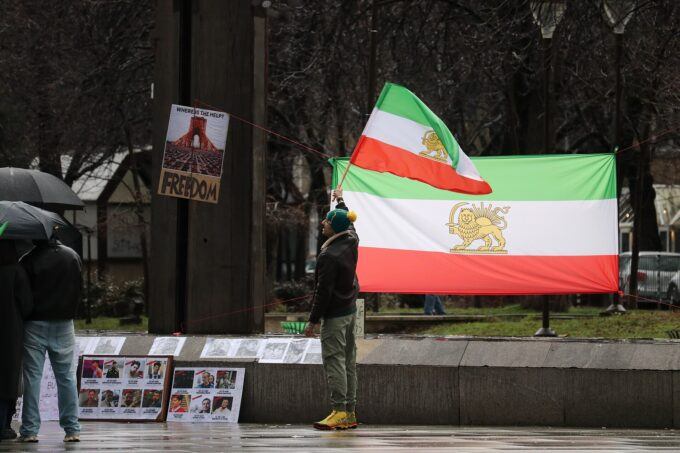
And unlike Gaza — where the Palestinian diaspora was unified against the military campaign — the Iranian diaspora is split on the strikes. Celebratory rallies drew hundreds of thousands in Los Angeles, Toronto, and Munich. That deprives the antiwar movement of a constituency that normally provides moral authority, and emotional urgency: people outside the country who know it, love it and are personally invested in its future.
This is a structural problem. It’s much harder to run a “hands off Iran” campaign when the community you’d expect to anchor it is often waving American (and sometimes Israeli) flags.
Organization
There is no infrastructure to turn opposition into action — on either side of the Atlantic.
In America, the antiwar grassroots that opposed Iraq never really regained its footing after Obama’s election. In Europe, the left lost ground electorally throughout the 2010s, and never rebuilt equivalent capacity in the street.
The Democratic Party — leaderless, without a narrative and often indistinguishable from the Republicans on foreign policy — offers no vehicle. Europe’s scattered left parties are in no shape to amplify what opposition does exist. Antiwar sentiment is real, but there’s no machinery to convert it into coordinated pressure.
And because Trump has sidelined international institutions, there’s no U.N. process to rally people around. Remember 2003: the fights over Security Council resolutions, weapons inspectors, the drama of institutional resistance? That gave organizers a focal point. With Iran, the U.S. has short-circuited all of that.
This isn’t specific to Iran, by the way. Trump has ordered strikes on seven countries since returning to office — Yemen, Syria, Iraq, Nigeria, Venezuela, Somalia, Iran — and faced no serious domestic opposition for any of them. Venezuela drew scattered protests in a handful of U.S. cities; Nigeria drew none at all. Neither generated sustained pressure or shifted the debate. Iran just makes the gap impossible to ignore.
Conditions
Several things are actively suppressing an activist response.
Much of the antiwar argument is framed in moral terms: international law, justice, solidarity. Those matter. But they don’t always translate into widespread mobilization when the war feels distant from daily life. When wars start to affect people materially — through conscription, prices, jobs, cuts to public spending — opposition tends to move from opinion into pressure.
Without consequences at home that people can feel, most people don’t have skin in the game. That’s not a moral judgment, it’s a structural one. And organizers need to factor it in. Every other condition holding activism back lands harder because of this.
Like the speed at which the war came about. Iraq was telegraphed for months. There was a vote in Congress and months of media build-up, which meant time to organize. The Iran strikes landed as a surprise to most people on a Saturday morning.
Yes, U.S. forces had been encircling Iran since January. But the fact that negotiations were happening made it look like leverage. This meant organizers were behind before they started.
Also, years of Gaza solidarity — marches and the largest student protest wave in a generation — produced a lot of energy and passion. But they didn’t shift policy. That reality has hit activists hard. “What good would it do?” is a feeling I keep hearing. When there’s no connection between effort and outcome, motivation can easily drain away.
I can’t discount the establishment’s repression of Gaza organizing, either. The ongoing de-banking, cancellations, criminal charges, police violence, all of it. Indications suggest it has had a chilling effect — on campuses, in the media and on the street. I’ve heard this from several organizers: People are scared to act. These authoritarian tactics work. I hate it, but I have to acknowledge it.
Another big factor is issue overload. Just look at 2026 alone: In the U.S., ICE raids and mass deportations; federal program cuts, including Medicaid; Gaza and Venezuela. The antiwar movement competes for the same finite pool of organizers. No sooner have you been outraged and figured out what to do, than the next outrage arrives. There’s no coming up for air.
And conflict has, scarily, become normalized. As mentioned, the U.S. has struck seven countries in just over a year. There’s a numbness to U.S. military intervention that didn’t exist even a decade ago.
So what can we do?
The real question to me isn’t why people aren’t in the streets. It’s what will it take to convert poll opposition into power? Here’s what I’m holding onto:
Spain. Unlike any Western government during Iraq, Spain has condemned the strikes as an “unjustified” and “dangerous” military intervention, refused to let the U.S. use its military bases, and held firm when Trump threatened to cut all trade. That’s not rhetoric; it’s material resistance at the state level. The kind of concrete refusal that organizers can point to, build on and demand from other governments.
Contrast that with the U.K., where Prime Minister Keir Starmer initially refused to allow the U.S. to use two of its bases, then reversed himself within 48 hours, reframing this decision as a “defensive” measure. That’s the default European pattern: concern, then compliance.
Spain is the exception. The question for organizers is how to make the exception the rule.
And there’s this: The material conditions argument cuts both ways. As the war drags on, its costs will land at home — oil prices are already climbing, and the U.S. is spending an estimated billion dollars a day. It’s only a matter of time before that starts competing with domestic spending.
When the war stops being abstract and starts showing up in people’s lives, everything can change. That’s when opinion starts converting into pressure.
A version of this article first appeared on Subvrt.
Why We Only Hear Iran Diaspora Voices Who Want War
Photograph Source: DemieK07 – CC BY-SA 4.0
In coverage of the war against Iran, a familiar choreography is playing out again, one that the media have carefully refined to exploit the perceived credibility of diaspora groups in order to push war and empire. This phenomenon of selectively and specifically amplifying diaspora voices who will cheerlead for war is now a well-documented feature of the American media ecosystem. For months in the lead up to this new illegal and unconstitutional war, high-profile American “news” outlets featured almost exclusively Iranians and Iranian-Americans who argued for regime change through ground invasion, a position arguably even more extreme and reckless than that of Donald Trump.
Major outlets host sympathetic figures with very good reasons to hate the target country and unassailable arguments that its rulers are authoritarian criminals. The Iranian-American social scientist Kian Tajbakhsh falls within this group. A former political prisoner of the Iranian government who was released as part of Barack Obama’s nuclear deal, Tajbakhsh recently appeared on CNN to help make the case for the war from his unique and apparently unassailable position. With respect to Tajbakhsh, having been a political prisoner allows one to make laughably ridiculous statements that others cannot. After insulting the Iranian people by saying that they are too weak to change the fate of their own country unless some major power like the United States helps them, he shifted to insulting the intelligence of the audience by saying that Israel and the U.S. had not started the war: “I don’t think it’s right to say that President Trump has started a war with Iran. I think President Trump wants to finish a war that Iran started in 1979, 47 years ago.”
To begin with, neither of these statements are true. Tajbakhsh conveniently left out the fact that the United States already conducted illegal regime change in 1953, when Washington made a brutal dictator of Mohammad Reza Pahlavi after overthrowing an elected leader, prime minister Mohammad Mosaddegh. Further, it is the responsibility of the Iranian people to rid themselves of the criminal regime in Tehran—or indeed it is no one’s responsibility. It is certainly not the responsibility or, more importantly, the right of the United States to do so. International law still exists. The Constitution of the United States still exists. Tajbakhsh’s thin reasoning would function as a carte blanche for the United States to start wars of choice and choose foreign governments, and in fact these kinds of arguments have operated in precisely this way for generations of imperialists in Washington. Because all governments the world over violate the human rights of their subjects, there is no cognizable upper limit on this kind of reason, no discernible reason why the American government shouldn’t, as Joe Biden put it, run the entire world.
The point is not to pick on Tajbakhsh; he is one among many. For months, the American media has pushed just these kinds of absurd “arguments” for another aggressive and illegal war, none of which care to address the requirements of international or domestic legal standards. American audiences frequently get similar pro-war messaging from the Iranian-American writer Masih Alinejad. Just days ago, after Israel and the U.S. began the war, Alinejad went on Jake Tapper’s show to scold opponents of war for being “allergic to regime change,” invoking the Berlin Wall, as she frequently does in her appearances. Like Tajbakhsh, she has been targeted by the Iranian government and uses a dramatic and personal story to occlude the much larger issues and stakes, and to manipulate unsophisticated American audiences who honestly want freedom for the Iranian people. This whole strategy is only possible due to how little Americans know about the rest of the world.
Reza Pahlavi, the son of ousted Iranian dictator Mohammad Reza Pahlavi, is also a frequent guest of the American broadcast media. Pahlavi also has a personal interest in the United States waging war and conducting regime change in Iran, as he has for years hoped to return to Tehran as a kind of king (he insists that he would be merely a transitional leader). It should be shocking to us to watch the U.S. media repeatedly elevate the voices of figures like Reza Pahlavi, the so-called Crown Prince whom Iranians rightly associate with Western interference in the country and its sovereign interests. We should appreciate that to the media companies that invite them on, the whole job of people like Tajbakhsh, Alinejad, and Pahlavi is to convince Americans, who are largely totally ignorant of Iran and the political situation therein, that another war of choice is not only permissible, but is the correct and morally required path. The “journalists” who promote these views uncritically are committing malpractice and in effect lying to their audiences.
It’s important for Americans to understand that such individuals represent an extremely small minority of the groups for which they claim to speak, and they are chosen to speak specifically because they support American war-making. A consistent majority of Iranians living in both the U.S. and Iran oppose American military action against Iran, even if they oppose the country’s current government. They understand that the costs of war are borne by innocent people, and that aggressive war against the regime is likely to strengthen hard-liners—and unlikely to do anything but convince Iranian elites that the only way forward is to arm themselves with a nuclear weapon. (In recent days, some commentators have recalled reports that U.S. attacks on Libya and the killing of Muammar Gaddafi influenced North Korean dictator Kim Jong Un’s decision to hold onto nuclear weapons for dear life.
The American media have done their best to silence and sideline the anti-war majority. A statement from the National Iranian American Council on February 6, before the U.S. and Israel began their war, put it plainly, “As the pressure campaign for the U.S. to bomb Iran mounts, efforts to silence anti-war voices like NIAC are intensifying.” The NIAC statement is consistent with the views of both the majority of the Iranian diaspora and the majority of Americans: “The Iranian hardliners hate that we consistently condemn human rights violations in Iran. The American hardliners hate that we consistently oppose war on Iran. And both hate us because we have been vocal advocates for U.S.-Iran diplomacy rather than confrontation.” Normal people overwhelmingly want to see diplomacy between governments because they understand that wars are paid for in their blood and that of their friends and neighbors; they also understand that most people anywhere in the world are just struggling to survive and provide for themselves and their families. Throughout history, the pro-war position has always been a minority position that serves the interests of a tiny elite, and the U.S. government (like all modern states) has always been an undemocratic and minoritarian one.
Here, too, parallels to the Iraq war are remarkable and deeply disturbing. Many will recall the parade of Iraqi ex-pats making the case for war and convincing American audiences that the United States military would be welcomed as liberators. Ahmed Chalabi was elevated as an authoritative figure on the situation in Iraq, despite the serious misgivings of many American intelligence veterans. We see all of these dynamics again and again, now in the public conversation about Cuba, in which a small but vocal and influential Cuban-Americans push for regime change on our televisions every day.
Because the U.S. government is not a democracy and isn’t anything like one, this kind of propaganda by cherry-picking is not actually necessary. The president doesn’t even need Congress to go to war, much less the popular masses of Americans. But the ruling class and its increasingly concentrated media conglomerates do certainly want us to share their views, and ultimately they expect us to. The only form of civic duty we as Americans seem to recognize these days is the acceptance and sharing of views given to us by a corrupt and imperialist state and giant entertainment companies. This situation should be unacceptable to a people who call ourselves free, but we can’t see it, much less analyze or comment on it.

No comments:
Post a Comment