
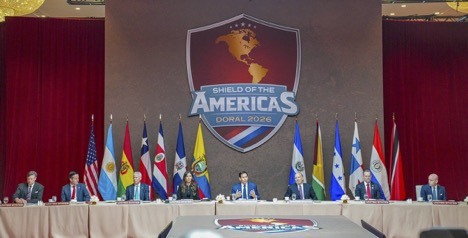
Shield of Americas summit. Photo: State Department.
The “Trump Corollary” to the Monroe Doctrine is a central feature of U.S. strategy designed to secure hegemony and limit Chinese and Russian influence in Latin America and the Caribbean. It does not, however, represent a decisive shift in Washington’s relations with the region. Although the corollary does not make this explicit in its formal statement, in practice it makes more evident what liberal rhetoric has long sought to mask: military and covert interventions aimed at preserving U.S. domination in the Western Hemisphere, undermining progressive movements and governments, and backing right-wing regimes. In this sense, it abandons even the pretense of respect for international law and human rights. In what follows we argue that the Trump Corollary constitutes not only an ideological and imperialist offensive against decolonial currents and multipolar tendencies in Latin America, but also a strategic project whose assault on Venezuela has broader geopolitical implications.
The Ideological Backdrop
Although Washington’s unrestrained militarism, which enjoys bipartisan support, is indeed cause for alarm, the erosion of the pretense of commitment to liberal-democratic values, human rights, and international law did not begin with the Trump administration. The live-streamed Israeli genocide in Gaza, enabled and backed by the Biden administration, has made this difficult to deny. Moreover, the assault on Gaza highlights how the U.S.-European axis has normalized impunity for systematic violence against non-combatants. This erosion of professed liberal values within that axis has helped consolidate a political climate in which the Trump administration could intensify its offensives against Venezuela and Cuba and pursue a war of aggression against Iran.
This normalization of necropolitics can be better understood through the ideological logic used to justify it. We can make sense of this logic by distinguishing between two different tendencies within Western Eurocentric modernity. On the one hand is the myth of European supremacy, what Enrique Dussel calls the “developmentalist fallacy,” which has been used to justify colonization, with its racial hierarchy, since the invasion of Amerindia in 1492. On the other is a rational, emancipatory current rooted in ideas of community, equality, and liberty. As critical historians have shown, these emancipatory traditions did not originate solely in Europe; they were also present among some Indigenous peoples, such as the Haudenosaunee Confederacy, whose Great Law of Peace established participatory forms of government centuries before European contact. Historically, these ideals were never extended fully to colonized peoples, nor to people of color within the metropole. This contradiction persists. Washington’s recent rhetoric justifying attacks on Venezuela, Cuba, and Iran expresses the colonial, violent side of modernity while discarding its emancipatory, humanist dimensions.
Civilizational Rhetoric and the Objectives of the Trump Corollary
It is this myth of European supremacy, often expressed with religious fervor even when stripped of its humanist facade, that serves as the ideological justification for the offensives launched this year. This worldview was crystallized in a speech delivered by Secretary of State Marco Rubio at the 62nd Munich Security Conference on February 14, 2026. That speech anticipated the inauguration in Miami, on March 7, of Shield of the Americas, a new U.S. partnership with right-wing allies in Latin America and the Caribbean, to be led by former Secretary of DHS Kristi Noem. Rubio, in effect, called for a rejection of historical accountability, stating:
We do not want our allies to be shackled by guilt and shame. We want allies who are proud of their culture and of their heritage, who understand that we are heirs to the same great and noble civilization, and who, together with us, are willing and able to defend it. . . . The great Western empires had entered into terminal decline, accelerated by godless communist revolutions and by anti-colonial uprisings that would transform the world and drape the red hammer and sickle across vast swaths of the map in the years to come.
This rhetoric illustrates Rubio’s disdain for anti-colonial struggles that commenced not with the Cold War and communism, but at the very start of the European invasions of Amerindia. Indeed, the “guilt and shame” surrounding the subjugation and exploitation of Indigenous peoples was expressed as early as the sixteenth century, when Bartolomé de Las Casas documented and denounced the tortures inflicted upon them in the name of a European civilizing mission. The same civilizational appeal surfaced again at the Miami summit, where Secretary of Defense Pete Hegseth called upon members of the Shield to defend their shared cultures and, in particular, “Western Christian civilization.” By casting anti-colonialism as an insidious force, Rubio’s rhetoric functions to blunt decolonial critiques of the Trump Corollary.
Despite Washington’s zeal for exporting Western ideals, decolonizing currents in Latin America’s political, economic, social, and cultural life have taken deep root. Since the 1960s, Marxism, along with liberation theology, liberation philosophy, and Indigenous struggles for self-governance, have helped articulate ethical and political critiques of colonial domination, racial hierarchy, and dependent forms of development from the perspective of the Global South. Indigenous cosmovisions and the philosophy of buen vivir have influenced constitutional and political life in the region and beyond. For example, the United Nations now recognizes the concept of the rights of nature as central to sustainable development. The recognition of the rights of Mother Earth has also been incorporated into the constitutions of both Bolivia and Ecuador, and the plurality of Indigenous and Afro-descendent nationalities is recognized in several Latin American constitutions.
The Trump Corollary emerges in direct opposition to these decolonial currents. It seeks to restore U.S. primacy over the hemisphere’s governance and resources by curtailing the region’s expanding commercial and diplomatic ties with China, Russia, and other non-Western partners. To advance this agenda, Washington has worked to destabilize or overthrow progressive governments while favoring right-wing administrations more aligned with its interests, in some cases through intimidation, electoral interference, or direct military intervention. Much like the Alliance for Progress, Operation Condor, and the invasion of Panama before it, this latest evolution of the Monroe Doctrine invokes the pretext of security to reassert Washington’s influence over hemispheric political and economic life while limiting the region’s turn toward greater autonomy. Yet that effort confronts a regional reality that Washington cannot easily reverse. Trade relations transcend political divisions in Latin America and the Caribbean. And in South America, China has become the principal trading partner for much of the subregion. This complicates Washington’s efforts to rein in Latin America’s turn toward multipolarity. China’s Third Policy Paper on Latin America and the Caribbean presents the region as an “essential force” in the move toward a multipolar world and economic globalization, and describes the bilateral relationship in terms of equality, mutual benefit, openness, and shared well-being. This stated approach stands in clear contrast to the Trump Corollary’s posture of coercion, Western supremacy, and geopolitical subordination. It is, in part, this regional turn toward multipolarity that the assault on Venezuela seeks to counter.
Venezuela: The Central Case
The violent reality of the Trump Corollary has been most clearly revealed in Venezuela. Washington’s campaign of deadly strikes against maritime vessels in the Caribbean, a series of extrajudicial killings that claimed the lives of more than 145 people, served as a prelude to the January 3 surprise aerial assault on Caracas, named Operation Absolute Resolve. The maritime victims included people from nations such as Colombia, Saint Lucia, Trinidad and Tobago, and Venezuela who were targeted without public evidence of narco-trafficking or due process. Operation Absolute Resolve itself claimed the lives of more than 120 people, including civilians and security forces, and culminated in the kidnapping of President Nicolás Maduro and First Lady Cilia Flores. In Venezuela, the Trump Corollary deploys military force, coercive diplomacy, and control over strategic resources. It also deals a blow to the Bolivarian cause by making an example of a state that has stood as the leading force of regional independence and integration for more than two decades.
Rather than moving, in the short term, to dismantle Chavista institutions, as many Venezuelan opposition hard-liners in Miami and Madrid expected, the Trump administration in the aftermath of Operation Absolute Resolve instead has resorted to “deal-making” with Acting President Delcy Rodríguez. The recognition of interim president Delcy Rodríguez as president of Venezuela is an effort by the Trump administration to strip President Nicolás Maduro and First Lady Cilia Flores of the presidential immunity to which they are entitled. Despite Trump’s praise for a supposedly mutually beneficial relationship with the Chavista government, this is not a win-win situation. Washington’s recognition of the government of Venezuela is not evidence of respect for sovereignty, given the continued detention of its President and First Lady in New York, but rather a tactical measure imposed on a besieged state acting under duress and seeking to endure. If Washington truly recognized the government of Venezuela, it would have freed its President and First Lady. Acting President Rodríguez is attempting to balance Washington’s demands for unfettered access to the country’s natural resources with Venezuela’s own economic interests and the long-term survival of the Bolivarian Revolution. That coercive political context also affects the economic arrangements now taking shape in Venezuela.
As new economic agreements are being “negotiated,” major Venezuelan state assets previously frozen, seized, or placed beyond Caracas’s control remain unrecovered. Prior to Operation Absolute Resolve, the U.S. seized Venezuelan aircraft and targeted ships carrying Venezuelan oil that U.S. authorities said were involved in sanctions evasion. The most egregious case is that of Citgo, Venezuela’s most valuable foreign asset. Caracas has already lost real control over it, and U.S. courts are now overseeing proceedings that could permanently strip Venezuela of ownership to pay creditors.
More recently, a series of Trump administration officials have gone to Caracas to press for greater U.S. influence over Venezuela’s oil industry. They have also “negotiated” with the Chavista government to bring about legal reforms that will facilitate U.S. investment in the extraction of critical minerals and other natural resources. According to Venezuela Analysis (02/20/26), “The Trump administration is forcing all royalty, tax, and dividend payments from Venezuelan oil production [to] be paid into accounts managed by Washington.” For Venezuelan critics of U.S. intervention, these arrangements may result in a significant transfer of national wealth under pressure. Other observers argue that renewed investment could bring Venezuela badly needed revenues. In any case, there is no doubt that these economic arrangements are being carried out in a coercive context.
Regional Extensions of the Corollary
The offensive against Venezuela did not occur in isolation. It was soon followed by a strangling energy embargo on Cuba designed to provoke a humanitarian crisis to bring about “regime change.” After more than sixty-six years of U.S. embargo against Cuba, this latest escalation is intended not only to destabilize and isolate the island but also to shatter the morale of the forces of resistance throughout the region. At the same time, it has galvanized worldwide solidarity, despite the betrayals of governments that have succumbed to U.S. pressure to expel Cuban doctors and dismantle other forms of Cuban internationalist assistance. Meanwhile, the administration has been pressuring Mexico with the specter of unilateral military strikes against drug cartels, signaling a disregard for Mexico’s repeated insistence on its own sovereignty. In Colombia, Washington antagonized President Gustavo Petro with politically charged drug-trafficking allegations and threats of military intervention, a confrontational posture that later gave way to rapprochement after Petro met with Trump at the White House. In Honduras, the U.S. intervened to back the presidency of the right-wing candidate Nasry “Tito” Asfura who won the presidential election in December 2025 and took office on January 27.
The latest example of this interventionist regional posture was the U.S.-Ecuadorian military operation launched on March 3, which conducted bombings near the Colombian border in northeastern Ecuador, ostensibly aimed at narco-terrorists and illegal mining. In Ecuador, as in Peru, small-scale artisanal mining is often practiced within Indigenous communities living near mineral deposits and employs methods with a far lighter environmental impact than industrial-scale extraction. Whatever its stated purpose, the operation may have the effect of displacing artisanal mining and opening mineral-rich territory to large North American transnational corporations. In brief, by convening twelve compliant right-wing regional leaders in Miami, the Shield of the Americas summit serves to institutionalize Washington’s renewed drive toward regional hegemony. But the significance of this offensive is not only regional.
Geopolitical Implications
The Trump Corollary has geopolitical importance because the recent offensive to consolidate U.S. hegemony in the Americas has served as a strategic prelude to the U.S.-Israeli war against Iran. The offensive in Venezuela not only stops Venezuelan crude from reaching Cuba, thereby sharpening the knife of the subsequent energy embargo, but also secures strategic leverage over the largest oil reserves in the world ahead of Iran’s restrictions on passage through the Strait of Hormuz. In this sense, Venezuela is not peripheral to the wider conflict, but central to it. This does not, however, mean that the Trump administration ever had a clear, coherent rationale for starting this war of aggression against Iran.
The ever-shifting rationale for the war was at first framed in terms of protecting demonstrators in Iran, then became an effort to overthrow the government, and has now dissolved into incoherence, with no consistent justification offered at all. In any case, the war may also carry broader geopolitical implications, insofar as prolonged disruption in Gulf oil exports would place pressure on China, whose energy needs depend heavily on Middle Eastern crude shipments. It is also beginning to generate visible political strains within NATO, as doubts about the direction of the war grow in Europe, with Spain as the clearest example. It has likewise raised concerns among some U.S. allies in the Gulf about the wisdom of continuing to host major U.S. bases.
Taken together, the shifting rationale for the war, the U.S.-Israeli callous disregard for civilian life and infrastructure, its mounting economic costs, and the danger that the conflict could spiral out of control and raise the specter of the possible deployment of nuclear weapons suggest that the decision to wage war on Iran was a profound miscalculation, one harmful not only to Iran and the wider region, but also to the people of the U.S. and the global economy. It also exhibits in stark relief the same colonial ideology that underlies the Trump Corollary. For these reasons, opposition to the war, as well as to the Trump Corollary, is growing both at home and abroad.
Trump’s “Shield of the Americas” and Extortion Diplomacy
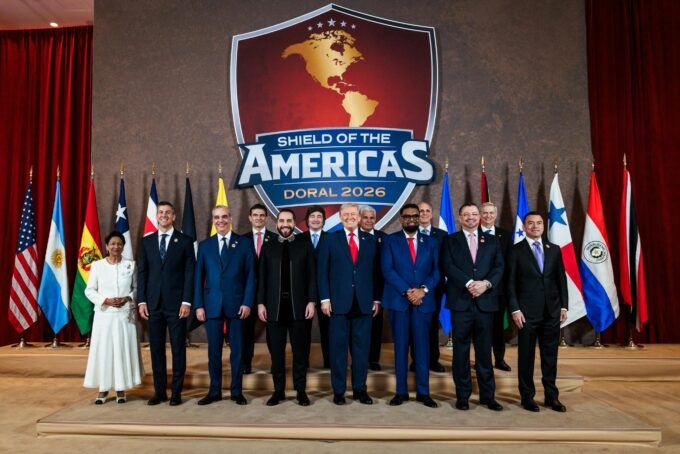
Photograph Source: Daniel Torok – Public Domain
A week after the treacherous joint military intervention by the United States and Israel in Iran, in the midst of negotiations, President Trump gathered the heads of state of his backyard, ideologically aligned with him, at the Trump National Doral Miami (hotel and golf course). Under the slogan “Shield of the Americas,” the event was attended by the presidents of Argentina, Bolivia, El Salvador, Ecuador, Guyana, Honduras, Paraguay, Costa Rica, Panama, the Dominican Republic, Trinidad and Tobago, and the president-elect of Chile. The meeting is part of the United States National Security Strategy, which seeks to fundamentally reorganize the hemisphere under a unified command to face competition with China and militarize the fight against drug trafficking, as occurred this week in Ecuador in a joint, but unconstitutional, operation by the Ecuadorian armed forces with the Southern Command. The Andean country’s constitution does not allow the participation of military forces from another country or foreign military bases. In November, President Daniel Noboa attempted to amend the constitution via a plebiscite that was not approved, so, following in the footsteps of his mentor, Donald Trump, he chose to trample on the law.
Trump’s speech to the 12 right-wing leaders of the region focused on the fight against organized crime. He noted that “at the heart of our agreement is a commitment to use lethal military force to destroy the sinister cartels and terrorist networks once and for all.” Perhaps because of his upcoming visit to Beijing, scheduled for the end of the month, Trump chose to use terms such as “foreign interference” and “external forces” on the podium instead of direct references to China. In a clear reference to that country, he said, “Under this new doctrine, we will not allow any hostile foreign force to set foot in our hemisphere, including the Panama Canal. Together, we will protect our sovereignty and our security, as well as our precious freedom and independence.”
The summit was convened to coordinate regional actions to limit China’s growing presence in the Western Hemisphere, which is seen as a risk to the security and prosperity of the United States. These issues were discussed with less fanfare during the meeting of defense ministers, in which 18 countries from the region participated. The task of carrying out the project was entrusted to Kristi Noem, who was dismissed as Secretary of Homeland Security on Thursday.
In fact, the presidential summit was preceded by a meeting (March 4 and 5) of defense ministers from 18 countries, hosted by Secretary of War Pete Hegseth and White House Deputy Chief of Staff and National Security Advisor Stephen Miller. In his speech, Miller said that the United States “will not cede an inch of territory in the hemisphere” to its “enemies or adversaries,” and admitted that the Donald Trump administration is using “hard power, military power, and lethal force to defend the American homeland.”
Both officials presented what the Pentagon called the first “Conference of the Americas Against Cartels” at the Southern Command in Miami. In the final statement, authorities labeled drug cartels as terrorist organizations, which allows for the use of lethal force and even unilateral operations in their territories. They also agreed to protect critical infrastructure and join a coalition to combat narco-terrorism and other shared threats facing the Western Hemisphere. The problem is that relying on the armed forces to replace the role traditionally played by civilian law enforcement carries risks in a region where military institutions and oversight are weak and the armed forces often bear the legacy of human rights abuses. Rebecca Bill Chavez, president of the Inter-American Dialogue and former deputy assistant secretary of defense for Western Hemisphere affairs, believes that without strong rule of law institutions and civilian oversight, militarizing the fight against cartels can weaken the very institutions needed to defeat them.
Farewell to the Summits of the Americas
The “Shield of the Americas” summit marks a break with the Summits of the Americas that have been held every three years since 1994, when President Clinton launched them in Miami, where the proposal to create the Free Trade Area of the Americas (FTAA) was officially launched. Those summits were less imperative, the directives more veiled, and consensus was even sought. At the 2015 Summit of the Americas, membership rose to 35 with the admission of Cuba, whose citizens are being subjected to inhumane punishment by President Trump in the form of a cruel oil embargo, which is leading to massive power cuts throughout the country. The aggression is multifaceted. On March 4, the Ecuadorian president expelled all diplomatic personnel from the Cuban embassy in Quito. In late February, the newly elected president of Honduras, Nasry Asfura, with strong support from Trump, terminated a medical cooperation agreement with Cuba, prompting the departure of more than 170 Cuban doctors who were serving low-income communities. Jamaica did the same under pressure from the United States.
The Summits of the Americas, organized by the OAS, sought to be inclusive (despite tensions), while the latest summit is a bloc of supporters of the current US president. The OAS, which was the Secretariat of these Summits, has been replaced by the Southern Command, making its agenda more militaristic and less diplomatic. Likewise, the absence of three important economies in the region reflects the difference between a bloc that seeks a more autonomous foreign policy and another that is unconditionally aligned with the United States. The presidents of Mexico, Brazil, and Colombia were excluded for maintaining critical or divergent positions on the intervention and security policies of the current US administration. Cuba, Nicaragua, and Venezuela have also been excluded. Although Venezuela’s acting president, Delcy Rodríguez, maintains open channels on energy issues, in the area of security they are considered the “target” to be neutralized, so they were not invited either.
Thus, the meeting of the 12 countries aligned with Trump seeks to consolidate itself as a regional bloc of strategic allies under a new security and geopolitical agenda that focuses on the fight against terrorism; curbing China’s growing economic and political influence in the Western Hemisphere, ensuring access to strategic resources for the United States and its allies; reducing irregular migration flows to the US border; reestablishing US dominance in the region through the so-called “Trump Corollary to the Monroe Doctrine”; and promoting free markets and “fair” trade among participating nations that share the ideological affinity of the current administration.
The United States will reward countries that have signed this agreement, as well as those that are part of the Conference of the Americas against Cartels, by providing lethal assistance via military loans with near-zero interest rates so that allies can renew their military equipment, provided it is of US origin. tax incentives for US companies that leave China to set up in the countries that have signed the agreement; and a Critical Infrastructure Fund consisting of fresh money to modernize ports and airports, in order to prevent these countries from depending on Chinese loans that Washington considers “debt traps.”
Shadows of China
The Doral Charter signed on Saturday allowed Trump to have his photo taken with his 12 guests and deliver the speech that defines his strategy. Despite the participants’ implicit commitment in that document to distance China from the region, they may not be entirely convinced. Governments have not always been able to comply with Washington’s directives to prevent their business elites from making joint investments, as was the case with the port of Chancay in Peru, where a group of Peruvian businessmen sought capital to invest in that deep-water port, which in 2007 had been identified by former sailors who later joined the Peruvian company Volcán. Thus, the Chinese state-owned company Cosco Shipping appeared, and in 2019 they jointly launched the project, which has turned that port into a hub for South America with the city of Shanghai, via a joint venture in which the Peruvian company has a 40% stake and the Chinese company the rest.
China has established itself as the leading trading partner of most South American countries, and Trump does not have the means to replace it. That is why he is applying tariffs even to countries that have existing free trade agreements (FTAs). In these agreements, approved by Congress, countries commit to reciprocally liberalizing their tariff regimes, with some exceptions provided for in the agreements themselves. However, Trump uses tariffs as a weapon of mass coercion, ignoring the legal certainty of the FTAs. This violation of the treaties is not being responded to forcefully by governments, despite the damage it causes to exporters. They seem to forget that, in order to achieve predictability in access to that country’s market, they had to give in to painful US demands in areas such as intellectual property (which led to more expensive medicines and agrochemicals), elimination of investment performance requirements, and opening up public procurement, among others. The US government is implementing a diplomacy of tariff extortion and causing a setback in international relations, where the strong impose their will.
For Latin American and Caribbean businesses, the presence of and negotiation with both hegemonic powers, the United States and China, represent a logical and pragmatic element of survival. But for US governments, particularly the current administration, freedom of choice is interpreted as a betrayal of the “Western Hemisphere,” accompanied by the most diverse and hilarious narratives, which most media outlets end up presenting as true.
The present condemns you
The Shield of the Americas project has no future. The United States is undergoing an economic, social, and moral crisis that, in the short term, will cause the government to suffer a crushing defeat in the midterm elections. Only 27% of the country’s citizens approve of military attacks on Iran. Trump has called for a 50% increase in the Pentagon’s budget at a time when the debt, spiraling uncontrollably, is approaching $40 trillion, with a chronic fiscal deficit of 6% per year, a fall in the value of Treasury bonds, and a loss of the dollar’s hegemony. These factors, particularly debt, are the major limitations of the Donroe Doctrine. Its investment promises often ring hollow in the face of tangible projects such as the laying of a submarine fiber optic cable from Valparaíso to Hong Kong by a Chinese company, which Chile has had to suspend due to pressure from the US government and threats to withdraw the visa waiver program for Chilean citizens; the suspension of the concession of two ports operated by a Hong Kong-based Chinese company at the ends of the Panama Canal, under threat from the United States to reclaim the canal; and the prevention of Chinese companies in Costa Rica from participating in tenders for the installation of 5G technology.
Most of the presidents invited are well aware of the economic situation in the United States. But they will validate the official US narrative on narco-terrorism and “the Christian heritage” that unites the hemisphere, as Pete Hegseth points out, because that discourse serves to legitimize the use of their armed forces in their respective countries. Ironically, by not demanding real economic compensation, they are accepting that the link with the United States is purely extractive and military. Washington sets the rules (and sells the weapons) and they provide the territory and obedience.
Trump does not have the resources to finance this plan. His miscalculation in invading Iran, thinking that the population of that country would bow down to the liberating bombs of a foreign army that assassinated its religious and military leaders, will prolong the war with the consequent increase in oil prices, rising inflation, economic contraction, and loss of political capital. In a scenario of war and Trump’s imminent electoral defeat, the Latin American countries that attended Doral will face an economic vacuum that China could ultimately fill more easily.
This first appeared in MIRA.

No comments:
Post a Comment